Archive for the Politics Category

A Time for Honours

Posted in Education, Politics, Science Politics, The Universe and Stuff with tags , , , on June 15, 2013 by telescoper

The word “honour” provides a (tenuous) link between yesterday’s post and this one. After our recent preoccupation with the classification of honours for graduating students (i.e. first class, second class, and so on), today’s news included the Queen’s Birthday Honours List for 2013, which you can download in full here. To make up for the lack of recycling going on in Brighton these days because of the strike that started yesterday, I thought I’d recycle my thoughts from previous years.

The honours system must appear extremely curious to people from outside the United Kingdom. It certainly seems so to me. On the one hand, I am glad that the government has a mechanism for recognising the exceptional contributions made to society by certain individuals. Musicians, writers, sportsmen, entertainers and the like generally receive handsome financial rewards, of course, but that’s no reason to begrudge a medal or two in recognition of the special place they occupy in our cultural life.  It’s  good to see scientists recognized too, although they tend not to get noticed so much by the press.

The name that stood out for me in this year’s list is Professor Jim Hough, who gets an OBE. Jim is Professor of Experimental Physics at the University of Glasgow, and his speciality is in the detection of gravitational waves.  Gravitational waves haven’t actually been detected yet, of course, but the experimental techniques designed to find them have increased their sensitivity by many orders of magnitude in recent years, Jim having played a large part in those improvements. I imagine he will be absolutely thrilled in February 2016, when gravitational waves are finally detected. Jim is also Chief Executive of the Scottish University Physics Alliance, which does so much to nurture Physics and Astronomy North of the Border.

Although I’m of course more than happy to see recognition given to such people, as I did  a couple of years ago I can’t resist stating my objections to the honours system again. One is that the list of recipients  of certain categories of award is overwhelmingly dominated by career civil servants, for whom an “honour”  goes automatically with a given rank. If an honour is considered an entitlement in this way then it is no honour at all, and in fact devalues those awards that are  given on merit to people outside the Civil Service. Civil servants get paid for doing their job, so they should have no more expectation of an additional reward than anyone else. There’s much more honour in a  student who earns a First Class degree than for a career civil servant who gets a knighthood.

Honours have relatively little monetary value on their own, of course so this is not question of financial corruption. An honour does, however, confer status and prestige on the recipient so what we have is a much more subtle form of sleaze. One wonders how many names listed in the current roll of honours are there because of political donations, for example.

I wouldn’t accept an honour myself, but that’s easy to say because I’m sure I’ll never be nominated for one; hopefully this post will dissuade anyone from even thinking of nominating me for a gong. However, I imagine that even people like me who are against the whole system are probably still tempted to accept such awards when offered, as they generate good publicity for one’s field, institution and colleagues.It’s a very personal decision and I have no criticism to make of people who think differently from me about whether to accept an honour.

Brighton Council pay dispute

Posted in Politics with tags , , , on June 10, 2013 by telescoper

Here’s another blog about the Brighton refuse collection dispute (by an author whose twitter handle is @socialistgreen), also asking for explanations of the mysterious “allowances”…

socialistgreen's avatarsocialistgreen

The current pay dispute at Brighton & Hove Council highlights all that is wrong about so many trade unions, who instead of looking at the bigger picture, concentrate on the needs of a small number of people, usually men.

As I understand it, the Council’s current plans to equalise pay will see many women earning more, but a small number of workers, mainly men, will be worse off. Why aren’t the unions scandalised that all those women have been underpaid for so many years, (and at least 4 years since most other councils sorted out ‘single status’), and why aren’t they seeking  compensation for all that pay that those women missed out on? Now that would be a good campaign!

Brighton Council are offering compensation to workers who will lose out, and maybe that could be raised or paid over a couple of years while they adjust to the change…

View original post 93 more words

Brighton’s Rubbish Collections

Posted in Politics with tags , , , on June 8, 2013 by telescoper

Time for a quick post about a local difficulty in Brighton. A dispute over allowances that has been rumbling on for weeks has resulted in a vote for a strike by the city’s refuse collectors and street cleaners, due to start next Friday (14th June). Unless a deal is reached there will be no refuse or recycling collections or any street cleaning for a week. If the warm weather continues, a serious environmental hazard could ensue, as uncollected food waste will no doubt lead to a proliferation of vermin.

I’m not going to comment on the rights and wrongs of the dispute, and facts about what precisely is going on are difficult to come by. A webcast by the Council explaining the background can be found here. The issue is not about basic hourly pay, which isn’t changing under the Council’s proposals, but Cityclean workers are claiming that changes to the Council’s system of allowances will lead to some of them losing as much as £4000 per year in take home pay. I don’t however understand what these mysterious “allowances” are. If anyone can enlighten me through the comments box then I’d be very happy. Other than that all I’ll say is that I hope a settlement is reached before things get even more unbearable, but the atmosphere between workers and Council seems already to be so acrimonious that it is hard to see either backing down. I hope they don’t but things could get very nasty.

I will, however, comment on the state of the rubbish collection in Brighton even before the strike starts next week. A two-day wildcat strike in May led to a pile-up of rubbish beside the communal bins. In the weeks since then “targetted disruption” (the Council’s phrase) has meant that this backlog has never been cleared, despite the Council effectively cancelling recycling collections to concentrate on ordinary refuse.

In fact I haven’t had any paper or glass collected for recycling for a month, so I have given up and now take it on foot to one of the few recycling centres dotted around the place. That’s a bit inconvenient, but not too much of a problem in the grand scheme of things. In fact, it has surprised me a lot since moving to Brighton from Cardiff a few months ago, just how poor the recycling service in Brighton is. Home to the UK’s only Green MP, Caroline Lucas, and with a (minority) Green party controlling the Council I would have expected a much more comprehensive approach to recycling than is actually the case. As it is,  compared to Cardiff (which isn’t brilliant), Brighton’s recycling service is really hopeless. The Greens will probably argue that they inherited the system in a time of austerity and have been unable to improve it, but if they can’t improve something which represents one of their core values why bother having Green councillors? Brighton’s Green Party shows signs of going into meltdown over this issue anyway, with the resignation of a Councillor in Hanover ward triggering a by-election so their prospects in the next Council elections look pretty grim.

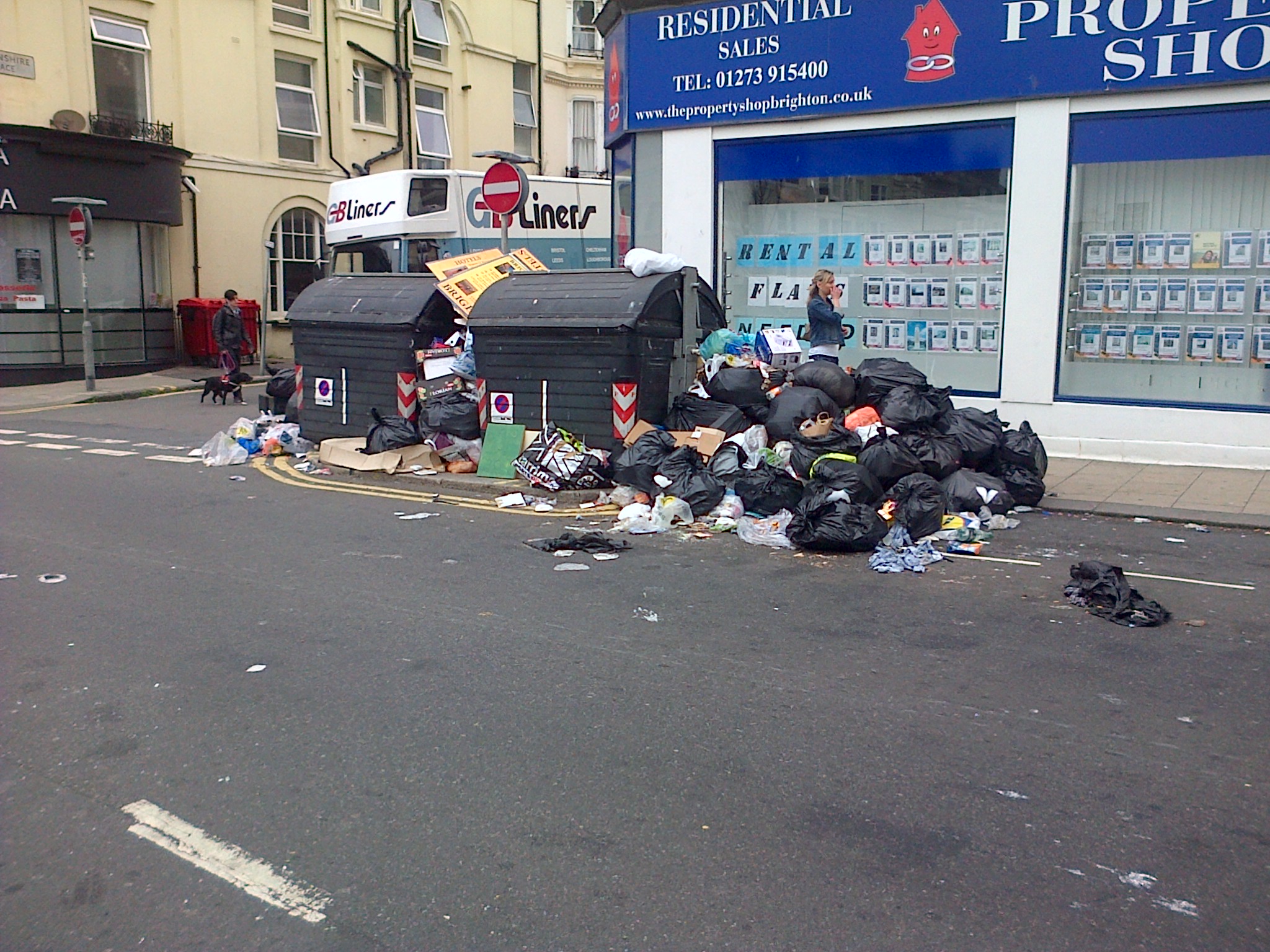
Anyway, the immediate problem is not the poor provision for recycling, but the regular refuse collection. Here’s a typical picture of St James Street (Kemptown):

IMG-20130510-00111

It’s extremely unpleasant to have to walk through or around piles of stinking garbage, but remember that this picture was taken before the official strike has even started! It seems to me that Cityclean workers, who are currently getting paid for not collecting garbage, will, when the strike begins, simply no longer get paid for not collecting the garbage. What this means about the likely duration of strike action remains to be seen.

I continue to hope that a settlement can be reached that averts industrial action, but that hope is fading fast, and so, unfortunately, is the prospect of Brighton having a decent refuse and recycling service in the foreseeable future.

And there’s another point. Councils have a statutory obligation to collect and dispose of domestic refuse. There’s no doubt in my mind that Brighton and Hove County Council is failing to meet that obligation, but what action can an ordinary person take? Answers on a postcard, or through the comments box….

UPDATE: I have invited @gmbcityclean to comment here on the nature of the allowances, but they have declined to do so.

Equal Marriage Bingo!

Posted in Politics with tags , , on June 3, 2013 by telescoper

If you’re following the debate in the House of Lords on the Second Reading of the Equal Marriage Bill, why not play Equal Marriage Bingo? Just cross off the predictable stock phrases as and when they occur, and you might win yourself a full House (of Lords). Although why you would want one is a mystery…

BL1_jx5CIAAcZBx

courtesy of Stonewall

Tuition Fee Caps

Posted in Education, Finance, Politics with tags , , , , , , , on May 27, 2013 by telescoper

I know it’s a Bank Holiday, but I’ve been thinking…

About a week ago I posted an item arguing that the current system of higher education funding is detrimental to the health of STEM disciplines (i.e. Science, Technology, Engineering and Mathematics). The main reason for this is that present funding arrangements fail to address the real difference in cost of degree courses in various disciplines: the income to a University for a student doing Physics is about £10.5K whereas for a student doing, say, English it is £9K. I would  estimate the extra cost for the former corresponds to at least a factor two and probably more. That’s partly because Physics requires laboratory space and equipment (and related technical support) that English does not, but also because Physics students receive many more contact hours with academic staff.  The issue is just as much about arts students being ripped off (as they undoubtedly are being) as it is a strategic failure to protect the sciences.

The problem is that the Council responsible for distributing funding (HEFCE) is strapped for cash, so is unable to fund STEM disciplines at the higher level of resource that it used to.  Since the government has decided, in its  (finite) wisdom, to transfer most of the cost of higher education to the students, HEFCE can now exert very little influence on how universities plan their portfolio of courses. Since it is a lot cheaper and easier to expand capacity in Arts & Social Sciences faculties than in the more expensive STEM disciplines, this is an incentive for Universities to turn away from the Sciences. Given our economic predicament this policy is simply perverse. We need more scientists and engineers, not fewer.

This morning I read an article in the Times Higher about the present £9K tuition fee cap. Not surprisingly the Russell Group of self-styled “elite” Universities wants it lifted, presumably so its Vice-Chancellors can receive even bigger pay rises. But that’s not the point. The article made me think of a cunning (or perhaps daft) plan, which I’m floating here with the prediction that people will shoot it down through the comments box.

Now before I go on, I just want to make it clear that I’m not – and never have been – in favour of the present funding system. I don’t object to the principle that students who can afford to should contribute to the cost of higher education, but the arrangements we’re stuck with are indefensible and I don’t think they will last long into the next Parliament. It’s telling that, only a decade after introducing tuition fees, Germany is now scrapping them. I’d prefer a hybdrid system in which the taxpayer funds scholarships for STEM disciplines and other strategically important areas, while leaving universities to charge fees for other disciplines.

However, since we’ve been lumbered with a silly system, it’s worth exploring what might be achieved by working within it. There doesn’t seem to be much creative thinking going on in the coalition, and the Labour Party just says it would reduce the fee cap to £6K which would squeeze all academic disciplines equally, without doing anything about the anomalies mentioned above.

My  idea is quite simple. I propose that universities be entitled to lift their fee levels for STEM subjects by an amount X, provide that they reduce the fees for Arts and Social Sciences students by the same amount. The current fee level is £9K for all disciplines, so an example might be for STEM subjects to charge £12K while A&SS (if you pardon the abbreviation) get £6K. That would achieve the factor of two differential I mentioned above.

The advantages of this proposal are that it gives an incentive for universities to promote STEM disciplines and more properly reflects the difference in cost of the different subjects, without increasing the cost to the Treasury. In fact only about 25% of students study in STEM disciplines, at least for the moment, so the cost of fee loans will actually go down

The biggest potential flaw is  that increasing the cost to STEM students would put them off. There’s simply no data on which to base an argument as to whether this would be the case or not. I suspect however that a difference in price would be perceived by many as a difference in value.

Anyway, it’s just an idea. That’s what blogs are for. Thinking out loud as it were. Feel free to object..

Proletarian Democracy Eurovision Song Contest Preview (Part 1)

Posted in Politics with tags , , , on May 16, 2013 by telescoper

As we approach the evening of interminable tedium that is the Eurovision Song Contest, it’s refreshing to stumble across a Blog post that reveals the competitions true political and cultural significance…

The Bravery of Being out of Range

Posted in Poetry, Politics with tags , , , , , on April 16, 2013 by telescoper

I’ve been planning for some time to post the lyrics of the song The Bravery of being out of Range by Roger Waters (ex Pink Floyd) as a response to the  ongoing covert war being waged by the United States, which has claimed thousands of innocent lives in Pakistan and elsewhere. The terrible events at the Boston Marathon yesterday reminded me of this intention.  Violence always  begets violence, but the circle becomes all the more vicious when the agressor doesn’t have to display a jot of personal courage. And that goes just as much to those who planted the bombs in Boston as those who aim the drones in Pakistan. Regardless of whether the Boston bombs had anything to do with American policy, when violence is made easy there’s bound to be more of it.

You have a natural tendency
To squeeze off a shot
You’re good fun at parties
You wear the right masks
You’re old but you still
Like a laugh in the locker room
You can’t abide change
And you’re home on the range
You opened the suitcase
Behind the old workings
To show off the magnum
You deafened the canyon
A comfort a friend
Only upstaged in the end
By the Uzi machine gun
Does the recoil remind you
Remind you of sex
Old man what the hell you gonna kill next
Old timer, who you gonna kill next

I looked over Jordan and what did I see
Saw a U.S. Marine in a pile of debris
I swam in your pools
And lay under your palm trees
I looked in the eyes of the Indian
Who lay on the Federal Building steps
And through the range finder over the hill
I saw the front line boys popping their pills
Sick of the mess they find on their desert stage
And the bravery of being out of range
Yeah the question is vexed
Old man what the hell you gonna kill next
Old timer who you gonna kill next

Hey bartender, over here
Two more shots
And two more beers
Sir, turn up the TV sound
The war has started on the ground
Just love those laser guided bombs
They’re really great for righting wrongs
You hit the target, win the game
From bars 3,000 miles away
3,000 miles away
We play the game
With the bravery of being out of range
We zap and maim
With the bravery of being out of range
We strafe the train
With the bravery of being out of range
We gain terrain
With the bravery of being out of range
We play the game
With the bravery of being out of range

Thatcher: A Nation Mourns

Posted in Politics on April 8, 2013 by telescoper

Changing Times

Posted in History, Politics with tags , , on February 5, 2013 by telescoper

I couldn’t resist a quick comment about the news that today the House of Commons began a debate on the second reading of the Marriage (Same Sex Couples) Bill. The timing of this when I’ve just moved back to Brighton after an absence of 23 years or so made me think back to what things were like when I was previously here as a DPhil student.

In those days the dominant concern facing LBGT staff and students was the notorious Section 28, part of the Local Government Act of 1988, which, among other things, attacked promotion of “the acceptability of homosexuality as a pretended family relationship”. I remember very well the numerous demonstrations and other protests I went on as part of the campaign against that repugnant and obviously discriminatory piece of legislation, but it passed into law anyway. I know 25 years is a long time, 1988 was before today’s generation of undergraduates was even born, but it’s still amazing to me that attitudes have changed so much that there’s even a remote possibility that same sex marriage might be legalized. And from what I hear, the possibility isn’t remote at all…

Science and Politics

Posted in Politics, Science Politics with tags , , , , on December 22, 2012 by telescoper

It’s a dark dreary December day with a downright deluge descending outside to add to the alliteration.  Fortunately, it being almost Christmas, this weekend is offering a glut of crosswords with which I’ve been occupying myself while waiting for a break in the rain.

Among the puzzles I’ve done was a moderately challenging one in the New Statesman.  I have a subscription to the New Statesman, which means that I get it delivered in the post approximately two days after everyone else has had a chance to read it. After finishing the crossword, which contain a number of hidden (unclued) famous pseudonyms, I had a look at the rest of the magazine and discovered that this issue, the Christmas one, was edited by Brian Cox (who needs no introduction) and Robin Ince (who I believe is a comedian of some sort). It’s nice to see science featured so strongly in a political magazine, of course, but I did raise an eyebrow when I read this (about the LHC) in a piece written by Professor Cox:

The machine itself is 27 kilometres in circumference and is constructed from 9,300 superconducting electromagnets operating at -271.3°C. There is no known place in the universe that cold outside laboratories on earth…

Not so. The cryogenic systems on ESA’s Planck mission achieved a stable operating temperature at the 0.1 K level. This experiment has now reached the end of its lifetime and is warming up, but  the Herschel Space Observatory with a temperature of 1.4 K is still cooler than the Large Hadron Collider. Moreover, there are natural phenomena involving very low temperatures. The Boomerang Nebula has a measured temperature of −272.15°C, also lower than the LHC.  How does this system manage to cool itself down below the temperature of the cosmic microwave background, I hear you asking.  A detailed model is presented here; it’s “supercooled” because it is expanding so quickly compared to the rate at which it is absorbing CMB photons.

Anyway, if this all seems a bit pedantic then I suppose it is, but if prominent science advocates can’t be bothered to check their facts on things they claim to be authorities about, one wonders why the public show pay them any attention in the broader sphere. Fame and influence bring with them difficult responsibilities.

That brings me to another piece in the same issue, this one co-authored by Cox and Ince, about Science and Society entitled Politicians must not elevate mere opinion over science. I’d realised that there was a bit of a Twitter storm brewing about this item, but had to wait until the horse and cart arrived with my snail mail copy before I could try figure out what it was about. I still haven’t because although it’s not a particularly focussed piece it doesn’t seem to say anything all that controversial. In fact it just struck me that it seems to be a bit self-contradictory, on the one hand arguing that politicians should understand science better and on the other calling for a separation of science and politics.   There are two more detailed rejoinders here and here.

For my part I’ll just say that I think it is neither possible nor desirable to separate science from politics.  That’s because, whether we like it or not, we need them both. Science may help us understand the world around us, and (to a greater or lesser degree of reliability) predict its behaviour, but it does not make decisions for us. Cox and Ince argue that

Science is the framework within which we reach conclusions about the natural world. These conclusions are always preliminary, always open to revision, but they are the best we can do.

I’d put it differently, in terms of probabilities and evidence rather than “conclusions”, but I basically agree. The problem is that at some point we have to make decision which may not depend solely on the interpretation of evidence but on a host of other factors that science can say nothing about. Definite choices have to be made, even when the evidence is ambiguous. In other words we have to bring closure, much as we do when a jury delivers a verdict in a court of law, which is something that science on its own can rarely do. Mere opinion certainly counts in that context, and so it should. The point is that science is done by people, not machines. People decide what questions to ask, and what assumptions to proceed from. Choices of starting point are political (in the widest sense of the word) and sometimes what you get out of a scientific investigation  is little more than what you put in.

It’s always going to a problem in a democratic society that scientific knowledge is confined to a relatively small number of experts. We can do our best to educate as many as possible about what we do, but we’re always going to struggle to explain ourselves adequately. There will always be conspiracy theories and crackpots of various kinds. The way to proceed is not to retreat into a bunker and say “Trust me, I’m a scientist” but to be more open about the doubts and uncertainties and to present a more realistic picture of the strengths and limitations of science. That means to engage with public debate, not by preaching the gospel of science as if it held all the answers, but by acknowledging that science is a people thing and that as such it belongs in politics as much as politics belongs in it.