Archive for the Politics Category

Pride Month 2022

Posted in LGBTQ+, Politics with tags , , , , on June 1, 2022 by telescoper

It’s 1st June 2022, which means that it’s the first day of Pride Month 2022. This year there’s actually going to be an in-person Pride Festival with a March and Parade in Dublin of which I’m planning to attend at least part, even if I am obviously too old for that sort of thing.

Anyway, I thought I’d flag this occasion with a selection of banners. Here is the traditional rainbow flag:

Here is the banner from Dublin Pride’s website, more accurately emphasizing the full spectrum of diversity covered by the term LGBTQIA+ than the original rainbow flag.

And here is the Pride Progress flag, hoisted today outside the John Hume Building on Maynooth University campus where it will remain for the rest of the month.

With its origins as a commemoration of the Stonewall Riots of 1969, Pride remains both a celebration and protest. It’s more necessary than ever now because of the sustained abuse being aimed at trans people from all quarters, including those in political power and those sad losers who have nothing better to do that spend all day tweeting their bigotry on social media. Bigots will always be bigots, but the lowest of the low are those that masquerade as some sort of progressive while spouting their hate and prejudice.

Anyway, as well as a celebration and a protest, Pride is an opportunity for us all to show solidarity against those who seek to divide us.

Though many LGBTQIA+ people in many countries – even those that claim to be more liberal – still face discrimination, hostility and violence, Pride Month always reminds me of how far we’ve come in the past 50 years ago. Recently my own celebration of Pride is very subdued as it tends to makes me feel old and irrelevant as well as worried that we might be headed back to the bigotry and intolerance of the past; the rights we have won could so easily be taken away.

As I get older, I find I have become more and more protective towards younger LGBT+ people. I don’t want them to have to put up with the crap that I did when I was their age.

I would like to wish all LGBTQIA+ people around the world, but especially staff and students at Maynooth University, a very enjoyable and inspiring Pride 2022!

Revisiting the Case for Irish Membership of CERN

Posted in Politics, Science Politics, The Universe and Stuff with tags , , , , on May 31, 2022 by telescoper

At last week’s Irish Theoretical Physics meeting I had the opportunity to have lunch with particle physicist Professor John Ellis (of King’s College London). Among other things we discussed whether or not it was likely that Ireland might join CERN. Currently Ireland has no official relationship with CERN, not even associate membership, which makes it anomalous among European countries. In November 2019 I blogged about the issue here.

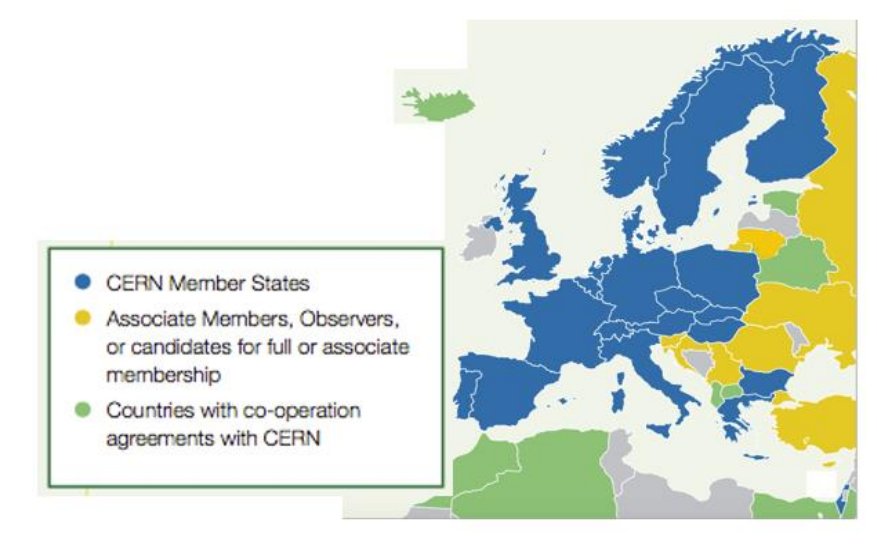
There was a move reported in the news here in Ireland of a report from a Committee of the Houses of the Oireachtas making the case for Ireland to join CERN. You can download the report here (PDF) and you’ll find this rather striking graphic therein:

You will see that there are only three European countries other than Ireland that don’t have any form of membership or other agreement with CERN: Latvia, Bosnia-Herzegovina, Moldova. The fact that almost everyone else is in is not in itself necessarily a good argument for Ireland to join, but it does make one wonder why so many other countries have found it to join or have an agreement with CERN while Ireland has not.

As the document explains, if the Irish government  were to decide to take Ireland into CERN then  it would first have to become an Associate Member, which would cost around €1.2 million per year. That’s small potatoes really, and  the financial returns to Irish industry and universities are likely to far exceed that, so the report strongly recommends this step be taken. This Associate member stage would last up to 5 years, and then to acquire full membership a joining fee of around €15.6 million would have to be paid, which is obviously a much greater commitment but in my view still worthwhile.

There were some positive noises when the document came out, but that was near the end of 2019. Not far into 2020 the pandemic struck and the idea sank without trace. Perhaps now is a good time to raise the issue again?

While I strongly support the idea of Ireland joining CERN I do have a couple of concerns about the case as presented in the Oireachtas report.

One is that I’m very sad that the actual science done at CERN is downplayed in the  report. Most of it is about the cash return to industry, training opportunities, etc. These are important, of course, but it must not be forgotten that big science projects like those carried out at CERN are above all else science projects. The quest for knowledge does have collateral benefits, but it a worthy activity in its own right and we shouldn’t lose sight of that.

My other (related) concern is that joining CERN is one thing, but in order to reap the scientific reward the government has to invest in the resources needed to exploit the access to facilities membership would provide. Without a related increase in research grant funding for basic science the opportunity to raise the level of scientific activity in Ireland would be lost.

Ireland recently joined the European Southern Observatory (ESO), a decision which gave Irish astronomers access to some amazing telescopes. However, there is no sign at all of Irish funding agencies responding to this opportunity by increasing funding for academic time, postdocs and graduate students needed to do the actual science. In one respect ESO is very like CERN: the facilities do not themselves do the science; we need people to do that. The jam is already spread very thinly in Ireland so having an extra thing to spread it on will not necessarily be a good thing for science in general.

From Labour to Labor

Posted in Crosswords, History, Politics with tags , , , , , , , , on May 22, 2022 by telescoper

I don’t know very much about Australian politics but I was delighted yesterday to hear news of Rupert Murdoch’s defeat in the Federal elections. The losing leader of the illiberal party, and previous PM, Scott Morrison, has now resigned. I’ve got nothing against Mr Morrison’s family, but I’m glad he’s going to be spending more time with them.

One thing that confused me is that the victorious Australian Labor Party is the spelling of the word “Labor”. I think Australians use the English spelling “labour” for the noun or verb so why the political party uses a different spelling for the political party is unclear to me. It is however just a name, and we all know that a rose by any other name would smell as sweet.

Some people refer to “labor” as the American spelling but it’s not as simple as that. The English word “labour” is derived from the 3rd declension Latin noun labor/laboris from which in turn is derived the verb laborare. The same sort of Latin origin is the case for many other familiar words: honor, color, valor, humor, vapor, rigor, and so on. All these were original Latin nouns that came into English via Norman French in the course of which they acquired the “u”.

The person responsible for the spelling of these words in American English (ie “labor” etc) was Noah Webster who thought English spelling was unnecessarily complicated and reverted to the Latin in these cases. It was also he who turned “centre” into “center”, for example. This spelling was introduced in his famous dictionary, first published in 1828, and subsequently acquired by the G&C Merriam Co and still in circulation nowadays after many revisions as the Merriam-Webster Dictionary.

Anyway, my point is that the English often look down on such spellings as “labour” and “colour” as vulgar Americanism but these are the “original” (unfrenchified) spellings.

It’s interesting that Norman French words sometimes displaced Old English words entirely but sometimes the Old English form survives as synonym. For example, the Old English word for “colour” is “hew” which survives as the English “hue”. The Old English word for “labour” is “swink” which has completely disappeared from common usage (though it is listed in the One True Chambers Dictionary with the description archaic).

All of which nonsense gives me an excuse to mention that I managed to get an HC (“Highly Commended”) for my clue in Azed Competition No. 2603 which I thought was a very tough puzzle to complete, which is no doubt why there were only 117 entries!

Notes on Eurovision

Posted in Biographical, Music, Politics with tags , , , , on May 15, 2022 by telescoper

To nobody’s surprise Ukraine won last night’s Eurovision song contest after collecting a huge dollop of the televotes. After the jury votes, the United Kingdom’s entry was in the lead which surprised me because I thought it wasn’t much of a song at all. I’ve never been very good at picking the tunes that do well though. I didn’t like Ukraine’s entry – Stefania by the Kalush Orchestra – much either, but obviously there are special circumstances this year and I’m not at all sorry that they won.

In fact I thought the best song – and the best singer – by a long way was the Lithuanian entry sung by Monika Liu, who held the stage brilliantly by standing there and singing, without any fancy staging. She finished a disappointing 14th.

Monika Liu

Other entries I enjoyed were: Spain, catchy dance number with excellent choreography that finished 3rd; Moldova, an energetic performance full of humour (7th); and Norway, whose entry Give that Wolf a Banana was enjoyably deranged (10th). The less said about the other entries the better. I’m still as baffled by how Sam Ryder’s entry for the UK, Space Man, did so well in the jury votes as I am that Lithuania did so badly there, but there you go. What do I know?

I’ll state without comment that the Ukrainian jury gave a maximum douze points to the United Kingdom, but in return the UK jury gave Ukraine nil points

Anyway, three things struck me as I sipped my wine and watched the show:

  1. Ironically the Opera on the radio last night was Wagner’s Die Meistersinger von Nürnberg which is about a sixteenth century song contest that resembles the Eurovision versiononly in the length of time it goes on for. Perhaps someone should write a modern music drama called Die Meistersinger von Eurovision?
  2. I think the Research Excellence Framework would be much more fun if it were done like the Eurovision Song Contest. Each University regardless of size could be given the same distribution of scores to allocate to the others (but not itself). I can see interesting patterns emerging during that!
  3. When I was formally presented with my DPhil in the summer of 1989, the graduation ceremony took place on the same stage (at the Brighton Centre) on which Abba won the Eurovision Song Contest in 1974 with their song Waterloo.

The Stormont Elections

Posted in Politics with tags , , , , on May 8, 2022 by telescoper

Yesterday proved to be an historic day in the politics of Northern Ireland, as the counting of votes from elections to the Northern Ireland Assembly at Stormont on Thursday made Sinn Féin the party with the largest number of seats. This is the first time a republican party has topped the poll, and thus the first time that Sinn Féin has the right to nominate the First Minister under the provisions of the Good Friday Agreement. Whether the leading unionist party (the Democratic Unionist Party) will play its part in forming a new administration remains to be seen. The DUP seem to be keener at manufacturing a crisis over the Northern Ireland Protocol than doing anything positive for the people of Northern Ireland as a whole.

For what it’s worth I think that if the DUP had any sense they would actually support the Protocol. Norther Ireland as a whole voted against Brexit, but the DUP helped deliver it anyway. In any case parties in favour of the Protocol are now in the majority in Stormont now.

I’m in no position to provide an expert political commentary on what these results mean for the future, but I will add a couple of observations to counter some silly comments flying around the, especially UK, media.

I saw countless statements that the electoral system used in these elections is “complex” and went on to make misleading statements by misunderstanding or misrepresenting how it works. I don’t think it is at all. The Single Transferable Vote in multi-member constituencies is actually very straightforward and is indeed the same system as used here in the Republic. Much attention was focussed on the share of first-round preferences (of which SF got 29% and the DUP 21%). The reason why the final total of seats is much more even than this is that the DUP lost a number of first-preferences to the Traditional Unionist Voice (TUV) which picked up about 7.7% of the first preferences, but most TUV voters probably put the DUP as second preference and the DUP would have picked up votes when TUV candidates were eliminated: adding TUV+DUP gives about 29%, roughly the same as SF.

The behaviour of voters in selecting parties below their first choice is more complicated than that and can be very interesting. Some will just vote for their favourite party and not list any alternatives at all. Others will carefully rank all the candidates. This is one of the things that makes STV elections something of a spectator sport, as each round of counting gradually reveals the pattern of transfers. I checked the results regularly on Friday and Saturday as the counts progressed, as I did during the election here in 2020.

Overall I wasn’t surprised that the results came out the way they did between SF and DUP but the surprise is how well the Alliance Party did, more than doubling its seats. When I was a lad the Alliance Party was a moderate Unionist outfit but is now basically neutral on the unionist/nationalist issue and is on other issues a pretty conventional centrist party analogous to the Liberal Democrats in the UK.

The other issue that people have been speculating about is whether these results will lead rapidly to a Border Poll and the prospect of a United Ireland. While it is true that a nationalist leadership of the NI Assembly is a necessary condition for that to happen, it is by no means sufficient. A huge amount of groundwork will have to be done before a fully-developed plan, encompassing difficult issues as healthcare provision and taxation, can be presented to voters. Having seen the fiasco of Brexit, no responsible leader would put anything less than concrete proposals to a public vote. It will take time to develop a proper strategy. A United Ireland would be a very big and difficult fish to land, so patience is definitely required: try to reel it in too quickly and you will lose it.

What is interesting is the emergence of a sizeable block of voters that is agnostic on this issue: whether or not there will be a United Ireland will depend on how these people see things. If the UK economy continues to slide and Westminster is further engulfed by corruption then opinion might shift rapidly towards NI unshackling itself from the corpse. But it’s not there yet. It’s not even clear whether a majority of voters in the Republic would want a United Ireland either. The recent rise of Sinn Féin in the Republic has at least as much to do with issues internal to the Republic – especially the chronic housing shortage – as the goal of a United Ireland.

When Northern Ireland it was set up a century ago, it was prepared in such a way that the electorate was polarized along a Catholic-Protestant religious axis (the boundaries of NI chosen to ensure a Protestant majority). Mostly (but not exclusively) this axis coincided with the Republican-Loyalist one, as well as the usual Right and Left of politics. Over time it seems these alignments have shifted and the overall level of polarization has decreased: the system is losing memory of its initial conditions. The rise of a centrist party such as the Alliance is a manifestation of this.

Words about Higher Education in Ireland

Posted in Education, Maynooth, Politics on May 5, 2022 by telescoper

Yesterday the Minister for Further and Higher Education, Research, Innovation and Science”, Simon Harris announced a “funding and reform framework” for Ireland which you can find here (PDF).

It’s a typical neoliberal trick to tie “funding” to “reform” because that immediately sends a message that Ireland’s universities are somehow underperforming in some way other than the fact that they are grossly underfunded. The document however admits that there is a huge funding shortfall caused by lack of Government investment over many years, leading among other things to huge student-staff ratios. Perhaps it’s primarily the Government that need reform rather than universities?

That said, I do agree that if extra money is going to be sent to universities, there should be some guarantee that it is spent on the right things: not only academic staff but also, where appropriate, laboratory facilities and so on. Based on my experience in several institutions, typically over half of  university’s budget is spent on central services, some of which are excellent but others of which are expensive and not fit for any purpose at all other than wasting money and causing frustration.

As for the proposals themselves, I’d just say that it is good to have a Minister who recognizes at least some of the problems and is prepared to make positive noises about addressing them. However, the document itself is extremely vague. Look at this, for example, from the
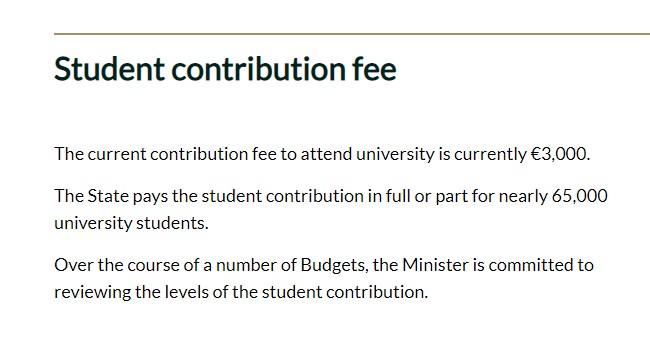
Government’s Press Release announcing the new “landmark policy on funding higher education and reducing the cost of education for families”:

That’s it.

Since the departure of the United Kingdom from the European Union, Ireland’s fees for undergraduate study are the highest in the EU and with the current cost of living crisis (including exorbitant rents) this is in need of reform.  The response however is that the Minister is “committed” only to reviewing (i.e. not necessarily reducing) the fee over some unspecified but probably lengthy timescale.

As with the other items in the “framework” there is no commitment to anything that will halt the immediate crisis currently afflicting students who are struggling to engage and academic staff whose workloads are skyrocketing. In fact I don’t foresee any prospect of material changes before I retire.

Another thing I’ll mention with deep frustration is that there is nothing in the policy about postgraduate education for which there is no framework at all in Ireland and very little funding. It seems Irish Governments just don’t think this is important aspect of what universities do.

Anyway, back to the “policy”, I know that what will actually happen depends on Mr Harris’s success in winning over cabinet colleagues so at this stage he can’t be very specific, but the media somehow dress all this nebulosity up as a policy, which it isn’t: it’s a collection of aspirations.

Warm words, perhaps, but just words nevertheless. We won’t find our for a while whether they actually mean anything.

Euclid Launch Concern

Posted in Euclid, Politics, Science Politics, The Universe and Stuff with tags , , on April 27, 2022 by telescoper

I saw the following picture on Twitter. It was taken during a talk at the annual Euclid Consortium Meeting (which I am not at) and it gives a not -very-optimistic update about the timescale for the launch of Euclid.

Picture Credit: Hervé Aussel

I thought a delay in the launch was inevitable as soon as news broke of the Russian invasion of Ukraine (see here) because the original plan was to launch on a Russian Soyuz vehicle. The subsequent decision by the Russians to remove all their personnel from the launch site at Kourou (see here) made these even more likely, although according to the slide not certain.

The basic problem is that Plan B involves launching Euclid on an Ariane 6 rocket (which comes in two varieties, Ariane62 and Ariane64, with two and four payloads boosters respectively). The problems are (a) that Ariane 6 is that it hasn’t yet had its first flight and (b) Euclid isn’t the only spacecraft having to find an alternative launcher. The competition from commercial and military satellites may mean a lengthy delay to the Euclid Launch unless lobbying succeeds at a political level, which is what the last lines of the slide are about.

Being one of life’s pessimists I think a long delay is the likeliest outcome, though this is not based on any specific knowledge at all about the discussions going on and I’d be delighted to be proved wrong. I am now however seriously wondering whether Euclid will be launched before I retire!

Decision Day for the French!

Posted in Politics on April 24, 2022 by telescoper

(from Private Eye)

Update: I wouldn’t have found it exactly inspiring to have to choose between a neoliberal drone and a fascist dunderhead but would have voted for the least bad alternative, as the French electorate seems to have done.

French Election Update

Posted in Politics with tags , on April 10, 2022 by telescoper

The first round of voting in the French Presidential Election is under way today and it reminded of this clipping from a few years ago:

(Read the caption.)

Rory O’Neill aka Panti Bliss

Posted in Biographical, LGBTQ+, Maynooth, Politics with tags , , , on April 2, 2022 by telescoper

Yesterday I attended an event at the Maynooth Students Union featuring Rory O’Neill, an LGBT+ rights activist who strongly involved in the campaign for Equal Marriage leading up to the referendum of 2015. Rory is perhaps better known in his drag persona, Panti Bliss. Rory left Panti at home for this event but it was extremely interesting and enjoyable – and a bit sweary! – to hear him talk about his life and experiences, especially why he became an activist and how he started out as a drag performer.

One of the things I remember very well was how he has spent time in countries where homosexuality is still unlawful talking to young LGBT+ people who a lack of hope that life can get better. He countered that Irish society even just a couple of decades ago was deeply homophobic and is now much more inclusive towards LGBT+ people. It’s not perfect, of course, but it’s a heck of a lot better than it was. Ireland proves that things do get better.

Although I’m a bit older than Rory, didn’t grow up in Ireland, and have had a very different career, much of his story did nevertheless resonate with me. I’ve said a number of times on this blog that if someone had told me back in 1988 (when the infamous Section 28 was brought in by the Thatcher Government to attack a community already reeling from the effects of AIDS) that in 25 times there would be equal marriage in the UK I simply would not have believed them. Rory said something very similar yesterday.

Anyway, although there wasn’t a huge turnout for the event yesterday I’m very glad I attended and am grateful for the Maynooth Access Programme for organizing it. The event also gives me an excuse to post this clip of Panti Bliss giving a brilliant (and now famous) speech at the Abbey Theatre in 2014.