Archive for the Science Politics Category

The real decline of UK research funding..

Posted in Science Politics with tags , , on February 12, 2015 by telescoper

I saw a news item the other day about a report produced by the Royal Society, the British Academy, the Royal Academy of Engineering and the Academy of Sciences calling for a big uplift in research spending. Specifically,

A target for investment in R&D and innovation of 3% of GDP for the UK as a whole – 1% from the government and 2% from industry and charities – in line with the top 10 OECD research investors. The government currently invests 0.5% of GDP; with 1.23% from the private sector.

For reference here is the UK’s overall R&D spending as a fraction of GDP since from 2000 to 2012 as a fraction of GDP:


PublicFunding2000_2012

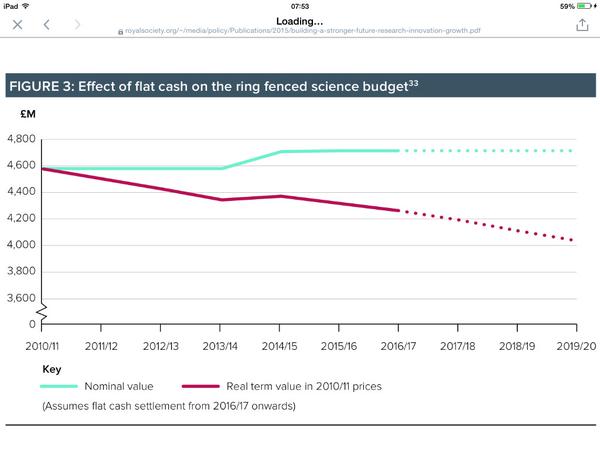
Some people felt that scientific research funding has done relatively well over the past few years in an environment of deep cuts in government funding in other areas. Iit has been protected against a steep decline in funding by a “ring fence” which has kept spending level in cash terms. Although inflation as measured by the RPI has been relatively low in recent years, the real costs of scientific research have been much faster than these measures. Here is a figure that shows the effective level of funding since the last general election that shows the danger to the UK’s research base:

flatcash

As a nation we already spend far less than we should on research and development, and this figure makes it plain that we are heading in the wrong direction. It’s not just a question of government funding either. UK businesses invest far too little in developing products and services based on innovations in science and technology. Because of this historic underfunding, UK based research has evolved into a lean and efficient machine but even such a machine needs fuel to make it work and the fuel is clearly running out…

Science, Art and The Song of the Lyre Bird

Posted in Biographical, Science Politics, The Universe and Stuff with tags , , , , , , , on February 10, 2015 by telescoper

I’ve posted this before but I thought I would do so again, just because it’s so marvellous.

I wonder what you felt as you watched it?  What went through your mind? Amusement? Fascination?  I’ll tell you how it was for me when I first saw it.  I marvelled.

Seeing the extraordinary behaviour of this incredible creature filled me with a sense of wonder. But I also began to wonder in another sense too. How did the Lyre Bird evolve its bizarre strategy? How does it learn to be such an accurate mimic? How does it produce such a fascinating variety of sounds? How can there be an evolutionary advantage in luring a potential mate to the sound of foresters and a chainsaw?

The Lyre Bird deploys its resources in such an elaborate and expensive way that you might be inclined to mock it, if all it does is draw females to “look at its plumes”.  I can think of quite a few blokes who adopt not-too-dissimilar strategies, if truth be told. But if you could ask a Lyre Bird it would probably answer that it does this because that’s what it does. The song defines the bird. That’s its nature.

I was moved to post the clip some time ago in response to a characteristically snide and ill-informed piece by Simon Jenkins in the Guardian. Jenkins indulges in an anti-science rant every now and again. Sometimes he has a point, in fact. But that article was just puerile. Perhaps he had a bad experience of science at school and never got over it.

I suppose I can understand why some people are cynical about scientists stepping into the public eye to proselytise about science. After all, it’s also quite easy to come up with examples of  scientists who have made mistakes. Sadly, there are also cases of outright dishonesty. The inference is that science is no good because scientists are fallible. But scientists are people, no better and no worse than the rest. To err is human and all that.  We shouldn’t expect scientists to be superhuman any more than we should believe the occasional megalomaniac who says they are.

To many people fundamental physics is a just a load of incomprehensible gibberish, the Large Hadron Collider a monstrous waste of money, and astronomy of no greater value to the world than astrology. Any scientist trying to communicate science to the public must be trying to hoodwink them, to rob them of the schools and hospitals that their taxes should be building and sacrifice their hard-earned income on the altar of yet another phoney religion.

And now the BBC is participating in this con-trick by actually broadcasting popular programmes about science that have generated huge and appreciative audiences. Simon Jenkins obviously feels threatened by it. He’s probably not alone.

I don’t  have anything like the public profile of the target of Jenkins’ vitriol, Lord Rees, but I try to do my share of science communication. I give public lectures from time to time and write popular articles, whenever I’m asked. I also answer science questions by email from the general public, and some of the pieces I post on here receive a reasonably wide distribution too.

Why do I (and most of my colleagues) do all this sort of stuff? Is it because we’re after your money?  Actually, no it isn’t. Not directly, anyway.

I do all this stuff because, after 25 years as a scientist, I still have a sense of wonder about the universe. I want to share that as much as I can with others. Moreover,  I’ve been lucky enough to find a career that allows me to get paid for indulging my scientific curiosity and I’m fully aware that it’s Joe Public that pays for me to do it. I’m happy they do so, and happier still that people will turn up on a rainy night to hear me talk about cosmology or astrophysics. I do this because I love doing science, and want other people to love it  too.

Scientists are wont to play the utilitarian card when asked about why the public should fund fundamental research. Lord Rees did this in his Reith Lectures, in fact. Physics has given us countless spin-offs – TV sets, digital computers,  the internet, you name it – that have created wealth for UK plc out of all proportion to the modest investment it has received. If you think the British government spends too much on science, then perhaps you could try to find the excessive sum on this picture.

Yes, the LHC is expensive but the cost was shared by a large number of countries and was spread over a long time. The financial burden to the UK now amounts to the cost of a cup of coffee per year for each taxpayer in the country. I’d compare this wonderful exercise in friendly international cooperation with the billions we’re about to waste on the Trident nuclear weapons programme which is being built on the assumption that international relations must involve mutual hatred.

This is the sort of argument that gets politicians interested, but scientists must be wary of it. If particle physics is good because it has spin-offs that can be applied in, e.g. medicine, then why not just give the money to medical research?

I’m not often put in situations where I have to answer questions like why we should spend money on astronomy or particle physics but, when I am, I always feel uncomfortable wheeling out the economic impact argument. Not because I don’t believe it’s true, but because I don’t think it’s the real reason for doing science. I know the following argument won’t cut any ice in the Treasury, but it’s what I really think as a scientist (and a human being).

What makes humans different from other animals? What defines us? I don’t know what the full answer to that is, or even if it has a single answer, but I’d say one of the things that we do is ask questions and try to answer them. Science isn’t the only way we do this. There are many complementary modes of enquiry of which the scientific method is just one. Generally speaking, though, we’re curious creatures.

I think the state should support science but I also think it should support the fine arts, literature, humanities and the rest, for their own sake. Because they’re things we do. They  make us human. Without them we’re just like any other animal that consumes and reproduces.

So the real reason why the government should support science is the song of the Lyre Bird.  No, I don’t mean as an elaborate mating ritual. I don’t think physics will help you pull the birds. What I mean is that even in this materialistic, money-obsessed world we still haven’t lost the  need to wonder, for the joy it brings and for the way it stimulates our minds; science doesn’t inhibit wonder, as Jenkins argues,  it sparks it.

Now, anyone want to see my plumes?

A whole lotta cheatin’ going on? REF stats revisited

Posted in Education, Science Politics with tags , , , on January 28, 2015 by telescoper

Here’s a scathing analysis of Research Excellence Framework. I don’t agree with many of the points raised and will explain why in a subsequent post (if and when I get the time), but I reblogging it here in the hope that it will provoke some comments either here or on the original post (also a wordpress site).

dereksayer's avatarcoasts of bohemia


1.

The rankings produced by Times Higher Education and others on the basis of the UK’s Research Assessment Exercises (RAEs) have always been contentious, but accusations of universities’ gaming submissions and spinning results have been more widespread in REF2014 than any earlier RAE. Laurie Taylor’s jibe in The Poppletonian that “a grand total of 32 vice-chancellors have reportedly boasted in internal emails that their university has become a top 10 UK university based on the recent results of the REF”[1] rings true in a world in which Cardiff University can truthfully[2]claim that it “has leapt to 5th in the Research Excellence Framework (REF) based on the quality of our research, a meteoric rise” from 22nd in RAE2008. Cardiff ranks 5th among universities in the REF2014 “Table of Excellence,” which is based on the GPA of the scores assigned by the REF’s “expert panels” to the three…

View original post 2,992 more words

Lognormality Revisited

Posted in Biographical, Science Politics, The Universe and Stuff with tags , , , , , on January 14, 2015 by telescoper

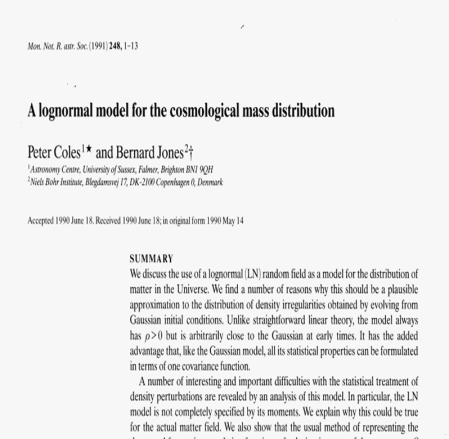
I was looking up the reference for an old paper of mine on ADS yesterday and was surprised to find that it is continuing to attract citations. Thinking about the paper reminds me off the fun time I had in Copenhagen while it was written.   I was invited there in 1990 by Bernard Jones, who used to work at the Niels Bohr Institute.  I stayed there several weeks over the May/June period which is the best time of year  for Denmark; it’s sufficiently far North (about the same latitude as Aberdeen) that the summer days are very long, and when it’s light until almost midnight it’s very tempting to spend a lot of time out late at night..

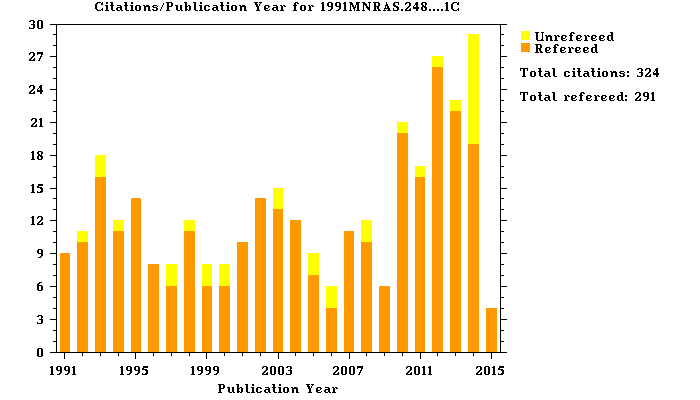
As well as being great fun, that little visit also produced what has turned out to be  my most-cited paper. In fact the whole project was conceived, work done, written up and submitted in the space of a couple of months. I’ve never been very good at grabbing citations – I’m more likely to fall off bandwagons rather than jump onto them – but this little paper seems to keep getting citations. It hasn’t got that many by the standards of some papers, but it’s carried on being referred to for almost twenty years, which I’m quite proud of; you can see the citations-per-year statistics even seen to be have increased recently. The model we proposed turned out to be extremely useful in a range of situations, which I suppose accounts for the citation longevity:

lognormal

I don’t think this is my best paper, but it’s definitely the one I had most fun working on. I remember we had the idea of doing something with lognormal distributions over coffee one day,  and just a few weeks later the paper was  finished. In some ways it’s the most simple-minded paper I’ve ever written – and that’s up against some pretty stiff competition – but there you go.

Picture1

The lognormal seemed an interesting idea to explore because it applies to non-linear processes in much the same way as the normal distribution does to linear ones. What I mean is that if you have a quantity Y which is the sum of n independent effects, Y=X1+X2+…+Xn, then the distribution of Y tends to be normal by virtue of the Central Limit Theorem regardless of what the distribution of the Xi is  If, however, the process is multiplicative so  Y=X1×X2×…×Xn then since log Y = log X1 + log X2 + …+log Xn then the Central Limit Theorem tends to make log Y normal, which is what the lognormal distribution means.

The lognormal is a good distribution for things produced by multiplicative processes, such as hierarchical fragmentation or coagulation processes: the distribution of sizes of the pebbles on Brighton beach  is quite a good example. It also crops up quite often in the theory of turbulence.

I’ll mention one other thing  about this distribution, just because it’s fun. The lognormal distribution is an example of a distribution that’s not completely determined by knowledge of its moments. Most people assume that if you know all the moments of a distribution then that has to specify the distribution uniquely, but it ain’t necessarily so.

If you’re wondering why I mentioned citations, it’s because it looks like they’re going to play a big part in the Research Excellence Framework, yet another new bureaucratical exercise to attempt to measure the quality of research done in UK universities. Unfortunately, using citations isn’t straightforward. Different disciplines have hugely different citation rates, for one thing. Should one count self-citations?. Also how do you aportion citations to multi-author papers? Suppose a paper with a thousand citations has 25 authors. Does each of them get the thousand citations, or should each get 1000/25? Or, put it another way, how does a single-author paper with 100 citations compare to a 50 author paper with 101?

Or perhaps the REF panels should use the logarithm of the number of citations instead?

That Was The REF That Was..

Posted in Finance, Science Politics with tags , , , , , , on December 18, 2014 by telescoper

I feel obliged to comment on the results of the 2014 Research Excellence Framework (REF) that were announced today. Actually, I knew about them yesterday but the news was under embargo until one minute past midnight by which time I was tucked up in bed.

The results for the two Units of Assessment relevant to the School of Mathematical and Physical Sciences are available online here for Mathematical Sciences and here for Physics and Astronomy.

To give some background: the overall REF score for a Department is obtained by adding three different components: outputs (quality of research papers); impact (referrring to the impact beyond academia); and environment (which measures such things as grant income, numbers of PhD students and general infrastructure). These are weighted at 65%, 20% and 15% respectively.

Scores are assigned to these categories, e.g. for submitted outputs (usually four per staff member) on a scale of 4* (world-leading), 3* (internationally excellent), 2* (internationally recognised), 1* (nationally recognised) and unclassified and impact on a scale 4* (outstanding), 3* (very considerable), 2* (considerable), 1* (recognised but modest) and unclassified. Impact cases had to be submitted based on the number of staff submitted: two up to 15 staff, three between 15 and 25 and increasing in a like manner with increasing numbers.

The REF will control the allocation of funding in a manner yet to be decided in detail, but it is generally thought that anything scoring 2* or less will attract no funding (so the phrase “internationally recognised” really means “worthless” in the REF, as does “considerable” when applied to impact). It is also thought likely that funding will be heavily weighted towards 4* , perhaps with a ratio of 9:1 between 4* and 3*.

We knew that this REF would be difficult for the School and our fears were born out for both the Department of Mathematics or the Department of Physics and Astronomy because both departments grew considerably (by about 50%) during the course of 2013, largely in response to increased student numbers. New staff can bring outputs from elsewhere, but not impact. The research underpinning the impact has to have been done by staff working in the institution in question. And therein lies the rub for Sussex…

To take the Department of Physics and Astronomy, as an example, last year we increased staff numbers from about 23 to about 38. But the 15 new staff members could not bring any impact with them. Lacking sufficient impact cases to submit more, we were obliged to restrict our submission to fewer than 25. To make matters worse our impact cases were not graded very highly, with only 13.3% of the submission graded 4* and 13.4% graded 3*.

The outputs from Physics & Astronomy at Sussex were very good, with 93% graded 3* or 4*. That’s a higher fraction than Oxford, Cambridge, Imperial College and UCL in fact, and with a Grade Point Average of 3.10. Most other departments also submitted very good outputs – not surprisingly because the UK is actually pretty good at Physics – so the output scores are very highly bunched and a small difference in GPA means a large number of places in the rankings. The impact scores, however, have a much wider dispersion, with the result that despite the relatively small percentage contribution they have a large effect on overall rankings. As a consequence, overall, Sussex Physics & Astronomy slipped down from 14th in the RAE to 34th place in the REF (based on a Grade Point Average). Disappointing to say the least, but we’re not the only fallers. In the 2008 RAE the top-rated physics department was Lancaster; this time round they are 27th.

I now find myself in a situation eerily reminiscent of that I found myself facing in Cardiff after the 2008 Research Assessment Exercise, the forerunner of the REF. Having been through that experience I’m a hardened to disappointments and at least can take heart from Cardiff’s performance this time round. Spirits were very low there after the RAE, but a thorough post-mortem, astute investment in new research areas, and determined preparations for this REF have paid dividends: they have climbed to 6th place this time round. That gives me the chance not only to congratulate my former colleagues there for their excellent result but also to use them as an example for what we at Sussex have to do for next time. An even more remarkable success story is Strathclyde, 34th in the last RAE and now top of the REF table. Congratulations to them too!

Fortunately our strategy is already in hand. The new staff have already started working towards the next REF (widely thought to be likely to happen in 2020) and we are about to start a brand new research activity in experimental physics next year. We will be in a much better position to generate research impact as we diversify our portfolio so that it is not as strongly dominated by “blue skies” research, such as particle physics and astronomy, for which it is much harder to demonstrate economic impact.

I was fully aware of the challenges facing Physics & Astronomy at Sussex when I moved here in February 2013, but with the REF submission made later the same year there was little I could do to alter the situation. Fortunately the University of Sussex management realises that we have to play a long game in Physics and has been very supportive of our continued strategic growth. The result of the 2014 REF result is a setback but it does demonstrate that the stategy we have already embarked upon is the right one.

Roll on 2020!

Anthem for Doomed Academics

Posted in Poetry, Science Politics with tags , , on December 17, 2014 by telescoper

Well, not long now until the announcement of the results of the 2014 Research Excellence Framework are known publicly. I’ll post something in the way of a personal reflection tomorrow, as long as I haven’t thrown myself off Brighton Pier by then. In the meantime, I couldn’t resist sharing this brilliant parody of Wilfred Owen I found via Twitter…

Paul Kleiman's avatarStumbling with Confidence

(This has been written as the momentous results of the Research Excellence Framework, known to all and sundry as the dreaded REF, are about to be announced, and as careers hang in the balance depending on who are the winners and losers.)

Anthem for Doomed Academics

(with apologies to Wilfred Owen)

What lasting hell for these who try as authors?
Only the monstrous anger of the dons.
Only the stuttering academic’s crippled cursor
Can patter out career horizons.
No metrics now for them; no citations nor reviews;
Nor any voice of warning save the choirs, –
The shrill, demented choirs of wailing peers;
And lost opportunities calling them from sad HEIs.
What meetings may be held to speed them all?
Not in the hand of managers but in their eyes
Shall shine the unholy glimmers of goodbyes.
The cost of student fees shall be their pall;
Their inheritance the frustrations…

View original post 11 more words

Wind versus Nuclear: The real story in pictures

Posted in Science Politics, The Universe and Stuff with tags , , , on November 5, 2014 by telescoper

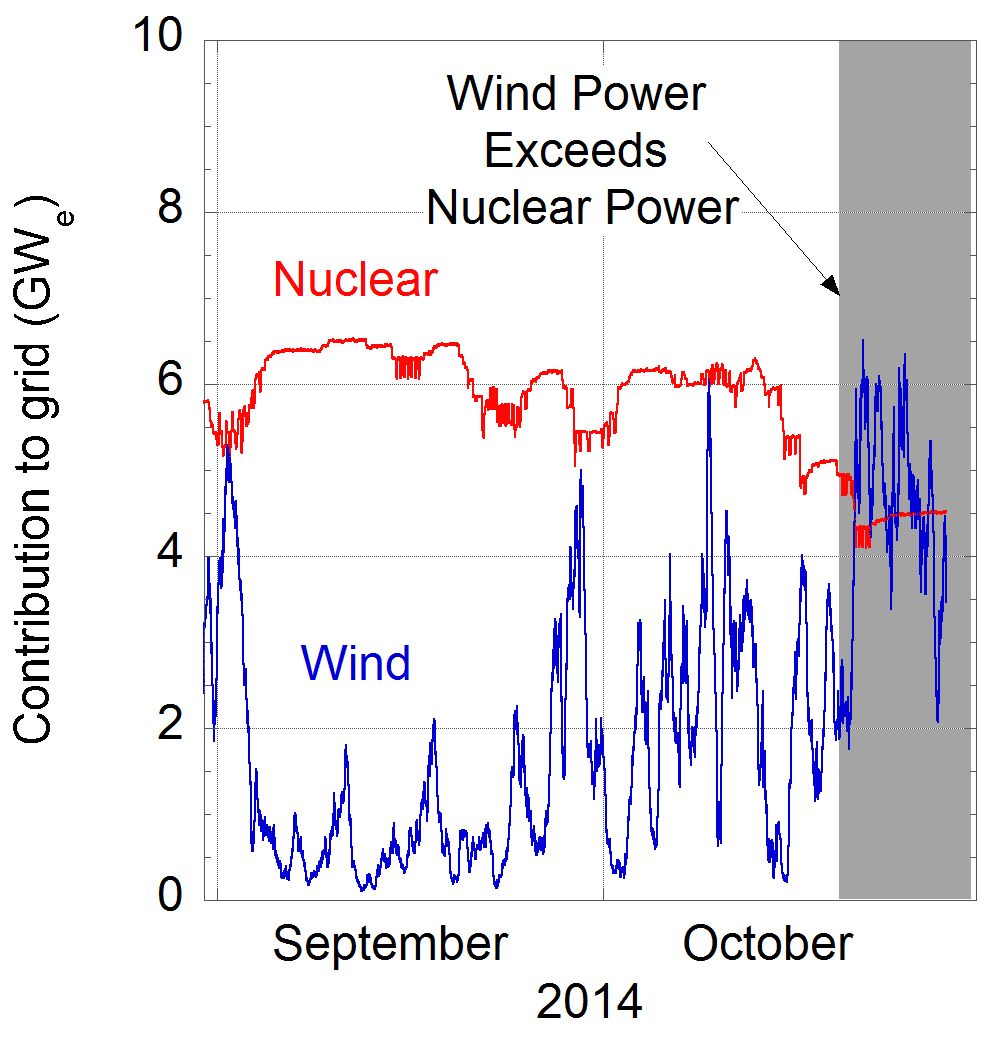
Here’s an interesting, balanced analysis of the statistics of wind power versus nuclear power in the UK over the past couple of months. There’s obviously room for more growth in renewable energy generation, but I still think we’ll need to increase nuclear capacity to provide a counter to the intermittent variability of wind power if we are to reduce our dependency on fossil fuels, which still produce most of the UK’s energy…

Michael de Podesta's avatarProtons for Breakfast

Graph showing the electricity generated by nuclear and wind power (in gigawatts) every 5 minutes for the months of September and October 2014. The grey area shows the period when wind power exceeded nuclear power. Graph showing the electricity generated by nuclear and wind power (in gigawatts) every 5 minutes for the months of September and October 2014. The grey area shows the period when wind power exceeded nuclear power. (Click Graph to enlarge)

For a few days in October 2014,  wind energy consistently generated more electricity in the UK than nuclear power. Wow!

You may have become aware of this through several news outlets. The event was reported on the BBC, but curiously the Daily Mail seems not to have noticed .

Alternatively, you may like me, have been watching live on Gridwatch – a web site that finally makes the data on electricity generation easily accessible.

I was curious about the context of this achievement and so I downloaded the historically archived data on electricity generation derived from coal, gas, nuclear and wind generation in the UK for the last three years. (Download Page)

And graphing the…

View original post 548 more words

STFC Consolidated Grants Review

Posted in Finance, Science Politics with tags , , , , , , , , on October 28, 2014 by telescoper

It’s been quite a while since I last put my community service hat on while writing a blog post, but here’s an opportunity. Last week the Science and Technology Facilities Council (STFC) published a Review of the Implementation of Consolidated Grants, which can be found in its entirety here (PDF). I encourage all concerned to read it.

Once upon a time I served on the Astronomy Grants Panel whose job it was to make recommendations on funding for Astronomy through the Consolidated Grant Scheme, though this review covers the implementation across the entire STFC remit, including Nuclear Physics, Particle Physics (Theory), Particle Physics (Experiment) and Astronomy (which includes solar-terrestrial physics and space science). It’s quite interesting to see differences in how the scheme has been implemented across these various disciplines, but I’ll just include here a couple of comments on the Astronomy side of things.

First, here is a table showing the number of academic staff for whom support was requested over the three years for which the consolidated grant system has been in existence (2011, 2012 and 2013 for rounds 1, 2 and 3 respectively).  You can see that the overall success rate was slightly better in round 3, possibly due to applicants learning more about the process over the cycle, but otherwise the outcomes seem reasonably consistent:

STFC_Con1

The last three rows of this table  on the other hand show quite clearly the impact of the “flat cash” settlement for STFC science funding on Postdoctoral Research Assistant (PDRA) support:
STFC_Con

Constant cash means ongoing cuts in real terms; there were 11.6% fewer Astronomy PDRAs supported in 2013 than in 2011. Job prospects for the next generation of astronomers continue to dwindle…

Any other comments, either on these tables or on the report as a whole, are welcome through the comments box.


BICEP2 bites the dust.. or does it?

Posted in Bad Statistics, Open Access, Science Politics, The Universe and Stuff with tags , , , , , , , , on September 22, 2014 by telescoper

Well, it’s come about three weeks later than I suggested – you should know that you can never trust anything you read in a blog – but the long-awaited Planck analysis of polarized dust emission from our Galaxy has now hit the arXiv. Here is the abstract, which you can click on to make it larger:

PlanckvBICEP2

My twitter feed was already alive with reactions to the paper when I woke up at 6am, so I’m already a bit late on the story, but I couldn’t resist a quick comment or two.

The bottom line is of course that the polarized emission from Galactic dust is much larger in the BICEP2 field than had been anticipated in the BICEP2 analysis of their data (now published  in Physical Review Letters after being refereed). Indeed, as the abstract states, the actual dust contamination in the BICEP2 field is subject to considerable statistical and systematic uncertainties, but seems to be around the same level as BICEP2’s claimed detection. In other words the Planck analysis shows that the BICEP2 result is completely consistent with what is now known about polarized dust emission.  To put it bluntly, the Planck analysis shows that the claim that primordial gravitational waves had been detected was premature, to say the least. I remind you that the original  BICEP2 result was spun as a ‘7σ’ detection of a primordial polarization signal associated with gravitational waves. This level of confidence is now known to have been false.  I’m going to resist (for the time being) another rant about p-values

Although it is consistent with being entirely dust, the Planck analysis does not entirely kill off the idea that there might be a primordial contribution to the BICEP2 measurement, which could be of similar amplitude to the dust signal. However, identifying and extracting that signal will require the much more sophisticated joint analysis alluded to in the final sentence of the abstract above. Planck and BICEP2 have differing strengths and weaknesses and a joint analysis will benefit from considerable complementarity. Planck has wider spectral coverage, and has mapped the entire sky; BICEP2 is more sensitive, but works at only one frequency and covers only a relatively small field of view. Between them they may be able to identify an excess source of polarization over and above the foreground, so it is not impossible that there may a gravitational wave component may be isolated. That will be a tough job, however, and there’s by no means any guarantee that it will work. We will just have to wait and see.

In the mean time let’s see how big an effect this paper has on my poll:


Note also that the abstract states:

We show that even in the faintest dust-emitting regions there are no “clean” windows where primordial CMB B-mode polarization could be measured without subtraction of dust emission.

It is as I always thought. Our Galaxy is a rather grubby place to live. Even the windows are filthy. It’s far too dusty for fussy cosmologists, who need to have everything just so, but probably fine for astrophysicists who generally like mucking about and getting their hands dirty…

This discussion suggests that a confident detection of B-modes from primordial gravitational waves (if there is one to detect) may have to wait for a sensitive all-sky experiment, which would have to be done in space. On the other hand, Planck has identified some regions which appear to be significantly less contaminated than the BICEP2 field (which is outlined in black):

Quieter dust

Could it be possible to direct some of the ongoing ground- or balloon-based CMB polarization experiments towards the cleaner (dark blue area in the right-hand panel) just south of the BICEP2 field?

From a theorist’s perspective, I think this result means that all the models of the early Universe that we thought were dead because they couldn’t produce the high level of primordial gravitational waves detected by BICEP2 have no come back to life, and those that came to life to explain the BICEP2 result may soon be read the last rites if the signal turns out to be predominantly dust.

Another important thing that remains to be seen is the extent to which the extraordinary media hype surrounding the announcement back in March will affect the credibility of the BICEP2 team itself and indeed the cosmological community as a whole. On the one hand, there’s nothing wrong with what has happened from a scientific point of view: results get scrutinized, tested, and sometimes refuted.  To that extent all this episode demonstrates is that science works.  On the other hand most of this stuff usually goes on behind the scenes as far as the public are concerned. The BICEP2 team decided to announce their results by press conference before they had been subjected to proper peer review. I’m sure they made that decision because they were confident in their results, but it now looks like it may have backfired rather badly. I think the public needs to understand more about how science functions as a process, often very messily, but how much of this mess should be out in the open?


UPDATE: Here’s a piece by Jonathan Amos on the BBC Website about the story.

ANOTHER UPDATE: Here’s the Physics World take on the story.

ANOTHER OTHER UPDATE: A National Geographic story

Scotland Should Decide…

Posted in Bad Statistics, Politics, Science Politics with tags , , , , , , , , , on September 9, 2014 by telescoper

There being less than two weeks to go before the forthcoming referendum on Scottish independence, a subject on which I have so far refrained from commenting, I thought I would write something on it from the point of view of an English academic. I was finally persuaded to take the plunge because of incoming traffic to this blog from  pro-independence pieces here and here and a piece in Nature News on similar matters.

I’ll say at the outset that this is an issue for the Scots themselves to decide. I’m a believer in democracy and think that the wishes of the Scottish people as expressed through a referendum should be respected. I’m not qualified to express an opinion on the wider financial and political implications so I’ll just comment on the implications for science research, which is directly relevant to at least some of the readers of this blog. What would happen to UK research if Scotland were to vote yes?

Before going on I’ll just point out that the latest opinion poll by Yougov puts the “Yes” (i.e. pro-independence) vote ahead of “No” at 51%-49%. As the sample size for this survey was only just over a thousand, it has a margin of error of ±3%. On that basis I’d call the race neck-and-neck to within the resolution of the survey statistics. It does annoy me that pollsters never bother to state their margin of error in press released. Nevertheless, the current picture is a lot closer than it looked just a month ago, which is interesting in itself, as it is not clear to me as an outsider why it has changed so dramatically and so quickly.

Anyway, according to a Guardian piece not long ago.

Scientists and academics in Scotland would lose access to billions of pounds in grants and the UK’s world-leading research programmes if it became independent, the Westminster government has warned.

David Willetts, the UK science minister, said Scottish universities were “thriving” because of the UK’s generous and highly integrated system for funding scientific research, winning far more funding per head than the UK average.

Unveiling a new UK government paper on the impact of independence on scientific research, Willetts said that despite its size the UK was second only to the United States for the quality of its research.

“We do great things as a single, integrated system and a single integrated brings with it great strengths,” he said.

Overall spending on scientific research and development in Scottish universities from government, charitable and industry sources was more than £950m in 2011, giving a per capita spend of £180 compared to just £112 per head across the UK as a whole.

It is indeed notable that Scottish universities outperform those in the rest of the United Kingdom when it comes to research, but it always struck me that using this as an argument against independence is difficult to sustain. In fact it’s rather similar to the argument that the UK does well out of European funding schemes so that is a good argument for remaining in the European Union. The point is that, whether or not a given country benefits from the funding system, it still has to do so by following an agenda that isn’t necessarily its own. Scotland benefits from UK Research Council funding, but their priorities are set by the Westminster government, just as the European Research Council sets (sometimes rather bizarre) policies for its schemes. Who’s to say that Scotland wouldn’t do even better than it does currently by taking control of its own research funding rather than forcing its institutions to pander to Whitehall?

It’s also interesting to look at the flipside of this argument. If Scotland were to become independent, would the “billions” of research funding it would lose (according to the statement by Willetts, who is no longer the Minister in charge) benefit science in what’s left of the United Kingdom? There are many in England and Wales who think the existing research budget is already spread far too thinly and who would welcome an increase south of the border. If this did happen you could argue that, from a very narrow perspective, Scottish independence would be good for science in the rest of what is now the United Kingdom, but that depends on how much the Westminster government sets the science budget.

This all depends on how research funding would be redistributed if and when Scotland secedes from the Union, which could be done in various ways. The simplest would be for Scotland to withdraw from RCUK entirely. Because of the greater effectiveness of Scottish universities at winning funding compared to the rest of the UK, Scotland would have to spend more per capita to maintain its current level of resource, which is why many Scottish academics will be voting “no”. On the other hand, it has been suggested (by the “yes” campaign) that Scotland could buy back from its own revenue into RCUK at the current effective per capita rate  and thus maintain its present infrastructure and research expenditure at no extra cost. This, to me, sounds like wanting to have your cake and eat it,  and it’s by no means obvious that Westminster could or should agree to such a deal. All the soundings I have taken suggest that an independent Scotland should expect no such generosity, and will get actually zilch from the RCUK.

If full separation is the way head, science in Scotland would be heading into uncharted waters. Among the questions that would need to be answered are:

  •  what will happen to RCUK funded facilities and staff currently situated in Scotland, such as those at the UKATC?
  •  would Scottish researchers lose access to facilities located in England, Wales or Northern Ireland?
  •  would Scotland have to pay its own subscriptions to CERN, ESA and ESO?

These are complicated issues to resolve and there’s no question that a lengthy process of negotiation would be needed to resolved them. In the meantime, why should RCUK risk investing further funds in programmes and facilities that may end up outside the UK (or what remains of it)? This is a recipe for planning blight on an enormous scale.

And then there’s the issue of EU membership. Would Scotland be allowed to join the EU immediately on independence? If not, what would happen to EU funded research?

I’m not saying these things will necessarily work out badly in the long run for Scotland, but they are certainly questions I’d want to have answered before I were convinced to vote “yes”. I don’t have a vote so my opinion shouldn’t count for very much, but I wonder if there are any readers of this blog from across the Border who feel like expressing an opinion?