Archive for the Science Politics Category

Fracking Confusion

Posted in Politics, Science Politics, The Universe and Stuff with tags , , , , , , on August 12, 2013 by telescoper

The news on the radio this morning featured a story about the Prime Minister wanting the UK to “get behind” hydraulic fracturing (or “fracking” as it is known for short) , a means of  liberating shale gas that offers the prospect of boosting the UK’s energy supply.

There’s not much sign any “getting behind” happening up the road from here in Balcombe, where a sizable anti-fracking protest has been going on for some time. There’s actually no fracking going on in Balcombe at the moment; the company involved, Cuadrilla Resources, is doing exploratory drilling to look for oil but may apply for a licence to pursue hydraulic fracturing if that is unsuccessful.

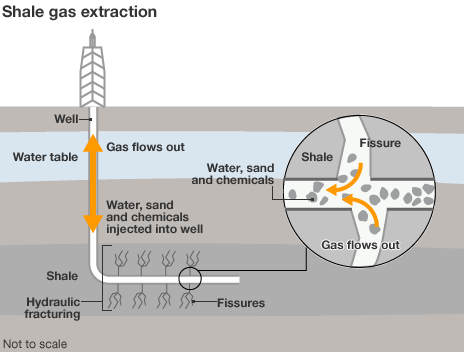
There’s a simple graphic on the BBC website that illustrates how fracking works:

_65309507_shale_gas_extraction464

In simple terms it involves pumping a mixture of water, sand and chemicals into a deposit of shale ato fracture the solid material contained therein and thus liberate the gas. Environmentalists argue that this technique might cause earth tremors and/or contamination of the water supply; advocates of fracking dispute these claims. I’m not sufficiently expert to be able to comment usefully on the arguments about the possible environmental dangers associated with it, so I’d be glad to receive comments via the box below.

One thing I will comment on, though, is the very poor quality of the media reporting on this issue. I’ve yet to see any meaningful attempt to comment on the science involved when surely that’s the key to whether we should “get behind” fracking or not? It struck me that quite a few readers might also be interested but ill-informed about this issue to, so for them I’d recommend reading the Beddington Report, the key findings of which were:

  • The health, safety and environmental risks can be managed effectively in the UK. Operational best practices must be implemented and enforced through strong regulation. Fracture propagation is an unlikely cause of contamination.
  • The risk of fractures propagating to reach overlying aquifers is very low provided that shale gas extraction takes place at depths of many hundreds of metres or several kilometres. Even if fractures reached overlying aquifers, the necessary pressure conditions for contaminants to flow are very unlikely to be met given the UK’s shale gas hydrogeological environments.
  • Well integrity is the highest priority. More likely causes of possible contamination include faulty wells. The UK’s unique well examination scheme was set up so that independent, specialist experts could review the design of every offshore well. This scheme must be made fit for purpose for onshore activities.
  • Robust monitoring is vital. Monitoring should be carried out before, during and after shale gas operations to detect methane and other contaminants in groundwater and potential leakages of methane and other gases into the atmosphere.
  • An Environmental Risk Assessment (ERA) should be mandatory. Every shale gas operation should assess risks across the entire lifecycle of operations, from water use through to the disposal of wastes and the abandonment of wells.
  • Seismic risks are low. Seismicity should be included in the ERA.Seismicity induced by hydraulic fracturing is likely to be of smaller magnitude than the UK’s largest natural seismic events and those induced by coal mining.
  • Water requirements can be managed sustainably. Water use is already regulated by the Environment Agency. Integrated operational practices, such as recycling and reusing wastewaters where possible, would help to minimise water requirements further. Options for disposing of wastes should be planned from the outset. Should any onshore disposal wells be necessary in the UK, their construction, regulation and siting would need further consideration.
  • Regulation must be fit for purpose. Attention must be paid to the way in which risks scale up should a future shale gas industry develop nationwide. Regulatory co-ordination and capacity must be maintained.
  • Policymaking would benefit from further research. The carbon footprint of shale gas extraction needs further research. Further benefit would also be derived from research into the public acceptability of shale gas extraction and use in the context of the UK’s energy, climate and economic policies.

I’m not sure how many anti-fracking activists, or others involved in the Balcombe protest, have read this report.

Anyway, in an attempt to gauge the mood of my totally unrepresentative readership, I thought I’d try a little poll:

And if you have strong opinions, please feel free to use the comments box.

The Dark Side of the REF

Posted in Finance, Science Politics with tags , , , , , , , , on August 8, 2013 by telescoper

There’s a disturbing story in the latest Times Higher which argues that the University of Leicester has apparently reneged on a promise that non-submission to the forthcoming (2014)  Research Excellence Framework (REF) would not have negative career consequences. They have now said that except in exceptional circumstances, non-submitted academics will either be moved to a teaching-only contract (where there is a vacancy and they can demonstrate teaching excellence), or have their performance “managed”, with the threat of sacking if they don’t meet the specified targets.  I’d heard rumours of this on the grapevine (i.e. Twitter) before the Times Higher story was published. It’s very worrying to have it confirmed, as it raises all kinds of questions about what might happen in departments that turn out to have disappointing REF results .

There are (at least) two possible reasons for non-inclusion of the outputs of a researcher and it is important to distinguish between them. One is that the researcher hasn’t enough high-quality outputs to submit. In the absence of individual extenuating circumstances, researchers are expected to submit four “outputs” (in my discipline that means “research papers”) for assessment. That’s a pretty minimal level of productivity, actually;  such a number per year is a reasonable average for an active researcher in my field.  A person employed on a contract that specifies their duties as Teaching and Research may therefore be under-performing  if they can’t produce four papers over the period 2008-2013. I think some form of performance management  may be justifiable in this case, but the primary aim should be to help the individual rather than show them the door. We all have fallow periods in research, and it’s not appropriate to rush to sack anyone who experiences a lean time.   Andrew Wiles would have been considered `inactive’ had there been a REF in 1992 as he hadn’t published anything for years. Then he produced a proof of Fermat’s Last Theorem. Some things just take time.

A second reason for excluding researcher from the REF is that the institution concerned may be making a tactical submission. As the Times Higher article explains:

The memo suggests that academics would be spared repercussions if, among other reasons, the number of individuals submitted is “constrained” by the volume of case studies their department intends to enter to demonstrate research impact.

Institutions must submit one case study for every 10 scholars entered.

Maria Nedeva, professor of science and innovation dynamics and policy at Manchester Business School, said the tactic of deciding how many academics to submit based on impact case study numbers was “rife”.

(Incidentally, the second paragraph is not quite right. The number of case studies required depends on the number of staff submitted as follows: for fewer than 15 staff , TWO case studies;  for 15-24.99 staff it is THREE case studies – and then for each additional ten members of staff entered a further case study is required.)

e case study for every scholars included plus one, i.e. forThe statement at the end of the quote there is in line with my experience too.  The point is that the REF is not just a means of allocating relatively small amounts of so-called `QR’ research funding . Indeed, it remains entirely possible that no funding at all will be allocated following the 2014 exercise. The thinking then is that the number of staff submitted is largely irrelevant; all that will count is league table position.

This by no means the only example of the dangers that lurk when you take league tables too seriously.

If a department is required to submit, say, four impact cases if all staff are included in the REF submission, but only has three viable ones, it would not be unreasonable to submit fewer staff because their overall would be dragged down by a poor impact case even if the output quality of all staff is high.  There will certainly be highly active researchers in UK institutions, including many who hold sizable external research grants, whose outputs are not submitted to the REF. As the article points out, it would be very wrong for managers to penalize scholars who have been excluded because of this sort of game-playing. That’s certainly not going to happen in the School of Mathematical and Physical Sciences at Sussex University.  Not while I’m Head of School, anyway.

Moreover, even researchers whose “outputs” are not selected may still contribute to the “Environment” and/or “Impact” sections so they still, in a very real sense, do participate in their department’s REF submission.

My opinion? All this silliness could easily have been avoided by requiring all staff in all units of assessment to be submitted by all departments. You know, like would have happened if the system were actually designed to identify and reward research excellence. Instead, it’s yet another example of a bureaucratic machine that’s become entirely self-serving. It exists simply because it exists.  Research would be much better off without it.

University Research Funding: Will the Axe Fall on QR?

Posted in Finance, Politics, Science Politics with tags , , , on June 25, 2013 by telescoper

As we tremble in anticipation of this week’s Spending Review, which will determine the budgets for Science and Higher Education in 2015/16, there’s fairly strong evidence that Chancellor of the Exchequer George Osborne is looking to save about £11.5 billion of public spending. Given that funding for some Whitehall departments is ring-fenced there is considerable speculation that the axe will fall heavily on the Department for Business, Innovation and Skills (BIS), which seems likely to have to make over £1 billion of savings.

But where will these savings in the BIS budget be made? The government has made noises that it will protect science funding (at least in cash terms) so big cuts in the larger research council budgets appear unlikely. However, Treasury officials have been rumoured as thinking that the Universities are now “awash with money” and should therefore be cut. On the other hand, incoming for University teaching now largely comes from fees so there’s very little of the HEFCE teaching budget to cut further.

Now here’s the rub. The part of HEFCE’s budget that deals with research amounts to about £1.6 billion per year. This, the so-called `QR’ funding, is currently being distributed to Higher Education Institutions according to the outcome of the 2008 Research Assessment Exercise (RAE). This year we
are preparing submissions to a new system called the Research Excellence Framework (REF), which was always intended to be used to distribute QR funding from 2015/16 onwards. But what if the government decides that the only way to balance the books is to remove the QR funding stream entirely?

The 2012 funding letter from HEFCE states explains that it is distributing

£1,558 million for research. The ring-fenced settlement for science and research means that we will be able to maintain overall funding, in cash terms, until 2014-15.

But this does not include the period covered by the spending review, so it’s perfectly possible that the “ring fence” could be removed, or at least re-interpreted as a result of this spending review.

The government could argue that QR and Research Council grant income correlate so well that there’s no need to continue with the current dual funding system, by which the Research Councils provide grants for specific projects and programmes and the higher education funding bodies provide block grant funding to universities via the QR line. It could also argue that the high fees being charged mean that Universities will be able to cope with these cuts without undue hardship. There is a precedent in Wales, where HEFCW will not be awarding any QR funding after the 2013 REF, so why shouldn’t England do the same? They could also get away with the argument that this money isn’t part of the ring fence mentioned above.

The only problem is that so many institutions have spent so much time on preparations for the REF that cancelling the funding associated with it will mean all that effort is wasted. Indeed, the only remaining justification (if it can be called that) for Universities participating in the REF is for position in various league tables, which is rather a lot of expense for something of extremely debatable value.

Anyway, if I were a gambling man (which I am, actually) I don’t think I’d be betting against this outcome. Predictions are very difficult, especially about the future, but this one is mine. And I hope it’s proved wrong…

The South-East Physics Network – The Sequel

Posted in Education, Science Politics with tags , , , , , , , , , , , , , on June 18, 2013 by telescoper

Every now and again I’m at a loss for something to blog about when a nice press release comes to the rescue. This announcement has just gone live, and I make no apology for repeating it here!


UPDATE: You can now read the University of Sussex take on this announcement here.

–0–

SEPnet_extratext_black

New Investment in Physics Teaching and Research in South East England

The South East Physics network (SEPnet) and HEFCE are delighted to announce their plans to invest £13.1 million pounds to sustain physics undergraduate and postgraduate teaching provision, and world class research facilities, staff and doctoral training over the 5 years up to 2018. HEFCE will provide £2.75 million to maintain and expand the network, to establish a dedicated regional graduate training programme for physics postgraduate students and address physics specific issues of student participation and diversity. On top of the HEFCE contribution, each SEPnet partner will support and fund programmes of Outreach, Employability and Research.

The South East Physics Network (SEPnet) was formed after receiving a £12.5 million grant from HEFCE in 2008 as a network of six Physics departments in South East England at the Universities of Kent, Queen Mary University of London, Royal Holloway University of London, Southampton, Surrey and Sussex. The Science and Technology Facilities Council and Rutherford Appleton Laboratory provided additional funds and resources for collaborations in particle physics and astrophysics. The University of Portsmouth joined in 2010. The Open University and the University of Hertfordshire will join the network effective the 1st August 2013.

SEPnet Phase One has been tremendously successful for the partners in SEPnet and for physics in the region. The Outreach programme, regarded as an exemplar for collaborative outreach, uses the combined knowledge and resources of each partner to provide greater impact and reach and demonstrates that the whole is greater than the sum of its parts. It has succeeded in effectively exploiting the growing national interest in physics through its wide range of public engagement and schools activities. There has been a substantial increase in applications and intake for physics undergraduate courses and undergraduate numbers are now 90% higher in the SEPnet physics departments compared with 2007 and applications up approximately 115% – well above national trends.

Announcing the investment, SEPnet’s Independent Chair Professor Sir William Wakeham said “This is a major success for physics both in the region and nationally. HEFCE’s contribution via SEPnet has enabled the partners in the consortium to grow and develop their physics departments for the long term. Before SEPnet, physics departments had falling student numbers and lacked research diversity. Now they are robust and sustainable and the SEPnet consortium is an exemplar of collaboration in Higher Education.”

David Sweeney, Director of Research, Innovation and Skills, HEFCE said: “We are delighted to see the fruits of a very successful intervention to support what was once a vulnerable subject. HEFCE are pleased to provide funding for a new phase, particularly to address new challenges in the field of postgraduate training and widening participation. The expansion to include new physics departments is a testament to the success of the network and can only act to strengthen and diversify the collaboration.”

Sir Peter Knight, President of the Institute of Physics, expressed strong support for the government’s continued investments in the sciences generally and in physics specifically. “SEPnet has been an undoubted success in sustaining physics in the South East region and has strongly participated in contributing to its beneficial effects nationally. It is an exemplar of collaborative best practice in outreach, employability and research and we now look forward to collaborating in the critical areas of graduate training, public engagement and diversity.”

The specific programmes already being developed by the network include:

  1. a regional Graduate Network built on the strength of current SEPnet research collaborations and graduate training whose  primary objectives  will be to:
  • develop and deliver an exemplar programme of PhD transferable and leadership skills training delivered flexibly to create employment-ready physics doctoral graduates for the economic benefit of the UK;
  • increase employer engagement with HEIs including PhD internships,  industrially-sponsored  studentships and Knowledge Transfer fellowships;
  • enhance the impact  of SEPnet’s research via a clear, collaborative impact strategy;
  • enhance research environment diversity through engagement with Athena SWAN and the IoP’s Project Juno.
  1. Expansion of its employer engagement and internship programmes, widening the range of work experiences available to enhance undergraduate (UG) and postgraduate (PG) employability and progress to research degrees.
  2. Enhancement of its Outreach Programme  to deliver and disseminate  best practice in schools and public engagement and  increase diversity in  physics education.

The inclusion of new partners The Open University and University of Hertfordshire broadens the range of teaching and postgraduate research in the network. The University of Reading, about to introduce an undergraduate programme in Environmental Physics (Department of Meteorology), will join as an associate partner.

A key part of the contributions from each partner is the provision of “SEPnet PhD Studentships”, a programme to attract the brightest and best physics graduates to engage in a programme of collaborative research within the network, of joint supervision and with a broad technical and professional graduate training programme within the SEPnet Graduate Network.

The network will be led by the University of Southampton. Its Vice-Chancellor, Professor Don Nutbeam: “I am delighted that the University of Southampton, in partnership with nine other universities in the region, is able to build on the success of the SEPnet initiative to reinvigorate the university physics teaching and research and take it to a new level in the turbulent period ahead for the higher education sector. The SEPnet training programme brings novelty, quality and diversity to the regions physics postgraduates that we expect to be a model for other regions and subjects.”

A Time for Honours

Posted in Education, Politics, Science Politics, The Universe and Stuff with tags , , , on June 15, 2013 by telescoper

The word “honour” provides a (tenuous) link between yesterday’s post and this one. After our recent preoccupation with the classification of honours for graduating students (i.e. first class, second class, and so on), today’s news included the Queen’s Birthday Honours List for 2013, which you can download in full here. To make up for the lack of recycling going on in Brighton these days because of the strike that started yesterday, I thought I’d recycle my thoughts from previous years.

The honours system must appear extremely curious to people from outside the United Kingdom. It certainly seems so to me. On the one hand, I am glad that the government has a mechanism for recognising the exceptional contributions made to society by certain individuals. Musicians, writers, sportsmen, entertainers and the like generally receive handsome financial rewards, of course, but that’s no reason to begrudge a medal or two in recognition of the special place they occupy in our cultural life.  It’s  good to see scientists recognized too, although they tend not to get noticed so much by the press.

The name that stood out for me in this year’s list is Professor Jim Hough, who gets an OBE. Jim is Professor of Experimental Physics at the University of Glasgow, and his speciality is in the detection of gravitational waves.  Gravitational waves haven’t actually been detected yet, of course, but the experimental techniques designed to find them have increased their sensitivity by many orders of magnitude in recent years, Jim having played a large part in those improvements. I imagine he will be absolutely thrilled in February 2016, when gravitational waves are finally detected. Jim is also Chief Executive of the Scottish University Physics Alliance, which does so much to nurture Physics and Astronomy North of the Border.

Although I’m of course more than happy to see recognition given to such people, as I did  a couple of years ago I can’t resist stating my objections to the honours system again. One is that the list of recipients  of certain categories of award is overwhelmingly dominated by career civil servants, for whom an “honour”  goes automatically with a given rank. If an honour is considered an entitlement in this way then it is no honour at all, and in fact devalues those awards that are  given on merit to people outside the Civil Service. Civil servants get paid for doing their job, so they should have no more expectation of an additional reward than anyone else. There’s much more honour in a  student who earns a First Class degree than for a career civil servant who gets a knighthood.

Honours have relatively little monetary value on their own, of course so this is not question of financial corruption. An honour does, however, confer status and prestige on the recipient so what we have is a much more subtle form of sleaze. One wonders how many names listed in the current roll of honours are there because of political donations, for example.

I wouldn’t accept an honour myself, but that’s easy to say because I’m sure I’ll never be nominated for one; hopefully this post will dissuade anyone from even thinking of nominating me for a gong. However, I imagine that even people like me who are against the whole system are probably still tempted to accept such awards when offered, as they generate good publicity for one’s field, institution and colleagues.It’s a very personal decision and I have no criticism to make of people who think differently from me about whether to accept an honour.

The Week Ahead

Posted in Biographical, Education, Science Politics on June 9, 2013 by telescoper

Looking at my calendar I see a very busy few days coming up, so I have to knuckle down and finish a couple of jobs today, as I won’t get time later in the week.

The most important events of the week ahead are various meetings of various examination boards culminating in the PAB (Progression & Award Board) at which final degree classifications are determined. There is a new system in place this year, and it requires the Head of School (i.e. Muggins here) to chair this meeting, which a number of external examiners also attend and which covers Mathematics, Physics and Astronomy.

Of course the decisions made at this Board can have a huge effect on students’ lives and career prospects, so a huge amount of work goes on beforehand: not just checking and double-checking marks, but also ensuring we follow the regulations scrupulously; because I’m new and the regulations have recently been revised, that’s required quite a lot of behind-the-scenes activity. Some will no doubt be disappointed come the end of the week, but at least we do everything we can to make the process as fair as possible.

The PAB take place on Thursday and marks will be released on Friday (14th) at which point the suspense will be over for this year’s graduating students at Sussex and the celebrations can begin..

I suppose the timetable at universities elsewhere is similar. I know it is in Cardiff, where some students I have known for 4 years will also be getting their results next week. I’ll be thinking of them, though obviously I can’t’ be there in person to congratulate them.

Anyway, good luck to all those at Sussex, Cardiff and anywhere else who are eagerly anticipating or completely dreading news next week. Just remember that triumph and disaster are indeed both impostors..

In between all the exams stuff I also have to fit in trips to London for a meeting of SEPNET and a Royal Society event, as well as Senior Management Group and Senate at the University of Sussex.

Then the undergraduate teaching year will be over, though I don’t see fewer appointments my calendar!

Royal Institution: Crowdfunding the opposition?

Posted in Science Politics with tags , on June 3, 2013 by telescoper

Not long ago I posted an item about the Royal Institution’s daft attempt to trademark the title “Christmas Lectures”. Here’s a possible way to challenge it, suggested by fellow astroblogperson Dave Clements…

davecl's avatarDisturbing the Universe

Having had further discussion with my friend the IP lawyer, it seems the chances of invalidating the RI’s trademark claim on Christmas Lecture are rather good. But there would be costs and the need for a contingency if it goes to court and the RI win and are awarded costs.

So – anybody interested in crowdsourcing the costs? A sum of about 3k would be needed.

View original post

(Lack of) Diversity in STEM Subjects

Posted in Science Politics with tags , , , , , , on May 10, 2013 by telescoper

Among the things I learnt over the last few days was some interesting information about the diversity (or, rather, lack of diversity) of undergraduates taking undergraduate degrees in STEM subjects in the UK universities. For those of you not up on the lingo, `STEM’ is short for Science, Technology, Engineering and Mathematics. Last year the Institute of Physics produced a report that contains a wealth of statistical information about the demographics of the undergraduate population, from which the following numbers are only a small component.

Physics

Maths

Chemistry

Engineering

Female

21%

41%

44%

12%

BME

11%

24%

20%

30%

Socio-Economic

37%

42%

43%

51%

Non-EU

5%

12%

7%

32%

For completeness I should point out that these numbers refer to first-year undergraduates in 2010-11; I have no particular reason to suppose there has been a qualitative change since then. “BME” stands for “Black and Minority Ethnic”, and “Socio-Economic” refers to students whose with parents not employed in managerial or professional positions.

Overall, the figures here at the University of Sussex are roughly in line with, but slightly better than, these national statistics; the proportion of female students in our Physics intake for 2010/11, for example, was 27%.

There are some interesting (and rather disappointing) things to remark. First is that the proportion of Physics students who are female remains low; Physics scores very badly on ethnic diversity too. Mathematics on the other hand seems a much more attractive subject for female students.  Notice also how Physics and Chemistry attract a very small proportion of overseas students compared to Engineering.

In summary, therefore, we can see that Physics is a subject largely studied by white  middle-class European males. What are we doing wrong?

Despite considerable efforts to promote Physics to a more diverse constituency,  the proportion of, e.g., female physics students seems to have been bumping along at around 20% for ages.  Interestingly, all the anecdotal evidence suggests that those women who do Physics at University do disproportionately well, in the sense that female students constitute a  much larger fraction of First-class graduates than 20%. This strongly suggests that the problem lies at school level; some additional IOP information and discussion on this can be found here.

I’m just passing these figures on for information, as I’m quite often asked about them during, e.g., admissions-related activities. I don’t have any really compelling suggestions, but I would like to invite the blogosphere to comment and/or make suggestions as to promote diversity in STEM disciplines.

The Cosener’s House

Posted in Biographical, Science Politics with tags , , , on May 9, 2013 by telescoper

Back in Brighton after a busy but productive day-and-a-half in Abingdon discussing the future of SEPNET of which more soon. I just have time to post a few pictures of the place I was staying, The Cosener’s House.

Incidentally, being fascinated by words, I just looked up “cosener” on the online Oxford English Dictionary and found that it is a common variant of the word “cozener” which means a “deceiver, cheat or impostor”. I felt quite at home there

The place is right next to the River Thames, which runs along the bottom of the pleasant garden adjacent to the house. I hadn’t realized that the whole establishment is run by the Science and Technology Facilities Council and is much frequented by users of various large scientific facilities (such as ISIS and the Diamond Light Source) situated nearby at the Rutherford Appleton Laboratory (RAL).

The particle physicists among us were quite familiar with The Cosener’s House owing to the connection with RAL but although I’ve done quite a few STFC panels I’ve never been there before. Anyway, as you can see, it’s a pleasant enough location and it met with my particular strong approval because of the splendid black pudding available at breakfast!

IMG-20130508-00106

House and Garden

IMG-20130508-00108

This be the Thames…

IMG-20130508-00110

The Bridge at Twilight.

IMG-20130508-00109

Calm as a Millpond…

Vote Away Day

Posted in Biographical, Science Politics with tags , on May 8, 2013 by telescoper

Well, I’m up early today because no sooner do I get back to work when I have to leave for the South East Physics Network SEPNET “Awayday”. Actually it’s more than a day, more like a day and a half but it’s pointless quibbling about such things. Anyway, it’s going to be held at the Cosener’s House in Abingdon and will be my first visit to that august establishment.

Before departing into the wilds of Oxfordshire, however, I thought I’d just post a quick reminder to any Fellows of the Royal Astronomical Society who happen to be reading this blog that the deadline is approaching for votes in the election of a new President and new Members of Council.Electronic votes must be received by 12 noon on 9 May 2013, and paper votes by the start of the Annual General Meeting on 10 May 2013, so if you are eligible but haven’t voted yet please get your finger out.

In the interest of full disclosure I should make it clear that I am standing for election to Council…