Archive for the Science Politics Category

Astronomy Grant History (via The e-Astronomer)

Posted in Finance, Science Politics with tags , , , on February 4, 2011 by telescoper

Interesting view of astronomy grant funding versus time from AGP Chair Andy Lawrence.

Before commenting, I’m first going to calculate the Fourier Transform of Andy’s graph and analyse it in reciprocal space.

Astronomy Grant History Time for me to break a rule. As many of you will know, I am currently chairperson of STFC’s Astronomy Grants Panel. I have steered clear of discussing AGP business on this blog, for obvious reasons. However, the current round is now complete, so I can relax that rule somewhat. I wrote a chairman’s report which went out yesterday on the astrocommunity email list. Paul Crowther has put it on his website, so you can read it if you haven’t already. T … Read More

via The e-Astronomer


Share/Bookmark

Astronomy Grants: Past, Present, and Future

Posted in Finance, Science Politics with tags , , , , on February 3, 2011 by telescoper

Just time to put my community service hat briefly in order draw the attention of all friendly astronomers to the report on the 2010 STFC Astronomy grant round that has been circulated by the AGP Chair, Andy Lawrence (aka the e-Astronomer).

There is a lot of important information in this report, not only about the statistics of the last round but also about the new grants system that will be in operation from this year onwards so you really should read it carefully, especially if you’re planning to submit a grant application in 2011.

The report has been circulated to the astrocommunity mailing list, so most of you out there will have seen it but for those of you who haven’t you can find it on Paul Crowther’s website here.

I haven’t got time today to add detailed comments of my own – it’s a UCAS day in Cardiff today (among other things) – but I may do so in future. However, please feel free to comment/react/moan but please remember not to shoot the messenger!


Share/Bookmark

Follow My Leader

Posted in Education, Science Politics with tags , , , on February 2, 2011 by telescoper

News broke today about  the dreaded “Letter from HEFCE” to heads of English higher education institutions informing them of their funding allocations for the near future. The cuts outlined in the funding letter were not entirely unexpected, but have nevertheless generated quite a lot of reaction – see, e.g., here. For those of you who can’t be bothered to read the Circular Letter, it is of the form:

Dear Vice-Chancellor or Principal,

You’re screwed.

Yours Sincerely,

HEFCE

One of the ramifications of the decisions made by the Higher Education Funding Council for England (for that is HEFCE) is that funding will be further cut for research rated a “mere” 2* in the 2008 Research Assessment Exercise. For those of you who prefer meaningless words to meaningless numbers-with-asterisks, 2* is translated in the HEFCE dictionary as “internationally recognised”. Obviously a waste of money then. By 2013 the only research that will be funded at all under the QR formula will be 3* (“internationally excellent) and 4* (world leading). Of course “world leading” won’t include “nationally leading”, as by then there won’t be anyone in England left to follow the survivors; everyone left after the cull will be doing their best to be a  “leader” in order to avoid being labelled a “follower”,  a crime for which the punishment is, apparently, death.

I only hope that this mad policy dismantling the Great Pyramind of Research from the bottom upwards isn’t pursued here in Wales too, otherwise I’ll soon be sitting next to the radiator in the local Wetherspoons drinking cheap beer with the rest of the prematurely terminated. For the time being, until HEFCW decides what do do, we in Wales have a stay of execution.

All this reminds me of a story I heard at a conference dinner years ago. I happened to be sitting next to someone Mrs X – the spouse of a physicist who shall remain nameless – who had for a time worked on undergraduate admissions for a Humanities Department of a  big American Ivy League university. One application for a place had been accompanied by a lukewarm recommendation from a high school teacher, containing a statement along the lines of John is definitely a follower rather than a leader. On this slim evidence of potential, my dining companion Mrs X decided to offer little Johnny a place.

Bewildered to hear that John had been admitted, the aforementioned teacher telephoned the Department and was put through to Mrs X. “But I thought I made it clear in my reference what I thought! Was the decision to let him in some sort of administrative error?”

“No,” said Mrs X.

“Let me explain. Every year this Department takes in about 500 undergraduate students. Virtually every  recommendation letter says this student is a leader rather than a follower. In the light of this huge number of leaders, I feel it is my duty every year to ensure that the Department contains at least one follower.”


Share/Bookmark

EPSRC : a capital affair (via The e-Astronomer)

Posted in Finance, Science Politics with tags , , , on February 2, 2011 by telescoper

If you think the grass is greener on the EPSRC side of the fence than on the STFC one, then you should read this post by the genial e-Astronomer. Times are tough…

I just came back from an EPSRC roadshow presentation to our University. Interesting to compare this to the STFC one we got a week or so back. Possibly the most striking thing, given that EPSRC is the biggest research council (budget 760M), is that the attendance was smaller than for the STFC show, and there was a much larger fraction of finance and admin people as opposed to scientists. I think this shows that despite all the troubles of the last … Read More

via The e-Astronomer

Certain Scientists aren’t Good Scientists

Posted in Science Politics, The Universe and Stuff with tags , , , , , on January 30, 2011 by telescoper

Just time for a quickie today because tomorrow is the first day of teaching (in what we optimistically call the “Spring Semester”) and I’ve decided to head into the department this afternoon to prepare some handouts and concoct some appropriately fiendish examples for my first problem set.

I thought I’d take the opportunity to add a little postscript to some comments I made in a post earlier this week on the subject of misguided criticisms of science. Where I (sometimes) tend to agree with some such attacks is when they are aimed at scientists who have exaggerated levels of confidence in the certainty of their results. The point is that scientific results are always conditional, which is to say that they are of the form “IF we assume this theoretical framework and have accounted for all sources of error THEN we can say this”.

To give an example from my own field of cosmology we could say “IF we assume the general theory of relativity applies and the Universe is homogeneous and isotropic on large scales and we have dealt with all the instrumental uncertainties involved etc etc THEN 74% of the energy density in the Universe is in a form we don’t understand (i.e. dark energy).” We don’t know for sure that dark energy exists, although it’s a pretty solid inference, because it’s by no means certain that our assumptions – and there are a lot of them – are all correct.

Similar statements are made in the literature across the entire spectrum of science. We don’t deal with absolute truths, but always work within a given theoretical framework which we should always be aware might be wrong. Uncertainty also derives from measurement error and statistical noise. A scientist’s job is to deal with all these ifs buts and don’t-knows in as hard-nosed a way as possible.

The big problem is that, for a variety of reasons, many people out there don’t understand that this is the way science works. They think of science in terms of a collection of yes or no answers to well-posed questions, not the difficult and gradual process of gathering understanding from partial clues and (occasionally inspired) guesswork.

Why is this? There are several reasons. One is that our system of science education does not place sufficient emphasis on science-as-method as opposed to science-as-facts. Another is that the media don’t have time for scientists to explain the uncertainties. With only a two-minute slot on the news to explain cosmology to a viewer waiting for the football results all you can do is deliver a soundbite.
This is what I wrote in my book From Cosmos to Chaos:

Very few journalists or television producers know enough about science to report sensibly on the latest discoveries or controversies. As a result, important matters that the public needs to know about do not appear at all in the media, or if they do it is in such a garbled fashion that they do more harm than good. I have listened many times to radio interviews with scientists on the Today programme on BBC Radio 4. I even did such an interview once. It is a deeply frustrating experience. The scientist usually starts by explaining what the discovery is about in the way a scientist should, with careful statements of what is assumed, how the data is interpreted, and what other possible interpretations might be. The interviewer then loses patience and asks for a yes or no answer. The scientist tries to continue, but is badgered. Either the interview ends as a row, or the scientist ends up stating a grossly oversimplified version of the story.

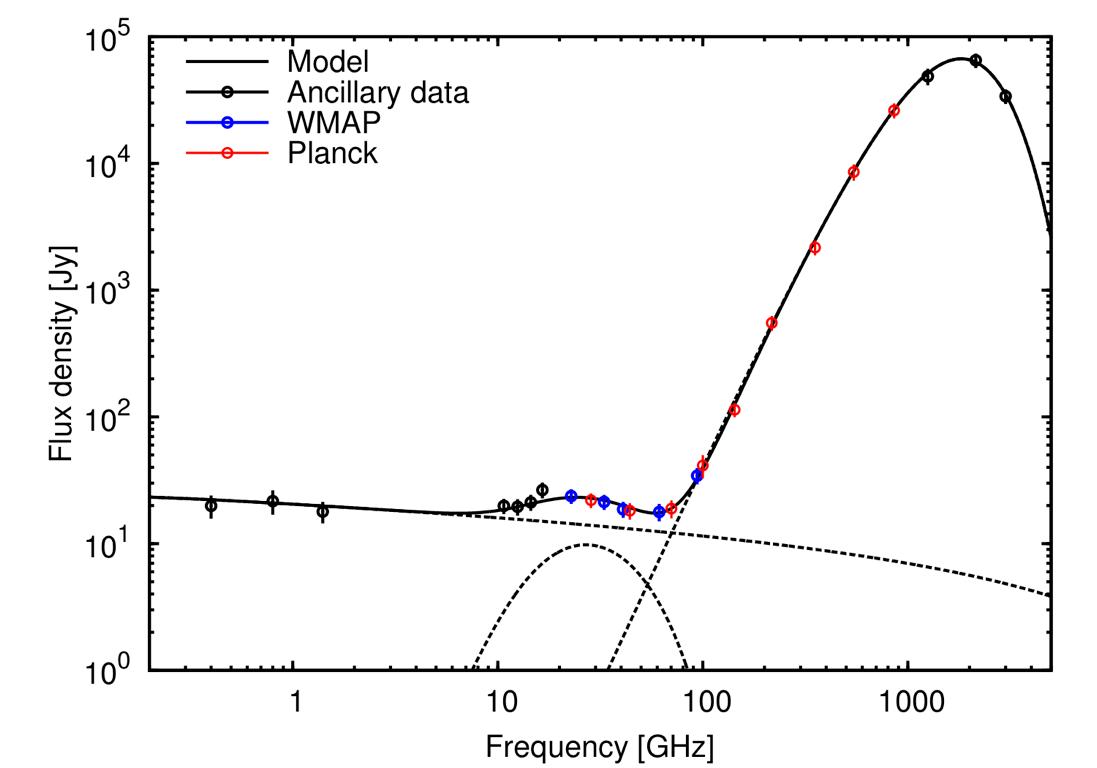
Here’s another, more recent, example. A couple of weeks ago, a clutch of early release papers from the Planck satellite came out; I blogged about them here. Among these results were some interesting new insights concerning the nature of the Anomalous Microwave Emission (AME) from the Milky Way; the subject of an excellent presentation by Clive Dickinson at the conference where the results were announced.

The title of a story in National Geographic is typical of the coverage this result received:

Fastest Spinning Dust Found; Solves Cosmic “Fog” Puzzle

Now look at the actual result. The little bump in the middle is the contribution from the anomalous emission, and the curve underneath it shows the corresponding “spinning dust” model:

There’s certainly evidence that supports this interpretation, but it’s clearly nowhere near the level of “proof”. In fact, in Clive’s talk he stated the result as follows:

Plausible physical models appear to fit the data

OK, so that would never do for a headline in a popular magazine, but I hope I’ve made my point. There’s a big difference between what this particular scientist said and what was presented through the media.

I hope you’re not thinking that I’m criticising this bit of work. Having read the papers I think it’s excellent science.

But it’s not just the fault of the educationalists and the media. Certain scientists play this dangerous game themselves. Some enjoy their 15 minutes – or, more likely, two minutes – of fame so much that they will happily give the journalists what they want regardless of the consequences. Worse still, even in the refereed scientific literature you can find examples of scientists clearly overstating the confidence that should be placed in their results. We’re all human, of course, but my point is that a proper statement of the caveats is at least as much a part of good science as theoretical calculation, clever instrument design or accurate observation and experiment.

We can complain all we like about non-scientists making ill-informed criticisms of science, but we need to do a much better job at being honest about what little we really know and resist the temptation to be too certain.


Share/Bookmark

Hard Decisions, Easy Targets

Posted in Science Politics, The Universe and Stuff with tags , , , , , , on January 25, 2011 by telescoper

Just back from a day trip to London – at the Institute of Physics to be precise – to wrap up the proceedings of this years protracted STFC Astronomy Grants Panel (AGP) business. The grant letters have already gone out, so no real decisions were made relating to the current round, but we did get the chance to look at a fairly detailed breakdown of the winners and losers. Perhaps more significantly we also discussed issues relating to the implementation of the brand new system which will be in place for 2011/12.

I’m not exactly sure at the moment how much of what we discussed is in the public domain, so I won’t write anything about the meeting here. Tomorrow there is a meeting of the RAS Astronomy Forum at which department representatives will also be briefed about these issues. I will, however, in due course, on as much information as I can through this blog in case there is anyone out there who doesn’t hear it via the Forum.

Not being able to blog about AGP business, I thought I’d comment briefly on a couple of recent things that sprang to mind on the train journey into London. Last night there was a programme in the BBC series Horizon called Science under Attack, presented by Nobel laureate Sir Paul Nurse. I didn’t watch all of it, but I was fortunate (?) enough to catch a segment featuring a chap called James Delingpole, whom I’d never heard of before, but who apparently writes for the Daily Torygraph.

My immediate reaction to his appearance on the small screen was to take an instant dislike to him. This is apparently not an uncommon response, judging by the review of the programme in today’s Guardian. I wouldn’t have bothered blogging about this at all had I wanted to indulge in an ad hominem attack on this person, but he backed up his “unfortunate manner” by saying some amazing things, such as

It’s not my job to sit down and read peer-reviewed papers, because I don’t have the time; I don’t have the expertise

Yet he feels qualified to spout off on the subject nevertheless. The subject, by the way, was climate change. I’m sure not even the most hardened climate skeptic would want Mr Delingpole on their side judging by his performance last night or, apparently, his track-record.

Anyway, this episode reminded me of another egregious example of uninformed drivel that appeared in last week’s Times Higher. This was a piece purporting to be about the limits of mathematical reasoning by another person who is quite new to me, Chris Ormell, who appears to have some academic credentials, if only in the field of philosophy.

Ormell’s piece includes a rant about cosmology which is on a par with Delingpole’s scribblings about climate change, in that he has absolutely no idea what he is talking about. Jon Butterworth and Sean Carroll have already had a go at pointing out the basic misunderstandings, so I won’t repeat the hatchet job here. If I had blogged about this at the weekend – which I might have done had my rodent visitor not intervened – I would have been considerably less polite than either of them. Ormell clearly hasn’t even read a wikipedia article on cosmology, never mind studied it to a level sufficiently deep to justify him commenting on it in a serious magazine.

I’m still amazed that such a pisspoor article could have made it through the Times Higher’s editorial procedures but more worrying still is the ract that Ormell is himself the editor of a journal, called Prospero, which is “a journal of new thinking of philosophy for education”. The last thing education needs is a journal edited by someone so sloppy that he can’t even be bothered to acquire a basic understanding of his subject matter.

What’s in common between these stories is, however, in my opinion, much more important than the inadequate scientific understanding of the personalities involved. Rubbishing the obviously idiotic, which is quite easy to do, may blind us to the fact that, behind all the errors, however badly expressed it may be, people like this may just have a point. Too often the scientific consensus is portrayed as fact when there are clearly big gaps missing in our understanding. Of course falsehoods should be corrected, but what science really needs to go forward is for bona fide scientists to be prepared to look at the technical arguments openly and responsibly and be candid about the unknowns and uncertainties. Big-name scientists should themselves be questioning the established paradigms and be actively exploring alternative hypotheses. That’s their job. Closing ranks and stamping on outsiders is what makes the public suspicious, not reasoned argument.

In both climatology and cosmology there are consensus views. Based on what knowledge I have, which is less in the former case than in the latter, both these views are reasonable inferences but not absolute truths. In neither case am I a denier, but in both cases I am a skeptic. Call me old-fashioned, but I think that’s what a scientist should be.


Share/Bookmark

Blydhen Nowydh Da!

Posted in Biographical, Education, Music, Politics, Science Politics, Sport with tags , , on January 1, 2011 by telescoper

I hope the blogosphere hasn’t got too bad a hangover this morning. I don’t, although I did have a nice lie in until about 11am when the lure of the Guardian prize crossword drew me out of bed and down to the newsagents. Luckily, I remembered to get dressed first. The crossword turned out to be quite a nice one to start the year with, by the perennial Araucaria, but it didn’t take all that long to do so I’ve got time to do a bit of shopping and a go on my exercise bike. Yes, that’s my New Year’s resolution. More shopping.

I know 2010 was a tough year for many people for many different reasons. I wouldn’t say it’s exactly been brilliant for me either, but I am looking forward to 2011 whatever it might bring. The first results from Planck will be released very soon (on 11th January, in fact), which will give me something exciting to blog about. More generally, the recent financial settlement for STFC was not as poor as many of us expected so the future doesn’t look quite as grim for UK astronomy as we feared.

There are exciting developments in store for the School of Physics & Astronomy at Cardiff University, where I work, with (hopefully) a number of new staff members joining us soon. Later on in the year we’ll be rolling out a completely redsigned set of physics courses which we’ve been working on for over a year. In addition we’ll be starting to work more closely with Swansea University in order to provide a broader range of advanced options for physics students at both institutions.

Of course behind all this there’s still considerable uncertainty about the funding situation for universities which are facing big cuts in government grants and having to increase tuition fees charged to students. Whether and to what extent this will deter students from going to university remains to be seen. The financial pressure will certainly lead to mergers and possibly to closures across the UK over the next few years, although only time will tell how many.

On the cultural side there’s a large number of concerts at St David’s Hall and a full season of Opera at WNO to look forward to, including a performance of Cosi fan Tutte on my birthday. Cardiff plays host to the First Test match between England and Sri Lanka at the end of May, and a one-day international against India in September. I might even get myself a membership of Glamorgan Cricket Club, something I’ve toyed with doing for a couple of years now. There’s also a good chance that Cardiff City F.C. might get themselves promoted to the Premiership, something that would be great for the city of Cardiff. It wouldn’t be beyond them to fall at the last fence, as they have a habit of doing..

May 2011 will also see the Welsh Assembly elections, and there will be a referendum on further law-making powers for the WAG on 3rd March.

On the wider political scene the question is whether the governing coalition’s cuts will force the economy back into recession or not. I don’t know the answer to that, but I do know that many ordinary working people are going to lose their jobs and many less advantaged members of society will have their benefits cut. Meanwhile the people who took us to the brink of economic ruin will no doubt carry on getting their bonuses.

In spite of all that, let me end by wishing you peace and prosperity for the New Year and beyond. And if that’s not possible, just remember Nil Illegitimi Carborundum.

The STFC Delivery Plan

Posted in Science Politics with tags , , , , , on December 20, 2010 by telescoper

Excuse the very quick and sketchy post on such an important topic, but I’ve got a lot of things to do before the dreaded Christmas lunch.

This morning the allocations of funding for the research councils were announced. The statement accompanying the ensuing Delivery Plan for the Science and Technology Facilities Council can be found here, while the plan itself is here. You’ll probably also want to read Paul Crowther’s analysis here.

Other research councils have also published their plans; you can find the one for EPSRC here.

The headline announcement reads:

After transferring responsibility for space science to the UK Space Agency, STFC’s overall baseline allocation for 2011-12 for resource funding (previously termed “near-cash”) is £377.5m rising to an allocation of £381.14m in 2014-15. This excludes administration which will be separately allocated. Our capital baseline allocation for 2011-12 is £91m, with an indicative allocation for the remainder of the spending review period reducing to £68m in 2014-15.

So not at all bad news for resource funding, but the implications of the capital cut are unclear (at least to me).

I haven’t had time to read the entire document, but did have a quick look at the crucial Appendix D which shows how each discipline is expected to fare:

  • Particle Physics expenditure will rise from £133M to £148M over 4 years
  • Astronomy expenditure will fall from £77M to £69M over the same period
  • Expenditure on Synchtron facilities (e.g. Diamond Light Source) will increase from £42M to £56M.

Within an approximately flat-cash settlement, therefore, Astronomy is a clear loser (although much of the cuts in expenditure relate to decisions already made, such as withdrawal from the Gemini Telescopes). Confusingly, much of the increase in Particle Physics expenditure relates to an increase in the CERN subscription, which I thought was supposed to be falling …

As far as I understand it, the plan also maintains grant funding at the current level (although it will move into the new consolidated grant system as quickly as this can be achieved).

Anyway, that’s all I’ve got time for right now, and comments/reactions/corrections/clarifications are very welcome through the box below.


Share/Bookmark

Important News from STFC

Posted in Science Politics with tags , , , on December 4, 2010 by telescoper

Donning my community service hat,  I’ll just pass on some important news from the Science and Technology Facilities Council (STFC) concerning Astronomy research grants. The message is contained in an email that has been circulated concerning the new grant system and you can also find it at Paul Crowther’s website here. I urge all astronomers to read the text in full. I believe separate instructions are going out to particle physics and nuclear physics groups concerning their grants.

The main points are that:

  • The new system of consolidated grants will be implemented for the forthcoming deadline (7th April 2011).
  • There will be no more standard grants.
  • Detailed guidance on how to apply the consolidated grants is not yet available.

A lot of questions remain to be answered, such as how on Earth people are going to be able to write a big proposal in the short time available when there are as yet no proper instructions, how groups with several existing grants will go about consolidating them when they all have different start and end dates, how the consolidated grants will be assessed, etc.

Also, it is now clear that results of the existing grant round (for grants due to start in April 2011) will not be forthcoming until January at the earliest, so that Swindon Office will be trying to sort out the new system at the same time as trying to complete the last round of the old one.

The combinations of delays to this round with the hasty implementation of a drastically different scheme for the next round is bound to cause a lot of problems both for STFC staff and researchers wanting to apply for grants, not to mention the Astronomy Grants Panel (of which I am a member).

The main purpose of this change is to save administrative costs at STFC, but it seems to me the main effect will be transfer an increased burden to universities, at least in the short term. Once again everything’s being done by the seat of the pants, with a complete lack of joined-up thinking.

Please don’t shoot the messenger, or anyone else on the AGP!


Share/Bookmark

A Gloom of Uninspired Research

Posted in Education, Poetry, Politics, Science Politics with tags , , , , , , , on November 26, 2010 by telescoper

I don’t mind admitting that I’m a bit down today. Being stuck at home with a fever and sore throat, and with mounting backlog of things to do isn’t helping my mood. On top of that I’ve got a general sense of depression about the future.

On the one hand there’s the prospect of huge increases in tuition fees for students, the motivation for many demonstrations all around the country (including an occupation here at Cardiff). I have to admit I’m firmly on the side of the students. It seems to me that what is happening is that whereas we used to finance our national gluttony by borrowing on over-valued property prices, we’ve now decided to borrow instead from the young, forcing them to pay for what we got for free instead of paying for it ourselves; it’s no wonder they’re angry. Call me old-fashioned, but I think universities should be funded out of general taxation. How many universities, and what courses, are different questions and I suspect I differ from the younger generation on the answers.

The other depressing thing relates to the other side of academic life, research. The tide of managerialism looks like sweeping away every last vestige of true originality in scientific research, in a drive for greater “efficiency”. I’ve already blogged about how the Science & Technology Facilities Council (STFC) is introducing a new system for grants which will make it impossible for individual researchers with good ideas to get money to start new research projects. Now it seems the Engineering and Physical Sciences Research Council (EPSRC) is going to go down the same road. It looks likely that in future only large-scale, low-risk research done in big consortia will be funded. Bandwagons are in; creativity is out.

Improving “efficiency” sounds like a good idea, but efficiency of what? These plans may reduce the cost of administering research grants, but they won’t do anything to increase the rate of scientific progress. Still, scientific progress can’t be entered easily on a spreadsheet so I suppose in this day and age that means it doesn’t matter.

I found the following in a story in this weeks Times Higher,

A spokeswoman for the Science and Technology Facilities Council also cited stability and flexibility as the main rationales for merging its grants programmes into one “consolidated grant”, a move announced earlier this month.

It looks like STFC has seconded someone from the  Ministry of Truth. The change to STFC’s grant system is in fact driven by two factors. One is to save money, which is what they’ve been told to do so no criticism there. The other is that the costly fiasco that is the new RCUK Shared Services Centre was so badly conceived that it has a grant system that is unable to adminster 5-year rolling grants of the type we have been used to having in astronomy. On top of that, research grants will last only 3 years (as opposed to the previous 5-year duration). There’s a typically Orwellian inversion  going on in our spokesperson’s comment: for “stability and flexibility”, read “instability and inflexibility”.

We’re not children. We all know that times are tough, but we could do with a bit less spin and a bit more honesty from the people ruining running British science. Still, I’m sure the resident spin doctors at STFC are “efficient”, and these days that’s all that matters.

The following excerpt from Wordsworth’s The Excursion pretty much sums it up.

Life’s autumn past, I stand on winter’s verge;
And daily lose what I desire to keep:
Yet rather would I instantly decline
To the traditionary sympathies
Of a most rustic ignorance, and take
A fearful apprehension from the owl
Or death-watch: and as readily rejoice,
If two auspicious magpies crossed my way;–
To this would rather bend than see and hear
The repetitions wearisome of sense,
Where soul is dead, and feeling hath no place;
Where knowledge, ill begun in cold remark
On outward things, with formal inference ends;
Or, if the mind turn inward, she recoils
At once–or, not recoiling, is perplexed–
Lost in a gloom of uninspired research;
Meanwhile, the heart within the heart, the seat
Where peace and happy consciousness should dwell,
On its own axis restlessly revolving,
Seeks, yet can nowhere find, the light of truth.


Share/Bookmark