Archive for the Science Politics Category

The Great Escape? Not yet.

Posted in Finance, Politics, Science Politics with tags , , , , , on October 20, 2010 by telescoper

I expected to wake up this morning with the blues all round my bed, about the results of the Comprehensive Spending Review about to be announced today, but news appearing in the Guardian and the BBC websites last night suggested that the UK Science budget may, repeat may, be spared the worst of the cuts.

This news has been greeted with euphoria in the science community, as we were expecting much worse than the settlement suggested by the news. The RCUK budget, it seems, will be fixed in cash terms around £3.5 billion per annum for four years, as will the approximately £1bn distributed for research through HEFCE’s QR mechanism. This translates into a real terms cut that depends on what figure you pick for inflation over this period. The Treasury suggests it will corresponding to a 10% reduction figured that way, but inflation has defied predictions and remained higher than expected over the past three years so things could be different. Also important to note is that this budget (amounting to around £4.6 billion) is to be ring-fenced within RCUK.

So why the apparent change of heart? Well, I don’t know for sure, but I think the Science is Vital campaign played a very big part in this. Huge congratulations are due to Jenny Rohn and the rest of the team for doing such a fantastic job. The Guardian makes this clear, stating that science is usually a non-issue for the Treasury, but this time it was

high on the political radar because strong representations have been made by the scientific community about what they have described as “long term and irreversible” damage to the UK economy if there are deep cuts to research funding.

That means everyone who wrote to their MP or lobbied or went on the demo really did make a difference. Give yourselves a collective pat on the back!

BUT (and it’s a very big BUT) we’re by no means out of the woods yet, at least not those of us who work in astronomy and particle physics. As the BBC article makes clear, the level cash settlement for RCUK comes with an instruction that “wealth creation” be prioritised. The budget for RCUK covers all the research councils, who will now have to make their pitch to RCUK for a share of the pie. It’s unlikely that it will be flat cash for everyone. There will be winners and losers, and there’s no prize for guessing who the likely losers are.

The performance of the STFC Executive during the last CSR should also be born in mind. STFC did very poorly then at a time when the overall funding allocation for science was relatively generous, and precipitated a financial crisis that STFC’s management still hasn’t properly come to grips with. The track-record doesn’t inspire me with confidence. Moreover, at a town meeting in London in December 2007 at which the Chief Executive of STFC presented a so-called delivery plan to deal with the crisis he led his organisation into, he confidently predicted a similarly poor settlement in the next CSR. Talk about a self-fulfilling prophecy. Let’s hope they get their act together better this time.

Taking all this together it remains by no means improbable that the STFC budget could be squeezed until the pips squeak in order to liberate funds to spend elsewhere within RCUK on things that look more likely to generate profits quickly. The nightmare scenario I mentioned a few days ago is still on the cards.

As we all know, STFC’s budget is dominated by large fixed items so its science programme is especially vulnerable. As the BBC puts it

So any cut in [STFC’s] budget will be greatly magnified and it is expected that it will have to withdraw from a major programme. Alternatively, it would have to cutback or close one of its research institutes.

We could have to wait until December to find out the STFC budget, so the anxiety is by no means over. However, the ring-fencing of RCUK’s budget within BIS may bring that forward a bit as it would appear to suggest one level of negotations could be skipped. We might learn our fate sooner than we thought.

Overall, this is a good result in the circumstances. Although it’s a sad state of affairs when a >10% real terms cut is presented as a success, it’s far less bad than many of us had expected. But I think STFC science remains in grave danger. It’s not an escape, just a stay of execution.

But there is one important lesson to be learned from this. When the STFC crisis broke three years ago, reaction amongst scientists was muted. Fearful of rocking the boat, we sat on our hands as the crisis worsened. I hope that the success of the Science is Vital campaign has convinced you that keeping quiet and not making a fuss is exactly the wrong thing to do.

If only we’d been braver three years ago.


Share/Bookmark

Astronomy Cuts Rumour Mill

Posted in Finance, Politics, Science Politics with tags , , , , on October 18, 2010 by telescoper

Following on from my recent post of the STFC budget, and the comments thereon, I thought it might be useful to make the discussion a bit more prominent as the scale of the cuts is revealed this week and people feel the consequent need to work off nervous energy.

To get things started I’ve taken the liberty of paraphrasing some of  Paul Crowther‘s comments (in italics):

\begin{paraphrase}

More or less 20% of the total STFC budget shifts across to UKSA from April 2011. This means the STFC budget will reduce from around £570m to around £455m even if the settlement is flat-cash. Grants for space science exploitation remain the responsibility of STFC even after the transfer of the other space activity to UKSA.

George Osborne has announced that ‘infrastructure’ cash from LFCF (Capital Fund) will go towards an upgrade of the Diamond light source. This is a different pot of money from individual Research Councils, but still part of the overall RCUK budget. The Drayson plan for STFC was always to separate Harwell operations (Diamond, ISIS, CLF) from the rest of STFC programmes, so support for Diamond upgrade is likely to come with operations cash too.

Putting these two items together, the STFC allocation will shrink and some of the remaining cash is going to be ring-fenced for Diamond operations. Assuming that the overall RCUK budget falls by  20%  in near-cash terms and 50% in capital on Wednesday 20th and STFC not do worse than “average” across the RCUK portfolio, the cash+capital for the rest of the non-UKSA programme at STFC would fall by 25% or so, i.e. approx £100 million pounds less to spend per annum than at present.

In practice this might mean..

…Mothballing ISIS + CLF (£35m)  AND withdrawing from ESO (£30m) AND cancelling all PP grants (£24m) AND stopping all accelerator R& D (£8m)…

… or some other equally hideous combination of items  in the spreadsheet.

\end{paraphrase}

In other words this really would be  “game over” for large parts of STFC science. Even if the cuts are at the level of 15%, which is apparently what the word on the street is saying, then there are still going to be extremely hard choices.

One nightmare possibility is that STFC not only cuts back on new research grants – as it has already done by approximately 40% over the past three years – but actually decides to claw back grants it has already issued. If this happens at the same time as the Treasury slashes HEFCE’s support for research through the QR element then many physics departments will go under very quickly, as they will no longer be even remotely viable financially.

We’re on the brink…


Share/Bookmark

Science is Vital – the Video

Posted in Finance, Politics, Science Politics with tags on October 18, 2010 by telescoper

A comment on my earlier post about the Science is Vital rally on 9th October included this video of the occasion. Actually it’s more a series of stills than a proper video, but if you look very closely around 39 seconds in you’ll see me lurking among the ill-disciplined rabble well-behaved demonstrators seeking to overthrow the state argue the case for science and bring about the collapse of global capitalism and try to dissuade the Treasury from huge cuts to the budget for research.


Share/Bookmark

Thatcher’s Final Victory?

Posted in History, Politics, Science Politics with tags , , , on October 16, 2010 by telescoper

Next Wednesday (20th October) we will hear the outcome of the Comprehensive Spending Review, and what it means for the scale of the cuts to UK public spending in each of the government departments. After that the detailed breakdown of cuts within each Ministry will gradually be revealed. Some news has already leaked out, of course. The Browne Report published last week almost certainly heralds huge cuts in the state subsidy to the UK University sector, with the cost of Higher Education consequently shifting from the taxpayer to the student. On top of that, and despite the best efforts of the Science is Vital campaign, it seems highly likely that there will be a steep decrease in investment in scientific research – both through the Research Councils and through the research component of Higher Education funding. On the other hand, the defence budget appears to have been spared the worst of the hatchet, with the Trident nuclear submarine programme set to go ahead (with a price tag around £25 billion) and two new aircraft carriers to be built at a cost of £5.5 billion (although it is not clear there will actually be any aircraft to operate from them).

Obviously, knowledge and learning are less important to the future of this country than the ability to fight pointless wars against invented enemies. Morover, we already spend more than most competitor economies on defence as a fraction of GDP, and less on  universities and science. How did we end up with such distorted priorities?

On top of these cuts we have to contend with a draconian cap on immigration. New restrictions on visas for non-EU citizens will make it much harder for British universities to recruit overseas students and staff. The new rules give exemptions only to those coming to the UK to take up highly paid jobs, such as professional footballers. Postdoctoral researchers and university lecturers don’t get paid enough to register as economically relevant, so many fewer will be able to enter this country. While these restrictions may satisfy xenophobic Daily Mail readers, they promise to damage the University sector almost as much as the funding cuts, as a significant fraction of the best staff in UK science departments are from outside the EU (including the two winners of the 2010 Nobel Prize for Physics).

All this sounds depressingly familiar to those of us who lived through the various Thatcher governments and their successors. In fact, looking at the following graph (which I nicked from Andy Lawrence’s blog, but which comes from a document produced by the Royal Society) you’ll see the steady reduction in science investment under previous Conservative governments

I know I’m not alone in interpreting these cuts as not being about the need to secure the country’s finances. The UK’s public debt as a fraction of GDP is rising, of course, and something needs to be done about it. But this graph shows the actual situation:


Serious? Yes, but not sufficient to justify the carnage we’re about to experience.

What is going on is that the parlous state of the UK’s finances is being used as a pretext to resume the Thatcherite attack on the welfare state through a campaign of privatisations and closures so that wealthy Tory voters can get richer at the expense of ordinary working people.

No doubt there will be people reading this who really think that cutting back state expenditure is a good thing, and even I agree with that to some extent. However, there is a part of Thatcher’s legacy that is actually the root of the problem and it represents a fundamental inconsistency of the Thatcher project. Unless it is tackled, the cut-and-burn route will not lead to a sustainable economy, but will take this country into inexorable decline.

The nub of the matter is the Invasion of the Bean Counters into every aspect of public life. The breakdown of trust between government and the public sector that ushered in Margaret Thatcher’s victory in the 1979 General Election has led to a huge increase in red tape involved in the assessment, regulation and general suffocation of public services. As the Thatcher project continued through John Major’s, and, yes, Tony Blair and Gordon Brown’s governments (Blair was undoubtedly a Thatcherite) any rises in public spending went not into providing better services but in a vast and unwieldly machinery of regulation. Now it matters less whether the public sector does things well. What matters is that they tick the boxes imposed by civil service mandarins. This mentality has led to a proliferation of overpaid administrators in the National Health Service, schools are hamstrung by the rigid constraints of the National Curriculum, the Police spend more time filling in forms than they do investigating crime, and the number of staff employed in university administration has increased at the expense of teaching and learning.

You might say that this is all the fault of New Labour, but I don’t think that’s right; the suffocation of the UK’s public sector began with Thatcher and it began as a direct result of the Winter of Discontent (a re-run of which seems eminently possible). The reason why a succession of right-wing governments have failed to get a grip on public spending is that they’ve all been run by control freaks and have pumped money into wasteful self-serving bureaucracies.

Britain has turned into a version of Golgafrincham, with the “useless third” now in the position of wielding the axe over those few remaining things in the UK which are actually pretty good.

Apparently, Margaret Thatcher is not in very good health and may not live much longer. I won’t mourn her passing. In Thatcher’s time in office, this country took giant steps towards becoming a police state. She encouraged xenophobia and intolerance, and spawned the generation of small-minded money-grabbing lizards who now occupy the Government benches. As Britain turns into a wilderness of cashable things once more, it looks like she might be set for her final victory.


Share/Bookmark


Has your MP signed EDM 767?

Posted in Politics, Science Politics with tags , on October 15, 2010 by telescoper

One of the interesting curiosities of the British parliamentary system is the Early Day Motion (EDM), which is a brief motion to be debated at an unspecified date in the future. Few of them ever get debated and they remain open for signature throughout a parliamentary session.

Early Day Motion 767 relates to the Science is Vital Campaign. It was tabled on 16th September 2010 and the text is as follows:

That this House notes the UK’s proud history of excellence in science and engineering, whereby it produces over 10 per cent. of global scientific output with just one per cent. of global population; believes that continued investment in research is vital in order to meet the technological and social challenges of the 21st century, and to continue to attract high-tech industries to invest in the UK; further believes that large cuts to science funding are a false economy, due to evidence that research investment fuels economic growth; further notes the increased investment in science by the UK’s international competitors, such as the USA, France and Germany; further believes that investment in research and development is vital to help rebalancethe economy towards hi-tech manufacturing and away from over-reliance on financial services; recognises the work of the Science is Vital coalition and the Campaign for Science and Engineering in arguing that the UK should seek to retain its role as a world leader in these fields; and calls on the Government to safeguard the UK’s scientific excellence by providing a research investment strategy which builds on the success of UK science and engineering.

(The rules require that at EDM be a single sentence, but often, as in this case, the sentences are somewhat lengthy.)

It was tabled by Julian Hippert, and has so far attracted 81 signatures, which is good going for such things.  The following MPs have signed EDM 767.

Is yours among them?

If not, I think you know what to do….

Huppert, Julian
Onwurah, Chi
Morris, David
Bottomley, Peter
Wright, Simon
Mulholland, Greg
Sanders, Adrian
Smith, Robert
Hughes, Simon
Jackson, Glenda
Jamieson, Cathy
Kaufman, Gerald
Kennedy, Charles
Lucas, Caroline
Cunningham, Jim
Cunningham, Tony
Dobbin, Jim
Doherty, Pat
Field, Frank
Foster, Don
Gapes, Mike
George, Andrew
Abbott, Diane
Hamilton, Fabian
Twigg, Stephen
Anderson, David
Hodgson, Sharon
Burt, Lorely
Johnson, Diana R
Leech, John
Soulsby, Peter
McGovern, Jim
Morden, Jessica
Williams, Stephen
Gilmore, Sheila
Hames, Duncan
Alexander, Heidi
Berger, Luciana
Henderson, Gordon
Hunt, Tristram
Lloyd, Stephen
McKinnell, Catherine
Mearns, Ian
Metcalfe, Stephen
Fovargue, Yvonne
Morrice, Graeme
Mowat, David
Murray, Ian
Reid, Alan
Hopkins, Kelvin
Osborne, Sandra
Brennan, Kevin
Campbell, Menzies
Caton, Martin
Clarke, Tom
Connarty, Michael
Donaldson, Jeffrey
Francis, Hywel
Hancock, Mike
Beith, Alan
Watson, Tom
Williams, Roger
Slaughter, Andy
Green, Kate
Creasy, Stella
Swales, Ian
Lazarowicz, Mark
McCrea, Dr William
Campbell, Ronnie
Corbyn, Jeremy
Ellman, Louise
Flynn, Paul
Vaz, Keith
Williams, Hywel
Banks, Gordon
Horwood, Martin
Sharma, Virendra
Chapman, Jenny
Blenkinsop, Tom
Dromey, Jack
Morris, Grahame M

UPDATE: The following 11 have signed since yesterday:

Meale, Alan
Brake, Tom
Brooke, Annette
Brown, Russell
Dowd, Jim
Main, Anne
O’Donnell, Fiona
Blomfield, Paul
Sarwar, Anas
Vaz, Valerie
Dakin, Nic


Share/Bookmark

STFC Budget 2010-11

Posted in Finance, Science Politics with tags , , on October 14, 2010 by telescoper

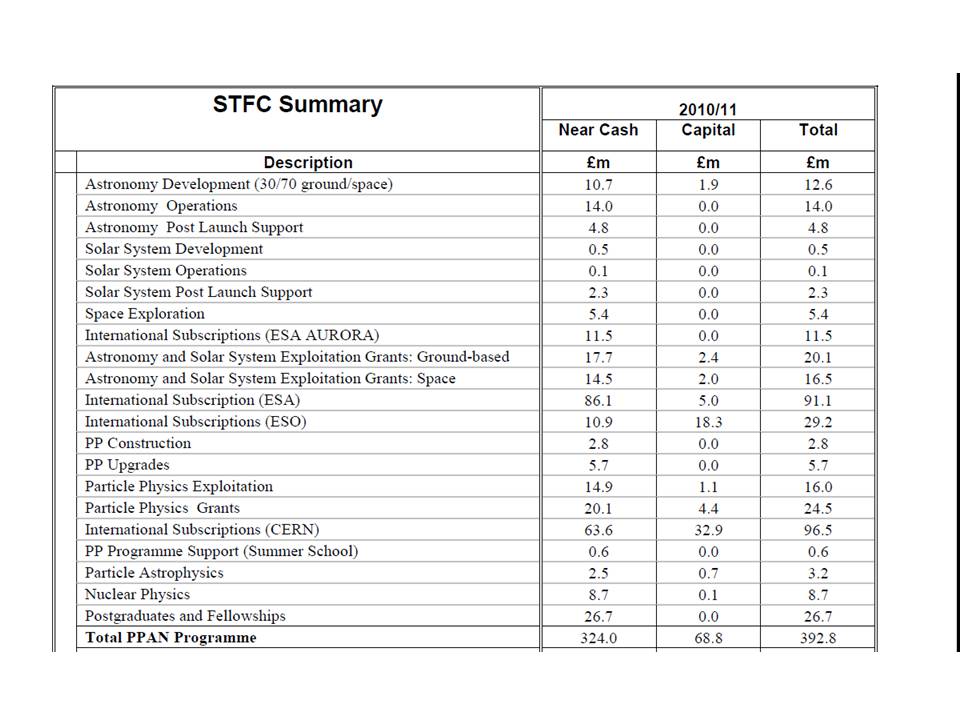
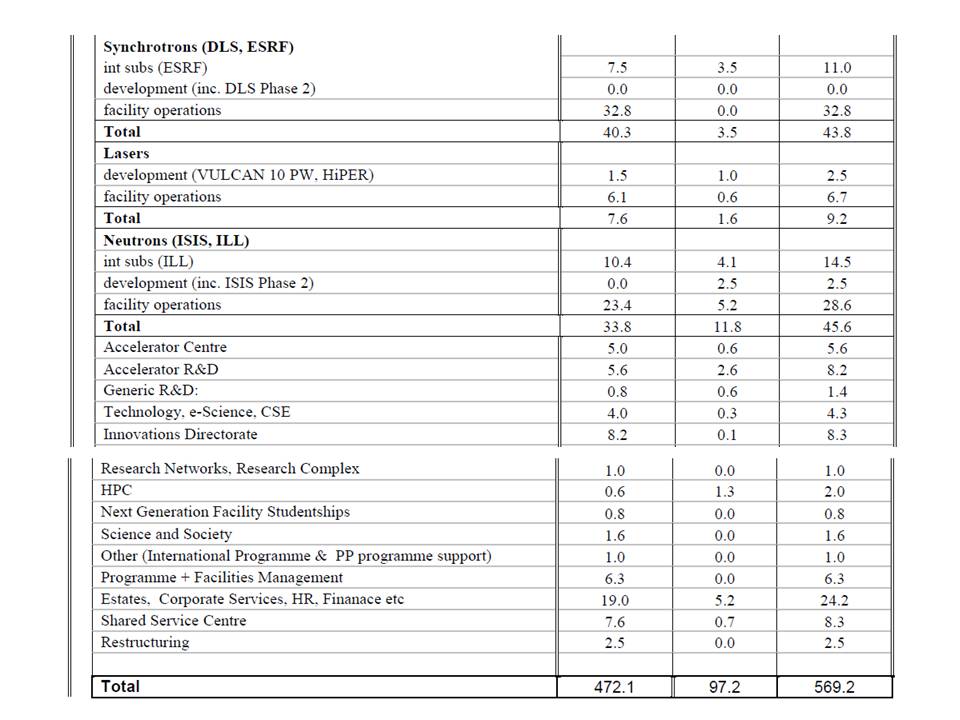
Just a quick post to point out that the Science and Technology Facilities Council have released a reasonably complete breakdown of their current budget. I’m sure many readers working in astronomy and particle physics will find it interesting reading, though others will probably find it incredibly boring.

Here it is, for easy reference, in bits, generated by a clumsy cut-and-paste-technique wholly unbefitting the hi-tech nature of STFC, starting with the PPAN Programme:

and now the rest

For those of you not up with the accounting lingo, “near cash” means assets investments and other things that could in principle be exchanged for cash in a relatively short period of time.

These are, of course, the figures before the impending cuts take place….

There’s a much more legible version of the whole thing here.


Share/Bookmark

Science (still) is Vital

Posted in Politics, Science Politics with tags , , on October 9, 2010 by telescoper

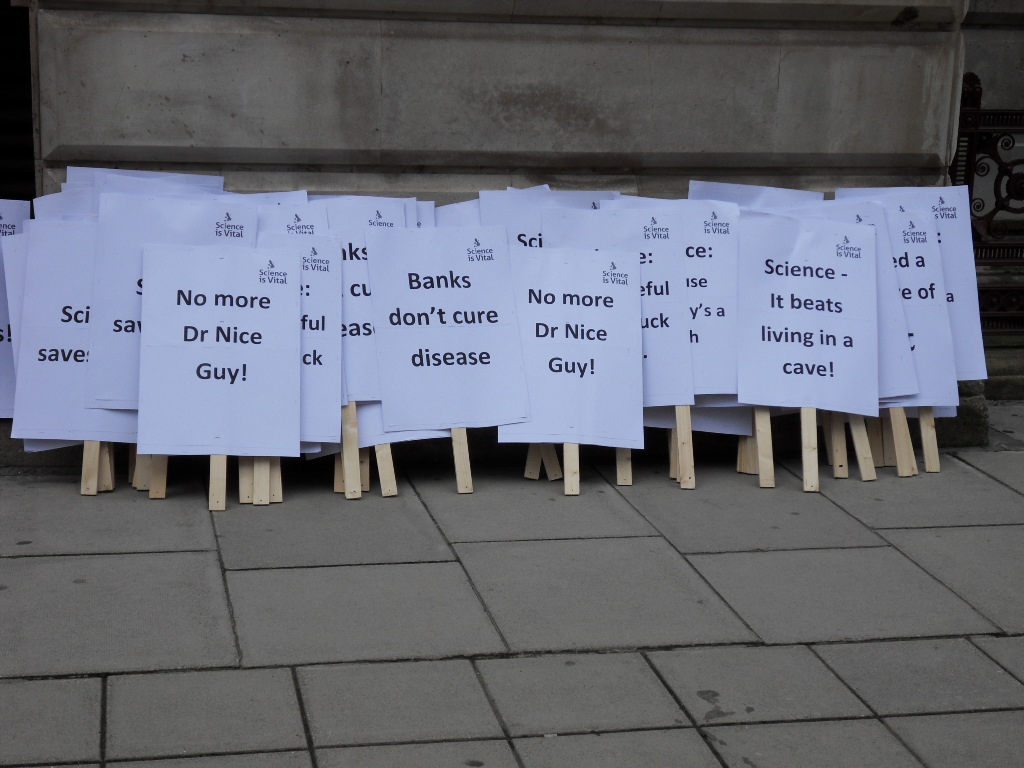
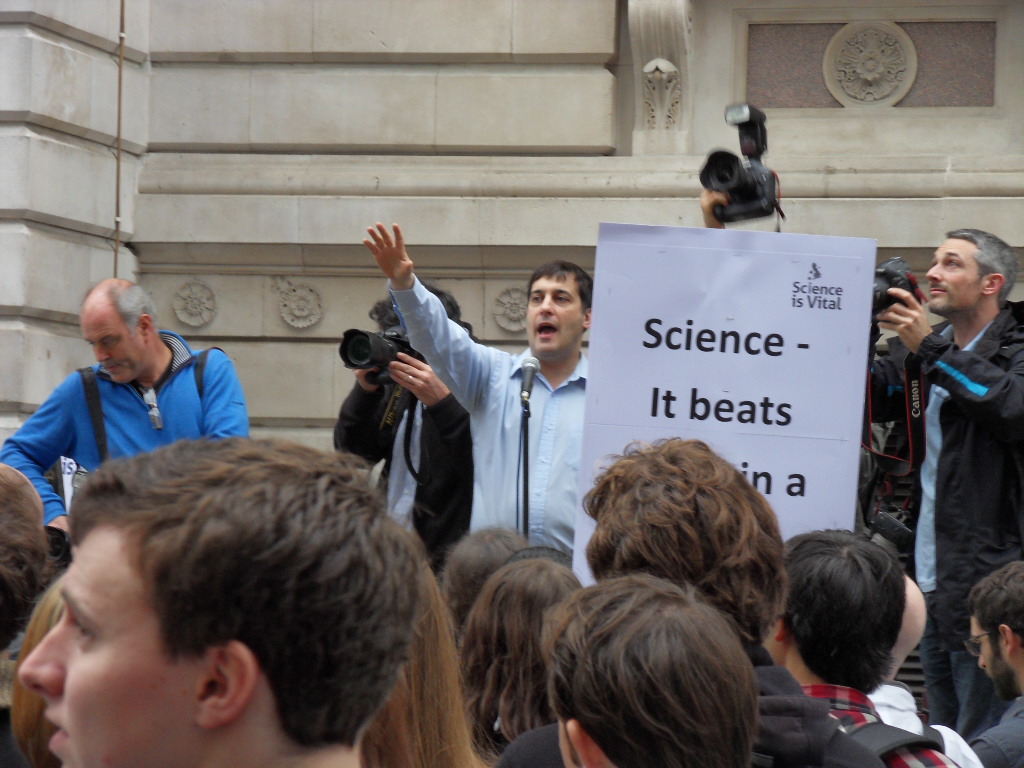
Just back from the Science is Vital rally in Whitehall, which was attended by an estimated 2000 people. I’m actually pretty tired after a late night in town following yesterday’s Royal Astronomical Society meeting and dinner at the Athenaeum after that, not to mention later events…

Anyway, I’m going to catch up with some quality Columbo time so I’ll just post a few snaps to prove I was there!

Just before the rally

A fellow astronomer, whose name I didn’t catch!

Rather unfortunate pose by Dr Evan Harris; he’s not a Nazi, honest!

Ben Goldacre, complete with anorak…

And here’s me in mid-tweet on the left of the picture, in front of the Treasury building and facing the Foreign & Commonwealth Office (to the right).

Picture taken by Paul Crowther


Many congratulations to those who organized the rally at such short notice, especially Jenny Rohn. The only thing I’d say here is that, although this was a truly inspiring and enjoyable occasion, if the campaign is going to make any lasting difference this must be the start not the finish…


Share/Bookmark

Number Crunching

Posted in Finance, Politics, Science Politics with tags , , on October 6, 2010 by telescoper

Only time for a (very) brief post this evening, as I’ve been in London all day and got back much later than expected.

In this morning’s Guardian there was a story about how the UK’s banks intend to pay out a whopping £7bn in bonuses this year. Banks. Remember them? They’re the organisations whose behaviour almost brought this country’s economy to its knees a few years ago and needed to be baled out by the taxpayer, at enormous cost to the public purse.

Meanwhile, the Science is Vital campaign is gearing up for Saturday’s rally. An article over on cosmic variance has raised the profile of this increasingly vocal campaign to stave off cuts which threaten to destroy Britain’s position as a leading scientific nation. The petition has now been signed by over 17,000 people (including the winners of this year’s Nobel Prize for Physics, announced yesterday).

It’s worth emphasizing the numbers behind this story too.  The annual UK science budget, before the next round of cuts, stands at £3.2billion. That’s everything – particle physics, astronomy, chemistry, biosciences, and countless other things.

I need hardly point out the irony. The amount we’re waging an increasingly desperate fight to protect is less than half the amount to be spent on yachts and fancy cars by the people who got us into this mess in the first place. Some of us hoped the financial sector would show some contrition after the disaster of 2007. Fat chance!  Their rescue by the taxpayer has probably just convinced them that however they behave they can always rely on Joe Public to get them out of trouble. It seems they’ve reverted to type.

So let’s have no more of the specious arguments about having to cut science in order to avoid having to cut, say, the National Health Service. Science isn’t as expensive as some people would have us believe, and it’s not a luxury either. It’s vital to our economic and cultural well-being. Each pound spend on science is worth a lot more to this country than  two disappearing into a banker’s offshore tax haven.

In any case the government should just tax the greedy bankers’ bonus payments and use the money to increase the science budget. Better still, put pressure on the banks to themselves invest in science, alongside other areas of innovation, which we know will generate healthy profits for those brave enough to take a calculated risk, rather than going back to the old game of playing around with dodgy property-based financial speculations, which have a good chance of taking us down the plughole for good.

(Guest Post) STFC – It isn’t just about money

Posted in Science Politics with tags , , , , , , on October 4, 2010 by telescoper

The following piece was written by Professor George Efstathiou, FRS, who is Professor of Astrophysics at the University of Cambridge and Director of the Kavli Institute for Cosmology. The views expressed therein are George’s own, but I’m not saying that out of a desire to distance myself from his opinions. As a matter of fact, I was one of the people who signed the petition he describes in the article…

–o–

As Peter has reported on this site, physicists around the country are anxiously awaiting the results of the forthcoming Comprehensive Spending Review. Scientists whose research is supported by the Science and Technology Facilities Council (STFC)  are particularly anxious.  Since its creation, STFC has gone through two difficult scientific prioritisation exercises. Many excellent projects have been cancelled and grants supporting University groups have been cut savagely, by about 35%. STFC science has already descended into the Royal Society’s ‘game over‘ scenario. All of this has happened before the consequences of the economic crisis have hit the science budget. STFC has left itself uniquely poorly placed amongst the Research Councils to absorb further reductions following the CSR.

It is for this reason, that I and a few others organised a petition expressing a loss of confidence in the Chief Executive of STFC. The petition was signed by 916 researchers, including 162 Professors and 18 Fellows of the Royal Society. It was formally submitted to the STFC Chair (Michael Sterling) on 1st July together with an explicit request that STFC Council should review its role in this loss of confidence.

People will have had many different reasons for signing the petition. I made my views public well in advance (see my Letter to Lord Drayson). In all of my letters to ministers and others concerning the STFC ‘crisis’, I have never asked for more money. More money would help, of course, but this is utterly unrealistic in the current economic circumstances. No, over the last three years I have been lobbying for good governance. The strutural difficulties with STFC were easy to identify and I believe that with good governance the STFC programme could have been managed without such a catastrophic loss of science. Over three years, STFC have failed to establish a compelling narrative, strategy and constructive engagement with its science community. When one bears in mind that about 40 % of Physics staff work in areas for which STFC is the primary funding source, the consequences of the STFC crisis for University Departments, and the rest of the science base, are indeed serious.

So, whatever the outcome of the CSR, there are governance issues that we should be concerned about. There are three that I would like to raise here:

1. Fellowships and grants. Senior scientists from outside the UK point to the Fellowships and Rolling Grants as two of the most effective features of the UK funding system. Both are now under threat. I was responsible for making the case for the current 5 year system to PPARC Council. In addition to the evident benefits of continuity and reduction in peer review, Council need to understand that recruitment for postdocs involves a substantial lead time. If we are to compete for the best postdocs around the world (and not lose our best post docs), grant funds must be committed four years in advance. The 5 year rolling grant system, even with tapers, allows groups to advertise posts on an international timetable and to vire funds to maximise science output. Any move to responsive mode 3 year grants is guaranteed to deliver less science for a fixed amount of money. I would vigorously defend the Fellowships. Fellowships encourage scientific independence and provide a valuable “bottom-up” correction to the increasingly narrow “top-driven” science programme of STFC. Attacks on Fellowships and Rolling Grants will inevitably lead to a more introspective and less internationally competitive science programme.

2. The Composition of STFC Council. STFC Council, with a minority of leading research scientists, differs from other Research Councils. I have had several vigorous discussions with Michael Sterling concerning this issue and, in particular, the recent decision by BIS to appoint three new non-academic members to STFC. This led me to write a long letter to Adrian Smith (Director General of the Research Councils) reproduced here. Professor Smith replied that he approved of the present balance of Council and thought that it was compatible with the recommendations of previous reviews. I will leave readers to decide whether they agree. This is not a minor point. My experience on PPARC Council was that `lay members’ can often provide interesting perspectives on problems, but if they lack understanding of the science (sometimes alarmingly so) they will tend to accept the recommendations of the Executive. STFC needs a scientifically strong Council. Competent management is not enough. It is easy to keep within budget – you can be tough about cutting things. It is much harder to maximise the amount of science that you can do on a fixed budget. For that you need a scientific strategy and scientific judgement.

3. The New CEO. The search has begun for a new Chief Executive. There is one school of thought that a suitable candidate may be found from the corporate sector. Someone who may not understand the science, but would be a capable manager and communicator. I think that this would be a disaster. In my view, it is essential that a new CEO have an understanding of the science programme at STFC and should be prepared to act as an enthusiastic advocate for STFC science. We need a CEO who can engage constructively with the academic community and, when times are tough, articulate a strategy to limit the loss of science rather than gloat at our misfortune.

It would be great to have more money for STFC science. But money isn’t everything – we need to pay attention to governance issues as well. If we had been braver back in 2008 and openly challenged the Executive, we might not be in such a weak position now. We should not be so reticent in the future.


Share/Bookmark

“Game Over” for Science? Not yet, I hope..

Posted in Politics, Science Politics with tags , on September 28, 2010 by telescoper

Just a quick update on the Science is Vital campaign against proposed cuts in the UK research budget that I blogged about (briefly) last week. The impact of these cuts could be devastating, not just for scientists and their own careers but also for the economical (and, yes, cultural) health of this country. I saw an apt comment on Twitter yesterday to the effect that cutting the science budget to save money was like trying to lose weight by blowing your own brains out.

The petition has now attracted well over 5000 signatures, and I’m sure it will get still larger in the next few days. The march, planned for Saturday 9th October in London is going ahead. I’m hoping to take part, as there is an interesting meeting at the Royal Astronomical Society the day before, which will give me an excuse to stay over so I can attend this event. Perhaps I’ll even meet in real life some people I know only through the blogosphere!

However, at least one blogger has suggested that the campaign might already be too late. An article in the Financial Times (probably hidden by a paywall for most of you) suggested that a decision has been taken to cut research by £960 million per year, close to the 20% level that the Royal Society regards as meaning “game over” for British science.

It is thought that the Comprehensive Spending Review may announce its allocation to BIS (the Department for Business, Innovation and Skills) as early as next week (i.e. before the planned demonstration), but that doesn’t mean that it is too late. Only after the BIS budget is announced will it decide how much of the cut will be handed down to RCUK, the body that controls the Research Councils. However, RCUK’s budget is only a relatively small fraction of the BIS cake – £2.8 billion out of approximately £22 billion. Maintaining pressure may just convince BIS to go easy on research, so there’s still a lot to play for.

If that doesn’t work, and the research councils do receive a cut of 20% (or even more) then it won’t be at all pretty. It will then be left to individual councils to argue their case within RCUK, a situation likely to generate ever-decreasing circles of desperation as different disciplines are forced to battle it out for the scraps. Allocations to individual councils probably aren’t going to be known until December. Then, in STFC (for example), the particle physicists and astronomers may be put in a situation where they have to go head-to-head against each other, at which point there are unlikely to be any real winners.

I have to admit that three years’ experience of the STFC crisis haven’t left me feeling terribly confident about the next few months. However, unless we make some sort of a stand now, things will get unimagineably worse. The only way the go forward is to show some solidarity, and resist the forces that that would have us turn on each other.

These next few weeks could be crucial to the survival of British science. So stand up and be counted. Action is the antidote to despair.


Share/Bookmark