Archive for the Science Politics Category

Science and Innovation after Brexit

Posted in Politics, Science Politics with tags , , on September 7, 2017 by telescoper

I’ve been busy most of today so I only have a little time for a short post pointing out that the long-awaited `position paper’ about collaboration on science and innovation between the UK and EU after Brexit has now been published. Those of you intending to remain in the United Kingdom if and when it leaves the European Union might be interested in reading it. I say `might be’ rather than `will be’ as it doesn’t really say anything concrete about anything.

Here’s the overall summary:

In preparing to leave the EU, one of the UK’s core objectives is to “seek agreement to continue to collaborate with European partners on major science, research, and technology initiatives”. It is the UK’s ambition to build on its unique relationship with the EU to ensure that together we remain at the forefront of collective endeavours to improve the world in which we live. The UK believes this is in the joint interest of the UK and EU, and would welcome discussion on how best to shape our future partnership in this area.

The answer to the last bit is, of course, easy. The best way to shape our future partnership in this area is unquestionably for the United Kingdom to remain in the European Union. This document says as much itself. As with most of these papers it consists primarily of a long list of the benefits in this area that the United Kingdom has enjoyed as a direct result of our membership of the European together with a desire to keep most of them after our departure. It offers no real ideas as to how to square the many circles that would involve. In particular, many EU schemes, including those funded by the European Research Council, depend on the freedom of movement the European Union guarantees. Given the leaked Home Office document outlining how it intends to deter EU citizens from coming here I don’t see how we can possibly remain an attractive destination for scientists, or anyone else for that matter.

Meanwhile, today, Parliament is debating the European Union Withdrawal Bill which, if passed, would give the Government sweeping powers – the so-called `Henry VIII’ powers – to bypass Parliament and directly repeal or amend any law it doesn’t like the look of without debate. This is exactly the right-wing power grab that many of who voted Remain feared would happen. If this Bill passes without significant amendment then we can say goodbye to our parliamentary democracy. The parallel with the Enabling Act of 1933 that gave absolute power to Adolf Hitler is frightening.

Doubt expressed over accuracy of measurement of the ‘Beard-Second’

Posted in Beards, Science Politics with tags , , , on September 4, 2017 by telescoper

As a practising scientist I too am concerned about the reliability of the definition of the `Beard Second’. In addition to the intrinsic variability from one individual to another (including genetic influences) many external environmental factors affect beard growth, so any definition must include conditions such as temperature, pressure, sunlight levels and whether or not the beard is supplied with nutrients. In any case the term `average’ usually applies to the arithmetic mean, whereas the quoted text seems to imply the median.

My advice to the Beard Liberation Front is to refer this matter to the National Measurement and Regulation Office for review but along with most government offices nowadays it only seems interested in issues that directly affect the ability of businesses to profit rather than safeguarding the accuracy and reproducibility of scientific matters of direct interest to the public, such as the rate of beard growth.

In the longer term, however, I believe the only way to establish a reliable standard for the `beard second’ is through an extensive research programme. A detailed proposal is in preparation to UK Research and Innovation, as it seems an appropriate topic for an interdisciplinary award.

kmflett's avatarKmflett's Blog

Beard Liberation Front

press release 3rd September contact Keith Flett 07803 167266

Doubt expressed over accuracy of measurement of the ‘Beard-Second’

The Beard Liberation Front, the informal network of beard wearers, has expressed doubt over the accuracy of the unit of measurement known as the ‘Beard-Second’.

The ‘Beard-Second’ is designed to measure how quickly in time a beard grows.

According to Wiki:

The beard-second is a unit of length inspired by the light-year, but applicable to extremely short distances such as those in integrated circuits. The beard-second is defined as the length an average beard grows in one second. Kemp Bennett Kolb defines the distance as exactly 100 angstroms (10 nanometers). as does Nordling and Österman’s Physics Handbook. However, Google Calculator supports the beard-second for unit conversions using the value 5 nm.

The beard-second establishes a related unit of time, the beard-inch which is 29.4 days (or 58.8 days…

View original post 111 more words

The Anomaly of Research England

Posted in Politics, Science Politics with tags , , , , on August 16, 2017 by telescoper

The other day I was surprised to see this tweet announcing the impending formation of a new council under the umbrella of the new organisation UK Research & Innovation (UKRI):

These changes are consequences of the Higher Education and Research Act (2017) which was passed at the end of the last Parliament before the Prime Minister decided to reduce the Government’s majority by calling a General Election.

It seems to me that it’s very strange indeed to have a new council called Research England sitting inside an organisation that purports to be a UK-wide outfit without having a corresponding Research Wales, Research Scotland and Research Northern Ireland. The seven existing research councils which will henceforth sit alongside Research England within UKRI are all UK-wide.

This anomaly stems from the fact that Higher Education policy is ostensibly a devolved matter, meaning that England, Wales, Scotland and Northern Ireland each have separate bodies to oversee their universities. Included in the functions of these bodies is the so-called QR funding which is allocated on the basis of the Research Excellence Framework. This used to be administered by the Higher Education Funding Council for England (HEFCE), but each devolved council distributed its own funds in its own way. The new Higher Education and Research Act however abolishes HEFCE and replaces some of its functions into an organisation called the Office for Students, but not those connected with research. Hence the creation of the new `Research England’. This will not only distribute QR funding among English universities but also administer a number of interdisciplinary research programmes.

The dual support system of government funding consists of block grants of QR funding allocated as above alongside targeted at specific projects by the Research Councils (such as the Science and Technology Facilities Council, which is responsible for astronomy, particle physics and nuclear physics research). There is nervousness in England that the new structure will put both elements of the dual support system inside the same organisation, but my greatest concern is that by exlcuding Wales, Scotland and Northern Ireland, English universities will be given an unfair advantage when it comes to interdisciplinary research. Surely there should be representation within UKRI for Wales, Scotland and Northern Ireland too?

Incidentally, the Science and Technology Facilities Council (STFC) has started the process of recruiting a new Executive Chair. If you’re interested in this position you can find the advertisement here. Ominously, the only thing mentioned under `Skills Required’ is `Change Management’.

LIGO and Open Science

Posted in Open Access, Science Politics, The Universe and Stuff with tags , , , , on August 8, 2017 by telescoper

I’ve just come from another meeting here at the Niels Bohr Institute between some members of the LIGO Scientific Collaboration and the authors of the `Danish Paper‘. As with the other one I attended last week it was both interesting and informative. I’m not going to divulge any of the details of the discussion, but I anticipate further developments that will put some of them into the public domain fairly soon and will comment on them as and when that happens.

I think an important aspect of the way science works is that when a given individual or group publishes a result, it should be possible for others to reproduce it (or not as the case may be). In normal-sized laboratory physics it suffices to explain the experimental set-up in the published paper in sufficient detail for another individual or group to build an equivalent replica experiment if they want to check the results. In `Big Science’, e.g. with LIGO or the Large Hadron Collider, it is not practically possible for other groups to build their own copy, so the best that can be done is to release the data coming from the experiment. A basic problem with reproducibility obviously arises when this does not happen.

In astrophysics and cosmology, results in scientific papers are often based on very complicated analyses of large data sets. This is also the case for gravitational wave experiments. Fortunately in astrophysics these days researchers are generally pretty good at sharing their data, but there are a few exceptions in that field. Particle physicists, by contrast, generally treat all their data as proprietary.

Even allowing open access to data doesn’t always solve the reproducibility problem. Often extensive numerical codes are needed to process the measurements and extract meaningful output. Without access to these pipeline codes it is impossible for a third party to check the path from input to output without writing their own version, assuming that there is sufficient information to do that in the first place. That researchers should publish their software as well as their results is quite a controversial suggestion, but I think it’s the best practice for science. In any case there are often intermediate stages between `raw’ data and scientific results, as well as ancillary data products of various kinds. I think these should all be made public. Doing that could well entail a great deal of effort, but I think in the long run that it is worth it.

I’m not saying that scientific collaborations should not have a proprietary period, just that this period should end when a result is announced, and that any such announcement should be accompanied by a release of the data products and software needed to subject the analysis to independent verification.

Now, if you are interested in trying to reproduce the analysis of data from the first detection of gravitational waves by LIGO, you can go here, where you can not only download the data but also find a helpful tutorial on how to analyse it.

This seems at first sight to be fully in the spirit of open science, but if you visit that page you will find this disclaimer:


In other words, one can’t check the LIGO data analysis because not all the data and tools necessary to do that are not publicly available.  I know for a fact that this is the case because of the meetings going on here at NBI!

Given that the detection of gravitational waves is one of the most important breakthroughs ever made in physics, I think this is a matter of considerable regret. I also find it difficult to understand the reasoning that led the LIGO consortium to think it was a good plan only to go part of the way towards open science, by releasing only part of the information needed to reproduce the processing of the LIGO signals and their subsequent statistical analysis. There may be good reasons that I know nothing about, but at the moment it seems to me to me to represent a wasted opportunity.

I know I’m an extremist when it comes to open science, and there are probably many who disagree with me, so I thought I’d do a mini-poll on this issue:

Any other comments welcome through the box below!

The STFC ‘Breadth of Programme’ Exercise

Posted in Science Politics with tags , , , , , on April 26, 2017 by telescoper

I suddenly realized this morning that I there was a bit of community service I meant to do when I got back from vacations, namely to pass on to astronomers and particle physicists a link to the results of the latest Programmatic Review (actually ‘Breadth of Programme’ Exercise) produced by the Science and Technology Facilities Council.

It’s a lengthy document, running to 89 pages, but it’s a must-read if you’re in the UK and work in area of science under the remit of STFC. There was considerable uncertainty about the science funding situation anyway because of BrExit, and that has increased dramatically because of the impending General Election which will probably kick quite a few things into the long grass, quite possibly delaying the planned reorganization of the research councils. Nevertheless, this document is well worth reading as it will almost certainly inform key decisions that will have to be made whatever happens in the broader landscape. With `flat cash’ being the most optimistic scenario, increasing inflation means that some savings will have to be found so belts will inevitable have to be tightened. Moreover, there are strong strategic arguments that some areas should grow, rather than remain static, which means that others will have to shrink to compensate.

There are 29 detailed recommendations and I can’t discuss them all here, but here are a couple of tasters:

The E-ELT is the European Extremely Large Telescope, in case you didn’t know.

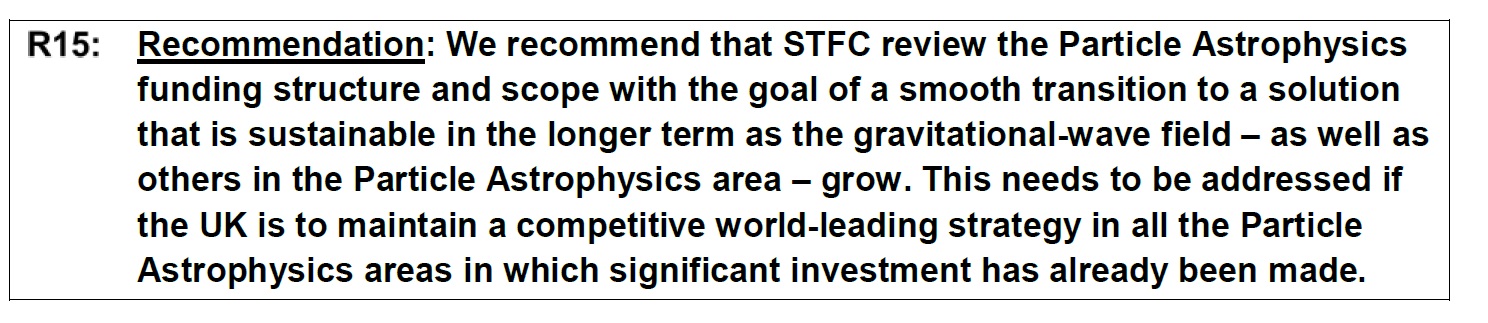
Another one that caught my eye is this:

I’ve never really understood why gravitational-wave research came under ‘Particle Astrophysics’ anyway, but given their recent discovery by Advanced LIGO there is a clear case for further investment in future developments, especially because the UK community is currently rather small.

Anyway, do read the document and, should you be minded to do so, please feel free to comment on it below through the comments box.


March for Science – Cardiff

Posted in Politics, Science Politics with tags , , , on April 21, 2017 by telescoper

MFS
Just a quick note to say that tomorrow I’ll be attending the Cardiff March for Science, which is one of a series of events happening around the world. I quote:

The March for Science is a celebration of science.  It’s not only about scientists and politicians; it is about the very real role that science plays in each of our lives and the need to respect and encourage research that gives us insight into the world.

The Cardiff March starts with a rally at 10am on the steps of the Senedd in Cardiff Bay and is followed by a march around the bay to Techniquest for a science event there to which families with children are particularly welcome. It should be a fun occasion  There’s a science-themed fancy dress competition. I’ll be going as a middle-aged man with a beard.

For further details see here or follow the Twitter feed:


Budget: 1000 New PhD STEM Studentships

Posted in Politics, Science Politics with tags , , , on March 9, 2017 by telescoper

I was out of the office all day yesterday at a very interesting meeting at the Institute of Physics, so I wasn’t able to listen to the 2017 Budget speech by the Chancellor of the Exchequer. On the way home by train, however, I caught up with some of the content and reaction via Twitter and various news outlets.

One thing of particular relevance to those of us who work in STEM subjects was the following announcement (from the BBC website):

  • £300m to support 1,000 new PhD places and fellowships in STEM (science, technology, engineering and maths) subjects

There’s a bit more detail about this here:

He also confirmed that the Industrial Strategy Fund will be managed by Innovate UK in its first year of existence, and will be administered by UK Research and Innovation from 2018-19.

The Industrial Strategy Challenge Fund is part of the National Productivity Investment Fund. As trailed earlier in the week, a further £90m from the NPIF will be spent on an additional 1,000 PhD places in areas aligned with the government’s industrial strategy. Around 85 per cent of these places will be in science, technology, engineering and mathematics subjects, and 40 per cent will focus on strengthening industry-academia collaboration.

Also under the NPIF, a total of £160m will be spent on new fellowships for early and mid-career researchers in areas aligned with the industrial strategy.

The NPIF will also include spending of £50m over the next four years on fellowship programmes to attract researchers from overseas.

So these studentships will be funded from the “extra money” for science and research announced in the Autumn Statement last year and it looks like they will be focussed on industrial applications rather than “pure” science.

The number 1000 seems a lot, but it has to be seen in perspective. Each year the Science and Technology Facilities Council funds about 100 PhD studentships in Astronomy, and a similar number in Particle Physics. Far more Physics PhDs are funded through the Engineering and Physical Sciences Research Council, which looks after the rest of physics as well as engineering and the rest of the physical sciences. Then there are the life sciences, medical research and all the other disciplines which are larger still. In 2014 the total number of students starting a PhD in STEM disciplines in England alone was about 6600. Not all these were funded by the UK research councils, of course, but that gives you some idea of the scale. The extra places this year are a significant boost, but don’t represent a huge increase across the board. They may have a real impact in specific areas, of course, depending on where they are targetted. Note also that the recent large growth in PhD places in the UK has largely been driven by access to EU funding programmes, which we are determined to throw away.

I don’t know how these studentships will be allocated, though I suspect they will be administered through the existing Research Council channels. However, if they are to be filled from October 2017 this will have to be decided quickly, as this year’s recruitment cycle is well under way.

On the other hand, rumours of extra money for PhD students in STEM subjects have been circulating for some time so I think this has been known about behind the scenes long enough to make preparations. I suspect it has all been under wraps until yesterday for political reasons, i.e. to allow the Chancellor to include it in his speech. I imagine things will now move pretty quickly and we’ll know quite soon where the studentships will be allocated.

It’s also worth noting that the money for studentships will be spread over 4 years, which means that this increase is effectively just for one cohort of students (a PhD typically taking 3-4 years to complete). We don’t know whether this level will be maintained in future to compensate for loss of EU funds.

Extra investment in STEM subjects is to be welcomed, but I do wonder about the wisdom of increasing PhD student numbers still further. As I have stated before, I think we already produce far too many PhDs. I think this money might be better spent increasing the number of Masters graduates or improving funding for STEM undergraduate programmes.


Ten Years of the European Research Council

Posted in Politics, Science Politics with tags , , , , on February 9, 2017 by telescoper

This little video reminded me that we’re coming up to the tenth anniversary of the founding of the European Research Council (ERC).


In my opinion the ERC has been an outstanding success that has revitalized science across the continent and here in the United Kingdom. Sadly the UK government has decided that the United Kingdom will play no further part in ERC-funded schemes or any other programme funded by the EU.  The participation of UK scientists has already started to diminish and when it dries up completely there will be a significant loss of research income, especially for fundamental science. I’m grateful to Paul Crowther for pointing out that over the past decade there have been no fewer than 176 ERC awards to UK physics departments, meaning over  1/3 of a billion Euros in research funding.

I estimate that most physics & astronomy departments in the UK will lose 20-30% of their research income as a result of leaving the EU. Most also have a similar fraction of staff who are EU nationals, many of whom will leave because of the UK government’s shocking refusal to guarantee their right to remain. I find it sad beyond words that we as a nation are not only about to throw away our leading role in so many excellent research projects but also destroy our own credibility as a civilized nation by the mean-spirited way we are behaving.

But the ERC will at least offer British scientists two ways to continue their involvement with EU programmes. The first is that existing grants are portable, so principal investigators who decided to relocate to an EU country can take their funding with them. The second is that future ERC grants are open to applicants from any country in the world who wish to carry out their research within the EU.

As Niels Bohr famously remarked “prediction is very difficult, especially about the future”. I don’t know whether there will be a significant brain drain to the EU from the UK as a result of BrExit, but I do know many colleagues are talking about it right now. As for myself, if someone were to offer me a job in Europe I’d definitely take it.

(My CV is available on request).


Splitting from Euratom

Posted in Politics, Science Politics with tags , , , , on January 27, 2017 by telescoper

This week the government published a short bill in response to the Supreme Court’s decision, announced on Tuesday morning, that Parliament should be involved in the process of notifying the European Union if and when the United Kingdom decides to leave. The Supreme Court (by a majority of 8-3) upheld the earlier decision of the High Court that  the Executive could not take a decision of such magnitude (effectively using the Royal Prerogative) without explicit Parliamentary approval.

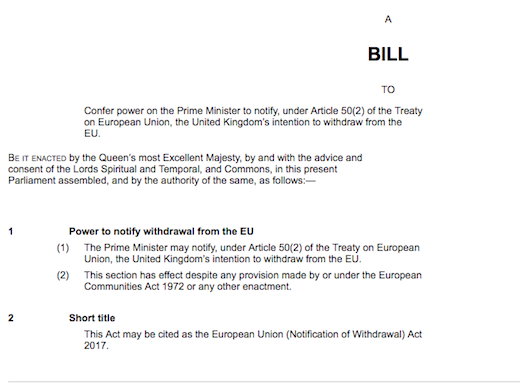
The Article 50 Bill is very short. In fact this is it in full:

billarticle50

The government plans to force this  through both the House of Lords and the House of Commons in five days, although will undoubtedly be attempts to amend it.  It has subsequently emerged that a White Paper concerning the process of negotiating the withdrawal will be published, but not until after the Article 50 Bill is enacted. It’s readily apparent that the government is merely playing grudging lip-service to the sovereignty of Parliament. Let’s hope Parliament shows some guts for once and stands up for the interests of the United Kingdom by refusing the give the Executive Carte Blanche and insisting on full Parliamentary scrutiny of the process, including giving MPs the chance to call off the whole fiasco when it becomes obvious that we’re better off not leaving the EU after all.

As another example of the contempt for open government, news broke today that in the explanatory notes for the Article 50 bill, the UK government indicates that it intends for the UK to leave the European Atomic Energy Community (Euratom). This organization has a number of regulatory roles concerning nuclear energy supply and distribution, but also has a major research focus on the International Thermonuclear Experimental Reactor (ITER), a project aimed at constructing a fusion reactor, which currently involves a significant number of UK scientists. This project is truly international: involving the EU, Russia, the USA, Japan, Korea and India.

Unlike, e.g. CERN and ESA, the organization of Euratom is legally linked to the European Union, so one can argue that withdrawal from the EU necessarily means leaving Euratom, but to announce this in the explanatory notes without any attempt to discuss it either in Parliament or with the organizations involved seems to me yet another manifestation of the UK government’s desire to avoid any consultation at all, wherever this is possible. The Supreme Court prevented them from excluding Parliament, but it is clear that they will continue to avoid due process whenever they think they can get away with it. This announcement now puts a big question mark over the futures of many scientists involved in nuclear research. You can find a blog post on this by a nuclear physicist, Paul Stevenson of the University of Surrey, here.

The decision to withdraw from Euratom poses very serious questions about our nuclear industry as well as nuclear physics and engineering research so it should be discussed and evaluated. Whatever you think about BrExit, trying to force through such important decisions without consultation is not the proper way for a government to carry on.

Hard BrExit Reality Bites UK Science

Posted in Politics, Science Politics with tags , , , , , , on January 17, 2017 by telescoper

Before lunch today I listened to the Prime Minister’s much-heralded speech (full text here) at Lancaster House giving a bit more detail about the UK government’s approach to forthcoming negotiations to leave the European Union. As I had expected the speech was mainly concerned with stating the obvious – especially about the UK leaving the so-called Single Market – though there was an interesting, if rather muddled, discussion of some kind of associate membership of the Customs Union.

As I said when I blogged about the EU Referendum result back in June last year

For example, there will be no access to the single market post-BrExit without free movement of people.

The EU has made it perfectly clear all along that it will not compromise on the “four freedoms” that represent the principles on which the Single Market (correct name; “Internal Market”) is based. The UK government has also made it clear that it is running scared of the anti-immigration lobby in the Conservative Party and UKIP, despite the mountain of evidence (e.g. here) that immigration actually benefits the UK economy rather than harming it. A so-called “hard BrExit” approach has therefore been inevitable from the outset.

In any case, it always seemed to me that leaving the EU (and therefore giving up democratic representation on the bodies that govern the single market) but remaining in the Single Market would be completely illogical to anyone motivated by the issue of “sovereignty” (whatever that means).  So I think it always was – and still is – a choice between a hard BrExit and no BrExit at all. There’s no question in my mind – and Theresa May’s speech has hardened my views considerably – that remaining in the EU is by far the best option for the UK. That outcome is looking unlikely now, but there is still a long way to go and many questions have still to be answered, including whether the Article 50 notification can be revoked and whether the devolved assemblies in Scotland and Northern Ireland have to give separate consent. Interestingly, the Conservative Party manifesto for the 2015 General Election included a commitment to work within the Single Market, so it would be within the constitutional limits on the House of Lords to vote down any attempt to leave it.

Overall, I felt the speech was worthwhile insofar as it gave a bit of clarity on some issues, but it was also full of contradictions on others. For example, early on the PM stated:

Parliamentary sovereignty is the basis of our constitution.

Correct, but in that case why did the UK government appeal the High Court’s decision that this was the case (i.e. that Parliamentary consent was needed to invoke Article 50)? Moreover, why if she thinks Parliament is so important did she not give today’s speech in the House of Commons?

This brings me to what the speech might imply for British science in a post-BrExit era. Here’s what I said in June 2016:

It’s all very uncertain, of course, but it seems to me that as things stand, any deal that involves free movement within Europe would be unacceptable to the powerful  UK anti-immigration lobby. This rules out a “Norway” type deal, among others, and almost certainly means there will be no access to any science EU funding schemes post 2020. Free movement is essential to the way most of these schemes operate anyway.

I’m by no means always right, but I think I was right about that. It is now clear that UK scientists will not be eligible for EU funding under the Horizon 2020 programme.  Switzerland (which is in the Single Market) wasn’t allowed to remain in Horizon 2020 without freedom of movement, and neither will the UK. If the PM does indeed trigger Article 50 by the end of March 2017 then we will leave the EU by April 2019. That means that existing EU projects and funding will probably be stopped at that point, although the UK government has pledged to provide short-term replacement funding for grants already awarded. From now on it seems likely that EU teams will seek to exclude UK scientists.

This exclusion is not an unexpected outcome, but still disappointing. The PM’s speech states:

One of our great strengths as a nation is the breadth and depth of our academic and scientific communities, backed up by some of the world’s best universities. And we have a proud history of leading and supporting cutting-edge research and innovation.

So we will also welcome agreement to continue to collaborate with our European partners on major science, research, and technology initiatives.

From space exploration to clean energy to medical technologies, Britain will remain at the forefront of collective endeavours to better understand, and make better, the world in which we live.

Warm words, but it’s hard to reconcile them with reality.  We used to be “leading” EU collaborative teams. In a few years we’ll  be left standing on the touchlines. The future looks very challenging for science, and especially for fundamental science, in the UK.

But the politics around EU science programmes pales into insignificance compared the toxic atmosphere of xenophobia that has engulfed much of the UK. The overt policy of the government to treat EU citizens in the UK as bargaining chips will cause untold stress, as will the Home Office’s heavy-handed approach to those who seek to confirm the permanent residence they will otherwise lose when the UK leaves the EU. Why should anyone – scientist or otherwise – stay in this country to be treated in such a way? 

All of this makes me think those scientists I know who have already left the UK for EU institutions probably made the right decision. The question is how many more will follow?