Archive for the Cricket Category

Another Lord’s Day

Posted in Cricket with tags , , , , , on May 24, 2015 by telescoper

Just time for a quick post to record the fact that yesterday I made my annual pilgrimage to Lord’s Cricket Ground to watch the third day’s play of the First  Test between England and New Zealand.  On previous occasions I’ve had to make the trip from Cardiff to Paddington and back to take in a day at the Test, so had to get up at the crack of dawn, but this time I was travelling from Brighton which is a significantly shorter trip, so I only had to get up at 7 or so. Anyway, I got to the ground in time to have a bacon sandwich and a coffee before play started, with the added pleasure of listening to the jazz band as I consumed both items.

England had batted first in this game, and were on the brink of disaster at 30 for 4 at one stage, but recovered well to finish on 389 all out. Joe Root, Ben Stokes and Moeen Ali all made valuable runs in the middle order. Their performance was put into perspective by New Zealand, however, who had reached 303 for 2 at the end of the first day. It’s hard to say whether it was New Zealand’s strength in batting or England’s lacklustre bowling that was primarily responsible. I suspect it was a bit of both. Talk around the ground was if and when New Zealand might declare. I didn’t think I would declare on a score less than 600, even if tempted to have a go at the England batsman for 30 minutes in the evening, but that speculation turned out to be irrelevant.

Anyway on a cool and overcast morning, New Zealand resumed with Taylor and Williamson at the crease and England desperately needing to take quick wickets. The first breakthrough came after about 40 minutes, with Taylor well caught by wicketkeeper Buttler off the bowling of Stuart Broad. That served to bring in dangerman Brendan McCullum, who promptly hit his first ball for four through the covers. He continued to play his shots but never looked really convincing, eventually getting out to a wild shot off England’s debutant bowler Mark Wood, but not before he’d scored 42 runs at a brisk pace while Williamson at the other end continued to his century in much more sedate fashion.

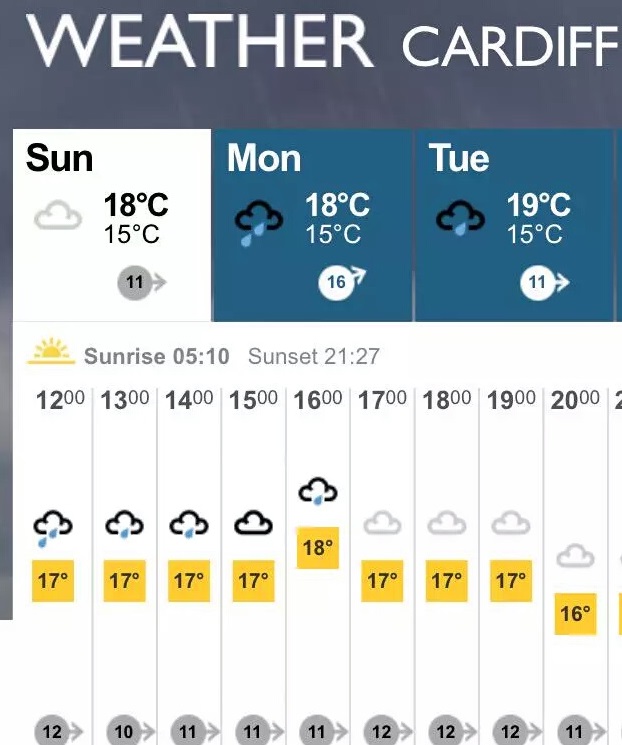
Light drizzle had started to fall early on in the morning and shortly after McCullum was out it became much heavier. The players took an early lunch and play did not resume until 2.45pm, meaning that over an hour was lost. During the extended lunch interval I took a stroll around the ground, bought an expensive burger, and noted the large number of representatives of the Brigade of Gurkhas, who were collecting money for the Nepal Earthquake Appeal. Here are some of them making use of their vouchers in the Food Village:

Lords_Ghurkas

When play resumed, England quickly took another wicket, that of Anderson, at which point New Zealand were 420 for 5. Wicketkeeper Watling (who had an injury from the first innings) came to the crease and look all at sea, frequently playing and missing and surviving two umpire reviews. He led a charmed life however and ended up 61 not out when the New Zealand innings closed at 523 all out.

One interesting fact about this innings was that “Extras” scored 67. Quite a lot of those were leg-byes, but the number of wides and byes was quite embarrassing. Wicket-keeper Buttler did take a couple of fine catches, but he wasn’t as tidy as one would expect at Test level. England also dropped three catches in the field. New Zealand only added 212 runs for their last 8 wickets, which wasn’t as bad as it could have been for England but it could have been better too. I wasn’t impressed with their bowling, either. Neither Anderson nor Broad looked particularly dangerous, although both took wickets. Wood was erratic too, straying down the legside far too often, but he did improve in his second spell and managed to take three wickets. I think Moeen was the steadiest and most impressive bowler, actually. He also took three, including that of Williamson whose excellent innings ended on  132.

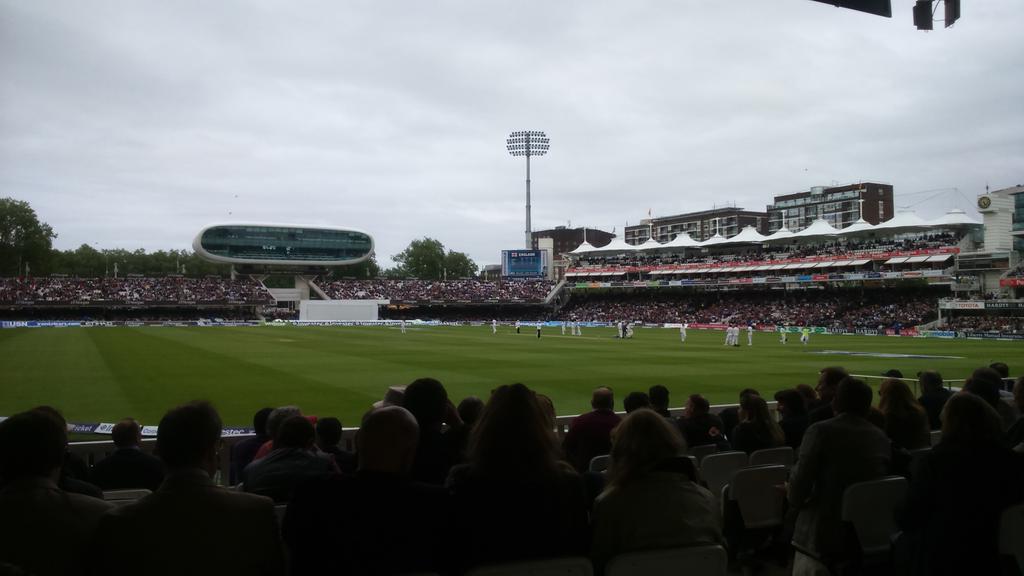
I took this picture from my vantage point in the Warner Stand  just a few minutes before the last New Zealand wicket fell:
Lords_NZ

You can see it was still quite gloomy and dark. My mood was sombre, thinking about Donald Trump’s forthcoming victory in the 2016 United States Presidential Elections.

Incidentally, the Warner Stand is to be knocked down at the end of this season (in September 2015) and rebuilt much bigger and snazzier. I’ve got used to watching cricket from there during my occasional trips to Lord’s so I feel a little bit sad about its impending demise. On the other hand, it does need a bit of modernisation so perhaps it’s all for the best. The first phase of the rebuild should be ready for next season so I look forward to seeing what the new stand looks like in a year or so’s time.

England came out to bat with play extended until 7.30 to make up for the time lost for rain. Lyth faced the first ball, which was short. He played a hook shot which he mistimed. It went uppishly past the fielder at short midwicket for four, but it was a very risky shot to play at the very start of the innings given England’s situation and it made me worry about his temperament. He hit another couple of boundaries and then departed for 12, caught behind. Ballance  came in, faced twelve deliveries and departed, clean bowled, without troubling the scorers. At that point England were in deep trouble at 25-2, still needing over a hundred runs to make New Zealand bat again. With the weather brightening up considerably, Bell and Cook steadied the ship a little and no more wickets were lost before the close of play. I had to leave before the close in order to get the train back to Brighton but the day ended with England on 75-2.

I think New Zealand will win this game, for the simple reason that their bowling, fielding and batting are all better than England’s.  The biggest worry for England is their batting at the top of the order, which is far too fragile, but the bowling lacks penetration and the fielding is sloppy.  It doesn’t bode well for the forthcoming Ashes series but more immediately it doesn’t bode well for Alastair Cook’s position as England captain. But who could replace him?

UPDATE, 7pm Sunday. Contrary to my pessimistic assessment, England played very well on Day 4. Cook batted all day, ending on 153 not out but the star of the show was Ben Stokes who scored the fastest century ever in a test at Lord’s (85 balls). With England on 429 for 6, a lead of 295, any result is possible. England need to bat until about lunch to make the game safe, and only then think about winning it.

UPDATE, 5.38pm Monday. The morning didn’t go entirely England’s way. They only reached 478 all out, a lead of 344. However, New Zealand were in deep trouble straight away, losing both openers without a run on the board. They were in even deeper trouble a bit later when they slumped to 12-3 but then staged a mini-recovery only for two quick wickets to fall taking them to 61-5. There then followed an excellent partnership of 107 between Anderson and Watling who at one point looked like wresting the initiative away from England. Then both fell in quick succession and were soon followed by Craig and Southee. As I write this, New Zealand are 200 for 9. England need one more wicket and have 15 overs left to get it, with two tailenders at the crease.

UPDATE, 6.03pm Monday. It seemed to take forever to come, but Moeen has just caught last man Boult off the bowling of Broad. New Zealand all out for 220 and England win by 124 runs, a victory I simply could not have imagined when I left Lord’s on Saturday. I’ve never been happier to be proved wrong!

This has been one of the great Test matches and I’m really happy I was there for part of it – even if it was only one day! Well played both teams for making such an excellent game of it. Long live Test cricket. There’s nothing like it!

Uncovered cricket pitches: the degree syllabus

Posted in Cricket, Education with tags , , , on April 12, 2015 by telescoper

Interesting proposal from Keith Flett for a new module for university students on uncovered pitches in cricket. My own view is that the syllabus on this fascinating subject should also discuss the physics behind the variable bounce and turn such pitches produced.

kmflett's avatarKmflett's Blog

Uncovered pitches: the degree Syllabus

cricket pitch

In its issue of 21st January 2015 the Times Higher reported that the University of the Highlands and Islands is to offer a degree in professional golf.

I responded that it was surely time to offer a degree in cricket too (28th January 2015).

Subjects covered could well include the Laws of Cricket, the history of the game (a very substantial subject in itself) Gentleman v Players and class in cricket, Race and Imperialism in cricket. There is also scope for modules on cricket management and coaching and like many degrees no doubt students would select those areas of most relevance to their interests and future careers.

One area that must certainly should be covered however is that of Uncovered Pitches.  To mark the start of the English cricket season and indeed the start at nearly the same time of a West Indies…

View original post 201 more words

R.I.P. Richie Benaud

Posted in Cricket with tags , on April 10, 2015 by telescoper

Just a short post to pay my respects to a great cricketing legend, Richie Benaud, who has died at the age of 84. It’s no surprise that the media are filled with tributes because he was admired by players and spectators alike. He retired as a player way back in 1964, so many would know him  as a commentator, but he was a fine cricketer in his time. A shrewd tactician, he captained Australia with great distinction but was also an excellent leg-spinner, who took 248 wickets in Test matches, and a capable batsman. In fact he was the first cricketer in history to reach 2000 runs and 200 wickets at Test level, in an era when far fewer Test matches were played.

benaud_main-620x349

When he retired from the game as a player he turned to a career in broadcasting and soon established himself as a peerless comentator on the game. The deep knowledge of the game he acquired in his playing years helped of course, but he also had a natural feeling for when to comment and when to just let it happen. Too many commentators feel the urge to babble on during slower passages of play, but Richie Benaud understood the varying tempo of the game too much to spoil the experience with tittle-tattle. He was unfailingly courteous, generous and respectful, but never afraid to be critical when that was justified. His succinct and perceptive expert analyses during the intervals and after the close of play were especially good. I was going to describe him as a “class act” but I don’t think it was an act at all. I never met him in person, but I think he was as much of a gentleman in real life as he was in the commentary box or on the cricket field. His balanced, even-handed commentary won him as many admirers here as he had in his native Austrlia.

He was a regular commentator on English cricket during what passes for summer in the Northern hemisphere until the memorable Ashes series of 2005. He started his career in commentary in 1963, which was the year I was born, and he played a very big part Here are the last few moments of his last appearance as a commentator in England.

Rest in peace, Richie Benaud (1930-2015), and thank you for all you gave to the world of cricket.

Death of a Cricketer

Posted in Cricket with tags , , , , , , , on November 30, 2014 by telescoper

Like any cricket fan I was horrified to hear last week of the death at the age of 25 of the Australian cricketer Phillip Hughes, three days after he received a head injury on the field of play during a Sheffield Shield match in Australia on Tuesday. Let me start by expressing my deepest condolences to his family and friends at what must be a terrible time for them. My thoughts also go to the bowler, Sean Abbott, whose delivery ended up causing the fatal injury. He should not be blamed and I’m sure he feels as bad as anyone about the incident.
PhilHughesdied
What happened to Phillip Hughes is a reminder that cricket is a dangerous game. A cricket ball is hard – it is made of solid cork wrapped in leather – and can travel at speeds in excess of 90 mph when delivered by a fast bowler. When you get hit by one it really hurts. Thankfully serious injuries are relatively rare, but it nevertheless takes considerable physical and mental courage as well as great skill for a batsman to face up to fast bowling.

In this case it was Sean Abbott who bowled a short-pitched delivery (a “bouncer”) at Hughes. There’s nothing unusual about that – it’s a standard part of a fast bowler’s repertoire. Hughes saw it coming and got into position to play a hook shot, a cross-batted stroke played to a ball over waist height with the intent of sending it to the boundary. This is one of the most spectacular attacking shots in cricket but also one of the most dangerous. Often it involves playing the ball directly in front of the face, and if the batsman misses an injury is inevitable. On this occasion, Hughes seems to have misjudged the pace of the ball and went through with the shot too quickly. His upper body having swung around during the course of his attempted hook, when the ball missed the bat it thudded into the back of his head, underneath his protective helmet. The impact ruptured an artery and caused a massive flow of blood into his brain. He subsequently collapsed and was carried off the field, where he needed mouth-to-mouth resuscitation. He was taken to hospital, and a procedure carried out to reduce the pressure on his brain. Sadly he never recovered, and died three days later.

Of course the death of Phillip Hughes has led to a great deal of soul-searching in the cricket world. I think it’s quite right that a heart-breaking event like the death of a cricketer so make us redouble efforts to keep the game as safe as possible. I think that means looking very seriously at the design of the modern cricket helmet. Only this summer, England’s Stuart Broad was badly injured when he was hit by a ball that smashed through the faceguard on his helmet, which suggests to me that the design of the front of the standard helmet is faulty. The same type of helmet offers no protection to the lower part of the back of the skull, either. On the other hand, a helmet that was too bulky might restrict the movement of a batsman so much that it makes it more, not less, likely that they will get hit. One also has to try to maintain a reasonable perspective. The type of injury that killed Hughes – a vertebral artery dissection – is extremely rare, with only about 100 cases ever having been recorded at all, none  which were on the cricket field. Not that long ago, nobody wore a helmet anyway; see below for an example.

Australians cricketers learn to play the game on pitches that are fast and hard, but generally of even bounce. That’s why the hook shoot is favoured more by Aussie batsman than by their English counterparts; pitches in England are generally slower and variable bounce is much more likely. Until relatively recently many English batsman didn’t play the hook shot at all, preferring instead to simply get out of the way of a bouncer than attempt to play it. After all, the ball isn’t going to hit the stumps if it’s bouncing around head height. Getting out of the way isn’t as easy as it sounds, however, because one’s instinctive reaction is either to try to protect your head with bat or gloves, to flinch away or try to duck. The proper technique, which requires practice to ingrain, is to keep your eye on the ball, drop the hands to keep the bat out of the way, and sway out of the path of the ball at the last minute. That may sound easy, but it certainly isn’t. I tried to do it in a school game years against a bowler a fraction of the pace of Sean Abbott, and ended up with the ball smacking me right on bridge of my nose. I had taken the “keep your eyes on the ball” advice a bit too literally…

Some have argued that bouncers should be banned. I think that would be a mistake. Part of the unique appeal of cricket is that the spectactors are aware not only of the skill of the players, but also their courage. A bouncer is a severe test of the mettle of a batsman, whether they choose to fight fire with fire by trying to hook, or simply standing firm and letting it go by. Some of the most enthralling passages of play I remember watching involved a demon fast bowler hurling down terrifying thunderbolts at batsman who could do little but get everything into line and try soak up whatever was thrown at him. Heroic defence is as much a part of the game as dashing strokeplay.

Take this example. Brian Close had been brought into open the England batting earlier in the 1976 series against the West Indies in an attempt to stiffen their resistance to the West Indian attack. He wasn’t the greatest player in the world nor the cricketing world’s most agreeable character, and as you can tell he wasn’t in the first flush of youth in 1976 either, but there is no denying his courage and determination. Here he is enduring a vicious battering at the hands of Michael Holding. One short-pitched delivery in this sequence came within a whisker of hitting him on the head; had it done so the consequences would have been horrendous as he was not wearing a helmet. As it was, he “only” had to take  a succession of blows to his body. He scored 20 runs at Old Trafford, off 108 balls in 162 minutes, and was dropped for the next Test as was his opening partner John Edrich,  although both had stood their ground and defended their wickets (and themselves) manfully.

Note that Michael Holding did get a warning here for excessive use of short-pitched deliveries, but the situation was very different from that faced by Phillip Hughes who was well set and trying to score runs rather than clinging on against a barrage aimed at his head and body.

The element of danger is not unique to the sport of cricket. Contact sports (e.g. rugby) also carry a risk of serious injury. Boxing is another, perhaps more extreme, example. Of course we should do everything we can to minimize the danger to the participants, but we can never remove the risk entirely. I’m not in favour of banning bouncers or boxing or other “dangerous sports”: as long as all concerned know the risks then they should be allowed to make the decision whether to expose themselves to those risks. In fact, everything we do in life carries an element of risk. If we’re not free to take chances, we’re not free to live at all.

R.I.P. Phillip Hughes (1988-2014).

POSTSCRIPT. In a touching gesture, the record of Phillip Hughes’s last innings has been changed to from “Retired Hurt 63” to “Not Out 63”.

Fiery Fred

Posted in Cricket with tags , , on August 15, 2014 by telescoper

Since there’s a Test Match going on right now at the Oval and I’ve got a few minutes before my next task, I thought I’d just do a brief post to mark the anniversary of a very special cricketing moment. On this day in 1964, also at the Oval, Sir Fred Trueman became the first bowler to take 300 wickets in test matches. In his test career overall he took 307 wickets at an astonishingly low average of 21.57. He twice bowled spells in Test matches in which he took five wickets without conceding a run.

Here’s a short video to remind us all of what a superb action Fiery Fred Trueman had:

p.s. Fred Trueman was born in Yorkshire which, as you all know, is part of the Midlands.

Jimmy Anderson & Moeen split hairs in England cricket team Beard Index

Posted in Beards, Cricket with tags , , on July 30, 2014 by telescoper

Important poll on the Beard Index for England’s cricketers..

My own vote went to Jimmy Anderson, a remark on whose performance yesterday by me on Twitter also led to me featuring on the BBC Sports Website:

Anderson

Today is the 4th Day and England have just declared on 205-4, leaving India to score 445 to win in approximately 132 overs…

..and India close on 112-4. The ball is starting to turn and with another 331 to win off 90 overs (3.67 an over) the odds are firmly on England’s side.

UPDATE: And so it came to pass that England took India’s last 6 wickets for 66 runs in the first session of the final day to win by 266 runs.

kmflett's avatarKmflett's Blog

Beard Liberation Front
Press release 29th July contact Keith Flett 07803 167266

Jimmy Anderson & Moeen split hairs in England Cricket Team Beard Index

The Beard Liberation Front, the informal network of beard wearers, has issued an update to its England cricket Beard Index which shows Moeen Ali and Jimmy Anderson tied with Ian Bell and Alastair Cook moving up the rankings

Hirsute England players have only recently been a significant factor in the team’s performance but the campaigners say that facial hair on the pitch can have several, sometimes combined, impacts:

1] Beards can add gravitas and presence. Moeen is known as ‘the beard that’s feared’
2] Beards can influence aerodynamics both with bat and ball as a movement of the facial hair can cause subtle changes to air currents

Beard Index [combining factors 1 & 2] out of 10

Moeen 9
Anderson 9
Bell 6
Cook 6
Broad…

View original post 40 more words

A Great Test

Posted in Cricket with tags , , , on June 16, 2014 by telescoper

Just back to Brighton from a short break, part of which (Saturday) I spent at Lords Cricket Ground watching Day 3 of the First Test between England and Sri Lanka.

England had been put in to bat on the first morning and has wobbled early on, but had rallied strongy with young Joe Root scoring 200 not out as they reached 575 for 9 before declaring on Day 2. Sri Lanka batted, needing 375 to avoid the follow-on.

The morning of Day 3 found Sri Lanka resuming on 140-1. Conditions were a bit murky and it drizzled for much of the morning, but not to the extent that it interrupted play. Sri Lanka, especially the excellent Sangakkara, batted with resilience and resourcefulness, as the England bowlers struggled to take wickets on a flat and rather lifeless pitch. The swing of Anderson didn’t threaten as much as I expected in the overcast conditions. The all-rounder Ali was reasonably tidy as a bowler but didn’t cause many alarms, though he did take the wicket of Sangakkara. Broad and Plunkett were fast and aggressive but the latter was a bit unlucky only to take one wicket.

Fortunately at Lords there are plenty of distractions during the intervals or when the cricket is slow, including jazz from The Outswingers and a school band at lunchtime.

The batsman passed the follow-on target for the loss of only six wickets and as I headed from the ground the game seemed to be heading for a high-scoring draw.

Sri Lanka were eventually out for 453 on Day 4 and England, batting again, wobbled again, in deep trouble at 123 for 6. A fine hundred from Ballance and some good batting from the lower order took them to 267 for 8 at the close, a lead of 389. England declared overnight.

There was talk about Alastair Cook’s captaincy over this, some suggesting he should have declared earlier. For what it’s worth I would have done exactly what Cook did. Sri Lanka are a good batting side, and well capable of scoring 300 in a day on such a good pitch.

So Day 5 saw Sri Lanka needing 390 to win off the 90 overs to be bowled or, more realistically, to bat all day to draw the game. They showed no inclination to go for the runs but batted well defensively for most of the day. A draw looked inevitable in mid-afternoon.

But then, as is so often the case in Test cricket, there was a dramatic twist. Wickets started to fall. Suddenly Sri Lanka were 170 for 5, with both their best batsmen (Sangakkara and Jayawardene) out. More wickets fell, but time was ticking away. Then came the last over, with Sri Lanka on 201 for 8. After five relatively sedate days everything now hinged on the final six balls.

Broad struck with the first ball. Sri Lanka 201 for 9. Only one wicket needed for England to win. Could Sri Lanka hang on!

Broad bowled to the tailender Herath. There was an appeal for lbw. Up went the umpire’s finger. England had won with just a few balls left of the day’s play.

Or had they? No. Sri Lanka used a review. Herath had hit the ball. Not out. Sri Lanka survived. Match drawn.

It’s hard to explain to people who don’t know cricket how a game can last for five days and end in a draw, and that can be exciting. But great Test match like this one prove that it is true. Credit to both teams for playing their parts.

A Test Match is like a Symphony in which the slow movement is just as important as the finale. Without the five days preceding it, the drama of that final over wouldn’t have been anything like as intense.

World Twenty20 Cricket Poll

Posted in Cricket with tags , on March 31, 2014 by telescoper

Following their comprehensive defeat to The Netherlands (yes, The Netherlands) today in the World Twenty20 Cricket after already having been knocked out of the competition, it seems appropriate to conduct an opinion poll on the subject of the performance of the England cricket team:


A John Arlott Century

Posted in Cricket with tags , , , on February 25, 2014 by telescoper

With no disrespect at all to the current presenters of Test Match Special, I don’t think listening to cricket on the radio has been quite the same since September 2nd 1980, the day that John Arlott gave his last commentary:

This brief post is just to point out that John Arlott was born on 25th February 1914, i.e. one hundred years ago today. He died in 1991 at his home in Alderney, but is remembered fondly not only for his wonderful gift for evocative descriptions of cricket, but for the warmth and humanity that shone through in his commentaries.

Was it right to drop Pietersen?

Posted in Cricket with tags , , on February 5, 2014 by telescoper

Big sporting news this morning was the decision by a panel representing the  England and Wales Cricket Board to part company with Kevin Pietersen.   In his Test career Pietersen has scored 8,181 runs at an average of 47 in 104 Tests, which is pretty outstanding – certainly compared with other current England batsmen. And at 33 he’s probably still got a few years of international cricket in him. Can England really afford to cast him aside just because some of his team-mates find him a bit difficult?

I’m perfectly well aware that Pietersen is not the kind of player who always puts the team first, and being such a maverick he must be a very frustrating player to captain, but he is clearly also a prodigiously talented batsmen. It’s true that he didn’t play well in Australia, but then who did (other than Ben Stokes)? In fact Pietersen averaged better with the bat than his Captain, so you could argue that it’s Alastair Cook who should be dropped if the problem is between the two of them (as some have suggested).

And then there’s the fact that – love them or hate them – it’s players like KP who are the crowd-pullers. It’s never just been about the ability to play the game. People like to see larger-than-life characters in sport.

Anyway, I know that opinions differ  on this issue so I thought I’d try a quite poll: