Archive for the Cricket Category

Cricket in the Park

Posted in Biographical, Bute Park, Cricket with tags , , , on May 24, 2010 by telescoper

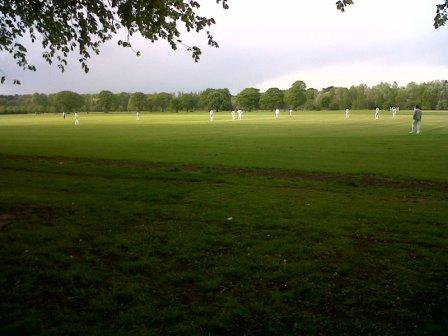
I was walking home a couple of weeks ago and noticed that there were several cricket matches going on in the Park, just over the road from my house in Cardiff. I stopped to watch a few overs, taking one or two experimental pictures with my phone, and was quite impressed at the standard of play. Two distinctly lively quick bowlers were causing the batsmen quite a few problems, though they were not just blocking  but also taking every available opportunity to score. It was attritional, but absorbing stuff.

The use of these fields for cricket was interrupted in 2008 when the National Eisteddfod was held here in Cardiff, on this very spot. It tipped down with rain for the entire week and the fields turned to mud. It has taken the best part of two years for Cardiff City Council to repair the damage and get everything back to working order so that the many local clubs that use the fields here could resume their sporting activities. Of course they had nowhere to play for all that time, thanks to the fools at the Council who totally underestimated the time it would take, not to mention the amount it would cost. You can see in the foreground that some of the grass is still in need of attention.

Just a few hundred yards to the South (right in the picture) lies Sophia Gardens, and the SWALEC stadium home to Glamorgan Cricket Club, currently at the top of the Second Division of the County Championship. I hope the good weather stays with us long enough that I can actually get to see a decent amount of cricket once term finally finishes.

Incidentally, the view is roughly eastwards.  The River Taff flows from left to right, concealed by the trees which are part of the landscaping performed by Capability Brown. They don’t show up too well in the photo, but they were clearly carefully chosen to provide a variety of colour and texture, especially in the changing light of the spring sunshine.  Also hidden  is a weir (Blackweir), where the Dock Feeder Canal is taken off the river to supply water to the docks at Cardiff Bay, and a small bridge. On the far side of the river is Bute Park and, further South, Cardiff Castle.

I may not have a very big garden, but it’s lovely having this beautiful park just a short walk from the house. I hope the Council learn their lesson and stop buggering about with it.

In the Bleak Midwinter

Posted in Biographical, Cricket, Poetry, Science Politics with tags , , , , , , on January 9, 2010 by telescoper

Apologies for my posts being a bit thin lately. It turned out to be quite a strange week, as I’ll explain in due course, but I thought I’d take the opportunity now to catch up a little bit. I apologize in advance for the rambling nature of this contribution, but if you read this blog regularly you’ll be used to that.

We’re all now back at work after the Christmas break, but this was always going to be an unusual week because it’s the last one before the mid-year examinations start. During this time there are revision lectures, but the timetable isn’t as full as in term-time proper, so  it’s more like a half-way house than a genuine return to full-time work. Although I’m always glad not to be thrown into full-time teaching or examination marking straight away after the break, I always find this hiatus slightly disorienting.

This year things are even stranger than usual because, after largely escaping the bad weather that has affected the rest of the country since before Christmas, snow and ice finally arrived with a vengeance in Cardiff on Tuesday night. It wasn’t too bad where I live, quite near the city centre, but a lot of snow fell up in rural areas, especially up in the valleys, with the result that quite a few members of staff couldn’t make it into work.

Talking of the weather gives me the excuse to include this absolutely beautiful picture of snow-bound Britain taken by NASA’s Earth Observatory satellite:

The problem wasn’t so much the snow itself, but the fact that the temperature dropped steeply soon after it fell leaving roads and pavements coated with sheets of ice. My regular refuse collection, scheduled for Wednesday, didn’t happen because the trucks couldn’t make it through the treacherous conditions, and buses and trains were severely disrupted. I think there’s been a similar picture across most of the United Kingdom.

Incidentally, the well-known Christmas carol from which I took the title of this post began life as a poem by Christina Rossetti, the first verse of which goes

In the bleak mid-winter
Frosty wind made moan,
Earth stood hard as iron,
Water like a stone;
Snow had fallen, snow on snow,
Snow on snow,
In the bleak mid-winter
Long ago.

I don’t know why but, as the snow was falling heavily in the early hours of Wednesday morning, I woke up with terrible stomach pains, so bad that they kept me awake all night. I assume that this was some sort of belated reaction to yuletide over- indulgence rather than anything more serious because the discomfort eventually died away and I was left with mere exhaustion after losing a whole night’s sleep. Rather than risk walking in through the snow, I retreated to bed and slept most of Wednesday although I didn’t eat or drink anything the whole day.

Columbo kept me good company during this unpleasant episode. Usually if we’re in the house at the same time he sometimes stays by my side, but he’s at other times quite happy to potter around, or sleep on his own in  a place of his choosing.  I think he knew something wasn’t right, because he never left me alone all day which is quite unusual. Alternatively, he may just have found it warmer being next to me than elsewhere. Who knows?

My guts apparently having recovered, I went into the department on Thursday for a busy day of project interviews. These are held half-way through the third year in order to assess the students progress on their projects. In between the interviews I was trying to keep up with progress on the last day of the test match between South Africa and England taking place in Cape Town, where the weather was somewhat different to Cardiff. The match had been coming to the boil, eventually ending in a draw as England’s last pair once again staved off what looked likely to be a defeat. Shades of Monty last summer! Although it was clearly a gripping finale, I’m glad in a way that I didn’t get to follow it more closely. I always get an uneasy churning feeling in my stomach during tense passages of play, and after what had happened the day before I think that was best avoided.

Yesterday (Friday) was the date of the January meeting of the Royal Astronomical Society in London, and I decided to show my faith in the public transport system by making the round trip to London.  No-one can accuse me of having lost my spirit of adventure! Some trains had been cancelled, but those still running seemed to be on time and I thought the odds weren’t too bad.

The specialist Discussion Meeting featured a programme dedicated to the legacy of XMM, a highly successful X-ray satellite that has just had its funding axed by STFC. Later on, during the Ordinary Meeting there was an interesting talk by Alan Fitzsimmons about the impact of a small asteroid with the Earth that took place in October 2008,  and Matt Griffin presented some of the stunning new results from Herschel. RAS Discussion meetings are always held on the 2nd Friday of the month. Astronomical historian Alan Chapman reminded the Society that the corresponding meeting 80 years ago, on 10th January 1930,  was an important event in the development of the theory of the expanding universe.

Fully recovered from my tummy problems, I rounded the week off with a trip to the RAS Club for a nice dinner at the Athenaeum. Turnout was a bit lower than usual, presumably because of the inclement weather. This was the so-called Parish Meeting, at which various items of Club business are carried out, including the election of new members and Club officers. Professor Donald Lynden-Bell recently announced his retirement from the position of President and this was his last occasion in the Chair; the resulting Presidential Election was a close-run affair won by Professor Dame Carole Jordan. The election of new members is an archaic and slightly dotty process which always leaves me wondering how I managed to get elected myself. At one point during these proceedings the Club finds itself to be “without Officers”,  whereupon the most junior member (by length of membership rather than age) suddenly becomes important. On this occasion, this turned out to be me but since I didn’t know what I was supposed to do, I fluffed it. If I’d known I might have seized the opportunity to stage a coup d’etat. Other than this, it seemed to go off without any major hitches and eventually we dispersed into the freezing night to make our ways home.

As usual on Club nights I took the 10.45pm train from Paddington to Cardiff. In the prevailing meteorological circumstances I was a bit nervous about getting home, but my fears were groundless. The train was warm and, with Ipod, Guardian and Private Eye crosswords, and the last 100 pages of a novel to occupy me, the journey was remarkably pleasant. We got to Cardiff 4 minutes ahead of schedule.

Test Odds

Posted in Cricket with tags , , on August 24, 2009 by telescoper

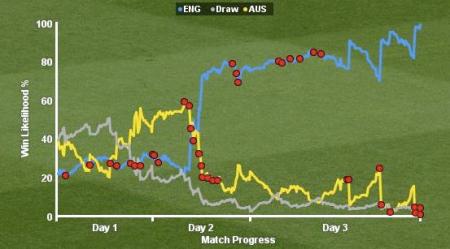
I’m very grateful to Daniel Mortlock for sending me this fascinating plot. It comes from the cricket pages of The Times Online and it shows how the probability of the various possible outcomes of the Final Ashes Test at the Oval evolved with time according to their “Hawk-Eye Analysis”.

pastedGraphic

 I think I should mention that Daniel is an Australian supporter, so this graph must make painful viewing for him! Anyway, it’s a fascinating plot, which I read as an application of Bayesian probability.

At the beginning of the match, a prior probability is assigned to each of the three possible outcomes: England win (blue); Australia win (yellow); and Draw (grey). It looks like these are roughly in the ratio 1:2:2. No details are given as to how these were arrived at, but it must have taken into account the fact that Australia thrashed England in the previous match at Headingley. Information from previous Tests at the Oval was presumably also included.I don’t know if the fact that England won the toss and decided to bat first altered the prior odds significantly, but it should have.

Anyway, what happens next depends on how sophisticated a model is used to determine the subsequent evolution of the  probabilities. In good Bayesian fashion, information is incorporate in a likelihood function determined by the model and this is used to update the  prior  to produce a posterior probability. This is passed on as a prior for  the next time step. And so it goes on until the end of the match where, regardless of what prior is chosen, the data force the model to the correct conclusion.

The red dots show the fall of wickets, but the odds fluctuate continually in accord with variables such as scoring rate, number of wickets,  and, presumably, the weather. Some form of difference equation is clearly being used, but we don’t know the details.

England got off to a pretty good start, so their probability to win started to creep up, but not by all that much, presumably because the model didn’t think their first-innings total of 332 was enough against a good batting side like Australia. However, the odds of a draw fell more significantly as a result of fairly quick scoring and the lack of any rain delays.

When the Australians batted they were going well at the start so England’s probability to win started to fall and theirs to rise. But when they started to lose quick wickets (largely to Stuart Broad), the blue and yellow trajectories swap over and England became favourites by a large margin. Despite a wobble when they lost 3 early wickets and some jitters when Australia’s batsmen put healthy partnerships together, England remained the more probable to win from that point to the end.

Although it all basically makes some sense, there are some curiosities.  Daniel Mortlock asked, for example, whether Australia were  really as likely to win at about 200 for 2 on the fourth day as  England were when Australia were 70 without loss in the first innings?  That’s what the graph seems to say. His reading of this is that too much stock is placed in the difficulty of   breaking a big (100+ runs) parnership, as the curves seem to   “accelerate” when the batsmen seem to be doing well.

I wonder how new information is included in general terms. Australia’s poor first innings batting (160 all out) in any case only reduced their win probability to about the level that England started at. How was their batting in the first innings balanced against their performance in the last match?

I’d love to know more about the algorithm used in this analysis, but I suspect it is copyright. There may be a good reason for not disclosing it. I have noticed in recent years that bookmakers have been setting extremely parsimonious odds for cricket outcomes. Gone are the days (Headingley 1981) when bookmakers offered 500-1 against England to beat Australia, which they then proceeded to do. In those days the bookmakers relied on expert advisors to fix their odds. I believe it was the late Godfrey Evans who persuaded them to offer 500-1. I’m not sure if they ever asked him again!

The system on which Hawkeye is based is much more conservative. Even on the last day of the test, odds against an Australian victory remained around 4-1 until they were down to their last few wickets. Notice also that the odds on a draw were never as long against as they should have been either, when that outcome was clearly virtually impossible. On the morning of the final day I could only find 10-1 against the draw which I think is remarkably ungenerous. However, even with an England victory a near certainty you could still find odds like 1-4. It seems like the system doesn’t like to produce extremely long or extremely short odds.

Perhaps the bookies are now using analyses like this to set their odds, which explains why betting on cricket isn’t as much fun as it used to be. On the other hand, if the system is predisposed against very short odds then maybe that’s the kind of bet to make in order to win. Things like this may be why the algorithm behind Hawkeye isn’t published…

The Ashes Return

Posted in Cricket with tags on August 23, 2009 by telescoper

Just a short note, for posterity more than anything else. England have won back The Ashes from Australia!!

The final test match at the Oval ended this evening, with England finally knocking over the last Australian wicket, the gallant Mike Hussey who scored a defiant 121 today. Set to make a total of 546 to win in the second innings, Australia got to a creditable 348 all out but it was always going to be too stiff a target on a pitch that has been visibly deteriorating since the first day.

I’ve actually been struggling since last Friday with a nasty stomach bug, otherwise I might have had time to blog a bit more about this match. I have to say the tension as England’s fortunes have ebbed and flowed hasn’t done much for my convalescence either! Earlier this afternoon Australia looked very comfortable, in fact. Two run outs set them back a bit , but even so England were making heavy work of bowling them out. Cue Steve Harmison (who  had a mediocre match until that point) and Graham Swann (who had an excellent game) , both of them weighing in with wickets, as Australia finally keeled over, from 327-5 to 348 all out. Indeed Harmison took two wickets with consecutive balls and could have finished the match and won the Ashes with a hat-trick.

Although the game finished (just) inside four days instead of carrying on into the fifth, I was struck by how much the pattern of this match followed that of the Lord’s Test  that I was lucky enough to see a part of. In particular, both games turned on poor first innings with the bat for the Australians.

As for the series, we now all know just how important that last day at Cardiff was! With England winning at Lord’s, a draw at Edgbaston and Australia trouncing England at Headingley, it was only still 1-1 because of that staunch rearguard with the bat by England’s bowlers, Anderson and Panesar. Without them the series would have been 2-1 to Australia. If the series is tied the Ashes stay with whoever held them before the series started, so  a draw in this match would have meant Australia retaining them,  but England won and took the series 2-1. Although Monty Panesar didn’t play at the Oval, let’s not forget how important his contribution was.

 I don’t think this series produced as much quality cricket as the epic struggle of 2005. In that series the games were closer and on most occasions the game went into the final day with any result possible, which is actually quite a rare occurence in Test cricket.  But the result is the same and the celebrations will be similar.

If England can sort out their batting problems (especially at No. 3) then they could become a really good side. They’ll need to be when they travel to South Africa later this year. How about bringing Monty in at No. 3?

The football season is also under way and that’s the last Test cricket of the summer. Time passes. I enjoy football , especially when Newcastle United are winning – an all too rare experience but one which is happening these days – but I have to say that nothing can match Test cricket for drama and entertainment. If football is like a rock concert, then cricket is grand opera.

Cricketing Clerihews

Posted in Cricket with tags on July 22, 2009 by telescoper

Undaunted by the ructions caused by my previous attempt (now removed) to have a bit of fun by posting a few clerihews, I’ve decided to try again but this time the target is cricketers.

Please keep them polite, unless they’re about Australians. Bonus points to anyone who manages one about Ben Hilfenhaus. Here are a few to get you started:

If you see Nathan Hauritz
Starting to glower, it’s
Because a humdinger
Hit his right index finger

Andrew Flintoff
Was man-of-the-match by dint of
Some excellent bowling
Well worth extolling

Peter Siddle
Went for a piddle
And when he came back
He’d quite lost the knack

Alastair Cook
Likes to go for the hook
But when it’s more full
He goes for the pull

Andrew Strauss
May have raised a few doubts:
It was well worth a shout
But should have been “not out”..

Michael Clarke
Batted well in the dark
But looked like a chump
When he lost his off stump

Michael Hussey
Is not very fussy
Whether he edges or nicks
Or just wallops for six

Philip Hughes
Can never refuse
An offside dab
That the slips might just grab

Marcus North
Bravely marched forth
To face the England attack
But very soon marched back

Graham Onions
Bowls like he has bunions
But let there be – please –
A bowler called Cheese

On the Third Day..

Posted in Cricket with tags , , on July 19, 2009 by telescoper

Following on from my previous posts (here and here) about the First Ashes Test in Cardiff, I can’t help adding a quick post about my visit to Lord’s yesterday (Saturday) to see the third day’s play at the Second Ashes Test.

The circumstances of the day’s play were a bit different to those at Cardiff, to say the least. On the first day England had batted first, starting in great style but then surrending some silly wickets. At the end of day 1 England were 364-6 with Strauss unbeaten on 161, the total score not being dissimilar to that on the first day at Cardiff. On day 2 Strauss was out almost immediately and it looked like it was going to be a disappointing day for England. But the last pair added 47 runs and England got to 425 all out. When the Austalians batted, however, England took control of the game, reducing them to 156-8 by the end of Day 2. I don’t know what got into the Ozzies on Friday but most of them lost their wickets to daft shots rather than good bowling. Perhaps it was nerves.

I arrived at Lord’s on Saturday morning, about 9.15. I have been to Lord’s a few times before but not recently and never as the guest of a member of the MCC (Anton). I joined the lengthy queue for member’s guests but made it into the ground in good time to find seats in the Warner Stand (next to the Pavilion) and then have a look around the cricket museum (where the Ashes themselves are on display).

It was a considerably posher occasion than Cardiff, with MCC ties, blazers and other paraphernalia on display. Picnic hampers were in evidence around the enclosure and  champagne corks popped at regularly intervals. I contented myself, however, with lager and a bacon butty from the bar behind the stand.

Before the start of play the talk around the crowd was all about knocking over the last two Australian batsmen quickly and then enforcing the follow on. (If the team batting second doesn’t get within 200 runs of the team batting first then they can be required to bat again by the captain of the other team, which is called “following on”.) As it happened the tailenders clung on doggedly and it looked for a while they would close in on the 225 runs needed to avoid the follow-on. However, the last two wickets did eventually fall for a total of 215, leaving a deficit of 210 runs. England could have asked Australia to bat again but, to the consternation of most of the crowd, the England captain Andrew Strauss declined to enforce the follow-on.

There are pros and cons making a team follow on. One of the pros is that it maintains the momentum of the bowling performance. One of the cons is that the bowlers have already bowled an entire innings and have to do the same again almost immediately. They might be a bit tired, which could hand the advantage to the batting side if they can avoid losing early wickets. If the Australian batsmen had scored well after following on then England might also have needed to bat last on a pitch that may have started to break up. Batting last in a Test match is usually quite difficult.

I think Strauss is quite a cautious man and I think he decided that Australia’s strong batting display at Cardiff was enough evidence of ability for him not to want to risk them posting a huge second-innings score. England’s brittle second-innings batting performance at Cardiff provided further reason for not wanting to get into a run chase.

Strauss obviously wants to win the game but he also won’t want to lose it from this position. Test cricket isn’t just win-or-lose: there is also a third possibility, a draw (like at Cardiff). Often the biggest chance of winning a game is to give the side batting last a target that they might try to chase in risky fashion and get bowled out. However, if the batting side are good they might actually get the runs.  Too big a target and they won’t be tempted to go for it, too small and they might well reach it. Maximizing the probability of winning does not miminize the probability of losing in this situation. If England simply didn’t want to lose they would bat out time, accumulate a huge total and give Australia insufficient time to make the runs. England might still win in such a strategy but a draw becomes much more probable.

It was clearly Strauss’ judgement was that England needed more runs but he wanted to get them quickly enough to declare and try to force a result in the two remaining days. The England batsmen came out just before lunch to try to push on to a huge lead. They started very brightly but unfortunately both openers Strauss and Cook were out shortly after lunch. There then followed a very turgid couple of hours when Pietersen and Bopara struggled to score runs. Pietersen, usually a prolific hitter, apeared to be struggling with his Achilles injury while Bopara is clearly out of touch at this level. Both batsmen scratched around unconvincingly for most of the session and then got themselves out.

At 174-4 it was looking like another collapse might be on the cards and the Australians might have to chase a total under about 400, which appeared to me to be eminently achievable with two full days play available after Saturday. However, Collingwood and (especially) Prior batted superbly well together taking the score to 260-5 and then Flintoff and Collingwood carried it onto 311 before Collingwood was out.

Many members of the crowd were screaming for a declaration now, but the weather intervened. It had been getting very dark for some time and finally started raining about 6.30. The umpires called off play for the day with England at 311-6, a lead of 521 with two days left to play, a good position to be in by any standards.

Unless the weather turns very bad over the next two days then it seems to me a draw is a very unlikely possibility now. If England declare overnight and Australia can bat for two days they will score enough runs to win the game, but in doing so they will have to surpass by some margin the highest ever total reached in the last innings to win a Test match. Frankly, if they can do that they deserve to win! On the other hand, England have plenty of time to bowl them out even if a  bit is lost to the weather. I actually think Strauss’ decision to bat again was probably a good one and I think he should carry on batting tomorrow to get another 100 runs or so. There will still be time to bowl out the Ozzies, but the chance of them scoring enough to win the game is smaller.

I left the ground and walked to Paddington to get the train back to Cardiff and was home by 10pm. A very satisfactory day.

Postscript. I just looked at the scorecard of today’s play (Sunday) before posting this. England declared their innings closed on 311-6 and Australia went into bat this morning. At lunch they were 76-2. The odds are in favour of England winning, but Ponting is still in. It’s nicely poised.

The Great Escape

Posted in Cricket, Uncategorized with tags , , on July 12, 2009 by telescoper

Just a little postscript to my blog post about the cricket at Cardiff. After Australia ran away to 674-6 and had England at 20-2 last night before the rain came down after the tea interval, it looked odds-on for an Australian victory. That impression was strengthened by the feeble batting of  England’s leading batsmen this morning. The rain that had been forecast also failed to materialize, so  England were staring at defeat with the score at 70-5 at one stage.

This afternoon one England batsman, Paul Collingwood, did show some mettle and the tailenders who had played brightly on Day 2 demonstrated much greater resilience than their teammates had this morning. Nevertheless, when Collingwood was out later on, it still looked like Australia would win. Eventually it came down to the last pair, the bowlers Monty Panesar and James Anderson, to cling on, bat out time and attempt to salvage an unlikely draw from almost certain defeat. Monty in particular defended like his soul depended on it and together the two tail-enders saw England to safety. Great stuff.

I absolutely love it when things like this happen. There’s something very “Dad’s Army” about bowlers having to save the day with the bat. Backs to the wall and all that. I have to admit I was completely gripped by the drama of the last hour or so of play and so nervous I was shaking as I watched. One mistake and the match would be lost. Runs didn’t matter, just survival. Fielders all around the bat. The crowd applauding every delivery that was kept out. Only cricket can produce that stomach-churning intensity. At the end of the time allocated for play, England were 252-9, just 13 runs ahead. Australia just hadn’t managed to get that last one out. The defiant rearguard action had held off everything that was thrown at them. England may have needed two innings to reach the score that Australia obtained in one, but that doesn’t matter. Match drawn.

If you want to know how a game can go on for five days and still end in a draw, this is how. And bloody marvellous it is too!

England have their work cut out to improve enough to compete over the rest of the five-match series for the Ashes, but at least this escape has denied the Australians the massive psychological boost the expected  big victory would have given them. I know it’s a draw, but there’s no doubting which team will be happier tonight.

And I’m really happy that the First Ashes Test at Cardiff turned out to be such a memorable one!

Ashes Ground

Posted in Cricket, Uncategorized with tags , , on July 11, 2009 by telescoper

Any of you who follow cricket will know that this is a very special time for the game and for the city of Cardiff. The First Test in the summer’s Ashes series against Australia is being played here. It’s the first time a test match has ever been played in Cardiff’s splendid ground at Sophia Gardens and to have an Ashes test as the inaugural fixture is a tremendous boost for the city. It’s actually a very good venue for Test cricket, being so close to the city centre and I hope this will be the first of many matches to be played here in Cardiff.

Owing to my general state of disorganization I didn’t manage to get a ticket when they first went on sale. Thinking I’d missed out I agreed to go and give a talk in Cambridge on the first day of the Test (Wednesday 8th July 2009). However,  a second load of tickets went on sale  a few weeks ago and I manage to get a couple for Thursday’s play (9th July). I was joined for the day by my regular contributor and old friend Anton.

The SWALEC stadium at Sophia Gardens, Cardiff (left) is actually just a short walk from my house in Pontcanna. The daily crowd of around 15,000 has caused a bit of congestion in the area but we got to our seats without any bother at all.


It’s actually quite a small ground, and our seats were right at the front of the Really Welsh Pavilion (which is the far side of the ground as seen in the picture), so we were close to where the players emerged onto the field. The outfield was extremely green with fairly lush grass on it and weather quite nice, with a mixture of broken cloud and sunshine.

England had won the toss and batted first on Wednesday, picking two spinners (Swann and Panesar), presumably in the belief that this was a slow wicket that would be increasingly helpful to the spinners as time wore on and the pitch began to break up a little. After some alarms and rash shots, and the unfortunate loss of two wickets right at the end of the day, England had batted their way to 336 for the loss of 7 wickets.

There having been no track record of Test cricket at Cardiff it was difficult to know whether this was a reasonable score or not. I had been away all day on Wednesday so hadn’t seen any of the play. By all accounts the pitch had played rather slow but was otherwise fairly good for batting. All England’s specialist batsmen were out so it wasn’t clear what kind of total they would reach with their remaining three wickets, but the tail wagged quite enjoyably and they added another 99 runs in the morning session until Swann ran out of partners and was left unbeaten on 47 with a little time to go before lunch.

So far, so good from an England point of view. However, from the point of view of their chances of winning the game it all started to go wrong as soon as the Ozzies went in to bat. The openers scored quite freely off the first few overs from England’s bowlers and went into lunch at 39-0.

For the rest  rest of the day, the England bowlers struggled to make any impression at all on the skilful and determined Australian batsmen. Flintoff accounted for the opener Hughes during a hostile spell of bowling in which he regularly exceed 90 mph and also dropped a very difficult caught-and-bowled chance. However, that only brought the Australian captain, Ricky Ponting, into bat which he did quite beautifully. He made no mistakes at all in his innings and played no rash shots, but by the end of play both he and Katich had reached centuries and Australia were 249-1.

Apart from Hughes’ wicket and Flintoff’s dropped return chance the only other time England were close to nabbing a wicket was a shout for LBW from Swann which was close but, I thought,  a bit high. Swann bowled very economically but without any real danger. Panesar was unimpressive, as where the other England seamers Broad and Anderson. It wasn’t that they bowled badly or were wayward, it just seemed that there was nothing in the pitch to help them and, of course, they were up against extremely good batting.

I wouldn’t say that this was the best day’s cricket I’ve ever seen – not by a long way – and I know that it’s a game that’s too slow for the taste of a lot of people anyway. There were, however, times – especially when Flintoff was bowling – where the atmosphere turned into something that you only get in cricket. As he pounded in over afer over with very few runs being scored and the batsmen defending stoutly, the action on the field became just the surface manifestation of a deep inner struggle between batsmen and bowler.  Who would win this battle of wills? The  stress could be felt all round the ground and one sensed that whoever came through that passage of play would have scored an important psychological victory. Undoubtedly the Australians came out of it stronger for having weathered everything England could throw at them. I find this kind of attritional cricket absolutely absorbing to watch, but I know many people who don’t get it.

Later on, after the match,  the England pace bowlers expressed their mystification that the ball simply wouldn’t swing. I was surprised too. I have no idea of the physics behind what makes a cricket ball swing but, empirically, it seems to correlate with the presence of cloud and humidity in the air. Both of these were present on Thursday but at no point did the ball curve, even for Anderson who is an accomplished swing bowler. This probably accounted for the ease with which the England tail had batted earlier in the morning.

Anyway, although I would definitely have preferred to see England skittle out the Australians, I did at least have the chance to watch a master batsman at work. I have to say I found it fascinating. Although there wasn’t a great deal of strokeplay – they didn’t really dominate the bowling – they ground their way to centuries in a very resolute fashion. There were very few boundaries scored, partly because of the very slow outfield.

Another reason I enjoyed the day was that our block of seats had its own resident comedian, a character called Chris who was found of shouting comments not only about the cricket but to anyone having the nerve to come into the stand during play.

Early on in the day this chap sitting behind us decided to amuse the crowd by shouting out clues from the Times crossword to see if anyone could get them. I got the first one straight away (the answer was METHODIST: IST was German for “is” and “Method” was clued by a reference to Stanislawski but I don’t remember the clue exactly).  Like a fool, shouted the answer back to him. I  became a target for him for the rest of the day’s play.

After several hours of his banter, I have to admit being a bit fed up with him but at least the crossword clues were fun.I don’t remember many of  them, but did get “Car held at murder location” (CATHEDRAL, i.e. anagram of car held at and reference to Murder in the Cathedral by TS Eliot) and “Rehabilitation of ailing animal” (NILGAI, anagram of ailing, is an Indian antelope). Eventually he came down, gave me the newspaper, and challenged me to finish the whole thing. I did so, and sent it back through the crowd, even getting a round of applause from them as I did so. I had become a minor celebrity providing a bit of distraction from Australia’s success. We may not have been doing well in the cricket, but at least I wasn’t letting the side down when it came to crosswords. Chris argued for a bit with some of my answers – he didn’t think TSETSE was a word, for example – but I think I convinced him I was right.

When play finished shortly after 6pm we left the ground to walk into town for something to eat. The path to the little bridge over the Taff was very crowded. Australian and England supporters mingled and, at one point, someone behind me shouted “Hey look, it’s Peter the crossword guy!”. Fame at last.

I didn’t have tickets for Friday but set out for work rather late. As I walked down Cathedral Road, crowds were turning up for Day 3. I nearly died when someone across the road shouted “Peter! Done the crossword yet?” I was quite impressed to be remembered, but hope my new found celebrity status disappears as quickly as it arose.

POSTSCRIPT: Australia batted throughout Day 3 to pass England’s total of 435 all out and had reached 479-5 despite losing some time to rain. The forecast for today (Saturday) was for rain, but it has so far refused to materialize and the Ozzies have powered on to 577-5 at lunch. It’s now a game that England can’t win. It is very overcast and still looks like some time will be lost to rain, so a draw is the likeliest result as long as England don’t fold pathetically in their second innings. Not that they haven’t done that before…
Dating terms for Cricket fans

Posted in Cricket, Uncategorized with tags , on June 22, 2009 by telescoper

Not long ago I was having a chat with an American friend of mine and I happened to mention to him that I’d never really understood how various expressions derived from baseball apply to dating. I’ve heard, in movies, phrases like “I only got to first base” but not knowing much about baseball -or dating, for that matter, although I am, as you all know, extremely dated – I never really knew what they meant. Now I do, of course, because he spelled them out to me, but I’ll spare my innocent readers the graphic details…

Anyway, I got to wondering about what it would be like if we British used cricketing expressions in this context in the same way as our American cousins do with those from baseball.

Some would work fairly well, of course. I think  leg bye has an obvious connotation for anyone who strays down the legside. I’m sure we’ve all also been in situations where we might have wanted to run out or even perhaps retire hurt. However, the mind boggles at what might have to go wrong in order for you to have to declare a wide or a no ball;  the latter may well involve a bouncer.  An outside edge would be an unfortunate occurrence, and it may have the same result as being stumped.

The presence of a third man is probably a rarity for most people on a date, but perhaps I’m just making a silly point there. Generally speaking, a fine leg is greatly appreciated, and a long leg would be a pretty good alternative. I’m not myself sure about short leg – let alone a square leg – but whatever floats your bat boat.

Cover or extra cover is usually recommended these days but, even then, there’s a risk of one or more slips. Things would have to go very badly wrong, however,  for there to be a risk of a leg-break. A late cut sounds too painful to contemplate and most would be satisfied with a pull if there was no alternative. I’ve always been partial to a quick single, and would even jump at the chance of a full toss, but most would prefer to make it through to a complete innings which probably involves finding one or more boundaries.

Phew! I’m glad I got all the way to the end without making a corny joke about bowling a maiden over…