Archive for the Sport Category

Match Day

Posted in Biographical, Sport with tags , , , , , , , , on February 13, 2010 by telescoper

Unusually for a saturday, I’ve been a bit busy today and I’m also going out later, so I’ll refrain from one of my discursive weekend posts and keep it brief (but not necessarily to any particular point).

Today, of course, is the date of Wales’ first home match in this year’s RBS Six Nations Rugby competition. They lost to England 30-17 last week (at Twickenham) largely because of a bit of indiscipline by Alan Wyn Jones who got himself sent off the field for ten minutes after tripping an England player. England forged ahead during the time Wales were down to 14 men and although Wales fought back later on I thought England deserved to win. It wasn’t, however, a very good game to watch.

The scene was thus set for a home game for Wales in Cardiff  today against Scotland (who lost at home to France last week). It’s really impossible to describe how special it is to be in this city when Wales are playing rugby. The Millennium Stadium can hold about 75,000 which is large compared to Cardiff’s population of around 330,000. The Scottish fans, easily identified by the kilts and the smell of alcohol, were out on the townin large numbers last night. No doubt many of them woke with substantial hangovers this morning, but it has been a beautiful sunny day and the sight of the Scots – blue and tartan – mixing with the Welsh – red and green with a liberal sprinkling of dragons- was marvellous to see as I walked around this morning running a few errands.

The atmosphere in town was just sensational, unique to Cardiff, and enough to make you just want to walk around and soak it up. Actually, enough to make you wish you had a ticket for the match too, which unfortunately I didn’t. Still, it was live on TV.

When I got home the crowds were already walking down past my house towards the stadium, which is only a mile or so away,  for the 2pm kickoff. Among them was the sizeable frame of legendary Welsh rugby hero JPR Williams. He’s quite  old now – a quick look on wikipedia reveals that he was born in 1949 – but he hasn’t changed much at all since his heyday in the 1970s.  Taller than I had imagined.

Anyway, I did a little gardening in the sunshine just before the match started and, standing outside, I could hear the sound of Land of my Fathers being sung before the kickoff all the way from the Stadium. It made the hairs stand up on the back of my neck. Tremendous.

The match itself was strangely disjointed to begin with but ended in extremely exciting fashion. Wales playing surprisingly poorly in the first half and Scotland surprisingly well. Wales appeared nervous and a bit disorganised and the two Scottish tries both involved defensive errors by the Welsh. The half-time score of  Wales 9 Scotland 18 was not what I would have expected before the start of the game, but was a fair reflection of the balance of play at that point.

The second half initially followed a similar pattern, Scotland edging 21-9 ahead at one point,  but Wales gradually crept back into it. However, it was a yellow card for a Scottish infringement that led to Wales gaining enough momentum to claw their way back to 21-24 with a try created by Shane Willians and scored by Leigh Halfpenny. Then, with less than a minute to play,  Scotland lost another player for a cynical piece of foul play that prevented another Welsh try. Wales decided to take the penalty kick to tie the game at 24-24 with just 40 seconds left. The Scots restarted with only 13 men on the field and only seconds left to play, hoping to run down the clock and finish with a draw. However the Welsh were scenting an unlikely victory and the Scots were very tired. The Welsh managed to keep the ball alive – the next dead ball would have been the end of the game – and, unbelievably, Shane Williams popped in to score a try. The match ended Wales 31 Scotland 24.

It wasn’t the best rugby I’ve ever seen in terms of quality, but it’s definitely the most dramatic final ten minutes! I’m not sure the referee was right to allow the restart after the kick to level it at 24-24 as it seemed to me the time was up then. I’m sure the rugby fans in Cardiff  tonight won’t be quibbling, though. The city will be buzzing tonight!

Today was also the day for two important footall matches. In the FA Cup, Cardiff City travelled to Premiership leaders Chelsea and, predictably, got thrashed 4-1. The other match that interested me was Swansea City versus Newcastle United in the Championship. That finished 1-1, a result I was happy with since Swansea are playing well and Newcastle had lost in feeble fashion 3-0 away at Derby County earlier in the week. They go back top, if only by one point.

All in all, a most satisfactory day, and it’s not over yet. Tonight I’m off to the Opera (for the first time in what seems like ages). So guess what tomorrow’s post will be about….

Results and Transfer Gossip

Posted in Finance, Football, Science Politics, Uncategorized with tags , , on February 6, 2010 by telescoper

I had to skip the usual trip to the Poet’s Corner last night and go home early because the general state of fatigue I’ve been in suddenly morphed into a fever. I went home at 5, went straight to bed, and it was only Columbo’s frantic pawing that woke me up several hours later. I had not only missed a leaving party for Kate Isaak, who is now off to work for the European Space Agency, but also slept all the way through Newcastle United’s splendid 5-1 hammering of Cardiff City in last night’s Coca Cola Championship match at St James’ Park.

Despite home advantage, and the fact that Newcastle won the corresponding away fixture here in Cardiff, I thought this tie would be pretty difficult for Newcastle so I was overjoyed to see the result when I finally roused myself from feverish slumbers. It seems that Newcastle’s recent signings in the January transfer window actually came good, especially Wayne Routledge who gives the side a much-needed injection of pace down the wing. Cardiff City, on the other hand, didn’t buy any players at all because they need all the cash they’ve got to pay off an outstanding tax bill and thwart various winding-up orders that have been served on them. The turbulence behind the scenes seems to have worked its way onto the pitch: the blues are definitely the most erratic team in the division, winning 6-0 only a week or so ago and then getting thrashed 5-1 yesterday.

And just to make  my allegiances clear, I do have a soft spot for Cardiff City and do want to see them do well – except when they’re playing Newcastle. Once a Geordie, always a Geordie…

Results of a different kind were the topic of discussion around the School of Physics & Astronomy yesterday, as it was the official day for tutors to hand the results of the 1st semester exams to their tutees. It’s always great to see students leaving their tutor’s office with a big smile on their face, which happened rather a lot yesterday.  Some, of course, got more disappointing news, but to them I’d just say that it’s only half way through the year so there’s plenty of time to recover. Stick at it, and don’t let setbacks get you down.  I hope to see even more happy faces in June than I did yesterday….

Football teams like Cardiff City aren’t the only things to be enduring financial uncertainty these days, either. Even the Premiership clubs of the university sector are feeling the pinch. Many institutions around the country are planning departmental closures and redundancies, but you know it’s serious when it hits the big colleges in London. Last week University College (UCL) and Imperial both announced plans for large-scale layoffs, and this week they were joined by King’s College which plans to sack 205 academics, including 30 in the School of Physical Sciences and Engineering.

The background to all this is that the cuts announced by Lord Mandelson in December have now been officially passed on to English universities by HEFCE, but one suspects also that in some cases this is being used as a cover for other management decisions. Imperial, for example, is going ahead with the purchase of new property in Wood Lane for a cool £28 million at the same time as cutting academic positions costing a fraction of that.

Amid all the gloom, however, it is nice to be able to report some good news. Cardiff University was almost declared bankrupt in the 1980s when it failed to get to grips with the cuts imposed by Margaret Thatcher’s Conservative  government which were similar in scale to those being implemented by New Labour. It was brought back from the brink, however, and since then has managed its finances with almost excessive caution. Other universities have scored spectacular successes in the League tables by spending money freely on fancy research initiatives and overseas campuses, but in the new reality of austerity Britain these may turn out to have been risky ventures.

By contrast, “Safe and Steady” has long been the motto in Cardiff. We might not have done brilliantly in the RAE but the insitution has an extremely sound financial base that should put it in as good position as any to withstand these difficult times. Moreover, we’ve just heard that the University management has agreed that the School of Physics & Astronomy can go ahead and make  four new academic appointments, and that these will be accompanied by substantial startup packages with which the new appointees can begin to equip their own laboratories. This involves a considerable investment in the School from the University’s central coffers and I think it’s fantastic news. I doubt if many UK universities are going to be investing so heavily in physics at this time, so this is an extremely welcome development. It’s always nice to buck the trend.

The adverts will be going out pretty soon, so the transfer window is about to open.  I look forward to meeting our new signings in due course, and I’m confident that they’ll help us climb up the League.

If only I could say the same for Cardiff City…

Cardiff City 1 Bristol City 0

Posted in Football with tags , , on January 19, 2010 by telescoper

It seems like ages since my last football blog post, but tonight has provided me with another opportunity. My local team, Cardiff City, was drawn against Bristol City in the 3rd round of the FA Cup. This promised to be quite a tasty fixture because Bristol City are the nearest English club to Cardiff and there’s consequently something of a local rivalry between the two. A couple of weekends ago I settled down to watch the match (away at Bristol) on the television, as it was shown live on welsh channel S4C. Unfortunately, the snow descended, the pitch froze and the game was postponed. When eventually played the result was 1-1 which meant, under FA Cup rules, a replay at the team initially drawn as the away side. Hence tonight’s fixture.

Cup ties like this often generate their own special kind of atmosphere, but it would be an exaggeration to say that this happened this evening. The attendance was pathetically small (only 6,731), partly because it was a very cold night and partly because the game was again being shown live on S4C. I left in good time from my house in P0ntcanna and found that it took me only 15 minutes from my front door until I was taking my seat in the stadium at Ninian Park. I’m certainly well placed for sporting venues where I live: football, rugby and cricket all within a quarter of an hour’s walk from my house!

The game started unimpressively. Both teams seemed lethargic, they were reluctant to press the ball in midfield, the quality of passing was poor and there were no clear-cut chances at either end. Then, after about 30 minutes, Cardiff’s teenage midfielder Aaron Wildig (who has just broken into the first team) picked up an injury and was replaced by Michael Chopra. This made a big difference to Cardiff’s attacking play and from then on they looked the more likely to score. Nevertheless it was an undistinguished first half which ended predictably at 0-0.

I warmed myself with a pint of ice-cold beer during the interval, and the game started again with Cardiff playing at a better tempo than in the first half. Although it was still a rather scrappy game, it started to get a bit stretched and both teams managed to string a few passes together and find a bit of space. Cardiff probed and made half-chances, but still didn’t look particularly likely to score primarily because they don’t have a particularly clinical finisher in the team, Chopra’s sporadic contributions notwithstanding. Thir best chances came when the Bristol City goalkeeper tried one of his speciality fumbles or botched clearance kicks. His name, by the way, was Gerken which sounded like gherkin on the public address; on a cold and frustrating evening this provided much-needed amusement.

Because the 4th round ties are being played this coming weekend, this game had to reach a conclusion tonight. I was beginning to worry we would have to sit through extra time and penalties, but at least I knew the ball would have to hit the back of the net at some point. I girded my teeth and gritted my loins for the long haul, wishing I had worn my thermal underwear too.

However, my fears turned out to be ill-founded. About 75 minutes into the game, Whittingham’s excellent pass found Chopra in space wide on Bristol City’s left inside the penalty area. The angle looked very tight, but he did brilliantly well to fire in a low shot that sped across the face of the goal. The danger seemed to have passed when it cannoned off the far post but, fortunately for Cardiff, the ball bounced off the woodwork into the path of the Bristol City defender Bradley Orr. I don’t know whether he was trying to put the ball out of danger wide of the post for a corner or just trying to get out of its way, but the result was that he smashed it with considerable force into the back of his own net. It was quite a comical moment, but they all count.

From then on, it was all Cardiff. They had made a good decision to keep going forward rather than try to sit on their lead. They don’t look the best defensive team I’ve seen, by a long way. There were two chances after that for Cardiff to score again, including one really good one for Chopra which he missed when it looked easier to score. Chopra is an enigmatic player, sometimes brilliant, sometimes ordinary.

Bristol tried to get back into it, but didn’t really threaten and betrayed their feelings a bit with a string of wild tackles, many of which went unpunished by an extremely indulgent referee. After a very long 4 minutes of extra time, the referee finally decided to blow his whistle and send Cardiff City into the next round. They will play Leicester City in the 4th Round on saturday. I might go, if I get back from my travels in time…

OK, so it wasn’t the greatest game I’ve ever seen but I still think it’s a shame there were so few supporters there. Along with many football clubs, Cardiff City has quite a few financial problems at the moment but I think if they showed a bit of imagination they could get the fans a bit more on their side. These cup games are not covered by season tickets, so why not cut the price to get more people in? Surely it’s better for the team to have a bigger crowd paying smaller prices, than one that’s depressingly empty?

You can read the BBC report on the match here.

In the Bleak Midwinter

Posted in Biographical, Cricket, Poetry, Science Politics with tags , , , , , , on January 9, 2010 by telescoper

Apologies for my posts being a bit thin lately. It turned out to be quite a strange week, as I’ll explain in due course, but I thought I’d take the opportunity now to catch up a little bit. I apologize in advance for the rambling nature of this contribution, but if you read this blog regularly you’ll be used to that.

We’re all now back at work after the Christmas break, but this was always going to be an unusual week because it’s the last one before the mid-year examinations start. During this time there are revision lectures, but the timetable isn’t as full as in term-time proper, so  it’s more like a half-way house than a genuine return to full-time work. Although I’m always glad not to be thrown into full-time teaching or examination marking straight away after the break, I always find this hiatus slightly disorienting.

This year things are even stranger than usual because, after largely escaping the bad weather that has affected the rest of the country since before Christmas, snow and ice finally arrived with a vengeance in Cardiff on Tuesday night. It wasn’t too bad where I live, quite near the city centre, but a lot of snow fell up in rural areas, especially up in the valleys, with the result that quite a few members of staff couldn’t make it into work.

Talking of the weather gives me the excuse to include this absolutely beautiful picture of snow-bound Britain taken by NASA’s Earth Observatory satellite:

The problem wasn’t so much the snow itself, but the fact that the temperature dropped steeply soon after it fell leaving roads and pavements coated with sheets of ice. My regular refuse collection, scheduled for Wednesday, didn’t happen because the trucks couldn’t make it through the treacherous conditions, and buses and trains were severely disrupted. I think there’s been a similar picture across most of the United Kingdom.

Incidentally, the well-known Christmas carol from which I took the title of this post began life as a poem by Christina Rossetti, the first verse of which goes

In the bleak mid-winter
Frosty wind made moan,
Earth stood hard as iron,
Water like a stone;
Snow had fallen, snow on snow,
Snow on snow,
In the bleak mid-winter
Long ago.

I don’t know why but, as the snow was falling heavily in the early hours of Wednesday morning, I woke up with terrible stomach pains, so bad that they kept me awake all night. I assume that this was some sort of belated reaction to yuletide over- indulgence rather than anything more serious because the discomfort eventually died away and I was left with mere exhaustion after losing a whole night’s sleep. Rather than risk walking in through the snow, I retreated to bed and slept most of Wednesday although I didn’t eat or drink anything the whole day.

Columbo kept me good company during this unpleasant episode. Usually if we’re in the house at the same time he sometimes stays by my side, but he’s at other times quite happy to potter around, or sleep on his own in  a place of his choosing.  I think he knew something wasn’t right, because he never left me alone all day which is quite unusual. Alternatively, he may just have found it warmer being next to me than elsewhere. Who knows?

My guts apparently having recovered, I went into the department on Thursday for a busy day of project interviews. These are held half-way through the third year in order to assess the students progress on their projects. In between the interviews I was trying to keep up with progress on the last day of the test match between South Africa and England taking place in Cape Town, where the weather was somewhat different to Cardiff. The match had been coming to the boil, eventually ending in a draw as England’s last pair once again staved off what looked likely to be a defeat. Shades of Monty last summer! Although it was clearly a gripping finale, I’m glad in a way that I didn’t get to follow it more closely. I always get an uneasy churning feeling in my stomach during tense passages of play, and after what had happened the day before I think that was best avoided.

Yesterday (Friday) was the date of the January meeting of the Royal Astronomical Society in London, and I decided to show my faith in the public transport system by making the round trip to London.  No-one can accuse me of having lost my spirit of adventure! Some trains had been cancelled, but those still running seemed to be on time and I thought the odds weren’t too bad.

The specialist Discussion Meeting featured a programme dedicated to the legacy of XMM, a highly successful X-ray satellite that has just had its funding axed by STFC. Later on, during the Ordinary Meeting there was an interesting talk by Alan Fitzsimmons about the impact of a small asteroid with the Earth that took place in October 2008,  and Matt Griffin presented some of the stunning new results from Herschel. RAS Discussion meetings are always held on the 2nd Friday of the month. Astronomical historian Alan Chapman reminded the Society that the corresponding meeting 80 years ago, on 10th January 1930,  was an important event in the development of the theory of the expanding universe.

Fully recovered from my tummy problems, I rounded the week off with a trip to the RAS Club for a nice dinner at the Athenaeum. Turnout was a bit lower than usual, presumably because of the inclement weather. This was the so-called Parish Meeting, at which various items of Club business are carried out, including the election of new members and Club officers. Professor Donald Lynden-Bell recently announced his retirement from the position of President and this was his last occasion in the Chair; the resulting Presidential Election was a close-run affair won by Professor Dame Carole Jordan. The election of new members is an archaic and slightly dotty process which always leaves me wondering how I managed to get elected myself. At one point during these proceedings the Club finds itself to be “without Officers”,  whereupon the most junior member (by length of membership rather than age) suddenly becomes important. On this occasion, this turned out to be me but since I didn’t know what I was supposed to do, I fluffed it. If I’d known I might have seized the opportunity to stage a coup d’etat. Other than this, it seemed to go off without any major hitches and eventually we dispersed into the freezing night to make our ways home.

As usual on Club nights I took the 10.45pm train from Paddington to Cardiff. In the prevailing meteorological circumstances I was a bit nervous about getting home, but my fears were groundless. The train was warm and, with Ipod, Guardian and Private Eye crosswords, and the last 100 pages of a novel to occupy me, the journey was remarkably pleasant. We got to Cardiff 4 minutes ahead of schedule.

Cardiff City 0 Newcastle United 1

Posted in Football with tags , , on September 13, 2009 by telescoper

I spent most of this afternoon at Cardiff City’s new stadium at Ninian Park (which is just over the road from the old one, in fact). The date of the fixture between Cardiff and Newcastle had been in my diary for weeks but by the time I got round to buying tickets it was sold out except for the Premier seats at £65 a go. I decided to go for it anyway and me and my colleague Derek (another astronomer) went in the posh lounge for drinks before during and after the game. I even had the proverbial prawn sandwich. It makes a big difference having food and drink available before and during the match, and although I’d never been in the upmarket part of a football stadium for a match before it’s something I could definitely get used to. In fact the comfort level was a bit more like you would find at the Opera (which I’m off to on Friday as it happens) than a football match.  Although the chorus was not very tuneful I enjoyed their renditions of  Chi è il bastardo in nero and l’arbitro è un coglione.

With seats at the top level of a packed stadium, we had an excellent view of the game. The atmosphere was brilliant – a contrast to the mid-week international I watched in an empty ground a few days ago.

Cardiff City were  either very nervous in front of their first full house or perhaps just stunned by the horrible sight of Newcastle United’s hideous away strip of two-tone yellow stripes, shown on the left modelled by defender Steven Taylor. It took the home side ages to settle, especially their back four who looked jittery throughout the game.
Newcastle were all over Cardiff in the first half and it was no surprise when the away side scored, from a poorly-defended corner which was eventually  put away by Coloccini. Thereafter Cardiff attacked only sporadically. Chopra – an ex-Newcastle player himself – carved one good chance but Rae skied his shot. The Toon were comfortably up 1-0 at half time.

There weren’t many clear-cut chances in the second half, with Newcastle content to sit back and protect their lead keeping the ball as long as possible. This might have been a mistake if Cardiff had managed to put anything together going forward, but their attacks were generally disjointed and lacking penetration. Chopra was the home side’s only real threat but he didn’t show much in the second half. Newcastle’s policy of playing a single striker – the lone Ranger – paid off in this phase. Although he rarely threatened goal himself  he provided an extremely useful channel through which  his defence could clear the ball. Alan Smith (captain for the day) played just in front of the back 4 in a 4-5-1 formation and showed good skill as well as determination.

Cardiff threatened a few times – including a shout for a penalty for handball that was rightly turned down by the official – but didn’t really look like getting an equaliser until, in stoppage time, a slip Coloccini let to a foul by Smith. His second yellow card got him sent off and also left Cardiff with a free kick in a dangerous position just outside the Newcastle penalty area. Nothing came of it, however, and shortly afterwards the referee blew the final whistle. Cardiff’s use of free kicks and other set-pieces was very poor throughout the game, in fact.

I’m biased of course but I think Newcastle thoroughly deserved to win. Nolan, Barton, and Smith were much more composed in midfield than their opposite numbers and Harper, who didn’t have that much to do, looked very solid in goal. Missing Ameobi up front through injury they picked a less adventurous side than perhaps they would have done for a home game.

There weren’t many shots on goal at either end and the only goal came from a set piece, but the game was played at a good tempo and was very enjoyable to watch.

I’d like to mention that the Newcastle fans in the far corner to our right at one point started singing “there’s only one Bobby Robson” in honour of the recently deceased legendary Newcastle and England manager. Cardiff fans all round the ground responded spontaneously with respectful applause. Good stuff.

A beautiful sunny day, a big crowd (25,000+), an excellent game, played in a good sporting atmosphere, and of course the right result. What more could you want? Actually, a few more beers down in Cardiff Bay which we had too.

Newcastle United now have 16 points from 6 games and remain unbeaten at the top of the championship. Cardiff City slip back from 4th place to 8th.

Wales 1 Russia 3

Posted in Football with tags , , on September 10, 2009 by telescoper

I went last night (9th September) to a mixed group of folks from the department (and various of their relatives) to see the FIFA World Cup “Qualifying” game between Wales and Russia at the Millennium Stadium in Cardiff. I put “qualifying” in inverted commas because, even before last night’s game, Wales were in a situation from which they could no longer qualify from their group. Russia, on the other hand, have a good chance – although they will have to beat Germany to be sure – of making it to the finals in South Africa next year.

When we arrived at the stadium (capacity 74,500), it was clear it was going to be pretty empty for this fixture even though the tickets were only £15 each. In fact the crowd numbered less than 12,000, a majority of which were probably Russian supporters, making the atmosphere inside somewhat eery.

To be honest I expected Russia to win the game fairly comfortably, but Wales had much the better of the opening exchanges and had quite a few chances in the first half an hour. Craig Bellamy (captain for the night) always looked lively, but the Welsh attacks usually lacked incisiveness in the final third of the pitch. Frequently resorting to long-range crosses,  but lacking the finish touch of a natural centre-forward, their sorties were usually dealt with fairly comfortably by a well-organized Russian defence.  Russia’s cagier approach meant that they didn’t get inside the Welsh penalty area so often, but when they did they looked threatening, with Hennessey being forced into two excellent saves during the first half.

In possession, Russia generally tried to slow the game down and pass the ball around waiting for a mistake. This wasn’t all that successful because their passing wasn’t particularly accurate and some of their players lacked the composure necessary to make this strategy work. Wales were much more direct and played  at a higher tempo when they had the ball; their players, however, were generally not as skilful as those in the Russian team. The result was an interesting but rather fragmented game.

On 36 minutes, a little against the run of play, a  bit of magic by Andrei Arshavin – by far the best player on the pitch – took him away from his marker and he released Igor Semshov whose perfectly timed run left him clear through on goal. He finished clinically from close range to put the visitors a goal up, which is how it stayed until half time.

About ten minutes into the second half, Wales were back on level terms. Aaron Ramsey’s poorly struck corner kick seemed to surprise the Russian defence who stood like statues as the ball went to James Collins. He jabbed it home between the Russian goalkeeper and the defender on the line who seemed to get in each other’s way.

After that the game opened up a bit but the quality of play deteriorated as Russia seemed to lose patience with its own passing game. Both sides had chances, but as the game wore on Russia seemed the more likely to score. Eventually, about 71 minutes in, clumsy tackling gave Russia  a free kick. It looked too far out to be threatening, but the Welsh wall melted away as Sergei Ignashevich’s accurate but harmless-looking shot approached. The ball could easily have been dealt with had the wall stayed in place, but it passed through and left the goalkeeper Hennessey with no chance.

Wales tried to salvage a draw in the remaining twenty minutes or so.  They were clearly lacking firepower upfront but the manager John Toshack resisted calls from the crowd to put on an extra attacker. In these final stages it was Russia that looked more likely to get another goal. Finally, in injury time, a comical mix-up in the Welsh defence led to a third for Russia, from Roman Pavlyuchenko.

Overall, I think the score flattered Russia quite a lot. They weren’t as good as I had expected them to be and Wales weren’t as anywhere near as bad as I’d feared.  Russia will definitely have to play a lot better than that if they’re going to make any impression at all in South Africa. Wales, on the other hand, should be reasonably pleased with the way they played for most of the game, given the number of inexperienced players in their side.

No doubt, though, that Russia deserved to win.

You can find a fuller report of the match here.

Test Odds

Posted in Cricket with tags , , on August 24, 2009 by telescoper

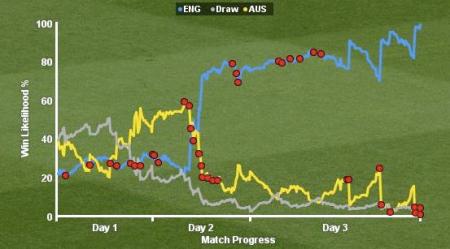
I’m very grateful to Daniel Mortlock for sending me this fascinating plot. It comes from the cricket pages of The Times Online and it shows how the probability of the various possible outcomes of the Final Ashes Test at the Oval evolved with time according to their “Hawk-Eye Analysis”.

pastedGraphic

 I think I should mention that Daniel is an Australian supporter, so this graph must make painful viewing for him! Anyway, it’s a fascinating plot, which I read as an application of Bayesian probability.

At the beginning of the match, a prior probability is assigned to each of the three possible outcomes: England win (blue); Australia win (yellow); and Draw (grey). It looks like these are roughly in the ratio 1:2:2. No details are given as to how these were arrived at, but it must have taken into account the fact that Australia thrashed England in the previous match at Headingley. Information from previous Tests at the Oval was presumably also included.I don’t know if the fact that England won the toss and decided to bat first altered the prior odds significantly, but it should have.

Anyway, what happens next depends on how sophisticated a model is used to determine the subsequent evolution of the  probabilities. In good Bayesian fashion, information is incorporate in a likelihood function determined by the model and this is used to update the  prior  to produce a posterior probability. This is passed on as a prior for  the next time step. And so it goes on until the end of the match where, regardless of what prior is chosen, the data force the model to the correct conclusion.

The red dots show the fall of wickets, but the odds fluctuate continually in accord with variables such as scoring rate, number of wickets,  and, presumably, the weather. Some form of difference equation is clearly being used, but we don’t know the details.

England got off to a pretty good start, so their probability to win started to creep up, but not by all that much, presumably because the model didn’t think their first-innings total of 332 was enough against a good batting side like Australia. However, the odds of a draw fell more significantly as a result of fairly quick scoring and the lack of any rain delays.

When the Australians batted they were going well at the start so England’s probability to win started to fall and theirs to rise. But when they started to lose quick wickets (largely to Stuart Broad), the blue and yellow trajectories swap over and England became favourites by a large margin. Despite a wobble when they lost 3 early wickets and some jitters when Australia’s batsmen put healthy partnerships together, England remained the more probable to win from that point to the end.

Although it all basically makes some sense, there are some curiosities.  Daniel Mortlock asked, for example, whether Australia were  really as likely to win at about 200 for 2 on the fourth day as  England were when Australia were 70 without loss in the first innings?  That’s what the graph seems to say. His reading of this is that too much stock is placed in the difficulty of   breaking a big (100+ runs) parnership, as the curves seem to   “accelerate” when the batsmen seem to be doing well.

I wonder how new information is included in general terms. Australia’s poor first innings batting (160 all out) in any case only reduced their win probability to about the level that England started at. How was their batting in the first innings balanced against their performance in the last match?

I’d love to know more about the algorithm used in this analysis, but I suspect it is copyright. There may be a good reason for not disclosing it. I have noticed in recent years that bookmakers have been setting extremely parsimonious odds for cricket outcomes. Gone are the days (Headingley 1981) when bookmakers offered 500-1 against England to beat Australia, which they then proceeded to do. In those days the bookmakers relied on expert advisors to fix their odds. I believe it was the late Godfrey Evans who persuaded them to offer 500-1. I’m not sure if they ever asked him again!

The system on which Hawkeye is based is much more conservative. Even on the last day of the test, odds against an Australian victory remained around 4-1 until they were down to their last few wickets. Notice also that the odds on a draw were never as long against as they should have been either, when that outcome was clearly virtually impossible. On the morning of the final day I could only find 10-1 against the draw which I think is remarkably ungenerous. However, even with an England victory a near certainty you could still find odds like 1-4. It seems like the system doesn’t like to produce extremely long or extremely short odds.

Perhaps the bookies are now using analyses like this to set their odds, which explains why betting on cricket isn’t as much fun as it used to be. On the other hand, if the system is predisposed against very short odds then maybe that’s the kind of bet to make in order to win. Things like this may be why the algorithm behind Hawkeye isn’t published…

The Ashes Return

Posted in Cricket with tags on August 23, 2009 by telescoper

Just a short note, for posterity more than anything else. England have won back The Ashes from Australia!!

The final test match at the Oval ended this evening, with England finally knocking over the last Australian wicket, the gallant Mike Hussey who scored a defiant 121 today. Set to make a total of 546 to win in the second innings, Australia got to a creditable 348 all out but it was always going to be too stiff a target on a pitch that has been visibly deteriorating since the first day.

I’ve actually been struggling since last Friday with a nasty stomach bug, otherwise I might have had time to blog a bit more about this match. I have to say the tension as England’s fortunes have ebbed and flowed hasn’t done much for my convalescence either! Earlier this afternoon Australia looked very comfortable, in fact. Two run outs set them back a bit , but even so England were making heavy work of bowling them out. Cue Steve Harmison (who  had a mediocre match until that point) and Graham Swann (who had an excellent game) , both of them weighing in with wickets, as Australia finally keeled over, from 327-5 to 348 all out. Indeed Harmison took two wickets with consecutive balls and could have finished the match and won the Ashes with a hat-trick.

Although the game finished (just) inside four days instead of carrying on into the fifth, I was struck by how much the pattern of this match followed that of the Lord’s Test  that I was lucky enough to see a part of. In particular, both games turned on poor first innings with the bat for the Australians.

As for the series, we now all know just how important that last day at Cardiff was! With England winning at Lord’s, a draw at Edgbaston and Australia trouncing England at Headingley, it was only still 1-1 because of that staunch rearguard with the bat by England’s bowlers, Anderson and Panesar. Without them the series would have been 2-1 to Australia. If the series is tied the Ashes stay with whoever held them before the series started, so  a draw in this match would have meant Australia retaining them,  but England won and took the series 2-1. Although Monty Panesar didn’t play at the Oval, let’s not forget how important his contribution was.

 I don’t think this series produced as much quality cricket as the epic struggle of 2005. In that series the games were closer and on most occasions the game went into the final day with any result possible, which is actually quite a rare occurence in Test cricket.  But the result is the same and the celebrations will be similar.

If England can sort out their batting problems (especially at No. 3) then they could become a really good side. They’ll need to be when they travel to South Africa later this year. How about bringing Monty in at No. 3?

The football season is also under way and that’s the last Test cricket of the summer. Time passes. I enjoy football , especially when Newcastle United are winning – an all too rare experience but one which is happening these days – but I have to say that nothing can match Test cricket for drama and entertainment. If football is like a rock concert, then cricket is grand opera.

Cricketing Clerihews

Posted in Cricket with tags on July 22, 2009 by telescoper

Undaunted by the ructions caused by my previous attempt (now removed) to have a bit of fun by posting a few clerihews, I’ve decided to try again but this time the target is cricketers.

Please keep them polite, unless they’re about Australians. Bonus points to anyone who manages one about Ben Hilfenhaus. Here are a few to get you started:

If you see Nathan Hauritz
Starting to glower, it’s
Because a humdinger
Hit his right index finger

Andrew Flintoff
Was man-of-the-match by dint of
Some excellent bowling
Well worth extolling

Peter Siddle
Went for a piddle
And when he came back
He’d quite lost the knack

Alastair Cook
Likes to go for the hook
But when it’s more full
He goes for the pull

Andrew Strauss
May have raised a few doubts:
It was well worth a shout
But should have been “not out”..

Michael Clarke
Batted well in the dark
But looked like a chump
When he lost his off stump

Michael Hussey
Is not very fussy
Whether he edges or nicks
Or just wallops for six

Philip Hughes
Can never refuse
An offside dab
That the slips might just grab

Marcus North
Bravely marched forth
To face the England attack
But very soon marched back

Graham Onions
Bowls like he has bunions
But let there be – please –
A bowler called Cheese

On the Third Day..

Posted in Cricket with tags , , on July 19, 2009 by telescoper

Following on from my previous posts (here and here) about the First Ashes Test in Cardiff, I can’t help adding a quick post about my visit to Lord’s yesterday (Saturday) to see the third day’s play at the Second Ashes Test.

The circumstances of the day’s play were a bit different to those at Cardiff, to say the least. On the first day England had batted first, starting in great style but then surrending some silly wickets. At the end of day 1 England were 364-6 with Strauss unbeaten on 161, the total score not being dissimilar to that on the first day at Cardiff. On day 2 Strauss was out almost immediately and it looked like it was going to be a disappointing day for England. But the last pair added 47 runs and England got to 425 all out. When the Austalians batted, however, England took control of the game, reducing them to 156-8 by the end of Day 2. I don’t know what got into the Ozzies on Friday but most of them lost their wickets to daft shots rather than good bowling. Perhaps it was nerves.

I arrived at Lord’s on Saturday morning, about 9.15. I have been to Lord’s a few times before but not recently and never as the guest of a member of the MCC (Anton). I joined the lengthy queue for member’s guests but made it into the ground in good time to find seats in the Warner Stand (next to the Pavilion) and then have a look around the cricket museum (where the Ashes themselves are on display).

It was a considerably posher occasion than Cardiff, with MCC ties, blazers and other paraphernalia on display. Picnic hampers were in evidence around the enclosure and  champagne corks popped at regularly intervals. I contented myself, however, with lager and a bacon butty from the bar behind the stand.

Before the start of play the talk around the crowd was all about knocking over the last two Australian batsmen quickly and then enforcing the follow on. (If the team batting second doesn’t get within 200 runs of the team batting first then they can be required to bat again by the captain of the other team, which is called “following on”.) As it happened the tailenders clung on doggedly and it looked for a while they would close in on the 225 runs needed to avoid the follow-on. However, the last two wickets did eventually fall for a total of 215, leaving a deficit of 210 runs. England could have asked Australia to bat again but, to the consternation of most of the crowd, the England captain Andrew Strauss declined to enforce the follow-on.

There are pros and cons making a team follow on. One of the pros is that it maintains the momentum of the bowling performance. One of the cons is that the bowlers have already bowled an entire innings and have to do the same again almost immediately. They might be a bit tired, which could hand the advantage to the batting side if they can avoid losing early wickets. If the Australian batsmen had scored well after following on then England might also have needed to bat last on a pitch that may have started to break up. Batting last in a Test match is usually quite difficult.

I think Strauss is quite a cautious man and I think he decided that Australia’s strong batting display at Cardiff was enough evidence of ability for him not to want to risk them posting a huge second-innings score. England’s brittle second-innings batting performance at Cardiff provided further reason for not wanting to get into a run chase.

Strauss obviously wants to win the game but he also won’t want to lose it from this position. Test cricket isn’t just win-or-lose: there is also a third possibility, a draw (like at Cardiff). Often the biggest chance of winning a game is to give the side batting last a target that they might try to chase in risky fashion and get bowled out. However, if the batting side are good they might actually get the runs.  Too big a target and they won’t be tempted to go for it, too small and they might well reach it. Maximizing the probability of winning does not miminize the probability of losing in this situation. If England simply didn’t want to lose they would bat out time, accumulate a huge total and give Australia insufficient time to make the runs. England might still win in such a strategy but a draw becomes much more probable.

It was clearly Strauss’ judgement was that England needed more runs but he wanted to get them quickly enough to declare and try to force a result in the two remaining days. The England batsmen came out just before lunch to try to push on to a huge lead. They started very brightly but unfortunately both openers Strauss and Cook were out shortly after lunch. There then followed a very turgid couple of hours when Pietersen and Bopara struggled to score runs. Pietersen, usually a prolific hitter, apeared to be struggling with his Achilles injury while Bopara is clearly out of touch at this level. Both batsmen scratched around unconvincingly for most of the session and then got themselves out.

At 174-4 it was looking like another collapse might be on the cards and the Australians might have to chase a total under about 400, which appeared to me to be eminently achievable with two full days play available after Saturday. However, Collingwood and (especially) Prior batted superbly well together taking the score to 260-5 and then Flintoff and Collingwood carried it onto 311 before Collingwood was out.

Many members of the crowd were screaming for a declaration now, but the weather intervened. It had been getting very dark for some time and finally started raining about 6.30. The umpires called off play for the day with England at 311-6, a lead of 521 with two days left to play, a good position to be in by any standards.

Unless the weather turns very bad over the next two days then it seems to me a draw is a very unlikely possibility now. If England declare overnight and Australia can bat for two days they will score enough runs to win the game, but in doing so they will have to surpass by some margin the highest ever total reached in the last innings to win a Test match. Frankly, if they can do that they deserve to win! On the other hand, England have plenty of time to bowl them out even if a  bit is lost to the weather. I actually think Strauss’ decision to bat again was probably a good one and I think he should carry on batting tomorrow to get another 100 runs or so. There will still be time to bowl out the Ozzies, but the chance of them scoring enough to win the game is smaller.

I left the ground and walked to Paddington to get the train back to Cardiff and was home by 10pm. A very satisfactory day.

Postscript. I just looked at the scorecard of today’s play (Sunday) before posting this. England declared their innings closed on 311-6 and Australia went into bat this morning. At lunch they were 76-2. The odds are in favour of England winning, but Ponting is still in. It’s nicely poised.