Archive for the The Universe and Stuff Category

Irish Quantum Foundations

Posted in The Universe and Stuff with tags , , , on May 28, 2018 by telescoper

I flew back from Cardiff to Dublin this morning in order to attend a conference called Irish Quantum Foundations which is taking place today and tomorrow on the All Hallow’s Campus of Dublin City University, in Drumcondra (Dublin). I usually take the Hopper bus directly to Maynooth from Dublin Airport but today involved a different journey, via the ordinary No. 16 Dublin Bus.Anyway, I got here on time.

I’m speaking just after lunch so I’m not sure how much time I will have to blog about the meeting, but I couldn’t resist posting this little video related to a talk by Emmanuel Fort which demonstrates a purely classical form of wave-particle duality:

I’ll post further comments about talks if and when I get the time!

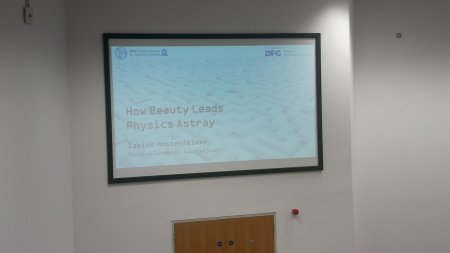
Evening update: two public talks, the first being by renowned physicist and blogger, Sabine Hossenfelder:

The talk ended with a plug for Sabine’s book, which is out soon.

After a short break we had a second public lecture by Nobel Physics Laureate (2016), Duncan Haldane.

Is Dark Matter a Superfluid?

Posted in The Universe and Stuff with tags , , , , , , on May 22, 2018 by telescoper

In between marking exams and project reports I’ve been doing a little bit of reading in preparation for a talk that I’m due to give next week, which prompted me to share this talk by Justin Khoury of the University of Pennsylvania, which is about framework that unifies the claimed success of Modified Newtonian Dynamics (MOND) on galactic scales with the that of the standard ΛCDM model on cosmological scales. This is achieved through the physics of superfluidity. The dark matter and MOND components have a common origin, representing different phases of a single underlying substance. In galaxies, dark matter thermalizes and condenses to form a superfluid phase. The superfluid phonons couple to baryonic matter particles and mediate a MOND-like force. This framework naturally distinguishes between galaxies (where MOND is successful) and galaxy clusters (where MOND is not): dark matter has a higher temperature in clusters, and hence is in a mixture of superfluid and normal phase. The rich and well-studied physics of superfluidity leads to a number of observational signatures, discussed in the talk.

The idea that dark matter might be in the form of a superfluid is not new (see e.g. this paper) but there has been a recent surge of interest driven largely by Khoury and collaborators. If you want to find out more, can find a review paper about this model here.

Planck wins the Gruber Prize (and the Shaw Prize)

Posted in Science Politics, The Universe and Stuff with tags , , on May 13, 2018 by telescoper

I forgot to mention last week that the 2018 Gruber Prize for Cosmology has been awarded to the Planck team, and its Principal Investigators Nazzareno Mandolesi and Jean-Loup Puget.

For more information about the award and the citation, see here.

This annual prize is worth $500,00; the two PIs will get $125,000 each and the rest divided among the team. I’m not sure whether this means the Planck Science Team (whose membership is listed here or the entire Planck Collaboration (which numbers several hundred people) but regardless of whoever gets the actual dosh, this award provides a good excuse to send congratulations to everyone who worked on this brilliant and highly successful mission!


UPDATE: 14th May 2018. Jean-Loup Puget has also been awarded the Shaw Prize for Astronomy.

Revisionist (Thermal) History of the Universe

Posted in Biographical, Cardiff, Education, The Universe and Stuff with tags , , on May 10, 2018 by telescoper

Well, today saw my last teaching session on my Cardiff University module Physics of the Early Universe. It was actually an optional revision lecture, during which I went through questions on last year’s examination paper, some matters arising therefrom and some general tips on `examination technique’. The latter included advice that seems obvious – such as `read the question carefully’ and `check your numerical answers’ – but that surprisingly many students seem not to have heard before or, if they have, choose not to follow!

Anyway, I hope the students who came today found it useful and I hope that they (and indeed everyone else taking examinations over the next few weeks) do themselves proper justice and get the results they need for whatever comes next in their plans.

The Physics of the Early Universe paper is a couple of weeks ago so no doubt I’ll get a few more queries to deal with before then.

I thought I’d give an idea of the stuff I’ve been teaching here by including one of the questions from last year’s paper. I thought this was quite an easy one, actually, but the students seemed to find it tricky while they mostly coped well with the other questions, which I thought were harder. One of the challenges of teaching is that it’s often hard to see what other people find difficult! See what you think. You don’t really need to know much cosmology to do this:

Anyway, today was not only the last teaching session for this particular module – it’s also the last teaching session I’ll ever conduct in the UK university system. Best wishes to whoever it is that teaches this module next year when I’m in Ireland.

Celebrating the Sloan Telescope

Posted in The Universe and Stuff with tags , , , , , , , , on May 9, 2018 by telescoper

A little bird tweeted at me this morning that today is the 20th anniversary of first light through the Sloan Telescope (funded by the Alfred P. Sloan Foundation) which has, for the past two decades, been surveying as much of the sky as it can from its location in New Mexico (about 25% altogether): the Sloan Digital Sky Survey is now on its 14th data release.

Here’s a picture of the telescope:

For those of you who want the optical details, the Sloan Telescope is a 2.5-m f/5 modified Ritchey-Chrétien altitude-azimuth telescope located at Apache Point Observatory, in south east New Mexico (Latitude 32° 46′ 49.30″ N, Longitude 105° 49′ 13.50″ W, Elevation 2788m). A 1.08 m secondary mirror and two corrector lenses result in a 3° distortion-free field of view. The telescope is described in detail in a paper by Gunn et al. (2006).

A 2.5m telescope of modest size by the standards of modern astronomical research, but the real assets of the Sloan telescope is a giant mosaic camera, highly efficient instruments and a big investment in the software required to generate and curate the huge data sets it creates. A key feature of SDSS is that its data sets are publicly available and, as such, they have been used in countless studies by a huge fraction of the astronomical community.

The Sloan Digital Sky Survey’s original `legacy’ survey was basically a huge spectroscopic redshift survey, mapping the positions of galaxies and quasars in three dimensions to reveal the `cosmic web’ in unprecedented detail:

As it has been updated and modernised, the Sloan Telescope has been involved in a range of other surveys aimed at uncovering different aspects of the universe around us, including several programmes still ongoing.

Stars Dance to the Music of Parallax

Posted in The Universe and Stuff with tags , , on May 3, 2018 by telescoper

I thought I’d share this cute video from the European Space Agency about the Gaia mission I blogged about last week. It shows the effect of parallax, as measured by Gaia, on the positions of stars on the sky. As the Earth orbits the Sun stars do a dance in the sky; the shift in their position greater for closer stars rather than distant ones. To make the video, parallaxes measured by Gaia have been exaggerated by a factor 100,000 and proper motions have been speeded up by one trillion (1012). The effect is rather hypnotic, and gives a sense of the three-dimensional nature of the distribution of stars. At the end of the video you can see the effect of proper motions too, i.e. the change in position of a star due to its actual motion rather than that of the observer.

Hubble Constant Catch-Up

Posted in Bad Statistics, The Universe and Stuff with tags , , , , on May 2, 2018 by telescoper

Last week when I wrote about the 2nd Data Release from Gaia, somebody emailed me to ask whether the new results said anything about the cosmological distance ladder and hence the Hubble Constant. As far as I could see, no scientific papers were released on this topic at the time and I thought there probably wasn’t anything definitive at this stage. However, it turns out that there is a paper now, by Riess et al., which focuses on the likely impact of Gaia on the Cepheid distance scale. Here is the abstract:

We present HST photometry of a selected sample of 50 long-period, low-extinction Milky Way Cepheids measured on the same WFC3 F555W, F814W, and F160W-band photometric system as extragalactic Cepheids in SN Ia hosts. These bright Cepheids were observed with the WFC3 spatial scanning mode in the optical and near-infrared to mitigate saturation and reduce pixel-to-pixel calibration errors to reach a mean photometric error of 5 millimags per observation. We use the new Gaia DR2 parallaxes and HST photometry to simultaneously constrain the cosmic distance scale and to measure the DR2 parallax zeropoint offset appropriate for Cepheids. We find a value for the zeropoint offset of -46 +/- 13 muas or +/- 6 muas for a fixed distance scale, higher than found from quasars, as expected, for these brighter and redder sources. The precision of the distance scale from DR2 has been reduced by a factor of 2.5 due to the need to independently determine the parallax offset. The best fit distance scale is 1.006 +/- 0.033, relative to the scale from Riess et al 2016 with H0=73.24 km/s/Mpc used to predict the parallaxes photometrically, and is inconsistent with the scale needed to match the Planck 2016 CMB data combined with LCDM at the 2.9 sigma confidence level (99.6%). At 96.5% confidence we find that the formal DR2 errors may be underestimated as indicated. We identify additional error associated with the use of augmented Cepheid samples utilizing ground-based photometry and discuss their likely origins. Including the DR2 parallaxes with all prior distance ladder data raises the current tension between the late and early Universe route to the Hubble constant to 3.8 sigma (99.99 %). With the final expected precision from Gaia, the sample of 50 Cepheids with HST photometry will limit to 0.5% the contribution of the first rung of the distance ladder to the uncertainty in the Hubble constant.

So, nothing definitive yet but potentially very interesting in the future and this group, led by Adam Riess, is now claiming a 3.8σ tension between measurements of the Hubble constant from cosmic microwave background measurements and from traditional `distance ladder’ approaches, though to my mind this is based on some rather subjective judgements.

The appearance of that paper reminded me that I forgot to post about a paper by Bernal & Peacock that appeared a couple of months ago. Here is the abstract of that one:

When combining data sets to perform parameter inference, the results will be unreliable if there are unknown systematics in data or models. Here we introduce a flexible methodology, BACCUS: BAyesian Conservative Constraints and Unknown Systematics, which deals in a conservative way with the problem of data combination, for any degree of tension between experiments. We introduce hyperparameters that describe a bias in each model parameter for each class of experiments. A conservative posterior for the model parameters is then obtained by marginalization both over these unknown shifts and over the width of their prior. We contrast this approach with an existing hyperparameter method in which each individual likelihood is scaled, comparing the performance of each approach and their combination in application to some idealized models. Using only these rescaling hyperparameters is not a suitable approach for the current observational situation, in which internal null tests of the errors are passed, and yet different experiments prefer models that are in poor agreement. The possible existence of large shift systematics cannot be constrained with a small number of data sets, leading to extended tails on the conservative posterior distributions. We illustrate our method with the case of the H0 tension between results from the cosmic distance ladder and physical measurements that rely on the standard cosmological model.

This paper addresses the long-running issue of apparent tension in different measurements of the Hubble constant that I’ve blogged about before (e.g. here) by putting the treatment of possible systematic errors into a more rigorus and consistent (i.e. Bayesian) form. It says what I think most people in the community privately think about this issue, i.e. that it’s probably down to some sort of unidentified systematic rather than exotic physics.

The title of the paper includes the phrase `Conservative Cosmology’, but I think that’s a bit of a misnomer. I think `Sensible Cosmology’. Current events suggest `conservative’ and `sensible’ have opposite meanings. You can find a popular account of it here, from which I have stolen this illustration of the tension:

A chart showing the two differing results for the Hubble constant – The expansion rate of the universe (in km/s/Mpc)
Result 1: 67.8 ± 0.9 Cosmic microwave background
Result 2: 73.52 ± 1.62 Cosmic distance ladder

Anyway, I have a poll that has been going on for some time about whether this tension is anything to be excited about, so why not use this opportunity cast your vote?

Gaia’s Second Data Release!

Posted in The Universe and Stuff with tags , , , on April 26, 2018 by telescoper

It seems like only yesterday that I was blogging excitedly about the first release of data (DR1) from the European Space Agency’s Gaia Mission. In fact it was way back in 2016! Anyway, yesterday came another glut of Gaia goodness in the form of the second release of data, known to its friends as DR2.

In case you weren’t aware, Gaia is an ambitious space mission to chart a three-dimensional map of our Galaxy, the Milky Way, in the process revealing the composition, formation and evolution of the Galaxy. Gaia will provide unprecedented positional and radial velocity measurements with the accuracy needed to produce a stereoscopic and kinematic census of about one billion stars in our Galaxy and throughout the Local Group. This amounts to about 1 per cent of the Galactic stellar population.

You can find links to all the DR2 science papers here, a guide to how to use the data here, and of course a link to the full Gaia Archive here.

Here’s a (brief!) list of the contents of DR2:

  • The five-parameter astrometric solution – positions on the sky (α, δ), parallaxes, and proper motions – for more than 1.3 billion (109) sources, with a limiting magnitude of G = 21 and a bright limit of G ≈ 3. Parallax uncertainties are in the range of up to 0.04 milliarcsecond for sources at G < 15, around 0.1 mas for sources with G=17 and at the faint end, the uncertainty is of the order of 0.7 mas at G = 20. The corresponding uncertainties in the respective proper motion components are up to 0.06 mas yr-1 (for G < 15 mag), 0.2 mas yr-1 (for G = 17 mag) and 1.2 mas yr-1 (for G = 20 mag). The Gaia DR2 parallaxes and proper motions are based only on Gaia data; they do no longer depend on the Tycho-2 Catalogue.
  • Median radial velocities (i.e. the median value over the epochs) for more than 7.2 million stars with a mean G magnitude between about 4 and 13 and an effective temperature (Teff) in the range of about 3550 to 6900 K. This leads to a full six-parameter solution: positions and motions on the sky with parallaxes and radial velocities, all combined with mean G magnitudes. The overall precision of the radial velocities at the bright end is in the order of 200-300 m s-1 while at the faint end the overall precision is approximately 1.2 km s-1 for a Teff of 4750 K and about 2.5 km s-1 for a Teff of 6500 K.
  • An additional set of more than 361 million sources for which a two-parameter solution is available: the positions on the sky (α, δ) combined with the mean G magnitude. These sources have a positional uncertainty at G=20 of about 2 mas, at J2015.5.
    G magnitudes for more than 1.69 billion sources, with precisions varying from around 1 milli-mag at the bright (G<13) end to around 20 milli-mag at G=20. Please be aware that the photometric system for the G band in Gaia DR2 is different from the photometric system as used in Gaia DR1.
  • GBP and GRP magnitudes for more than 1.38 billion sources, with precisions varying from a few milli-mag at the bright (G<13) end to around 200 milli-mag at G=20.
  • Full passband definitions for G, BP and RP. These passbands are now available for download.
  • Epoch astrometry for 14,099 known solar system objects based on more than 1.5 million CCD observations. 96% of the along-scan (AL) residuals are in the range -5 to 5 mas, and 52% of the AL residuals are in the range of -1 to 1 mas. The transit observations are part of Gaia DR2 and have also been delivered to the Minor Planet Center (MPC).
  • Subject to limitations (see below) the effective temperatures Teff for more than 161 million sources brighter than 17th magnitude with effective temperatures in the range 3000 to 10,000 K. For a subset of about 87 million sources also the line-of-sight extinction AG and reddening E(BP-RP) are given and for a part of this subset (around 76 million sources) the luminosity and radius are available as well.
  • Classifications for more than 550,000 variable sources consisting of Cepheids, RR Lyrae, Mira and Semi-Regular Candidates as well as High-Amplitude Delta Scuti, BY Draconis candidates, SX Phoenicis Candidates and short time scale phenomena.
  • Planned cross-matches between Gaia DR2 sources on the one hand and Hipparcos-2, Tycho-2, 2MASS PSC, SDSS DR9, Pan-STARRS1, GSC2.3, PPM-XL, AllWISE, and URAT-1 data on the other hand.

There’s much more to Gaia than pictures, but here’s a map of the stars in our galaxy to give you an idea:

I remember first hearing about Gaia about 17 years ago when I was on a PPARC advisory panel and was immediately amazed  by the ambition of its objectives. As I mentioned above, Gaia is a global space astrometry mission, which will make the largest, most precise three-dimensional map of our Galaxy by surveying more than a billion stars. In some sense Gaia is the descendant of the Hipparcos mission launched in 1989, but it’s very much more than that. Gaia monitors each of its target stars about 70 times over a five-year period. It is expected to discover hundreds of thousands of new celestial objects, such as extra-solar planets and brown dwarfs, and observe hundreds of thousands of asteroids within our own Solar System. The mission is also expected to yield a wide variety of other benefits, including new tests of the  General Theory of Relativity.

For the brighter objects, i.e. those brighter than magnitude 15, Gaia  measures their positions to an accuracy of 24 microarcseconds, comparable to measuring the diameter of a human hair at a distance of 1000 km. Distances of relatively nearby stars are measured to an accuracy of 0.001%. Even stars near the Galactic Centre, some 30,000 light-years away, have their distances measured to within an accuracy of 20%.

It’s an astonishing mission that will leave an unbelievably rich legacy not only for the astronomers working on the front-line operations of Gaia but for generations to come.

Pictures from Post-Planck Cosmology in Pune

Posted in Biographical, Books, Talks and Reviews, The Universe and Stuff with tags , , on April 20, 2018 by telescoper

Regular readers of this blog (Sid and Doris Bonkers) will know that last year I went to the Inter-University Centre for Astronomy and Astrophysics in Pune (India) for a conference on `Post-Planck Cosmology’. Well, I recently received a copy of the official conference photograph, which I thought I’d share:

There is also an online collection of pictures taken during the talks, from which I have taken the liberty of extracting this picture of me during my talk:

I think this picture has a lot of potential for a caption competition, so please feel free to suggest captions through the comments block!

The Dark Matter of Astronomy Hype

Posted in Astrohype, Bad Statistics, The Universe and Stuff with tags , , , , on April 16, 2018 by telescoper

Just before Easter (and, perhaps more significantly, just before April Fool’s Day) a paper by van Dokkum et al. was published in Nature with the title A Galaxy Lacking Dark Matter. As is often the case with scientific publications presented in Nature, the press machine kicked into action and stories about this mysterious galaxy appeared in print and online all round the world.

So what was the result? Here’s the abstract of the Nature paper:


Studies of galaxy surveys in the context of the cold dark matter paradigm have shown that the mass of the dark matter halo and the total stellar mass are coupled through a function that varies smoothly with mass. Their average ratio Mhalo/Mstars has a minimum of about 30 for galaxies with stellar masses near that of the Milky Way (approximately 5 × 1010 solar masses) and increases both towards lower masses and towards higher masses. The scatter in this relation is not well known; it is generally thought to be less than a factor of two for massive galaxies but much larger for dwarf galaxies. Here we report the radial velocities of ten luminous globular-cluster-like objects in the ultra-diffuse galaxy NGC1052–DF2, which has a stellar mass of approximately 2 × 108 solar masses. We infer that its velocity dispersion is less than 10.5 kilometres per second with 90 per cent confidence, and we determine from this that its total mass within a radius of 7.6 kiloparsecs is less than 3.4 × 108 solar masses. This implies that the ratio Mhalo/Mstars is of order unity (and consistent with zero), a factor of at least 400 lower than expected. NGC1052–DF2 demonstrates that dark matter is not always coupled with baryonic matter on galactic scales.


I had a quick look at the paper at the time and wasn’t very impressed by the quality of the data. To see why look at the main plot, a histogram formed from just ten observations (of globular clusters used as velocity tracers):

I didn’t have time to read the paper thoroughly before the Easter weekend,  but did draft a sceptical blog on the paper only to decide not to publish it as I thought it might be too inflammatory even by my standards! Suffice to say that I was unconvinced.

Anyway, it turns out I was far from the only astrophysicist to have doubts about this result; you can find a nice summary of the discussion on social media here and here. Fortunately, people more expert than me have found the time to look in more detail at the Dokkum et al. claim. There’s now a paper on the arXiv by Martin et al.

It was recently proposed that the globular cluster system of the very low surface-brightness galaxy NGC1052-DF2 is dynamically very cold, leading to the conclusion that this dwarf galaxy has little or no dark matter. Here, we show that a robust statistical measure of the velocity dispersion of the tracer globular clusters implies a mundane velocity dispersion and a poorly constrained mass-to-light ratio. Models that include the possibility that some of the tracers are field contaminants do not yield a more constraining inference. We derive only a weak constraint on the mass-to-light ratio of the system within the half-light radius or within the radius of the furthest tracer (M/L_V<8.1 at the 90-percent confidence level). Typical mass-to-light ratios measured for dwarf galaxies of the same stellar mass as NGC1052-DF2 are well within this limit. With this study, we emphasize the need to properly account for measurement uncertainties and to stay as close as possible to the data when determining dynamical masses from very small data sets of tracers.

More information about this system has been posted by Pieter van Dokkum on his website here.

Whatever turns out in the final analysis of NGC1052-DF2 it is undoubtedly an interesting system. It may indeed turn out to  have less dark matter than expected though I don’t think the evidence available right now warrants such an inference with such confidence. What worries me most however, is the way this result was presented in the media, with virtually no regard for the manifest statistical uncertainty inherent in the analysis. This kind of hype can be extremely damaging to science in general, and to explain why I’ll go off on a rant that I’ve indulged in a few times before on this blog.

A few years ago there was an interesting paper  (in Nature of all places), the opening paragraph of which reads:

The past few years have seen a slew of announcements of major discoveries in particle astrophysics and cosmology. The list includes faster-than-light neutrinos; dark-matter particles producing γ-rays; X-rays scattering off nuclei underground; and even evidence in the cosmic microwave background for gravitational waves caused by the rapid inflation of the early Universe. Most of these turned out to be false alarms; and in my view, that is the probable fate of the rest.

The piece went on to berate physicists for being too trigger-happy in claiming discoveries, the BICEP2 fiasco being a prime example. I agree that this is a problem, but it goes far beyond physics. In fact its endemic throughout science. A major cause of it is abuse of statistical reasoning.

Anyway, I thought I’d take the opportunity to re-iterate why I statistics and statistical reasoning are so important to science. In fact, I think they lie at the very core of the scientific method, although I am still surprised how few practising scientists are comfortable with even basic statistical language. A more important problem is the popular impression that science is about facts and absolute truths. It isn’t. It’s a <em>process</em>. In order to advance it has to question itself. Getting this message wrong – whether by error or on purpose -is immensely dangerous.

Statistical reasoning also applies to many facets of everyday life, including business, commerce, transport, the media, and politics. Probability even plays a role in personal relationships, though mostly at a subconscious level. It is a feature of everyday life that science and technology are deeply embedded in every aspect of what we do each day. Science has given us greater levels of comfort, better health care, and a plethora of labour-saving devices. It has also given us unprecedented ability to destroy the environment and each other, whether through accident or design.

Civilized societies face rigorous challenges in this century. We must confront the threat of climate change and forthcoming energy crises. We must find better ways of resolving conflicts peacefully lest nuclear or chemical or even conventional weapons lead us to global catastrophe. We must stop large-scale pollution or systematic destruction of the biosphere that nurtures us. And we must do all of these things without abandoning the many positive things that science has brought us. Abandoning science and rationality by retreating into religious or political fundamentalism would be a catastrophe for humanity.

Unfortunately, recent decades have seen a wholesale breakdown of trust between scientists and the public at large. This is due partly to the deliberate abuse of science for immoral purposes, and partly to the sheer carelessness with which various agencies have exploited scientific discoveries without proper evaluation of the risks involved. The abuse of statistical arguments have undoubtedly contributed to the suspicion with which many individuals view science.

There is an increasing alienation between scientists and the general public. Many fewer students enrol for courses in physics and chemistry than a a few decades ago. Fewer graduates mean fewer qualified science teachers in schools. This is a vicious cycle that threatens our future. It must be broken.

The danger is that the decreasing level of understanding of science in society means that knowledge (as well as its consequent power) becomes concentrated in the minds of a few individuals. This could have dire consequences for the future of our democracy. Even as things stand now, very few Members of Parliament are scientifically literate. How can we expect to control the application of science when the necessary understanding rests with an unelected “priesthood” that is hardly understood by, or represented in, our democratic institutions?

Very few journalists or television producers know enough about science to report sensibly on the latest discoveries or controversies. As a result, important matters that the public needs to know about do not appear at all in the media, or if they do it is in such a garbled fashion that they do more harm than good.

Years ago I used to listen to radio interviews with scientists on the Today programme on BBC Radio 4. I even did such an interview once. It is a deeply frustrating experience. The scientist usually starts by explaining what the discovery is about in the way a scientist should, with careful statements of what is assumed, how the data is interpreted, and what other possible interpretations might be and the likely sources of error. The interviewer then loses patience and asks for a yes or no answer. The scientist tries to continue, but is badgered. Either the interview ends as a row, or the scientist ends up stating a grossly oversimplified version of the story.

Some scientists offer the oversimplified version at the outset, of course, and these are the ones that contribute to the image of scientists as priests. Such individuals often believe in their theories in exactly the same way that some people believe religiously. Not with the conditional and possibly temporary belief that characterizes the scientific method, but with the unquestioning fervour of an unthinking zealot. This approach may pay off for the individual in the short term, in popular esteem and media recognition – but when it goes wrong it is science as a whole that suffers. When a result that has been proclaimed certain is later shown to be false, the result is widespread disillusionment.

The worst example of this tendency that I can think of is the constant use of the phrase “Mind of God” by theoretical physicists to describe fundamental theories. This is not only meaningless but also damaging. As scientists we should know better than to use it. Our theories do not represent absolute truths: they are just the best we can do with the available data and the limited powers of the human mind. We believe in our theories, but only to the extent that we need to accept working hypotheses in order to make progress. Our approach is pragmatic rather than idealistic. We should be humble and avoid making extravagant claims that can’t be justified either theoretically or experimentally.

The more that people get used to the image of “scientist as priest” the more dissatisfied they are with real science. Most of the questions asked of scientists simply can’t be answered with “yes” or “no”. This leaves many with the impression that science is very vague and subjective. The public also tend to lose faith in science when it is unable to come up with quick answers. Science is a process, a way of looking at problems not a list of ready-made answers to impossible problems. Of course it is sometimes vague, but I think it is vague in a rational way and that’s what makes it worthwhile. It is also the reason why science has led to so many objectively measurable advances in our understanding of the World.

I don’t have any easy answers to the question of how to cure this malaise, but do have a few suggestions. It would be easy for a scientist such as myself to blame everything on the media and the education system, but in fact I think the responsibility lies mainly with ourselves. We are usually so obsessed with our own research, and the need to publish specialist papers by the lorry-load in order to advance our own careers that we usually spend very little time explaining what we do to the public or why.

I think every working scientist in the country should be required to spend at least 10% of their time working in schools or with the general media on “outreach”, including writing blogs like this. People in my field – astronomers and cosmologists – do this quite a lot, but these are areas where the public has some empathy with what we do. If only biologists, chemists, nuclear physicists and the rest were viewed in such a friendly light. Doing this sort of thing is not easy, especially when it comes to saying something on the radio that the interviewer does not want to hear. Media training for scientists has been a welcome recent innovation for some branches of science, but most of my colleagues have never had any help at all in this direction.

The second thing that must be done is to improve the dire state of science education in schools. Over the last two decades the national curriculum for British schools has been dumbed down to the point of absurdity. Pupils that leave school at 18 having taken “Advanced Level” physics do so with no useful knowledge of physics at all, even if they have obtained the highest grade. I do not at all blame the students for this; they can only do what they are asked to do. It’s all the fault of the educationalists, who have done the best they can for a long time to convince our young people that science is too hard for them. Science can be difficult, of course, and not everyone will be able to make a career out of it. But that doesn’t mean that it should not be taught properly to those that can take it in. If some students find it is not for them, then so be it. We don’t everyone to be a scientist, but we do need many more people to understand how science really works.

I realise I must sound very gloomy about this, but I do think there are good prospects that the gap between science and society may gradually be healed. The fact that the public distrust scientists leads many of them to question us, which is a very good thing. They should question us and we should be prepared to answer them. If they ask us why, we should be prepared to give reasons. If enough scientists engage in this process then what will emerge is and understanding of the enduring value of science. I don’t just mean through the DVD players and computer games science has given us, but through its cultural impact. It is part of human nature to question our place in the Universe, so science is part of what we are. It gives us purpose. But it also shows us a way of living our lives. Except for a few individuals, the scientific community is tolerant, open, internationally-minded, and imbued with a philosophy of cooperation. It values reason and looks to the future rather than the past. Like anyone else, scientists will always make mistakes, but we can always learn from them. The logic of science may not be infallible, but it’s probably the best logic there is in a world so filled with uncertainty.