Archive for the The Universe and Stuff Category

Cosmology beyond the Centenary of Λ

Posted in Talks and Reviews, The Universe and Stuff with tags , , on June 6, 2017 by telescoper

I didn’t expect to be doing anything other than listening to the talks and getting updated on the progress of the Euclid project at this meeting in London, but this morning I was roped in to introduce a public event tomorrow evening, called Cosmology beyond the Centenary of Λ:
ECSM_public_evening_event_2


This will take the form of a dialogue/discussion/debate between two leading cosmologists taking a `big picture’ view of the state of cosmology now and likely future developments. I’m sure it will be very friendly so I won’t use any form of language that suggests confrontation but it features, in the red corner, George Efstathiou of the University of Cambridge and, in the blue corner, Ofer Lahav of University College London.

Incidentally, I posted some months ago about the fact that this is the centenary year of Einstein’s introduction of the cosmological constant into the field equations of general relativity in this paper:

cosmo

I recommend anyone attending this Euclid meeting and indeed anyone with a passing interest in cosmology to read that paper – it’s very different from what you might probably imagine it to be!

A Tale of Two Cities 

Posted in Biographical, The Universe and Stuff with tags , , on June 5, 2017 by telescoper

“It was the best of times, it was the worst of times..”

As planned on Saturday evening I stayed at home,  cooked myself dinner, opened a bottle of wine, and watched an old film on DVD. Self-indulgent, I know, but a good way to  have a pleasant evening while avoiding  the crowds at the UEFA Champions League final.

Some time after 10pm  I checked Twitter to see what the score was (4-1 to Real Madrid), and just to check that nothing untoward had happened before or during the match.

It hadn’t, but that was exactly when news was coming in of another terrorist attack in London, this time on London Bridge and in the area of Borough Market. Stories were initially very confused, and I went to bed before a clear picture emerged.

I checked the news feeds again when I woke up and felt the saddest I’ve ever been on a birthday, but still determined to go to Der Rosenkavalier. The best way for us all to beat terrorism is to carry on regardless.

Likewise I didn’t think twice about coming to London today for the Euclid meeting this week. That said, I did arrive very late. Torrential rain overnight in Cardiff, combined with a blocked gutter, led to a flood in my kitchen. I had to call a useful person to fix it the problem, which delayed me by a few hours. Fortunately it was only rainwater in the leak, not nasty stuff backed up from the drain.

Now I’m in London where it is also tipping down, but at least I’m in a pleasant hotel and looking to get a good night’s sleep. The sound of rain can be restful, at least when it’s not flooding your kitchen.

I made my way to the hotel, which is in Bayswater, after a wine and nibbles reception at the workshop. I have never stayed here before and it took a while to find. I was a bit nervous too, as the place is remarkably cheap by London standards. Before correctly locating the hotel I wandered into another establishment on the same street with a similar name. It was quite obviously a brothel, and they politely directed me to the correct address. The hotel turned out to be fine, though obviously without any of the ‘extras’ that would have been available at the other place.

I can’t stay the whole week here as I have to get back to Cardiff to vote on Thursday, but it’s been nice to catch up with news of the Euclid mission and to meet some old friends. There are about 400 cosmologists here in London for this meeting, some of them familiar some of them less so. The mission won’t be launched until 2021 at the earliest, and it’s unlikely I’ll be involved very much, but it’s still exciting to see it all taking shape.

Simulation of the binary black-hole coalescence GW170104

Posted in The Universe and Stuff with tags , , , on June 2, 2017 by telescoper

Via the Cardiff University news website, I found this video of a computer simulation of the binary black-hole coalescence that gave rise to the gravitational wave event GW170104 whose detection was announced yesterday, so I thought I’d share it here.

Here’s the  blurb accompanying the video:

The video shows a numerical simulation of a binary black-hole coalescence with masses and spins consistent with the GW170104 observation. The strength of the gravitational wave is indicated by elevation as well as color, with blue indicating weak fields and yellow indicating strong fields. We rescale the amplitude of the gravitational wave during the simulation to show the signal during the entire animation not only close to merger, where it is strongest. The sizes of the black holes are increased by a factor of two to improve visibility. The bottom panel in the video shows the gravitational waveform starting at frequency of 25Hz. The fade in of the video corresponds to a frequency of about 30Hz.

© Numerical-relativistic simulation: S. Ossokine, A. Buonanno (Max Planck Institute for Gravitational Physics) and the Simulating eXtreme Spacetimes project; scientific visualization: T. Dietrich (Max Planck Institute for Gravitational Physics), R. Haas (NCSA).

The colour scheme gives me a headache, and there’s no sountrack, but it’s quite instructive nonetheless.


New Astronomy at the New Year (GW170104)

Posted in The Universe and Stuff with tags , on June 1, 2017 by telescoper

The inside story of the detection of gravitational wave event announced earlier today..

Shane L. Larson's avatarWrite Science

by Shane L. Larson

Newton’s portrait.

January 4 holds a special place in the hearts of scientists — it is Isaac Newton’s birthday (*). Newton stood at the crossroads that led to modern science, and astronomy in particular. He was the first person to build a workable reflecting telescope, a design that now bears his name and for the past 4 centuries has been the dominant type of telescope used by amateurs and professionals alike. Newtonian telescopes have revealed much about the Cosmos to our wondering minds. Newton was also responsible for the first formulation of a physical law that describes the working of gravity, called the Universal Law of Gravitation. Today we use the Universal Law to launch satellites, send astronauts into orbit, convert the force of your feet on the bathroom scale into your “weight“, and a thousand other applications.  There is much to celebrate…

View original post 1,623 more words

Newsflash: another LIGO detection!

Posted in The Universe and Stuff with tags , , , on June 1, 2017 by telescoper

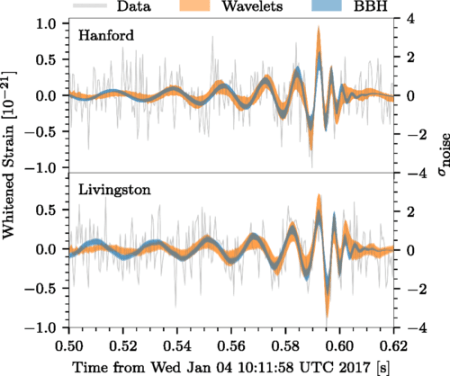
I’ve just heard the news that  LIGO has just announced the detection of another gravitational-wave signal, which has been given the identifier GW170104; it was detected on 4th January 2017.

The event was the merger of a black-hole binary system a redshift z=0.2, which is a proper distance of about 800 Mpc in the standard cosmological model, the most distant event yet detected. There are also tantalising hints that at least one of the black holes had spin opposite the orbital angular momentum, which implies it may have originated in a globular cluster. For more details please see the refereed paper.

If you’d rather just look at the plot here is the evidence for the event, in the form of coincident signals at the two components of LIGO:

 
LIGO

I reckon there’s a good chance of seeing members of the Cardiff University Gravitational Physics group celebrating in the pub later this evening!

It’s also a reasonable inference given the rate of detection of these events so far that we’re going to see many more in the very near future!

Fake Authors in Physics

Posted in The Universe and Stuff with tags , , , on May 30, 2017 by telescoper

Back to work – and exam business – after the Bank Holiday weekend (during most of which I was a bit under the weather), I thought I’d try to get back into the swing of blogging with a brief post about fake authorship.

What provoked me to write this was a strange news item about a Caltech professor who apparently created a fictitious female collaborator called `Ursula C. T. Gamma’ and got her name added as author on scientific papers as well as official email lists on the Caltech website; she also appears in an acknowledgement:

Finally, we thank Ursula C. T. Gamma for continued inspiration.

The professor responsible for all this was none other than Christian Ott, whom I’ve mentioned in a blog post before, because he was placed on unpaid leave by Caltech for harassing two female colleagues.

I don’t know what Ott hoped to gain by inventing a female co-worker. Was it just for a joke, or was there some ulterior motive? I’m not going to speculate here.

If you’ll excuse a bit of frivolity this episode reminded me that a few years ago I toyed with the idea of adding my cat, Columbo, under the pseudonym `Felix Columbo’, as a co-author on a paper I was writing. That would have been for my own amusement – and also because I thought Felix Columbo was a cool name for a physicist, but in the end I didn’t do it largely because I heard about F.D.C. Willard:

The American physicist and mathematician Jack H. Hetherington, Michigan State University, in 1975 wanted to publish some of his research results in the field of low–temperature physics in the scientific journal Physical Review Letters. A colleague, to whom he had given his paper for review, pointed out that Hetherington had used the first person plural in his text, and that the journal would reject this form on submissions with a sole author. Rather than take the time to retype the article to use the singular tense, or to bring in a co-author, Hetherington decided to invent one.

The co-author he invented was his cat, whose name was Chester. The cat’s father was called Willard and the letters F.D.’ stand for `Felis Domesticus’ (the species name for a a house cat).

Other physicists have done similar things. For example, Nobel laureate Andre Geim has written a paper with a hamster as a co-author.

More famously, George Gamow added the name of Hans Bethe to a paper he was writing with his PhD student Ralph Alpher, simply so its authors would be Alpher, Bethe and Gamow. Bethe did subsequently work on the topic discussed in the paper – nucleosynthesis – but hadn’t significantly to the paper. It is reported that Alpher was upset by Gamow’s actions. The paper was published in the Physical Review in 1948 and is a classic in the field of physical cosmology.

As well as being an outstanding physicist, George Gamow was a very colourful and amusing fellow. I’m sure his decision to add Bethe to this paper was just meant as a bit of fun. Likewise with the cat and the hamster. These days, however, authorship of scientific papers is taken far more seriously than it was, as a means to assess research activity and distribute resources. You could argue that this emphasis on authorship is an unhealthy development, but nevertheless that’s the way things. A responsible senior scientist should know that. Adding a phoney author – even if intended as a joke – could well be construed by some institutions as a form of research misconduct.

And how are your real co-workers (especially students and postdocs) supposed to feel if you decide they haven’t contributed enough to merit authorship of a collaborative paper, when they see you adding names of people who don’t even exist?
The Sundial of Trevithick 

Posted in The Universe and Stuff with tags , , on May 26, 2017 by telescoper

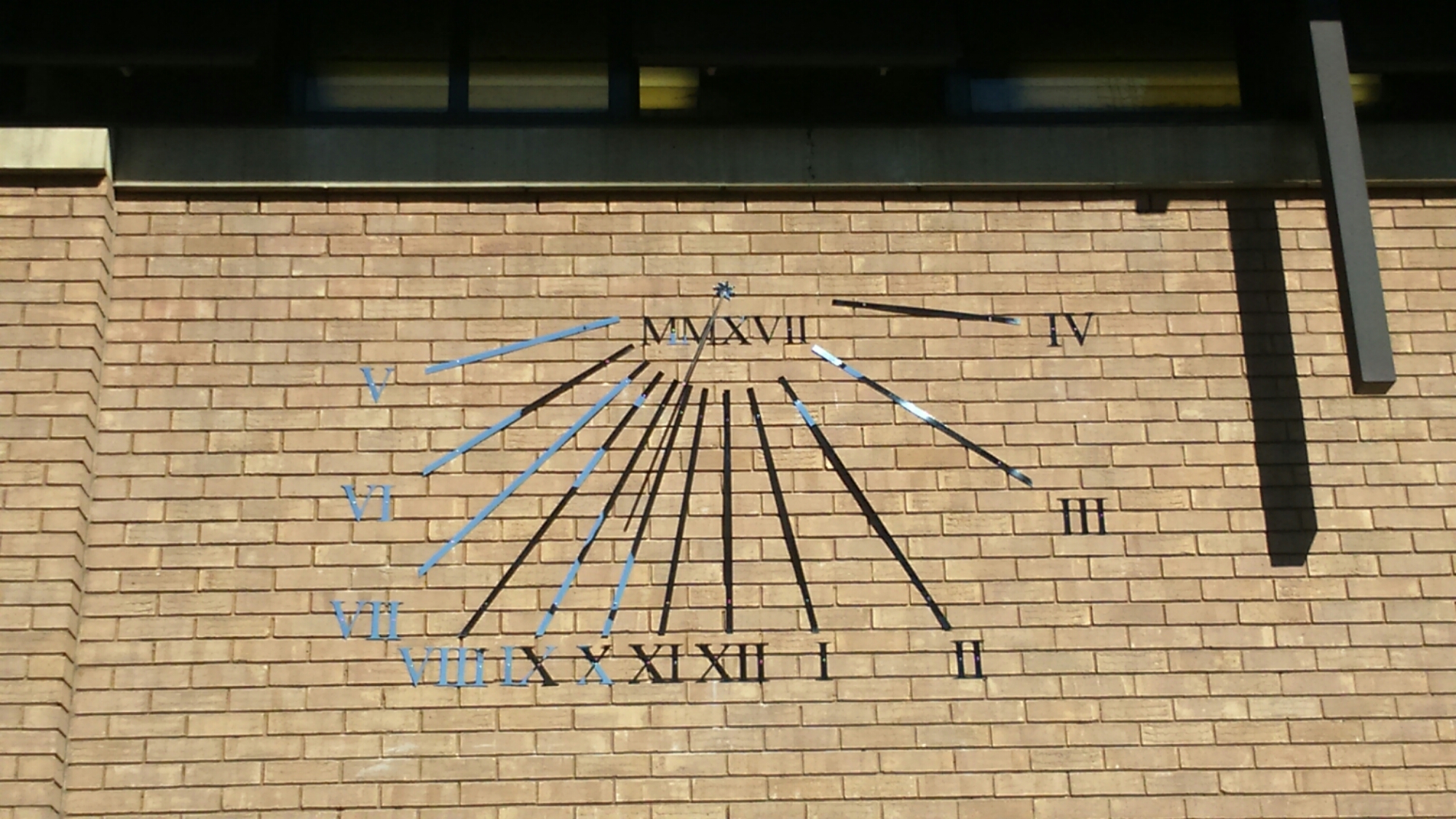
Since it’s a lovely sunny day in Cardiff – and already very warm – I thought I’d step outside the office of the Cardiff University Data Innovation Research Institute which is situated in the Trevithick Building and take a picture of our new sundial:

This flat sundial was installed by a company called Border Sundials and is designed very carefully to be as accurate as possible for the particular wall on which it is place. It’s also corrected for longitude.

However, I took the photograph at about 10.30am, and you’ll notice that it’s showing about 9.30. That’s because it hasn’t been corrected for British Summer Time so it’s offset by an hour. Moreover, a sundial always shows the local solar time rather than mean time which is shown on clocks. These differ because of (a) the inclination of the Earth’s orbit around the Sun relative to the equator and (b) the eccentricity of the Earth’s orbit around the Sun, which means that it does not move at a constant speed. The difference between mean time and solar time can be reconciled using the equation of time. The maximum correction is about 15 minutes, which is large enough to be seen on a sundial of this type. Often a graph of the equation of time is placed next to a sundial so one can do the correct oneself, but for some reason there isn’t one here.

The sundial adds quite a lot of interest to what otherwise is a featureless brick wall and we often notice people looking at it outside our office.

The Art of Jupiter

Posted in Art, The Universe and Stuff with tags , on May 25, 2017 by telescoper

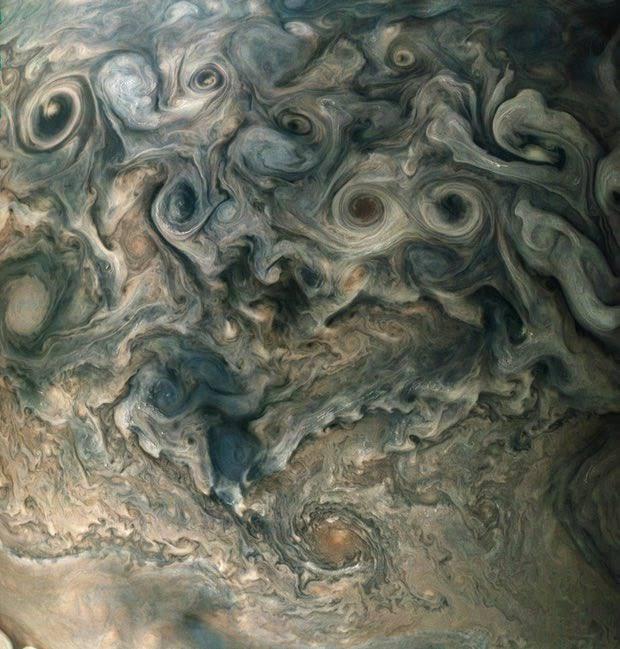
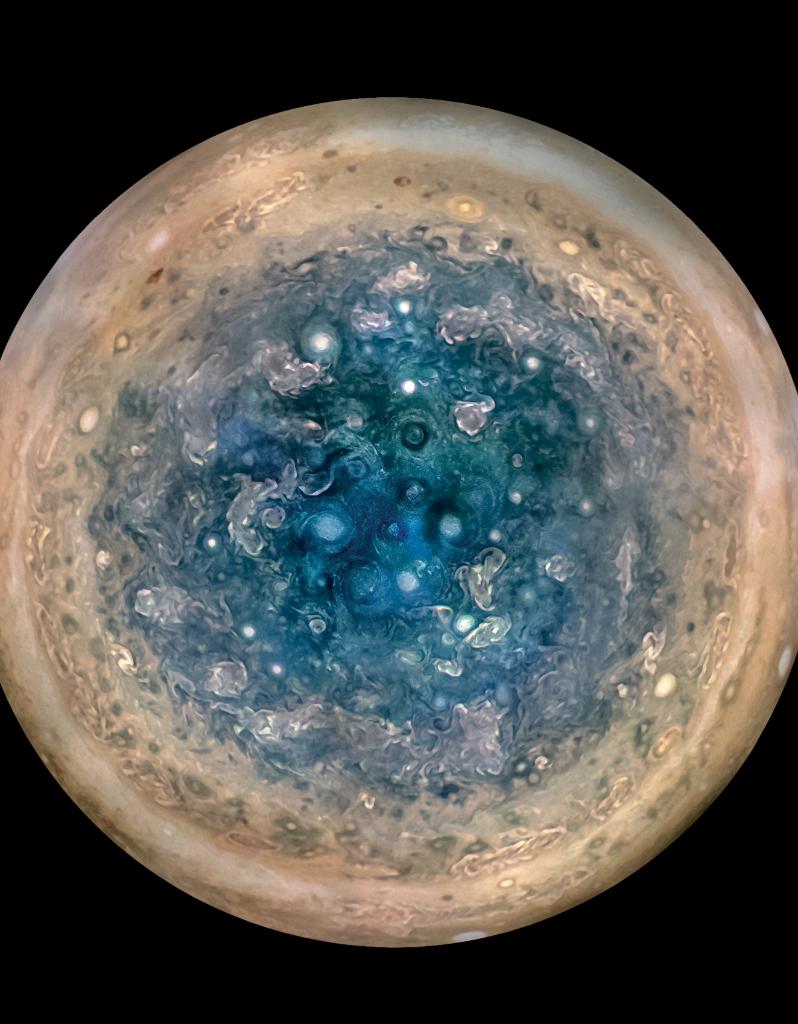
This amazing closeup image is of the North polar region of Jupiter. It was taken by NASA’s Juno spacecraft. Here’s a wider view:


I think it will take scientists quite some time to figure out what is going on in all those complex vortex structures!

In the meantime, though, I think these picture and the others that have been released can be enjoyed as a work of art! As a matter of fact reminds me of van Gogh’s Starry Night...

Yellow Stars, Red Stars and Bayesian Inference

Posted in Bad Statistics, The Universe and Stuff with tags , , , , , , on May 25, 2017 by telescoper

I came across a paper on the arXiv yesterday with the title `Why do we find ourselves around a yellow star instead of a red star?’.  Here’s the abstract:

M-dwarf stars are more abundant than G-dwarf stars, so our position as observers on a planet orbiting a G-dwarf raises questions about the suitability of other stellar types for supporting life. If we consider ourselves as typical, in the anthropic sense that our environment is probably a typical one for conscious observers, then we are led to the conclusion that planets orbiting in the habitable zone of G-dwarf stars should be the best place for conscious life to develop. But such a conclusion neglects the possibility that K-dwarfs or M-dwarfs could provide more numerous sites for life to develop, both now and in the future. In this paper we analyze this problem through Bayesian inference to demonstrate that our occurrence around a G-dwarf might be a slight statistical anomaly, but only the sort of chance event that we expect to occur regularly. Even if M-dwarfs provide more numerous habitable planets today and in the future, we still expect mid G- to early K-dwarfs stars to be the most likely place for observers like ourselves. This suggests that observers with similar cognitive capabilities as us are most likely to be found at the present time and place, rather than in the future or around much smaller stars.

Athough astrobiology is not really my province,  I was intrigued enough to read on, until I came to the following paragraph in which the authors attempt to explain how Bayesian Inference works:

We approach this problem through the framework of Bayesian inference. As an example, consider a fair coin that is tossed three times in a row. Suppose that all three tosses turn up Heads. Can we conclude from this experiment that the coin must be weighted? In fact, we can still maintain our hypothesis that the coin is fair because the chances of getting three Heads in a row is 1/8. Many events with a probability of 1/8 occur every day, and so we should not be concerned about an event like this indicating that our initial assumptions are flawed. However, if we were to flip the same coin 70 times in a row with all 70 turning up Heads, we would readily conclude that the experiment is fixed. This is because the probability of flipping 70 Heads in a row is about 10-22, which is an exceedingly unlikely event that has probably never happened in the history of the universe. This
informal description of Bayesian inference provides a way to assess the probability of a hypothesis in light of new evidence.

Obviously I agree with the statement right at the end that `Bayesian inference provides a way to assess the probability of a hypothesis in light of new evidence’. That’s certainly what Bayesian inference does, but this `informal description’ is really a frequentist rather than a Bayesian argument, in that it only mentions the probability of given outcomes not the probability of different hypotheses…

Anyway, I was so unconvinced by this description’ that I stopped reading at that point and went and did something else. Since I didn’t finish the paper I won’t comment on the conclusions, although I am more than usually sceptical. You might disagree of course, so read the paper yourself and form your own opinion! For me, it goes in the file marked Bad Statistics!

Wave Mechanics and Large-scale Structure

Posted in Books, Talks and Reviews, The Universe and Stuff with tags , , , on May 24, 2017 by telescoper

I thought I’d share the slides I used for the short talk I gave last Thursday at the Osservatorio Astronomico di Bologna, on the topic of Wave Mechanics and Large-scale Structure. I’ve posted about the general idea underpinning this workhere, and here are some links to references with more details of the cosmological setting, including a couple of papers by myself and Chris Short on some of whose old slides I based the talk.

http://adsabs.harvard.edu/abs/1993ApJ…416L..71W
http://adsabs.harvard.edu/abs/1997PhRvD..55.5997W
http://adsabs.harvard.edu/abs/2002MNRAS.330..421C
http://adsabs.harvard.edu/abs/2003MNRAS.342..176C
http://adsabs.harvard.edu/abs/2006JCAP…12..012S
http://adsabs.harvard.edu/abs/2006JCAP…12..016S
http://adsabs.harvard.edu/abs/2010MNRAS.402.2491J

I had a few problems with the movies during the actual talk, and they probably don’t work in this embedded version. There are a few formatting errors in the slideshare version too, but hopefully you can figure out what’s going on!