Yet again, I find myself having to use this blog pass on some very sad news. Distinguished theoretical physicist Tom Kibble (below) passed away today, at the age of 83.
Sir Thomas Walter Bannerman Kibble FRS (to give his full name) worked on quantum field theory, especially the interface between high-energy particle physics and cosmology. He has worked on mechanisms ofsymmetry breaking, phase transitions and the topological defects (monopoles, cosmic strings or domain walls) that can be formed in some theories of the early Universe; he is probably most famous for introducing the idea of cosmic strings to modern cosmology in a paper with Mark Hindmarsh. Although there isn’t yet any observational support for this idea, it has generated a great deal of very interesting research.
Tom was indeed an extremely distinguished scientist, but what most people will remember best is that he was an absolutely lovely human being. Gently spoken and impeccably courteous, he was always receptive to new ideas and gave enormous support to younger researchers. He will be very sadly missed by friends and colleagues across the physics world.
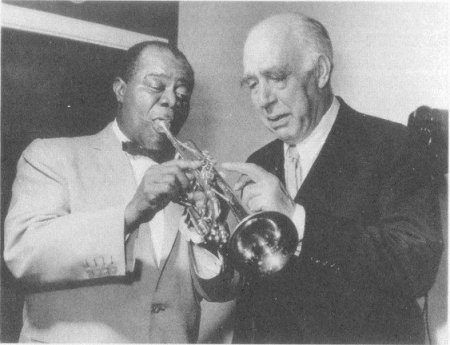
No time for a full post today, so I’ll just share this intriguing picture I found on the interwebs of two great figures from very different fields: Jazz trumpet legend Louis Armstrong and pioneering quantum physicist, Niels Bohr.
When I first saw this I assumed it had been photoshopped, but I’m reliably informed that the picture is genuine and that it was taken in Copenhagen in 1959. Other than that I know nothing of the circumstances in which it was taken. I’d love to hear from anyone who knows the full story!
The chance conjunction on this blog of a post about the death of Professor J.D. Jackson with another about the greed of academic publishers caught the attention of one Ian Jackson (son of the aforementioned Professor) and prompted him to forward me some correspondence between his father and the publisher of the famous textbook, Classical Electrodynamics (published by John Wiley & Sons).
I won’t copy it all here, but here is an excerpt:
The Letter of Agreement of 1996 stipulates that Wiley should not increase the net price more than 5% in any two year period with the author’s permission. A month or so ago I found out from the physics Editor that the US net price was $87, a big jump from the last number I knew. By knowing that the list price is closely 1.3 times the net, I could look at my records of the single copy list price on Wiley’s web site to find that they had increased the price by 5% at least once and probably twice beyond what was permitted by our agreement. I wrote a strong letter, citing chapter and verse about their obvious violation.
John David Jackson was obviously a generous man: the royalties for this book were divided among his four children (including my correspondent Ian). He goes on to add in a letter to all four of them, after the publishers agreed to reduce the list price:
Sorry to be keeping your royalties in check, but I was thinking of the poor students who are paying 1.3 x $82 = $106.60.
They do keep the book for the rest of their lives, so perhaps it is an OK investment.
I don’t remember how much I paid for my copy, but I don’t begrudge the amount because it’s an excellent book. You should always remember, however, that the author of a textbook typically only gets a small percentage (usually~10% ) of the net receipts.
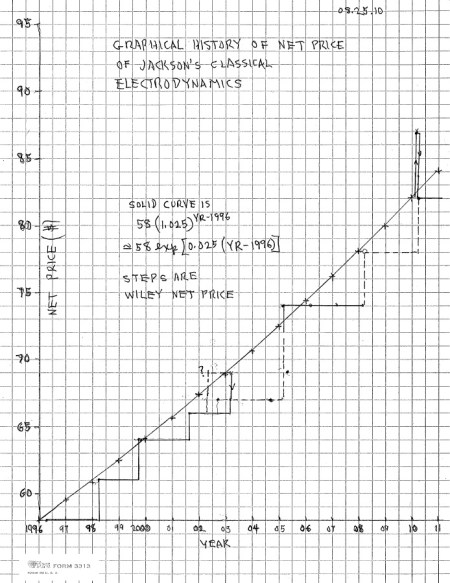
The correspondence sent by Ian includes this hand-drawn graph by the late Professor Jackson:
It seems Professor Jackson shared my (low) opinion of academic publishers!
For the record, my textbook on Cosmology (co-authored with Francesco Lucchin) was also published by Wiley. A representative of the publisher explained to me that their pricing strategy involved trying to keep the revenue constant in time, so that as sales went down the price went up. My book is now very much out of date so I can understand why the sales have fallen off, but I find it hard to believe that the same is true of an enduring classic. Professor Jackson seems to have agreed; he described Wiley’s pricing strategy as “gouging”…
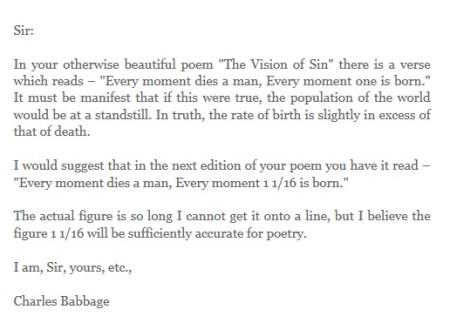
The English mathematician Charles Babbage, who designed and built the first programmable calculating machine, wrote to the (then) young poet Tennyson, whose poem The Vision of Sin he had recently read:
I like to think Babbage was having a laugh with Tennyson here, rather than expressing a view that poetry should be taken so literally, but you never know..
Anyway, I was reminded of the above letter by the much-hyped recent story of the alleged astronomical “dating” of this ancient poem (actually just a fragment) by Sappho:
Tonight I’ve watched the moon and then the Pleiades go down
The night is now half-gone; youth goes; I am
in bed alone
It is a trivial piece of astronomical work to decuded that if the “Pleiades” does indeed refer to the constellation and “the night is now half-gone” means sometime around midnight, then the scene described in the fragment happened, if it happened at all, between January and March. However, as an excellent rebuttal piece by Darin Hayton points out, the assumptions needed to arrive at a specific date are all questionable.
More important, poetry is not and never has been intended for such superficial interpretation. That goes for modern works, but is even more true for ancient verse. Who knows what the imagery and allusions in the text would have meant to an audience when it was composed, over 2500 years ago, but which are lost on a modern reader?
I’m not so much saddened that someone thought to study the possible astronomical interpretation an ancient text, even if they didn’t do a very thorough job of it. At least that means they are interested in poetry, although I doubt they were joking as Babbage may have been.
What does sadden me, however, is the ludicrous hype generated by the University of Texas publicity machine. There’s far too much of that about, and it’s getting worse.
Yet again I have to pass on some very sad news. Physicist John David Jackson, best known for his classic textbook Classical Electrodynamics, has passed away at the age of 91. I’m sure I speak for many physicists when I say that Classical Electrodynamics was not only an essential part of my physics education but also a constant companion throughout the rest of my career. I have consulted my copy regularly over the last thirty years. I was often frustrated that when I found the topic I was looking for in the index, it referred to a problem (usually a difficult one) rather than a solution, but there’s no question it made me a better physicist.
I saw this clip for the first time yesterday during a training session about unconscious bias. The context then was a discussion of how we make quick decisions about things (and people) relying on contextual associations of which we are often entirely unaware. The clip illustrates how difficult it is to overrule some things your brain does automatically even when you know they are wrong.
Related to this is something I’ve noticed in a slightly different setting. Not having a TV set I do sometimes watch DVDs on my laptop, but the screen is quite small and, for a person of my advanced years, rather difficult to view comfortably for a long period. A while ago I started plugging my laptop into a monitor instead. When I do that I usually put the laptop well out of the way, which means moving the relatively small loudspeaker out of the line of sight between myself and the screen. It is however immediately noticeable that the sound immediately seems to be coming from the screen rather than the speaker. I guess this is yet another example of the visual overruling the auditory which it does in the McGurk effect.
Oh, and I just remembered this, which I heard a while ago at a public talk given by Simon Singh. I guess many of you will have come across it before, but there’s no harm in repeating it. I don’t know why it popped into my head at this particular moment, but perhaps it’s because I’ve been reading some stuff about how my colleagues in gravitational wave research use templates to try to detect specific patterns in noisy data. The method involves cross-correlating a simulated signal against the data until a match is obtained; the problem is often how to assess the probability of a “chance” coincidence correctly and thus avoid spurious detections. The following might perhaps be a useful warning that unless you do this carefully, you only get out what you put in!
This is an excerpt from the classic track Stairway to Heaven, by the popular beat combo Led Zeppelin, played backwards. I suggest that you listen to it once without looking at the words on the video, and then again with the words in front of you. If you haven’t heard/seen it before, I think you’ll find it surprising…
I saw an interesting news item this morning reporting that at one point last Sunday about 87% of Germany’s energy needs were supplied by renewable sources. The circumstances that led to this were relatively short-lived, but it is interesting nevertheless. I keep an eye on the UK’s national grid statistics from time to time and it rarely exceeds 20% in the form of renewables.
Anyway, all that reminded me of this, which appeared in the Guardian a couple of weeks weeks ago. It’s the last interview recorded by David Mackay before his untimely death from cancer in April. He’s characteristically direct in pointing out that the idea that the UK could be powered entirely by renewable energy is not at all practicable.
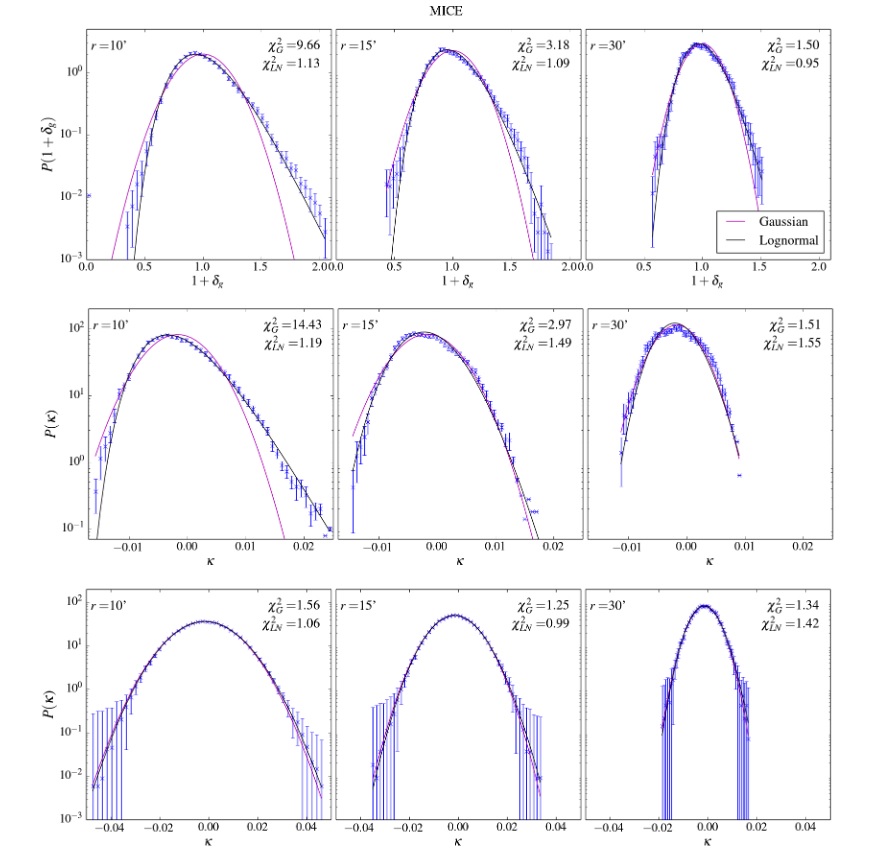
The points here are from MICE simulations. Not simulations of mice, of course, but simulations of MICE (Marenostrum Institut de Ciencies de l’Espai). Note how well the curves from a simple lognormal model fit the calculations that need a supercomputer to perform them!
The lognormal model used in the paper is basically the same as the one I developed in 1990 with Bernard Jones in what has turned out to be my most-cited paper. In fact the whole project was conceived, work done, written up and submitted in the space of a couple of months during a lovely visit to the fine city of Copenhagen. I’ve never been very good at grabbing citations – I’m more likely to fall off bandwagons rather than jump onto them – but this little paper seems to keep getting citations. It hasn’t got that many by the standards of some papers, but it’s carried on being referred to for almost twenty years, which I’m quite proud of; you can see the citations-per-year statistics even seen to be have increased recently. The model we proposed turned out to be extremely useful in a range of situations, which I suppose accounts for the citation longevity:
Citations die away for most papers, but this one is actually attracting more interest as time goes on! I don’t think this is my best paper, but it’s definitely the one I had most fun working on. I remember we had the idea of doing something with lognormal distributions over coffee one day, and just a few weeks later the paper was finished. In some ways it’s the most simple-minded paper I’ve ever written – and that’s up against some pretty stiff competition – but there you go.
The lognormal seemed an interesting idea to explore because it applies to non-linear processes in much the same way as the normal distribution does to linear ones. What I mean is that if you have a quantity Y which is the sum of n independent effects, Y=X1+X2+…+Xn, then the distribution of Y tends to be normal by virtue of the Central Limit Theorem regardless of what the distribution of the Xi is If, however, the process is multiplicative so Y=X1×X2×…×Xn then since log Y = log X1 + log X2 + …+log Xn then the Central Limit Theorem tends to make log Y normal, which is what the lognormal distribution means.
The lognormal is a good distribution for things produced by multiplicative processes, such as hierarchical fragmentation or coagulation processes: the distribution of sizes of the pebbles on Brighton beach is quite a good example. It also crops up quite often in the theory of turbulence.
I’ll mention one other thing about this distribution, just because it’s fun. The lognormal distribution is an example of a distribution that’s not completely determined by knowledge of its moments. Most people assume that if you know all the moments of a distribution then that has to specify the distribution uniquely, but it ain’t necessarily so.
If you’re wondering why I mentioned citations, it’s because they’re playing an increasing role in attempts to measure the quality of research done in UK universities. Citations definitely contain some information, but interpreting them isn’t at all straightforward. Different disciplines have hugely different citation rates, for one thing. Should one count self-citations?. Also how do you apportion citations to multi-author papers? Suppose a paper with a thousand citations has 25 authors. Does each of them get the thousand citations, or should each get 1000/25? Or, put it another way, how does a single-author paper with 100 citations compare to a 50 author paper with 101?
Or perhaps a better metric would be the logarithm of the number of citations?
I was wondering whether the calculation was concerned with plane geometry but that seems not to be the case. The academic concerned is an Economist and he was studying a differential equation. That surprises me. I hadn’t realised economists knew about calculus. Or about anything else, for that matter.
The physicists among you will recognize this as a representation of some of Maxwell’s Equations. I very much doubt they played a part in the work of our Economics Professor, so presumably this is just one of the BBC’s stock of generic “scary maths” images.
Other things worth noting are that this version of Maxwell’s Equations isn’t written in SI units, the standard notation in the UK and Europe. As a matter of fact it uses cgs units, which suggests it may be an American import. Nor is it really correct anyway, because the time derivative inside the brackets should surely be partial.
All of which goes to demonstrate how Mathematics is usually viewed in the media and, by extension, the public at large: like an arcane book written in an incomprehensible language that should be viewed with suspicion or ridicule by any sensible person.
There is nothing new about this, of course. I’m reminded that in 1870, during the Franco-Prussian Way, Norwegian mathematician Sophus Lie was arrested in France on suspicion of being a German spy because the authorities thought his mathematical notes were coded messages of some sort.
In reality, mathematics is the most open and universal language of all and, as such, is a powerful force for human good. Among many other things, quantitative reasoning and proper logic help to defend us against those who lie and distort the facts in order to gain power. Mathematics may not be the easiest language to learn, but it’s well worth the effort, even if you can only master the basics.
Today is the 90th birthday of one of my biggest heroes, Sir David Attenborough, so let me start by wishing him many happy returns of the day!
There has been some controversy recently about the new Polar Research ship being called the Sir David Attenborough despite overwhelming support in a public poll for it to be called Boaty McBoatface. The latter name has been retained for one of the remote-controlled submersibles carried by the larger vessel, but I’ve seen a number of complaints that this was inappropriate. Actually, I disagree. For one thing the new vessel is undoubtedly a ship rather than a boat; its prefix ‘RRS’ means ‘Royal Research Ship’ after all. For another, submarines – even the very big ones – are always known as boats. This has been the practice since the earliest days of submersible craft, presumably because the earliest ones were small enough to be carried by other vessels. A submersible Boaty McBoatface is absolutely fine by me!
Anyway I thought I’d use the occasion of Sir David Attenborough’s birthday to post one of my favourite clips from one of his many TV programmes, and the piece I wrote about it a while ago…
I wonder what you felt as you watched it? What went through your mind? Amusement? Fascination? I’ll tell you how it was for me when I first saw it. I marvelled.
Seeing the extraordinary behaviour of this marvellous creature filled me with a sense of wonder. But I also began to wonder in another sense too. How did the Lyre Bird evolve its bizarre strategy? How does it learn to be such an accurate mimic? How does it produce such a fascinating variety of sounds? How can there be an evolutionary advantage in luring a potential mate to the sound of foresters and a chainsaw?
The Lyre Bird deploys its resources in such an elaborate and expensive way that you might be inclined to mock it, if all it does is draw females to “look at its plumes”. I can think of quite a few blokes who adopt not-too-dissimilar strategies, if truth be told. But if you could ask a Lyre Bird it would probably answer that it does this because that’s what it does. The song defines the bird. That’s its nature.
I was moved to post the clip in response to a characteristically snide and ill-informed piece by Simon Jenkins in the Guardian a while ago. Jenkins indulges in an anti-science rant every now and again. Sometimes he has a point, in fact. But this article was just puerile. Perhaps he had a bad experience of science at school and never got over it.
I suppose I can understand why some people are cynical about scientists stepping into the public eye to proselytise about science. After all, it’s also quite easy to come up with examples of scientists who have made mistakes. Sadly, there are also cases of outright dishonesty. Science is no good because scientists are fallible. But scientists are people, no better and no worse than the rest. To err is human and all that. We shouldn’t expect scientists to be superhuman any more than we should believe the occasional megalomaniac who says they are.
To many people fundamental physics is a just a load of incomprehensible gibberish, the Large Hadron Collider a monstrous waste of money, and astronomy of no greater value to the world than astrology. Any scientist trying to communicate science to the public must be trying to hoodwink them, to rob them of the schools and hospitals that their taxes should be building and sacrifice their hard-earned income on the altar of yet another phoney religion.
And now the BBC is participating in this con-trick by actually broadcasting popular programmes about science that have generated huge and appreciative audiences. Simon Jenkins obviously feels threatened by it. He’s probably not alone.
I don’t have anything like the public profile of the target of Jenkins’ vitriol, Lord Rees, but I try to do my share of science communication. I give public lectures from time to time and write popular articles, whenever I’m asked. I also answer science questions by email from the general public, and some of the pieces I post on here receive a reasonably wide distribution too.
Why do I (and most of my colleagues) do all this sort of stuff? Is it because we’re after your money? Actually, no it isn’t. Not directly, anyway.
I do all this stuff because, after 25 years as a scientist, I still have a sense of wonder about the universe. I want to share that as much as I can with others. Moreover, I’ve been lucky enough to find a career that allows me to get paid for indulging my scientific curiosity and I’m fully aware that it’s Joe Public that pays for me to do it. I’m happy they do so, and happier still that people will turn up on a rainy night to hear me talk about cosmology or astrophysics. I do this because I love doing science, and want other people to love it too.
Scientists are wont to play the utilitarian card when asked about why the public should fund fundamental research. Lord Rees did this in his Reith Lectures, in fact. Physics has given us countless spin-offs – TV sets, digital computers, the internet, you name it – that have created wealth for UK plc out of all proportion to the modest investment it has received. If you think the British government spends too much on science, then perhaps you could try to find the excessive sum on this picture.
Yes, the LHC is expensive but the cost was shared by a large number of countries and was spread over a long time. The financial burden to the UK now amounts to the cost of a cup of coffee per year for each taxpayer in the country. I’d compare this wonderful exercise in friendly international cooperation with the billions we’re about to waste on the Trident nuclear weapons programme which is being built on the assumption that international relations must involve mutual hatred.
This is the sort of argument that gets politicians interested, but scientists must be wary of it. If particle physics is good because it has spin-offs that can be applied in, e.g. medicine, then why not just give the money to medical research?
I’m not often put in situations where I have to answer questions like why we should spend money on astronomy or particle physics but, when I am, I always feel uncomfortable wheeling out the economic impact argument. Not because I don’t believe it’s true, but because I don’t think it’s the real reason for doing science. I know the following argument won’t cut any ice in the Treasury, but it’s what I really think as a scientist (and a human being).
What makes humans different from other animals? What defines us? I don’t know what the full answer to that is, or even if it has a single answer, but I’d say one of the things that we do is ask questions and try to answer them. Science isn’t the only way we do this. There are many complementary modes of enquiry of which the scientific method is just one. Generally speaking, though, we’re curious creatures.
I think the state should support science but I also think it should support the fine arts, literature, humanities and the rest, for their own sake. Because they’re things we do. They make us human. Without them we’re just like any other animal that consumes and reproduces.
So the real reason why the government should support science is the song of the Lyre Bird. No, I don’t mean as an elaborate mating ritual. I don’t think physics will help you pull the birds. What I mean is that even in this materialistic, money-obsessed world we still haven’t lost the need to wonder, for the joy it brings and for the way it stimulates our minds; science doesn’t inhibit wonder, as Jenkins argues, it sparks it.
The views presented here are personal and not necessarily those of my employer (or anyone else for that matter).
Feel free to comment on any of the posts on this blog but comments may be moderated; anonymous comments and any considered by me to be vexatious and/or abusive and/or defamatory will not be accepted. I do not necessarily endorse, support, sanction, encourage, verify or agree with the opinions or statements of any information or other content in the comments on this site and do not in any way guarantee their accuracy or reliability.




 In the Dark