Archive for the The Universe and Stuff Category

The Nobel Prize for Neutrino Oscillations

Posted in The Universe and Stuff with tags , , , , , , , , on October 6, 2015 by telescoper

Well the Nobel Prize for Physics in 2015 has been announced. It has been awarded jointly to Takaaki Kajita and Arthur B. McDonald for..

the discovery of neutrino oscillations, which prove that neutrinos have mass.

You can read the full citation here. Congratulations to them both. Some physicists around here were caught by surprise because the 2002 Nobel Prize was also awarded for neutrino physics, but it is fair because this award goes for a direct measurement of neutrino oscillations, which is an important breakthrough in its own right; the earlier award was for measurements of solar neutrinos. For a nice description of the background you could do worse than the Grauniad blog post by Jon Butterworth about neutrino physics.

In brief the a process in which neutrinos (which have three distinct flavour states, associated with the electron, mu and tau leptons) can change flavour as they propagate. It’s quite a weird thing to spring on students who previously thought that lepton number (which denotes the flavour) was always conserved. I remember years ago having to explain this phenomenon to third-year students taking my particle physics course.  I decided to start with an analogy based on more familiar physics, but it didn’t go to plan.

A charged fermion such as an electron (or in fact anything that has a magnetic moment, which would include, e.g. the neutron)  has spin and, according to standard quantum mechanics, the component of this in any direction can  can be described in terms of two basis states, say |\uparrow> and |\downarrow> for spin in the z direction. In general, however, the spin state will be a superposition of these, e.g.

\frac{1}{\sqrt{2}} \left( |\uparrow> + |\downarrow>\right)

In this example, as long as the particle is travelling through empty space, the probability of finding it with spin “up” is  50%, as is the probability of finding it in the spin “down” state. Once a measurement is made, the state collapses into a definite “up” or “down” wherein it remains until something else is done to it.

If, on the other hand, the particle  is travelling through a region where there is a  magnetic field the “spin-up” and “spin-down” states can acquire different energies owing to the interaction between the spin and the magnetic field. This is important because it means the bits of the wave function describing the up and down states evolve at different rates, and this  has measurable consequences: measurements made at different positions yield different probabilities of finding the spin pointing in different directions. In effect, the spin vector of the  particle performs  a sort of oscillation, similar to the classical phenomenon called  precession.

The mathematical description of neutrino oscillations is very similar to this, except it’s not the spin part of the wavefunction being affected by an external field that breaks the symmetry between “up” and “down”. Instead the flavour part of the wavefunction is “precessing” because the flavour states don’t coincide with the eigenstates of the Hamiltonian that describes the neutrinos’ evolution. However, it does require that different neutrino types have intrinsically different energies  in quite  a similar way similar to the spin-precession example. In the context of neutrinos however the difference in energy means a difference in mass, and if there’s a difference in mass then not all flavours of neutrino can be massless.

Although the analogy I used isn’t a perfect, I thought  it was a good way of getting across the basic idea. Unfortunately, however, when I subsequently asked an examination question about neutrino oscillations I got a significant number of answers that said “neutrino oscillations happen when a neutrino travels through a magnetic field….”. Sigh. Neutrinos don’t interact with  magnetic fields, you see…

Anyway, today’s announcment also prompts me to mention that neutrino physics is one of the main research interests in our Experimental Particle Physics group here at Sussex. You can read a recent post here about an important milestone in the development of the NOvA Experiment which involves several members of the Department of Physics and Astronomy in the School of Mathematical and Physical Sciences here at the University of Sussex. Here’s the University of Sussex’s press release on the subject. In fact Art McDonald is a current collaborator of our neutrino physicists, who have been celebrating his award today!

Neutrino physics is a fascinating subject even to someone like me, who isn’t really a particle physicist. My impression of the field is that was fairly moribund until about the turn of the millennium  when the first measurement of atmospheric neutrino oscillations was announced. All of a sudden there was evidence that neutrinos can’t all be massless (as many of us had long assumed, at least as far as lecturing was concerned).  Now the humble neutrino is the subject of intense experimental activity, not only in the USA and UK but all around the world in a way that would have been difficult to predict twenty years ago.

But then, as the physicist Niels Bohr famously observed, “Prediction is very difficult. Especially about the future.”

An Open Letter to the Times Higher World University Rankers

Posted in Education, The Universe and Stuff with tags , , , , , , , , on October 5, 2015 by telescoper

Dear Rankers,

Having perused your latest set of league tables along with the published methodology, a couple of things puzzle me.

First, I note that you have made significant changes to your methodology for combining metrics this year. How, then, can you justify making statements such as

US continues to lose its grip as institutions in Europe up their game

when it appears that any changes could well be explained not by changes in performance, as gauged by the metrics you use,  but in the way they are combined?

I assume, as intelligent and responsible people, that you did the obvious test for this effect, i.e. to construct a parallel set of league tables, with this year’s input data but last year’s methodology, which would make it easy to isolate changes in methodology from changes in the performance indicators.  Your failure to publish such a set, to illustrate how seriously your readers should take statements such as that quoted above, must then simply have been an oversight. Had you deliberately witheld evidence of the unreliability of your conclusions you would have left yourselves open to an accusation of gross dishonesty, which I am sure would be unfair.

Happily, however, there is a very easy way to allay the fears of the global university community that the world rankings are being manipulated: all you need to do is publish a set of league tables using the 2014 methodology and the 2015 data. Any difference between this table and the one you published would then simply be an artefact and the new ranking can be ignored. I’m sure you are as anxious as anyone else to prove that the changes this year are not simply artificially-induced “churn”, and I look forward to seeing the results of this straightforward calculation published in the Times Higher as soon as possible.

Second, I notice that one of the changes to your methodology is explained thus

This year we have removed the very small number of papers (649) with more than 1,000 authors from the citations indicator.

You are presumably aware that this primarily affects papers relating to experimental particle physics, which is mostly conducted through large international collaborations (chiefly, but not exclusively, based at CERN). This change at a stroke renders such fundamental scientific breakthroughs as the discovery of the Higgs Boson completely worthless. This is a strange thing to do because this is exactly the type of research that inspires  prospective students to study physics, as well as being direct measures in themselves of the global standing of a University.

My current institution, the University of Sussex, is heavily involved in experiments at CERN. For example, Dr Iacopo Vivarelli has just been appointed coordinator of all supersymmetry searches using the ATLAS experiment on the Large Hadron Collider. This involvement demonstrates the international standing of our excellent Experimental Particle Physics group, but if evidence of supersymmetry is found at the LHC your methodology will simply ignore it. A similar fate will also befall any experiment that requires large international collaborations: searches for dark matter, dark energy, and gravitational waves to name but three, all exciting and inspiring scientific adventures that you regard as unworthy of any recognition at all but which draw students in large numbers into participating departments.

Your decision to downgrade collaborative research to zero is not only strange but also extremely dangerous, for it tells university managers that participating in world-leading collaborative research will jeopardise their rankings. How can you justify such a deliberate and premeditated attack on collaborative science? Surely it is exactly the sort of thing you should be rewarding? Physics departments not participating in such research are the ones that should be downgraded!

Your answer might be that excluding “superpapers” only damages the rankings of smaller universities because might owe a larger fraction of their total citation count to collaborative work. Well, so what if this is true? It’s not a reason for excluding them. Perhaps small universities are better anyway, especially when they emphasize small group teaching and provide opportunities for students to engage in learning that’s led by cutting-edge research. Or perhaps you have decided otherwise and have changed your methodology to confirm your prejudice…

I look forward to seeing your answers to the above questions through the comments box or elsewhere – though you have ignored my several attempts to raise these questions via social media. I also look forward to seeing you correct your error of omission by demonstrating – by the means described above – what  changes in league table positions are by your design rather than any change in performance. If it turns out that the former is the case, as I think it will, at least your own journal provides you with a platform from which you can apologize to the global academic community for wasting their time.

Yours sincerely,

Telescoper

The 2015 Nobel Prize for Physics: could it be Vera Rubin?

Posted in Science Politics, The Universe and Stuff with tags , , , on October 4, 2015 by telescoper

Just a quick note to point out that the 2015 Nobel Prize for Physics will be announced next Tuesday, 6th October. According to the Nobel Foundation’s website the announcement will be made “no earlier than 11.45am” Swedish time, which is one hour ahead of British Summer Time.

As is the case every year there’s quite a lot of speculation going on about who might garner this year’s prize. There’s a piece in Nature and another in Physics World, to give just two examples. There’s also the annual prediction from Thomson Reuters, which has never to my knowledge been correct (although some of the names they have suggested for a given year have won it in a subsequent year); perhaps they will strike lucky this time round.

For myself, I’ll just say that I think Vera Rubin is conspicuous by her absence from the list of Nobel Physics laureates – her classic work on galactic rotation and the evidence for dark matter in galaxies surely deserves an award, possibly alongside Kent Ford. Most Nobel Prizes are awarded for work done decades before the year of the award; the research in this case was mostly done in the 1970s. I think recognition is long overdue. I’m biased in favour of astronomy, of course, but my fingers will be crossed that Vera Rubin’s time will come on Tuesday!

I’m not going to open a book  – even Ladbrokes stopped taking bets on the Nobel Prize for Physics some years ago! – but I’d be interested to hear opinions through the comments box…

The 9 kinds of physics seminar

Posted in Education, The Universe and Stuff on October 2, 2015 by telescoper

I just couldn’t resist reblogging this!! 🙂

Matthew Rave's avatarMany Worlds Theory

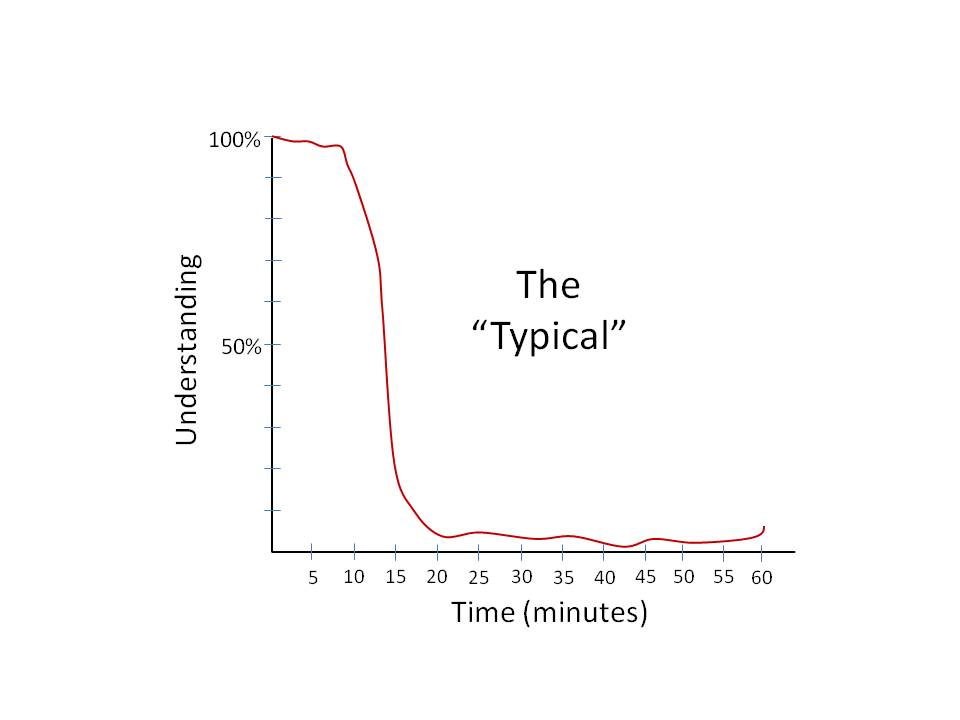
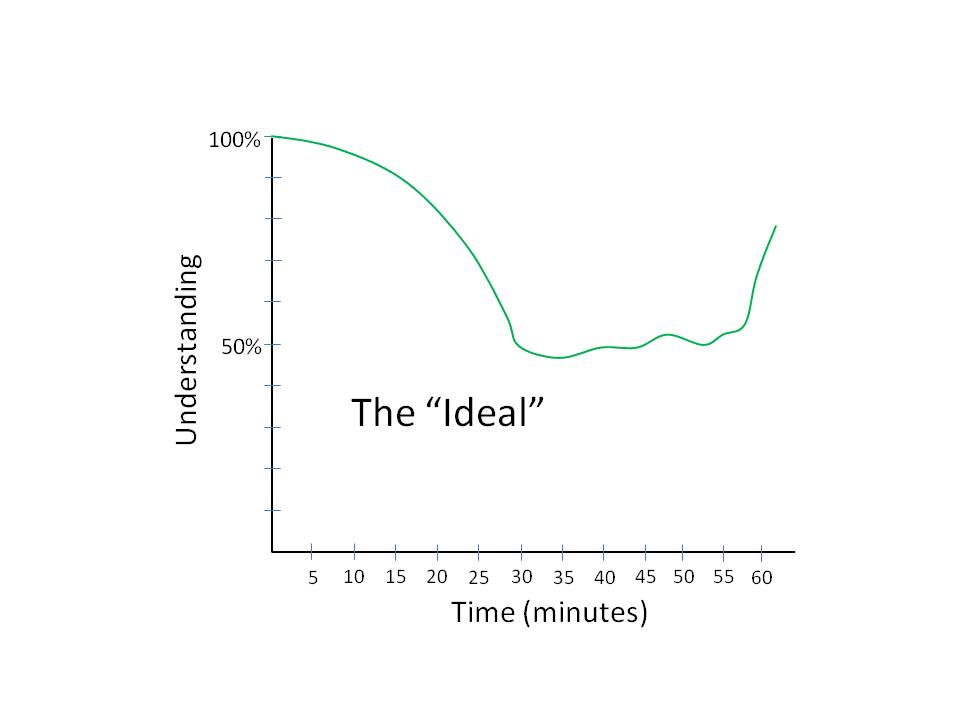
As a public service, I hereby present my findings on physics seminars in convenient graph form.  In each case, you will see the Understanding of an Audience Member (assumed to be a run-of-the-mill PhD physicist) graphed as a function of Time Elapsed during the seminar.  All talks are normalized to be of length 1 hour, although this might not be the case in reality.

Typical

The “Typical” starts innocently enough: there are a few slides introducing the topic, and the speaker will talk clearly and generally about a field of physics you’re not really familiar with.  Somewhere around the 15 minute mark, though, the wheels will come off the bus.  Without you realizing it, the speaker will have crossed an invisible threshold and you will lose the thread entirely.  Your understanding by the end of the talk will rarely ever recover past 10%.

Ideal

The “Ideal” is what physicists strive for in…

View original post 763 more words

Evidence for Liquid Water on Mars?

Posted in Astrohype, The Universe and Stuff with tags , , , , , , , , on September 28, 2015 by telescoper

There’s been a lot of excitement this afternoon about possible evidence for water on Mars from the Compact Reconnaissance Imaging Spectrometer for Mars (CRISM) on board the Mars Reconaissance Orbiter (MRO). Unfortunately, but I suppose inevitably, some of the media coverage has been a bit over the top, presenting the results as if they were proof of liquid water flowing on the Red Planet’s surface; NASA itself has pushed this interpretation. I think the results are indeed very interesting – but not altogether surprising, and by no means proof of the existence of flows of liquid water. And although they may indeed provide evidence confirming that there is water on Mars,  we knew that already (at least in the form of ice and water vapour).

The full results are reported in a paper in Nature Geoscience. The abstract reads:

Determining whether liquid water exists on the Martian surface is central to understanding the hydrologic cycle and potential for extant life on Mars. Recurring slope lineae, narrow streaks of low reflectance compared to the surrounding terrain, appear and grow incrementally in the downslope direction during warm seasons when temperatures reach about 250–300K, a pattern consistent with the transient flow of a volatile species1, 2, 3. Brine flows (or seeps) have been proposed to explain the formation of recurring slope lineae1, 2, 3, yet no direct evidence for either liquid water or hydrated salts has been found4. Here we analyse spectral data from the Compact Reconnaissance Imaging Spectrometer for Mars instrument onboard the Mars Reconnaissance Orbiter from four different locations where recurring slope lineae are present. We find evidence for hydrated salts at all four locations in the seasons when recurring slope lineae are most extensive, which suggests that the source of hydration is recurring slope lineae activity. The hydrated salts most consistent with the spectral absorption features we detect are magnesium perchlorate, magnesium chlorate and sodium perchlorate. Our findings strongly support the hypothesis that recurring slope lineae form as a result of contemporary water activity on Mars.

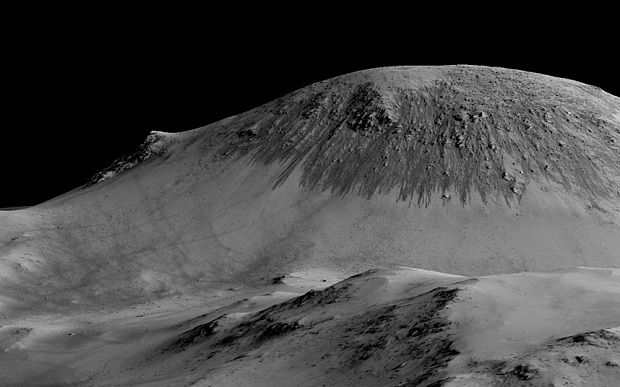
Here’s a picture taken with the High Resolution Imaging Science Experiment (HIRISE) on MRO showing some of the recurring slope lineae (RSL):

Mars_Water

You can see a wonderful gallery of other HIRISE images of other such features here.

The dark streaky stains in this and other examples are visually very suggestive of the possibility they were produced by flowing liquid. They also come and go with the Martian seasons, which suggests that they might involve something that melts in the summer and freezes in the winter. Putting these two facts together raises the quite reasonable question of whether, if that is indeed how they’re made, that liquid might be water.

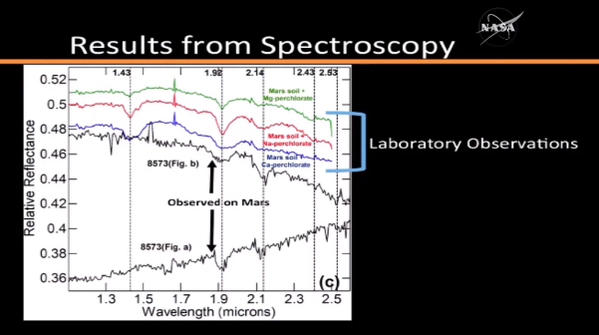
What is new about the latest results that adds to the superb detail revealed by the HIRISE images – is that there is spectroscopic information that yields clues about the chemical composition of the stuff in the RSLs:


Spectroscopy

The black lines denote spectra that are taken at two different locations; the upper one has been interpreted as indicating the presence of some mixture of hydrated Calcium, Magnesium and Sodium Perchlorates (i.e. salts). I’m not a chemical spectroscopist so I don’t know whether other interpretations are possible, though I can’t say that I’m overwhelmingly convinced by the match between the data from laboratory specimens and that from Mars…

Anyway, if that is indeed what the spectroscopy indicates then the obvious conclusion is that there is water present, for without water there can be no hydrated salts. This water could have been absorbed from the atmospheric vapour or from the ice below the surface. The presence of salts would lowers the melting point of water ice, so this could explain how there could be some form of liquid flow at the sub-zero temperatures prevalent even in a Martian summer. It would not be pure running water, however, but an extremely concentrated salt solution, much saltier than sea water, probably in the form of a rather sticky brine. This brine might flow – or perhaps creep – down the sloping terrain (briefly) in the summer and then freeze. But nothing has actually been observed to flow in such a way. It seems to me – as a non-expert – that the features could be caused not by a flow of liquid, but by the disruption of the Martian surface, caused by melting and freezing, involving  movement of solid material, or perhaps localized seeping. I’m not saying that it’s impossible that a flow of briny liquid is responsible for the features, just that I think it’s far from proven. But there’s no doubt that whatever is going on is fascinatingly complicated!

The last sentence of the abstract quoted above reads:

Our findings strongly support the hypothesis that recurring slope lineae form as a result of contemporary water activity on Mars.

I’m not sure about the “strongly support” but “contemporary water activity” is probably fair as it includes the possibilities I discussed above, but it does seem to have led quite a few people to jump to the conclusion that it means “flowing water”, which I don’t think it does. Am I wrong to be so sceptical? Let me know through the comments box!


The Meaning of Cosmology

Posted in Biographical, The Universe and Stuff with tags , , , , on September 27, 2015 by telescoper

I know it’s Sunday, and it’s also sunny, but I’m in the office catching up with my ever-increasing backlog of work so I hope you’ll forgive me for posting one from the vaults, a rehash of an old piece that dates from 2008..

–o–

When asked what I do for a living, I’ve always avoided describing myself as an astronomer, because most people seem to think that involves star signs and horoscopes. Anyone can tell I’m not an astrologer anyway, because I’m not rich. Astrophysicist sounds more impressive, but perhaps a little scary. That’s why I usually settle on the “Cosmologist”. Grandiose, but at the same time somehow cuddly.

I had an inkling that this choice was going to be a mistake at the start of my first ever visit to the United States, which was to attend a conference in memory of the great physicist Yacov Borisovich Zel’dovich, who died in 1989. The meeting was held in Lawrence, Kansas, home of the University of Kansas, in May 1990. This event was notable for many reasons, including the fact that the effective ban on Russian physicists visiting the USA had been lifted after the arrival of glasnost to the Soviet Union. Many prominent scientists from there were going to be attending. I had also been invited to give a talk, the only connection with Zel’dovich that I could figure out was that the very first paper I wrote was cited in the very last paper to be written by the great man.

I think I flew in to Detroit from London and had to clear customs there in order to transfer to an internal flight to Kansas. On arriving at the customs area in the airport, the guy at the desk peered at my passport and asked me what was the purpose of my visit. I said “I’m attending a Conference”. He eyed me suspiciously and asked me my line of work. “Cosmologist,” I proudly announced. He frowned and asked me to open my bags. He looked in my suitcase, and his frown deepened. He looked at me accusingly and said “Where are your samples?”

I thought about pointing out that there was indeed a sample of the Universe in my bag but that it was way too small to be regarded as representative. Fortunately, I thought better of it. Eventually I realised he thought cosmologist was something to do with cosmetics, and was expecting me to be carrying little bottles of shampoo or make-up to a sales conference or something like that. I explained that I was a scientist, and showed him the poster for the conference I was going to attend. He seemed satisfied. As I gathered up my possessions thinking the formalities were over, he carried on looking through my passport. As I moved off he suddenly spoke again. “Is this your first visit to the States, son?”. My passport had no other entry stamps to the USA in it. “Yes,” I said. He was incredulous. “And you’re going to Kansas?”

This little confrontation turned out to be a forerunner of a more dramatic incident involving the same lexicographical confusion. One evening during the Zel’dovich meeting there was a reception held by the University of Kansas, to which the conference participants, local celebrities (including the famous writer William Burroughs, who lived nearby) and various (small) TV companies were invited. Clearly this meeting was big news for Lawrence. It was all organized by the University of Kansas and there was a charming lady called Eunice who was largely running the show. I got talking to her near the end of the party. As we chatted, the proceedings were clearly winding down and she suggested we go into Kansas City to go dancing. I’ve always been up for a boogie, Lawrence didn’t seem to be offering much in the way of nightlife, and my attempts to talk to William Burroughs were repelled by the bevy of handsome young men who formed his entourage, so off we went in her car.

Before I go on I’ll just point out that Eunice – full name Eunice H. Stallworth – passed away suddenly in 2009. I spent quite a lot of time with her during this and other trips to Lawrence, including a memorable day out at a pow wow at Haskell Indian Nations University where there was some amazing dancing.

Anyway, back to the story. It takes over an hour to drive into Kansas City from Lawrence but we got there safely enough. We went to several fun places and had a good time until well after midnight. We were about to drive back when Eunice suddenly remembered there was another nightclub she had heard of that had just opened. However, she didn’t really know where it was and we spent quite a while looking for it. We ended up on the State Line, a freeway that separates Kansas City Kansas from Kansas City Missouri, the main downtown area of Kansas City actually being for some reason in the state of Missouri. After only a few moments on the freeway a police car appeared behind us with its lights blazing and siren screeching, and ushered us off the road into a kind of parking lot.

Eunice stopped the car and we waited while a young cop got out of his car and approached us. I was surprised to see he was on his own. I always thought the police always went around in pairs, like low comedians. He asked for Eunice’s driver’s license, which she gave him. He then asked for mine. I don’t drive and don’t have a driver’s license, and explained this to the policeman. He found it difficult to comprehend. I then realised I hadn’t brought my passport along, so I had no ID at all.

I forgot to mention that Eunice was black and that her car had Alabama license plates.

I don’t know what particular thing caused this young cop to panic, but he dashed back to his car and got onto his radio to call for backup. Soon, another squad car arrived, drove part way into the entrance of the parking lot and stopped there, presumably so as to block any attempted escape. The doors of the second car opened and two policemen got out, kneeled down and and aimed pump-action shotguns at us as they hid behind the car doors which partly shielded them from view and presumably from gunfire. The rookie who had stopped us did the same thing from his car, but he only had a handgun.

“Put your hands on your heads. Get out of the car. Slowly. No sudden movements.” This was just like the movies.

We did as we were told. Eventually we both ended up with our hands on the roof of Eunice’s car being frisked by a large cop sporting an impressive walrus moustache. He reminded me of one of the Village People, although his uniform was not made of leather. I thought it unwise to point out the resemblance to him. Declaring us “clean”, he signalled to the other policemen to put their guns away. They had been covering him as he searched us.

I suddenly realised how terrified I was. It’s not nice having guns pointed at you.

Mr Walrus had found a packet of French cigarettes (Gauloises) in my coat pocket. I clearly looked scared so he handed them to me and suggested I have a smoke. I lit up, and offered him one (which he declined). Meanwhile the first cop was running the details of Eunice’s car through the vehicle check system, clearly thinking it must have been stolen. As he did this, the moustachioed policeman, who was by now very relaxed about the situation, started a conversation which I’ll never forget.

Policeman: “You’re not from around these parts, are you?” (Honestly, that’s exactly what he said.)

Me: “No, I’m from England.”

Policeman: “I see. What are you doing in Kansas?”

Me: “I’m attending a conference, in Lawrence..”

Policeman: “Oh yes? What kind of Conference?”

Me: “It’s about cosmology”

At this point, Mr Walrus nodded and walked slowly to the first car where the much younger cop was still fiddling with the computer.

“Son,” he said, “there’s no need to call for backup when all you got to deal with is a Limey hairdresser…”.

Amplitude & Energy in Electromagnetic Waves

Posted in Cute Problems, The Universe and Stuff with tags , , , on September 22, 2015 by telescoper

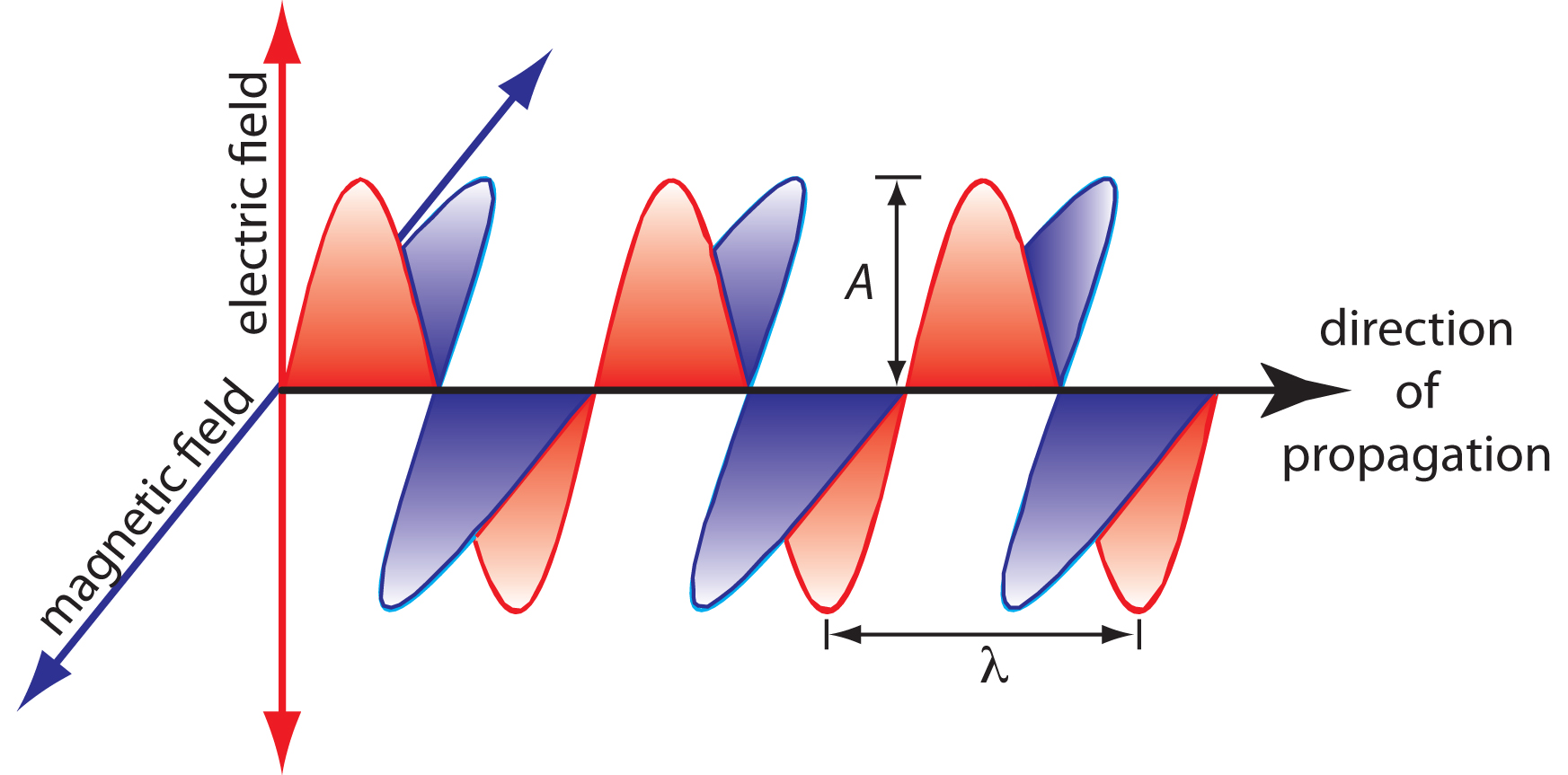
Here’s a little physics riddle. As you all know, electromagnetic radiation consists of oscillating electric and magnetic fields rather like this:

Figure10.1(Graphic stolen from here.) The polarization state of the wave is defined by the direction of the Electric field, in this case vertically upwards.

Now the energy carried by an electromagnetic wave of a given wavelength is proportional to the square of its amplitude, denoted in the Figure by A, so the energy is of the form kA2 in this case with k constant. Two separate electromagnetic waves with the same amplitude and wavelength would thus carry an energy = 2kA2.

But now consider what happens if you superpose two waves in phase, each having the same wavelength, polarization and amplitude to generate a single wave with amplitude 2A. The energy carried now is k(2A)2 = 4kA2, which is twice the value obtained for two separate waves.

Where does the extra energy come from?

Answers through the Comments Box please!

A Botanic Garden of Planets

Posted in Poetry, The Universe and Stuff on September 19, 2015 by telescoper

I’ve been reading, with rapidly growing delight and astonishment, an amazing poem called The Botanic Garden , which was written by Erasmus Darwin in 1789. It is a truly wonderful work which depicts the Universe as a vast laboratory set up by a Divine Creator through verses that generate a thrilling sense of  momentum and vitality. Take this example, a passage from the First Canto, dealing with the creation of the stars and planets:

‘Let there be Light!’, proclaimed the Almighty Lord,
Astonish’d Chaos heard the potent word: – 
Through all his realms the kindly Ether runs,
And the mass starts into a million suns; 
Earths round each sun with quick explosions burst,
And second planets issue from the first; 
Bend, as they journey with projectile force, 
In bright ellipses bend their reluctant course; 
Orbs wheel in orbs, round centres centres roll, 
And form, self-balanced, one revolving Whole.

It doesn’t quite fit with modern theories of star and planet formation, but it’s certainly beautifully expressed!

Quantum Madness

Posted in The Universe and Stuff with tags , , on September 18, 2015 by telescoper

A very busy day lies in store so I only have time for a quick morning visit to the blog. If you enjoyed the recent guest post on the “hidden variables” interpretation of Quantum Mechanics, then you will probably enjoy reading a paper that recently appeared on the arXiv with the abstract:

Motivated by some recent news, a journalist asks a group of physicists: “What’s the meaning of the violation of Bell’s inequality?” One physicist answers: “It means that non-locality is an established fact”. Another says: “There is no non-locality; the message is that measurement outcomes are irreducibly random”. A third one says: “It cannot be answered simply on purely physical grounds, the answer requires an act of metaphysical judgement”. Puzzled by the answers, the journalist keeps asking questions about quantum theory: “What is teleported in quantum teleportation?” “How does a quantum computer really work?” Shockingly, for each of these questions, the journalist obtains a variety of answers which, in many cases, are mutually exclusive. At the end of the day, the journalist asks: “How do you plan to make progress if, after 90 years of quantum theory, you still don’t know what it means? How can you possibly identify the physical principles of quantum theory or expand quantum theory into gravity if you don’t agree on what quantum theory is about?” Here we argue that it is becoming urgent to solve this too long lasting problem. For that, we point out that the interpretations of quantum theory are, essentially, of two types and that these two types are so radically different that there must be experiments that, when analyzed outside the framework of quantum theory, lead to different empirically testable predictions. Arguably, even if these experiments do not end the discussion, they will add new elements to the list of strange properties that some interpretations must have, therefore they will indirectly support those interpretations that do not need to have all these strange properties.

You can download a PDF of the full paper here. It’s a short piece, but with a very good list of references for further reading.

Gamma-Ray Bursts and the Cosmological Principle

Posted in Astrohype, Bad Statistics, The Universe and Stuff with tags , , , on September 13, 2015 by telescoper

There’s been a reasonable degree of hype surrounding a paper published in Monthly Notices of the Royal Astronomical Society (and available on the arXiv here). The abstract of this paper reads:

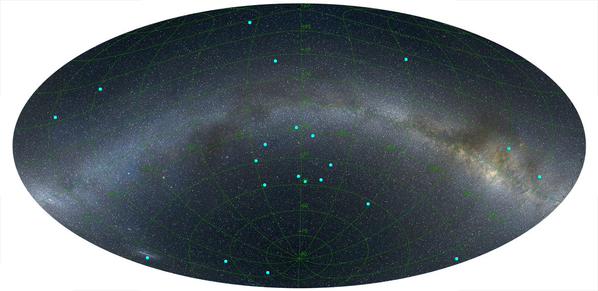
According to the cosmological principle (CP), Universal large-scale structure is homogeneous and isotropic. The observable Universe, however, shows complex structures even on very large scales. The recent discoveries of structures significantly exceeding the transition scale of 370 Mpc pose a challenge to the CP. We report here the discovery of the largest regular formation in the observable Universe; a ring with a diameter of 1720 Mpc, displayed by 9 gamma-ray bursts (GRBs), exceeding by a factor of 5 the transition scale to the homogeneous and isotropic distribution. The ring has a major diameter of 43° and a minor diameter of 30° at a distance of 2770 Mpc in the 0.78 < z < 0.86 redshift range, with a probability of 2 × 10⁻⁶ of being the result of a random fluctuation in the GRB count rate. Evidence suggests that this feature is the projection of a shell on to the plane of the sky. Voids and string-like formations are common outcomes of large-scale structure. However, these structures have maximum sizes of 150 Mpc, which are an order of magnitude smaller than the observed GRB ring diameter. Evidence in support of the shell interpretation requires that temporal information of the transient GRBs be included in the analysis. This ring-shaped feature is large enough to contradict the CP. The physical mechanism responsible for causing it is unknown.

The so-called “ring” can be seen here:
ring_Australia

In my opinion it’s not a ring at all, but an outline of Australia. What’s the probability of a random distribution of dots looking exactly like that? Is it really evidence for the violation of the Cosmological Principle, or for the existence of the Cosmic Antipodes?

For those of you who don’t get that gag, a cosmic antipode occurs in, e.g., closed Friedmann cosmologies in which the spatial sections take the form of a hypersphere (or 3-sphere). The antipode is the point diametrically opposite the observer on this hypersurface, just as it is for the surface of a 2-sphere such as the Earth. The antipode is only visible if it lies inside the observer’s horizon, a possibility which is ruled out for standard cosmologies by current observations. I’ll get my coat.

Anyway, joking apart, the claims in the abstract of the paper are extremely strong but the statistical arguments supporting them are deeply unconvincing. Indeed, I am quite surprised the paper passed peer review. For a start there’s a basic problem of “a posteriori” reasoning here. We see a group of objects that form a map of Australia ring and then are surprised that such a structure appears so rarely in simulations of our favourite model. But all specific configurations of points are rare in a Poisson point process. We would be surprised to see a group of dots in the shape of a pretzel too, or the face of Jesus, but that doesn’t mean that such an occurrence has any significance. It’s an extraordinarily difficult problem to put a meaningful measure on the space of geometrical configurations, and this paper doesn’t succeed in doing that.

For a further discussion of the tendency that people have to see patterns where none exist, take a look at this old post from which I’ve taken this figure which is generated by drawing points independently and uniformly randomly:

pointaI can see all kinds of shapes in this pattern, but none of them has any significance (other than psychological). In a mathematically well-defined sense there is no structure in this pattern! Add to that difficulty the fact that so few points are involved and I think it becomes very clear that this “structure” doesn’t provide any evidence at all for the violation of the Cosmological Principle. Indeed it seems neither do the authors. The very last paragraph of the paper is as follows:

GRBs are very rare events superimposed on the cosmic
web identified by superclusters. Because of this, the ring is
probably not a real physical structure. Further studies are
needed to reveal whether or not the Ring could have been
produced by a low-frequency spatial harmonic of the large-
scale matter density distribution and/or of universal star
forming activity.

It’s a pity that this note of realism didn’t make it into either the abstract or, more importantly, the accompanying press release. Peer review will never be perfect, but we can do without this sort of hype. Anyway, I confidently predict that a proper refutation will appear shortly….

P.S. For a more technical discussion of the problems of inferring the presence of large structures from sparsely-sampled distributions, see here.