Archive for the The Universe and Stuff Category

An Exciting Opportunity in Experimental Physics at the University of Sussex!

Posted in Education, The Universe and Stuff with tags , , , , on July 14, 2015 by telescoper

After much planning and preparatory work, I’m pleased that I am now in a position to announce that the Department of Physics & Astronomy at the University of Sussex has an exciting opportunity in the form of a brand new Chair position in Experimental Physics. The advertisement will shortly appear in both Nature and the Times Higher but it has already appeared on the University of Sussex website. I’m taking the liberty of posting a description of the new position here, but for fuller details please visit the formal advertisement.

–0–

The School of Mathematical and Physical Sciences seeks to appoint a Professor in Experimental Physics in the Department of Physics & Astronomy to lead the next phase of expansion and diversification of the research portfolio within the School by establishing an entirely new research activity in laboratory-based physics.

Sufficient resources will be made available to the selected candidate to establish a new group at Sussex in their field of experimental physics including, for example, condensed matter (interpreted widely), materials science, nanophysics or biophysics. Applicants in research areas with scope for interdisciplinary collaborations with other Schools at the University of Sussex (e.g. Life Sciences, Engineering & Informatics or Brighton and Sussex Medical School) are encouraged, especially  those in areas with potential for generating research impact, as defined in the context of the UK Research Excellence Framework.

The successful applicant will have a proven track-record of success in obtaining substantial external funding through research grants and/or industrial sponsorship.

The appointee will be supported with substantial (seven-figure) sum for start-up funding and an extensive newly-refurbished laboratory space. The financial package on offer will also support the appointment of at least two further experimental lectureships; the appointed professor is expected to be strongly involved in recruitment to these positions.

Informal (and confidential) enquiries may be addressed in the first instance to the Head of School, Professor Peter Coles (P.Coles@sussex.ac.uk).


A Galaxy at Record Redshift?

Posted in The Universe and Stuff with tags , , , , , on July 13, 2015 by telescoper

Skimming through the arXiv this morning I discovered a paper by Zitrin et al. with the following abstract:


abstract_z

I’m not sure if the figures are all significant, but a redshift of z=8.68 makes this the most distant spectroscopically confirmed galaxy on record with a present proper distance of about 9.3 Gpc according to the standard cosmological model, just pipping the previous record holder (whose redshift was in any case disputed). Light from this galaxy has taken about 13.1 Gyr to reach us; that means light set out from it when the Universe was only about 4% of its current age, only about 600 million years after the Big Bang. (Those figures were obtained using the inestimable Ned Wright’s cosmology calculator.)

We are presumably seeing a very young object, in which stars are forming at a considerable rate to account for its brightness. We don’t know exactly when the first stars formed and began to ionize the intergalactic medium, but every time the cosmic distance record is broken we push that time back closer to the Big Bang.

Mind you, I can’t say I’m overwhelmingly convinced by the identification of the redshifted Lyman-α line:

high_zBut what do I know? I’m a theorist whose suspicious of data. Any observers care to comment?

Bad Statistics, Bad Science

Posted in Bad Statistics, Science Politics, The Universe and Stuff with tags , , on July 2, 2015 by telescoper

I saw an interesting article in Nature the opening paragraph of which reads:

The past few years have seen a slew of announcements of major discoveries in particle astrophysics and cosmology. The list includes faster-than-light neutrinos; dark-matter particles producing γ-rays; X-rays scattering off nuclei underground; and even evidence in the cosmic microwave background for gravitational waves caused by the rapid inflation of the early Universe. Most of these turned out to be false alarms; and in my view, that is the probable fate of the rest.

The piece goes on to berate physicists for being too trigger-happy in claiming discoveries, the BICEP2 fiasco being a prime example. I agree that this is a problem, but it goes far beyond physics. In fact its endemic throughout science. A major cause of it is abuse of statistical reasoning.

Anyway, I thought I’d take the opportunity to re-iterate why I statistics and statistical reasoning are so important to science. In fact, I think they lie at the very core of the scientific method, although I am still surprised how few practising scientists are comfortable with even basic statistical language. A more important problem is the popular impression that science is about facts and absolute truths. It isn’t. It’s a process. In order to advance it has to question itself. Getting this message wrong – whether by error or on purpose -is immensely dangerous.

Statistical reasoning also applies to many facets of everyday life, including business, commerce, transport, the media, and politics. Probability even plays a role in personal relationships, though mostly at a subconscious level. It is a feature of everyday life that science and technology are deeply embedded in every aspect of what we do each day. Science has given us greater levels of comfort, better health care, and a plethora of labour-saving devices. It has also given us unprecedented ability to destroy the environment and each other, whether through accident or design.

Civilized societies face rigorous challenges in this century. We must confront the threat of climate change and forthcoming energy crises. We must find better ways of resolving conflicts peacefully lest nuclear or conventional weapons lead us to global catastrophe. We must stop large-scale pollution or systematic destruction of the biosphere that nurtures us. And we must do all of these things without abandoning the many positive things that science has brought us. Abandoning science and rationality by retreating into religious or political fundamentalism would be a catastrophe for humanity.

Unfortunately, recent decades have seen a wholesale breakdown of trust between scientists and the public at large. This is due partly to the deliberate abuse of science for immoral purposes, and partly to the sheer carelessness with which various agencies have exploited scientific discoveries without proper evaluation of the risks involved. The abuse of statistical arguments have undoubtedly contributed to the suspicion with which many individuals view science.

There is an increasing alienation between scientists and the general public. Many fewer students enrol for courses in physics and chemistry than a a few decades ago. Fewer graduates mean fewer qualified science teachers in schools. This is a vicious cycle that threatens our future. It must be broken.

The danger is that the decreasing level of understanding of science in society means that knowledge (as well as its consequent power) becomes concentrated in the minds of a few individuals. This could have dire consequences for the future of our democracy. Even as things stand now, very few Members of Parliament are scientifically literate. How can we expect to control the application of science when the necessary understanding rests with an unelected “priesthood” that is hardly understood by, or represented in, our democratic institutions?

Very few journalists or television producers know enough about science to report sensibly on the latest discoveries or controversies. As a result, important matters that the public needs to know about do not appear at all in the media, or if they do it is in such a garbled fashion that they do more harm than good.

Years ago I used to listen to radio interviews with scientists on the Today programme on BBC Radio 4. I even did such an interview once. It is a deeply frustrating experience. The scientist usually starts by explaining what the discovery is about in the way a scientist should, with careful statements of what is assumed, how the data is interpreted, and what other possible interpretations might be and the likely sources of error. The interviewer then loses patience and asks for a yes or no answer. The scientist tries to continue, but is badgered. Either the interview ends as a row, or the scientist ends up stating a grossly oversimplified version of the story.

Some scientists offer the oversimplified version at the outset, of course, and these are the ones that contribute to the image of scientists as priests. Such individuals often believe in their theories in exactly the same way that some people believe religiously. Not with the conditional and possibly temporary belief that characterizes the scientific method, but with the unquestioning fervour of an unthinking zealot. This approach may pay off for the individual in the short term, in popular esteem and media recognition – but when it goes wrong it is science as a whole that suffers. When a result that has been proclaimed certain is later shown to be false, the result is widespread disillusionment.

The worst example of this tendency that I can think of is the constant use of the phrase “Mind of God” by theoretical physicists to describe fundamental theories. This is not only meaningless but also damaging. As scientists we should know better than to use it. Our theories do not represent absolute truths: they are just the best we can do with the available data and the limited powers of the human mind. We believe in our theories, but only to the extent that we need to accept working hypotheses in order to make progress. Our approach is pragmatic rather than idealistic. We should be humble and avoid making extravagant claims that can’t be justified either theoretically or experimentally.

The more that people get used to the image of “scientist as priest” the more dissatisfied they are with real science. Most of the questions asked of scientists simply can’t be answered with “yes” or “no”. This leaves many with the impression that science is very vague and subjective. The public also tend to lose faith in science when it is unable to come up with quick answers. Science is a process, a way of looking at problems not a list of ready-made answers to impossible problems. Of course it is sometimes vague, but I think it is vague in a rational way and that’s what makes it worthwhile. It is also the reason why science has led to so many objectively measurable advances in our understanding of the World.

I don’t have any easy answers to the question of how to cure this malaise, but do have a few suggestions. It would be easy for a scientist such as myself to blame everything on the media and the education system, but in fact I think the responsibility lies mainly with ourselves. We are usually so obsessed with our own research, and the need to publish specialist papers by the lorry-load in order to advance our own careers that we usually spend very little time explaining what we do to the public or why.

I think every working scientist in the country should be required to spend at least 10% of their time working in schools or with the general media on “outreach”, including writing blogs like this. People in my field – astronomers and cosmologists – do this quite a lot, but these are areas where the public has some empathy with what we do. If only biologists, chemists, nuclear physicists and the rest were viewed in such a friendly light. Doing this sort of thing is not easy, especially when it comes to saying something on the radio that the interviewer does not want to hear. Media training for scientists has been a welcome recent innovation for some branches of science, but most of my colleagues have never had any help at all in this direction.

The second thing that must be done is to improve the dire state of science education in schools. Over the last two decades the national curriculum for British schools has been dumbed down to the point of absurdity. Pupils that leave school at 18 having taken “Advanced Level” physics do so with no useful knowledge of physics at all, even if they have obtained the highest grade. I do not at all blame the students for this; they can only do what they are asked to do. It’s all the fault of the educationalists, who have done the best they can for a long time to convince our young people that science is too hard for them. Science can be difficult, of course, and not everyone will be able to make a career out of it. But that doesn’t mean that it should not be taught properly to those that can take it in. If some students find it is not for them, then so be it. I always wanted to be a musician, but never had the talent for it.

I realise I must sound very gloomy about this, but I do think there are good prospects that the gap between science and society may gradually be healed. The fact that the public distrust scientists leads many of them to question us, which is a very good thing. They should question us and we should be prepared to answer them. If they ask us why, we should be prepared to give reasons. If enough scientists engage in this process then what will emerge is and understanding of the enduring value of science. I don’t just mean through the DVD players and computer games science has given us, but through its cultural impact. It is part of human nature to question our place in the Universe, so science is part of what we are. It gives us purpose. But it also shows us a way of living our lives. Except for a few individuals, the scientific community is tolerant, open, internationally-minded, and imbued with a philosophy of cooperation. It values reason and looks to the future rather than the past. Like anyone else, scientists will always make mistakes, but we can always learn from them. The logic of science may not be infallible, but it’s probably the best logic there is in a world so filled with uncertainty.


SpaceX – the Anatomy of an Explosion

Posted in The Universe and Stuff with tags , , , on June 29, 2015 by telescoper

Yesterday an unmanned Falcon-9 SpaceX rocket was launched from Cape Canaveral in Florida. All seemed to go well. At first…

Here’s a super-slow-motion video of the terrifying explosion that engulfed and destroyed the rocket:

I’m no rocket scientist – and no doubt a full expert analysis of this event will be published before too long – but it does seem clear that the problem originated in the Stage 2 rocket. I fancy I can see something happen near the top of the rocket just before the main explosion started.

It’s not easy putting things into space, but we shouldn’t stop doing things just because they’re hard.


My PhD Tree

Posted in Biographical, The Universe and Stuff with tags , , on June 23, 2015 by telescoper

Last week I discovered that somebody has kindly constructed my PhD Tree. I later discovered that similar things have been constructed for quite a few other scientists of my acquaintance. Perhaps even yours?

Anyway, here is my academic lineage. As you can see, I have some distinguished ancestors. In particular, my great-grandfather (academically speaking) was Paul Dirac

PhD Tree

Incidentally, you might like to see Dirac’s hand-written notes for his PhD Thesis, which you can find here. It dates from 1926. As far as I am aware this is the first PhD thesis ever written on the subject of Quantum Mechanics. It’s also worth mentioning the tremendous contribution to British science made by R.H. Fowler. Fifteen Fellows of the Royal Society and three Nobel Laureates (Chandrasekhar, Dirac, and Mott) were supervised by Fowler in Cambridge between 1922 and 1939.

Six key trends in contemporary statistics that really could revolutionise astronomical data analysis …

Posted in Biographical, The Universe and Stuff with tags on June 11, 2015 by telescoper

I’ve just come across this very interesting astrostatistics site, and I thought I’d reblog a piece from it. In fact I did make a very crude attempt back in the 90s to do something very like the SPDE analysis described here, but it came to nothing and I dropped the idea. Now it seems that there’s been a great deal of more recent activity in this area which I knew nothing about so it might be worth reviving interest in it.

Now. Where did I put those notes?

The Latest TV – Experimental Particle Physics at Sussex

Posted in Brighton, The Universe and Stuff with tags , , , , on June 10, 2015 by telescoper

I just came across this clip featuring our own Prof. Antonella de Santo of the Department of Physics & Astronomy at the University of Sussex (where she leads the Experimental Particle Physics group) talking about the group’s work on The Latest TV, a new documentary TV station based in Brighton.

The Frontier of Computing – Quantum Technology

Posted in The Universe and Stuff with tags , , , on June 6, 2015 by telescoper

I came across this video last week and thought I would share it here. It was made by a group students and is called The Frontier of Computing – Quantum Technology. It features Prof. Winfried (“Winni”) Hensinger of the Department of Physics & Astronomy at the University of Sussex.

This gives me a chance to plug once more the unique Frontiers of Quantum Technology MSc Course at the University of Sussex, which seems to be attracting considerable interest this year!

Higher Energy Physics at the LHC

Posted in The Universe and Stuff with tags , , , , on June 3, 2015 by telescoper

I’ve been busy with meetings most of the day but couldn’t resist a quick post to catch up on the exciting events at CERN. Today is the day that the Large Hadron Collider was due to start operating at its highest collision energies so far, 13 TeV. It was quite a nervous morning, and the first attempt to ramp up to this energy failed.

Here was the scene this morning in the control room of the ATLAS experiment.

Control Room

This kind of photograph always reminds me of the inside of a betting shop..

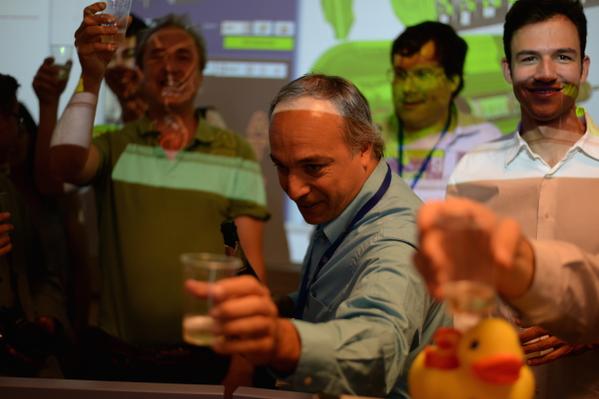
However, it didn’t take long to succeed, at which point much celebration ensued. This story has a strong local connection here in the Department of Physics & Astronomy at the University of Sussex. The run coordinator for the ATLAS experiment on the Large Hadron Collider is Dr Alessandro Cerri of Sussex  and he has figured prominently in today’s action. Here he is, having a glass of bubbly (purely medicinal, I’m assured) when they first achieved stable beams at the new collision scale:

Cerri

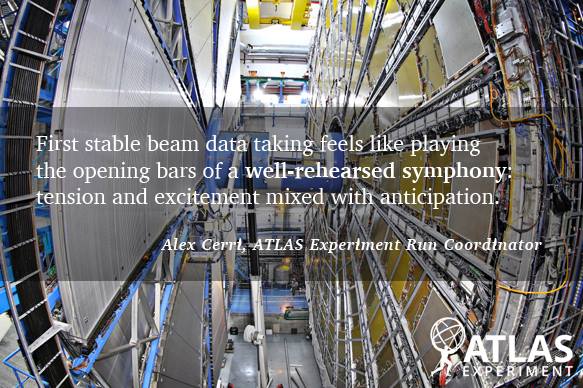
He also produced this nice quote which I took from the ATLAS Twitter feed.

LHC_Restart

It is hoped that operating at 13 TeV will allow the various detectors on the Large Hadron Collider to probe the possible existence of supersysmmetric particles which have so far defied detection. On the other hand if it doesn’t find them it will cause a lot of theorists to go back to the drawing board. Incidentally I’ve been going around asking particle physicists how much they’d be willing to bet on the LHC finding evidence of supersymmetry and I can’t get any of them to make a wager with me. Any one willing to rise to the challenge please do so via the Comments Box.

Of course we all know that the main reason for increasing the LHC’s energy is not to detect supersymmetric particles, or indeed any other evidence of physics beyond the standard model that had previous been accessible. It’s to generate papers with even longer author lists

Big Science is not the Problem – it’s Top-Down Management of Research

Posted in Finance, Science Politics, The Universe and Stuff with tags , , , , on June 2, 2015 by telescoper

I’m very late to this because I was away at the weekend, but I couldn’t resist making a comment on a piece that appeared in the Grauniad last week entitled How can we stop big science hovering up all the research funding? That piece argues for a new system of allocating research funding to avoid all the available cash being swallowed by a few big projects. This is an argument that’s been rehearsed many times before in the context of physics and astronomy, the costs of the UK contribution to facilities such as CERN (home of the Large Hadron Collider) and the European Southern Observatory being major parts of the budget of the Science and Technology Facilities Council that often threaten to squeeze the funds available for “exploiting” these facilities – in other words for doing science. What’s different about the Guardian article however is that it focusses on genomics, which has only recently threatened to become a Big Science.

Anyway, Jon Butterworth has responded with a nice piece of his own (also in the Guardian) with which I agree quite strongly. I would however like to make a couple of comments.

First of all, I think there are two different usages of the phrase “Big Science” and we should be careful not to conflate them. The first, which particularly applies in astronomy and particle physics, is that the only way to do research in these subjects is with enormous and generally very expensive pieces of kit. For this reason, and in order to share the cost in a reasonable manner, these fields tend to be dominated by large international collaborations. While it is indeed true that the Large Hadron Collider has cost a lot of money, that money has been spent by a large number of countries over a very long time. Moreover, particle physicists argued for that way of working and collectively made it a reality. The same thing happens in astronomy: the next generation of large telescopes are all transnational affairs.

The other side of the “Big Science” coin is quite a different thing. It relates to attempts to impose a top-down organization on science when that has nothing to do with the needs of the scientific research. In other words, making scientists in big research centres when it doesn’t need to be done like that. Here I am much more sceptical of the value. All the evidence from, e.g., the Research Excellence Framework is that there is a huge amount of top-class research going on in small groups here and there, much of it extremely innovative and imaginative. It’s very hard to justify concentrating everything in huge centres that are only Big because they’ve taken killed everything that’s Small, by concentrating resources to satisfy some management fixation rather than based on the quality of the research being done. I have seen far too many attempts by funding councils, especially the Engineering and Physical Sciences Research Council, to direct funding from the top down which, in most cases, is simply not the best way to deliver compelling science. Directed programmes rarely deliver exciting science, partly because the people directing them are not the people who actually know most about the field.

I am a fan of the first kind of Big Science, and not only for scientific reasons. I like the way it encourages us to think beyond the petty limitations of national politics, which is something that humanity desparately needs to get used to. But while Big Science can be good, forcing other science to work in Big institutes won’t necessarily make it better. In fact it could have the opposite effect, stifling the innovative approaches so often found in small groups. Small can be beautiful too.

Finally, I’d have to say that I found the Guardian article that started this piece of to be a bit mean-spirited. Scientists should be standing together not just to defend but to advance scientific research across all the disciplines rather than trying to set different kinds of researchers against each other. I feel the same way about funding the arts, actually. I’m all for more science funding, but don’t want to see the arts to be killed off to pay for it.