Archive for the The Universe and Stuff Category

Launch!

Posted in The Universe and Stuff with tags , , , on January 3, 2015 by telescoper

Meanwhile, in Antarctica, the search for signatures of primordial gravitational waves in the polarization of the cosmic microwave background goes on. Here’s a fascinating blog by a member of the SPIDER team, whose balloon-borne experiment was recently launched and is currently circling the South Pole taking data. Here’s hoping it works out as planned!

annegambrel22's avatarSPIDER on the Ice

This is surreal.

I have been working on SPIDER for three and a half years, and much of the rest of the collaboration has been working for many years beyond that. We have all gone through intense times of stress and disappointment, victories and defeats. The personal sacrifice on the part of every individual on the team to get SPIDER to the point of flight readiness has been a weight on all of our shoulders as we prepared to launch our hopes and dreams on a balloon.

Ballooning is incredibly risky. Everything can work flawlessly on the ground, and then one thing can break during launch, or freeze or overheat at float altitude, and no amount of commanding from afar can bring it back to life. This happens so often in ballooning, and all you can do is obsess over every aspect of the experiment, have redundancy where possible, and…

View original post 760 more words

The Cliffs of Comet Churyumov–Gerasimenko

Posted in The Universe and Stuff with tags , , on December 23, 2014 by telescoper

I don’t often post pictures from the excellent Astronomy Picture of the Day but today’s is so beautiful I couldn’t resist.

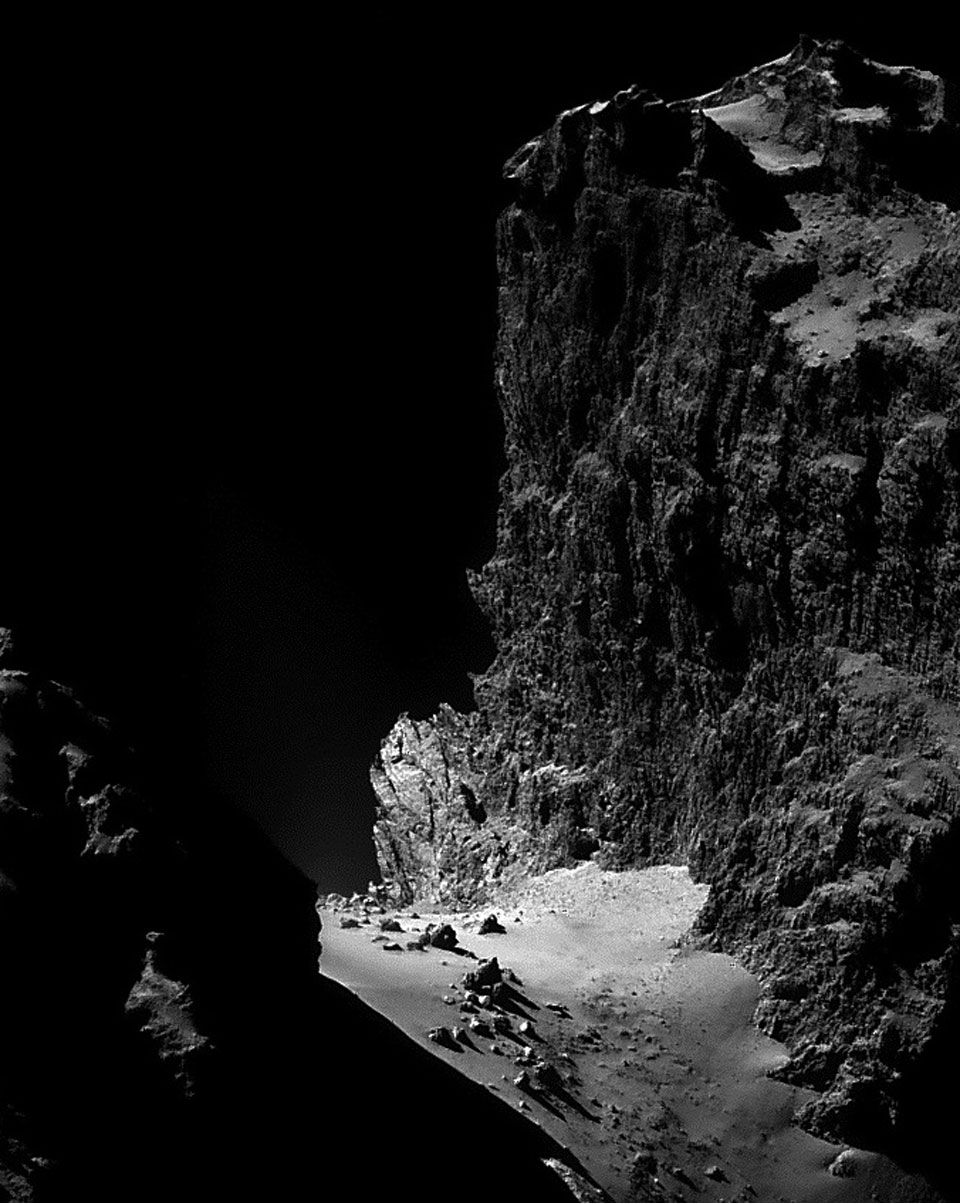
cometcliffs_rosetta_960

Image Credit & Licence (CC BY-SA 3.0 IGO): ESA, Rosetta spacecraft, NAVCAM; Additional Processing: Stuart Atkinson

The explanation published with the picture goes:

These high cliffs occur on the surface of a comet. They were discovered to be part of the dark nucleus of Comet Churyumov–Gerasimenko (CG) by Rosetta, a robotic spacecraft launched by ESA which began orbiting the comet in early August. The ragged cliffs, as featured here, were imaged by Rosetta about two weeks ago. Although towering about one kilometer high, the low surface gravity of Comet CG would likely make a jump from the cliffs, by a human, survivable. At the foot of the cliffs is relatively smooth terrain dotted with boulders as large as 20 meters across. Data from Rosetta indicates that the ice in Comet CG has a significantly different deuterium fraction — and hence likely a different origin — than the water in Earth’s oceans. The Rosetta spacecraft is scheduled to continue to accompany the comet as it makes its closest approach to the Sun in 2015 August.

For me, Rosetta has undoubtedly been the science highlight of the year. It has been an absolute triumph, and it’s not over yet as Rosetta will now follow the comet on its journey towards the Sun. With a bit of luck, the lander Philae will also awaken (hopefully in March) as the Sun begins to shine more brightly on its solar panels.

I think we should all wish a special Merry Christmas and Happy New Year to everyone involved with this wonderful adventure!

Planck Talks Online!

Posted in The Universe and Stuff with tags , , , , , on December 11, 2014 by telescoper

After yesterday’s frivolity, I return to community service mode today with a short post before a series of end-of-term meetings.

You may recall that not long ago  I posted an item about a meeting in Ferrara which started on 1st December and which  concerned results from the Planck satellite. Well, although the number of new results was disappointingly limited, all the talks given at that meeting are now available online here. Not all of the talks are about new Planck results, and some of those that do are merely tasters of things that will be more completely divulged in due course, but there is still a lot of interesting material there so I recommend cosmology types have a good look through. Any comments would be welcome through the usual channel below.

I’ll take this opportunity to pass on another couple of related items. First is that there is another meeting on Planck, in Paris next week. Coincidentally, I will be in Paris on Monday and Tuesday for a completely unrelated matter (of which more anon) but I will try to keep up with the cosmology business via Twitter etc and pass on whatever I can pick up.

The other bit of news is that there is to be a press conference on December 22nd at which I’m led to believe the outcome of the joint analysis of CMB polarization by Planck and BICEP2 will be unveiled. Now that will be interesting, so stay tuned!

Oh, and my poll on this subject is still open:


Happy Birthday XMM Newton!

Posted in The Universe and Stuff with tags , on December 10, 2014 by telescoper

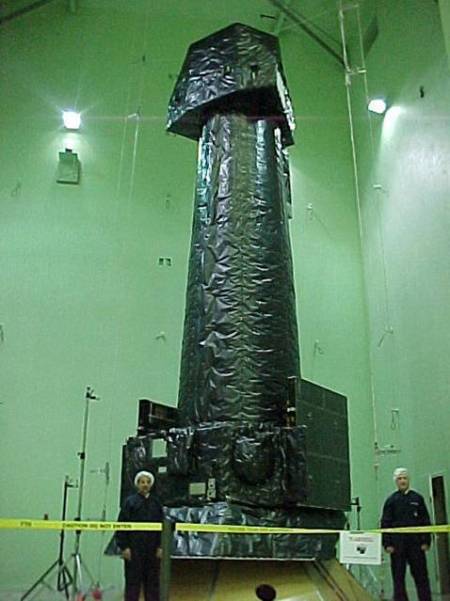
I just discovered this morning that it’s fifteen years to the day since the launch of the orbiting X-ray Observatory XMM Newton. Here’s a nice slide-show with audio accompaniment featuring Drs Darren Baskill and Kathy Romer, both colleagues of mine in the Department of Physics & Astronomy at the University of Sussex, which was recorded for the occasion of the 10th anniversary of the launch of XMM-Newton, back on 10th December 2009.

Here’s a nice video about the science of XMM-Newton.

Anyway, I hope the birthday celebrations go well. I know I can barely contain my excitement…

xmm_phallic

XMM-Newton being prepared for launch…

Planck 2014: The Results That Weren’t….

Posted in The Universe and Stuff with tags , , , , , on December 1, 2014 by telescoper

A big conference started today in Ferrara, Italy, which my duties here at the University of Sussex unfortunately did not allow me to attend. The purpose of the meeting was to announce the latest science results and data products from the Planck mission. There was quite a lot of excitement in advance of today’s session as there was supposed to be a press conference at which some exciting results would be announced. Although I’m in Sussex rather than Italy, I have been doing my best to keep up with some of the goings-on via Twitter.

From what I have gathered, it has so far been a bit of an anti-climax. For a start, it was announced some time ago that the full data sets would not be released during this meeting after all, with the effect the conference would just give a preview of the final Planck results. Here’s an explanation from the Planck website:

– The data products and scientific results will be presented at a public conference in Ferrara.

– It is planned to release full mission data products and scientific papers to the public before the end of 2014. A few of the derived products will need a little more time to be readied for release, but will be made public within the month of January 2015.

So the results were to be “presented”, but not “released”. Hmm..

The press conference scheduled for this morning didn’t actually happen either, so we had to wait for the science sessions for juicy information. Not being there in person I had to pick up what I could from Twitter, which included only a few images with accompanying text (only in French).

Here, for example are the main power-spectra for temperature (TT), E-mode polarization (EE) and the cross-spectrum between the two (TE), together with a picture of the temperature pattern across the sky:

france_120114.005

Lovely results of course – look how accurately the data fit the theoretical model curves – but notice that both the TE and EE spectra are cut off at low l. That’s because the polarization signal on large angular scales is so heavily affected by systematics that measurements for l<30 are unreliable. It’s not clear when, if ever, those systematic issues will be resolved. There’s no measurement of the primordial B-mode spectrum to compare with BICEP2, either, although there is a strong detection of a B-mode lensing signal obtained by cross-correlating Planck data with galaxy maps.

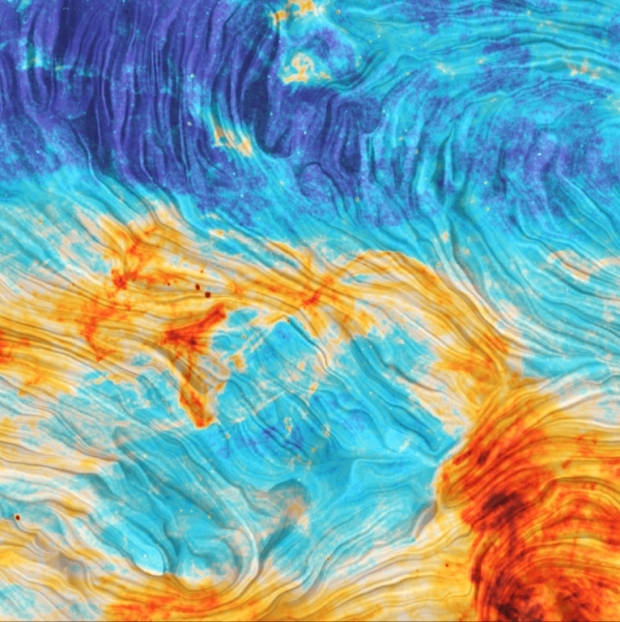
Still, that doesn’t mean that there is no polarization data at all. There is for example, this rather beautiful visualization of the polarized emission at 353 GHz, together with the Galactic magnetic field, shown over a thirty-degree square region of the sky:

lic_3_page_7

The science results that I’ve been able to glean from social media largely amount to minor corrections to last year’s results, with only small changes (less than ~1σ)  to the cosmological parameters derived from them. Good science, of course, but nothing to get too worked up about. What with the “now you see it, now you don’t” press conference, the decision not to release the data, and the polarization data  still being in a mess, I can’t help feeling distinctly underwhelmed by the whole thing. This might be a bit harsh, but I think it’s been a bit of a farce…

Still, at least I’m no longer sad I couldn’t make the conference!


Solitons in a Swimming Pool

Posted in The Universe and Stuff with tags , , , on December 1, 2014 by telescoper

Here’s a fascinating physics video for your amusement and edification:

I think the video explains what is going on pretty well, but if you want more information (including some connections with other bits of physics) you can look at this paper (whence I’ve nicked the following pictures and description).

Basically what is happening is that the motion of the plate through the water in the pool creates a connected pair of Rankine Vortices, rotating in opposite directions. The kinetic energy and the angular momentum the vortices quickly decay so the structure turns into a pair of dimpled singular surfaces called Falaco Solitons. Although unstable, these structures can survive for several minutes if the water in the pool is otherwise still:

soliton_1

Severing the thin, string-like, structure that connects the two dimples will make them vanish extremely rapidly.

The spooky-looking black discs you can see apparently floating on the surface are actually an optical artefact, formed on the floor of the pool by Snell refraction through the rotationally-induced dimpled surface:

Soliton_2

The physics is quite simple, really, but the result is fascinating to watch. If you agree, you’ll also be interested in this old post of mine about vortex rings.

Quantum Technologies at Sussex

Posted in The Universe and Stuff with tags , , , , , on November 26, 2014 by telescoper

Some good news arrived today. We had been hoping to hear it since September but it finally appeared today. It involves several physicists from the Atomic, Molecular and Optical (AMO) Group of the Department of Physics & Astronomy in the School of Mathematical and Physical Sciences here at the University of Sussex who bid to participate in a major investment (of ~£270M) in quantum technology overseen by the Engineering and Physical Sciences Research Council (EPSRC). Today we learned that Sussex physicists were successful in their applications and in fact will participate in two of the four new Quantum Technology “hubs” now being set up. One of the hubs is led by the University of Oxford and the other by the University of Birmingham. We will be starting work on these projects on 1st December 2014 (i.e. next Monday) and the initial funding is for five years. Congratulations to all those involved, not just at Sussex but also in those other institutions participating in the new programme.

For a relatively small Department this is an outstanding achievement for Sussex, and the funding gained will help us enormously with our strategy of expanding laboratory-based experiment physics on the University of Sussex campus. Since I arrived here last year it has been a priority for the School to increase and diversify its research portfolio, both to enhance the range and quality of our research itself and to allow us to teach a wider range of specialist topics at both undergraduate and postgraduate level. This particular subject is also one in which we hope to work closely with local comanies, as quantum technology is likely to be a key area for growth over the next few years.

I’m very excited by all this, because it represents a successful first step towards the ambitious goals the Department has set and it opens up a pathway for further exciting developments I hope to be able to post about very soon.

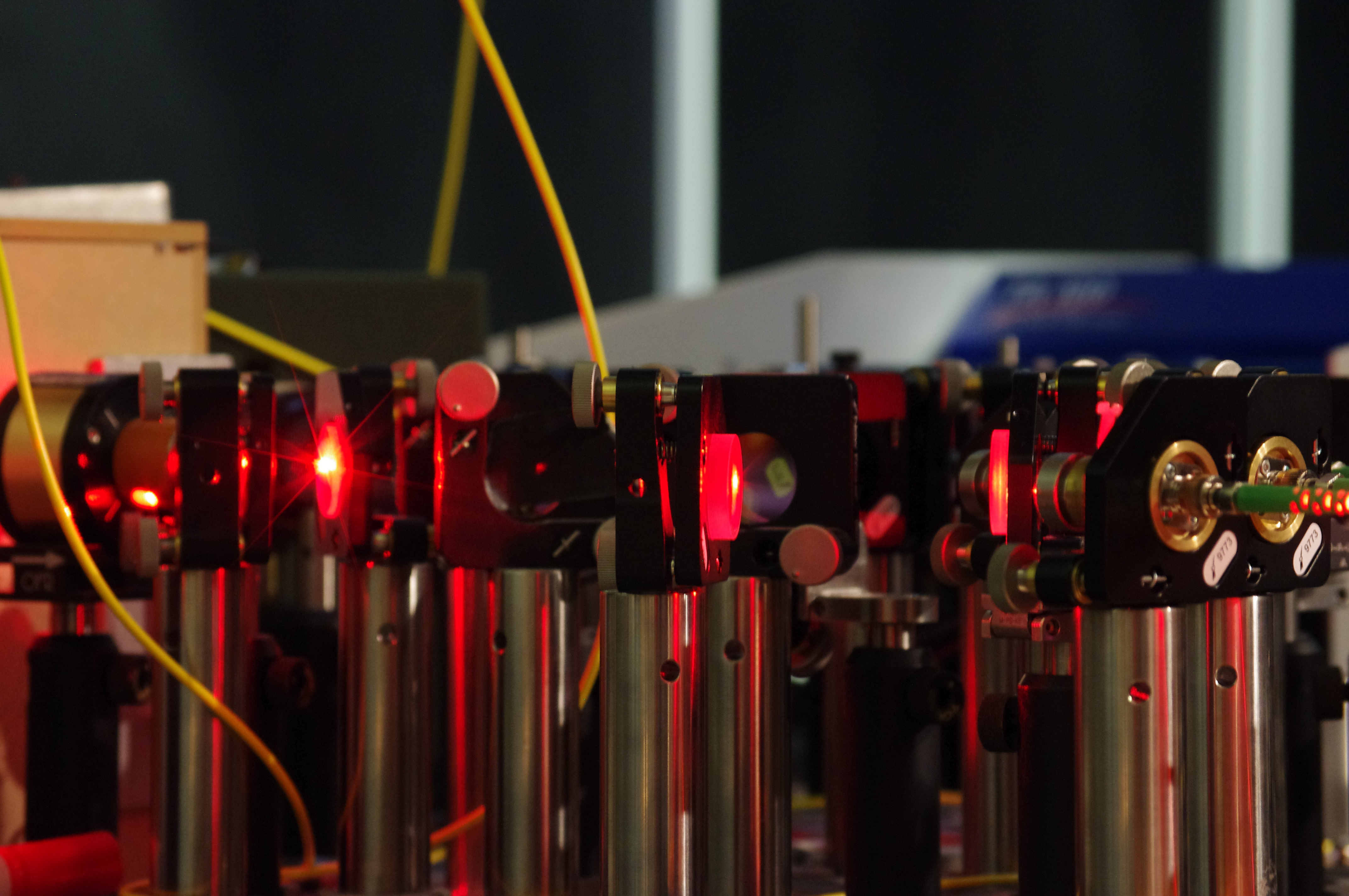
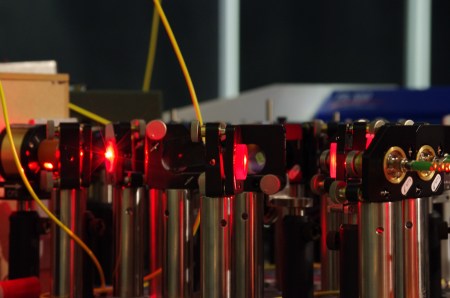
To celebrate, here’s a gratuitous picture of a laser experiment:
laser

You can find more information about the Quantum Technology hubs altogether here.

The text of the official University of Sussex  press release follows:

Sussex scientists have been awarded £5.5 million to develop devices that could radically change how we measure time, navigate our world and solve seemingly impossible mathematical equations.

The grants, received by members of the University’s Atomic, Molecular and Optical Physics (AMO) research group, represent part of a £270 million UK government investment announced today (26 November) to convert quantum physics research into commercial products.

Quantum technology is the applied field of quantum theory. It includes such phenomena as “quantum entanglement”, the idea that objects are not independent if they have interacted with each other or come into being through the same process, and that changing one will also change the other, no matter how far apart they are.

Members of the AMO group have become part of two major national quantum centres: the UK Quantum Technology Hub on Networked Quantum Information Technologies and the UK Quantum Technology Hub for Sensors and Metrology. These centres bring together universities and industry to develop and construct quantum technologies.

The award from the Engineering and Physical Sciences Research Council (EPSRC) will help to fund several Sussex research projects:

  • Dr Jacob Dunningham will be developing a theory to understand how remote objects can be detected with exquisite precision by making use of a networks of sensors linked by quantum entanglement.
  • Dr Winfried Hensinger, as part of one hub, will develop the quantum processor microchip architecture and a new technique of quantum processing using microwave radiation to enable the construction of a large-scale “super-fast” quantum computer. As part of the other hub, he will develop powerful portable sensors able to detect magnetic fields with unprecedented accuracy utilizing a new generation of microchips capable of holding arrays of individual charged atoms.
  • Dr Alessia Pasquazi will develop miniature, ultra-fast, photonic sources of light that form the heart of a new generation of quantum sensors and navigation devices.
  • Dr Marco Peccianti will shrink to the size of a shoe box an “optical frequency comb”, a highly accurate clock currently found only in state-of-the-art laboratories.
  • Prof Barry Garraway will design new rotation sensors for compact navigation devices using atom-chip technology.
  • Dr Matthias Keller will develop a network connecting several quantum processors through the exchange of single photons, resulting in a new version of the internet, the so-called ‘quantum internet’.

In response to the funding news, Professor Peter Coles, Head of the School of Mathematics and Physical Sciences, said: “Quantum sensors offer amazing possibilities for smaller and lighter devices with extraordinary precision. As a consequence, quantum theory promises revolutionary technological applications in computing, measurement, navigation, and security.”

Professor Michael Davies, Pro-Vice-Chancellor for Research, said: “This new research programme will consolidate the reputation of the University of Sussex as one of the world-leading centres for the development of ground-breaking quantum technologies.”

The research will be supplemented by a significant Sussex investment and will make use of the world-leading multi-million pound quantum technology laboratories located at the University.

Professor Coles added: “Our pioneering ‘MSc in Frontiers of Quantum Technology’ program along with numerous PhD positions will provide training for a new generation of researchers and developers to be employed in the emerging quantum technology sector.”

Greg Clark, Minister of State for Universities, Science and Cities, said: “This exciting new Quantum Hubs network will push the boundaries of knowledge and exploit new technologies, to the benefit of healthcare, communications and security.

“Today’s announcement is another example of the government’s recognition of the UK’s science base and its critical contribution to our sustained economic growth”.

Research in Modelling Ocean Systems

Posted in The Universe and Stuff with tags , , , on November 26, 2014 by telescoper

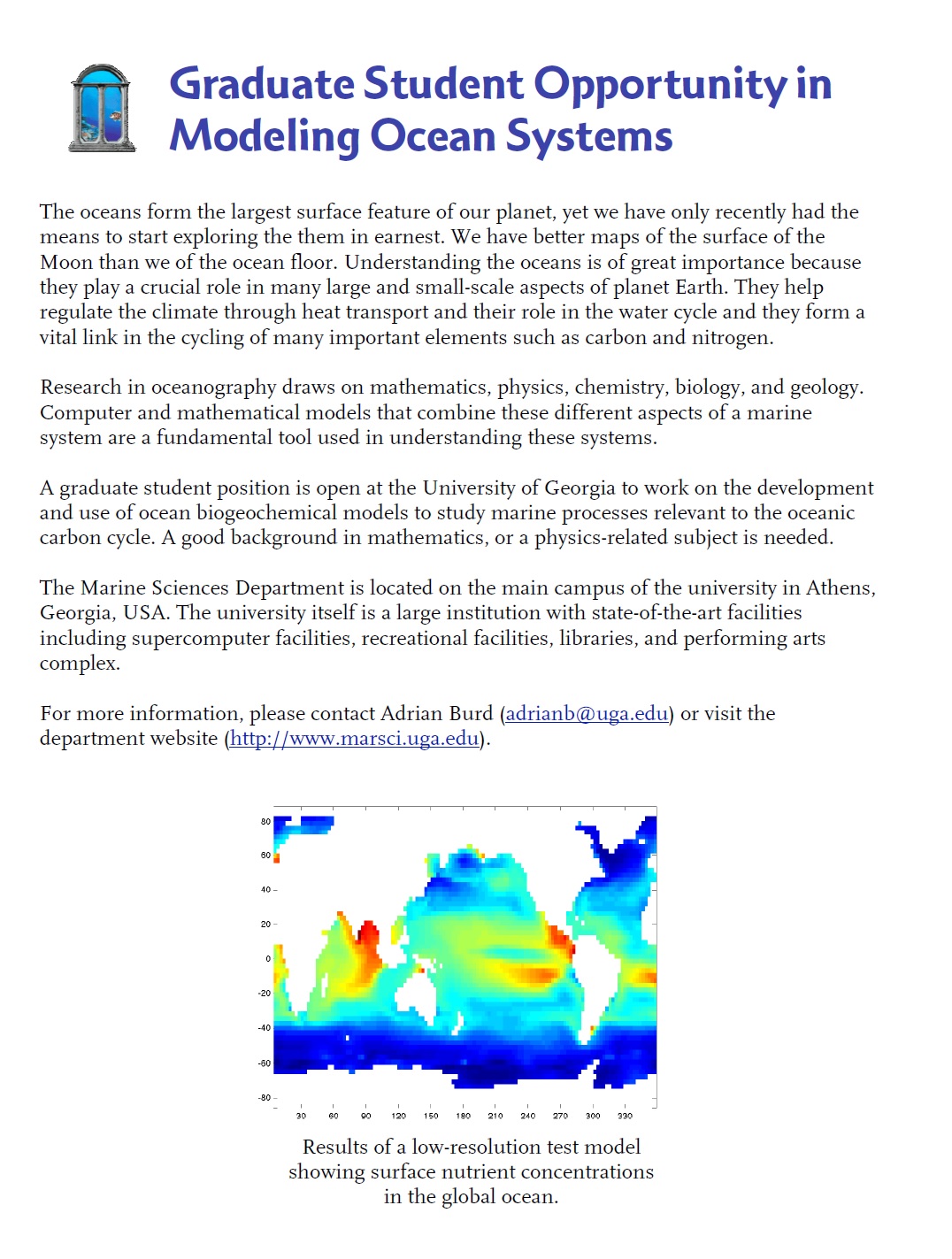
Time to do a favour for an old friend of mine (who was in fact a graduate student at Sussex at the same time as me, back in the 80s, and is an occasional commenter on this blog), Adrian Burd. Adrian moved to the US of A some time ago and now works on Oceanography (that’s Wave Mechanics, I guess..). Anyway, he now has an opportunity for a PhD student which is suitable for a candidate with a background in Mathematics or Physics. Since I’m Head of the School of Mathematical and Physical Sciences, I thought I’d put the advertisement up on here and see if there are any takers. Looks like an interesting one to me!

GradFlyer

You can download a pdf of the flyer here.

Please direct any queries to Adrian!

Doomsday is Cancelled…

Posted in Bad Statistics, The Universe and Stuff with tags , on November 25, 2014 by telescoper

Last week I posted an item that included a discussion of the Doomsday Argument. A subsequent comment on that post mentioned a paper by Ken Olum, which I finally got around to reading over the weekend, so I thought I’d post a link here for those of you worrying that the world might come to an end before the Christmas holiday.

You can find Olum’s paper on the arXiv here. The abstract reads (my emphasis):

If the human race comes to an end relatively shortly, then we have been born at a fairly typical time in history of humanity. On the other hand, if humanity lasts for much longer and trillions of people eventually exist, then we have been born in the first surprisingly tiny fraction of all people. According to the Doomsday Argument of Carter, Leslie, Gott, and Nielsen, this means that the chance of a disaster which would obliterate humanity is much larger than usually thought. Here I argue that treating possible observers in the same way as those who actually exist avoids this conclusion. Under this treatment, it is more likely to exist at all in a race which is long-lived, as originally discussed by Dieks, and this cancels the Doomsday Argument, so that the chance of a disaster is only what one would ordinarily estimate. Treating possible and actual observers alike also allows sensible anthropic predictions from quantum cosmology, which would otherwise depend on one’s interpretation of quantum mechanics.

I think Olum does identify a logical flaw in the argument, but it’s by no means the only one. I wouldn’t find it at all surprising to be among the first “tiny fraction of all people”, as my genetic characteristics are such that I could not be otherwise. But even if you’re not all that interested in the Doomsday Argument I recommend you read this paper as it says some quite interesting things about the application of probabilistic reasoning elsewhere in cosmology, an area in which quite a lot is written that makes no sense to me whatsoever!


Hubble Images With Music By Herschel

Posted in History, Music, The Universe and Stuff with tags , , on November 20, 2014 by telescoper

Too busy for a full post today, so here’s a little stocking filler. The, perhaps familiar, pictures are taken by the Hubble Space Telescope but the music is by noted astronomer (geddit?) Sir William Herschel – the Second Movement of his Chamber Symphony In F Major, marked Adagio e Cantabile. Although best known as an astronomer Herschel was a capable musician and composer with a style very obviously influenced by his near contemporary Georg Frideric Handel. Although music of this era puts me on a High Harpsichord Alert, I thought I’d share this example of music for those of you unfamiliar with his work…