Archive for the The Universe and Stuff Category

Falisifiability versus Testability in Cosmology

Posted in Bad Statistics, The Universe and Stuff with tags , , , , , on July 24, 2015 by telescoper

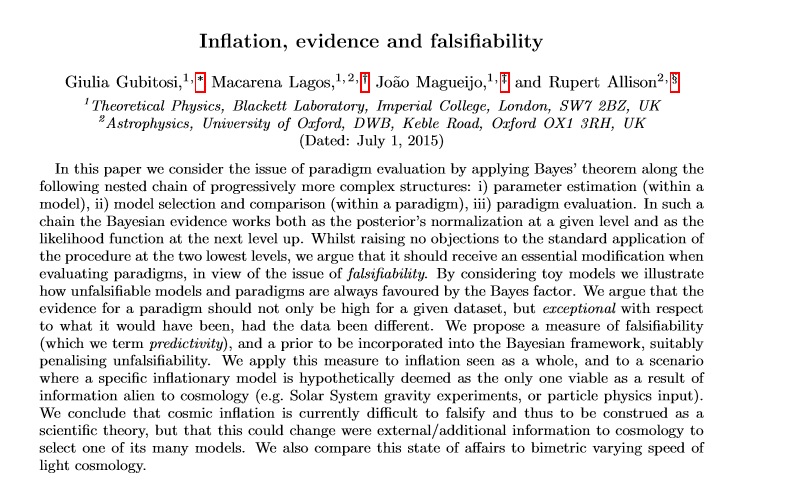
A paper came out a few weeks ago on the arXiv that’s ruffled a few feathers here and there so I thought I would make a few inflammatory comments about it on this blog. The article concerned, by Gubitosi et al., has the abstract:
Inflation_falsifiabiloty

I have to be a little careful as one of the authors is a good friend of mine. Also there’s already been a critique of some of the claims in this paper here. For the record, I agree with the critique and disagree with the original paper, that the claim below cannot be justfied.

…we illustrate how unfalsifiable models and paradigms are always favoured by the Bayes factor.

If I get a bit of time I’ll write a more technical post explaining why I think that. However, for the purposes of this post I want to take issue with a more fundamental problem I have with the philosophy of this paper, namely the way it adopts “falsifiablity” as a required characteristic for a theory to be scientific. The adoption of this criterion can be traced back to the influence of Karl Popper and particularly his insistence that science is deductive rather than inductive. Part of Popper’s claim is just a semantic confusion. It is necessary at some point to deduce what the measurable consequences of a theory might be before one does any experiments, but that doesn’t mean the whole process of science is deductive. As a non-deductivist I’ll frame my argument in the language of Bayesian (inductive) inference.

Popper rejects the basic application of inductive reasoning in updating probabilities in the light of measured data; he asserts that no theory ever becomes more probable when evidence is found in its favour. Every scientific theory begins infinitely improbable, and is doomed to remain so. There is a grain of truth in this, or can be if the space of possibilities is infinite. Standard methods for assigning priors often spread the unit total probability over an infinite space, leading to a prior probability which is formally zero. This is the problem of improper priors. But this is not a killer blow to Bayesianism. Even if the prior is not strictly normalizable, the posterior probability can be. In any case, given sufficient relevant data the cycle of experiment-measurement-update of probability assignment usually soon leaves the prior far behind. Data usually count in the end.

I believe that deductvism fails to describe how science actually works in practice and is actually a dangerous road to start out on. It is indeed a very short ride, philosophically speaking, from deductivism (as espoused by, e.g., David Hume) to irrationalism (as espoused by, e.g., Paul Feyeraband).

The idea by which Popper is best known is the dogma of falsification. According to this doctrine, a hypothesis is only said to be scientific if it is capable of being proved false. In real science certain “falsehood” and certain “truth” are almost never achieved. The claimed detection of primordial B-mode polarization in the cosmic microwave background by BICEP2 was claimed by some to be “proof” of cosmic inflation, which it wouldn’t have been even if it hadn’t subsequently shown not to be a cosmological signal at all. What we now know to be the failure of BICEP2 to detect primordial B-mode polarization doesn’t disprove inflation either.

Theories are simply more probable or less probable than the alternatives available on the market at a given time. The idea that experimental scientists struggle through their entire life simply to prove theorists wrong is a very strange one, although I definitely know some experimentalists who chase theories like lions chase gazelles. The disparaging implication that scientists live only to prove themselves wrong comes from concentrating exclusively on the possibility that a theory might be found to be less probable than a challenger. In fact, evidence neither confirms nor discounts a theory; it either makes the theory more probable (supports it) or makes it less probable (undermines it). For a theory to be scientific it must be capable having its probability influenced in this way, i.e. amenable to being altered by incoming data “i.e. evidence”. The right criterion for a scientific theory is therefore not falsifiability but testability. It follows straightforwardly from Bayes theorem that a testable theory will not predict all things with equal facility. Scientific theories generally do have untestable components. Any theory has its interpretation, which is the untestable penumbra that we need to supply to make it comprehensible to us. But whatever can be tested can be regared as scientific.

So I think the Gubitosi et al. paper starts on the wrong foot by focussing exclusively on “falsifiability”. The issue of whether a theory is testable is complicated in the context of inflation because prior probabilities for most observables are difficult to determine with any confidence because we know next to nothing about either (a) the conditions prevailing in the early Universe prior to the onset of inflation or (b) how properly to define a measure on the space of inflationary models. Even restricting consideration to the simplest models with a single scalar field, initial data are required for the scalar field (and its time derivative) and there is also a potential whose functional form is not known. It is therfore a far from trivial task to assign meaningful prior probabilities on inflationary models and thus extremely difficult to determine the relative probabilities of observables and how these probabilities may or may not be influenced by interactions with data. Moreover, the Bayesian approach involves comparing probabilities of competing theories, so we also have the issue of what to compare inflation with…

The question of whether cosmic inflation (whether in general concept or in the form of a specific model) is testable or not seems to me to boil down to whether it predicts all possible values of relevant observables with equal ease. A theory might be testable in principle, but not testable at a given time if the available technology at that time is not able to make measurements that can distingish between that theory and another. Most theories have to wait some time for experiments can be designed and built to test them. On the other hand a theory might be untestable even in principle, if it is constructed in such a way that its probability can’t be changed at all by any amount of experimental data. As long as a theory is testable in principle, however, it has the right to be called scientific. If the current available evidence can’t test it we need to do better experiments. On other words, there’s a problem with the evidence not the theory.

Gubitosi et al. are correct in identifying the important distinction between the inflationary paradigm, which encompasses a large set of specific models each formulated in a different way, and an individual member of that set. I also agree – in contrast to many of my colleagues – that it is actually difficult to argue that the inflationary paradigm is currently falsfiable testable. But that doesn’t necessarily mean that it isn’t scientific. A theory doesn’t have to have been tested in order to be testable.
Exciting Opportunity in Experimental Physics at the University of Sussex!

Posted in Education, The Universe and Stuff with tags , , , , on July 23, 2015 by telescoper

Just a quick update on the news that Department of Physics & Astronomy at the University of Sussex has an exciting opportunity in the form of a brand new Chair position in Experimental Physics. The advertisement appeared on the University of Sussex website somedays ago. But it has now appeared on Nature Jobs and the Times Higher websites. It is also in today’s print edition of the Times Higher. At least I think it is. I couldn’t find a copy in W.H. Smith’s when I went there today. Obviously it has sold out because word has got out about this job!

I’m taking the liberty of reposting a description of the new position here, but for fuller details please visit the formal advertisement.

–0–

The School of Mathematical and Physical Sciences seeks to appoint a Professor in Experimental Physics in the Department of Physics & Astronomy to lead the next phase of expansion and diversification of the research portfolio within the School by establishing an entirely new research activity in laboratory-based physics.

Sufficient resources will be made available to the selected candidate to establish a new group at Sussex in their field of experimental physics including, for example, condensed matter (interpreted widely), materials science, nanophysics or biophysics. Applicants in research areas with scope for interdisciplinary collaborations with other Schools at the University of Sussex (e.g. Life Sciences, Engineering & Informatics or Brighton and Sussex Medical School) are encouraged, especially  those in areas with potential for generating research impact, as defined in the context of the UK Research Excellence Framework.

The successful applicant will have a proven track-record of success in obtaining substantial external funding through research grants and/or industrial sponsorship.

The appointee will be supported with substantial (seven-figure) sum for start-up funding and an extensive newly-refurbished laboratory space. The financial package on offer will also support the appointment of at least two further experimental lectureships; the appointed professor is expected to be strongly involved in recruitment to these positions.

Informal (and confidential) enquiries may be addressed in the first instance to the Head of School, Professor Peter Coles (P.Coles@sussex.ac.uk).

The Curious Case of the 3.5 keV “Line” in Cluster Spectra

Posted in Bad Statistics, The Universe and Stuff with tags , , , , , , on July 22, 2015 by telescoper

Earlier this week I went to a seminar. That’s a rare enough event these days given all the other things I have to do. The talk concerned was by Katie Mack, who was visiting the Astronomy Centre and it contained a nice review of the general situation regarding the constraints on astrophysical dark matter from direct and indirect detection experiments. I’m not an expert on experiments – I’m banned from most laboratories on safety grounds – so it was nice to get a review from someone who knows what they’re talking about.

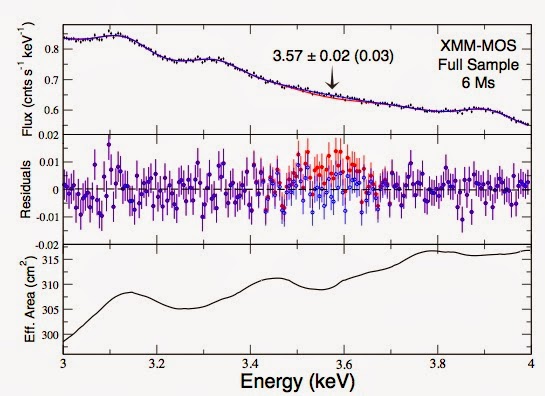
One of the pieces of evidence discussed in the talk was something I’ve never really looked at in detail myself, namely the claimed evidence of an  emission “line” in the spectrum of X-rays emitted by the hot gas in galaxy clusters. I put the word “line” in inverted commas for reasons which will soon become obvious. The primary reference for the claim is a paper by Bulbul et al which is, of course, freely available on the arXiv.

The key graph from that paper is this:

XMMspectrum

The claimed feature – it stretches the imagination considerably to call it a “line” – is shown in red. No, I’m not particularly impressed either, but this is what passes for high-quality data in X-ray astronomy!

There’s a nice review of this from about a year ago here which says this feature

 is very significant, at 4-5 astrophysical sigma.

I’m not sure how to convert astrophysical sigma into actual sigma, but then I don’t really like sigma anyway. A proper Bayesian model comparison is really needed here. If it is a real feature then a plausible explanation is that it is produced by the decay of some sort of dark matter particle in a manner that involves the radiation of an energetic photon. An example is the decay of a massive sterile neutrino – a hypothetical particle that does not participate in weak interactions –  into a lighter standard model neutrino and a photon, as discussed here. In this scenario the parent particle would have a mass of about 7keV so that the resulting photon has an energy of half that. Such a particle would constitute warm dark matter.

On the other hand, that all depends on you being convinced that there is anything there at all other than a combination of noise and systematics. I urge you to read the paper and decide. Then perhaps you can try to persuade me, because I’m not at all sure. The X-ray spectrum of hot gas does have a number of known emission features in it that needed to be subtracted before any anomalous emission can be isolated. I will remark however that there is a known recombination line of Argon that lies at 3.6 keV, and you have to be convinced that this has been subtracted correctly if the red bump is to be interpreted as something extra. Also note that all the spectra that show this feature are obtained using the same instrument – on the XMM/Newton spacecraft which makes it harder to eliminate the possibility that it is an instrumental artefact.

I’d be interested in comments from X-ray folk about how confident we should be that the 3.5 keV “anomaly” is real…

Software Use in Astronomy

Posted in Education, The Universe and Stuff with tags , , , , on July 21, 2015 by telescoper

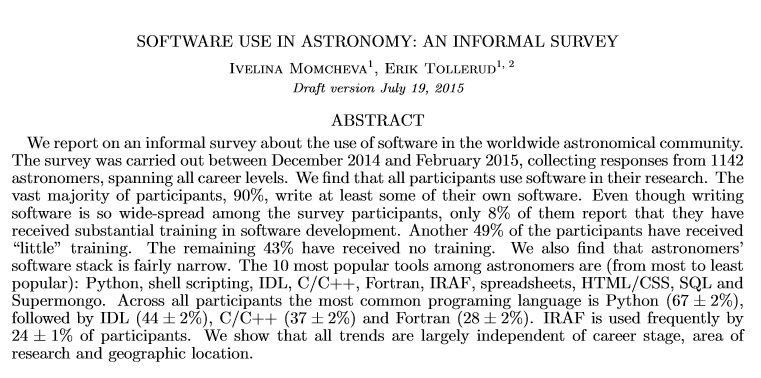
I just saw an interesting paper which hit the arXiv last week and thought I would share it here. It’s called Software Use in Astronomy: An Informal Survey and the abstract is here:

softwareA couple of things are worth remarking upon. One concerns Python. Although I’m not surprised that Python is Top of the Pops amongst astronomers – like many Physics & Astronomy departments we actually teach it to undergraduates here at the University of Sussex – it is notable that its popularity is a relatively recent phenomenon and it’s quite impressive how rapidly it has caught on.

Another interesting thingis the continuing quite heavy use of Fortran. Most computer scientists would consider this to be an obsolete language, and is presumably mainly used because of inertia: some important and well established codes are written in it and presumably it’s too much effort to rewrite them from scratch in something more modern. I would have thought that Fortran would have been used primarily by older academics, i.e. old dogs who can’t learn new programming tricks. However, that doesn’t really seem to be the case based on the last sentence of the abstract.

Finally, it’s quite surprising that over 40% of astronomers claim to have had no training in software development. We do try to embed that particular skill in graduate programmes nowadays, but it seems that doesn’t always work!

Anyway, do read the paper yourself. It’s very interesting. Any further comments through the box below please, but please ensure they compile before submitting them…


Astronomy: One of the Seven Liberal Arts

Posted in Art, Education, History, The Universe and Stuff with tags , , , on July 20, 2015 by telescoper

This morning I came across this picture (via @hist_astro on Twitter):

Seven Liberal ArtsIt is by Giovanni dal Ponte and was painted in or around 1435; the original is in the Museo Nacional del Prado in Madrid. It depicts the Seven Liberal Arts which, in antiquity were considered the essential elements of the education system. The Arts concerned are: Grammar, Rhetoric, Dialectic, Astronomy, Arithmetic, Geometry and Music. Appropriately enough, Astronomy is in the middle.

I suspect some of you may have noticed that there are more than seven figures in the painting. That’s because each of the Liberal Arts is itself represented by a (female) figure, presumably a Goddess, and also a famous character associated with the particular discipline. Second from the right, for example, you can see Arithmetic accompanied by Pythagoras, who seems to be trying to copy from her notebook. Astronomy. In the centre, kneeling at the feet of Urania (the muse of Astronomy) is Ptolemy..

It’s quite interesting to look at the structure of a Liberal Arts education as it would be in classical antiquity. The first three subjects (Grammar, Rhetoric and Dialectics) formed the Trivium (from which we get the English word “trivial”). “Grammar” means the science of the correct usage of language, knowledge and understanding of which helps a person to speak and write correctly; “Dialectic” basically means “logic”, the science of rational thinking as a means of arriving at the truth; and “Rhetoric” the science of expression, especially persuasion, which includes ways of organizing and presenting an argument so that people will understand and hopefully believe it. These may have been considered trivial in ancient times, but I can’t help thinking that we could do with a lot more emphasis on such fundamental skills in the modern curriculum.

After the Trivium came the Quadrivium: Arithmetic, Geometry, Astronomy and Music all of which were considered to be disciplines connected with Mathematics. Presumably these are the non-trivial subjects. We might nowadays consider Astronomy to be a mathematical subject – indeed in the United Kingdom astronomy was until relatively recently generally taught in mathematics departments, even after the rise of astrophysics in the 19th Century. On the other hand, fewer would nowadays would recognize music as being essentially mathematical in nature. Historically, however the connections between music, mathematics and natural philosophy were many and profound.

Of course there are now many other disciplines and it would be impossible for any education to encompass all fields of study, but I do think that it’s a shame that modern education systems are so lacking in breadth, as they tend to emphasize the differences between subjects rather than what they all have in common.

Honoris Causa: John Francis, Inventor of the QR Algorithm

Posted in The Universe and Stuff with tags , , , , , , on July 18, 2015 by telescoper

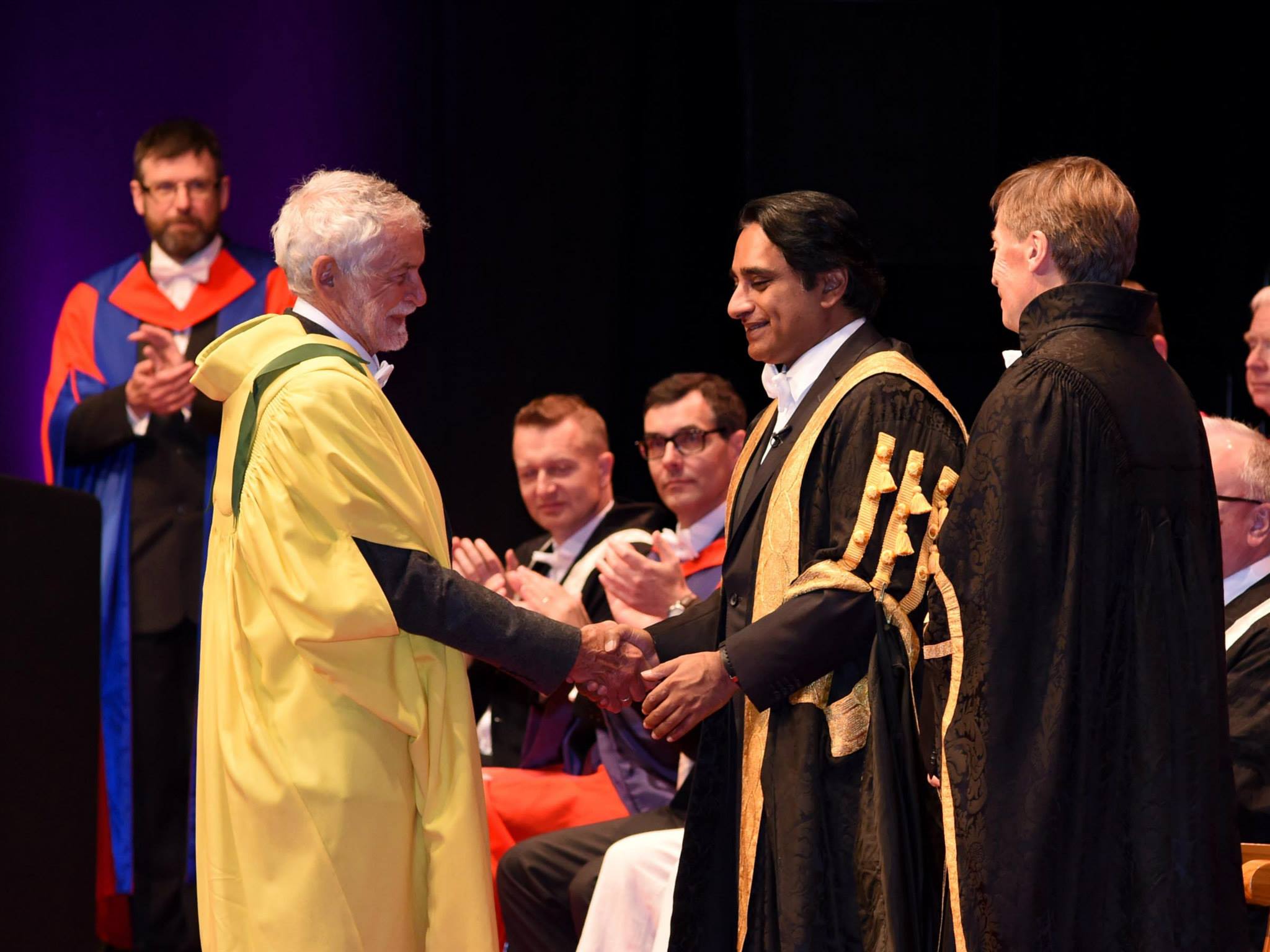
It’s been yet another busy week, trying to catch up on things I missed last week as well as preparing for Thursday’s graduation ceremony for students from the School of Mathematical and Physical Sciences. At this year’s ceremony, as well as reading out the names of graduands from the School of which I am Head, I also had the pleasant duty of presenting mathematician John G.F. Francis for an Honorary Doctorate of Science.

The story of John Francis is a remarkable one which I hope you will agree if you read the following brief account which is adapted from the oration I delivered at the ceremony. It was a special pleasure to asked to present this award because you could never wish to meet a more modest or self-effacing individual. Indeed, when I asked him at the lunch following the ceremony, what he thought of the work for which he had been awarded a degree honoris causa he shrugged it off, and said that he thought it was an obvious thing to do and anyone else could have done it had they thought of it. Maybe that’s true in hindsight, but the point is that “they” didn’t and “he” did. The fact that it has taken over fifty years for him to be recognized for something so important is regrettable to say the least, but I am glad to have been there to see him justifiably honoured. Great thanks are due to Drs Omar Lakkis and Anotida Madzvamuse of the Department of Mathematics at the University of Sussex for bringing his case to the attention of the University as eminently suitable for such an honour. So impressed were the graduating students that a number shook his hand as they passed him on the stage during their own part of the ceremony. I’ve never seen that happen before!

John Francis receiving his Honorary Doctorate from the Chancellor, Sanjeev Bhaskar.

John Francis receiving his Honorary Doctorate from the Chancellor, Sanjeev Bhaskar.

John Francis is a pioneer in the field of mathematical computation where his name is more-or-less synonymous with the so-called “QR algorithm”, an ingenious factorization procedure used to calculate the eigenvalues and eigenvectors of linear operators (represented as matrices).

Before I go on it’s probably worth explaining that the letters ‘QR’ don’t stand for any words in particular. The algorithm involves decomposing the matrix whose eigenvalues are required into the product of an orthogonal matrix (which Francis happened to call Q) and an upper-triangular matrix (which Francis happened to call R). In fact in his original manuscript, the orthogonal matrix was called O but it was subsequently changed to avoid confusion with ‘O’. At any rate, certainly has nothing to do with research funding!

The mathematics and physics graduates in the audience were probably well aware of the importance of eigenvalue problems, which crop up in a huge variety of contexts in these and other scientific disciplines, from geometry to graph theory to quantum mechanics to geology to molecular structure to statistics to engineering; the list is almost endless. Indeed here can be few people working in such fields who haven’t at one time or another turned to the QR algorithm in the course of their calculations. I know I have, in my own field of astrophysics! It has become a standard component of any theoretician’s mathematical toolkit because of its numerical stability.

The algorithm was first derived by John Francis in two papers published in 1959 and, independently a couple of years later, by the Russian mathematician Vera Kublanovskaya (who passed away in 2012). You can find both the papers online: here and here. Interestingly, the problem that John Francis was trying to solve when he devised the QR algorithm concerned the “flutter” or vibrations of aircraft wings.

But it is in the world of the World Wide Web that the QR algorithm has had perhaps its greatest impact. Many of us who were using the internet in 1998 were astonished when Google arrived on the scene because it was so much faster and more effective than all the other search engines available at the time. The secret of this success was the PageRank algorithm (named after Larry Page, one of the founders of Google) which involved applying the QR decomposition to calculate numerical factors expressing the relative “importance” of elements within a linked set (such as pages on the World Wide Web) measured by the nature of their links to other elements. The QR algorithm is not the only technique exploited by Google, but it is safe to say that it is what gave Google its edge.

The achievements of John Francis are indeed impressive, even more so when you read his biography, for he did all this pioneering work in numerical analysis without even having an undergraduate degree in Mathematics.

John Francis actually left school in 1952 and obtained a place at Christ’s College, Cambridge for entry in 1955, after two years of National Service during which he served in Germany and Korea with the Royal Artillery. On leaving the army in 1954 he worked for a time at the National Research Development Corporation which was set up in 1948 by the Attlee government in order to facilitate the transfer of new technologies developed during World War 2 into the private sector in an effort to boost British commerce and industry. Among the priority areas covered by the NRDC was computing, and it was there that John Francis cut his teeth in the field of numerical analysis. He went to University as planned but did not complete his degree, instead returning to the NRDC in 1956 after less than a year of study. It was while working there in 1958 and 1959 that he devised the QR algorithm.

He left the NRDC in 1961 to work at Ferranti Ltd after which, in 1967, he moved to Brighton and took up a position at the University of Sussex in the Laboratory of Experimental Psychology, helping to devise a new computer language for running experiments. He left the University in 1972 to work in various private sector computer service companies in Sussex. He has now retired but still lives locally, in Hove.

Having left the field of numerical analysis in the 1960s, John Francis had absolutely no idea of the impact his work on the QR algorithm had had, nor was he aware that it was widely recognized as one of the Top Ten Algorithms of the Twentieth Century, until he was traced and contacted in 2007 by the organizers of a mini-symposium that was being planned to celebrate 50 years of the QR algorithm; he was the opening speaker at that meeting in Glasgow when it took place in 2009.

More recently still, in 2011, after what he describes as “sporadic” study over many years, John Francis was awarded an undergraduate degree from the Open University, 56 years after he started one at Cambridge.  I am very glad that there was no similar delay in him proceeding to a Doctorate!

Physics is more than applied mathematics

Posted in Education, The Universe and Stuff with tags , , , on July 15, 2015 by telescoper

I thought rather hard before reblogging this, as I do not wish to cause any conflict between the different parts of my School – the Department of Mathematics and the Department of Physics and Astronomy!

I don’t think I really agree that Physics is “more” than Applied Mathematics, or at least I would put it rather differently. Physics and Mathematics intersect, but there are parts of mathematics that are not physical and parts of physics that are not mathematical.

Discuss.

Michael de Podesta's avatarProtons for Breakfast

A problem set for potential applicants in the foyer of the Cavendish Laboratory. Despite appearances - this is not physics! A problem set for potential applicants in the foyer of the Physics department of a premier UK university. It looks like physics, but it is in fact maths. The reason is that in the context of this problem, the string cannot pull a particle along at all unless it stretches slightly. Click the image for a larger diagram.

While accompanying my son on an Open Day in the Physics Department of a premier UK university, I was surprised and appalled to be told that Physics ‘was applied mathematics‘.

I would just like to state here for the record that Physics is notapplied mathematics.

So what’s the difference exactly?

I think there are two linked, but subtly distinct, differences.

1. Physics is a science and mathematics is not.

This means that physics has an experimental aspect. In physics, it is possible to disprove a hypothesis by experiment: this cannot be done in maths.

2. Physics is about…

View original post 256 more words

An Exciting Opportunity in Experimental Physics at the University of Sussex!

Posted in Education, The Universe and Stuff with tags , , , , on July 14, 2015 by telescoper

After much planning and preparatory work, I’m pleased that I am now in a position to announce that the Department of Physics & Astronomy at the University of Sussex has an exciting opportunity in the form of a brand new Chair position in Experimental Physics. The advertisement will shortly appear in both Nature and the Times Higher but it has already appeared on the University of Sussex website. I’m taking the liberty of posting a description of the new position here, but for fuller details please visit the formal advertisement.

–0–

The School of Mathematical and Physical Sciences seeks to appoint a Professor in Experimental Physics in the Department of Physics & Astronomy to lead the next phase of expansion and diversification of the research portfolio within the School by establishing an entirely new research activity in laboratory-based physics.

Sufficient resources will be made available to the selected candidate to establish a new group at Sussex in their field of experimental physics including, for example, condensed matter (interpreted widely), materials science, nanophysics or biophysics. Applicants in research areas with scope for interdisciplinary collaborations with other Schools at the University of Sussex (e.g. Life Sciences, Engineering & Informatics or Brighton and Sussex Medical School) are encouraged, especially  those in areas with potential for generating research impact, as defined in the context of the UK Research Excellence Framework.

The successful applicant will have a proven track-record of success in obtaining substantial external funding through research grants and/or industrial sponsorship.

The appointee will be supported with substantial (seven-figure) sum for start-up funding and an extensive newly-refurbished laboratory space. The financial package on offer will also support the appointment of at least two further experimental lectureships; the appointed professor is expected to be strongly involved in recruitment to these positions.

Informal (and confidential) enquiries may be addressed in the first instance to the Head of School, Professor Peter Coles (P.Coles@sussex.ac.uk).


A Galaxy at Record Redshift?

Posted in The Universe and Stuff with tags , , , , , on July 13, 2015 by telescoper

Skimming through the arXiv this morning I discovered a paper by Zitrin et al. with the following abstract:


abstract_z

I’m not sure if the figures are all significant, but a redshift of z=8.68 makes this the most distant spectroscopically confirmed galaxy on record with a present proper distance of about 9.3 Gpc according to the standard cosmological model, just pipping the previous record holder (whose redshift was in any case disputed). Light from this galaxy has taken about 13.1 Gyr to reach us; that means light set out from it when the Universe was only about 4% of its current age, only about 600 million years after the Big Bang. (Those figures were obtained using the inestimable Ned Wright’s cosmology calculator.)

We are presumably seeing a very young object, in which stars are forming at a considerable rate to account for its brightness. We don’t know exactly when the first stars formed and began to ionize the intergalactic medium, but every time the cosmic distance record is broken we push that time back closer to the Big Bang.

Mind you, I can’t say I’m overwhelmingly convinced by the identification of the redshifted Lyman-α line:

high_zBut what do I know? I’m a theorist whose suspicious of data. Any observers care to comment?

Bad Statistics, Bad Science

Posted in Bad Statistics, Science Politics, The Universe and Stuff with tags , , on July 2, 2015 by telescoper

I saw an interesting article in Nature the opening paragraph of which reads:

The past few years have seen a slew of announcements of major discoveries in particle astrophysics and cosmology. The list includes faster-than-light neutrinos; dark-matter particles producing γ-rays; X-rays scattering off nuclei underground; and even evidence in the cosmic microwave background for gravitational waves caused by the rapid inflation of the early Universe. Most of these turned out to be false alarms; and in my view, that is the probable fate of the rest.

The piece goes on to berate physicists for being too trigger-happy in claiming discoveries, the BICEP2 fiasco being a prime example. I agree that this is a problem, but it goes far beyond physics. In fact its endemic throughout science. A major cause of it is abuse of statistical reasoning.

Anyway, I thought I’d take the opportunity to re-iterate why I statistics and statistical reasoning are so important to science. In fact, I think they lie at the very core of the scientific method, although I am still surprised how few practising scientists are comfortable with even basic statistical language. A more important problem is the popular impression that science is about facts and absolute truths. It isn’t. It’s a process. In order to advance it has to question itself. Getting this message wrong – whether by error or on purpose -is immensely dangerous.

Statistical reasoning also applies to many facets of everyday life, including business, commerce, transport, the media, and politics. Probability even plays a role in personal relationships, though mostly at a subconscious level. It is a feature of everyday life that science and technology are deeply embedded in every aspect of what we do each day. Science has given us greater levels of comfort, better health care, and a plethora of labour-saving devices. It has also given us unprecedented ability to destroy the environment and each other, whether through accident or design.

Civilized societies face rigorous challenges in this century. We must confront the threat of climate change and forthcoming energy crises. We must find better ways of resolving conflicts peacefully lest nuclear or conventional weapons lead us to global catastrophe. We must stop large-scale pollution or systematic destruction of the biosphere that nurtures us. And we must do all of these things without abandoning the many positive things that science has brought us. Abandoning science and rationality by retreating into religious or political fundamentalism would be a catastrophe for humanity.

Unfortunately, recent decades have seen a wholesale breakdown of trust between scientists and the public at large. This is due partly to the deliberate abuse of science for immoral purposes, and partly to the sheer carelessness with which various agencies have exploited scientific discoveries without proper evaluation of the risks involved. The abuse of statistical arguments have undoubtedly contributed to the suspicion with which many individuals view science.

There is an increasing alienation between scientists and the general public. Many fewer students enrol for courses in physics and chemistry than a a few decades ago. Fewer graduates mean fewer qualified science teachers in schools. This is a vicious cycle that threatens our future. It must be broken.

The danger is that the decreasing level of understanding of science in society means that knowledge (as well as its consequent power) becomes concentrated in the minds of a few individuals. This could have dire consequences for the future of our democracy. Even as things stand now, very few Members of Parliament are scientifically literate. How can we expect to control the application of science when the necessary understanding rests with an unelected “priesthood” that is hardly understood by, or represented in, our democratic institutions?

Very few journalists or television producers know enough about science to report sensibly on the latest discoveries or controversies. As a result, important matters that the public needs to know about do not appear at all in the media, or if they do it is in such a garbled fashion that they do more harm than good.

Years ago I used to listen to radio interviews with scientists on the Today programme on BBC Radio 4. I even did such an interview once. It is a deeply frustrating experience. The scientist usually starts by explaining what the discovery is about in the way a scientist should, with careful statements of what is assumed, how the data is interpreted, and what other possible interpretations might be and the likely sources of error. The interviewer then loses patience and asks for a yes or no answer. The scientist tries to continue, but is badgered. Either the interview ends as a row, or the scientist ends up stating a grossly oversimplified version of the story.

Some scientists offer the oversimplified version at the outset, of course, and these are the ones that contribute to the image of scientists as priests. Such individuals often believe in their theories in exactly the same way that some people believe religiously. Not with the conditional and possibly temporary belief that characterizes the scientific method, but with the unquestioning fervour of an unthinking zealot. This approach may pay off for the individual in the short term, in popular esteem and media recognition – but when it goes wrong it is science as a whole that suffers. When a result that has been proclaimed certain is later shown to be false, the result is widespread disillusionment.

The worst example of this tendency that I can think of is the constant use of the phrase “Mind of God” by theoretical physicists to describe fundamental theories. This is not only meaningless but also damaging. As scientists we should know better than to use it. Our theories do not represent absolute truths: they are just the best we can do with the available data and the limited powers of the human mind. We believe in our theories, but only to the extent that we need to accept working hypotheses in order to make progress. Our approach is pragmatic rather than idealistic. We should be humble and avoid making extravagant claims that can’t be justified either theoretically or experimentally.

The more that people get used to the image of “scientist as priest” the more dissatisfied they are with real science. Most of the questions asked of scientists simply can’t be answered with “yes” or “no”. This leaves many with the impression that science is very vague and subjective. The public also tend to lose faith in science when it is unable to come up with quick answers. Science is a process, a way of looking at problems not a list of ready-made answers to impossible problems. Of course it is sometimes vague, but I think it is vague in a rational way and that’s what makes it worthwhile. It is also the reason why science has led to so many objectively measurable advances in our understanding of the World.

I don’t have any easy answers to the question of how to cure this malaise, but do have a few suggestions. It would be easy for a scientist such as myself to blame everything on the media and the education system, but in fact I think the responsibility lies mainly with ourselves. We are usually so obsessed with our own research, and the need to publish specialist papers by the lorry-load in order to advance our own careers that we usually spend very little time explaining what we do to the public or why.

I think every working scientist in the country should be required to spend at least 10% of their time working in schools or with the general media on “outreach”, including writing blogs like this. People in my field – astronomers and cosmologists – do this quite a lot, but these are areas where the public has some empathy with what we do. If only biologists, chemists, nuclear physicists and the rest were viewed in such a friendly light. Doing this sort of thing is not easy, especially when it comes to saying something on the radio that the interviewer does not want to hear. Media training for scientists has been a welcome recent innovation for some branches of science, but most of my colleagues have never had any help at all in this direction.

The second thing that must be done is to improve the dire state of science education in schools. Over the last two decades the national curriculum for British schools has been dumbed down to the point of absurdity. Pupils that leave school at 18 having taken “Advanced Level” physics do so with no useful knowledge of physics at all, even if they have obtained the highest grade. I do not at all blame the students for this; they can only do what they are asked to do. It’s all the fault of the educationalists, who have done the best they can for a long time to convince our young people that science is too hard for them. Science can be difficult, of course, and not everyone will be able to make a career out of it. But that doesn’t mean that it should not be taught properly to those that can take it in. If some students find it is not for them, then so be it. I always wanted to be a musician, but never had the talent for it.

I realise I must sound very gloomy about this, but I do think there are good prospects that the gap between science and society may gradually be healed. The fact that the public distrust scientists leads many of them to question us, which is a very good thing. They should question us and we should be prepared to answer them. If they ask us why, we should be prepared to give reasons. If enough scientists engage in this process then what will emerge is and understanding of the enduring value of science. I don’t just mean through the DVD players and computer games science has given us, but through its cultural impact. It is part of human nature to question our place in the Universe, so science is part of what we are. It gives us purpose. But it also shows us a way of living our lives. Except for a few individuals, the scientific community is tolerant, open, internationally-minded, and imbued with a philosophy of cooperation. It values reason and looks to the future rather than the past. Like anyone else, scientists will always make mistakes, but we can always learn from them. The logic of science may not be infallible, but it’s probably the best logic there is in a world so filled with uncertainty.