Archive for the The Universe and Stuff Category

Stokes V – The Lost Parameter

Posted in The Universe and Stuff with tags , , , , , , on August 27, 2014 by telescoper

Some years ago I went to a seminar on the design of an experiment to measure the polarization of the cosmic microwave background. At the end of the talk I asked what seemed to me to be an innocent question. The point of my question was the speaker had focussed entirely on measuring the intensity of the radiation (I) and the two Stokes Parameters that measure linear polarization of the radiation (usually called Q and U). How difficult, I asked, would it be to measure the remaining Stokes parameter V (which quantifies circular polarization)?

There was a sharp intake of breath among the audience and the speaker responded with a curt “the cosmic microwave background is not circularly polarized”. It is true that in the standard cosmological theory the microwave background is produced by Thomson scattering in the early Universe which produces partial linear polarization, so that Q and U are non-zero, but not circular polarization so V=0. However, I had really asked my question because I had an idea that it might be worth measuring V (or at least putting an upper limit on it) in order to assess the level of instrumental systematics (which are a serious issue with polarization measurements).

I was reminded of this episode when I saw a paper on the arXiv today by Asantha Cooray, Alessandro Melchiorri and Joe Silk which points out that the CMB may well have some level of circular polarization. When light travels through a region containing plasma and a magnetic field, circular polarization can be generated from linear polarization via a process called Faraday conversion. For this to happen, the polarization vector of the incident radiation (defined by the direction of its E-field) must have non-zero component along the local magnetic field, i.e. the B-field. Charged particles are free to move only along B, so the component of E parallel to B is absorbed and re-emitted by these charges, thus leading to phase difference between it and the component of E orthogonal to B and hence to the circular polarization. This is related to the perhaps more familiar process of Faraday rotation, which causes the plane of linear polarization to rotate when polarized radiation travels through a region containing a magnetic field.

Anyway, here is the abstract of the paper

The primordial anisotropies of the cosmic microwave background (CMB) are linearly polarized via Compton-scattering. The Faraday conversion process during the propagation of polarized CMB photons through regions of the large-scale structure containing magnetized relativistic plasma, such as galaxy clusters, will lead to a circularly polarized contribution. Though the resulting Stokes-V parameter is of order 10-9 at frequencies of 10 GHz, the contribution can potentially reach the total Stokes-U at low frequencies due to the cubic dependence on the wavelength. In future, the detection of circular polarization of CMB can be used as a potential probe of the physical properties associated with relativistic particle populations in large-scale structures.

It’s an interesting idea, but it’s hard for me to judge the feasibility of measuring a value of Stokes V as low as 10-9. Clearly it would only work at frequencies much lower than those probed by current CMB experiments such as BICEP2 (which operates at 150 GHz). Perhaps if the speaker had answered my question all those years ago I’d be in a better position to decide!

The truth is out there

Posted in Biographical, The Universe and Stuff with tags , , , , , on August 23, 2014 by telescoper

So here I am, then, sitting in my hotel room in Copenhagen and drinking coffee, filling in time before I check out and travel to the airport for the journey home. I don’t have to be there until this afternoon so today is going to be a bit more leisurely than the rest of the week has been. It’s nice to get a couple of hours to myself.

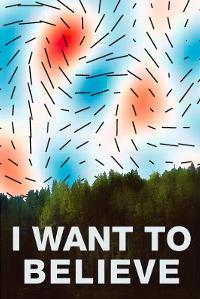
It was an interesting little workshop, with lots of time for discussions, but lurking in the background of course was the question mark  over BICEP2. Many theorists have clearly been beavering  away on models which assume that BICEP2 has measured primordial gravitational waves and I suspect most of them really want the result to be correct. When I posted a message on Twitter about this, Ian Harrison posted this homage to a famous poster for the TV series The X-files. There’s more than a little truth in the comparison!

BICEP_Xfiles

Whatever the truth about the BICEP2 measurements there’s no question that it’s a brilliant experiment, with exquisite sensitivity. There is no question that it has detected something so faint that it boggles the mind. Here is a slide from Phil Lubin’s talk at the meeting, which shows the unbelievably rapid improvement in sensitivity of microwave detectors:


IMG-20140820-00388

I don’t think cosmologists ever pay enough credit to the people behind these technological developments, as it is really they who have driven the subject forward. In the case of BICEP2 the only issue is whether it has picked up a cosmological signal or something from our own Galaxy. Whatever it is, it’s an achievement that deserves to be recognized.

And as for the claims of the person responsible for the post I reblogged yesterday that the cosmic microwave background is a fraud, well I can assure you it is not. Any scientific result is open to discussion and debate, but the ultimate arbiter is experimental test. Several independent teams are working in competition on CMB physics and any fraud would be easily exposed. The cosmic microwave background is out there.

And so is the truth.

BICEP2: Watch this Space!

Posted in The Universe and Stuff with tags , , , on August 21, 2014 by telescoper

One of the advantages of informal workshops like this one I’m attending in Copenhagen right now is that there’s a lot of time for discussions and picking up various bits of gossip. Some of the intelligence gathered in this way is unreliable but often it represents knowledge that’s widely known in the cosmological community but which I’ve missed because I don’t spend as much time on the conference circuit these days.

Anyway, those of you with more than a passing interest in cosmology will remember the results from the BICEP2 experiment announced with a great fanfare of publicity in March this year. A significant number of eminent cosmologists immediately seized on the detection of B-mode correlations in the polarized cosmic microwave background as definitive proof of the existence of primordial gravitational waves. Some went even further, in fact, and claimed that the BICEP2 results prove all kinds of other things too.

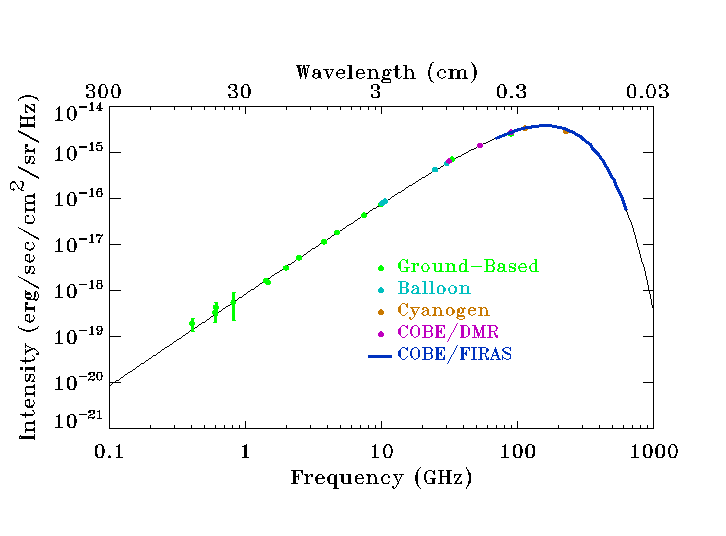
As time passed, however, and folks had time to digest some of the details presented by the BICEP2 team, there has been a growing unease about the possibility that the measurements may have been misinterpreted. The problem – the Achilles Heel of BICEP, so to speak – is that it operates at a single frequency, 150 GHz. That means that it is not possible for this experiment on its own to determine the spectrum of the detected signal. This is important because it is not only the cosmic microwave background that is capable of producing polarized radiation at a frequency of 150 GHz, foreground dust inside our own Galaxy being the prime suspect as an alternative source. It should be possible to distinguish between dust and CMB using measurements at different frequencies because the microwave background has a black-body spectrum  whereas dust does not. However, BICEP2 maps only a small part of the sky and at the time of the announcement there were no other measurements covering the same region, so a convincing test has not so far been possible.


cmbspectrum

The measured spectrum of the cosmic microwave background. It’s indistinguishable from the theoretical black-body curve shown as a solid line

The initial BICEP2 announcement included a discussion of foregrounds that concluded that these were expected to be much lower than their detected signal in the area mapped, but serious doubts have emerged about the accuracy of this claim. Have a look at my BICEP2 folder to see more discussion.

More recently, in July, it was announced that the BICEP2 team would collaborate with the large consortium working on the analysis of data from the Planck experiment to try to resolve these difficulties. Planck not only covers the whole sky but also has detectors making measurements over a wide range of frequencies (all the way up to 857 GHz). This should provide a definitive measurement of the contribution of Galactic dust to the BICEP2 field and at last give us a strong experimental basis on which to decided whether the BICEP2 signal is primordial or not. The result of my informal poll on BICEP2 was a clear majority (~62%) in favour of the statement that it was “too early to say” what the BICEP2 signal actually represents.

Anyway, I have it on very good authority that Planck’s analysis of the Galactic foregrounds in the BICEP2 region will be published (on the arXiv) on or around September 1st 2014. That’s just about 10 days from now. Maybe then this tantalizing wait will be over. I’ll try my best to post about the results when it comes out. In the meantime, I thought I’d do something completely unscientific and try to gauge what how current opinion stands on this issue by means of a poll of the total unrepresentative readership of this blog. Suppose you had to bet on whether the BICEP2 result is due to (a) primordial gravitational waves or (b) Galactic foregrounds, which would you go for?

Of course, those working on this project probably know the answer already so they’ll have to decide for themselves whether they wish to vote!

On Problems

Posted in Poetry, The Universe and Stuff with tags , , , on August 19, 2014 by telescoper

Since I’m in Denmark I thought I’d put up one of the wonderfully witty little poems written by Danish mathematician Piet Hein. He called each of these verses a “grook” (or actually, in Danish, the word is gruk) and he wrote thousands of them over his long life. I’ve posted one of these before but this one is even shorter but it makes a deep point, the danger of becoming be trapped by your own assumptions. I won’t comment on the relevance of this to the cosmology workshop I’m attending…

Our choicest plans
have fallen through
our airiest castles
tumbled over
because of lines
we neatly drew
and later neatly
stumbled over.

by Piet Hein (1905-1996).

Copenhagen, Cosmology and Coleman Hawkins

Posted in Biographical, Jazz, The Universe and Stuff with tags , , on August 18, 2014 by telescoper

Now that I’ve finally checked into my hotel in the wonderful city of Copenhagen I thought I’d briefly check in on the old blog as well. I’m here once again for a meeting, this time as an invited speaker at the 2nd NBIA-APCTP Workshop on Cosmology and Astroparticle Physics; NBIA being the Niels Bohr International Academy (based in Denmark) and APTCTP being the Asia Pacific Centre for Theoretical Physics (based in Korea). This is the kind of meeting I actually like, with relatively few participants and lots of time for discussion; as a welcome gesture for the first day there was also free beer!

I decided for some reason to try an experimental route getting here. There wasn’t a flight at a convenient date and  time from Gatwick, the nearest airport to my Brighton residence, so I decided to get an early morning flight from Heathrow instead. The departure time of 06:40, however, left me with the difficulty of getting there in time by public transport as the relevant trains don’t run overnight. I toyed with the idea of booking an airport hotel for the night, but decided that would be extravagant so instead opted to get a coach from Brighton; this was cheap and comfortable – only a handful of other passengers got on the bus – and got me there right on schedule. The downside was that I had to catch the 01:40 from Brighton Coach Station, which arrived at about 4am at Heathrow Terminal 3. It was quite interesting finding the normally busy terminal almost deserted but although I did a self-service check-in straight away the bag drops didn’t open until almost 5am. None of the cafes in the check-in area were open, so I had to hang around for an hour before finally getting rid of my luggage and passing through to the airside whereupon I nabbed some coffee and a bite to eat.

The flight was almost uneventful. Unfortunately, however, as we came in to land at Copenhagen’s Kastrup airport, a young person sitting behind me vomited uncontrollably and at considerable length, producing a steady flow both of chunder and unpleasant noises. The aftermath was quite unpleasant, so I was quick out of the blocks when the plane finally came to a stop at the gate. An aisle seat turned out to have been a wise choice.

Assuming it would be too early to check into the hotel that had been booked for me, I decided to go straight to the meeting but got to the Niels Bohr Institute’s famous Auditorium A near the end of the first talk, about the Imprint of Radio Loops on the CMB (a subject I’ve blogged about), which is a shame because (a) its interesting and (b) some of my own work was apparently discussed. That happens so rarely these days I’m sorry I missed it.

I was a bit tetchy as a result of my sleepless night, though I limited the expression of this to a  couple of rants about frequentist statistics during the discussions.

After the free beer I finally made my way to the hotel and checked in. It’s not bad, actually. There can’t be that many hotel rooms that have a picture of the great tenor saxophonist Coleman Hawkins on the wall:

SAMSUNG DIGITAL CAMERA

Anyway, I was due to give the conference summary on Friday but I’ve been moved forward to Wednesday so I’d better think of something to say. Maybe in the morning though, I could do with an early night…

Newcastle Joins the Resurgence of UK Physics

Posted in Education, Science Politics, The Universe and Stuff with tags , , , on August 17, 2014 by telescoper

I’ve posted a couple of times about how Physics seems to undergoing a considerable resurgence in popularity at undergraduate level across the United Kingdom, with e.g. Lincoln University setting up a new programme. Now there’s further evidence in that Newcastle University has now decided to re-open its Physics course for 2015 entry.

The University of Newcastle had an undergraduate course in Physics until 2004 when it decided to close it down, apparently owing to lack of demand. They did carry on doing some physics research (in nanoscience, biophysics, optics and astronomy) but not within a standalone physics department. The mid-2000s were tough for UK physics,  and many departments were on the brink at that time. Reading, for example, closed its Physics department in 2006; there is talk that they might be starting again too.

The background to the Newcastle decision is that admissions to physics departments across the country are growing at a healthy rate, a fact that could not have been imagined just ten years ago. Times were tough here at Sussex until relatively recently, but now we’re expanding on the back of increased student numbers and research successes. Indeed having just been through a very busy clearing and confirmation period at Sussex University, it is notable that its the science Schools that have generally done best.  Sussex has traditionally been viewed as basically a Liberal Arts College with some science departments; over 70% of the students here at present are not studying science subjects. With Mathematics this year overtaking English as the most popular A-level choice, this may well change the complexion of Sussex University relatively rapidly.

I’ve always felt that it’s a scandal that there are only around 40 UK “universities” with physics departments Call me old-fashioned, but I think a university without a physics department is not a university at all; it’s particularly strange that a Russell Group university such as Newcastle should not offer a physics degree. I believe in the value of physics for its own sake as well as for the numerous wider benefits it offers society in terms of new technologies and skills. Although the opening of a new physics department will create more competition for the rest of us, I think it’s a very good thing for the subject and for the Higher Education sector general.

That said, it won’t be an easy task to restart an undergraduate physics programme in Newcastle, especially if it is intended to have as large an intake as most successful existing departments (i.e. well over 100 each year). Students will be applying in late 2014 or early 2015 for entry in September 2015. The problem is that the new course won’t figure in any of the league tables on which most potential students based their choice of university. They won’t have an NSS score either. Also their courses  will probably need some time before it can be accredited by the Institute of Physics (as most UK physics courses are).

There’s a lot of ground to make up, and my guess is that it will take some years to built up a significant intake.The University bosses will therefore have to be patient and be prepared to invest heavily in this initiative until it can break even. The decision a decade ago to cut physics doesn’t exactly inspire confidence that they will be prepared to do this, but times have changed and so have the people at the helm so maybe that’s an unfair comment.

There are also difficulties on the research side (which is also vital for a proper undergraduate teaching programme), there are also difficulties. Grant funding is already spread very thin, and there is little sign of any improvement for the foreseeable future  in the “flat cash” situation we’re currently in. There’s also the stifling effect of theResearch Excellence Framework I’ve blogged about before. I don’t know whether Newcastle University intends to expand its staff numbers in Physics or just to rearrange existing staff into a new department, but if they do the former they will have to succeed against well-established competitors in an increasingly tight funding regime. A great deal of thought will have to go into deciding which areas of research to develop, especially as their main regional competitor, Durham University, is very strong in physics.

On the other hand, there are some positives, not least of which is that Newcastle is and has always been a very popular city for students (being of course the finest city in the whole world). These days funding follows students, so that could be a very powerful card if played wisely.

Anyway, these are all problems for other people to deal with. What I really wanted to do was to wish this new venture well and to congratulate Newcastle on rejoining the ranks of proper universities (i.e. ones with physics departments). Any others thinking of joining the club?

Sussex and the World Premier League of Physics

Posted in Education, The Universe and Stuff with tags , , , , , on August 16, 2014 by telescoper

In the office again busy finishing off a few things before flying off for another conference (of which more anon).

Anyway, I thought I’d take a short break for a cup of tea and a go on the blog.

Today is the first day of the new Premiership season and , coincidentally, last week saw some good news about the Department of Physics and Astronomy at the University of Sussex in a different kind of league table.

The latest (2014) Academic Rankings of World Universities (often called the “Shanghai Rankings”) are out so, as I suspect many of my colleagues also did, I drilled down to look at the rankings of Physics departments.

Not surprisingly the top six (Berkeley, Princeton, MIT, Harvard, Caltech, & Stanford) are all based in the USA. The top British university is, also not surprisingly, Cambridge in 9th place. That’s the only UK university in the top ten for Physics. The other leading UK physics departments are: Manchester (13th), Imperial (15th), Edinburgh (20th), Durham (28th), Oxford (39th) and UCL (47th). I don’t think there will be any surprise that these all made it into the top 50 departments worldwide.

Just outside the top 50 in joint 51st place in the world is the Department of Physics & Astronomy at the University of Sussex. For a relatively small department in a relatively small university this is a truly outstanding result. It puts the Department  clear in 8th place in the UK, ahead of Birmingham, Bristol, Leicester, Queen Mary, Nottingham, Southampton,  St Andrews, Lancaster, Glasgow, Sheffield and Warwick, all of whom made the top 200 in the world.

Incidentally, two of the other departments tied in 51st place are at Nagoya University in Japan (where I visited in January) and Copenhagen University in Denmark (where I’m going next week).

Although I have deep reservations about the usefulness of league tables, I’m not at all averse to using them as an excuse for a celebration and to help raise the profile of Physics and Astronomy at Sussex generally.  I’d therefore like to take the opportunity to offer hearty congratulations to the wonderful staff of the Department of Physics & Astronomy on their achievement. 

With the recent investments we’ve had and further plans for growth I hope over the next few years we can move even further up the rankings. Unless of course the methodology changes or we’re subect to a “random” (ie downward) fluctuation…


Do-It-Yourself Supernova Explosion

Posted in Education, The Universe and Stuff with tags , , , , on August 15, 2014 by telescoper

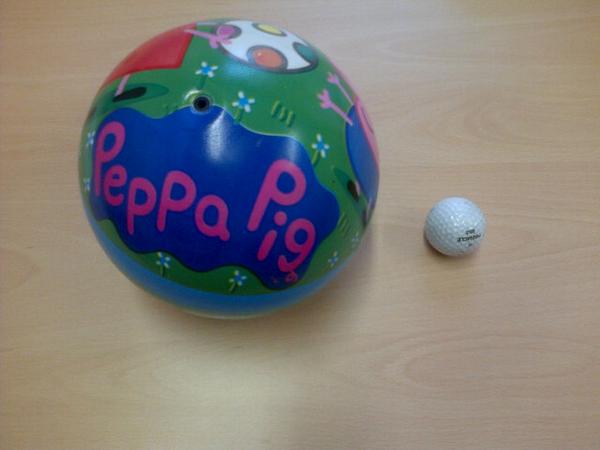
Visitors to the office of the Head of the School of Mathematical and Physical Sciences at the University of Sussex often remark upon the presence of these two objects and inquire as to their purpose:

Supernova

Since I don’t play golf and am a bit long in the tooth to be a fan of Peppa Pig, most assume that it must be for some strange astrophysical reason. I tried asking on Twitter what people think I use them for, and the most common answer was to demonstrate the relative size of the Earth and Moon. As Roy Walker would have said, “That’s a good answer, but it’s wrong”.

In fact I use the objects concerned to demonstrate what goes on when a star goes supernova.

The point is that a supernova explosion begins with gravitational collapse of the progenitor star, so why does that manifest itself as an explosion? The point is that the outer layers are blown off while the core collapses into a compact object such as a neutron star or, perhaps, a black hole.

The way to demonstrate this is first to balance the golf ball (representing the outer layers) on top of the beach ball; the air hole in the latter is a useful place to do this. You then lift the conjoined objects to a reasonable height and drop them onto the table or bench provided for such a purpose in a lecture theatre. The objects fall together under gravity until the beach ball hits the surface. You will find that the beach ball (representing the core) stops still while the golf ball (representing the outer shells) shoots upwards as most of the kinetic energy of the system is transferred to it during the bounce.

I think this is quite an effective demonstration, but I’d encourage inexperienced lecturers to note that there is a Health and Safety Issue, so it is necessary to carry out a risk assessment before attempting it. When I first did this during a lecture many years ago, I used a ball bearing rather than a golf ball and a fully-inflated and much larger beach ball instead of the more manageable (and slightly deflated) Peppa Pig one I now use. I told the students in the audience to watch carefully what happened and then dropped them as described above…

What happened in that case was that the ball bearing rocketed up so fast that it reached the ceiling and smashed into the lights above the lecturer’s bench, whereupon there was a very loud bang and I was showered with broken glass and other debris. I have to say that got the loudest round of applause I’ve ever had while lecturing, but it wasn’t exactly the effect I’d been hoping for.

But the real reason for posting today is to wish a very happy 65th birthday to supernova expert extraordinaire and occasional reader of this blog, Robert Kirshner of Harvard University, who has celebrating along with a number of my astro-chums at a conference in Australia.

Many happy returns, Bob!

Supermoon Surgery

Posted in Biographical, The Universe and Stuff with tags , , , , , , , on August 11, 2014 by telescoper

I have a busy day today (including my Annual Appraisal) to kick off a very busy week dominated by the release of this years A-level results and consequent admissions business, so I’ll just post a quickie though one which is at least fairly topical.

Last night (10th August) I took a (not very good) picture of the Moon with my phone:


supermoon

This is a so-called “supermoon“, a not particularly rare phenomenon which takes place when there is a Full Moon that coincides with the Moon being at the point of its orbit which is closest to the Earth, i.e. its perigee. A much better name is “Perigee Full Moon”, but that somehow doesn’t seem to have caught on in the popular media. The Moon orbits the Earth in an ellipse rather than a circle and at its closest approach it is about 14% closer than at its furthest (apogee). It therefore looks about 14% bigger and about 30% brighter during a Perigee Full Moon than during an Apogee Full Moon.

The Moon was certainly looking very bright when I took the picture last night, at least compared to a few minutes later when it disappeared behind a supercloud.

The Moon’s proximity to Earth during this Full Moon does have a noticeable effect on terrestrial tides, but not a particularly strong one; certainly not enough to trigger the end of the world. Actually, the tides have an amplitude just a few inches higher than average during a Perigee Full Moon. In any case roughly one in 14 Full Moons is a supermoon so it’s actually quite a common event, and as far as I’m aware the world didn’t come to an end during the last one or the one before that or the one before that or…

Anyway, all this supermoon malarkey reminded me of something that happened about 15 years ago,  just after I had moved to Nottingham to take up the position of Professor of Astrophysics at the University of Nottingham. I was sitting in my office, working – blogs hadn’t been invented then – when the phone rang and the voice at the other end said May I speak to Professor Coles please? When I replied that I was he, the caller went on to explain that he was a surgeon who worked at Queen’s Medical Centre, a hospital located right next to the University of Nottingham, with teaching staff working for the University.

It turned out that news of the setting up of the new Astronomy group there had made it into the University newsletter which my caller had seen. He asked if I had a few moments to answer a question about astrophysics which had been bothering him for some time and which he had just been discussing with some of his colleagues.  I said yes, and he asked: Does the Moon rotate?

I paused a bit, thinking how best to explain, and he went on to clarify his point, which was that if the Moon always has the same face towards the Earth does that mean it’s not rotating?

Understanding his question, I went on to explain that, yes, the Moon does rotate and that the reason it always shows the same face to the Earth (more-or-less, ignoring libration) is that the period of its rotation is the same as the Moon’s orbital period around the Earth. I also explained how to demonstrate this with two coffee mugs, moving one in a circle around the other and rotating the outer one so as to keep the handle pointing towards the central mug. Moreover, I explained the physics of this phenomenon, which is called tidal locking, and pointed out other examples in astrophysics.

After this spiel the caller said that was all very interesting but he had to go  now. Assuming I had bored him, as I fear I tend to do rather a lot, I apologized for going on about it for too long. He said no he wasn’t at all bored by the detail I had put in, he found it all absolutely fascinating. The reason for him needing to go was that he had to go back to tell the answer to the colleagues he had been discussing it with  just before phoning me.  They were all  in the operating theatre,  standing around a patient lying on the operating table, waiting  for him to return and complete the operation he had left in order to make the call…

Combining Research and Teaching in Physics & Astronomy

Posted in Education, The Universe and Stuff with tags , , , , , on August 7, 2014 by telescoper

Among the distinctive things we do here in the School of Mathematical and Physical Sciences at the University of Sussex are our degree programmes that involve a Research Placement (RP). Students on these courses take the normal lectures, laboratory classes and workshops during the academic year, but they spend the summer vacation doing (paid) work with research groups in the School to get an experience of what the world of research is really like. Various combinations of Physics and Astronomy with a Research Placement have been around for some time. These courses have been so popular and successful that we’ve extended the idea to Mathematics for 2015 entry. We have also started extending the RP scheme to include placements in laboratories elsewhere, either in industry or in a university abroad; we even have two students currently doing their placements in China.

Here are a couple of videos we’ve made featuring two RP students who have been working in the Department of Physics & Astronomy this summer.

This is Ross Callaghan:

And this is Nathaniel Wiesendanger Shaw:

Both these students are in between their 2nd and 3rd years of a 4-year MPhys programme. As it happens, both survived the experience of being in my Theoretical Physics class last term too!

It’s an ongoing frustration of mine that so many influential people think that teaching and research are separate functions of a university and should not be mixed. I believe that the two go hand-in-hand and that you can’t really claim to be getting a real university education if it’s not informed by the latest developments in research. Moreover, some also imply that research-led teaching only happens in the Russell Group, which is not the case at all. In fact, I think we provide a much better environment for this in Sussex than either of the Russell Group universities in which I’ve previously worked.

Many Departments talk about how important it is that their teaching is based on state-of-the-art research, but here at Sussex we don’t just talk about research to undergraduates – we let them do it!