Archive for the The Universe and Stuff Category

BICEP2 – The Video!

Posted in The Universe and Stuff with tags , , , on July 23, 2014 by telescoper

A video about cosmic inflation and the BICEP2 results produced by the University of Sussex and PhD Comics!

Sleep well last night?

Posted in The Universe and Stuff with tags , on July 18, 2014 by telescoper

We had a spectacular thunderstorm over Brighton last night. I do love a good thunderstorm. Although I enjoyed the show, I didn’t get much sleep. Judging by the following graphic from BBC Weather, I’m not the only one…

Lightning

IAU Symposium 308 – Conference Photo Caption Competition

Posted in Beards, Biographical, The Universe and Stuff with tags , , on July 16, 2014 by telescoper

Regular readers of this blog (Sid and Doris Bonkers) will recall that I recently attended IAU Symposium No. 308 in Tallinn, Estonia. To prove that I didn’t make it all up, here is the official conference photograph.

iau308 conference_photo 1 lres

You can see me three rows back on the right-hand-side of the picture; you can click on the image to make it largely should you wish. Behind me and to my left as I look at the camera you will see the esteemed cosmologist Carlos Frenk wearing an unusual facial expression.

I wonder if anyone might like to suggest an explanation for Prof. Frenk’s behaviour by way of a suitable caption for the photograph?

Honoris Causa, Dr Chryssa Kouveliotou

Posted in Education, The Universe and Stuff with tags , , , , , on July 10, 2014 by telescoper

This morning I had the privilege of participating in a graduation ceremony at the University of Sussex. It was great to get to shake the hands of all the successful graduates as they crossed the stage to receive their degrees. I hope I’ll be able to collect a few pictures of the occasion and post them in due course.


Kouveliotou

I also had the privilege of being able to present an extremely distinguished honorary graduand, Dr Chryssa Kouveliotou. Here the oration I delivered, which I’m posting simply to record her amazing achievements and to underline that she is one of many people who have done the MSc in Astronomy at Sussex University and gone on to do great things…


Vice-Chancellor,

It is both a pleasure and an honour to present for the award of the degree of Doctor of Science, Dr Chryssa Kouveliotou.

Inspired by watching Neil Armstrong take his first step on the moon, Dr Kouveliotou always wanted to be an astronaut but, with no such opportunities apparently on offer in her native, she instead chose a career in astronomy. However, when she completed college Greece her astronomy professor (who shall remain nameless) advised her that there was no future for her in astrophysics. She has never known whether he really thought it was a poor choice or whether it was because she was a woman. Determined to follow her own path, she disregarded him completely and, even though her open-minded parents’ preference was for her to settle down and stay in her home country, she left to study for her Master’s degree in Astronomy at the University of Sussex; the topic of her dissertation was “The Sodium emission cloud around Io: mapping and correlation with Jupiter’s magnetic field”. She received the MSc in Astronomy in 1977. Although the topic of her subsequent research was rather different, the connection with magnetic fields remained strong.

Dr Kouveliotou then moved to Germany to do postgraduate research on the-then very new topic of gamma-ray bursts. Indeed, she may well have been the very first person to complete a thesis on this, which remains to this day an extremely active and exciting field of research. Gamma-ray bursts are considered to be the most powerful explosions in the universe, second only to the Big Bang itself.

After completing her PhD, Dr Kouveliotou returned to Greece to teach Physics and Astronomy at the University of Athens. All the while she knew that she really wanted to do research so spent her free time pursuing this goal. Every vacation and on her one-year sabbatical she went to the USA to undertake research at the National Aeronautics and Space Administration (NASA). Her work was on solar flares but she moonlighted during evenings, nights and weekends researching her ‘first love’ gamma-ray bursts. Because of the research she undertook outside her “day job”, she found a series of bursts which all came from the same part of the sky and, as a result, became part of the discovery team for a brand new phenomenon called a soft gamma-ray repeater.

By observing gamma rays produced in space, her team discovered an example of a new class of exotic astronomical object called a magnetar, an object which has a magnetic field trillions of times stronger than that of the Earth. A magnetar is now known to be a type of neutron star, a burnt-out relic resulting from the death of an ordinary star in a supernova explosion.

Dr Kouveliotou has always loved to ask big questions, to look at the universe and ask how nature expresses itself. By overcoming obstacles in her path she really has reached the stars. In January 2013 Dr Chryssa Kouveliotou was named the Senior Scientist for High Energy Astrophysics, Science and Research Office at NASA’s Marshall Space Flight Center in Hunstville, Alabama.

She has received many awards for her work, including the Dannie Heineman Prize for Astrophysics and the NASA Exceptional Service Medal in 2012 and the NASA Space Act Award in 2005. She was also named amongst Time Magazine’s 25 Most Influential People in Space in 2012. In 2003 she was honoured with the annual Rossi Prize by the High Energy Astrophysics division of the American Astronomical Society for a significant contribution to high-energy astrophysics. In 2002 she received the Descartes Prize which recognises scientific breakthroughs from European collaborative research in any scientific field. In the awards bestowed upon her she has also been recognised for her effectiveness at creating the sort of large collaboration needed to make effective use of multi-wavelength astronomical observations.

Dr Kouveliotou has published almost 400 papers in refereed scientific journals and has been amongst the top 10 most-cited space science researchers in the academic literature across the world. She has been elected chair of the Division of Astrophysics of the American Physical Society and is a member of the Council of the American Astronomical Society, of which she chairs the High Energy Astrophysics Division.

Vice-Chancellor, I present to you for the degree of Doctor of Science, honoris causa, Dr Chryssa Kouveliotou.


BICEP2 Redux: How the Sausage is Made

Posted in The Universe and Stuff with tags , , , on July 6, 2014 by telescoper

I came across this (rather lengthy, but very good) discussion of the BICEP2 story so far so thought I would share it here. There’s a particularly useful collection of articles at the end for those who would like to read more.

I’ll also take this opportunity to refer you to a recent BBC News story which states that the BICEP2 and Planck teams are now in discussions about sharing data. About time, if you ask me. Still, it will take a considerable time to work out the ordering of the authors if they ever do write a paper!

Glen Mark Martin's avatarWhiskey...Tango...Foxtrot?

An ongoing problem with communicating science to the general public is the existence of widely-held misconceptions among the public regarding how science actually works. A case in point is the March 17 announcement by the BICEP2 Collaboration regarding the detection of B-Mode polarization in the Cosmic Microwave Background and the events which have unfolded since then.

All too often, news stories and blog posts will trumpet some announcement with sensational headlines like “Scientists Say Cheap, Efficient Solar Cells Just Around the Corner”, or “Scientists Close in on Cure for Cancer.” Many people take such announcements at face value and consider the case closed. The work has been done.  The reality of the situation, however, is that the initial announcement of a discovery or breakthrough is just the beginning of the hard work, breathlessly hyped headlines notwithstanding.

How Science Actually Works (or at least how it is supposed to work)

Once…

View original post 2,843 more words

Talking About Undergraduate Physics Research…

Posted in Education, The Universe and Stuff with tags , , , , , , , on July 2, 2014 by telescoper

One of the courses we offer in the School of Physics & Astronomy here at the University of Sussex is the integrated Masters in Physics with a Research Placement. Aimed at high-flying students with ambitions to become research physicists, this programme includes a paid research placement as a Junior Research Associate each summer vacation for the duration of the course; that means between Years 1 & 2, Years 2 & 3 and Years 3 & 4 . This course has proved extremely attractive to a large number of very talented students and it exemplifies the way the Department of Physics & Astronomy integrates world-class research with its teaching in a uniquely successful and imaginative way.

Some time ago I blogged about  some very good news about one of our undergraduate researchers, Talitha Bromwich, who is about to graduate from her MPhys degree, after which she will be heading to Oxford to start her PhD DPhil; she is pictured below with her supervisor Dr Simon Peeters:

Talitha Bromwich with her JRA supervisor Dr Simon Peeters at 'Posters in Parliament' event 25 Feb 14

Talitha spent last summer working on the DEAP3600 dark-matter detector after being selected for the University’s Junior Research Associate scheme. Her project won first prize at the University’s JRA poster exhibition last October, and she was then chosen to present her findings – alongside undergraduate researchers from 22 other universities – in Westminster yesterday as part of the annual Posters in Parliament exhibition, organized under the auspices of the British Conference of Undergraduate Research (BCUR).

A judging panel – consisting of Ben Wallace MP, Conservative MP for Wyre and Preston North; Sean Coughlan, Education Correspondent for the BBC; and Professor Julio Rivera, President of the US Council of Undergraduate Research; and Katherine Harrington of the Higher Education Academy – decided to award Talitha’s project First Prize in this extremely prestigious competition.

We held a small drinks party in the School of Mathematical and Physical Sciences to congratulate Talitha on her success. Here are a couple of pictures of that occasion:

3479.item

From left to right you see Simon Peeters, myself, Talitha and Prof. Michael Farthing (the Vice Chancellor of the University of Sussex); the winning poster is in the background. Here’s me presenting a little gift:

3478.item

More recently still, the MPS Elves have made a little video featuring Talitha talking about her research placement:

We take undergraduate research very seriously here at the University of Sussex, and are now extending the Research Placement scheme to Mathematics. Many Departments talk about how important it is that their teaching is based on state-of-the-art research, but here at Sussex we don’t just talk about research to undergraduates – we let them do it!


The Zel’dovich Lens

Posted in The Universe and Stuff with tags , , , , on June 30, 2014 by telescoper

Back to the grind after an enjoyable week in Estonia I find myself with little time to blog, so here’s a cute graphic by way of  a postscript to the IAU Symposium on The Zel’dovich Universe. I’ve heard many times about this way of visualizing the Zel’dovich Approximation (published in Zeldovich, Ya.B. 1970, A&A, 5, 84) but this is by far the best graphical realization I have seen. Here’s the first page of the original paper:

zeld

In a nutshell, this daringly simple approximation considers the evolution of particles in an expanding Universe from an early near-uniform state into the non-linear regime as a sort of ballistic, or kinematic, process. Imagine the matter particles are initial placed on a uniform grid, where they are labelled by Lagrangian coordinates \vec{q}. Their (Eulerian) positions at some later time t are taken to be

\vec{r}(\vec(q),t) = a(t) \vec{x}(\vec{q},t) = a(t) \left[ \vec{q} + b(t) \vec{s}(\vec{q},t) \right].

Here the \vec{x} coordinates are comoving, i.e. scaled with the expansion of the Universe using the scale factor a(t). The displacement \vec{s}(\vec{q},t) between initial and final positions in comoving coordinates is taken to have the form

\vec{s}(\vec{q},t)= \vec{\nabla} \Phi_0 (\vec{q})

where \Phi_0 is a kind of velocity potential (which is also in linear Newtonian theory proportional to the gravitational potential).If we’ve got the theory right then the gravitational potential field defined over the initial positions is a Gaussian random field. The function b(t) is the growing mode of density perturbations in the linear theory of gravitational instability.

This all means that the particles just get a small initial kick from the uniform Lagrangian grid and their subsequent motion carries on in the same direction. The approximation predicts the formation of caustics  in the final density field when particles from two or more different initial locations arrive at the same final location, a condition known as shell-crossing. The caustics are identified with the walls and filaments we find in large-scale structure.

Despite its simplicity this approximation is known to perform extremely well at reproducing the morphology of the cosmic web, although it breaks down after shell-crossing has occurred. In reality, bound structures are formed whereas the Zel’dovich approximation simply predicts that particles sail straight through the caustic which consequently evaporates.

Anyway the mapping described above can also be given an interpretation in terms of optics. Imagine a uniform illumination field (the initial particle distribution) incident upon a non-uniform surface (e.g. the surface of the water in a swimming pool). Time evolution is represented by greater depths within the pool.  The light pattern observed on the bottom of the pool (the final distribution) displays caustics with a very similar morphology to the Cosmic Web, except in two dimensions, obviously.

Here is a very short  but very nice video by Johan Hidding showing how this works:

In this context, the Zel’dovich approximation corresponds to the limit of geometrical optics. More accurate approximations can presumably be developed using analogies with physical optics, but this programme has only just begun.

The Zel’dovich Universe – Days 5 & 6 Summary

Posted in History, The Universe and Stuff with tags , , , , , on June 29, 2014 by telescoper

Well, it’s Sunday morning and it’s raining in Tallinn. I’ve got a few hours to kill but fortunately don’t have to check out of the hotel until noon so I thought I’d briefly summarize Days Five and Six of IAU Symposium No. 308, The Zel’dovich Universe just to complete the story.

Day Five (Friday) began with a talk by Jaan Einasto, recent winner of the Gruber Prize for Cosmology. As you can see from this picture I took before his talk commenced,  the topic was Yakov Zel’dovich and the Comic Sans Cosmic Web Paradigm:

IMG-20140627-00354

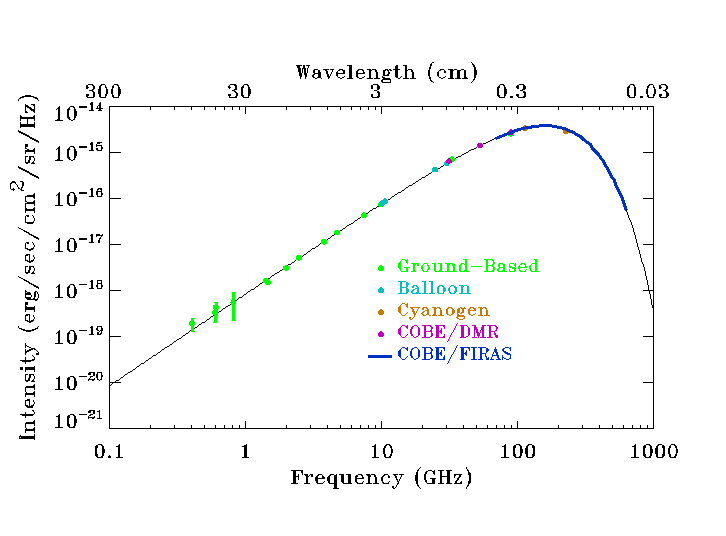
The following talk was by the ebullient Rashid Sunyaev, whose name is associated with Zel’dovich in so many contexts, including the Sunyaev-Zeld’ovich effect. Sunyaev is such a big personality that he is unconstrained by the banal notions of time, and his talk set the schedule back for the rest of the morning. Among the things I remember from his contribution was a discussion of the Berkeley-Nagoya distortion. This was a hot topic during the time I was a graduate student, as it was a measurement that suggested the spectrum of the cosmic microwave background departed significantly from a black-body (Planck) curve in the Wien part of the spectrum; this is now usually known as a y-distortion. Anyway, lots of theorists wrote papers explaining the measured excess in terms of this that and the other and then it was shown to be an error; the excess emission came not from the Big Bang but from the exhaust of the rocket carrying the measurement. The thing I remember most strongly about this was that as soon as the error was identified it ceased to be the Berkeley-Nagoya distortion and became instead the Nagoya-Berkeley distortion…

Rashid Sunyaev was himself a winner of the Gruber prize some years ago, as indeed were Dick Bond and Brent Tully who spoke erlier in the conference, so the organizers decided to form a Gruber-panel to discuss various topics suggested by the audience. Here is Sunyaev, hogging the microphone:

IMG-20140627-00355

Carlos Frenk is also a Gruber prize winner, but he only arrived after lunch so wasn’t part of this discussion. The afternoon was all about cosmological simulations of various aspects of the Cosmic Web. This gives me an opportunity to repeat how the Oxford English Dictionary defines “simulation”:

1. a. The action or practice of simulating, with intent to deceive; false pretence, deceitful profession.

b. Tendency to assume a form resembling that of something else; unconscious imitation.

In the World Cup players can even get sent off for simulation, although regrettably they seldom are.

Anyway, Friday evening found us at the famous House of Blackheads (aptly on Pikk Street) for an evening of very long speeches punctuated by small amounts of food and wine (and of course some very lovely music as I described yesterday). When the party was over a group of us adjourned to a local bar, from which I returned to my hotel at about 2am.

Day Six was a half-day, with some very interesting talks about gravitational len-sing in the first session and “superstructures” in the cosmic web. Then we were into the final furlong as it were. Nick Kaiser was put in Session (No. 21) all of his own. As usual, given how annoyingly brilliant he is, Nick gave  fabulously interesting talk full of insights and ideas. The organizers had definitely saved the best for second-to-last.

Then, after five-and-a-half days and almost 100 talks, it was down to me to give the conference summary. Obviously I couldn’t really summarize all that such I just picked up a few things that occurred to me during the course of the conference (some of which I’ve written about over the last week or so on this blog) and made a few jokes, primarily at the expense of Carlos Frenk. I was interested to see that signs like this had been put up around Tallinn advertising my talk:

IMG-20140628-00356

The OMG and WOW are self-explanatory, but I was a bit confused about the SAH so I googled it and found that it means the Society of Architectural Historians. I’ve never heard it put quite like that before, but I guess that’s what we cosmologists are: trying to understanding the origins and time evolution of the architecture of the Universe.

A number of speakers at this conference referred to a conference in Hungary in 1987 at which they had met Zel’dovich (who died later that year). I was a graduate student (at Sussex) at that time and owing the shortage of travel funds I wasn’t able to go; I went to a meeting in Cambridge called The Post-Recombination Universe instead. If memory serves that’s when I gave my first conference talk. Anyway, Carlos Frenk gave a talk at that meeting in Hungary which he decribed in his talk at this conference on Friday afternoon. Somebody back in 1987 had written a series of limericks to describe that meeting, so I was challenged to come up with one to conclude this one. Here’s my effort, which is admittedly pretty feeble, but at least the sentiments behind it are genuine..

In Tallinn (IAU 308)
The sessions invariably ran late
But despite being tired
We still much inspired
By Yakov Zel’dovich (the Great).

The Fractal Universe, Part 2

Posted in History, The Universe and Stuff with tags , , , , , , on June 27, 2014 by telescoper

Given the recent discussion in comments on this blog I thought I’d give a brief update on the issue of the scale of cosmic homogeneity; I’m going to repeat some of the things I said in a post earlier this week just to make sure that this discussion is reasonable self-contained.

Our standard cosmological model is based on the Cosmological Principle, which asserts that the Universe is, in a broad-brush sense, homogeneous (is the same in every place) and isotropic (looks the same in all directions). But the question that has troubled cosmologists for many years is what is meant by large scales? How broad does the broad brush have to be? A couple of presentations discussed the possibly worrying evidence for the presence of a local void, a large underdensity on scale of about 200 MPc which may influence our interpretation of cosmological results.

I blogged some time ago about that the idea that the Universe might have structure on all scales, as would be the case if it were described in terms of a fractal set characterized by a fractal dimension D. In a fractal set, the mean number of neighbours of a given galaxy within a spherical volume of radius R is proportional to R^D. If galaxies are distributed uniformly (homogeneously) then D = 3, as the number of neighbours simply depends on the volume of the sphere, i.e. as R^3, and the average number-density of galaxies. A value of D < 3 indicates that the galaxies do not fill space in a homogeneous fashion: D = 1, for example, would indicate that galaxies were distributed in roughly linear structures (filaments); the mass of material distributed along a filament enclosed within a sphere grows linear with the radius of the sphere, i.e. as R^1, not as its volume; galaxies distributed in sheets would have D=2, and so on.

We know that D \simeq 1.2 on small scales (in cosmological terms, still several Megaparsecs), but the evidence for a turnover to D=3 has not been so strong, at least not until recently. It’s just just that measuring D from a survey is actually rather tricky, but also that when we cosmologists adopt the Cosmological Principle we apply it not to the distribution of galaxies in space, but to space itself. We assume that space is homogeneous so that its geometry can be described by the Friedmann-Lemaitre-Robertson-Walker metric.

According to Einstein’s theory of general relativity, clumps in the matter distribution would cause distortions in the metric which are roughly related to fluctuations in the Newtonian gravitational potential \delta\Phi by \delta\Phi/c^2 \sim \left(\lambda/ct \right)^{2} \left(\delta \rho/\rho\right), give or take a factor of a few, so that a large fluctuation in the density of matter wouldn’t necessarily cause a large fluctuation of the metric unless it were on a scale \lambda reasonably large relative to the cosmological horizon \sim ct. Galaxies correspond to a large \delta \rho/\rho \sim 10^6 but don’t violate the Cosmological Principle because they are too small in scale \lambda to perturb the background metric significantly.

In my previous post I left the story as it stood about 15 years ago, and there have been numerous developments since then, some convincing (to me) and some not. Here I’ll just give a couple of key results, which I think to be important because they address a specific quantifiable question rather than relying on qualitative and subjective interpretations.

The first, which is from a paper I wrote with my (then) PhD student Jun Pan, demonstrated what I think is the first convincing demonstration that the correlation dimension of galaxies in the IRAS PSCz survey does turn over to the homogeneous value D=3 on large scales:

correlations

You can see quite clearly that there is a gradual transition to homogeneity beyond about 10 Mpc, and this transition is certainly complete before 100 Mpc. The PSCz survey comprises “only” about 11,000 galaxies, and it relatively shallow too (with a depth of about 150 Mpc),  but has an enormous advantage in that it covers virtually the whole sky. This is important because it means that the survey geometry does not have a significant effect on the results. This is important because it does not assume homogeneity at the start. In a traditional correlation function analysis the number of pairs of galaxies with a given separation is compared with a random distribution with the same mean number of galaxies per unit volume. The mean density however has to be estimated from the same survey as the correlation function is being calculated from, and if there is large-scale clustering beyond the size of the survey this estimate will not be a fair estimate of the global value. Such analyses therefore assume what they set out to prove. Ours does not beg the question in this way.

The PSCz survey is relatively sparse but more recently much bigger surveys involving optically selected galaxies have confirmed this idea with great precision. A particular important recent result came from the WiggleZ survey (in a paper by Scrimgeour et al. 2012). This survey is big enough to look at the correlation dimension not just locally (as we did with PSCz) but as a function of redshift, so we can see how it evolves. In fact the survey contains about 200,000 galaxies in a volume of about a cubic Gigaparsec. Here are the crucial graphs:

homogeneity

I think this proves beyond any reasonable doubt that there is a transition to homogeneity at about 80 Mpc, well within the survey volume. My conclusion from this and other studies is that the structure is roughly self-similar on small scales, but this scaling gradually dissolves into homogeneity. In a Fractal Universe the correlation dimension would not depend on scale, so what I’m saying is that we do not live in a fractal Universe. End of story.

The Zel’dovich Universe – Day 4 Summary

Posted in History, The Universe and Stuff with tags , , , , , , , on June 27, 2014 by telescoper

And on the fourth day of this meeting about “The Zel’dovich Universe”  we were back to a full schedule (9am until 7.30pm) concentrating on further studies of the Cosmic Web. We started off with a discussion of the properties of large-scale structure at high redshift. As someone who’s old enough to remember the days when “high redshift” meant about z~0.1 the idea that we can now map the galaxy distribution at redshifts z~2. There are other measures of structure on these huge scales, such as the Lyman alpha forest, and we heard a bit about some of them too.

The second session was about “reconstructing” the Cosmic Web, although a more correct word have been “deconstructing”. The point about this session is that cosmology is basically a backwards subject. In other branches of experimental science we set the initial conditions for a system and then examine how it evolves. In cosmology we have to infer the initial conditions of the Universe from what we observe around us now. In other words, cosmology is an inverse problem on a grand scale.  In the context of the cosmic web, we want to infer the pattern of initial density and velocity fluctuations that gave rise to the present network of clusters, filaments and voids. Several talks about this emphasized how proper Bayesian methods have led to enormous progress in this field over the last few years.

All this progress has been accompanied by huge improvements in graphical visualisation techniques. Thirty years ago the state of the art in this field was represented by simple contour plots, such as this (usually called the Cosmic Chicken):

chicken

You can see how crude this representation is by comparing it with a similar plot from the modern era of precision cosmology:

chicken

Even better examples are provided by the following snapshot:

IMG-20140626-00352

It’s nice to see a better, though still imperfect,  version of the chicken at the top right, though I found the graphic at the bottom right rather implausible; it must be difficult to skate at all with those things around your legs.

Here’s another picture I liked, despite the lack of chickens:

IMG-20140626-00353

Incidentally, it’s the back of Alar Toomre‘s head you can see on the far right in this picture.

The afternoon was largely devoted to discussions of how the properties of individual galaxies are influenced by their local environment within the Cosmic Web. I usually think of galaxies as test particles (i.e. point masses) but they are interesting in their own right (to some people anyway). However, the World Cup intervened during the evening session and I skipped a couple of talks to watch Germany beat the USA in their final group match.

That’s all for now. Tonight we’ll have the conference dinner, which is apparently being held in the “House of Blackheads” on “Pikk Street”. Sounds like an interesting spot!