Archive for the The Universe and Stuff Category

Hawking at BAFTA

Posted in Film, Television, The Universe and Stuff with tags , , , , on June 13, 2013 by telescoper

Having survived the chairing of our lengthy Progression and Award Board this morning here in Sussex, I thought I’d just spend a few minutes on the blog before going up to London for an event at the Royal Society this evening.

In fact I was in London for much of yesterday too, partly for a meeting relating to SEPNET but then later to attend a special Event for Fellows of the Institute of Physics at the plush premises of British Academy of Film and Television Arts (BAFTA) in Piccadilly:

entrance-8976

The event was a special preview screening of the a feature length documentary called Hawking, about the life and career of celebrated British cosmologist and theoretical physicist Stephen Hawking, followed by a question-and-answer session with the producer and director. There have been many films about Hawking already, but the distinctive thing about this one is that Hawking himself contributed to the script so, to some extent, it’s “in his own words”. It’s quite clear that it wasn’t meant so much as a science documentary as an unflinching look at Hawking’s struggle against Motor Neurone Disease, with his scientific work merely serving as background to the human interest story. It is, of course, a very moving narrative not only because of the hardship he has been forced to endure but also because of what he has achieved as a scientist in the face of difficulties that would have defeated persons of lesser determination.

I found the film interesting but a little frustrating because, while it raised many interesting issues (such as the conflict between celebrity and privacy), it moved on so quickly that none of them were really explored in any depth. I did strike me, however, as a very honest film – the discussion of the break-up of his first marriage was very candid, but it was nice to discover that in recent years Stephen and Jane have are at least on speaking terms again. Hawking’s sense of humour, which is often concealed by his disability, also came across very well. I could give an example of this from my own experience, but given the nature of the prank he played I think it’s better not to!

Anyway, I won’t say anything more because I don’t want to colour anyone’s judgement about the film, which doesn’t go on general release in the UK until later in the year. Go to see it yourself, and make your own mind up! In the meantime, here is the official trailer:

Replacement Plug

Posted in Biographical, Education, The Universe and Stuff with tags , on June 11, 2013 by telescoper

Time moves on. I just noticed that an advertisement has appeared for my old job at Cardiff University.

Faculty Position in Theoretical Astrophysics or Cosmology

(Senior Lecturer/Reader/Professor depending on experience)

The School of Physics and Astronomy at Cardiff University has an immediate vacancy for a permanent faculty position in Theoretical Astrophysics or Cosmology. Applications are particularly welcome from applicants who can work closely with existing observational astronomers in the School.  The position can be at any level from Senior Lecturer to full Professor depending on the experience of the appointed candidate.

 The appointee will be expected to strengthen further the existing programme and have demonstrated a world-class programme of research. The appointee will also be expected to teach theoretical astrophysics and physics courses at undergraduate and postgraduate level.

 Further information about the School may be found at http://www.astro.cf.ac.uk/ and further details about employment at Cardiff University as well as downloadable application forms may be found on the University website at http://www.cardiff.ac.uk/jobs/  under vacancy number 1046BR.

 Informal enquiries regarding this position may be made to Professor Walter Gear, Head of School (Walter.Gear@astro.cf.ac.uk).

If the person that eventually gets the job applies as a result of seeing the advert here it would be rather ironic! I’d consider applying for it myself, but it says the applicant  must “have demonstrated a world-class programme of research”, which clearly rules me out!

A Question of Bores

Posted in Cute Problems, The Universe and Stuff with tags , , , on June 7, 2013 by telescoper

I was at a lengthy meeting this morning so naturally there popped into my mind the subject of bores. The most prominent of these that will be familiar to British folk is the Severn Bore, but they happen in a variety of locations, including Morecambe Bay (which is in the Midlands):

Tidal_Bore_-_geograph.org.uk_-_324581

As you can see, a bore consists of a steep wavefront that travels a long distance without disruption, and is one manifestation of a more general phenomenon called a hydraulic jump; in a coordinate frame that moves with the wavefront, a bore is basically identical to a stationary hydraulic jump.

Anyway, I while ago I decided to set an examination question about this, which I reproduce here in severely edited form for your amusement and edification; you can click on it to make it larger if you have difficulty reading the question. With the examination season over I’m sure there are many people out there missing the opportunity to grapple with physics problems! Or perhaps not…

Bore

If you need hints, I suggest first working out how the pressure P varies with depth and then using the result to work out to work out the balance of forces either side of the discontinuity. Then deploy Bernoulli’s theorem and Bob’s your uncle!

P.S. For another hint, try the yellow pages:

Boring

Cosmic Swirly Straws Feed Galaxy

Posted in The Universe and Stuff with tags , , , , , on June 5, 2013 by telescoper

I came across this video on youtube and was intrigued because the title seemed like a crossword clue (to which I couldn’t figure out the answer). It turns out that it goes with a piece in the Guardian which describes a computer simulation showing the formation of a galaxy during the first 2bn years of the Universe’s evolution. Those of us interested in cosmic structures on a larger scale than galaxies usually show such simulations in co-moving coordinates (i.e. in a box that expands at the same rate as the Universe), but this one is in physical coordinates showing the actual size of the objects therein; the galaxy is seen first to condense out of the expanding distribution of matter, but then grows by accreting matter in a complicated and rather beautiful way.

This calculation includes gravitational and hydrodynamical effects, allowing it to trace the separate behaviour of dark matter and gas (predominantly hydrogen).  You can see that this particular object forms very early on; the current age of the Universe is estimated to be about 13 – 14 billion years. When we look far into space using very big telescopes we see objects from which light has taken billion of years to reach us. We can therefore actually see galaxies as they were forming and can therefore test observationally whether they form as theory (and simulation) suggest.

The Curious Case of Weinstein’s Theory

Posted in The Universe and Stuff with tags , , , , , on May 29, 2013 by telescoper

I’m late onto this topic, but that’s probably no bad thing given how heated it seems to have been. Most of you have probably heard that, last week,  Marcus du Sautoy (who is the Simonyi Professor for the Public Understanding of Science at the University of Oxford), wrote a lengthy piece in the Grauniad about some work by a friend of his, Eric Weinstein. The Guardian piece was headed

Eric Weinstein may have found the answer to physics’ biggest problems
A physicist has formulated a mathematical theory that purports to explain why the universe works the way it does – and it feels like ‘the answer’

I’m not sure whether du Sautoy wrote this heading or whether it was added by staff at the newspaper, but Weinstein is not actually working as a physicist; he has a PhD from Harvard in Mathematical Physics, right enough, but has been working for some time as an economics consultant. Anyway, Weinstein also presented his work in a two-hour lecture at the Mathematics Department at Oxford University. Unfortunately, it appears that few (if any) of Oxford’s physicists received an invitation to attend the lecture which, together with the fact that there isn’t an actual paper (not even a draft, unrefereed one) laying out the details, led to some rather scathing responses from Twitterland and Blogshire. Andrew Pontzen’s New Scientist blog piece is fairly typical. This talk was followed by a retraction of an allegation that physicists were not invited to the talk; it turns out the invitation was sent, but not distributed as widely as it should.

Anyway, what are we to make of this spat? Well, I think it would be very unfortunate if this episode led to the perception that physicists feel that only established academics can make breakthroughs in their own field. There are plenty of historical examples of non-physicists having great ideas that have dramatically changed the landscape of physics; Einstein himself wasn’t an academic when he did his remarkable work in 1905. I think we should all give theoretical ideas a fair hearing wherever they come from. And although Marcus du Sautoy is also not a physicist, he no doubt knows enough about physics to know whether Weinstein’s work is flawed at a trivial level. And even if it is wrong (which, arguably, all theories are) then it may well be wrong in a way that’s interesting, possibly precisely because it does come from outside the current mainstream (which, in my opinion, is too obsessed with string theory for its own good).

That aside, I do have a serious issue with the way Marcus du Sautoy used his media connections to plug some work that hasn’t even been submitted to, let alone passed, the gold standard of peer review. I can’t comment on the work because I wasn’t at the talk and there is no paper for me to study and form my own conclusions. The accompanying blog post isn’t enough to make an informed decision either. It may or not be brilliant. I assure you I have an open mind on that, but I don’t think it’s apppropriate for a Professor of Public Understand of Science to indulge in such hype. It reminds me of a recent episode involving another famous Oxford mathematician, Roger Penrose. Perhaps he’ll get together with Eric Weinstein and look for evidence supporting the new theory in the cosmic microwave background?

Don’t get me wrong. I don’t at all object to Weinstein being given an opportunity to air his work at a departmental seminar or colloquium. Actually, I wish more departmental talks were of a speculative and challenging nature, rather than just being rehashes of already published work. The problem with talking about work in progress, though, is (as I know from experience) is that if you talk too openly about ideas then someone quicker and cleverer than yourself can work out the details faster than you can; while it’s a bit frustrating when that happens, in the long run it’s good for science. Or so I tell myself. Anyway, the problem is not with that: it’s with airing this in the wider media inappropriately early, i.e. before it has received proper scrutiny. This could give the impression to the public that science is just a free-for-fall and that anyone’s ideas, however half-baked, are equally valid. That is irresponsible.

Anyway, that’s my take on this strange business. I’d be interested to hear other opinions through the comments box. Please bear in mind, however, that the word “defamation” has been bandied about, so be careful, and note that this piece expresses my opinion. That’s all.

Synchronicity

Posted in Music, The Universe and Stuff with tags , , , , , on May 23, 2013 by telescoper

I stumbled across this a while ago and, with my mind emptied by a day full of meetings, I thought I’d take the opportunity to post it today along with a couple of random connections that sprang into my mind when I saw it. The process by which 32 metronomes seem to synchronize themselves in the first video might look like magic at first glance, but it’s actually based on very simple physics…

And if you want to see an explanation of how it works with rather fewer metronomes, see

which brings me onto this remarkable piece of music by György Ligeti which is called Poème Symphonique and is written for 100 metronomes placed, hopefully, on a hard surface:

All this reminds me of the legendary Geordie darts commentator Sid Waddell, who once described the ebb-and-flow of a championship darts match in the following style…

the pendulum is swinging backwards and forwards, like a metronome…

The Moral Activity which Disentangles

Posted in Literature, The Universe and Stuff with tags , , , , , , , on May 22, 2013 by telescoper

I came across this last night and thought I would share it with you. It’s the preamble to Edgar Allan Poe‘s famous short story The Murders in the Rue Morgue, which is arguably the first-ever work in the genre of detective fiction. The piece is a bit dated (especially by the reference to the (now) discredited pseudoscience of phrenology, but Poe nevertheless says some very interesting things about a topic that I have returned to a number of times on this blog: the interplay between analysis and synthesis (and between deductive and inductive reasoning) involved not only in detective stories but also in card games and – I would contend – in the scientific method generally. I  agree with Poe when he says that the most fascinating part of such endeavours is the poorly understood yet vital element of intuition, that creative spark of ingenuity that sets apart a true genius, but am not sure about his contention that it is closely related to the analytic aspect. Anyway, see what you think…

–o–

IT is not improbable that a few farther steps in phrenological science will lead to a belief in the existence, if not to the actual discovery and location, of an organ of analysis. If this power (which may be described, although not defined, as the capacity for resolving thought into its elements) is not, in fact, an essential portion of what late philosophers term ideality, then there are, indeed, many good reasons for supposing it a primitive faculty. That it may be a constituent of ideality is here suggested in opposition to the vulgar dictum (founded, however, upon the assumptions of grave authority) that the calculating and discriminating powers (causality and comparison) are at variance with the imaginative — that the three, in short, can hardly co-exist. But, although thus opposed to received opinion, the idea will not appear ill-founded when we observe that the processes of invention or creation are strictly akin with the processes of resolution — the former being nearly, if not absolutely, the latter conversed.

It cannot be doubted that the mental features discoursed of as the analytical, are, in themselves, but little susceptible of analysis. We appreciate them only in their effects. We know of them, among other things, that they are always to their possessor, when inordinately possessed, a source of the liveliest enjoyment. As the strong man exults in his physical ability, delighting in such exercises as call his muscles into action, so glories the analyst in that moral activity which disentangles.  He derives pleasure from even the most trivial occupations bringing his talent into play. He is fond of enigmas, of conundrums, of hieroglyphics; exhibiting in his solutions of each a degree of acumen which appears to the ordinary apprehension præternatural. His results, brought about by the very soul ­and essence of method, have, in truth, the whole air of intuition.

The faculty in question is possibly much invigorated by mathematical study, and especially by that highest branch of it which, unjustly, and merely on account of its retrograde operations, has been called, as if par excellence, analysis.  Yet to calculate is not in itself to analyse. A chess-player, for example, does the one without effort at the other.  It follows that the game of chess, in its effects upon mental character, is greatly misunderstood. I am not now writing a treatise, but simply prefacing a somewhat peculiar narrative by observations very much at random; I will, therefore, take occasion to assert that the higher powers of the reflective intellect are more decidedly and more usefully tasked by the unostentatious game of draughts than by all the elaborate frivolity of chess. In this latter, where the pieces have different and bizarre motions, with various and variable values, that which is only complex is mistaken (a not unusual error) for that which is profound. The attention is here called powerfully into play. If it flag for an instant, an oversight is committed, resulting in injury or defeat. The possible moves being not only manifold but involute, the chances of such oversights are multiplied; and in nine cases out of ten it is the more concentrative rather than the more acute player who conquers. In draughts, on the contrary, where the moves are unique and have but little variation, the probabilities of inadvertence are diminished, and the mere attention being left comparatively unemployed, what advantages are obtained by either party are obtained by superior acumen. To be less abstract — Let us suppose a game of draughts, where the pieces are reduced to four kings, and where, of course, no oversight is to be expected. It is obvious that here the victory can be decided (the players being at all equal) only by some recherché movement, the result of some strong exertion of the intellect. Deprived of ordinary resources, the analyst throws himself into the spirit of his opponent, identifies himself therewith, and not unfrequently sees thus, at a glance, the sole methods (sometimes indeed absurdly simple ones) by which he may seduce into miscalculation or hurry into error.

Whist has long been noted for its influence upon what is termed the calculating power; and men of the highest order of intellect have been known to take an apparently unaccountable delight in it, while eschewing chess as frivolous. Beyond doubt there is nothing of a similar nature so greatly tasking the faculty of analysis. The best chess-player in Christendom may be little more than the best player of chess; but proficiency ­ in whist implies capacity for success in all those more important undertakings where mind struggles with mind. When I say proficiency, I mean that perfection in the game which includes a comprehension of all the sources (whatever be their character) whence legitimate advantage may be derived. These are not only manifold but multiform, and lie frequently among recesses of thought altogether inaccessible to the ordinary understanding. To observe attentively is to remember distinctly; and, so far, the concentrative chess-player will do very well at whist; while the rules of Hoyle (themselves based upon the mere mechanism of the game) are sufficiently and generally comprehensible. Thus to have a retentive memory, and to proceed by “the book,” are points commonly regarded as the sum total of good playing. But it is in matters beyond the limits of mere rule that the skill of the analyst is evinced. He makes, in silence, a host of observations and inferences. So, perhaps, do his companions; and the difference in the extent of the information obtained, lies not so much in the falsity of the inference as in the quality of the observation. The necessary knowledge is that of what to observe. Our player confines himself not at all; nor, because the game is the object, does he reject deductions from things external to the game. He examines the countenance of his partner, comparing it carefully with that of each of his opponents. He considers the mode of assorting the cards in each hand; often counting trump by trump, and honor by honor, through the glances bestowed by their holders upon each. He notes every variation of face as the play progresses, gathering a fund of thought from the differences in the expression of certainty, of surprise, of triumph or of chagrin. From the manner of gathering up a trick he judges whether the person taking it can make another in the suit. He recognises what is played through feint, by the air with which it is thrown upon the table. A casual or inadvertent word; the accidental dropping or turning of a card, with the accompanying anxiety or carelessness in regard to its concealment; the counting of the tricks, with the order of their arrangement; embarrassment, hesitation, eagerness or trepidation — all afford, to his apparently intuitive perception, indications of the true state of affairs. The first two or three rounds having been played, he is in full possession of the contents of each hand, and thenceforward puts down his cards with as absolute a precision of purpose as if the rest of the party had turned outward the faces of their own.

The analytical power should not be confounded with simple ingenuity; for while the analyst is necessarily ingenious, the  ingenious man is often remarkably incapable of analysis. I have spoken of this latter faculty as that of resolving thought into its elements, and it is only necessary to glance upon this idea to perceive the necessity of the distinction just mentioned. The constructive or combining power, by which ingenuity is usually manifested, and to which the phrenologists (I believe erroneously) have assigned a separate organ, supposing it a primitive faculty, has been so frequently seen in those whose intellect bordered otherwise upon idiocy, as to have attracted general observation among writers on morals. Between ingenuity and the analytic ability there exists a difference far greater indeed than that between the fancy and the imagination, but of a character very strictly analogous. It will be found, in fact, that the ingenious are always fanciful, and the truly imaginative never otherwise than profoundly analytic.

All models are wrong

Posted in The Universe and Stuff with tags , , , , , , , , , on May 17, 2013 by telescoper

I’m back in Cardiff for the day, mainly for the purpose of attending presentations by a group of final-year project students (two of them under my supervision, albeit now remotely).  One of the talks featured a famous quote by the statistician George E.P. Box:

Essentially, all models are wrong, but some are useful.

I agree with this, actually, but only if it’s not interpreted in a way that suggests that there’s no such thing as reality and/or that science is just a game.  We may never achieve a perfect understanding of how the Universe works, but that’s not the same as not knowing anything at all. 

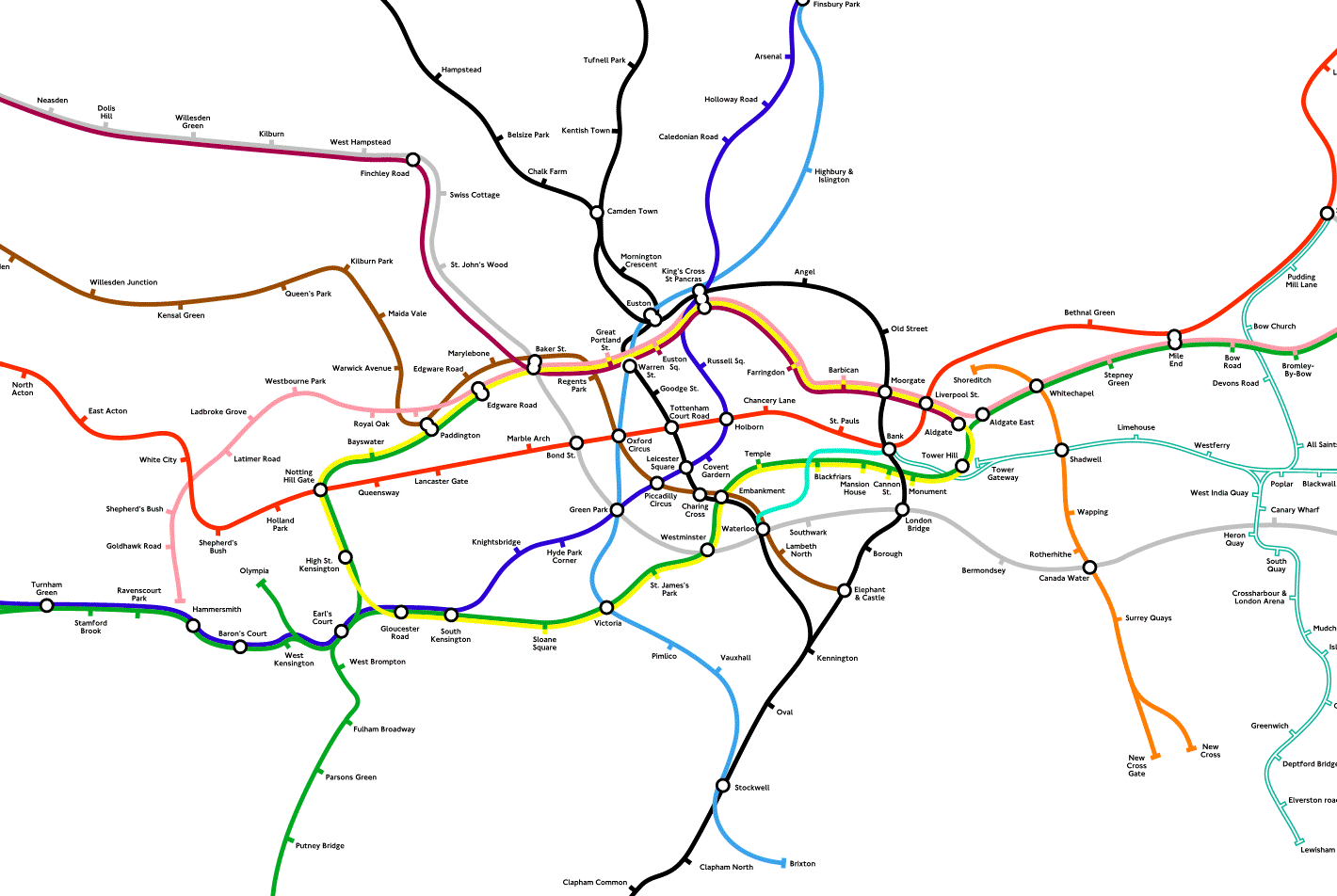
A familiar example that nicely illustrates my point  is the London Underground or Tube map. There is a fascinating website depicting the evolutionary history of this famous piece of graphic design. Early versions simply portrayed the railway lines inset into a normal geographical map which made them rather complicated, as the real layout of the lines is far from regular. A geographically accurate depiction of the modern tube network is shown here which makes the point:

geo_tubemap

A revolution occurred in 1933 when Harry Beck compiled the first “modern” version of the map. His great idea was to simplify the representation of the network around a single unifying feature. To this end he turned the Central Line (in red) into a straight line travelling left to right across the centre of the page, only changing direction at the extremities. All other lines were also distorted to run basically either North-South or East-West and produce a much more regular pattern, abandoning any attempt to represent the “real” geometry of the system but preserving its topology (i.e. its connectivity).  Here is an early version of his beautiful construction:

Note that although this a “modern” map in terms of how it represents the layout, it does look rather dated in terms of other design elements such as the border and typefaces used. We tend not to notice how much we surround the essential things with embellishments that date very quickly.

More modern versions of this map that you can get at tube stations and the like rather spoil the idea by introducing a kink in the central line to accommodate the complexity of the interchange between Bank and Monument stations as well as generally buggering about with the predominantly  rectilinear arrangement of the previous design:

I quite often use this map when I’m giving popular talks about physics. I think it illustrates quite nicely some of the philosophical issues related with theoretical representations of nature. I think of theories or models as being like maps, i.e. as attempts to make a useful representation of some  aspects of external reality. By useful, I mean the things we can use to make tests. However, there is a persistent tendency for some scientists to confuse the theory and the reality it is supposed to describe, especially a tendency to assert there is a one-to-one relationship between all elements of reality and the corresponding elements in the theoretical picture. This confusion was stated most succintly by the Polish scientist Alfred Korzybski in his memorable aphorism :

The map is not the territory.

I see this problem written particularly large with those physicists who persistently identify the landscape of string-theoretical possibilities with a multiverse of physically existing domains in which all these are realised. Of course, the Universe might be like that but it’s by no means clear to me that it has to be. I think we just don’t know what we’re doing well enough to know as much as we like to think we do.

A theory is also surrounded by a penumbra of non-testable elements, including those concepts that we use to translate the mathematical language of physics into everday words. We shouldn’t forget that many equations of physics have survived for a long time, but their interpretation has changed radically over the years.

The inevitable gap that lies between theory and reality does not mean that physics is a useless waste of time, it just means that its scope is limited. The Tube  map is not complete or accurate in all respects, but it’s excellent for what it was made for. Physics goes down the tubes when it loses sight of its key requirement, i.e. to be testable, and in order to be testable it has to be simple enough to calculate things to be compared with observations. In many cases that means a simplified model is perfectly adequete.

Another quote by George Box expands upon this point:

Remember that all models are wrong; the practical question is how wrong do they have to be to not be useful.

In any case, an attempt to make a grand unified theory of the London Underground system would no doubt produce a monstrous thing so unwieldly that it would be useless in practice. I think there’s a lesson there for string theorists too…

Many modern-day physicists are obsessed with the idea of a “Theory of Everything” (or TOE). Such a theory would entail the unification of all physical theories – all laws of Nature, if you like – into a single principle. An equally accurate description would then be available, in a single formula, of phenomena that are currently described by distinct theories with separate sets of parameters. Instead of textbooks on mechanics, quantum theory, gravity, electromagnetism, and so on, physics students would need just one book. But would such a theory somehow be  physical reality, as some physicists assert? I don’t think so. In fact it’s by no means clear to me that it would even be useful..

How to make a knotted vortex ring

Posted in The Universe and Stuff with tags , , , , on May 15, 2013 by telescoper

Not long ago I posted a short item about the physics of vortex rings. More recently I stumbled across this video that shows how University of Chicago physicists have succeeded in creating a vortex knot—a feat akin to tying a smoke ring into a knot. Linked and knotted vortex loops have existed in theory for more than a century, but creating them in the laboratory had previously eluded scientists. I stole that bit shamelessly from the blurb on Youtube, by the way. I’m not sure whether knotting a vortex tube has any practical applications, but then I don’t really care  much about that because it’s fun!

Hall and Knight (or `z + b + x = y + b + z’)

Posted in The Universe and Stuff with tags , , , , on May 14, 2013 by telescoper

This poem will be a bit of a puzzle to younger readers, so I’ll just explain that Messrs Hall & Knight mentioned in the poem were the authors of a famous textbook about algebra “Elementary Algebra for Schools” that first went into publication in the 19th Century (1885, I think) and is still in press over a century later. It’s a classic book, fully meriting a celebration in verse, even if it’s a bit tongue-in-cheek!

When he was young his cousins used to say of Mr Knight:
‘This boy will write an algebra – or looks as if he might.’
And sure enough, when Mr Knight had grown to be a man,
He purchased pen and paper and an inkpot, and began.

But he very soon discovered that he couldn’t write at all,
And his heart was filled with yearnings for a certain Mr Hall;
Till, after many years of doubt, he sent his friend a card:
‘Have tried to write an Algebra, but find it very hard.’

Now Mr Hall himself had tried to write a book for schools,
But suffered from a handicap: he didn’t know the rules.
So when he heard from Mr Knight and understood his gist,
He answered him by telegram: ‘Delighted to assist.’

So Mr Hall and Mr Knight they took a house together,
And they worked away at algebra in any kind of weather,
Determined not to give up until they had evolved
A problem so constructed that it never could be solved.

‘How hard it is’, said Mr Knight, ‘to hide the fact from youth
That x and y are equal: it is such an obvious truth!’
‘It is’, said Mr Hall, ‘but if we gave a b to each,
We’d put the problem well beyond our little victims’ reach.

‘Or are you anxious, Mr Knight, lest any boy should see
The utter superfluity of this repeated b?’
‘I scarcely fear it’, he replied, and scratched this grizzled head,
‘But perhaps it would be safer if to b we added z.’

‘A brilliant stroke!’, said Hall, and added z to either side;
Then looked at his accomplice with a flush of happy pride.
And Knight, he winked at Hall (a very pardonable lapse).
And they printed off the Algebra and sold it to the chaps.

by E. V. Rieu (1887-1972)