Archive for the The Universe and Stuff Category

A Flight Through the Universe

Posted in The Universe and Stuff with tags , , on August 15, 2012 by telescoper

Today I’m taking a flight back from Copenhagen to London, a flight through a very small part of the Universe, so it seems apt to put it in perspective by posting this nice video produced on behalf of the the Sloan Digital Sky Survey. I’ve even had the nerve to copy the blurb:

This animated flight through the universe was made by Miguel Aragon of Johns Hopkins University with Mark Subbarao of the Adler Planetarium and Alex Szalay of Johns Hopkins. There are close to 400,000 galaxies in the animation, with images of the actual galaxies in these positions (or in some cases their near cousins in type) derived from the Sloan Digital Sky Survey (SDSS) Data Release 7. Vast as this slice of the universe seems, its most distant reach is to redshift 0.1, corresponding to roughly 1.3 billion light years from Earth. SDSS Data Release 9 from the Baryon Oscillation Spectroscopic Survey (BOSS), led by Berkeley Lab scientists, includes spectroscopic data for well over half a million galaxies at redshifts up to 0.8 – roughly 7 billion light years distant – and over a hundred thousand quasars to redshift 3.0 and beyond.

Click here for more information about BOSS and the latest data release.

A blog by any other name..

Posted in The Universe and Stuff with tags , , , on August 8, 2012 by telescoper

While I’m online I thought I’d pass on the following gripe.

\begin{gripe}

Some months ago I saw a message going around on Twitter that the Guardian was looking for new science bloggers to cover a wide range of disciplines for its website. After thinking hard about it, I decided to submit an application basically so I could find out more about what was involved and see if I really wanted to do it. Anyway, I’ve already written a commissioned piece for the Guardian website, so I thought it was an idea worth pursuing.

My idea wasn’t to scrap In the Dark or move it all to the Guardian, but to post less frequent and more sciencey pieces there and keep this as a personal ego-trip blog. The advantage of that being that they pay, whereas this blog doesn’t make me any dosh at all, and also presumably generates significantly wider exposure. As well as making a pitch for the content of the proposed blog, I had to think of a new title if In the Dark was to carry on, so I came up with Across the Universe, which seemed to me to emphasize nicely the cosmological slant of the pieces I would be likely to write. It’s not a new coinage, of course. It’s based on a Beatles song I have posted about previously.

So I filed the application and waited. Then I was contacted by Alok Jha, who looks after the Science blog network at the Grauniad, who initially made encouraging noises, explained that there would be minimal editorial control and  I would keep copyright of anything I wrote for them, etc. Most of my questions having been answered I awaited further developments. Then Alok Jha contacted me again and explained that the editorial team wanted me to jump through several extra hoops if I wanted to take the idea forward. I sensed cold feet. For a number of reasons, the timing of these new phases of the process were also very inconvenient, so, after mulling it over, I contacted Alok Jha and politely withdrew my application.

I’ve no regrets about that decision, and thought no more about it, until last week when the Guardian started to roll out its new blogging team. I was delighted to see neuroscientist, comedian, and fellow Cardiff University chappie Dean Burnett among the bloggers. Their new blogger for matters astronomical is Stuart Clark, a well-known and respected science writer who I’m sure will cover a wide range of interesting topics (as he has already started to do).

What I’m peeved about, however, is that Stuart’s blog title is Across the Universe, exactly what I had suggested in my proposal! Coincidence? I asked Stuart via Twitter and he told me that the name was suggested to him by none other than Alok Jha.

Of course the title isn’t copyrighted by me, and wasn’t even original, but it was my suggestion and I do think it’s very poor form to have appropriated what was on my proposal without asking or giving acknowledgement. I’ve no complaints about Stuart Clark, of course. He didn’t know what had happened, and I wish him well with his new blog – which I shall certainly be reading. But I’m not at all chuffed about the way this was handled by the Guardian.

In the interests of full disclosure, I should point out Alok Jha recently contacted me to apologize and say that he had “forgotten” that Across the Universe was the title I gave on my proposal.

\end{gripe}

Anyway, the upshot of all this is that I’ll be keeping In the Dark going pretty much as it is for the foreseeable future.

Health willing.
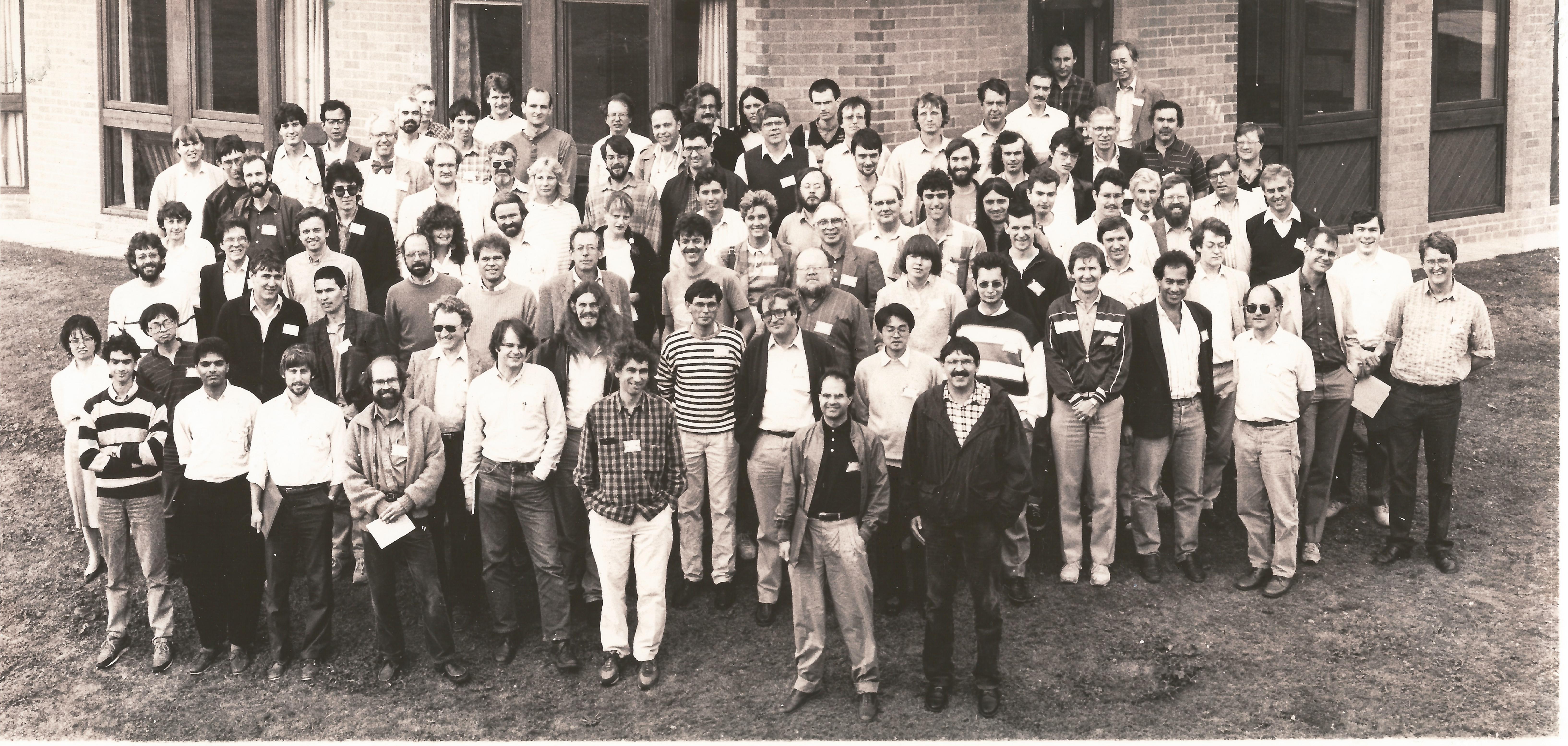
The Epoch of Galaxy Formation, Durham 1988.

Posted in Biographical, The Universe and Stuff with tags , , , on August 2, 2012 by telescoper

The previous old conference photograph I posted seemed to be quite popular, so I thought I’d try an even older vintage. This was also taken at Durham, but at a meeting entitled The Epoch of Galaxy Formation, which took place between July 18th and 22nd 1988. Appropriately enough, this one is in glorious monochrome. Spot any familiar faces?

The Low-down on the LHC Boson

Posted in Open Access, The Universe and Stuff with tags , , , , , , on August 2, 2012 by telescoper

Although it’s a little late I thought I’d just put up a brief post to draw your attention to the news that a couple of technical papers have appeared on the arXiv giving updated details of the recent discovery at the Large Hadron of a new scalar particle that could be the Higgs boson. I don’t think it’s yet absolutely proven that this is what the new particle is, which is why I’ve called it the “LHC boson” in the title.

The ATLAS paper reports the detection of a Higgs-like particle with a 5.9 sigma confidence level, up from the 5.0 sigma reported on July 4. Here’s the abstract:

A search for the Standard Model Higgs boson in proton-proton collisions with the ATLAS detector at the LHC is presented. The datasets used correspond to integrated luminosities of approximately 4.8 fb^-1 collected at sqrt(s) = 7 TeV in 2011 and 5.8 fb^-1 at sqrt(s) = 8 TeV in 2012. Individual searches in the channels H->ZZ^(*)->llll, H->gamma gamma and H->WW->e nu mu nu in the 8 TeV data are combined with previously published results of searches for H->ZZ^(*), WW^(*), bbbar and tau^+tau^- in the 7 TeV data and results from improved analyses of the H->ZZ^(*)->llll and H->gamma gamma channels in the 7 TeV data. Clear evidence for the production of a neutral boson with a measured mass of 126.0 +/- 0.4(stat) +/- 0.4(sys) GeV is presented. This observation, which has a significance of 5.9 standard deviations, corresponding to a background fluctuation probability of 1.7×10^-9, is compatible with the production and decay of the Standard Model Higgs boson.

The paper from CMS reinforces the discovery of a Higgs-like particle with a mass of 125 GeV at a 5-sigma level of confidence:

Results are presented from searches for the standard model Higgs boson in proton-proton collisions at sqrt(s)=7 and 8 TeV in the CMS experiment at the LHC, using data samples corresponding to integrated luminosities of up to 5.1 inverse femtobarns at 7 TeV and 5.3 inverse femtobarns at 8 TeV. The search is performed in five decay modes: gamma gamma, ZZ, WW, tau tau, and b b-bar. An excess of events is observed above the expected background, a local significance of 5.0 standard deviations, at a mass near 125 GeV, signalling the production of a new particle. The expected significance for a standard model Higgs boson of that mass is 5.8 standard deviations. The excess is most significant in the two decay modes with the best mass resolution, gamma gamma and ZZ; a fit to these signals gives a mass of 125.3 +/- 0.4 (stat.) +/- 0.5 (syst.) GeV. The decay to two photons indicates that the new particle is a boson with spin different from one.

I’ll refrain from commenting on the use of frequentist language in both these papers, but instead just comment that these extremely important papers are available for free on the arXiv. Open access, we call it.

PS. There’s an interesting blog post related to these papers, about citations in particle physics here.

Camera may have exposed a fossil…

Posted in The Universe and Stuff with tags , , , on August 1, 2012 by telescoper

Yesterday’s old photograph reminded me of this classic from Private Eye ages ago. It appeared originally in the Guardian (before it went all Helvetica). Sorry it’s a bit battered…

Observational Tests of Inflation, Durham 1990.

Posted in Biographical, The Universe and Stuff with tags , , , on July 31, 2012 by telescoper

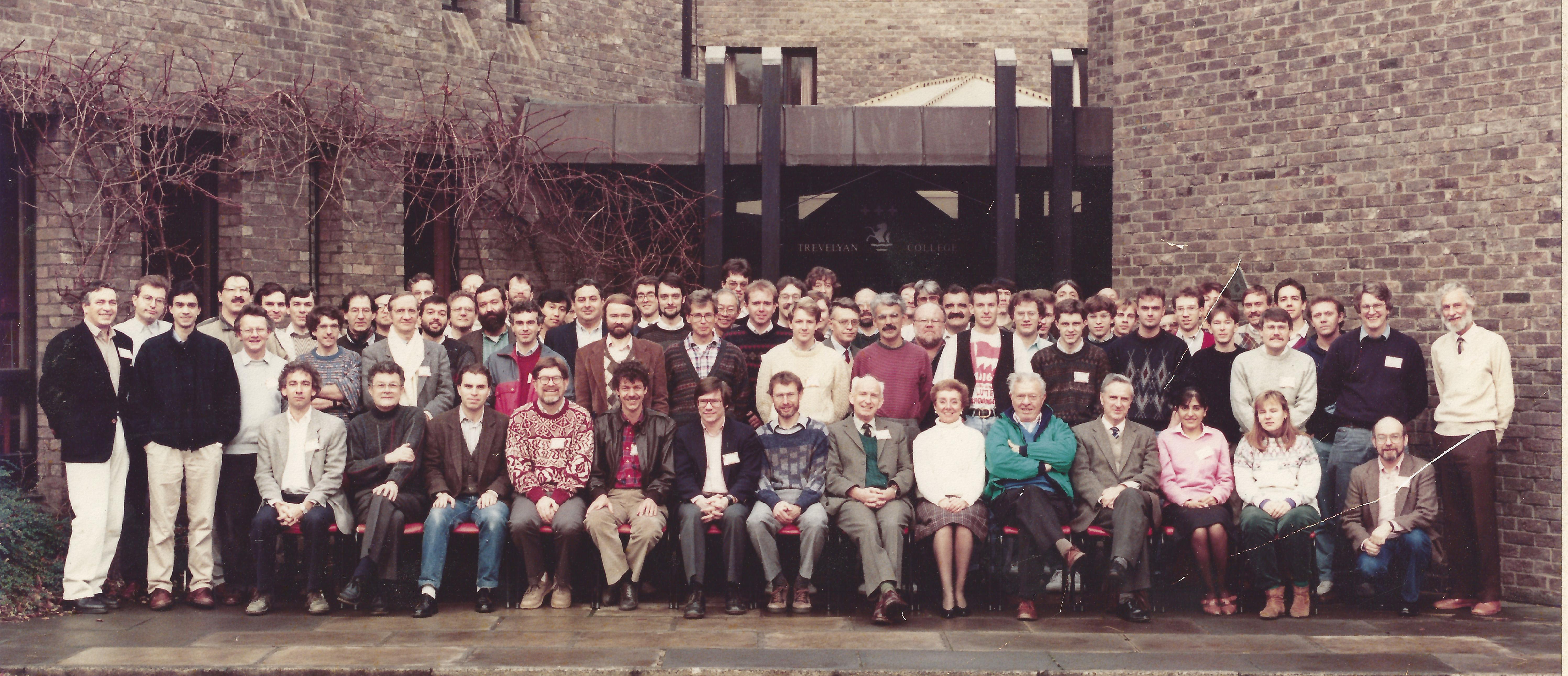
I came across this old picture in my office today and couldn’t resist posting it for nostalgia’s sake. It was taken at a NATO Advanced Research Workshop called Observational Tests of Inflation, which took placed in Durham in December 1990. You’ll probably need to click on the image to be able to recognize faces, but I should at least point out Sir Fred Hoyle in the turquoise jacket in the front row; I am behind in the red and white T-shirt and black waistcoat. In those days I was considered quite trendy, among cosmologists.

You can also see George Smoot, Simon White and Alan Guth sitting next to each other in the front row.

The Origins of the Expanding Universe

Posted in Books, Talks and Reviews, The Universe and Stuff with tags , , , , on July 30, 2012 by telescoper

Not having much time to write anything particularly original, I thought I’d use this blog to advertise a forthcoming centenary celebration which I hope to attend and speak at, if my recovery goes to plan.  The text below is taken from the conference website for a meeting due to take place at the Lowell Observatory in Flagstaff, Arizona from September 13-15. I’m sure they won’t mind me borrowing it, as it helps promote the event.  Registration is open until 10th August…

On September 17, 1912, Vesto Slipher obtained the first radial velocity of a “spiral nebula” – the Andromeda Galaxy. Using the 24-inch telescope at Lowell Observatory, he followed up with more Doppler shifts, and wrote a series of papers establishing that large velocities, usually in recession, are a general property of the spiral nebulae. Those early redshifts were recognized as remarkable by Slipher, and were critical to the discovery of what came eventually to be called the expanding Universe. Surprisingly, Slipher’s role in the story remains almost unknown to much of the astronomical community.

The nature, and especially the distance, of spiral nebulae was fiercely argued – most famously in the 1920 Shapley-Curtis debate. Hubble’s 1923 discovery of Cepheids in Andromeda, along with Henrietta Leavitt’s period-luminosity relation for Cepheids, led to a distance scale for the nebulae, enabling Lemaitre (1927) to derive a linear relation between velocity and distance (including a “Hubble constant” and, by 1931, a Primeval Atom theory).

Meanwhile, a new concept of space and time was formulated by Einstein, providing a new language in which to understand the large-scale Universe. By 1932, all the major actors had arrived on stage, and Universal expansion – the most general property of the Universe yet found – acquired a solid basis in observation and in the (relativistic) concept of space. “Space expands”… or does it? How did Lemaitre and Hubble interpret this concept? How do we interpret it? It continues to evolve today, with cosmic inflation and dark energy presenting new challenges still not fully assimilated.

This conference is in honor of Vesto Melvin Slipher and is timed to coincide with the 100th anniversary of the first measured Doppler shift in a Galaxy (then known as a Spiral-Nebula) on September 17, 1912:Slipher 1913 Lowell Obs 2, 56

We are bringing together astronomers and historians of science to explore the beginnings and trajectories of the subject, at the place where it began. 

Time Lapse

Posted in The Universe and Stuff with tags , on July 24, 2012 by telescoper

This has been doing the rounds for a week or so, but I’ve only just found it. It’s a time-lapse video made from still photographs taken by the crew of the International Space Station. I thought I’d share it here because it’s wonderful…


A Grand Design Challenge

Posted in Astrohype, The Universe and Stuff with tags , , , , , on July 20, 2012 by telescoper

While I’m incarcerated at home I thought I might as well make myself useful by passing on an interesting news item I found on the BBC website. This relates to a paper in the latest edition of Nature that reports the discovery of what appears to be a classic “Grand Design” spiral galaxy at a redshift of 2.18. According to the standard big bang cosmology this means that the light we are seeing set out from this object over 10 billion years ago, so the object formed about 3 billion years after the big bang.

I found this image of the object – known to its friends as BX442 – and was blown away by it..

..until I saw the dreaded words “artist’s rendering”. The actual image is somewhat less impressive.

But what’s really interesting about the study reported in Nature are the questions it asks about how this object first into our understanding of spiral galaxy formation. According to the prevailing paradigm, galaxies form hierarchically by progressively merging smaller clumps into bigger ones. The general expectation is that at high redshift – corresponding to earlier stages of the formation process – galaxies are rather clumpy and disturbed; the spiral structure we see in nearby galaxies is rather flimsy and easily disturbed, so it’s quite surprising to see this one. Does BX442 live in an especially quiet environment? Have we seen few high-redshift spirals because they are rare, or because they are hard to find? Answers to these and other questions will only be found by doing systematic surveys to establish the frequency and distribution of objects like this, as well as the details of their internal kinematics.

Quite Interesting.

Blowing Smoke

Posted in Education, The Universe and Stuff with tags , , , , on July 18, 2012 by telescoper

I’ve been trying to make myself useful over the last few days thinking about the new module I’m supposed to start teaching in October. I’m a bit daunted by it to be honest. The title is The Physics of Fields and Flows and it will be taken by students when they return to start their second year after the summer break.  It’s twice the size of our usual modules, which means a lot of teaching and it’s all new for me, which means a lot of preparation.

The idea behind introducing this module was to teach a number of things together which previously had been taught in separate modules, specifically electromagnetism and vector calculus, or not at all, e.g. fluid mechanics. I’m not sure when or why classical fluid mechanics dropped out the syllabus, but I think it’s an essential part of a physics curriculum in its own right and also helps develop a physical understanding of the mathematics used to describe electric and magnetic fields. It’s one of the unhappy side-effects of modular teaching that it hides the important underlying connections between apparently disparate phenomena which are the essence of what physics is about.

Another thing I reckon we don’t do enough of these days is use lecture demonstrations. That’s harder to do these days because we tend to use pooled lecture theatres that don’t have the specialist equipment that they might have if they were dedicated to physics lectures only.  Practical demonstrations are now usually given second-hand, by using video clips.  That’s fine, but not as good as the real thing.

Anyway, it struck me that it would be quite easy to arrange a demonstration of the transition between laminar and turbulent flow using the simple and relatively inexpensive equipment shown in the rather beautiful image. Unfortunately, however, demonstrating this sort of thing isn’t allowed on University premises even for scientific purposes…