Archive for the The Universe and Stuff Category

To “boldly” go…

Posted in Biographical, The Universe and Stuff with tags , , , on July 15, 2012 by telescoper

I thought anyone reading my rather gloomy recent posts could probably do with a laugh so I thought I’d put this up. It’s something I posted a while ago, in fact, but the video links on that have long since evaporated; a newer version appeared recently on Youtube so I thought I’d update it and re-post the piece.

This clip contains a short item  I did about twelve years ago for the BBC series Space, which was presented by Sam Neill. It was subsequently screened outside the UK with an alternative title, Universe. Originally we were going to demonstrate wormholes using a snooker table, clever editing and reversed video. However, the producer, Jeremy,  decided that wouldn’t look spectacular enough so instead we went to St Anton in Austria: I was flown over the Alps in a helicopter and then driven through the Arlberg tunnel in an impressively fast car. Well worth the cost to license fee payers, I’m sure, even if the three-day trip to Austria by me and a crew of six as well as the hire of the helicopter ended up as a mere three minutes of screen time…

The episode I was in, the last of 6 in the series, was called To Boldly Go. I remember suggesting to the producer that the only way to travel faster than light in the manner required was with a split infinitive drive, but they didn’t use that in the final script.

The segment I’m in starts at about 18:00 on the video. Notice how, in the helicopter sequence, I give the appearance of being completely terrified. A fine piece of acting by me, I thought. *Cough*

The item is daft, I know, and I don’t really believe any of that stuff about wormholes, but it was great fun doing it and I have to say the camera guys took some amazing footage of the mountains from the helicopter.

P.S. The next sequence, after mine, explains how the Anglo-Australian 2dF Galaxy Redshift Survey was done in order to provide a map for future generations of intergalactic space travellers. Really?

Student Comments

Posted in Biographical, Education, The Universe and Stuff with tags , , , , , on July 14, 2012 by telescoper

I sneaked into the department this morning to pick up some things from the office and leave some other things that I’ve finished with. I went quite early, to avoid the Saturday crowds there and back.

One of the things I found in my pigeonhole was a packet of student questionnaires about the third-year module Nuclear and Particle Physics for which I was responsible. It seems like a decade since I finished teaching it and marked the exams, but it can only be a couple of months. I was dreading reading the responses this time because I know I struggled a bit with this module, partly because it’s the first time I taught the Nuclear Physics part and partly for other reasons I won’t go into.

In fact the students were very kind and gave me quite good reviews; the only score that let me down really was that they thought the material was rather difficult. I’m not really surprised by that, because I think it is. However, as I’ve said before, I don’t think it’s a physics lecturer’s job to pretend that the subject  is easy; it is  a lecturer’s job to try to convince students that they can do things that are difficult. I don’t mean making  things difficult just for the sake of it, but trying to get the message across that a brain is made for thinking with and figuring difficult things out can be intensely rewarding.

The main criticism that students wrote in the space provided for their own comments was that they didn’t like the fact that I used powerpoint for some lectures. Actually, I don’t like using powerpoint for lectures either, but unfortunately I had no choice on some occasions. First I had a rather large class (85 students) and one of the rooms I had to use had a very small whiteboard; I was worried about its visibility from the back and the need to keep cleaning it every five minutes. Also in that room the projector screen covers the same area as the whiteboard, so it’s a pain to keep changing between powerpoint and whiteboard. Anyway, it’s a fair criticism. I’ll try to work out a better way of doing it next year.

To be perfectly honest I don’t like whiteboards much either. Call me old-fashioned, but  chalkboards are much better. Received wisdom, however, is that we have to have whiteboards, with all the ludicrous cost and environmental unfriendliness of the accompanying dry-wipe marker pens. But I digress.

Anyway, next Wednesday afternoon will see our graduation ceremony. Graduation day always reminds me of something somebody told me years ago when I attended my first one, at Queen Mary (and Westfield College, as it was then).  The essence of the comment was that what you have to remember as a lecturer is that when the students do well it’s their achievement; but when they don’t it’s your fault. Life’s like that, it’s never as symmetrical as particle physics.

Many of the students who took  Nuclear and Particle Physics will be graduating on Wednesday. I’m distraught that I won’t be able to go myself; this will be the first ceremony I’ve missed since I moved here five years ago.  If any of the graduating Physics class from Cardiff University happens to read this, I really hope you have a great day on Wednesday. I wish I could be there to shake your hand and wish you a very fond goodbye, but sadly that’s just not possible on this occasion.

Nevaeh ot Yawriats

Posted in Bad Statistics, Music, The Universe and Stuff with tags , , , on July 12, 2012 by telescoper

I just remembered hearing this a while ago at a public talk given by Simon Singh. I guess many of you will have come across it before, but there’s no harm in repeating it. I don’t know why it popped into my head at this particular moment, but perhaps it’s because I’ve been reading some stuff about how my colleagues in gravitational wave research use templates to try to detect specific patterns in noisy data. The method involves cross-correlating a simulated signal against the data until a match is obtained; the problem is often how to assess the probability of  a “chance” coincidence correctly and thus avoid spurious detections. The following might perhaps be a useful warning that unless you do this carefully, you only get out what you put in!

This is an excerpt from the classic  track Stairway to Heaven, by the popular beat combo Led Zeppelin, played backwards. I suggest that you listen to it once without looking at the words on the video, and then again with the words in front of you. If you haven’t heard/seen  it before, I think you’ll find it surprising…

Of course the proper way to interpret (or dismiss) matches like this is to use tools based on  Bayesian inference….

Dr Dee

Posted in History, Music, Opera, The Universe and Stuff with tags , , , , , on July 10, 2012 by telescoper

Last Friday evening, after my afternoon shift at the Royal Society Summer Exhibition, I took the chance to go and see something a bit different, in the shape of English National Opera’s production of  Dr Dee at the Coliseum. I hadn’t really known what to expect of this beforehand, actually, but needed to find a bit of distraction in London and was fortunately able to persuade my lovely friends Joao and Kim to come with me to try it out.

Dr Dee is based on the life of John Dee, the famous Elizabethan mathematician, astrologer, courtier, and spymaster. Written by Mr Damon Albarn, former lead singer of the popular beat combo Blur, it’s not exactly an opera but more of a renaissance-style pageant depicting the life of this mysterious character in a series of dramatic tableaux. Not being at all naturalistic in style it would have been quite difficult to follow what was going on without the programme notes, but each episode was brilliantly realised with dramatic staging, dancing and stunning visual effects. Rufus Norris was responsible for the overall direction of the piece. Hat’s off to him. I wasn’t really expecting the music to be so interesting, either; mixing pop vocals with orchestral music from the period could have been awful, but actually I warmed to it very quickly.

An influential polymath, Dee was, for a time, a trusted confidante of Elizabeth I and he was recruited by Sir Francis Walsingham to set up a network of informants and decipher Catholic codes in the build-up to the attempted invasion of England by the Spanish Armada. Dee is also purported to be the inspiration behind Prospero in Shakespeare’s The Tempest. What’s particularly interesting about him from an historical perspective is that lies at the crossroads between magic and science. A gifted mathematician, Dee developed an obsession for the occult after meeting a very dodgy character called Edward Kelly, who persuaded Dee that he could talk to angels in their own language with the help of a crystal ball, a technique known as scrying. Dee eventually went mad and was alienated not only from Elizabethan society but also from his own family. Had he lived at a slightly different time, he could well have ended up burned as a heretic. His story reminds us that the distinction between rationality and irrationality has not always been so clear. Alchemy and the occult could co-exist in many great minds alongside mathematics and empirical study so it should not surprise us that science and pseudoscience both seem able to thrive in modern culture.

The run of Dr Dee at ENO has now ended, but I’m definitely glad I plucked up the courage to go and see it. It’s a truly imaginative work and produced a memorable theatrical experience.

The Higgs? A Definite Maybe..

Posted in The Universe and Stuff with tags , , , , , , on July 4, 2012 by telescoper

This is really something for expert particle physicists to blog about, but I couldn’t resist saying something about this morning’s dramatic physics news.

Well, after yesterday’s preview here is the actual press release from CERN:

Geneva, 4 July 2012. At a seminar held at CERN1 today as a curtain raiser to the year’s major particle physics conference, ICHEP2012 in Melbourne, the ATLAS and CMS experiments presented their latest preliminary results in the search for the long sought Higgs particle. Both experiments observe a new particle in the mass region around 125-126 GeV.

“We observe in our data clear signs of a new particle, at the level of 5 sigma, in the mass region around 126 GeV. The outstanding performance of the LHC and ATLAS and the huge efforts of many people have brought us to this exciting stage,” said ATLAS experiment spokesperson Fabiola Gianotti, “but a little more time is needed to prepare these results for publication.”

“The results are preliminary but the 5 sigma signal at around 125 GeV we’re seeing is dramatic. This is indeed a new particle. We know it must be a boson and it’s the heaviest boson ever found,” said CMS experiment spokesperson Joe Incandela. “The implications are very significant and it is precisely for this reason that we must be extremely diligent in all of our studies and cross-checks.”

“It’s hard not to get excited by these results,” said CERN Research Director Sergio Bertolucci. “ We stated last year that in 2012 we would either find a new Higgs-like particle or exclude the existence of the Standard Model Higgs. With all the necessary caution, it looks to me that we are at a branching point: the observation of this new particle indicates the path for the future towards a more detailed understanding of what we’re seeing in the data.”

The results presented today are labelled preliminary. They are based on data collected in 2011 and 2012, with the 2012 data still under analysis.  Publication of the analyses shown today is expected around the end of July. A more complete picture of today’s observations will emerge later this year after the LHC provides the experiments with more data.

The next step will be to determine the precise nature of the particle and its significance for our understanding of the universe. Are its properties as expected for the long-sought Higgs boson, the final missing ingredient in the Standard Model of particle physics? Or is it something more exotic? The Standard Model describes the fundamental particles from which we, and every visible thing in the universe, are made, and the forces acting between them. All the matter that we can see, however, appears to be no more than about 4% of the total. A more exotic version of the Higgs particle could be a bridge to understanding the 96% of the universe that remains obscure.

“We have reached a milestone in our understanding of nature,” said CERN Director General Rolf Heuer. “The discovery of a particle consistent with the Higgs boson opens the way to more detailed studies, requiring larger statistics, which will pin down the new particle’s properties, and is likely to shed light on other mysteries of our universe.”

Positive identification of the new particle’s characteristics will take considerable time and data. But whatever form the Higgs particle takes, our knowledge of the fundamental structure of matter is about to take a major step forward.

There’s a hive of internet activity related to this announcement, and I can’t possibly link to all the excellent expert commentary going on, but for details you can do no better that Sean Carroll’s live blog from Geneva or the Guardian’s live blog.

In a nutshell, there’s definitely something in both CMS and Atlas data which, if it really is a new particle,  is definitely a boson and which weighs in around 125 GeV. The two-photon decays are consistent with what a standard model Higgs boson would be expected to produce, for example. The consistency between the two experiments is very compelling.

The overall level of significance is around 5σ. I’ll refrain from making churlish comments about the frequentist language and just say that the LHC certainly seems to have detected something that could definitely be the Higgs. This is genuinely exciting because it has come more quickly than most people expected. That’s a tribute to the LHC teams, I’d say.

However, it isn’t yet proven that the Higgs what this particle is. If it’s a new particle that’s not the Higgs that could be even more interesting. To establish the identity of the particle that has been discovered will require a lot more work,  looking at much more detailed aspects of its behaviour as revealed by collision data. But it’s certainly possible that it is the Higgs, and I venture to suggest that’s what most particle physicists think it is.

So a discovery. A palpable discovery. Now comes the exploration…

Higgs Preview

Posted in Science Politics, The Universe and Stuff with tags , , , , , , on July 3, 2012 by telescoper

I’m a bit slow to post anything about the ongoing bout of Higgs-steria that’s been engulfing the interwebs in recent days. Even Andy Lawrence got there ahead of me.  What’s caused all the commotion is an announcement about an announcement from CERN at a special seminar tomorrow (Wednesday 4th July) at 9am CEST, which is 8am British “Summer” Time.  Here’s a bit of the press release:

CERN will hold a scientific seminar at 9:00 CEST on 4 July to deliver the latest update in the search for the Higgs boson. At this seminar, coming on the eve of this year’s major particle physics conference, ICHEP, in Melbourne, the ATLAS and CMS experiments will deliver the preliminary results of their 2012 data analysis.

“Data taking for ICHEP concluded on Monday 18 June after a very successful first period of LHC running in 2012,” said CERN’s Director for Accelerators and Technology, Steve Myers. “I’m very much looking forward to seeing what the data reveals.”

The 2012 LHC run schedule was designed to deliver the maximum possible quantity of data to the experiments before the ICHEP conference, and with more data delivered between April and June 2012 than in the whole 2011 run, the strategy has been a success. Furthermore, the experiments have been refining their analysis techniques to improve their efficiency in picking out Higgs-like events from the millions of collisions occurring every second. This means that their sensitivity to new phenomena has significantly increased for both years’ data sets.  The crunching of all this data has been done by the Worldwide LHC Computing Grid, which has exceeded its design specifications to handle the unprecedented volume of data and computing.

“We now have more than double the data we had last year,” said CERN Director for Research and Computing, Sergio Bertolucci, “that should be enough to see whether the trends we were seeing in the 2011 data are still there, or whether they’ve gone away. It’s a very exciting time.”

I won’t try to repeat what’s been said better and more authoritatively elsewhere; a nice collection of video material at the STFC website and a piece by Sean Carroll (also here) are worth mentioning if you’re not up on why the Higgs Boson is so important.

I wrote  a rather facetious post about the last episode of Higgs-mania way back in December because I found the actual announcement to be a bit of a damp squib and the associated hype rather irritating. This time there are even more rumours flying around – not to everyone’s approval – but it’s obviously best to wait and see what is actually announced rather than comment on them.

The main question in my mind is whether it’s sufficiently interesting to get up in time to watch the seminar 8am tomorrow morning…

Brian Cox is 44.

Herschel at the Royal Society

Posted in The Universe and Stuff with tags , , , on July 2, 2012 by telescoper

I found this nice little video about the forthcoming Royal Society Summer Science Exhibition which opens tomorrow at the Royal Society’s premises in Carlton House Terrace in London.

Astronomers from Cardiff University are heavily involved in one of the exhibits related to the Herschel Telescope – To infrared and beyondI’m actually doing a couple of shifts on the Herschel stand myself, on  Thursday and Friday afternoons, as well as during a posh black tie  “soirée” on Thursday evening. Last time I attended such an event (in 2009) was during a heat wave, which made the soirée an uncomfortably sticky experience, but the forecast suggests the weather might be a bit different this time round…

R.I.P. Prof. John G. Taylor

Posted in The Universe and Stuff with tags , , , , , , , on June 27, 2012 by telescoper

I just received an email from Ian Ridpath pointing out that Professor John G. Taylor had died back in March 2012. The news had passed me by, and I’m quite surprised that there’s very little about this news on the internet with the exception of a brief announcement from the Department of Mathematics at King’s College London:

The Department is very sorry to announce the death of Professor John G. Taylor (JGT) on 10th March. John Taylor was appointed to the established Chair in Applied Mathematics at King’s College London in 1971. His research interests were wide, ranging over high energy physics, superstrings, quantum field theory and quantum gravity, neural computation, neural bases of behaviour and mathematical modelling in neurobiology. He was formidably energetic and remained actively engaged in research until his death.

His name came up on a post of mine a while ago of which the following is an excerpt.

In the 1970s, when Uri Geller was at the height of his popularity,  Professor Taylor took great interest in him and the things that he appeared to be able to do. Professor of applied mathematics at King’s College, London, Taylor was (and remains) a very distinguished scientist and was the first to take the paranormal phenomena displayed by Geller seriously. When Uri Geller visited Britain in 1974, Taylor conducted scientific tests of Geller’s feats of metal bending using all the paraphernalia of modern science, including a Geiger counter. Taylor also experimented with some of the children and adults who claimed to manifest psychic abilities after seeing Uri Geller’s appearances on British television programs. Taylor’s interest in such phenomena was not only in its scientific validation, but also in investigation of the way in which such phenomena take place and the nature of the forces involved. He suggested the phenomena may be some low-frequency electromagnetic effect generated by human beings.

Through the 1970s Taylor was regarded as fully endorsing the paranormal metal bending of Uri Geller, but gradually has made more guarded statements; then in 1980 he largely retracted his support for Geller’s paranormal talents. In 1974 he wrote

The Geller effect—of metal-bending—is clearly not brought about by fraud. It is so exceptional it presents a crucial challenge to modern science and could even destroy the latter if no explanation became available.

Taylor then spent three years of careful investigation of such phenomena as psychokinesis, metal bending, and dowsing, but could not discover any reasonable scientific explanation or validation that satisfied him. He was particularly concerned to establish whether there is an electromagnetic basis for such phenomena. After failing to find this he did not believe that there was any other explanation that would suffice. Most of his experiments under laboratory conditions were negative; this left him in a skeptical position regarding the validity of claimed phenomena.

In contrast to the endorsement in his first book, Superminds, he published a paper expressing his doubts in a paper in Nature (November 2, 1978) titled “Can Electromagnetism Account for Extra-sensory Phenomena?” He followed this with his book Science and the Supernatural (1980) in which he expressed complete skepticism about every aspect of the paranormal. In his final chapter he stated:

We have searched for the supernatural and not found it. In the main, only poor experimentation [including his own], shoddy theory, and human gullibility have been encountered.

Taylor’s investigation of the Geller effect is interesting because it shows that physics doesn’t have all the answers all the time, particularly not when the phenomena in question involve people. Physics research proceeds by assuming that Nature is not playing tricks, and that what can be measured must represent some sort of truth. This faith can be easily exploited by a charlatan. James Randi always argued that scientists aren’t the right people to detect tricks performed by people. This is best left to tricksters. There’s no reason to believe that a theoretical physicist – no matter how brilliant – can spot the way a clever deception is carried out. The best person to see that is a magician, someone like James Randi. Set a thief to catch a thief, and all that.

Clusters, Splines and Peer Review

Posted in Bad Statistics, Open Access, The Universe and Stuff with tags , , , , , on June 26, 2012 by telescoper

Time for a grumpy early morning post while I drink my tea.

There’s an interesting post on the New Scientist blog site by that young chap Andrew Pontzen who works at Oxford University (in the Midlands). It’s on a topic that’s very pertinent to the ongoing debate about Open Access. One of the points the academic publishing lobby always makes is that Peer Review is essential to assure the quality of research. The publishers also often try to claim that they actually do Peer Review, which they don’t. That’s usual done, for free, by academics.

But the point Andrew makes is that we should also think about whether the form of Peer Review that journals undertake is any good anyway.  Currently we submit our paper to a journal, the editors of which select one (or perhaps two or three) referees to decide whether it merits publication. We then wait – often many months – for a report and a decision by the Editorial Board.

But there’s also a free online repository called the arXiv which all astrophysics papers eventually appear on. Some researchers like to wait for the paper to be refereed and accepted before putting it on the arXiv, while others, myself included, just put it on the arXiv straight away when we submit it to the journal. In most cases one gets prompter and more helpful comments by email from people who read the paper on arXiv than from the referee(s).

Andrew questions why we trust the reviewing of a paper to one or two individuals chosen by the journal when the whole community could do the job quicker and better. I made essentially the same point in a post a few years ago:

I’m not saying the arXiv is perfect but, unlike traditional journals, it is, in my field anyway, indispensable. A little more investment, adding a comment facilities or a rating system along the lines of, e.g. reddit, and it would be better than anything we get academic publishers at a fraction of the cost. Reddit, in case you don’t know the site, allows readers to vote articles up or down according to their reaction to it. Restrict voting to registered users only and you have the core of a peer review system that involves en entire community rather than relying on the whim of one or two referees. Citations provide another measure in the longer term. Nowadays astronomical papers attract citations on the arXiv even before they appear in journals, but it still takes time for new research to incorporate older ideas.

In any case I don’t think the current system of Peer Review provides the Gold Standard that publishers claim it does. It’s probably a bit harsh to single out one example, but then I said I was feeling grumpy, so here’s something from a paper that we’ve been discussing recently in the cosmology group at Cardiff. The paper is by Gonzalez et al. and is called IDCS J1426.5+3508: Cosmological implications of a massive, strong lensing cluster at Z = 1.75. The abstract reads

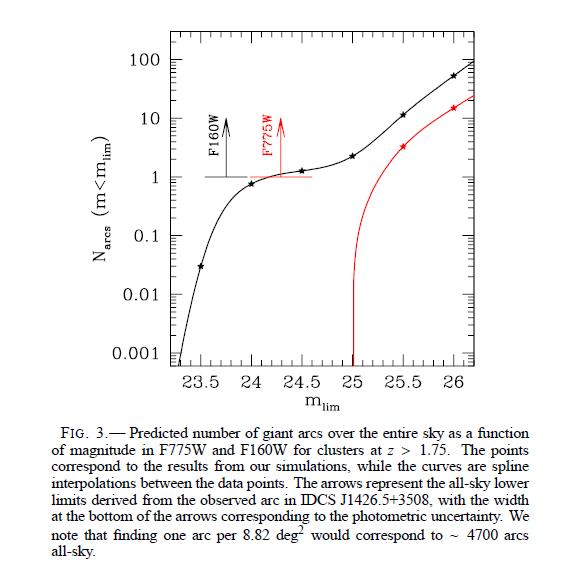
The galaxy cluster IDCS J1426.5+3508 at z = 1.75 is the most massive galaxy cluster yet discovered at z > 1.4 and the first cluster at this epoch for which the Sunyaev-Zel’Dovich effect has been observed. In this paper we report on the discovery with HST imaging of a giant arc associated with this cluster. The curvature of the arc suggests that the lensing mass is nearly coincident with the brightest cluster galaxy, and the color is consistent with the arc being a star-forming galaxy. We compare the constraint on M200 based upon strong lensing with Sunyaev-Zel’Dovich results, finding that the two are consistent if the redshift of the arc is  z > 3. Finally, we explore the cosmological implications of this system, considering the likelihood of the existence of a strongly lensing galaxy cluster at this epoch in an LCDM universe. While the existence of the cluster itself can potentially be accomodated if one considers the entire volume covered at this redshift by all current high-redshift cluster surveys, the existence of this strongly lensed galaxy greatly exacerbates the long-standing giant arc problem. For standard LCDM structure formation and observed background field galaxy counts this lens system should not exist. Specifically, there should be no giant arcs in the entire sky as bright in F814W as the observed arc for clusters at  z \geq 1.75, and only \sim 0.3 as bright in F160W as the observed arc. If we relax the redshift constraint to consider all clusters at z \geq 1.5, the expected number of giant arcs rises to \sim 15 in F160W, but the number of giant arcs of this brightness in F814W remains zero. These arc statistic results are independent of the mass of IDCS J1426.5+3508. We consider possible explanations for this discrepancy.

Interesting stuff indeed. The paper has been accepted for publication by the Astrophysical Journal too.

Now look at the key result, Figure 3:

I’ll leave aside the fact that there aren’t any error bars on the points, and instead draw your attention to the phrase “The curves are spline interpolations between the data points”. For the red curve only two “data points” are shown; actually the points are from simulations, so aren’t strictly data, but that’s not the point. I would have expected an alert referee to ask for all the points needed to form the curve to be shown, and it takes more than two points to make a spline.  Without the other point(s) – hopefully there is at least one more! – the reader can’t reproduce the analysis, which is what the scientific method requires, especially when a paper makes such a strong claim as this.

I’m guessing that the third point is at zero (which is at – ∞ on the log scale shown in the graph), but surely that must have an error bar on it, deriving from the limited simulation size?

If this paper had been put on a system like the one I discussed above, I think this would have been raised…

A Return to O-levels?

Posted in Education, The Universe and Stuff with tags , , , , , , , on June 21, 2012 by telescoper

I woke up this morning as usual to the 7am news on BBC Radio 3, which included an item about how Education Secretary Michael Gove is planning to scrap the current system of GCSE Examinations and replace them with something more like the old GCE O-levels, which oldies like me took way back in the mists of time.

There is a particular angle to this in Wales, because Michael Gove doesn’t have responsibility for education here. That falls to the devolved Welsh Government, and in particular to Leighton Andrews. He’s made it quite clear on Twitter that he has no intention to take  Wales  back to O-levels. Most UK media sources – predominantly based in London – seem to have forgotten that Gove speaks for England, not for the whole United Kingdom.

This is not the central issue, however. The question is whether GCSEs are, as Michael Gove claims, “so bad that they’re beyond repair”. Politicians, teachers and educationalists are basically saying that students are doing better; others are saying that the exams are easier. It’s a shouting match that has been going for years and which achieves very little. I can’t add much to it either, because I’m too old to have done GCSEs – they hadn’t been invented then. I did O-levels.

It does, however, give me the excuse to show you  the O-level physics paper I took way back in 1979. I’ve actually posted this before, but it seems topical to put it up again:

You might want to compare this with a recent example of an Edexcel GCSE (Multiple-choice) Physics paper, about which I have also posted previously.

I think most of the questions in the GCSE paper are much easier than the O-level paper above. Worse, there are many that are so sloppily put together that they  don’t make any sense at all. Take Question 1:

I suppose the answer is meant to be C, but since it doesn’t say that A is the orbit of a planet, as far as I’m concerned it might just as well be D. Are we meant to eliminate D simply because it doesn’t have another orbit going through it?

On the other hand, the orbit of a moon around the Sun is in fact similar to the orbit of its planet around the Sun, since the orbital speed and radius of the moon around its planet are smaller than those of the planet around the Sun. At a push, therefore you could argue that A is the closest choice to a moon’s orbit around the Sun. The real thing would be something close to a circle with a 4-week wobble variation superposed.

You might say I’m being pedantic, but the whole point of exam questions is that they shouldn’t be open to ambiguities like this, at least if they’re science exams. I can imagine bright and knowledgeable students getting thoroughly confused by this question, and many of the others on the paper.

Here’s a couple more, from the “Advanced” section:
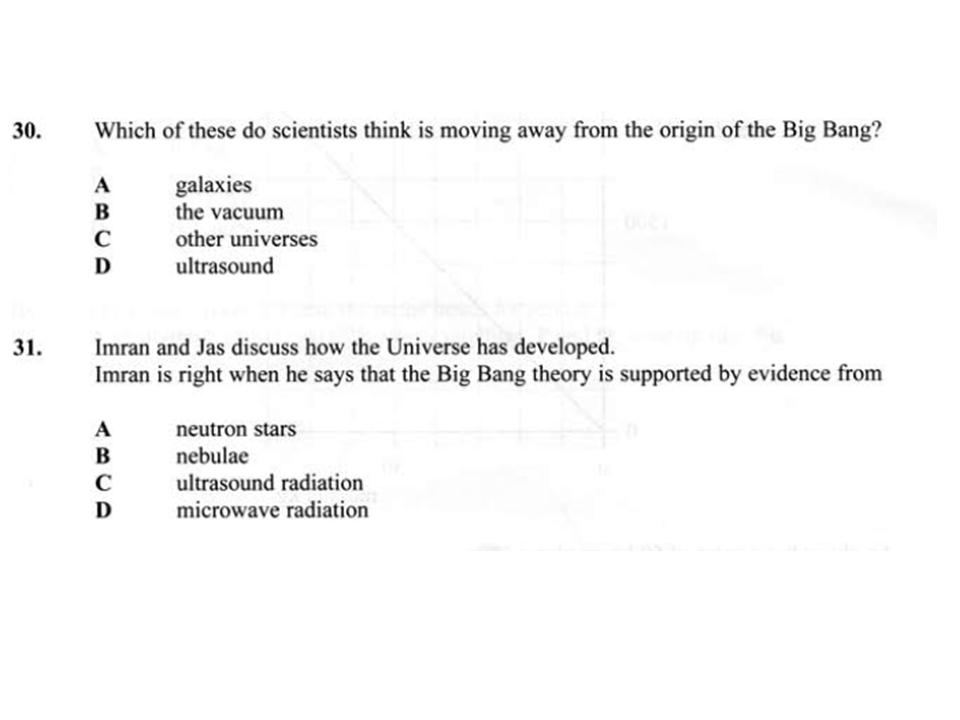
The answer to Q30 is, presumably, A. But do any scientists really think that galaxies are “moving away from the origin of the Big Bang”?  I’m worried that this implies that the Big Bang was located at a specific point. Is that what they’re teaching?

Bearing in mind that only one answer is supposed to be right, the answer to Q31 is presumably D. But is there really no evidence from “nebulae” that supports the Big Bang theory? The expansion of the Universe was discovered by observing things Hubble called “nebulae”..

I’m all in favour of school students being introduced to fundamental things such as cosmology and particle physics, but my deep worry is that this is being done at the expense of learning any real physics at all and is in any case done in a garbled and nonsensical way.

Lest I be accused of an astronomy-related bias, anyone care to try finding a correct answer to this question?
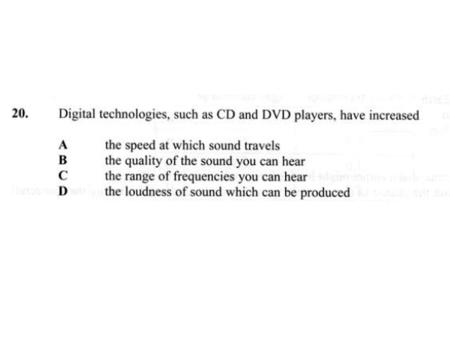
The more of this kind of stuff I see, the more admiration I have for the students coming to study physics and astronomy at University. How they managed to learn anything at all given the dire state of science education represented by this paper is really quite remarkable.

Ultimately, however, the issue is not whether we have GCSEs or O-level examinations. There’s already far too much emphasis in the education system on assessment instead of   learning. That runs all the way through schools and into the university system. The excessive time we spend examining students reduces what we can teach them and turns the students’ learning experience into something resembling a treadmill. I agree that we need better examinations than we have now, but we also need   fewer. And we need to stop being obsessed by them.