Archive for the The Universe and Stuff Category

Nam et ipsa scientia potestas est

Posted in Biographical, Cricket, The Universe and Stuff with tags , on April 17, 2011 by telescoper

Well, dear readers, I’ve had a lovely day of gardening and watching cricket; the former hacking down the dead half a Forsythia this morning, the latter watching Glamorgan gain their first win of the Championship season by beating Gloucestershire in fine style here in Cardiff. I also managed to catch a bit of the sun, which has left me a bit woozy. I’ll have to buy myself a hat to wear on days like this. With fair skin and blue eyes, I don’t tan – I stroke.

Anyway, tomorrow morning I’ll be heading off up to the fine seaside resort of Llandudno in North Wales for this years National Astronomy Meeting (NAM for short). It starts this evening, in fact, with a wine reception and other festivities, but unfortunately the journey by train from Cardiff takes absolutely ages on a Sunday, so I decided to eschew the delights of the first evening and travel up tomorrow morning. On a weekday it only takes 5 hours from Cardiff to Llandudno….

I’ll probably miss most, and possibly all, of tomorrow’s talks but should get there in good time for the out-of-town meeting of the RAS Dining Club which will be held in the St George’s Hotel in Llandudno and to which a number of illustrious guests have been invited. On Tuesday morning there’s the session I organised on astrostatistics, which I am looking forward to chairing, and then the conference dinner in the evening. The following day I’m chairing a session on astroparticle physics too. There’s no rest for the wicked. Most of the rest of the time I’ll probably be at the numerous cosmology or extragalactic astronomy sessions or, more likely, in the bar. If the weather stays like this, however, I might wander along the beach and, rolling my trousers up and donning a knotted handkerchief, go for a paddle in the sea.

I’m told there will be wireless connectivity in Llandudno throughout NAM 2011 so I hope to post a few brief blogettes about interesting events, but possibly not tomorrow as I might not have time. The excellent RAS Press Office will no doubt be hard at it for the duration, so watch out for a stream of press releases. I’m not sure whether the mass media will be bothered to get off their backsides and travel all that way from their London offices, so we’ll just have to see how much gets onto the main news.

I’m not particularly looking forward to the journey by the slow train tomorrow, but am definitely looking forward to the change of scenery and to catch up not only with the astronomy but also with some old friends.

If anyone I’ve never actually met before who reads this blog is there, do please say hello! You’ll find I’m quite a friendly chap, really…

P.S. The latin quotation I used in the title here isn’t really relevant. I just picked it because it starts with the word “NAM”. If you’re interested, however, it’s by Francis Bacon and it means, roughly speaking, “knowledge is power”.


Share/Bookmark

A Discovery At the Tevatron! – Maybe (via Collider Blog)

Posted in The Universe and Stuff with tags , on April 13, 2011 by telescoper

I mentioned during a particle physics lecture today that sometimes big results grow from small statistical indications, but more often than not these turn out to be false detections. I wonder what this will turn out to be?

A Discovery At the Tevatron! - Maybe The CDF Collaboration released this plot today (arXiv:1104.0699, 6-April-2011): The blue peak at MJJ = 145 GeV is not predicted by the standard model, of course. The CDF paper is very clear and sober, and it is good that the collaboration reported these results. Let me outline the analysis in a few paragraphs. Th … Read More

via Collider Blog


Share/Bookmark

Gravity waves goodbye to LISA?

Posted in Science Politics, The Universe and Stuff with tags , , , on April 8, 2011 by telescoper

It seems that we’re not allowed to have any good news these days without a bit of bad to go with it. This week it has emerged here and there that the US National Aeronautics and Space Administration (better known as NASA) is pulling the plug on one of the most exciting space missions on its drawing board. Feeling the pressure of budget constraints and a ballooning overspend on the James Webb Space Telescope (JWST), NASA has decided not to participate further in the Laser Interferometric Space Antenna, a.k.a. LISA. The project teams working on LISA have been disbanded, and the shutters have been pulled down on a project which would have revolutionised astrophysics by opening up new possibilities of observing astronomical objects using gravitational waves, rather than electromagnetic radiation.

This does not mean that LISA is necessarily completely dead. For one thing, it was always planned to be a partnership between NASA and its European counterpart ESA (the European Space Agency); you can find ESA’s LISA page here. In fact a technological demonstrating mission LISA-Pathfinder, operated by ESA, is scheduled for launch in 2013.
It remains possible that ESA will proceed on its own with some version of LISA, although given its own financial constraints it is unlikely that it will be able to fund the full original mission concept. The best we can hope for, therefore, is probably some slimmed-down low-budget version and perhaps an even later launch date.

I still hold out some hope that LISA might come out of mothballs when gravitational waves are actually detected. This may well be accomplished by Advanced LIGO, a ground-based interferometric system based in the states, although it has to be said that gravitational waves have been “on the brink of detection” for at least 30 years and still haven’t actually been found. When detection does become a reality it might galvanise NASA into finding room in its budget again.

This news will be a particularly concern for the sizeable Gravitational Physics group here in the School of Physics & Astronomy at Cardiff University. However, LISA was very much in the planning and development stages so it won’t impact their current work. I haven’t had the chance to discuss the news about LISA with members of this group, so I’d be interested to receive comments from them, or indeed anyone else who knows more about what NASA’s decision may or not mean for the future of gravitational wave physics.


Share/Bookmark

On My Radio (Telescope) …

Posted in Science Politics, The Universe and Stuff with tags , , , , , , on April 7, 2011 by telescoper

A piece of news I should have passed on sooner than this is the announcement that the  Headquarters for the Square Kilometre Array will be based at the Jodrell Bank Observatory which, as you all know, is situated in the English Midlands.

The Square Kilometre Array (known to the astronomical community as SKA) will be, when it’s built, the largest radio telescope, and in fact the largest telescope of any kind, ever constructed.  Building it will be a huge technical challenge, and it involves teams from all around the world. Although it hasn’t yet been decided where the actual kit will be sited – Australia and South Africa are two strong contenders – it’s definitely a coup for the UK to be hosting the Project Office. So congratulations to Jodrell Bank and to John Womersley, Director of Science Programmes at the Science and Technology Facilities Council who will be heading up the operation.

I think  that the SKA is by far the most exciting project in ground-based astronomy on the STFC books: it has a significantly stronger science case than its competitor in the optical part of the spectrum, the European Extremely Large Telescope (E-ELT), although it is admittedly more of a challenge to build it from a technological point of view. Over the last few years I’ve feared on many occasions that STFC would have to pull out of one of these two very expensive projects and that E-ELT would be the one that survived because it is within the remit of the European Southern Observatory (ESO) to which we pay a hefty subscription. Fortunately the clouds seem to have lifted a bit and it looks like we’re going to remain in both, which is excellent news for UK astronomy.

I was thinking of putting up a bit of music to celebrate the good news. Hmmm….Ska….radio. No brainer really. I wonder who was The Selecter for the  location of the SKA Project Office?

P.S. I just looked at the date when On My Radio was in the charts. October 1979, when I was 16.  I have to confess that in those days I had a massive crush on lead singer Pauline Black


Share/Bookmark

What’s your mixing angle?

Posted in Science Politics, The Universe and Stuff with tags , , , , on April 5, 2011 by telescoper

Today I’ve been preparing tomorrow’s particle physics lecture on the Cabibbo mechanism for quark mixing, which inspired me to go back to Paul Crowther’s guest post of a couple of days ago to present the data in a slightly different way.

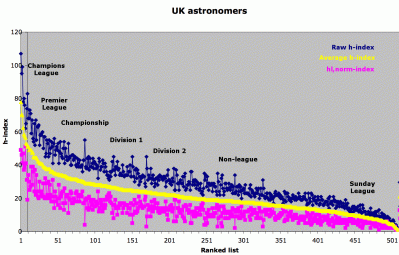
The centrepiece of Paul’s post was the following graph which shows the distribution of two different bibliometric measures for the UK astronomical community. There is the h-index (which is the number h such that the author has h papers cited at least h times) and a normalised version of h in which each paper’s citations are divided by the number of authors of that paper before the index is formed; I call this index hnorm. The results are shown below:

Generally speaking the two indices track each other fairly well, but there are clearly some individuals for whom they diverge. These correspond to researchers whose main mode of productivity is through large consortia and for whom h is correspondingly much larger than hnorm.

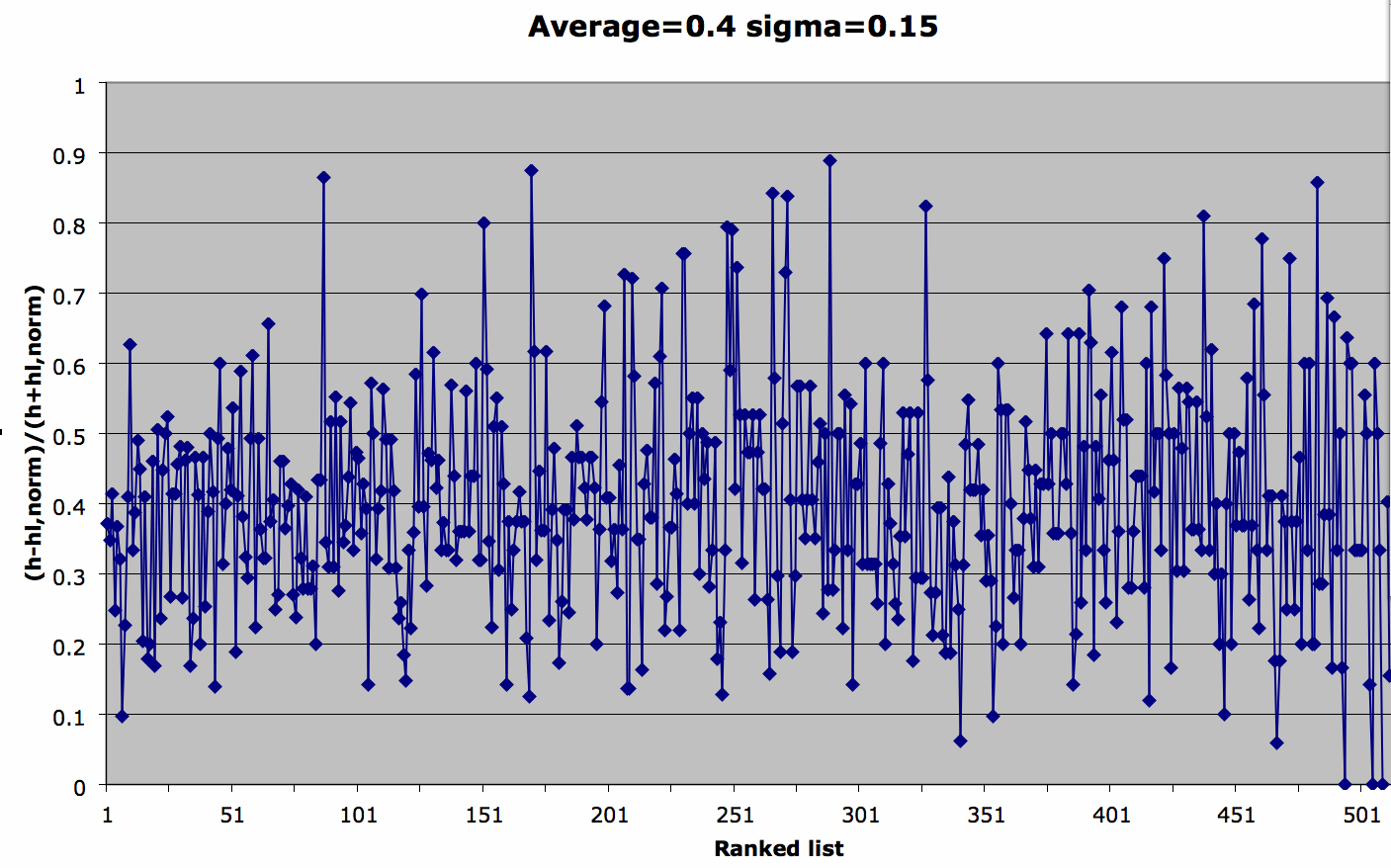
The “outliers” are more easily identified by forming the ratio

l= \frac{h-h_{\rm norm}}{h+h_{norm}}

which is plotted in the graph below kindly provided by Paul Crowther.

Notice that the “lurker index” l is constructed to normalise out any general trend with h and the data do seem consistent with a constant mean across the ranked list. There is, however, a huge spread even among the top performers.

If this were particle physics rather than astronomy the results wouldn’t be presented in terms of a ratio like l but as a mixing angle like the Weinberg angle or the Cabibbo angle. In this scheme we envisage each researcher’s output publication list as involving a mixture of “solo” and “collaborator” basis states, i.e.

|output>=cos(θ) |solo>+sin(θ) |collaborator>

The angle θ gives a quantitative indication of an author’s inclination to lurk in other people’s publication lists. If θ=0 then the individual’s papers are going to be all single-author affairs with no question marks over attribution of impact. If θ=90° then the individual does primarily  collaborative research – perhaps he/she is a good mixer? Most researchers  lie somewhere between these two extremes.

I therefore suggest that we should measure bibliometric productivity and impact not just through one “amplitude”, say h, but by the addition of a mixing angle, i.e. the whole output should be summarised as (h,θ). One could estimate the relevant angle fairly straightforwardly as

\sin\theta = l= \frac{h-h_{\rm norm}}{h+h_{norm}},

but alternative definitions are possible and a more complete understanding of the underlying process is needed to make this more rigorous.

Stephen Hawking has a particularly small mixing angle (~5.7°); many members of the astronomical Premiership have much larger values of this parameter. The value of θ corresponding to the average value of l is about 23.5° and my own angle is about 8.6°.

And here, courtesy of the ever-reliable Paul Crowther, is a graph of mixing angle versus raw h-index for the whole crowd shown in the above diagram.

P.S. If you thinking this application of mixing angle is daft, then you should read this post.


Share/Bookmark

No Cox please, we’re British…

Posted in Television, The Universe and Stuff with tags , , , , , , , on March 29, 2011 by telescoper

The final episode of the BBC television series Wonders of the Universe was broadcast this weekend. Apparently it’s been incredibly popular, winning huge plaudits for its presenter Brian Cox, and perhaps inspiring the next generation of budding cosmologists the way Carl Sagan did thirty-odd years ago with his series Cosmos.

Grumpy old cosmologists (i.e. people like myself) who have watched it are a bit baffled by the peculiar choices of location – seemingly chosen simply in order to be expensive, without any relevance to the topic being discussed – the intrusive (and rather ghastly) music, and the personality cult generated by the constant focus on the dreamy-eyed presenter. But of course the series wasn’t made for people like us, so we’ve got no right to complain. If he does a great job getting the younger generation interested in science, then that’s enough for me. I can always watch Miss Marple on the other side instead.

But walking into work this morning I suddenly realised the real reason why I don’t really like Wonders of the Universe. It’s got nothing to do with the things I mentioned above. It’s because it’s just not British enough.

I’m not saying that Brian Cox isn’t British. Obviously he is. Although I do quibble with him being labelled as a “northerner”. Actually, he’s from Manchester. The North is in fact that part of England that extends southwards from the Scottish border to the Tyne. The Midlands start with Gateshead and include Yorkshire, Manchester and Liverpool and all those places whose inhabitants wish they were from the North, but aren’t really hard enough.

Anyway, I just put that bit in to inform non-British readers of this blog about the facts of UK geography. It’s not really relevant to the main point of the piece.

The problem with Wonders of the Universe is betrayed by its title. The word “wonders” suggests that the Universe is wonder-ful, or even, in a word which has cropped up in the series a few times, “awesome”. No authentic British person, and certainly not one who’s forty-something, would ever use the word “awesome” without being paid a lot of money to do so. It just doesn’t ring true.

I reckon it doesn’t do to be too impressed by anything on TV these days (especially if its accompanied by awful music), but there is a particularly good reason for not being taken in by all this talk about “Wonders”, and that is that the Universe is basically a load of rubbish.

Take this thing, for example.

It’s a galaxy (the Andromeda Nebula, M31, to be precise). We live in a similar article, in fact. Of course it looks quite pretty on the surface, but when you look at them with a physicist’s eye galaxies are really not all they’re cracked up to be.

We live in a relatively crowded part of our galaxy on a small planet orbiting a fairly insignificant star called the Sun. Now you’ve got me started on the Sun. I know it supplies the Earth with all its energy, but it does so pretty badly, all things considered. The Sun only radiates a fraction of a milliwatt per kilogram. That’s hopeless! Pound for pound, a human being radiates more than a thousand times as much. All in all, stars are drastically overrated: bloated, wasteful, inefficient and  not even slightly awesome. They’re only noticeable because they’re big. And we all know that size shouldn’t really matter.

But even in what purports to be an interesting neighbourhood of our Galaxy, the nearest star is 4.5 light years from the Sun. To get that in perspective, imagine the Sun is the size of a golfball. On the same scale, where is the nearest star?

The answer to that will probably surprise you, as it does my students when I give this example in lectures. The answer is, in fact, on the order of a thousand kilometres away. That’s the distance from Cardiff to, say, Munich. What a dull landscape our Galaxy possesses. In between one little golf ball in Wales and another one in Germany there’s nothing of any interest at all, just a featureless incomprehensible void not worthy of the most perfunctory second thought; it’s usually called France.

So galaxies aren’t dazzlingly beautiful jewels of the heavens. They’re flimsy, insubstantial things more like the cheap tat you can find on QVC. What’s worse is that they’re also full of a grubby mixture of soot and dust. Indeed, some are so filthy that you can hardly see any stars at all. Somebody needs to give the Universe a good clean. I suppose you just can’t get the help these days.

And then there’s the Big Bang. Well, I don’t need to go on about that because I’ve already posted about it. Suffice to say that the Big Bang wasn’t anywhere near as Big as you’ve been led to believe. The volume was between about 115 and 120 decibels. Quite loud, but many rock concerts are louder. Very disappointing. If I’d been in charge I would have put on something much more spectacular.

In any case the Big Bang happened a very long time ago. The Universe is now a cold and desolate place, lit by a few feeble stars and warmed only by the fading glow of the heat given off when it was all so much younger and more exciting. It’s as if we inhabit a shabby downmarket retirement home, warmed only by the feeble radiation given off by a puny electric fire as we occupy ourselves as best we can until Armageddon comes.

No, the Universe isn’t wonderful at all. In fact, it’s basically a bit crummy. It’s only superficially impressive because it’s quite large, and it doesn’t do to be impressed by things just because they are large. That would be vulgar.

Digression: I just remembered a story about a loudmouthed Texan who owned a big ranch and who was visiting the English countryside on holiday. Chatting to locals in the village pub he boasted that it took him several days to drive around his ranch. A farmer replied “Yes. I used to have a car like that.”

We British just don’t like showy things. It’s in our genes. We’re fundamentally a rather drab and dowdy race. We don’t really enjoy being astonished either. We prefer things we can find fault with over things that intimidate us with their splendour. We’re much more likely to tut disapprovingly than stare open-mouthed in amazement at something that seems pointlessly ostentatious. If pushed, we might even write a letter of complaint to the Council.

Ultimately, however, the fact is that whatever we think about it, we’re stuck with it. Just like the trains, the government and the weather. Nothing we can do about it, so we might as well just soldier on. That’s the British way.

So you can rest assured that none of this Wonders of the Universe stuff will distract us for long from getting on with the important things in life, such as watching Coronation Street.

Professor Brian Cox is 43.


Share/Bookmark


The Two Deserts

Posted in Poetry, The Universe and Stuff with tags , , , on March 28, 2011 by telescoper

An interesting choice for Poem of the Week in the Grauniad today is this, Two Deserts, by Coventry Patmore.

Not greatly moved with awe am I
To learn that we may spy
Five thousand firmaments beyond our own.
The best that’s known
Of the heavenly bodies does them credit small.
View’d close, the Moon’s fair ball
Is of ill objects worst,
A corpse in Night’s highway, naked, fire-scarr’d, accurst;
And now they tell
That the Sun is plainly seen to boil and burst
Too horribly for hell.
So, judging from these two,
As we must do,
The Universe, outside our living Earth,
Was all conceiv’d in the Creator’s mirth,
Forecasting at the time Man’s spirit deep,
To make dirt cheap.
Put by the Telescope!
Better without it man may see,
Stretch’d awful in the hush’d midnight,
The ghost of his eternity.
Give me the nobler glass that swells to the eye
The things which near us lie,
Till Science rapturously hails,
In the minutest water-drop,
A torment of innumerable tails.
These at the least do live.
But rather give
A mind not much to pry
Beyond our royal-fair estate
Betwixt these deserts blank of small and great.
Wonder and beauty our own courtiers are,
Pressing to catch our gaze,
And out of obvious ways
Ne’er wandering far.

I think this is quite an interesting composition because of its fluid structure and variable metre, although I think the language is a bit contrived in places. Or is it just dated? However, as a scientist, I can’t really agree with the sentiments it expresses (which are also found in abundance elsewhere in 19th Century poetry, such in Walt Whitman’s When I heard the learn’d astronomer).

As the accompanying piece in the Guardian puts it,

Patmore hymns imaginative perception of local realities at the expense of scientific discovery: the reverse position is today’s default.

I’m not sure that last statement is true, for most people, but in any case I’d argue that the more we discover through scientific means the more there is to inspire artists, as long as they have their imaginative eyes open…

Although you probably associate Patmore’s point view with poets of the romantic tradition, such as Wordsworth (whose poetry I admire enormously), I think it’s a misguided assertion that science ignores “the imaginative eye”.  I don’t think it does. Science is full of imagination, it’s just of a form different from that found in the arts. Science and the arts offer complementary ways of imagining. They’re neither incompatible with each other nor is one superior to the other.

And, as I’ve mentioned before there’s more to life than the tedious arts-versus-science rants beloved of certain academics. I can’t think of a clearer expression of the supreme importance of simply living than this, from a poem by William Wordsworth I posted just a few days ago:

Enough of Science and of Art;
Close up these barren leaves;
Come forth, and bring with you a heart
That watches and receives.


Share/Bookmark

Northern Lights

Posted in The Universe and Stuff with tags , on March 23, 2011 by telescoper

Never seen the Aurora Borealis? Then get a load of this. It’s not a fake. This is what it’s really like.

I stood under a show like this once, in northern Norway, and I can tell you ever the word “awesome” applied to anything, this is it.

The curious thing is that I had the definite feeling that there was a booming and whooshing sound to go with the light show. I wasn’t the only one there who thought they could hear it as well as see it. And I wasn’t drunk either. Well, not very.

I’m reliably informed however that there is no physical mechanism that could produce sound waves of sufficient power to reach ground level from the altitude at which the light is generated. It must have been psychological, as if the brain wants to add a backing track when it sees something as spectacular as this.


Share/Bookmark

Astrostatistics at NAM

Posted in The Universe and Stuff with tags , , , on March 22, 2011 by telescoper

I’m using the opportunity of my enforced layoff to remind astronomers that this year’s forthcoming Royal Astronomical Society National Astronomy Meeting, incorporating the MIST and UKSP meetings, will be taking place at the splendid Venue Cymru conference centre, Llandudno, North Wales, from Sunday 17 April to Thursday 21 April.

The period for egistration has been extended , and you can now also submit abstracts of either oral or poster presentations to be considered for inclusion in the various sessions described in the science programme.

I’m organising a session on Recent Developments in Astro-statistics. I haven’t exactly been overwhelmed with offers to speak and there are still one or two slots available, so if you’d like to give a talk in that session please register and upload an abstract to the website. You can’t do the latter until you have done the former. Astro-statistics will be interpreted widely, so I hope to have a varied programme including as many applications of statistics to astronomy and astrophysics as I can get!

NAM is a particularly good opportunity for younger researchers – PhD students and postdocs – to present their work to a big audience so I particularly encourage such persons to submit abstracts. Would more senior readers please pass this message on to anyone they think might want to give a talk?

If you have any questions please feel free to use the comments box (or contact me privately).

Oh, and I should have mentioned that Andrew Jaffe is also touting for trade for the cosmology sessions he’s organising…


Share/Bookmark

What time is it?

Posted in The Universe and Stuff with tags , on March 21, 2011 by telescoper


Share/Bookmark