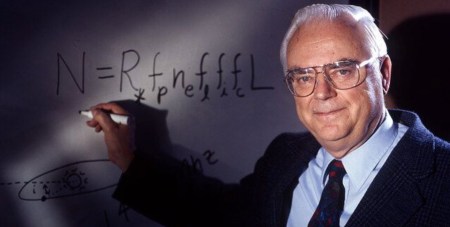
Frank Drake and the Drake Equation (Picture credit: Space.com)
I heard last night of the death at the age of 92 of astronomer Frank Drake, one of the pioneers of the Search for Extraterrestrial Intelligence (SETI). He was best known to most people for formulating the Drake Equation, so since it’s a rainy Saturday morning I thought I’d commemorate him here by presenting a brief discussion of that equation and what it means.
Our Universe is contrived in such a way as to make life possible within it. After all, we’re here! But just because it is possible, that doesn’t mean that it is commonplace. Is life all around us, or did it only happen on Earth? It fascinates me that this topic comes up so often in the question sessions that follow the public lectures I give on astronomy and cosmology. Do you think there is life on other worlds? Are there alien civilisations more advanced than our own? Have extraterrestrials visited Earth? These are typical of the kind of things people ask me when I give talks on the Big Bang theory of the origin of the Universe. It often seems that people are more interested in finding out if there is life elsewhere than in making more serious efforts to sustain life in the fragile environment of our own planet. But there’s no doubting the effect that it would have on humanity to have proof that we are not alone in the cosmos. We could then accept that the Universe was not made for our own benefit. Such proof might also help release mankind from the shackles currently placed on it by certain fundamentalist religious cults. But whatever the motives for seeking out life on other worlds, this is undoubtedly a subject worthy of serious scientific study.
Our understanding of the origins of terrestrial life still has important gaps. There is still no compelling direct evidence that life has existed elsewhere in the Solar system. Conditions may, for example, have been conducive to life earlier in the history of Mars but whatever did manage to evolve there has not left any unambiguous clues that we have yet found. The burgeoning new field of astrobiology seeks to understand the possible development of life far from Earth, and perhaps in extreme conditions very different from those found on our planet. This is, however, a very new field and it will be a very long time before it becomes fully established as a rigorous scientific discipline with a solid experimental and observational foundation. What I want to do in this discussion is therefore not to answer the question “Are we alone?” but to give some idea of the methods used to determine if there might be life elsewhere, including the SETI (Search for ExtraTerrestrial Intelligence) industry which aims to detect evidence of advanced civilizations.
The first ever scientific conference on SETI was held in 1961, in Green Bank, West Virginia, the site of a famous radio telescope. A search had just been carried out there for evidence of radio signals from alien intelligences. This conference didn’t exactly change the world, which is not surprising because only about ten people showed up. It did, however, give rise to one of the most famous equations in modern science: the Drake Equation.
The astronomer Frank Drake was setting up the programme for the inaugural SETI conference and he wanted to summarize, for further discussion, the important factors affecting the chances of detecting radio transmissions from alien worlds. The resulting equation yields a rough guess of the number of civilizations existing in the Milky Way from which we might get a signal. Of course we can’t calculate the answer. The equation’s usefulness is that it breaks down the puzzle into steps, rather than providing the solution. The equation has been modified over the years so that there are various versions of it addressing different questions, but its original form in all its glory was
N=R× fp × ne × fl × fi × fc × L
The symbols in this equation have the following meanings. The left hand side N is the number of transmitting civilisations in our Galaxy, which is what we want to determine The first term on the right hand side is R, which is the birth-rate of stars in our Galaxy per year. We know that the Milky Way is about 10 billion years old, and it contains about 100 billion stars. As a very rough stab we could guess that the required birth-rate is therefore about ten stars per year. It seems unlikely that all stars could even in principle be compatible with life existing in their neighbourhood. For example, very big stars burn out very quickly and explode, meaning that there is very little time for life to evolve there in the first place and very little chance of surviving once it has. Next in the equation is fp, the fraction of these stars having planets, followed by ne, the typical number of planets one might find. This is followed by fl, the fraction of all planets on which life in some form does actually evolve. The next term is fi, the fraction of those planets with life on them that have intelligent life on them. Finally we have two factors pertaining to civilization: fc is the fraction of planets inhabited by intelligent beings on which civilizations arise that are capable of interstellar communication and L is the average lifetime of such civilizations.
The Drake equation probably looks a bit scary because it contains a large number of terms, but I hope you can see that it is basically a consequence of the rules for combining probabilities. The idea is that in order to have a transmitting civilisation, you must the simultaneous occurrence of various properties each of which whittles away at the original probability.
To distil things a little further we can simplify the original Drake equation so that it has only four terms
N=NH × fl × fc × fnow
The first three terms of the original equation have been absorbed into NH, the number of habitable planets and the last two have become fnow, the fraction of civilized planets that happen to be transmitting now, when we are trying to detect them. This is important because many civilizations could have been born, flourished and died out millions of years in the past so will never be able to communicate with them.
Whichever way you write it, the Drake equation depends on a number of unknown factors. Combining factors multiplicatively like this can rapidly lead to very large (or very small) numbers. In this case each factor is very uncertain, so the net result is very poorly determined.
Recent developments in astronomy mean that we at least have something to go on when it comes to NH, the number of habitable planets. Until relatively recently the only planets we knew about for sure were in our own Solar System orbiting our own star, the Sun. We didn’t know about planets around other stars because even if there were there we were not able to detect them. Many astronomers thought planets would turn out to be quite rare but absence of evidence is not evidence of absence. Observations now seem to support the idea that planets are fairly common, and this also seems to be implied by our improved understanding of how stars form.
Planets around distant stars are difficult to detect directly because they only shine by light reflected from their parent star and are not themselves luminous. They can, however, be detected in a number of very convincing ways. Strictly speaking, planets do not orbit around stars. The star and the planet both orbit around their common centre of mass. Planets are generally much smaller than stars so this centre of mass lies very close to the centre of the star. Nevertheless the presence of a planet can be inferred through the existence of a wobble in the stars’ path through the Galaxy. Dozens of extrasolar planets have been discovered using this basic idea. The more massive the planet, and the closer it is to the star the larger is the effect. Interestingly, many of the planets discovered so far are large and closer in than the large ones in our Solar System (Jupiter, Saturn, Uranus and Neptune). This could be just a selection effect – we can only detect planets with a big wobble so we can’t find any small planets a long way from their star – but if it isn’t simply explained away like that it could tell us a lot about the processes by which planets formed.
The birth of a star is thought to be accompanied by the formation of a flattened disk of debris in the form of tiny particles of dust, ice and other celestial rubbish. In time these bits of dirt coagulate and form larger and larger bodies, all the way up in scale to the great gas giants like Jupiter. The planets move in the same plane, as argued by Laplace way back in the 19th century, because they were born in a disk.
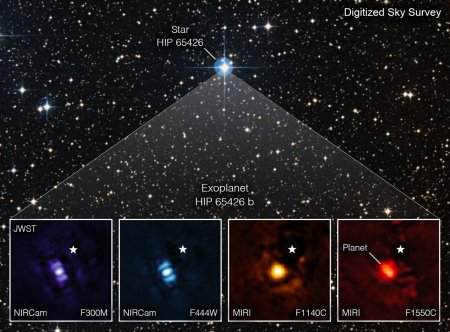
As an aside I’ll mention that when I started my PhD in 1985 there were no known extra-solar planets -exoplanets for short – so as a field exoplanet research hadn’t really started. Now it’s one of the biggest areas of astrophysics and is set to grow even more with the launch of JWST, which has just made its first direct image of an exoplanet:
Of course, while planets may be common we still do not know for sure whether habitable planets are also commonplace. We have no reason to think otherwise, however, so we could reasonably assume that there could be one habitable planet per system of planets. This would give a very large value for NH, perhaps 100 billion or so in our Galaxy.
The remaining terms in the Drake Equation pose a bit more of a problem. We certainly don’t have any rational or reliable way to estimate fl. We only know of one planet with life on it. Even Bayesians can’t do much in the way of meaningful statistical inference in this case because we do not have a sensible model framework within which to work. On the other hand, there is a plausibility argument that suggests fl may be larger rather than smaller. We think Earth formed as a solid object about 4.5 billion years ago. Carbon-isotope evidence suggests that life in a primitive form had evolved about 3.85 billion years ago, and the fossil record suggests it was abundant by 3.5 billion years. At least the early stages of evolution happened relatively quickly after the Earth was formed and it is a reasonable inference that life is not especially difficult to get going.
It might be possible therefore that fl=1, or close to it, which would mean that all habitable planets have life. On the other hand, suppose life has a one-in-a-million chance of arising then this reduces the number of potentially habitable planets with life actually on them to only a millionth of this value.
The factor fc represents the fraction of inhabited planets on which transmitting civilizations exist at some point. Here we really don’t have much to go on at all. But there may be some strength in the converse argument to that of the previous paragraph. The fact that life itself arose 3.85 billion years ago but humans only came on the scene within the last million years suggests that this step may be difficult, and fc should consequently take a small value.
The last term in the simplified Drake equation, fnow, is even more difficult because it involves a discussion of the survivability of civilizations. Part of the problem is that we lack examples on which to base a meaningful discussion. For present purposes, however, it is worth looking at the numbers for terrestrial life. The Milky Way is roughly 10 billion years old. We have only been capable of interstellar communication for about 80 years, initially accidentally through through stray radio broadcasts. This is only about one part in 200 million of the lifetime of our Galaxy. If we destroy ourselves in the very near future, either by accident or design, then this is our lifetime L as it appears in the original Drake equation. If this is typical of other civilizations then we would have roughly a one in 200 million chance of detecting them at any particular time. Even if our Galaxy had nurtured hundreds of millions of civilizations, there would only be a few that would be detectable by us now.
Incidentally, it is worth making the comment that Drake’s equation was definitely geared to the detection of civilizations by their radio transmissions. It is quite possible that radio-based telecommunication that results in leakage into space only dominates for a brief stage of technological evolution. Maybe some advanced form of cable transmission is set to take over. This would mean that accidental extraterrestrial communications might last only for a short time compared to the lifetime of a civilization. Many SETI advocates argue that in any case we should not rely on accidents, but embark on a programme of deliberate transmission. Maybe advanced alien civilizations are doing this already…
In Drake’s original discussion of this question, he came to the conclusion that the first six factors on the right-hand-side of the equation, when multiplied together, give a number about one. This leads to the neat conclusion that N=L (when L is the lifetime of a technological civilization in years). I would guess that most astronomers probably doubt the answer is as large as this, but agree that the weakest link in this particular chain of argument is L. Reading the newspapers every day does not make me optimistic that L is large…








 In the Dark