Archive for the The Universe and Stuff Category

Cosmology Talks: James Alvey on Big Bang Nucleosynthesis in 2021

Posted in The Universe and Stuff with tags , , , , , on October 15, 2021 by telescoper

It’s been a while since I last shared another one of those interesting cosmology talks on the Youtube channel curated by Shaun Hotchkiss. This channel features technical talks rather than popular expositions so it won’t be everyone’s cup of tea but for those seriously interested in cosmology at a research level they should prove interesting. I found this one particular interesting as it is a field that I lost track of quite a long time ago and it was great to see what has been going on!

Here James Alvey gives a pedagofical overview of the general state of the field of Big Bang Nucleosynthesis (BBN) in 2021, including the basic physics that goes into BBN calculations through each of the relevant epochs (neutrino decoupling, the deuterium bottleneck, etc). He gives particular emphasis to the recent LUNA measurements of the D + p →γ + 3He reaction (or deuterium + proton goes to photon and 3-Helium). This was previously the source of greatest uncertainty in predicting the final deuterium abundance of BBN. He ends by talking about the implications of the LUNA measurements on possible new physics beyond the standard model, in particular possible thermal relics.

There is a Nature paper about the LUNA results here and  two other papers on this topic by James can be found here and here.

Writing Papers for Scientific Journals

Posted in Literature, The Universe and Stuff with tags , on October 14, 2021 by telescoper

Knowing that not all readers of this blog have a flair for writing like what I have got, I thought I’d pass on a link to a paper that appeared on the arXiv earlier this week. Here is the abstract:

Writing is a vital component of a modern career in astronomical research. Very few researchers, however, receive any training in how to produce high-quality written work in an efficient manner. We present a step-by-step guide to writing in astronomy. We concentrate on how to write scientific papers, and address various aspects including how to crystallise the ideas that underlie the research project, and how the paper is constructed considering the audience and the chosen journal. We also describe a number of grammar and spelling issues that often cause trouble to writers, including some that are particularly hard to master for non-native English speakers. This paper is aimed primarily at Master’s and PhD level students who are presented with the daunting task of writing their first scientific paper, but more senior researchers or writing instructors may well find the ideas presented here useful.

Knapen et al. 2021, arXiv:2110.05503

The title of the paper is actually Writing Scientific Papers in Astronomy, which seems curious wording to me – rather like Writing Scientific Papers in French (for example) – which is why I didn’t use it for the title of this post. Not that I’m pedantic or anything.

One of the problems with the scientific literature is that most journals have their own style rules which are often in conflict with one another so the detailed guidance on grammar, etc is probably of lesser value than the good tips on how to structure a paper. Those bits apply to any scientific field really, not just astronomy.

I remember very well what a struggle I found it when I wrote my first scientific paper. I had invaluable help, though, from my supervisor, who was an excellent writer. This is well worth reading for those early career researchers who want to avoid at least some of the pain!

The only tip I can offer to a postgraduate student struggling to write a paper is to think of who is going to be reading it. In most cases that will mainly be other early career researchers, so write in such a way that you can connect with them. That usually means, for example, taking special care to explain the things that you found difficult when you started in the area. In other words, you should put enough in your paper to allow someone else entering the field to understand it.

Other tips are of course welcome through the Comments Box.

Writing Vectors

Posted in mathematics, The Universe and Stuff with tags , , , on October 11, 2021 by telescoper

Once again it’s time to introduce first-year Mathematical Physics students to the joy of vectors, or specifically Euclidean vectors. Some of my students have seen them before, but probably aren’t aware of how much we use them theoretical physics. Obviously we introduce the idea of a vector in the simplest way possible, as a directed line segment. It’s only later on, in the second year, that we explain how there’s much more to vectors than that and explain their relationship to matrices and tensors.

Although I enjoy teaching this subject I always have to grit my teeth when I write them in the form that seems obligatory these days.

You see, when I was a lad, I was taught to write a geometric vector in the following fashion:

\vec{r} =\left(\begin{array}{c} x \\ y \\ z \end{array} \right).

This is a simple column vector, where x,y,z are the components in a three-dimensional cartesian coordinate system. Other kinds of vector, such as those representing states in quantum mechanics, or anywhere else where linear algebra is used, can easily be represented in a similar fashion.

This notation is great because it’s very easy to calculate the scalar (dot) and vector (cross) products of two such objects by writing them in column form next to each other and performing a simple bit of manipulation. For example, the scalar product of the two vectors

\vec{u}=\left(\begin{array}{c} 1 \\ 1 \\ 1 \end{array} \right) and \vec{v}=\left(\begin{array}{c} 1 \\ 1 \\ -2 \end{array} \right)

can easily be found by multiplying the corresponding elements of each together and totting them up:

\vec{u} \cdot \vec{v} = (1 \times 1) + (1 \times 1) + (1\times -2) =0,

showing immediately that these two vectors are orthogonal. In normalised form, these two particular vectors appear in other contexts in physics, where they have a more abstract interpretation than simple geometry, such as in the representation of the gluon in particle physics.

Moreover, writing vectors like this makes it a lot easier to transform them via the action of a matrix, by multipying rows in the usual fashion, e.g.
\left(\begin{array}{ccc} \cos \theta & \sin\theta & 0 \\ -\sin\theta & \cos \theta & 0 \\ 0 & 0 & 1\end{array} \right) \left(\begin{array}{c} x \\ y \\ z \end{array} \right) = \left(\begin{array}{c} x\cos \theta + y\sin\theta \\ -x \sin \theta + y\cos \theta \\ z \end{array} \right)
which corresponds to a rotation of the vector in the x-y plane. Transposing a column vector into a row vector is easy too.

Well, that’s how I was taught to do it.

However, somebody, sometime, decided that, in Britain at least, this concise and computationally helpful notation had to be jettisoned and students instead must be forced to write a vector laboriously in terms of base vectors:

\vec{r} = x\hat{\imath} + y \hat{\jmath} + z \hat{k}

Some of you may even be used to doing it that way yourself. Why is this awful? For a start, it’s incredibly clumsy. It is less intuitive, doesn’t lend itself to easy operations on the vectors like I described above, doesn’t translate easily into the more general case of a matrix, and is generally just …well… awful. The only amusing thing about this is that you get to tell students not to put a dot on the “i” or the “j” – it always gets a laugh when you point out that these little dots are called “tittles“.

Worse still, for the purpose of teaching inexperienced students physics, it offers the possibility of horrible notational confusion. In particular, the unit vector \hat{\imath} is too easily confused with i, the square root of minus one. Introduce a plane wave with a wavevector \vec{k} and it gets even worse, especially when you want to write \exp(i\vec{k}\cdot \vec{x}), and if you want the answer to be the current density \vec{j} then you’re in big trouble!

Call me old-fashioned, but I’ll take the row and column notation any day!

(Actually it’s better still just to use the index notation, a_i which generalises easily to a_{ij} and, for that matter, a^{i}.)

Or perhaps being here in Ireland we should, in honour of Hamilton, do everything in quaternions.

Romanesco and the Golden Spiral

Posted in mathematics, The Universe and Stuff with tags , , , on October 7, 2021 by telescoper

This week’s veggie box included the following beauty

The vegetable in the picture is called Romanesco. I’ve always thought of it as a cauliflower but I’ve more recently learned that it’s more closely related to broccoli. It doesn’t really matter because both broccoli and cauliflower are forms of brassica, which term also covers things like cabbages, kale and spinach. All are very high in vitamins and are also very tasty if cooked appropriately. Incidentally, the leaves of broccoli and cauliflower are perfectly edible (as are those of Romanesco) like those of cabbage, it’s just that we’re more used to eating the flower (or at least the bud).

A while ago, inspired by a piece in Physics World,  I wrote an item about  Romanesco, which points out that a “head” of Romanesco displays a form of self-similarity, in that each floret is a smaller version of the whole bud and also displays structures that are smaller versions of itself. That fractal behaviour is immediately obvious if you take a close look. Here’s a blow-up so you can see more clearly:
romanesco-broccoli2-550x412

There is another remarkable aspect to the pattern of florets, in that they form an almost perfect golden spiral. This is a form of logarithmic spiral that grows every quarter-turn by a factor of the golden ratio:

\phi = \frac{1+\sqrt{5}}{2}.

Logarithmic, or at least approximately logarithmic, spirals occur naturally in a number of settings. Examples include spiral galaxies, various forms of shell, such as that of the nautilus and in the phenomenon of phyllotaxis in plant growth (of which Romanesco is a special case). It would seem that the reason for the occurrence of logarithmic spirals  in living creatures is that such a shape allows them to grow without any change in shape.

Although it is rather beautiful, the main attraction of Romanesco is that it is really delicious. It can be eaten like cauliflower (e.g. in a delicious variation of cauliflower cheese) but my favourite way of cooking it is to roast it with a bit of olive oil, lemon juice and garlic. Yum!

Nobel Prize for Physics Speculation

Posted in Biographical, The Universe and Stuff with tags , , , on October 4, 2021 by telescoper

Just  to mention that tomorrow morning (October 5th 2021) will see the announcement of this year’s Nobel Prize for Physics. I must remember to make sure my phone is fully charged…

I do, of course, already have a Nobel Prize Medal of my own already, dating from 2006, when I was lucky enough to attend the prize-giving ceremony and banquet.

I was, however, a guest of the Nobel Foundation rather than a prizewinner, so my medal is made of chocolate rather than gold. I think after 15 years the chocolate is now inedible, but it serves as a souvenir of a very nice weekend in Stockholm!

I have a spectacular bad track record at predicting the Physics Nobel Prize winner. Most pundits have, actually. I certainly didn’t see the last two coming. I couldn’t resist having a go again however.

It’s been a good few years for cosmology and astrophysics, with Jim Peebles (2019), Roger Penrose, Andrea Ghez & Reinhard Genzel (2020) following on from Kip Thorne, Rainer Weiss and Barry Barish (2017) for the detection of gravitational waves.  Although I said so last year only to be proved wrong, I think it’s very unlikely that it will be in this area again. I have no idea who will win but if I had to take a punt I would suggest  Alain Aspect, Anton Zeilinger and John Clauser for their Bell’s inequality experiments and contributions to the understanding of quantum phenomena, including entanglement. I’m probably wrong though.

Feel free to make your predictions through the comments box below.

To find out you’ll have to wait for the announcement, around about 10.45 (UK/Irish time) tomorrow morning. I’ll update tomorrow when the wavefunction has collapsed.

Anyway, for the record, I’ll reiterate my opinion that while the Nobel Prize is flawed in many ways, particularly because it no longer really reflects how physics research is done, it does at least have the effect of getting people talking about physics. Surely that at least is a good thing?

UPDATE: Unsurprisingly, I was wrong again. The 2021 Nobel Prize for Physics goes to Syukuro Manabe and Klaus Hasselmann (1/4 each) and Giorgio Parisi (1/2). Manabe and Hasselmann were cited for their work in “the physical modeling of Earth’s climate, quantifying variability and reliably predicting global warming”. The second half of the prize was awarded to Parisi for “the discovery of the interplay of disorder and fluctuations in physical systems from atomic to planetary scales.” Congratulations to them all!

Astrophysics Job Opportunity in Cork

Posted in The Universe and Stuff on October 2, 2021 by telescoper

Just time today to pass on the news that the University of Cork is advertising a Professorship “with a specialism in astrophysics, gravitational physics or cosmology”. More details can be found here.

I’m posting this information here to encourage cosmologists and gravitational physicists to apply because I would love to see the community in these areas grown in Ireland. It’s nice to see the University of Cork investing in astrophysics too. I had a quick look at their Physics department webpage and it seems their main interest at the moment is in radio astronomy and Active Galactic Nuclei so presumably they are looking for something to complement this activity. There is a follow-up position in theoretical astrophysics in the pipeline too.

P.S. I’ve never been to Cork, actually, but I’ve heard very good things about the city and it’s high on my list of places to visit when travel becomes more feasible than it is at the moment.

New Publication at the Open Journal of Astrophysics

Posted in OJAp Papers, Open Access, The Universe and Stuff with tags , , , , , , on September 30, 2021 by telescoper

Time to announce another publication in the Open Journal of Astrophysics. This one is the twelfth paper in Volume 4 (2021) and the 43rd in all.

The latest publication is entitled  Bridging the Gap Between Simply Parametrized and Free-Form Pixelated Models of Galaxy Lenses: The Case of WFI 2033-4723 Quad and is in the folder marked Astrophysics of Galaxies. The authors are Bernardo Barrera (Tecnológico de Monterrey, Mexico), Liliya Williams (University of Minnesota, USA), Jonathan P. Coles* (Technical University of Munich, Germany) and Philipp Denzel (University of Zurich, Switzerland).

*No relation.

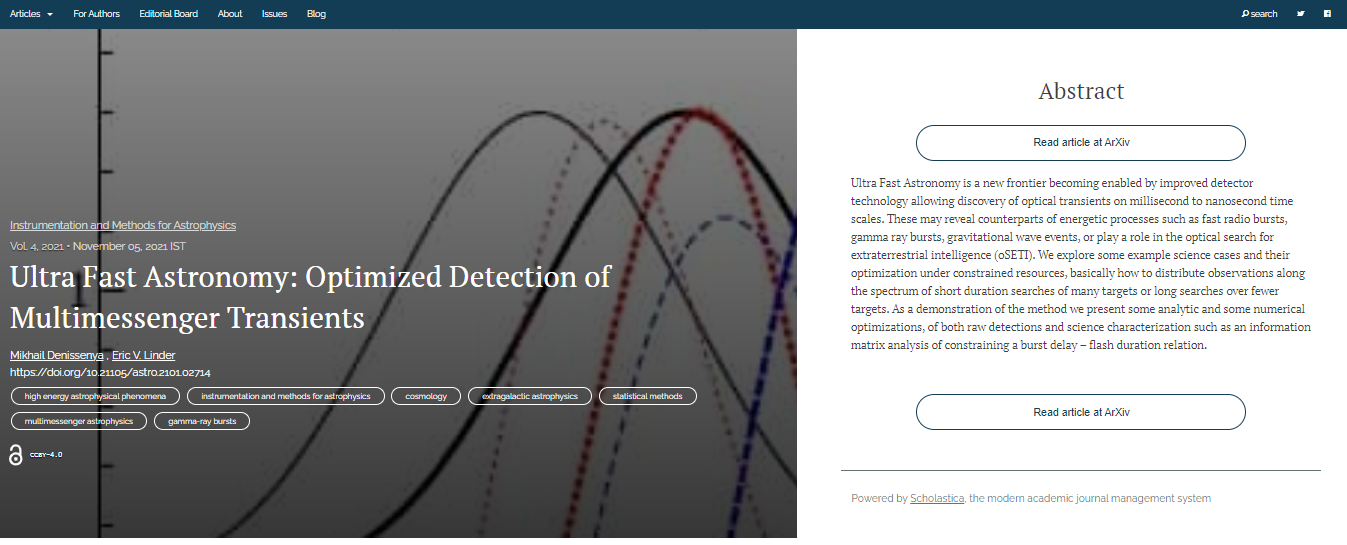
Here is a screen grab of the overlay which includes the abstract:

You can click on the image to make it larger should you wish to do so. You can find the arXiv version of the paper here.

The teaser image doesn’t show up very well on the overlay so here it is in all its glory:

New Publication at the Open Journal of Astrophysics

Posted in OJAp Papers, Open Access, The Universe and Stuff with tags , , , , , , on September 28, 2021 by telescoper

Time to announce another publication in the Open Journal of Astrophysics. This one is the eleventh paper in Volume 4 (2021) and the 42nd in all.

The latest publication is entitled Squeezing the Axion – it’s about inflationary scalar field perturbations using the squeezed state formalism – and is by

Here is a screen grab of the overlay which includes the abstract:

You can click on the image to make it larger should you wish to do so. You can find the arXiv version of the paper here. This one is also in the folder marked Cosmology and Non-Galactic Astrophysics.  

P.S. I hope to publish another paper tomorrow…

Astrophysics & Cosmology Masterclass at Maynooth!

Posted in Biographical, Education, Maynooth, The Universe and Stuff with tags , , on September 28, 2021 by telescoper

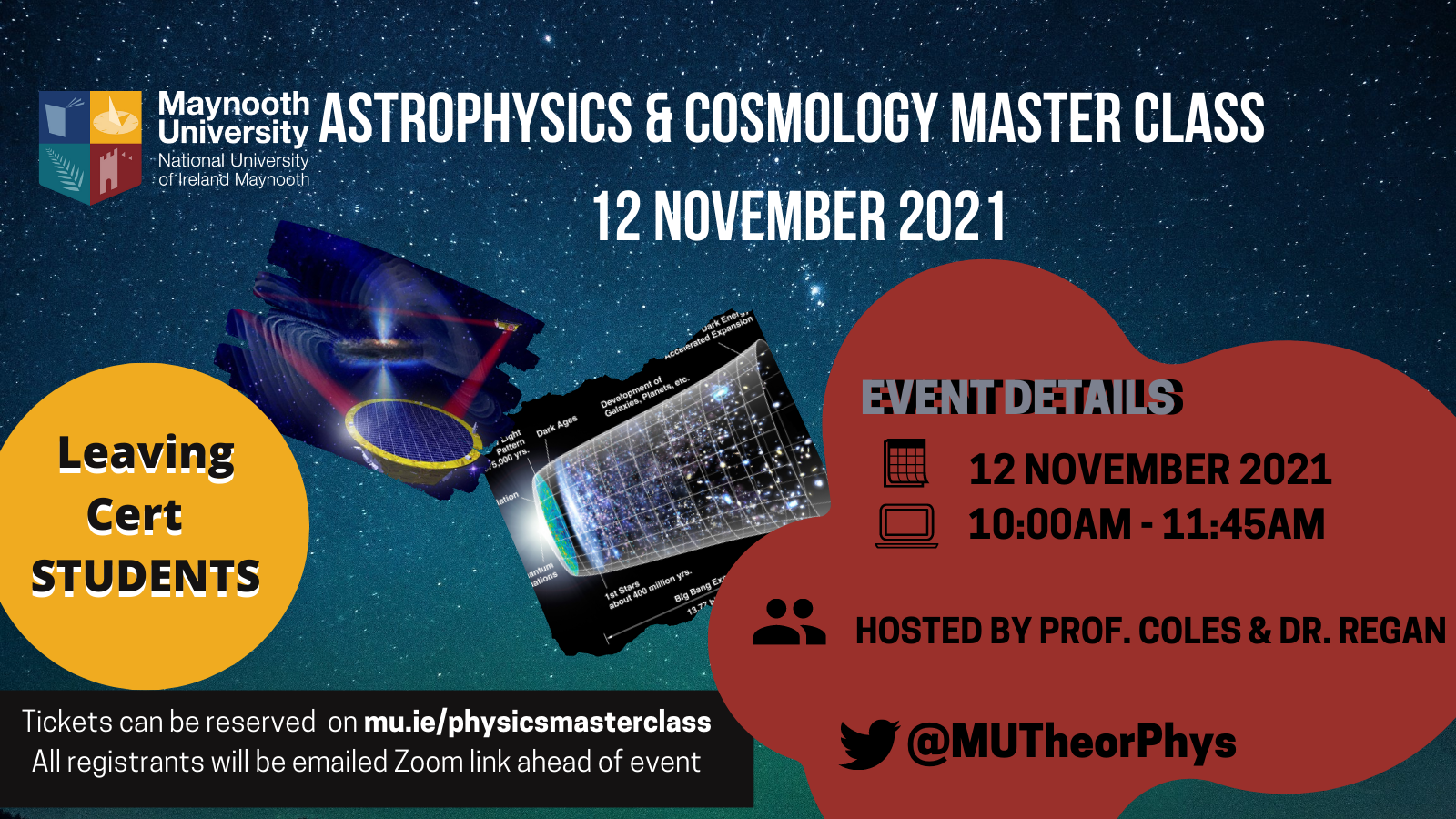
Regular readers of the blog – both of them – may remember that, after a couple of postponements due to Covid-19,  we presented a Masterclass in Astrophysics & Cosmology in Maynooth on March 25th 2021. Well, owing to popular demand we’ve decided to do a re-run of the event on Friday 12th November 2021 ahead of next year’s CAO cycle.

This will be a half-day virtual event via Zoom. It’s meant for school students in their 5th or 6th year of the Irish system. There might be a few of them or their teachers who see this blog so I thought I’d share the news here. You can find more information, including instructions on how to book a place, here.

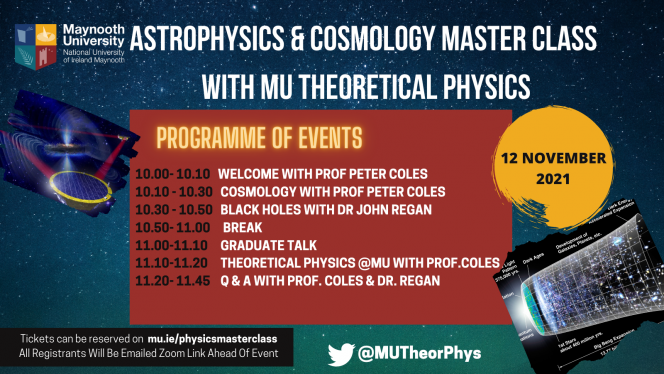
Here is the updated official poster and the programme:

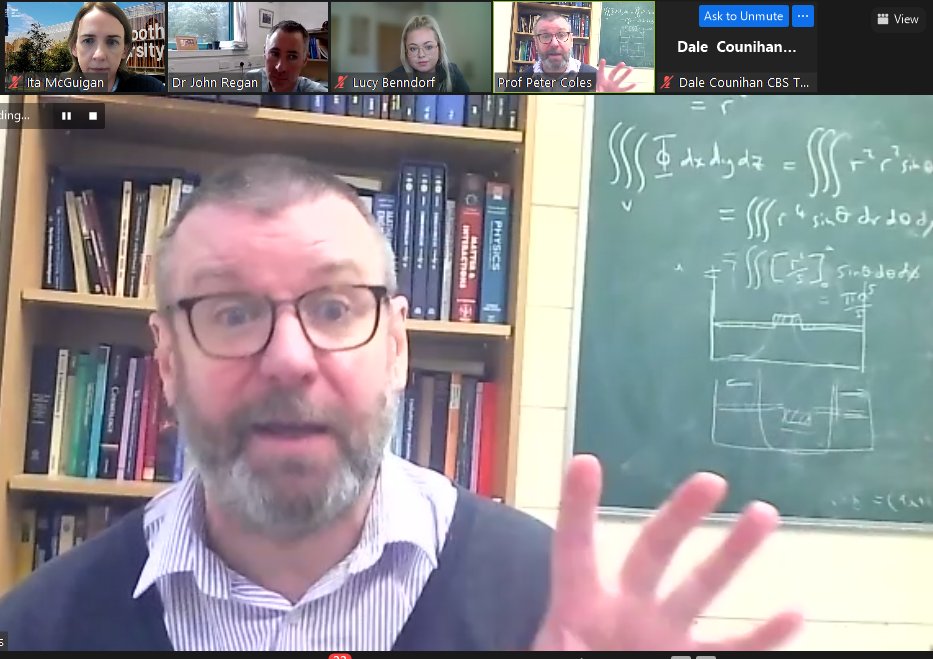
I’ll be talking about cosmology early on, while John Regan will talk about black holes. After the coffee break one of our PhD students will talk about why they wanted to study astrophysics. Then I’ll say something about our degree programmes for those students who might be interested in studying astrophysics and/or cosmology as part of a science course. We’ll finish with questions either about the science or the study!

(And at 12 noon I don’t turn into a pumpkin but do have to run off to give a lecture on vector calculus..)

Welcome to the First Year

Posted in Education, Maynooth, The Universe and Stuff with tags , , , on September 27, 2021 by telescoper

Well this morning I had my first lecture to the new first-year students on their first day of teaching at Maynooth University. It went fairly well, and my improvised attempts to record the lecture for the students were reasonably successful too.

When I started at about 11.05am I was a little disappointed that I only had around two-thirds of the number I expected, but I assumed that was that students had difficulty locating the venue, Physics Hall. Not unreasonably quite a few new students assume that this is in the Science Building on the North Campus where the Physics staff are based. In fact Physics Hall is on the much more scenic South Campus, which is quite a distance from the Science Building which usually means that some newbies arrive late as a result of going to the wrong venue.

Incidentally, here is a view of Physics Hall from the front taken in 2012 at a Mathematics Lecture by Tim Gowers. The hall hasn’t changed much since then!

I like this room because (a) it has good blackboards at the front and (b) although a reasonable size there is not a huge distance from the lecturer to the back of the audience so everyone can see and hear the lecturer, and can be heard by the lecturer if they ask something.

Anyway, the first lecture was very introductory so late students weren’t going to miss anything earth-shattering, and in any case I was recording it, so I started on time. After talking for over half an hour someone – a theoretical physics PhD student – came in to the hall and explained that about half the class had been standing outside thinking I hadn’t turned up because the door was closed. Why they didn’t try the handle and have a look inside I don’t know! When the latecomers had all filed in and found a seat I had roughly the number I had initially expected so all was well. I explained to them that they shouldn’t stand on ceremony next time.

It did occur to me that this year’s new students have a pretty good reason for not knowing where anything is on campus is that for many of them today is the first day they’ve ever been herein Maynooth. Open days last year were all virtual, for example. It must feel very strange to commit to a four-year degree at a University you’ve never even visited before, but that’s what this cohort of students have been forced to do.

One of the things I tend to do in the first lecture is to explain that I do like to have interaction in my lectures and it was nice to find that quite a few people did answer when I asked questions. Lectures are so dull if it’s just an old fart blathering on for 50 minutes. The capacity of Physics Hall is about 90, which is not huge, but interaction is possible in much bigger rooms if you work to create the right atmosphere.

Giving students the encouragement to get involved is also helpful to the lecturer, as students will then be more willing to point out errors on the blackboard (which, of course, I put in deliberately to see if they’re paying attention). After today I have a pretty good feeling about this new class and I’m looking forward to seeing them for Lecture 2 tomorrow.

Oh, and the instruction that masks are mandatory in lectures was observed impeccably by the students.