Archive for the The Universe and Stuff Category

Eye on Burlington House

Posted in The Universe and Stuff with tags , , on October 27, 2020 by telescoper

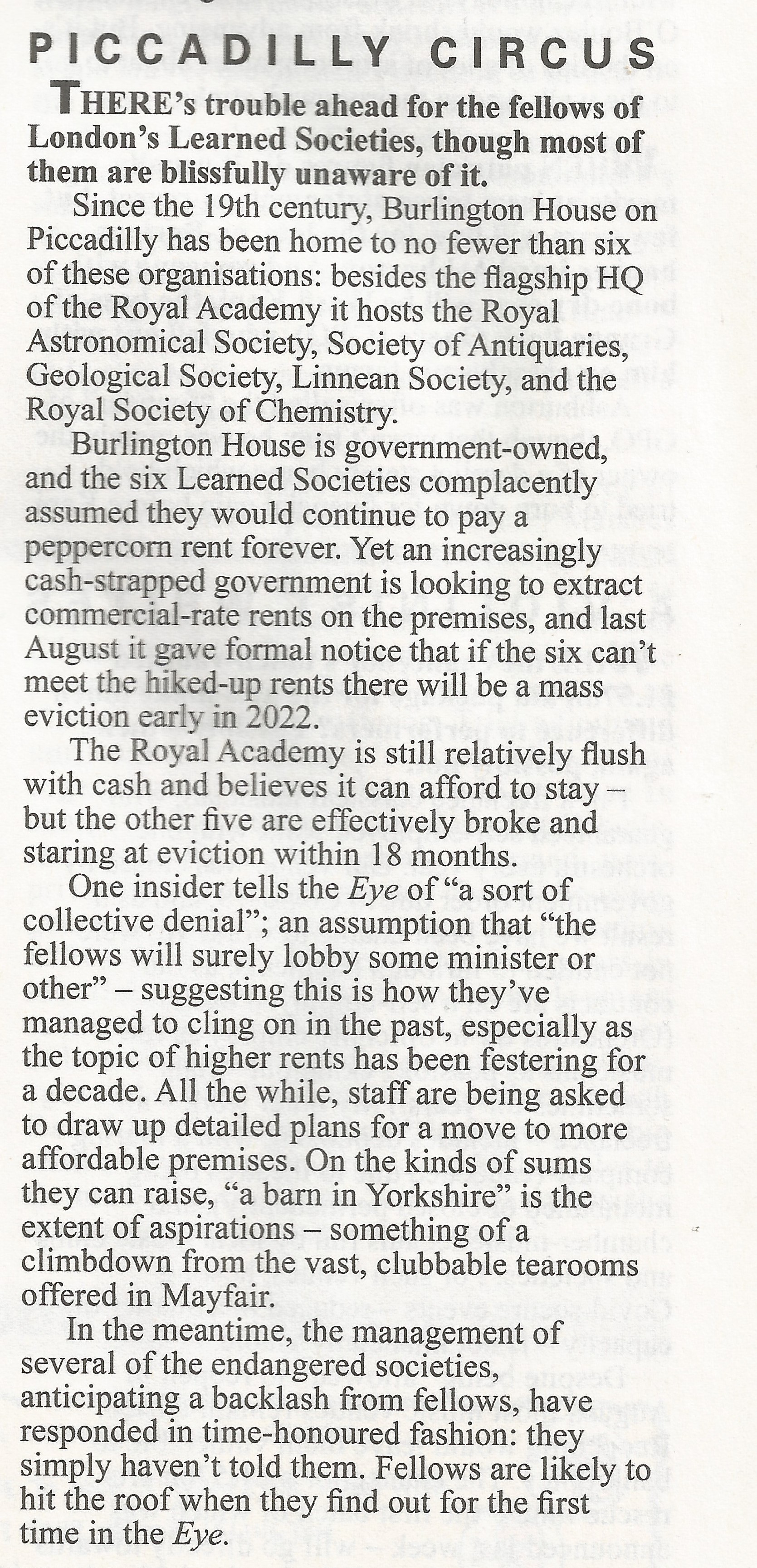
Having been forewarned of this story as soon as my copy of Private Eye arrived (this morning, owing to the Bank Holiday weekend) I headed straight to this:

It sounds rather alarming for the Royal Astronomical Society, which is currently accommodated in Burlington House in Piccadilly, but I do remember something similar being in the air not too long ago when I was a Member of RAS Council. The Government of the time threatened to increased rents and everyone involved with the RAS, including its Fellows, was a bit worried but an agreement was struck. Presumably now the leases are up for negotiation again?

It’s worth pointing out a few inaccuracies in the Eye piece.

  1.  “..the six Learned Societies complacently assumed they would continue to pay a peppercorn rent forever”. This is untrue as the rents have been renegotiated before (see above).
  2.  “The Royal Academy is still relatively flush….but the other five are effectively broke”. I don’t know anything about the others but I’d be very surprised if the Royal Society of Chemistry is “effectively broke” given the income from its academic publishing wing. It also has sizeable industrial income, as does the Geological Society. The Royal Astronomical Society has sizeable reserves in the form of a portfolio of long-term investments built up over the 200 years of its existence but it tends not to use them to fund expenditure; its main cash flow is provided again by academic publishing, especially Monthly Notices of the Royal Astronomical Society. This year – the bicentenary of its foundation – is a bit of an exception because it has dipped into reserves to fund a series of celebratory outreach activities.
  3. The description of “vast clubbable tearooms” is inaccurate too. The RAS occupies rather cramped accommodation in one corner of Burlington house. There is a Fellows’ Room but it is rather small. There are staff offices, a (small) lecture theatre and an important historical library. There are also the President’s Apartments (which I have of course never seen).

I wouldn’t put it past this particular Government to kick out the Learned Societies and outsource Burlington House to Serco but even if this does happen, it wouldn’t be the end of the world.  In my view the RAS needs to shake off the fusty image that its current accommodation in what looks like an old museum tends to perpetuate.  It has always been the case that most of the regulars at the monthly Open Meetings in Burlington House are based in or near London, which means many Fellows don’t get the chance to be involved. Would it really be all that bad for the Royal Astronomical Society had to move? They may have to overhaul their finances anyway if their publishing revenues dry up…

Why not use the opportunity to move the Society out of London altogether to a place with a strong astronomical connection, Bath for example, although that would admittedly make it difficult to get to the Athenaeum in time for dinner…

And if “commercial rates” are going to be the thing for Government-owned buildings, shouldn’t the occupant of 10 Downing Street be charged for his accommodation?


Lá Saoire i mí Dheireadh Fómhair

Posted in Beards, Biographical, Covid-19, Irish Language, Maynooth, The Universe and Stuff with tags on October 26, 2020 by telescoper

Today being the last Monday of October, it’s a Bank Holiday here in Ireland so I’m having the day off (well, at least the morning: I have a telecon this afternoon). This week is Study Week too so there are no lectures or tutorials – real or virtual – until next Monday. Now that I have a broadband connection at home I’ll be working from here much more as the Level 5 restrictions require me to. It won’t be ideal because a lot of my work stuff is still in the office on campus, but at least I’ll be more comfortable than first time round, when I was in the flat.

Normally, most students go home for some or all of Study Week and return to campus the following week. This year I suppose most will stay where they are, although some might go home and stay there until the end of term since virtually all their teaching is online this term. They won’t even have to come back for the examinations after Christmas as these will be online too. It’s anyone’s guess whether we will have teaching on campus next Semester.

Coincidentally, the first campus closure started just before a Bank Holiday too. That was St Patrick’s Day. It seems like an eternity ago. The news of my award of the St Patrick’s Day Beard of Ireland would surely have made front pages across the Republic had it not been for the Covid-19 Pandemic. I think I’ll refrain from trimming my beard for the duration of the new restrictions like I did during the original lockdown.

Incidentally, the Irish word for beard is Féasóg. Also incidentally, I’ve signed up to have Irish language lessons this term; they start in November.

As I’ve mentioned before, this Bank Holiday (as others of its type in Ireland) has a sort of astronomical connection. In the Northern hemisphere, from an astronomical point of view, the solar year is defined by the two solstices (summer, around June 21st, and winter around December 21st) and the equinoxes (spring, around March 21st, and Autumn, around September 21st). These four events divide the year into four roughly equal parts each of about 13 week. If you divide each of these intervals in two you divide the year into eight pieces of six and a bit weeks each. The dates midway between the astronomical events mentioned above are (roughly) :

1st February: Imbolc (Candlemas)
1st May: Beltane (Mayday)
1st August: Lughnasadh (Lammas)
1st November: Samhain (All Saints Day)

The names I’ve added are taken from the Celtic/neo-Pagan (and Christian) terms for these cross-quarter days. These timings are rough because the dates of the equinoxes and solstices vary from year to year. Imbolc is often taken to be the 2nd of February (Groundhog Day) and Samhain is sometimes taken to be October 31st, Halloween.
Another name for the present Bank Holiday is Lá Saoire Oíche Shamhna (Halloween Holiday), although Halloween itself does not occur until next Saturday. Bank Holidays are always on Mondays here so they’re often a few days away from the dates above.

An Ungracious Nobel

Posted in The Universe and Stuff with tags , , , on October 25, 2020 by telescoper

Reinhard Genzel

You will no doubt recall the announcement a few weeks ago of the award of the 2020 Nobel Prize for Physics to Roger Penrose, Andrea Ghez and Reinhard Genzel.

Last week I saw an interview Professor Genzel to the German magazine Der Spiegel, which you can find here. I posted in on Facebook and was going to blog about it but I was busy and it slipped my mind. You can read the interview yourself and form your own opinion about it, but I found parts of it churlish and discourteous. You would think someone who had just won a Nobel prize would be a bit more gracious. Perhaps Genzel resents having to share it?

The first thing I found regrettable was the part about the work of the Event Horizon Telescope that I reported here last year:

Genzel: It was good that their image received a lot of attention. It is important to get people excited about research. And astronomy has a special role to play.

DER SPIEGEL: Are you trying to say that the image was good for attracting an audience, but wasn’t all that important from a scientific point of view?

Genzel: No, I wouldn’t say that. It is true, though, that such a beautiful, orange picture is enticing, even if it can’t be clearly interpreted. An open discussion is still ongoing among experts: Are we really sure of what we are looking at in this picture?

It is true that there are questions about how precisely to interpret the famous image, but did he really have to sound so dismissive? It seems to me that what follows  “No, I wouldn’t say that..” indicates that is precisely what he thinks.

I think of more importance though is what the interview reveals about his attitude to Andrea Ghez, with whom he shared half the prize. I’m not going to comment on the obvious falling out between the two. That kind of thing is regrettable but it does happen from time to time, and I don’t know enough about the background to attach any blame to either side. The question is, though, why would Genzel choose this moment to drag this all up? He seems to be going out of his way to imply that Andrea Ghez didn’t deserve her share of the prize.  Ypu would think someone who had just won a Nobel Prize would be a bit more gracious. And although he doesn’t say it explicitly there is more than a hint that he thinks Andrea Ghez only got her share because she is a woman.

Perhaps I’m reading too much into his words, but I know I’m not the only one to have been “disappointed” by these remarks. I’ve always supported the idea of the Physics Nobel Prize primarily on the grounds that it gets people talking about Physics, which this year’s announcement certainly has done. I just wish this particular interview had been more focussed on celebrating the science than on scoring points over his co-winner.


R.I.P. James Randi (1928-2020)

Posted in LGBTQ+, The Universe and Stuff with tags , , , , on October 22, 2020 by telescoper

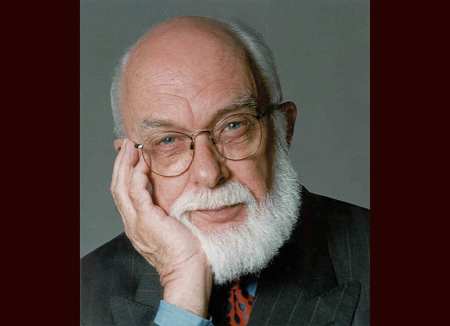
Yesterday I heard the sad news of the death, at the age of 92, of stage conjuror, humanist and famous debunker of charlatans, James Randi.  I guess quite a few of my readers won’t have heard of him, but he was a really interesting character. His real name was Randall James Hamilton Zwinge and he was born in Toronto. He was a professional magician (i.e. a conjuror) with the stage name “The Amazing Randi” who spent most of the last four decades debunking psychics and exposing fraudulent claims of the paranormal. Those of you out there old enough to remember the 1970s will recall the  “paranormalist”  Uri Geller being a household name for his numerous TV appearances bending spoons, stopping clocks and generally exhibiting supernatural powers. Randi exposed these as simple conjuring tricks, and got himself sued for his trouble.

There’s an interesting connection between the Uri Geller phenomenon and physics. In the 1970s, when Geller was at the height of his popularity, a physicist called John G. Taylor took great interest in him and the things that he appeared to be able to do. Professor of applied mathematics at King’s College, London, Taylor was (and remains) a very distinguished scientist and was the first to take the paranormal phenomena displayed by Geller seriously. When Uri Geller visited Britain in 1974, Taylor conducted scientific tests of Geller’s feats of metal bending using all the paraphernalia of modern science, including a Geiger counter. Taylor also experimented with some of the children and adults who claimed to manifest psychic abilities after seeing Uri Geller’s appearances on British television programs. Taylor’s interest in such phenomena was not only in its scientific validation, but also in investigation of the way in which such phenomena take place and the nature of the forces involved. He suggested the phenomena may be some low-frequency electromagnetic effect generated by human beings.

Through the 1970s Taylor was regarded as fully endorsing the paranormal metal bending of Uri Geller, but gradually has made more guarded statements; then in 1980 he largely retracted his support for Geller’s paranormal talents. In 1974 he wrote

The Geller effect—of metal-bending—is clearly not brought about by fraud. It is so exceptional it presents a crucial challenge to modern science and could even destroy the latter if no explanation became available.

Taylor then spent three years of careful investigation of such phenomena as psychokinesis, metal bending, and dowsing, but could not discover any reasonable scientific explanation or validation that satisfied him. He was particularly concerned to establish whether there is an electromagnetic basis for such phenomena. After failing to find this he did not believe that there was any other explanation that would suffice. Most of his experiments under laboratory conditions were negative; this left him in a skeptical position regarding the validity of claimed phenomena.

In contrast to the endorsement in his first book, Superminds, he published a paper expressing his doubts in a paper in Nature (November 2, 1978) titled “Can Electromagnetism Account for Extra-sensory Phenomena?” He followed this with his book Science and the Supernatural (1980) in which he expressed complete skepticism about every aspect of the paranormal. In his final chapter he stated:

We have searched for the supernatural and not found it. In the main, only poor experimentation [including his own], shoddy theory, and human gullibility have been encountered.

Taylor’s investigation of the Geller effect is interesting because it shows that physics doesn’t have all the answers all the time, particularly not when the phenomena in question involve people. Physics research proceeds by assuming that Nature is not playing tricks, and that what can be measured must represent some sort of truth. This faith can be easily exploited by a charlatan. James Randi always argued that scientists aren’t the right people to detect tricks performed by people: this is best left to tricksters. There’s no reason to believe that a theoretical physicist – no matter how brilliant – can spot the way a clever deception is carried out. The best person to see that is a magician, someone like James Randi. Set a thief to catch a thief, and all that…

I wrote a blog post about James Randi about a decade ago because it was not until then, when he had reached the age of 81 that he revealed to the public that he was gay. I feel a bit sad that took him so long to step out of the closet, but I’m sure he was glad he made the decision. From wikipedia I learn that he married his partner José Alvarez in 2013. I hope their time together was happy, and send my condolences to José  on his loss.

Rest in peace, James Randi (1928-2020).
A Question of Phosphine

Posted in Astrohype, The Universe and Stuff with tags , , , on October 21, 2020 by telescoper

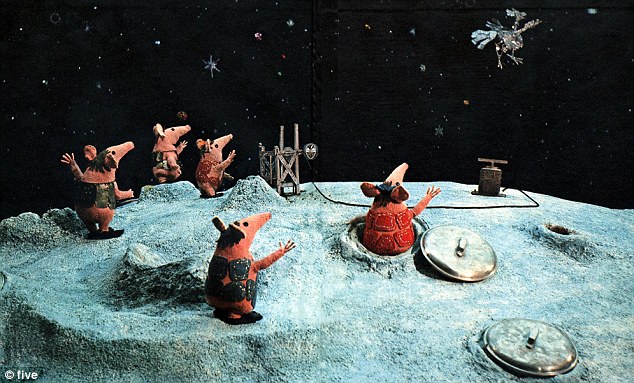
Remember all the excitement last month about the claimed detection of phlogiston phosphine in the atmosphere of Venus?

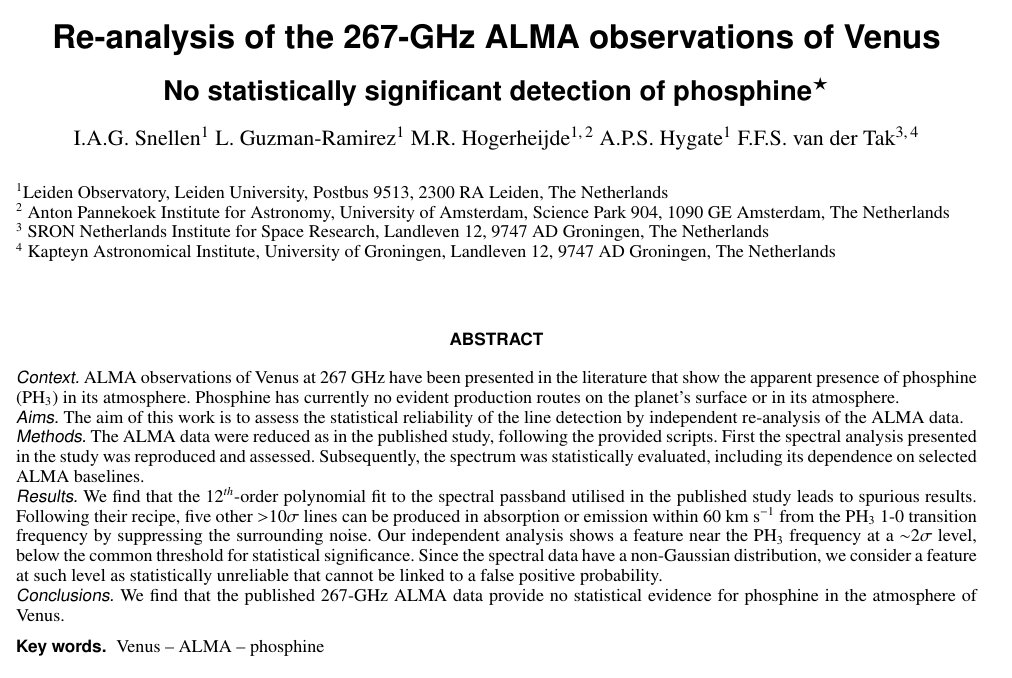
Well, a wet blanket appears to have been thrown over it by a new paper on the arXiv by Snellen et al. Here is the abstract:

The conclusions are very clear, but the paper hasn’t been refereed yet. Let’s see what the authors of the original work have to say. For myself, I think a proper (i.e. Bayesian) analysis of the data is called for…

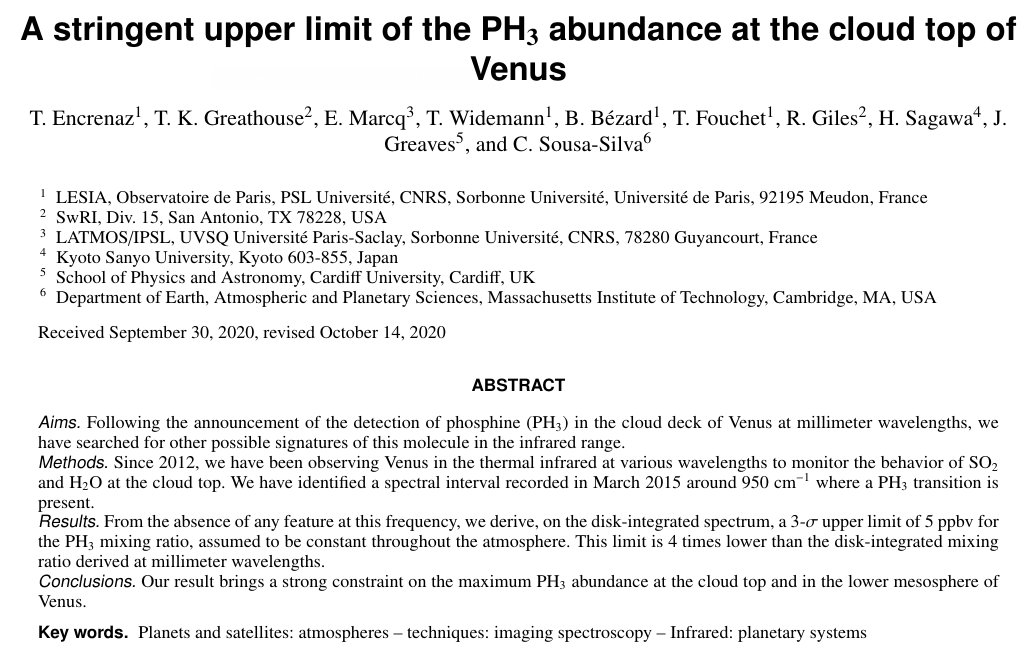
I should also mention in this context another paper on the arXiv from a few days ago, which uses a null detection to place an upper limit on the phosphine abundance.

Note that one of the authors of this second paper is Jane Greaves, who was on the original discovery paper.

A Test of the Cosmological Principle using Quasars

Posted in The Universe and Stuff with tags , , , , on October 8, 2020 by telescoper

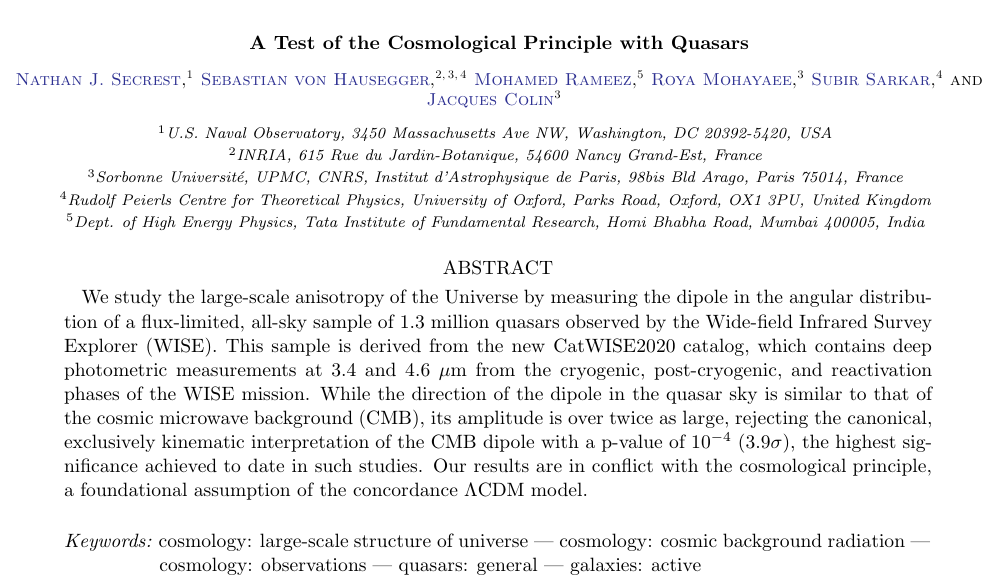
I’m not getting much time these days to even think about cosmology but Subir Sarkar drew my attention to an intriguing paper by his team so I thought I’d share it here. Here is the abstract and author list:

I find this an intriguing result because I’ve often wondered about the dipole anisotropy of the cosmic microwave background might not be exclusively kinematic in origin and whether they might also be a primordial contribution. The dipole (180°) variation corresponds to a ΔT/T of order 10-3, which a hundred times larger than the variation on any other angular scale. This is what it looks like:

This is usually interpreted as being due to the motion of the observer through a frame in which the cosmic microwave background is completely isotropic. A simple calculation then gives the speed of this motion using ΔT/T ≈ v/c. This motion is assumed to be generated by gravitational interaction with local density fluctuations rather than being due to anything truly cosmological (i.e. of primordial origin).

The features in the cosmic microwave background temperature pattern on smaller angular scales (the quadrupole, octopole, etc…) , which have ΔT/T of order 10-5 are different in that they are dominated by primordial density fluctuations. There should be a primordial dipole at some level, but the fact that these other harmonic modes have such low amplitudes and the assumption that the primordial dipole should be of the same order, combined with the fact that the CMB dipole does indeed roughly line up with the dipole expected to be generated by local inhomogeneities, has led to the widespread belief that this intrinsic dipole is negligible. This analysis suggests that it might not be.

What the authors have done is study the anisotropy of a large sample of quasars (going out to redshifts of order three) finding the dipole to be larger than that of the CMB. Note however that the sample does not cover the whole sky because of a mask to remove regions wherein AGN are hard to observe:

As well as the mask there are other possible systematics that might be at play, which I am sure will be interrogated when the paper is peer-reviewed which, as far as I know, is not yet the case.

P.S. I might just quibble a little bit about the last sentence of the abstract. We know that the Universe violates the cosmological principle even in the standard model: with scale-invariant perturbations there is no scale at which the Universe is completely homogeneous. The question is really how much and in what way it is violated. We seem to be happy with 10-5 but not with 10-3

Update: On 23rd October Subir will be giving a talk about this an participating in a debate. For more details, see here.

Astronomy Look-alikes No. 101

Posted in Astronomy Lookalikes, Television, The Universe and Stuff with tags , , , , , on October 6, 2020 by telescoper

One winner of the 2020 Nobel Prize for Physics, Roger Penrose, is based in Oxford where he also plays Chief Superintendent Bright in the popular TV detective series Endeavour

The 2020 Nobel Prize for Physics

Posted in The Universe and Stuff with tags , , , on October 6, 2020 by telescoper

I don’t know about you but I was a bit surprised by this year’s announcement of the Physics Nobel Prize but that’s largely because it went to something cosmic last year and not because I disapprove in any way. Roger Penrose’s work in the 1960s on the black hole singularity theorems is rightly famous and the observational discovery of the supermassive black hole in the centre of the Milky Way is also more than worthy of recognition.

Congratulations to Roger Penrose, Reinhard Genzel and Andrea Ghez!

New Publication at the Open Journal of Astrophysics!

Posted in OJAp Papers, Open Access, The Universe and Stuff with tags , , , , , , on October 2, 2020 by telescoper

Time to announce another new paper in the Open Journal of Astrophysics. The latest publication is by Amy Louca and Elena Sellentin, both of the Sterrewacht Leiden in the The Netherlands, and is entitled The impact of signal-to-noise, redshift, and angular range on the bias of weak lensing 2-point functions. This is another one for the Cosmology and Nongalactic Astrophysics folder.

Here is a screen grab of the overlay:

You can click on the image to make it larger should you wish to do so. You can find the arXiv version of the paper here.

We actually published this one a few days ago but there was a slight delay registering the metadata and also I was very busy, so this post is a little late. With this paper, we have published as many papers so far in 2020 as we did in 2019 so with several more in the pipeline this looks like being our busiest year

17 Postdoctoral Positions in Astronomy all at the same Institution!

Posted in The Universe and Stuff with tags , , on October 1, 2020 by telescoper

I know how difficult it is for budding astronomers to find postdoctoral positions, so when I saw that there are no fewer than 17 such positions have become available at the same time at the same institution – Instituto de Astrofísica de Canarias (IAC) on Tenerife (Spain) – I couldn’t resist sharing. Postdoc positions are a bit like buses: you can wait ages for one,  and then seventeen come along all at the same time!

Below you will find links these positions, most of which have deadlines at the end of October (except one with has 15th October, and one at the end of November). Applicants must have their PhD by the time of the application deadline.

The Galaxias 2020 post is in Johan Knapen’s group, and can be to work on deep imaging from LSST.

You will see that 12 of the 17 positions are for 4-year ‘Advanced Fellow’ positions, several of which are in the area of formation and evolution of galaxies. Other areas are Solar physics, exoplanets, stellar and interstellar physics, Milky Way and Local Group, and cosmology & astroparticles.

Other galaxies-related positions are the HARMONI and the ‘Estallidos’ ones; EUROCC is for supercomputing support.

– 12 contratos PS-2020-040 Advanced -Fellows SO 2020 (deadline: 31/10/20)
https://www.iac.es/en/employment/doce-contratos-postdoctorales-advanced-fellows-so-2020twelve-postdoctoral-contracts-advanced-fellows-so-2020-ps

– 1 contrato PS-2020-041 Galaxias 2020 (deadline: 31/10/20)
https://www.iac.es/en/employment/un-contrato-postdoctoral-galaxias-2020one-postdoctoral-contract-galaxias-2020-ps-2020-041

– 1 contrato PS-2020-043 HARMONI 2020 (deadline: 31/10/20)
https://www.iac.es/en/employment/un-contrato-postdoctoral-harmoni-2020one-postdoctoral-contract-harmoni-2020-ps-2020-043

– 1 contrato PS-2020-044 Astroparticulas-MAGIC 2020 (deadline 30/11/20)
https://www.iac.es/en/employment/un-contrato-postdoctoral-astroparticulas-magicone-postdoctoral-contract-astroparticulas-magic-2020-ps-2020-044

– 1 contrato PS-2020-045) EUROCC 2020 (deadline: 31/10/20)
https://www.iac.es/en/employment/un-contrato-postdoctoral-eurocc-2020one-postdoctoral-contract-eurocc-2020-ps-2020-045

– 1 contrato PS-2020-049 Estallidos 2020 (deadline: 15/10/20)
https://www.iac.es/en/employment/un-contrato-postdoctoral-estallidos-2020one-postdoctoral-contract-estallidos-2020-ps-2020-049