Archive for the The Universe and Stuff Category

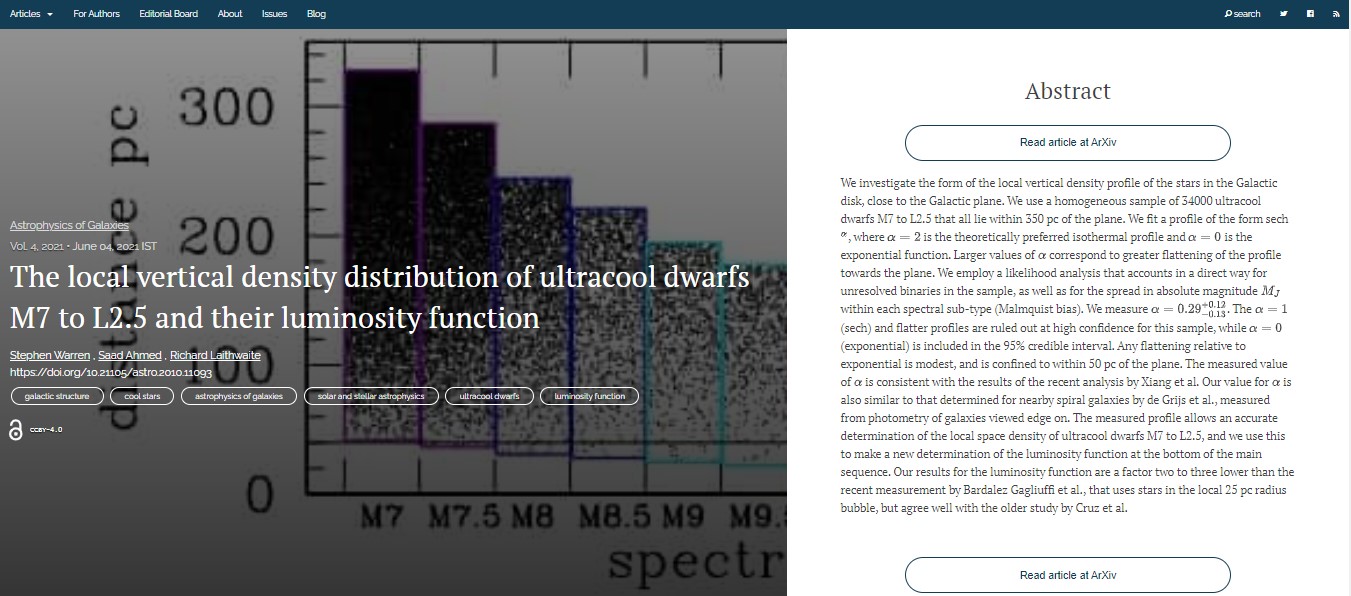
Cosmology Talks about the Open Journal of Astrophysics

Posted in Open Access, The Universe and Stuff with tags , , on May 3, 2021 by telescoper

I have from time to time posted videos from the series of Cosmology Talks curated by Shaun Hotchkiss. These are usually technical talks at the level you might expect for a cosmology seminar, but this time it’s something different. Shaun asked me if I’d like to give a talk about the Open Journal of Astrophysics, so one night last week we recorded this. We ended up chatting about quite a lot of things so it turned out longer than most of the videos in the series, but it’s not a technical talk so I hope you’ll find it bearable!

Cosmology from Home

Posted in The Universe and Stuff on April 29, 2021 by telescoper

Just a quick post to pass on an announcement about the forthcoming Cosmology from Home 2021 conference.

Cosmology from Home is an online cosmology conference with a novel format aimed at bringing the real-world workshop experience into the virtual domain. The format includes the use of pre-recorded talks, and a combination of asynchronous and scheduled live discussions. A freely-navigated virtual office space also facilitates ongoing, organic discussions. The conference will bring together cosmologists from around the world to discuss the current state of cosmology at the interface of theory and observations. For more details see here.

Registration for this event is now open here.

Please note that there will be a limited number of participants so book early!


The State of the Universe Talk

Posted in Biographical, Books, Talks and Reviews, Talks and Reviews, The Universe and Stuff on April 26, 2021 by telescoper

When I saw the calibre of the other speakers in the Chalonge – De Vega Series organized by Norma Sanchez- including a number of Nobel Laureates – it was with some trepidation that I accepted the invitation to give a Colloquium, but there we are. I’m on the list. If you want to attend the Colloquium (via Zoom) you can register for it here. This series was originally named after Daniel Chalonge but was renamed to honour Hector de Vega, who sadly passed away in 2015.

I used to get invited quite often to the famous Norma Sanchez Schools and Conferences in Paris and Sicily (both Erice and Palermo) but then, about a year ago. I was suddenly stopped receiving invitations. I gather that a number of other colleagues have also been abruptly “cancelled” over the years. Anyway it seems I’m back on the list, at least virtually, possibly owing to some form of administrative error.

I remember one year in Erice at the end of a talk I gave (in the OHP/Transparency era) Norma Sanchez, who was meant to be chairing the questions and discussion started writing on my transparencies, crossing out the word “theory” and replacing it with “model”. That event made quite an impression on the audience who thought it was hilarious and people who were there often remind me of it. Coincidentally, I thought of that event when I wrote Saturday’s post. Since the forthcoming colloquium is via Zoom I think I’ll be safe from any such intervention this time.

Backwards and Forwards in Science

Posted in Biographical, Maynooth, The Universe and Stuff on April 24, 2021 by telescoper

I spent a few hours today involved with our Open Day at Maynooth University, including – as I mentioned here – giving a presentation about Theoretical Physics to complement one about Experimental Physics followed by a couple of hours of Q&A. It was a bit of a shame to be cooped up inside on such a lovely Spring day but we had a lot of interesting questions and it was all quite enjoyable.

One of the things that I tried to stress in my talk is that while there theorists and experimentalists (or observers), real science is about the interplay between the two, which I’ve illustrated in the above diagram which I use sometimes when talking about cosmology though it applies to other disciplines.

We have theoretical models – normally including a set of free parameters which we don’t know how to fix a priori. What we can do though is calculate the consequences if we did know the values of these parameters. That forward calculation is represented by the upward arrow, using theory to predict the result of a measurement. The backward calculation (inverse reasoning) involves using the measurements to infer values for the free parameters; that’s represented by the downward arrow. There’s usually a considerable amount of back-and-forth between theory space and measurement space as scientific knowledge develops. If one version of a model doesn’t fit we can adjust its parameters until it does, then we might need new data to test this iteration. It is only when the theoretical slack is sufficiently tight and freedom to adjust parameters is eliminated or severely restricted can we really test a theoretical idea definitively.

In cosmology we have only a handful of free parameters and this process has worked pretty well in providing a model in which these parameters are tightly constrained by a host of observational results. This is the standard model and although there a “tensions”, most prominently concerning the Hubble Constant, the model has survived very well. The same situation holds for the standard model of particle physics, though there is tension concerning the muon magnetic moment that I blogged about here.

I’ve written quite a lot on this blog about the inverse reasoning step – partly because I think there are many people (even professional scientists) who don’t understand this part very well and partly because cosmology provides a good example of a model with elements that can’t be calculated from first principles.

It struck me this morning, however, in answering a question about the muon magnetic moment that we often tend to assume that the forward calculation is somehow trivial. In fact the theoretical calculation of (g-2) is nothing of the sort: it requires lengthy supercomputer computations before the theory can make a prediction and there is some doubt over whether the current values of the theoretically expected value of the muon dipole moment are correct within the model.

The same issue arises in cosmology. It is not at all easy to calculate, for example, detailed properties of galaxy clustering in a given cosmological model. The forward calculation here uses huge N-body experiments. This is why a very considerable part of the effort being expended in preparation for the European Space Agency’s Euclid mission is on the simulation side.

Both particle physics and cosmology – and no doubt other fields – are thus limited by how well we can do the forward calculation and that is not going to change very soon. Nevertheless it is the interplay between theory and measurement that has driven the progress so far, and it will continue to do so even if it is the case that the more progress we make the harder it gets to go further.

Climate Change Research at Maynooth University

Posted in Maynooth, The Universe and Stuff on April 23, 2021 by telescoper

Did you know that Maynooth University is Ireland’s leading institution for climate change research and teaching? Researchers are internationally recognized and they are working in areas such as climate modelling, investigating severe weather events and their mitigation, right through to examining the social and economic impacts of climate change.

Here’s a little video about it.

Theorists and Experimentalists in Physics

Posted in Education, Maynooth, The Universe and Stuff with tags , , , on April 22, 2021 by telescoper

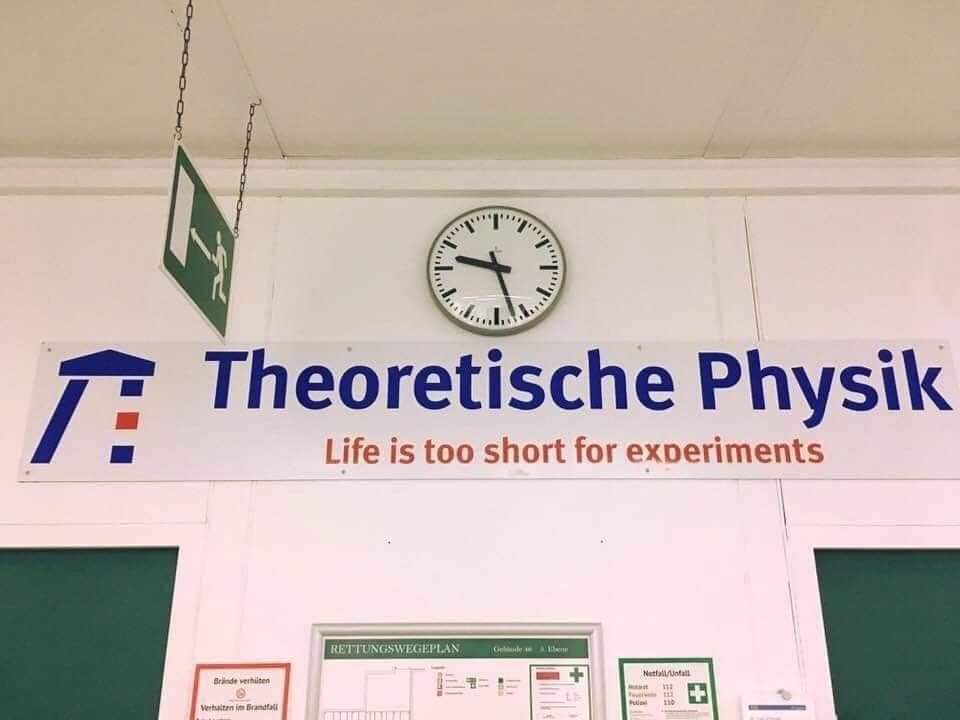
Regular readers of his blog (Sid and Doris Bonkers) will know that here at Maynooth University there are two Physics departments, one the Department of Theoretical Physics (of which I am a Faculty member) and the other the Department of Experimental Physics. These two units are in the same building but have so far have been largely separate in terms of teaching and research; Experimental Physics (EP) is somewhat larger in terms of staff and student numbers than Theoretical Physics (TP).

For instance, when students enter on our General Science degree programme they have to choose four subjects in the first year, including Mathematics (much as I did when I did my Natural Sciences degree at Cambridge back in the day). Picking `double physics’ (i.e. Experimental Physics and Theoretical Physics) uses up two of those choices, whereas Physics was a single choice in the first year of my degree. In the second year of this programme students do three subjects so can continue with both Theoretical and Experimental Physics (and another) , as they can in Year 3 where they do two subjects, and in Year 4 where they can do a single Major in either TP or EP or a double Major doing a bit of both.

To confuse matters still further, the Department of Theoretical Physics only changed its name from the Department of Mathematical Physics relatively recently and some of our documentation still carries that title. Quite often I get asked what’s the difference between Theoretical Physics and Mathematical Physics? As far as Maynooth is concerned we basically use those terms interchangeably and, although it might appear a little confusing at first, having both terms scattered around our webpages means that Google searches for both `Mathematical Physics’ and `Theoretical Physics’ will find us.

The Wikipedia page for Theoretical Physics begins

Theoretical physics is a branch of physics that employs mathematical models and abstractions of physical objects and systems to rationalize, explain and predict natural phenomena. This is in contrast to experimental physics, which uses experimental tools to probe these phenomena.

This is what Wikipedia says about Experimental Physics:

Experimental physics is the category of disciplines and sub-disciplines in the field of physics that are concerned with the observation of physical phenomena and experiments. Methods vary from discipline to discipline, from simple experiments and observations, such as the Cavendish experiment, to more complicated ones, such as the Large Hadron Collider.

I count myself as a theoretical physicist (that’s what I did in Part II at Cambridge, anyway) though I do work a lot with data and many of the researchers in my discipline (cosmology) actually work at the interface between theory and experiment, so the distinction between theorists and experimentalists is perhaps not a very useful one.

As a matter of fact I think there’s a good case for theoretical physicists to have at least some experience of practical experimental work. There are two reasons for this:

  1. to understand about errors in measurement and how to treat them properly using statistical methods;
  2. to learn how easy it is to break expensive laboratory equipment.

In the past during Open Days I have asked the audience of prospective physics students if they could name a famous physicist. Most popular among the responses were the names you would have guessed: Einstein, Hawking, Feynman, Dirac, Newton, Schrodinger, and some perhaps less familiar names such as Leonard Susskind and Brian Greene. Every single one of these is (or was) a theorist of some kind. This is confirmed by the fact that many potential students mention similar names in the personal statements they write in support of their university applications. For better or worse, it seems that to some potential students at least Physics largely means Theoretical (or Mathematical) Physics.

Although it is probably good for our recruitment that there are so many high-profile theoretical physicists, it probably says more about how little the general public knows about what physics actually is and how it really works. No doubt there are many prospective students who are primarily drawn to laboratory work just as there are many drawn to theoretical calculations. But there are probably others whose interests encompass both. For me the important thing is the interplay between theory and experiment (or observation), as it is in that aspect where the whole exceeds the sum of the parts.

Anyway, this year we’ve been thinking very hard about bringing about closer cooperation between the two Physics Departments at Maynooth. It remains to be seen precisely what form that closer cooperation will take but I think it’s a good idea in principle. In fact in the Open Day at Maynooth coming up on Saturday 24th April there will, for the first time ever, be a joint talk by the Departments of Theoretical Physics and Experimental Physics. I’m looking forward to seeing how that goes!

Oh Larmor! Energy in Electromagnetic Waves

Posted in Cute Problems, The Universe and Stuff with tags , , , on April 16, 2021 by telescoper

This week I started the bit of my Advanced Electromagnetism module that deals with electromagnetic radiation, including deriving the famous Larmor Formula. It reminded me of this little physics riddle, which I thought I’d share again here.

As you all know, electromagnetic radiation consists of oscillating electric and magnetic fields rather like this:

Figure10.1

(Graphic stolen from here.) The polarization state of the wave is defined by the direction of the Electric field, in this case vertically upwards.

Now the energy carried by an electromagnetic wave of a given wavelength is proportional to the square of its amplitude, denoted in the Figure by A, so the energy is of the form kA2 in this case with k constant. Two separate electromagnetic waves with the same amplitude and wavelength would thus carry an energy = 2kA2.

But now consider what happens if you superpose two waves in phase, each having the same wavelength, polarization and amplitude to generate a single wave with amplitude 2A. The energy carried now is k(2A)2 = 4kA2, which is twice the value obtained for two separate waves.

Where does the extra energy come from?

Answers through the Comments Box please!

The Moon and Blackrock Castle

Posted in Art, The Universe and Stuff with tags , on April 14, 2021 by telescoper

Picture Credit: Cian O’Regan

This image of February’s Full Moon (the “Snow Moon”) by Blackrock Castle Observatory in Cork is by Cian O’Regan. Prints of this and other beautiful images can be bought from his website here.

Testing Cosmological Reciprocity

Posted in The Universe and Stuff with tags , , on April 13, 2021 by telescoper

I have posted a few times about Etherington’s Reciprocity Theorem in cosmology, largely in connection with the Hubble constant tension – see, e.g., here.

The point is that if the Universe is described by a space-time with the Robertson-Walker Metric (which is the case if the Cosmological Principle applies in the framework of General Relativity) then angular diameter distances and luminosity distances can differ only by a factor of (1+z)2 where z is the redshift: DL=DA(1+z)2.

I’ve included here some slides from undergraduate course notes to add more detail to this if you’re interested:

The result DL=DA(1+z)2 is an example of Etherington’s Reciprocity Theorem and it does not depend on a particular energy-momentum tensor; the redshift of a source just depends on the scale factor when light is emitted and the scale factor when it is received, not how it evolves in between.

Etherington’s theorem requires light rays to be described by null geodesics which would not be the case if photons had mass, so introducing massive photons would violate the theorem. It also requires photon numbers to be conserved, so some mysterious way of making photons disappear might do the trick, so adding some exotic field that interacts with light in a peculiar way is another possibility, as is the possibility of having a space-time with torsion, i.e. a non-Riemannian space-time.

Another possibility you might think of is to abandon the Robertson-Walker metric. We know that the Universe is not exactly homogeneous and isotropic, so one could appeal to the gravitational lensing effect of lumpiness to provide a departure from the simple relationship given above. In fact a inhomogeneous cosmological model based on GR does not in itself violate Etherington’s theorem, but it means that the relation DL=DA(1+z)2 is no longer global. In such models there is no way of defining a global scale factor a(t) so the reciprocity relation applies only locally, in a different form for each source and observer. In order to test this idea one would have to have luminosity distances and angular diameter distances for each source. The most distant objects for which we have luminosity distance measures are supernovae, and we don’t usually have angular-diameter distances for them.

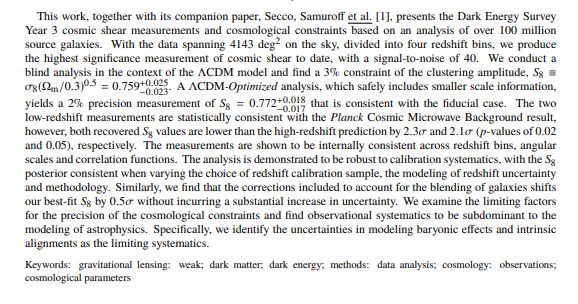
Anyway, these thoughts popped back into my head when I saw a new paper on the arXiv by Holanda et al, the abstract of which is here:

Here we have an example of a set of sources (galaxy clusters) for which we can estimate both luminosity and angular-diameter distances (the latter using gravitational lensing) and thus test the reciprocity relation (called the cosmic distance duality relation in the paper). The statistics aren’t great but the result is consistent with the standard theory, as are previous studies mentioned in the paper. So there’s no need yet to turn the Hubble tension into torsion!

Theoretical Uncertainty and Uncertain Theory

Posted in The Universe and Stuff on April 10, 2021 by telescoper

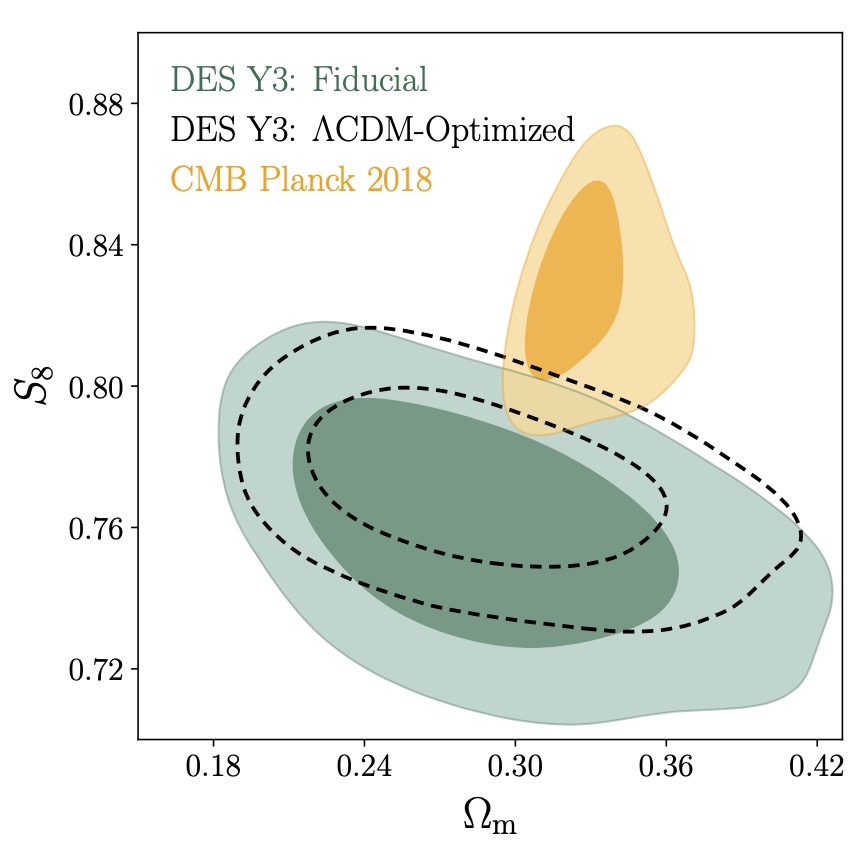
Here’s a discussion of the status of the latest measurements of (g-2) versus theory. This kind of problem is not confined to particle physics. It also happens in cosmology that we have problems making accurate predictions to compare with observations, especially when using galaxies to trace large-scale structure. There’s a lot of messy astrophysics to be accounted for.

4gravitons's avatar4 gravitons

Yesterday, Fermilab’s Muon g-2 experiment announced a new measurement of the magnetic moment of the muon, a number which describes how muons interact with magnetic fields. For what might seem like a small technical detail, physicists have been very excited about this measurement because it’s a small technical detail that the Standard Model seems to get wrong, making it a potential hint of new undiscovered particles. Quanta magazine has a great piece on the announcement, which explains more than I will here, but the upshot is that there are two different calculations on the market that attempt to predict the magnetic moment of the muon. One of them, using older methods, disagrees with the experiment. The other, with a new approach, agrees. The question then becomes, which calculation was wrong? And why?

What does it mean for a prediction to match an experimental result? The simple, wrong, answer is…

View original post 736 more words