Episode 1, in which I explain why stars are not very good at generating power and that a couch potato radiates more energy per kilogram than the Sun.
Follow @telescoper
Episode 1, in which I explain why stars are not very good at generating power and that a couch potato radiates more energy per kilogram than the Sun.
Follow @telescoper
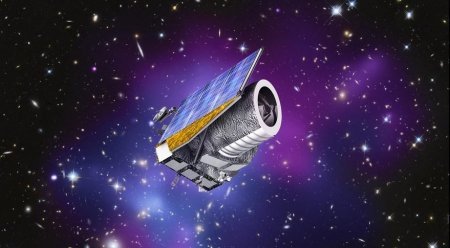
It’s a bright sunny Bank Holiday Monday and I’m here in my flat in Maynooth taking a coffee break before resuming work from home.
Before the Covid-19 outbreak started I had imagined that I’d be spending this week (or at least most of it) in Sitges near Barcelona for the annual Euclid Consortium Meeting which was planned to take place there. That has understandably been cancelled and replaced with a virtual meeting. Yet more Zoom sessions beckon…
Over the past weeks my workload has increased enormously but I’ve tried to clear the decks a little so I can tune in to some of the sessions but I won’t be able to make them all or even most.
I hope the virtual meeting goes well. Euclid is due to be launched in 2022 so time is getting short and there is much preparatory work still to do.
Well, talking of work I better get back to it! The first plenary is not until this afternoon and I’ve lots to do before then.
I wonder if normality will have returned in time for there to be a Euclid Consortium Meeting next year?
Follow @telescoper
I was so busy at the weekend that although I had the date in my diary I forgot to write a post on 26th April, which was the centenary of the Great Debate that took place on 26th April 1920 at the Smithsonian Museum of Natural History.
The principal protagonists on the US debate were astronomers Harlow Shapley and Heber Curtis. It concerned the nature of so-called spiral nebulae (such as the Andromeda Nebula M31 shown above) and the size of the Universe.
Shapley argued the case that distant nebulae were relatively small and lay within the outskirts of Earth’s home galaxy, while Curtis held that they were in fact independent galaxies, implying that they were exceedingly large and distant.
The two scientists first presented independent technical papers about “The Scale of the Universe” during the day and then took part in a joint discussion that evening. Two papers outlining their opposing positions were subsequently published by Shapley and by Curtis in the May 1921 issue of the Bulletin of the National Research Council. The published papers each included counter arguments to the position advocated by the other scientist at the 1920 meeting.
Many at the time felt that Shapley had won the debate, interpretating the Milky Way as the entire Universe rather than just one of many galaxies. The spiral nebulae were relatively nearby, possibly solar systems in the process of formation.
A key piece of evidence in favour of the Shapley argument was provided by Adriaan van Maanen, who claimed to have measured the rotation a spiral nebula which implied the object had to be nearby. Van Maanen’s measurements were later shown to be incorrect. Moreover, within a decade, Edwin Hubble and others had established that the spiral nebulae are in fact large and enormously distant; they galaxies like our own Milky Way.
Two things struck me about this story. One is that it illustrates that its not unusual for a majority scientists to be wrong about something. Debates like this are really not very good for settling scientific arguments. In the end it the data count far more than opinions.
The second is that it is remarkable to think that just a century ago we knew so little about the Universe. Our modern view of the Universe may well turn out to be wrong in some important respects but I still think we can say we know more now than we did then!
I’m reminded of this quote:
Follow @telescoperWe have not succeeded in answering all our problems. The answers we have found only serve to raise a whole set of new questions. In some ways we feel we are as confused as ever, but we believe we are confused on a higher level and about more important things.
Well Maynooth University may have been closed by the Coronavirus but the The Open Journal of Astrophysics certainly has not!
In fact we have just published another paper! This one is called Discrete Chi-square Method for Detecting Many Signals and the author is Lauri Jetsu of the University of Helsinki in Finland.
Here is a grab of the overlay as it appears on my phone:
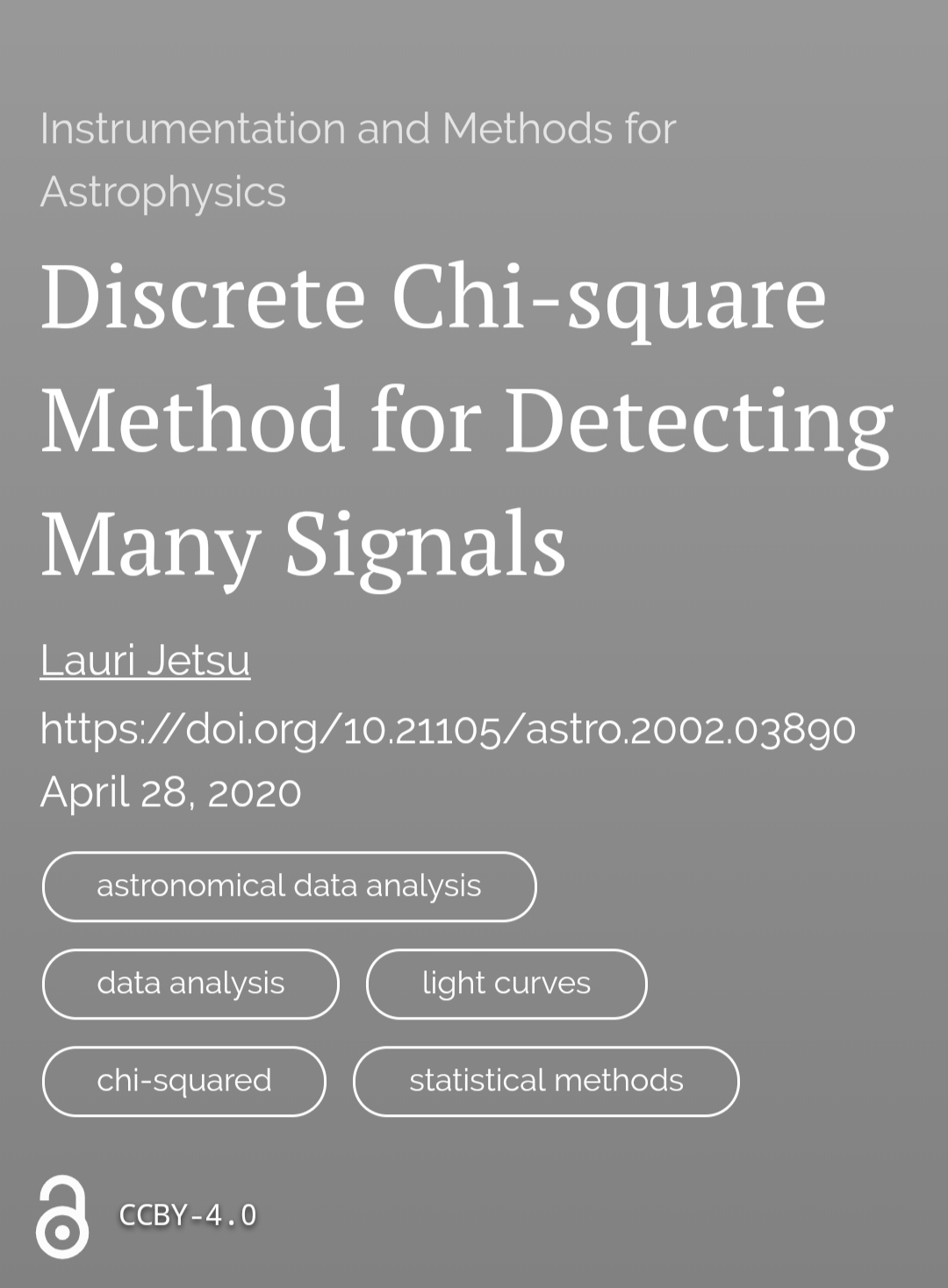
You can find the arXiv version of the paper here.
I’d like to take this opportunity to thank the Editorial team and various referees for their efforts in keeping the Open Journal of Astrophysics going in these difficult times.
Follow @telescoperAnd now for something completely different.
I was listening to the radio last night – specifically to Bernard Clarke’s Blue of the Night on RTÉ Lyric FM – as a result of which I heard a fascinating piece of music by a composer who is new to me, John McClachlan. The composition I heard was a miniature with an astrophysical theme called Sagittarius A* (the name of the supermassive black hole at the centre of the Milky Way Galaxy) . It turns out that this piece is the first of 12 such miniatures composed during the ‘cultural wave’ of the current Covid-19 lockdown. I gather one is going to played every evening on Blue of the Night for the next few weeks.
All these miniatures are on astrophysical themes, which gives me another excuse for posting them in a playlist here!
Follow @telescoperIf you are missing your regular seminar experience because of the Coronavirus lockdown, Shaun Hotchkiss has set up a YouTube channel just for you!
The channel features technical talks rather than popular expositions so it won’t be everyone’s cup of tea but for those seriously interested in cosmology at a research level they should prove interesting.
Here’s another example from that series in which Jurek Bauer talks about ‘Fuzzy’ Dark Matter (ie matter in the form of a very light particle such as the axion) and the prospects for constraining its existence using the Square Kilometre Array.
P. S. The paper that accompanies this talk can be found on the arXiv here.
Follow @telescoper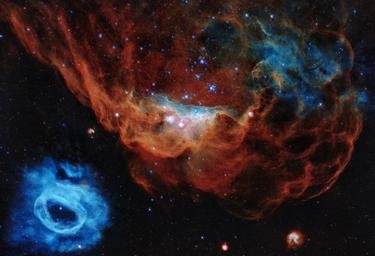
Today marks the 30th anniversary of the launch of the Hubble Space Telescope in 1990 on the Space Shuttle Discovery. Despite a problematic start to its career – it was made with a defective mirror that had to be corrected after launch – this space observatory has been stunningly successful over its thirty year career.
The picture above has been chosen to mark this important anniversary. It shows the giant red nebula (NGC 2014) and its smaller blue neighbour (NGC 2020), part of a vast star-forming region in the Large Magellanic Cloud, a satellite galaxy of the Milky Way, located 163,000 light-years away. The image is nicknamed the “Cosmic Reef,” because NGC 2014 resembles part of a coral reef floating in a vast sea of stars.
Happy Birthday Hubble Space Telescope! Let’s hope that your orbit brings many happy returns..
Follow @telescoperIf you are missing your regular seminar experience because of the Coronavirus lockdown, Shaun Hotchkiss has set up a YouTube channel just for you!
The channel features technical talks rather than popular expositions so it won’t be everyone’s cup of tea but for those seriously interested in cosmology at a research level they should prove interesting.
Here’s another example from that series in which Omar Darwish talks about CMB Lensing Maps and specifically about an extremely impressive example thereof which he made using data from the Atacama Cosmology Telescope.
Follow @telescoperThere’s a new paper out that has been making a few waves in cosmology. Here’s the title and abstract:

It’s published in Astronomy & Astrophysics but you can find it on the arXiv here.
Here’s a gratuitous pretty picture showing the distribution of the X-ray clusters used in the analysis.

The discussion in the paper focuses on two possibilities: (i) that the clusters are participating in a large-scale correlated motion; and (ii) that the Expansion of the Universe is not occurring isotropically. The latter option is the one that has attracted the most media attention (presumably because it has the most far-reaching implications). This seems to me to be a very unlikely explanation, however, because anisotropic expansion of the magnitude implied would leave a ~10% signal in the Cosmic Microwave Background which is not observed.
There is, however, a third possibility (admittedly duller than the other two) which is that there is some unknown systematic error in the observations…
Follow @telescoper

