Archive for the The Universe and Stuff Category

More Cosmic Tension?

Posted in The Universe and Stuff with tags , , , , , , , , , on November 12, 2019 by telescoper

Quite a lot of fuss was being made in cosmological circles while I was away last week concerning a paper that had just been published in Nature Astronomy by Eleonora Di Valentino, Alessandro Melchiorri and Joe Silk that claims evidence from the Planck Cosmic Microwave background and other data that the Universe might be closed (or at least have positive spatial curvature) in contrast to the standard cosmological model in which the spatial geometry is Euclidean. Nature Astronomy is behind a paywall but the paper is available for free on the arXiv here. The abstract reads:

The recent Planck Legacy 2018 release has confirmed the presence of an enhanced lensing amplitude in CMB power spectra compared to that predicted in the standard ΛCDM model. A closed universe can provide a physical explanation for this effect, with the Planck CMB spectra now preferring a positive curvature at more than 99% C.L. Here we further investigate the evidence for a closed universe from Planck, showing that positive curvature naturally explains the anomalous lensing amplitude and demonstrating that it also removes a well-known tension within the Planck data set concerning the values of cosmological parameters derived at different angular scales. We show that since the Planck power spectra prefer a closed universe, discordances higher than generally estimated arise for most of the local cosmological observables, including BAO. The assumption of a flat universe could, therefore, mask a cosmological crisis where disparate observed properties of the Universe appear to be mutually inconsistent. Future measurements are needed to clarify whether the observed discordances are due to undetected systematics, or to new physics, or simply are a statistical fluctuation.

I think the important point to take from this study is that estimates of cosmological parameters obtained from Planck are relatively indirect, in that they involve the simultaneous determination of several parameters some of which are almost degenerate. For example, the `anomalous’ lensing amplitude discussed in this paper is degenerate with the curvature so that changing one could mimic the effect on observables of changing the other; see Figure 2 in the paper.

It’s worth mentioning another (and, in my opinion, better argued) paper on a similar topic by Will Handley of Cambridge which is on the arXiv here. The abstract of this one reads:

The curvature parameter tension between Planck 2018, cosmic microwave background lensing, and baryon acoustic oscillation data is measured using the suspiciousness statistic to be 2.5 to 3σ. Conclusions regarding the spatial curvature of the universe which stem from the combination of these data should therefore be viewed with suspicion. Without CMB lensing or BAO, Planck 2018 has a moderate preference for closed universes, with Bayesian betting odds of over 50:1 against a flat universe, and over 2000:1 against an open universe.

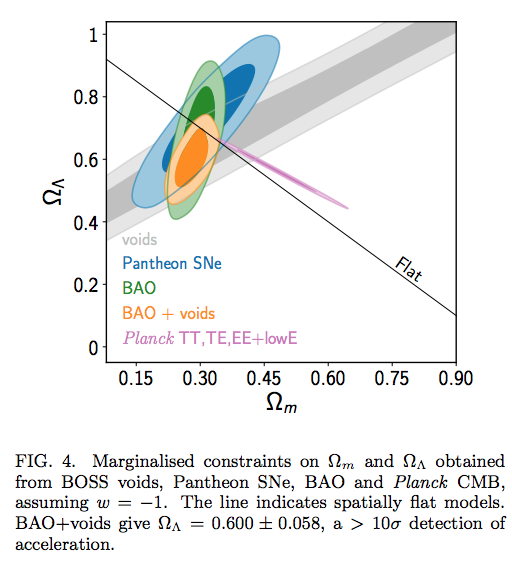
Figure 1 makes a rather neat point that the combination of Planck and Baryon Acoustic Oscillations does not separately give consistent values for the Hubble constant and the curvature and neither does the combination of Planck and direct Hubble constant estimates:

I don’t know what the resolution of these tensions is, but I think it is a bit dangerous to dismiss them simply as statistical flukes. They might be that, of course, but they also might not be. By shrugging one’s shoulders and ignoring such indications one might miss something very fundamental. On the other hand, in my opinion, there is nothing here that definitely points the finger at spatial curvature either: it is possible that there is something else missing from the standard model that, if included, would resolve these tensions. But what is the missing link?

Answers on a postcard, or through the comments box.

The University Strikes are Back!

Posted in Education, The Universe and Stuff with tags , , , , on November 6, 2019 by telescoper

I noticed that a recent ballot of members of the University and College Union (UCU) has delivered a mandate for industrial action across 60 UK universities. Eight days of strikes will start later this month: they will last from November 25th until December 4th. The cause of the dispute is twofold: (1) the long-running saga of the Universities pension scheme (about which there were strikes in 2018); and (2) over pay, equality, workloads and the ever-increasing casualisation of lecturing and other work.

Among the institutions to have voted for strike action are my previous employers Cardiff, Sussex and Nottingham.
It seems to have taken a long time to count the votes in the case of Sussex UCU, but the result was a large majority in favour of action. It remains to be seen what the impact of these strikes will be, but they could affect a very large number of students. Nobody likes going on strike but the UK higher education system is a very poor state right now, and many of my former colleagues feel that they have no alternative.

Anyway, the real purpose of this short post is simply to express solidarity with those taking industrial action. It it set to be a big struggle, but I wish everyone taking part all the best on the picket lines!

The Cosmic Web in Maynooth

Posted in Books, Talks and Reviews, Talks and Reviews, The Universe and Stuff with tags , , on November 5, 2019 by telescoper

Next week (10th to 17th November) in Ireland is Science Week and this will be celebrated by a number of events here in Maynooth, among which is a talk by yours truly on 15th November:

Here is a short description:

How can we map the distribution of galaxies over thousands of millions of light years? What does the Universe look like on these scales? How did get to look like that? And how do we know?This talk will explain how astronomers and cosmologists have come together over the past couple of decades to make huge surveys of the Universe, revealing the existence of a complex but beautiful `Cosmic Web’ with vast chains of galaxies strung out around immense dark voids. These observational breakthroughs have been mirrored by advances in theory and computer simulation that allow us to understand how this amazing structure was born 14 billion years ago in the Big Bang and has been growing and evolving ever since. Free and open to TY, 5th and 6th year students, this talk will be of particular interest in those interested astronomy, space, physics and the Universe itself!

It is on in the morning to make it possible for school students to attend and the talk is adapted to this audience, so it won’t be the same as the one I gave in Dublin last week. The timing seems to have worked because the lecture theatre has over 200 seats in it but is already almost full. There are still a few places available so if you’re in the area you can book here.


First Light at the Dark Energy Spectroscopic Instrument

Posted in The Universe and Stuff with tags , , , , , , on November 4, 2019 by telescoper

While I was away last week there was quite a lot of press coverage (e.g. here) about the new Dark Energy Spectroscopic Instrument, which has just seen first light. I didn’t have time to mention this until now, and in any case  I have little to add to the coverage that has already appeared, but it does give me the excuse to post this nice video – which features quite a few people I actually know! – to describe  the huge galaxy survey that DESI will perform. It’s hard to believe that when I started in the field in 1985 the largest such survey, which took several years to compile, had only a few thousand galaxies in it. The DESI instrument will be able to determine spectra of more sources than that in a single pointing of the telescope that lasts about 20 minutes. Overall it should determine redshifts of over 35 million galaxies! Vorsprung durch Technik.


The Cosmic Web at DIAS

Posted in Books, Talks and Reviews, The Universe and Stuff with tags , , on November 1, 2019 by telescoper

Yesterday evening found me at the Dublin Institute for Advanced Studies, complete with scary Hallowe’en beard, to give a talk.

Picture Credit: Prof. Luke Drury

It was a nice friendly audience and we had a lot of interesting discussions afterwards. As usual on such occasions I’ve put up the slides in case anyone wants to see them:

After the talk I headed back to Maynooth. It was a very rainy night, but at least some of the fireworks were going off despite the potential for damp squibs.

The Royal Society really needs to work on its history of the telescope

Posted in History, The Universe and Stuff with tags , , , on October 30, 2019 by telescoper

An important corrective to frequently repeated fallacies about the history of telescopes in astronomy. The Royal Society really shouldn’t be making mistakes like this!

thonyc's avatarThe Renaissance Mathematicus

One would think that the Royal Society being one of the eldest, but not the eldest as they like to claim, scientific societies in Europe when presenting themselves as purveyors of the history of science, would take the trouble to get their facts right. If, however, one thought this, one would be wrong. Last week on the Internet the Royal Society was pushing a slide show, under their own name, on Google Arts and Culture on the history of the telescope in astronomy that in terms of historical accuracy is less than one, as a historian of science, nay of the telescope, might hope or indeed wish for.

The slide show in question is titled, Silent Harmony: astronomy at the Royal Society: Discover how innovation in telescopes and other optical instruments changed the way we see the universe. Following the title slide we have another general blurb slide…

View original post 835 more words

The Gaia video!

Posted in The Universe and Stuff with tags , on October 24, 2019 by telescoper

I’ve blogged quite a few times about the European Space Agency’s Gaia mission (see this tag). Social media brought this nice new video to my attention this morning so I couldn’t resist adding it to the collection. I don’t think it accompanies any new data release or scientific results but it’s very impressive anyway!

Most Popular Programming Languages 1965-2019

Posted in The Universe and Stuff with tags , , , on October 21, 2019 by telescoper

I find this absolutely fascinating. I’ve programmed in Fortran, Pascal, Basic, Assembler, C, C++, Javascript and Python lived long enough to see quite the fashion for most of these languages come and go on a relatively short timescale. Perhaps it provides a salutary lesson for those who think their current Python codes will always be useful?

Gravitational Lensing, Cosmological Distances and the Hubble Constant

Posted in The Universe and Stuff with tags , , , on October 17, 2019 by telescoper

To continue the ongoing Hubble constant theme, there is an interesting paper on the arXiv by Shajib et al. about determining a distance to a gravitational lens system; I grabbed the above pretty picture from the paper.

The abstract is:


You can click on this to make it bigger. You will see that this approach gives a `high’ value of H0 ≈ 74.2, consistent with local stellar distances measures, rather than with the `cosmological’ value which comes in around H0 ≈ 67 or so. It’s also consistent with the value derived from other gravitational lens studies discussed here.

Here’s my ongoing poll on the Hubble constant, with


More Hubble Constant Tension

Posted in The Universe and Stuff with tags , , , on October 14, 2019 by telescoper

Here’s the abstract of another contribution to ongoing discussions around so-called tension between different estimates of the Hubble Constantpolldaddy (see this blog passim):

You can find the actual paper (by Lin, Mack and Hou) on the arXiv here.

Now, before Mr Hine starts to fill up my blocked comments folder with rants, I will add a few comments of my own.

First, at the Royal Astronomical Society on Friday I discussed all this with a renowned observational astronomer and expert on stellar distance measurements. He agreed with me that if the `tension’ is indeed real then it is far more likely to be a problem with stellar distance measurements than the cosmology.

Second, I am writing a review of all this to be published in Astronomy & Geophysics next year. Watch this space.

Third, this gives me an excuse to include yet again my poll on whether you are worried about the “tension”: