Archive for the The Universe and Stuff Category

What to do if you find yourself inside the horizon of a black hole

Posted in The Universe and Stuff with tags , , , on May 7, 2019 by telescoper

Consider how lucky you are that life has been good to you so far.

Alternatively, if life hasn’t been good to you so far – which, given your current circumstances seems more likely – consider how lucky you are that it won’t be bothering you much longer.

That was the advice given to Ford Prefect by The Hitchhikers Guide to the Galaxy when he looked up `What do if you find yourself in a crack in the ground underneath a giant boulder you can’t move with no hope of rescue’. It seems fairly general advice to me, though. If you want more specific advice on what to do if you find yourself inside the horizon of a black hole then you can find it in an interesting paper on the arXiv with the abstract:

In this methodological paper we consider two problems an astronaut faces with under the black hole horizon in the Schwarzschild metric. 1) How to maximize the survival proper time. 2) How to make a visible part of the outer Universe as large as possible before hitting the singularity. Our consideration essentially uses the concept of peculiar velocities based on the “river model”. Let an astronaut cross the horizon from the outside. We reproduce from the first principles the known result that point 1) requires that an astronaut turn off the engine near the horizon and follow the path with the momentum equal to zero. We also show that point 2) requires maximizing the peculiar velocity of the observer. Both goals 1) and 2) require, in general, different strategies inconsistent with each other that coincide at the horizon only. The concept of peculiar velocities introduced in a direct analogy with cosmology, and its application for the problems studied in the present paper can be used in advanced general relativity courses.

It is advertised as a `methodological paper’ and I don’t know if they are planning experimental studies of this problem. I imagine might be difficult to secure funding.

With Strings Attached?

Posted in Biographical, The Universe and Stuff with tags , on May 6, 2019 by telescoper

Image Credit: Flickr user Trailfan.

I was flicking through various posts on the interwebs this morning while I was having my breakfast and came across one that nearly made me choke on my muesli. What it’s like to be a theoretical physicist is a piece in Stanford University news. In it I found the following quote:

String theory feels like a little superpower that I have, this physical intuition that enables me to make connections and have insights into things that by rights I should not be able to say anything interesting about.

I’ve tried many times to read that in a way that doesn’t come across as arrogant, but I’m afraid I’ve failed – especially because (speaking as a physicist) I don’t think string theory has so far given us any profound insights into physics at all.

Now I’m mindful of the fact that many mathematicians think string theory is great. I’ve had it pointed out to me that it has a really big influence on for example geometry, especially non-commutative geometry, and even some number theory research in the past 30 years. It has even inspired work that has led to Fields medals. That’s all very well and good, but it’s not physics. It’s mathematics.

Of course physicists have long relied on mathematics for the formulation of theoretical ideas. Riemannian geometry was `just’ mathematics before its ideas began to be used in the formulation of the general theory of relativity, a theory that has since been subjected to numerous experimental tests. It may be the case that string theory will at some point provide us with predictions that enable it to be tested in the way that general relativity did. But it hasn’t done that yet and until it does it is not a scientifically valid physical theory.

I remember a quote from Alfred North Whitehead that I put in my PhD DPhil thesis many years ago. I wasn’t thinking of string theory at the time, but it seems relevant:

There is no more common error that to assume that, because prolonged and accurate mathematical calculations have been made, the application of the result to some fact of nature is absolutely certain.

My problem is not with string theory itself but with the fact that so many string theorists have become so attached to it that it has become a universe in its own right, with very little to do with the natural universe which is – or at least used to be – the subject of theoretical physics. I find it quite alarming, actually, that in the world outside academia you will find many people who think theoretical physics and string theory are more-or-less synonymous.

The most disturbing manifestation of this tendency is the lack of interest shown by some exponents of string theory in the issue of whether or not it is testable. By this I don’t mean whether we have the technology at the moment to test it (which we clearly don’t). Many predictions of the standard model of particle physics had to wait decades before accelerators got big enough to reach the required energies. The question is whether string theory can be testable in principle, and surely this is something any physicist worthy of the name should consider to be of fundamental importance?

P.S. This rant reminded me of the time I got severely told off by a very senior British physicist (who shall remain nameless) when I was quoted in Physics World as saying that I thought that in a hundred years time string theory would be of more interest to sociologists than physicists…

Redshift and Distance in Cosmology

Posted in The Universe and Stuff with tags , , , , , on April 29, 2019 by telescoper

I was looking for a copy of this this picture this morning and when I found it I thought I’d share it here. It was made by Andy Hamilton and appears in this paper. I used it (with permission) in the textbook I wrote with Francesco Lucchin which was published in 2003.

I think this is a nice simple illustration of the effect of the density parameter Ω and the cosmological constant Λ on the relationship between redshift and (comoving) distance in the standard cosmological models based on the Friedman Equations.

On the left there is the old standard model (from when I was a lad) in which space is Euclidean and there is a critical density of matter; this is called the Einstein de Sitter model in which Λ=0. On the right you can see something much closer to the current standard model of cosmology, with a lower density of matter but with the addition of a cosmological constant. Notice that in the latter case the distance to an object at a given redshift is far larger than in the former. This is, for example, why supernovae at high redshift look much fainter in the latter model than in the former, and why these measurements are so sensitive to the presence of a cosmological constant.

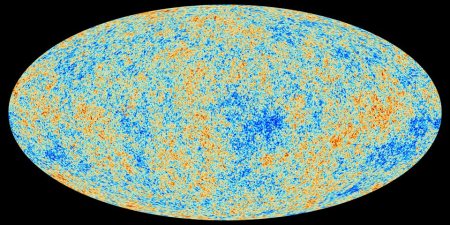
In the middle there is a model with no cosmological constant but a low density of matter; this is an open Universe. Because it decelerates much more slowly than in the Einstein de Sitter model, the distance out to a given redshift is larger (but not quite as large as the case on the right, which is an accelerating model), but the main property of interest in the open model is that the space is not Euclidean, but curved. The effect of this is that an object of fixed physical size at a given redshift subtends a much smaller angle than in the cases either side. That shows why observations of the pattern of variations in the temperature of the cosmic microwave background across the sky yield so much information about the spatial geometry.

It’s a very instructive picture, I think!

A Short (Physical Review) Letter!

Posted in History, Maynooth, The Universe and Stuff with tags , , , , on April 26, 2019 by telescoper

I think it is Blaise Pascal who is to be credited with the quote frequently paraphrased as “I didn’t have time to write a short letter so here’s a long one instead” but, whoever it was, this afternoon’s interesting theoretical physics seminar at Maynooth University about Magnetic Molecules by Jürgen Schnack of Bielefeld University provided a great example of how a short letter can pay off.

William Giauque was awarded the Nobel Prize for Chemistry in 1949 for his work on the properties (including magnetic properties) of matter at very low temperatures. Among the many achievements that led to this award Giauque was the first person to generate matter in a laboratory with a temperature below 1 Kelvin. This result was described in a publication in Physical Review Letters in 1933. Here is the letter in full:

I’ve seen a number of surprisingly short short communications from this era, but I think this one is the record. I’m not sure how many marks this would get as a lab report from an undergraduate physics student, but it doesn’t seem to have done Giauque any harm to keep it extremely brief!

While I’m here I’ll also mention that this also the common practice of awarding the Nobel Prize for Chemistry on the basis of work that is really Physics is clearly not a recent innovation!

Dos and Don’ts of reduced chi-squared

Posted in Bad Statistics, The Universe and Stuff with tags , , on April 26, 2019 by telescoper

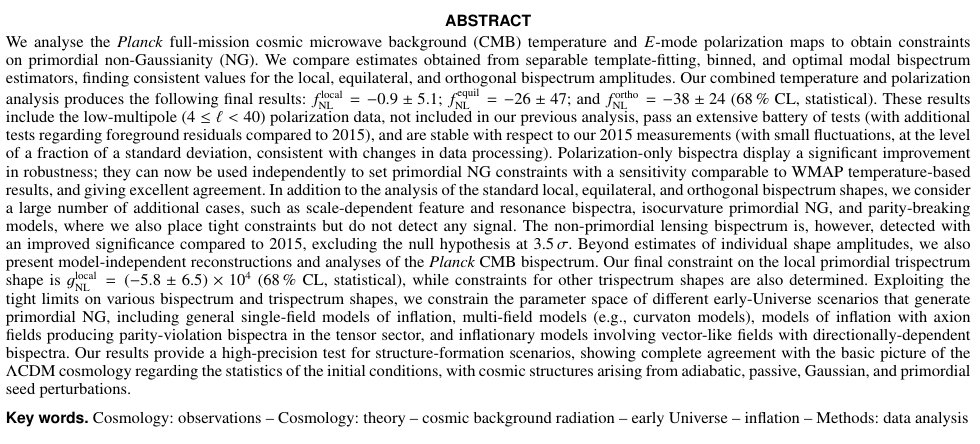
Yesterday I saw a tweet about an arXiv paper and thought I’d share it here. The paper, I mean. It’s not new but I’ve never seen it before and I think it’s well worth reading. The abstract of the paper is:

Reduced chi-squared is a very popular method for model assessment, model comparison, convergence diagnostic, and error estimation in astronomy. In this manuscript, we discuss the pitfalls involved in using reduced chi-squared. There are two independent problems: (a) The number of degrees of freedom can only be estimated for linear models. Concerning nonlinear models, the number of degrees of freedom is unknown, i.e., it is not possible to compute the value of reduced chi-squared. (b) Due to random noise in the data, also the value of reduced chi-squared itself is subject to noise, i.e., the value is uncertain. This uncertainty impairs the usefulness of reduced chi-squared for differentiating between models or assessing convergence of a minimisation procedure. The impact of noise on the value of reduced chi-squared is surprisingly large, in particular for small data sets, which are very common in astrophysical problems. We conclude that reduced chi-squared can only be used with due caution for linear models, whereas it must not be used for nonlinear models at all. Finally, we recommend more sophisticated and reliable methods, which are also applicable to nonlinear models.

I added the link at the beginning; you can download a PDF of the paper here.

I’ve never really understood why this statistic (together with related frequentist-inspired ideas) is treated with such reverence by astronomers, so this paper offers a valuable critique to those tempted to rely on it blindly.


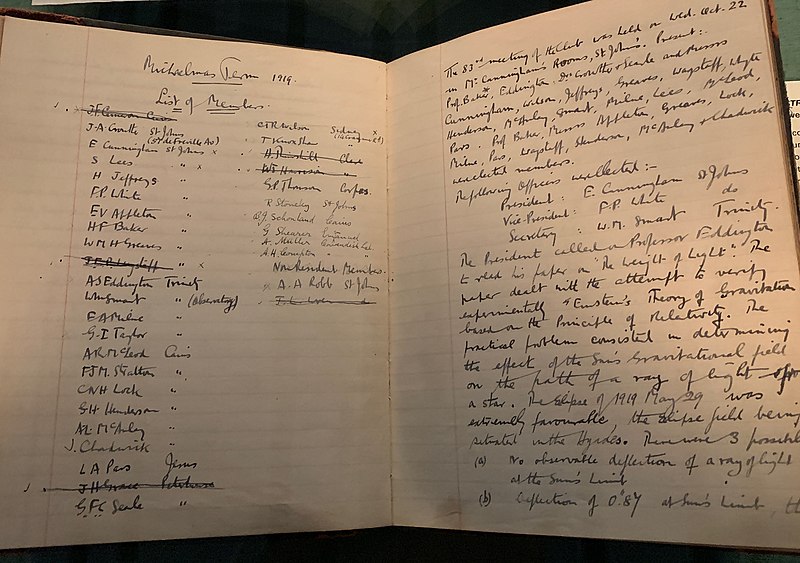
Lights all askew in the Heavens – the 1919 Eclipse Expeditions

Posted in History, Talks and Reviews, The Universe and Stuff with tags , , , , , on April 23, 2019 by telescoper

I completely forgot to upload the slides from my talk at the Open Meeting of the Royal Astronomical Society on April 12 2019 so here they are now!

Just a reminder that the centenary of the famous 1919 Eclipse Expeditions is on 29 May 2019.

On the Fellowship of Roy Kerr

Posted in The Universe and Stuff with tags , , , , , , , on April 18, 2019 by telescoper

Among the new Fellows of the Royal Society announced this week, I was astonished to see the name of Roy Kerr, the man who gave his name to the Kerr Metric an exact solution of Einstein’s equations of general relativity which describes the geometry of space-time around a rotating black hole.

When I say “astonished” I don’t mean that Kerr does not deserve this recognition. Far from it. I’m astonished because it has taken so long:the Kerr solution was published way back in 1963.

Anyway, better late than never, and heartiest congratulations to him!

While I’m on about Roy Kerr I’ll also say that I now think there is a very strong case for him to be awarded a Nobel Prize. The reasons are twofold.

One is that all the black hole binary systems whose coalescences produced gravitational waves detected by LIGO have involved Kerr black holes. Without Kerr’s work it would not have been possible to construct the template waveforms needed to extract signals from the LIGO data.

Second, and even more topically, the black hole in M87 recently imaged (above) by the Event Horizon Telescope is also described by the Kerr geometry. Without Kerr’s work the modelling of light paths around this object would not have been possible either.

The Multiverse – Andrew Wynn Owen

Posted in Poetry, The Universe and Stuff with tags , , on April 18, 2019 by telescoper

The Multiverse is Andrew Wynn Owen‘s first book of poems. It was published last year by Carcanet Press, but I only found out about it a week or two ago, from a review in a recent edition of the Times Literary Supplement. I had £10 in book tokens left over from a crossword prize so decided to spend them on this exuberant and diverse collection (which cost £9.99).

There are two particularly interesting things about this book. One is its thematic range, which is centred on science and philosophy but spreads out very widely across many fields. It’s actually not unusual for poets to be interested in science, though perhaps it is rather rarer for scientists to be interested in poetry…

The other particularly interesting aspect of these poems is their stylistic range. All of them are written in very precise forms, including the various types of sonnet, each with a strict metre but differing radically in structure from one to the other. As you might expect there are clear echoes of poetry from other eras, including nods in the direction of the metaphysical poets such as George Herbert.

You might infer from what I’ve said that these poems are merely imitative of other works, but that’s not the case. Although they are often very witty, these poems are not just parodies. I think the poet’s intention was to demonstrate how much can still be said that’s relevant to the modern world using established forms. I think he succeeds brilliantly, and he shows such mastery of so many different styles that it’s hard to believe this is a debut collection.

The title The Multiverse plays both on the aspects I described above, the scientific and philosophical themes, and the plurality of verse forms contained in this collection. As a physicist, though I’m not a proponent of the ‘scientific’ Multiverse, I recommend the poetic version very highly!

Nature Piece Plug

Posted in History, The Universe and Stuff with tags , , on April 17, 2019 by telescoper

Just a quick post to advertise that a short piece what I wrote is now published online on the journal Nature. It will appear in the print edition published tomorrow.

I think the title is fairly self-explanatory – it’s basically a triple book review, but with some additional scientific background thrown in.

Should you wish to do so, you can download a PDF version of the article here.

There’s a SharedIt link too.

Grubb Parsons: the Irish Connection

Posted in History, The Universe and Stuff with tags , , , , , , , , on April 15, 2019 by telescoper

The other day I stumbled across an interesting article that discusses, among other things, the famous telescope and optical instrument manufacturing company, Grubb Parsons. The piece is a few years old but I didn’t see it when it came out. It’s well worth a read.

Grubb Parsons was still a famous company when I was at school, but it closed down in 1985. The main works were in Heaton, in Newcastle Upon Tyne, not far from where I was born; my father went to Heaton Grammar School.

Grubb Parsons made a huge number of extremely important astronomical telescopes, including the Isaac Newton Telescope, pictured above at the works in Heaton.

Interestingly, the names ‘Grubb’ and ‘Parsons’ both have strong Irish connections.

Howard Grubb was born in Dublin in 1844 and in 1864 he joined the optical instruments company set up there by his father Thomas Grubb. When his father died in 1878 Howard Grubb took over the Grubb Telescope Company and consolidated its reputation for manufacturing high quality optical components and devices. He was knighted in 1887.

Back in 1845 Thomas Grubb had helped build the famous ‘Leviathan‘ telescope for William Parsons, 3rd Earl of Rosse at Birr Castle in County Offaly.

Charles Algernon Parsons, who took over the Grubb Telescope Company after it was liquidated in 1925, and relocated it to Tyneside, was the youngest son of William Parsons ( just as Howard Grubb was the youngest son of Thomas). He no doubt kept the name Grubb in the company name because of its associated reputation.

Parsons had a wide range of business interests besides telescopes, mainly in the marine heavy engineering sector, especially steam turbines. When I was a lad, ‘C A Parsons & Company’ was still one of the biggest employers on Tyneside. It still exists but as part of Siemens and is a much smaller operation than in its heyday.

One final connection is that Sir Howard Grubb and Sir Charles Algernon Parsons both passed away in the same year, 1931.