Archive for the Uncategorized Category

R.I.P. Phil Anderson (1923-2020)

Posted in Uncategorized with tags , , on March 30, 2020 by telescoper

I heard this morning via a friend who knew him personally of the death, yesterday at the age of 96, of condensed matter physicist and Nobel Laureate Professor Philip Warren Anderson. He will perhaps be best remembered known for Anderson Localization but he worked on a huge range of topics in physics and his influence was felt across many branches of science (including astrophysics). It’s too early for obituaries to have been published yet but I will add links when they become available.

Update: here is the New York Times obituary.

R.I.P. Philip W Anderson (1923-2020).

The Open Journal of Astrophysics and the Free Journals Network

Posted in Uncategorized with tags , , , on March 30, 2020 by telescoper


I am pleased to announce that The Open Journal of Astrophysics is now a member of the Free Journal Network.

We are in fact the 51st member of the network, which exists

…to promote scholarly journals run according to the Fair Open Access model (roughly, journals that are controlled by the scholarly community, and have no financial barriers to readers and authors.

A full list of the illustrious journals belonging to this network can be found here.


The Shell House Raid

Posted in Uncategorized on March 21, 2020 by telescoper

Almost forgot that the grim events described in this old post took place in Copenhagen 75 years ago today…

telescoper's avatarIn the Dark

An early morning walk around Copenhagen this morning reminded me of a longer visit I made here about 25 years ago, during which I rented a room in a nice large apartment on Frederiksberg Allé, which is in a rather posh part of the city called Frederiskberg. The landlord, who also lived on the premises, was a Mr Vagn Jul Pedersen, a nice old man who had lived in that part of the city all his life. One evening we sat talking over a beer or two and he told me of a terrible thing that he had seen during the latter stages of the Second World War when he was a young man, and I thought some of you might be interested to learn about it.

In March 1945, the British decided to carry out a low-level bombing attack on a target in Copenhagen, which was under German…

View original post 1,328 more words

The Spread of the Coronavirus

Posted in Covid-19, Uncategorized with tags , on March 7, 2020 by telescoper

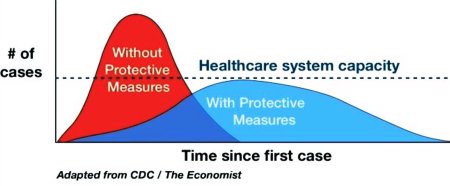
I thought I would share the above graphic because provides a simple yet very effective illustration of why
it is so important to delay the spread of the Coronavirus, and why strict precautions are being taken to achive that.

The primary cause of death for patients suffering from COVID-19, the disease carried by this virus is that inflamation of the lining of the alveoli in the lungs makes it harder for oxygen to diffuse across into the capillaries and for carbon dioxide to diffuse out. As outlined in the report I shared a few days ago, severe cases therefore require treatment that involves being supplied with oxygen via a respirator for a long period, perhaps weeks. The number of available respirators and intensive care units generally is likely to prove the factor that limits the capacity of hospitals to cope.

The situation might be worse in England because the NHS only has about 2.3 hospital beds per thousand of the population so the capacity limit may be hit much earlier. For reference, Ireland is not much better on 2.96, Scotland has 4.2 and Germany has 8; see here for OECD figures from other countries.

Delaying the spread of the virus may prevent health services from being overwhelmed by spreading out the peak in the manner indicated in the diagram even if the total number of cases were not to reduce. Pushing back the bulk of the distribution by weeks or months may also help if the virus is seasonal – it may transmit infection less efficiently during the spring or summer than it does during the winter.

In the light of this it can’t do any harm to share the HSE advice for Ireland again.

Now wash your hands please.

Farewell to Flybe

Posted in Uncategorized with tags , on March 5, 2020 by telescoper

It had been on the cards for some time, but last night the airline Flybe collapsed and has now gone into administration. Let me just leave this Twitter announcement made in January by Transport Secretary Grant Shapps here:

It seems that Flybe has gone the inevitable way of every Tory promise.

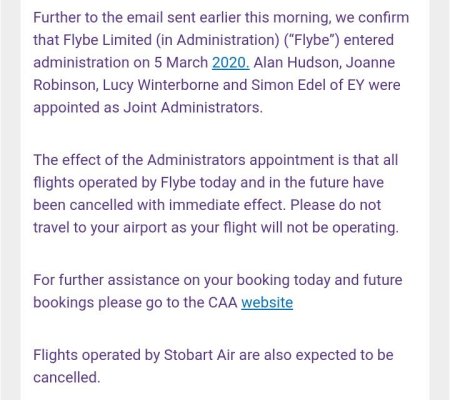
I had bought a ticket to fly from Dublin to Cardiff at the end of next week as the following week is a study break that includes the St Patrick’s Day holiday. As a result I got this email this morning.

Obviously it’s an inconvenience for me as I’ll have to find another way to get to Cardiff, but I’ll probably get my money refunded by the Chargeback scheme so it’s not such a big deal. The same can’t be said of the 2000 people who worked for Flybe who have now lost their jobs, nor the many others whose livelihoods depended indirectly on this airline who may also lose theirs. The impact on some of the smaller regional airports in the UK will be considerable, although some airlines may well step in and take up some of the demand.

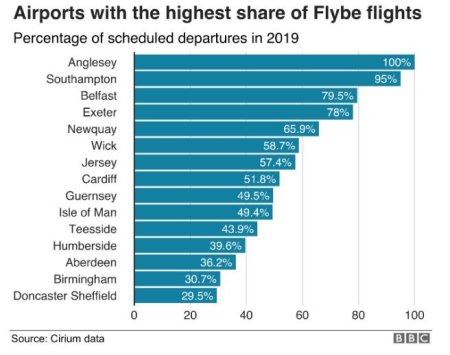
As of last year, almost 80% of flights from Belfast City airport and 95% from Southampton were via Flybe

I think another airline might well take up some of the Belfast routes, but I doubt if the same would be true of Southampton. In a way, it’s a pity that these small mainland regional airports are so important, which is partly because regional train services are so poor and so expensive, but I can’t see that changing.

I have actually used Flybe quite a lot over the last couple of years. For a while I was taking weekly flights between Cardiff and Dublin and the service was generally quite reliable. I feel very sorry for the staff who have lost their jobs and send them my best wishes and hope that they can find alternative employment before too long.

The WHO-China Report on Corvid-19

Posted in Covid-19, Uncategorized with tags , , on March 4, 2020 by telescoper

As it is a matter of topical and general interest I thought it would be worthwhile sharing the joint World Health Organization – China report on Coronavirus, which you can find here. There is also a discussion thread on Reddit here.

A key figure from this report shows that the number of new cases of Covid-19 has indeed been declining:

The report indicates why and how this has happened. For example, when a cluster of several infected people occurred in China, it was most often (78-85%) caused by an infection within the family transmitted by droplets and other carriers of infection in close contact with an infected person. Transmission by fine aerosols in the air over long distances is not one of the main causes of transmission.

Do read the report. While not being complacent about the scale of the public health challenge, it is a valuable antidote to some of the scaremongering going on.

Ash Wednesday Observance

Posted in Uncategorized on February 26, 2020 by telescoper

So today is post-Pancake Day, or Ash Wednesday as it is sometimes known. I remember this time two years ago when I was very much a newcomer to Maynooth being quite surprised to see some folk wearing a cross marked in ash on their forehead as in the picture above. I think this practice is a tradition within the Roman Catholic Church with which Maynooth has long historical associations, so it’s not really surprising to see it here. Having been brought up in Protestant England I had never seen this before moving to Ireland, but it has become a familiar sight to me to see people with crosses on their foreheads.

Apparently the tradition used to be for ashes to be sprinkled on the top of the head of a male worshipper but a cross to be made on the forehead of a woman because she would be expected to be wearing a hat. Based on a small sample of those I have observed it seems both genders wear the cross on the forehead nowadays.

Anyway, although I’m not a Christian myself, respect to all those observing the season of Lent (Quadragesima), whether that means fasting, devotional prayer, or just giving up luxuries, such as reading this blog perhaps.

P.S. I’m told that the normal rule for Lent is `One meal and two collations’. The word collation, in the sense of ‘light meal,’ comes from the title of John Cassian‘s early fifth-century work Collationes patrum in scetica eremo (Conferences with the Egyptian hermits), which was read in Benedictine communities before a light meal. I haven’t heard that English word for a while, but it has the same origin as the Italian colazione, used in prima colazione (breakfast).

PhD Studentship in Gravitational Wave Astrophysics at Maynooth University!

Posted in Uncategorized with tags , , , , on February 11, 2020 by telescoper

With the arrival of Dr John Regan in the Department of Theoretical Physics at Maynooth University we are delighted to announce a fully-funded PhD studentship. In order to boost the circulation, here’s a copy of the advert you can find on John’s own website.

–o–


Project Description. Recent detections of gravitational waves from stellar mass sized black holes with the LIGO observatory has opened up a new window for black hole astrophysics as well as heralding the dawn of multimessenger astrophysics. LIGO is sensitive to the mergers of black holes in the range 10 solar masses up to approximately 100 solar masses out to a few Megaparsecs.

LISA is the planned, next generation, space-based gravitational wave observatory due for launch in 2034. LISA will be sensitive to gravitational waves at a much lower frequency compared to LIGO and as a result will be able to detect the mergers of both much larger and much more distant black holes. Planning for LISA is now well underway and the science base and objectives are being determined.

This PhD project will involve computing gravitational wave forms from mergers of massive black holes from the early Universe – which will be detectable by LISA. The origin of massive black holes is currently unknown and hence being able to detect their mergers from the early Universe is seen as a critical aspect in understanding their formation pathways. In this project the student will use the state-of-the-art Enzo-E code to model the mergers of black holes. In doing so the student will be able to accurately compute the gravitational wave signal from black holes which are merging in the distant Universe thus making predictions for LISA.

Student fees and a full stipend (€18k per annum) are available as part of this studentship.

Candidate Criteria. Applicants should have (or be about to complete) an undergraduate degree and/or taught postgraduate degree in (applied) mathematics, (theoretical) physics, computer science or a related discipline. Past experience shows that successful applicants usually have a very good first class degree (or equivalent). Applicants with computational experience are particularly encouraged to apply. In addition, the applicants must have excellent communication, planning and team working skills.

Application Procedure

Application Deadline: Friday May 1st 2020

Students who wish to apply for this studentship should apply in writing to john.regan@mu.ie. Please put “PhD Studentship Position” in the subject of the email. The application must comprise:

  • A full CV
  • A covering letter outlining why you wish to pursue this PhD program
  • Two references, preferably from your current academic institution, outlining your suitability for the position

Shortlisted candidates will be notified of the outcome of the selection process in early May with interviews in mid-late May. The start date for the PhD is expected to be September 2020.

Please direct any questions or queries on the above position to Dr. John Regan (john.regan@mu.ie)



Appeal by Astronomers

Posted in Uncategorized with tags , , on January 27, 2020 by telescoper

I apologize for being a bit late onto this but this is a very important initiative that tries to safeguard the sky from the plethora of satellite fleets that threaten to cause untold damage to major astronomical projects, especially surveys. I’ve signed the document and I hope you will also consider doing so.

Many of the readers of this blog will be aware of the fast-moving issue of satellite constellations, which is the launching of the first of potentially tens of thousands of communications satellites. The SpaceX Starlink cluster is one of these, but there will be others such as Amazon’s project Kuiper and Facebook Athena.
These satellite constellations will be detrimental to both optical and radio ground-based astronomy, from their reflected light and broadcasted emissions. Mitigating the effects of these satellites needs to be done quickly before services such as 5G internet from them are established in the coming months. Beyond that point, it will be harder to regulate them.
Organisations which represent our discipline such as the AAS, IAU, EAS and RAS are attempting to engage directly with SpaceX and others on this issue.
Please consider promptly adding your name to the appeal linked to in the post below.

Stefano Gallozzi's avatarAstronomers' Appeal

Safeguarding the Astronomical Sky (IT)

Download EN_PDFDownload IT_PDF

THIS APPEAL HAS BEEN SIGNED BY

901+ ASTRONOMERS

VIEW SIGNATURES

(the refresh rate of the counter may slow down).

To sign/subscribefollow this link.

This is an international appeal by professional astronomers open for subscription to ask for an intervention from institutions and governments.

Astronomical observations from the ground can be greatly harmed by the ongoing deployment of large satellite fleets in preparation for the next generation of telecommunications.

For centuries the astronomical observations from the ground have led to exceptional progress in our scientific understanding of the Laws of Nature. Currently, the capability of astronomical instrumentation from the ground is endangered by the deployment of satellites fleets.

Through this international appeal and following the same concerns expressed by the International Astronomical Union, IAU [1] and other institutions, we raise a formal request for greater…

View original post 1,586 more words

Classics in the Russell Library

Posted in History, Literature, Maynooth, Uncategorized with tags on January 9, 2020 by telescoper

Here’s a taster of the wonderful collection of books and manuscripts in the Russell Library at Maynooth University..

Special Collections's avatarMU Library Treasures

Ruth O’Hara, Collections and Content

Ruth pic 1

Study of the classical world has been a staple of this University for centuries. The Russell Library’s classic’s collection, which was amassed largely by the early professors of St. Patrick’s College, is eclectic covering all areas of the ancient world and indeed it transcends disciplines. So, besides Homer and Virgil, for example, sit the poems of Catullus, the theological tracts of Ambrose of Milan, and the philosophical musings of Aristotle. One blog can’t hope to capture the extent and range of such a collection so, instead, I just want to look at some of the ways that we in the Russell Library continue to foster interest in this diverse subject area by integrating it into the research, teaching and life of the University.

We have found our classics collection to be a really useful resource for postgraduate students, for example, who engage with primary source…

View original post 426 more words