Archive for the Uncategorized Category

The Little Waster

Posted in Uncategorized with tags , , on April 12, 2010 by telescoper

Since Britain seems set for a return to the 1970s, I thought I’d wallow in nostalgia for the bygone days of Margaret Thatcher and my adolescence in the North East with this clip of the legendary comedian Bobby Thompson in his role as The Little Waster. He never achieved popularity outside the region, probably owing to his accent and the kind of material he liked to perform. He was, however, a permanent fixture in many working men’s clubs across the North East, most of which looked just like the one in North Shields this was filmed in.  

Bobby Thompson’s accent and upbringing were Wearside, rather than Tyneside, so he wasn’t strictly speaking a Geordie.  I find it quite easy to locate the accent myself, as closer to Sunderland than Newcastle, but I think people born outside the North East probably  find it difficult to grasp the difference. Unfortunately there are no subtitles on this clip so the jokes will probably go right over the head of most of you! He did have a very special status in the North East, however, right up until his death in 1988, because of the affinity he shared with his audience, many of whom had been brought up in real hardship and knew exactly what he was talking about. He always laughed with them, not at them.

I saw him only once, and I’ll never forget the effect he had on the crowd. Some people were laughing so much I thought they were going to die. His act was in two parts, the first being The Little Waster (as in the clip) and the second, which I thought much funnier, in which, dressed as a scruffy soldier he recounted obviously made-up stories about his wartime experiences. Another thing I remember is his trademark Woodbine, from a packet he bought in 1944…

My favourite joke of his dates to the night of the 1951 election when the victorious Conservative Party was rumoured to be planning to abolish the National Health Service:

It came t’ last orders and the barman shouted ‘Come on, let’s see yer glasses off’, and I said ‘Well, them Tories haven’t wasted any time, have the!’

Brake Out

Posted in Uncategorized with tags , on April 7, 2010 by telescoper

You may recall that I’ve posted a few times about Mark Brake, the professor at the University of Glamorgan who falsely claimed to have a PhD on a grant application written in 2006 (see, for example,  here, here, and here). The UoG purportedly held an  “investigation” into this matter, but took no disciplinary action against Brake. When the story resurfaced again last year, first in the Western Mail and then in the Times Higher, the University of Glamorgan kept very quiet about why it hadn’t taken this case more seriously in the first place, but promised a further investigation into the actions taken at the time.

Things have been very quiet on this front for quite some time now, but I recently heard from a reliable source that Mark Brake has been made redundant by the University of Glamorgan (as of March 31st 2010).  If this is a result of an investigation into past wrongdoings then  clearly the UoG have decided to let Brake go quietly rather than make any of the evidence public. I have no information about the redundancy settlement but, whatever it is, it is largely funded by the taxpayer, as his salary has been for the past three years, since the original investigation exonerated him. Of course, if the UoG did uncover evidence that was overlooked in 2007 then it would be extremely embarrassing to have to admit it three years later…

The UoG remains quiet about the affair which – at least to me – casts grave doubts on its system of governance. They seem to want this case to disappear quietly, but I don’t think it is in the public interest to let the circumstances of Brake’s departure remain secret. At the very least I hope they make an official announcement confirming that he has left the organisation, otherwise his famous wikipedia page will  forever state that he is an employee of the UoG.

The University of Glamorgan website doesn’t say anything about the Mark Brake affair. However, there is an announcement about the new Wales Fraud Forum which will meet there for the first time later this month. Who said irony was dead?

Baroness Gaga

Posted in Uncategorized with tags , , on April 6, 2010 by telescoper

While I’m on the subject of look-alikes, I couldn’t help noticing the resemblance between Baroness Susan Greenfield, former Director of the Royal Institution, and popular American recording artist Lady Gaga. I wonder if by any chance they might be related?

Grandmother and granddaughter perhaps?

Lady Greenfield

Lady Gaga

The Bute Park Horror

Posted in Bute Park, Uncategorized with tags , , , on April 5, 2010 by telescoper

What could be nicer on lovely spring day than to take a walk through the local park? Even better if you live in the city of Cardiff, home to one of the largest areas of mature parkland in any urban setting, so you can take a stroll among lovely old trees and fields (landscaped by Capability Brown) in the shadow of a picturesque and historic castle.

At least that’s what it should be like. Unfortunately, Cardiff City Council has other ideas. Bute Park is currently being redeveloped by the Council in order to make it more accessible to lorries and other heavy vehicles. This is intended to allow more large-scale “Events” to take place on Coopers Fields, the area just behind Cardiff Castle.  Further commercial exploitation of this area will no doubt ensue. Despite vigorous opposition to the plans by regular users of the Park, including myself, and widespread condemnation in the press (including the esteemed organ Private Eye) the Council last year granted itself planning permission (surprise, surprise) to construct a new road into the heart of this precious “green lung”.

I’m depressed to say that work on the new road has gathered pace during the early months of this year. Irreplaceable trees have been felled, and a hideous new bridge is being built over the Dock Feeder Canal. Needless to say, all this construction is accompanied by frequent movement of heavy vehicles in and out of the park. Large areas are now out of bounds for pedestrians, and those that do bravely venture along the footpaths elsewhere have to vie with the trucks. Many of the paths have been resurfaced to make them more suitable for motor vehicles and the signs denoting the speed limit, which used to be 5 mph throughout, have now all been removed. It’s no fun sharing a footpath with a juggernaut doing 30 mph, I can tell you. Still, I suppose we better get used to it. Bute Lorry Park it’s going to be from now on.

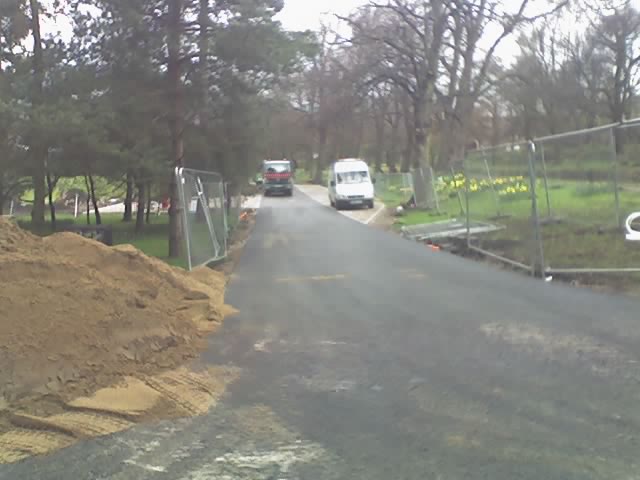
I’ve just got one of those new-fangled Blackberry things (which I don’t know how to work yet). However, a few days ago I did use the old one to take a few pictures of the devastation on view from my usual route into work. The first one shows the view looking North from just behind the castle.

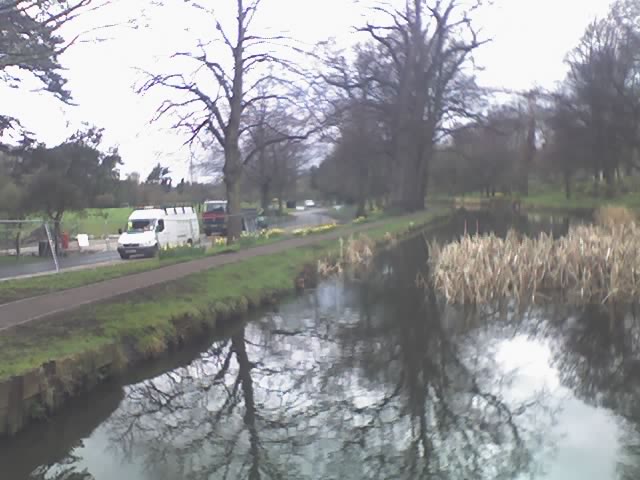
The Dock Feeder canal is just to the right. There used to be a relatively narrow trackway  running along the route taken shown here, which the Council decided to replace to make it more suitable for heavy road vehicles. Coopers’ Fields lie to the left and this road is used to bring equipment, temporary buildings etc for use there. On the Council’s literature this work is described as “resurfacing”, but, as you can see from the picture, in addition to the new tarmac surface they have taken the opportunity to construct a sort of lay-by which more-or-less doubles the width of the path. Here’s another view, showing the new stretch of tarmac snaking its way along the side of the canal. You can see more clearly the area of grassland onto which lorries will be driving in ever-increasing numbers. It would be easier for them to tarmac over the whole thing and be done with it.

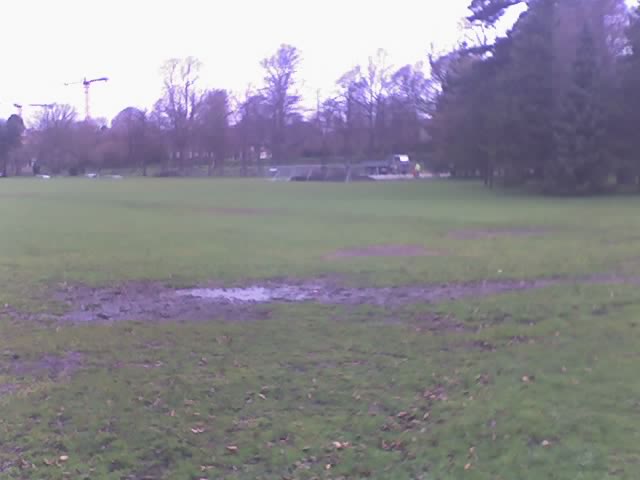
Two short but wide spurs to the left cut into the fields, presumably to allow vehicles easier access to the grass in order to churn it up into a quagmire. Here’s a view taken from a vantage point to the left of that in the first picture, showing the dire state of disprepair that Coopers Fields are in anyway, even before the new regime of rapacious commercial exploitation. The grass has been left in this damaged state since last September. No doubt it will be similarly neglected in those brief future periods in between being covered by temporary buildings and mobile entertainments of various sorts.

To the left of the above picture you can also see the cranes involved in construction work further North. I’ve stopped walking in that part of the park because it’s just too dangerous. A main road far worse than the one shown here, and complete with traffic lights, now enters from North Road and cuts deep into the park in order to reach the Council’s nursery facility – the type for plants, not children – which is right next to the River Taff (which lies to the East of the site shown in the pictures). At least the Council says its so lorries can reach the nursery. But how many lorries are going to need to get to the nursery every day such that they require a whole new road to be built? I know I’m not the only one who thinks this is just a cover. Phase 2 of the operation isn’t hard to guess: an extension of the road Eastwards across the River Taff via a new road bridge to Sophia Gardens, completely bisecting Bute Park and creating a major thoroughfare to relieve congestion to the West.

If you think the Council wouldn’t dare, and that they’d never get away with it, just look at what they have got away with already. And not just here. The idiotic Highways Department of Cardiff City Council has been responsible for monstrosity after monstrosity in this city. Only now are they turning their attention to beautiful Bute Park. They must be stopped.

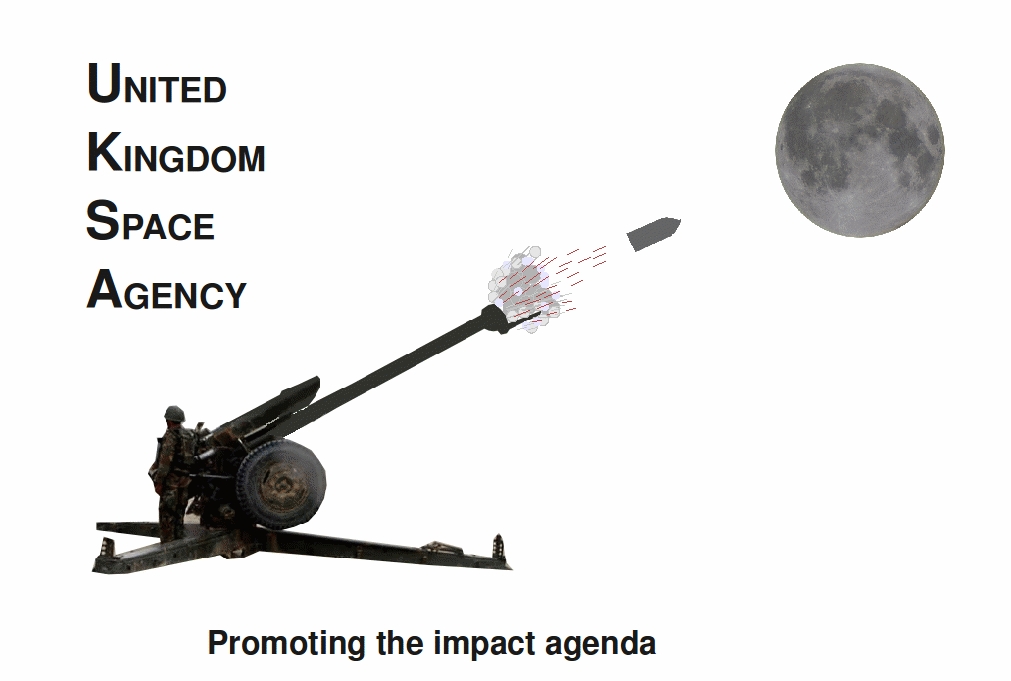
An early draft of the UK Space Agency logo

Posted in Uncategorized with tags , on March 29, 2010 by telescoper

Space without Physics…

Posted in Uncategorized with tags , , , , , on March 24, 2010 by telescoper

I’m indebted to a colleague (Annabel Cartwright) for sending me this (coincidentally topical) sample question, illustrating the quality of a modern British school science examination.

Since it’s now clear  that there is no room for science in the new era of the UK Space Agency, I suppose we should get used to the removal of science from other things too. Starting with science exams.

This question is taken from a GCSE Physics examination.

Some people think that governments spend too much money on space research.

Which ONE of the following statements is true?

  1. Science can tell us what the planets are made of, and whether they ought to be explored.
  2. Science can tell us what the planets are made of, but not whether they ought to be explored.
  3. Science cannot tell us what the planets are made of but can tell us whether they ought to be explored.
  4. Science cannot tell us what the planets are made of, nor whether they ought to be explored.

Apparently one (and only one) answer is correct. Any offers?

Idus Martiae

Posted in Uncategorized with tags , , on March 15, 2010 by telescoper

Today is the Ides of March and we’re entering the final straight before crossing the finishing line of term and collapsing in a sweaty mess into the arms of the Easter holiday. I’ve been ridiculously busy today so, being too knackered to think of anything else to post, I thought I’d tap into a priceless bit of British cultural history relevant to this auspicious day.

This is from the First Folio Edition of Carry On Cleo, and stars the sublime Kenneth Williams as Julius Caesar delivering one of the funniest lines in the whole Carry On series. The joke may be nearly as old as me, but it’s still a cracker…

The True Origin of CERN

Posted in Uncategorized with tags , , on February 27, 2010 by telescoper

During my fascinating visit to CERN to see the Large Hadron Collider yesterday it occurred to me that many of my readers might be unaware of the true historical origin of that organization. I have to say the general misunderstanding of the background to CERN is not helped by the information produced locally which insists that CERN is an acronym for Conseil Européen pour la Recherche Nucléaire and that it came into being in the 1950s. This is false.

CERN is in fact named after the Dorset village of Cerne Abbas, most famous for a prehistoric hill figure called the Cerne Abbas Giant. The following aerial photograph of this outstanding local landmark proves that the ancient Brits had the idea of erecting a large hardon facility thousands of years ago…

PC and the PCC (by PC)

Posted in Uncategorized with tags , , on February 21, 2010 by telescoper

Another bit of news to emerge last week was the decision by the Press Complaints Commission (PCC) not to censure the Daily Mail journalist Jan Moir for the truly odious article she wrote after the death of Stephen Gately. Even by the standards of the Daily Mail, this piece was so horrendous that it led to a Twitter storm and provoked no less than 25,000 complaints from the public in addition to a direct complaint from Stephen’s partner, Andrew Cowles. I even blogged about it here.

The PCC, however, decided not to uphold these complaints. I can’t say that I’m at all surprised at their decision and not surprised either that it has also led to many expressions of outrage via Twitter and elsewhere. In among all the noise there have also been some thoughtful blog posts giving more reasoned discussions of the outcome. If you’re interested, I recommend Unspeak,  The Free Speech Blog and Enemies of Reason for a range of different takes on the affair. I’m sure you will all have your own views on whether the PCC was right or wrong to let Jan Moir off the hook. My own opinion – for what it’s worth – is that they were partly right and partly wrong.

If you read the PCC announcement you will see that the complaints were made under three clauses of their code: 1 (which stipulates that articles must distinguish fact from conjecture), 5 (that reporting should be handled sensitively at a time of grief) and 12 (that articles must avoid pejorative references to an individual’s sexual orientation).

The overriding issue is, of course,  the freedom of the press. I quote

The price of freedom of expression is that often commentators and columnists say things with which other people may not agree, may find offensive or may consider to be inappropriate.

In other words, the price we have to pay for freedom of speech is that we have to allow people to say things we don’t like. I agree.

However, the PCC is a body formed by the press in order to regulate the press. This is tacit acceptance that freedom of speech has its limits. We  all know that there are things we shouldn’t say even though we have the right to say them. In private life our outbursts are controlled by social conventions or by guidelines issued by our employers governing conduct in the workplace. Political Correctness is sometimes taken to ridiculous extremes, but its primary aim is, in my opinion, laudable – to be aware of the possibly pejorative interpretation of certain words and avoid using them in a way that could cause offence. The PCC plays a similar role for the press.  Conscious of the harm that can be caused by extremely prejudicial articles, the press has subjected itself to voluntary regulation.

I think that’s a good thing, in principle. The alternative would be official censorship and the further intrusion of the criminal law into matters of individual expression. However, self-regulation must not be mere window-dressing. Any organization can publish codes of conduct and the like, but unless they are applied rigorously and in good faith they are nothing other than exercises in hypocrisy.

It’s clear that the PCC found much of Moir’s article extremely distasteful but did not feel that she had offended sufficiently in respect of any of the clauses to warrant censure. I think they were right on Clause 1 – the piece was clearly identifiable as comment rather than fact – and I’m not sure about Clause 5. I’m convinced, however, that they got it wrong with respect to Clause 12. You can make your own mind up, of course, but if that is their decision in this case I’d like to know what sort of article they would censure.

In particular, the adjudication on Clause 12 states

While many complainants considered that there was an underlying tone of negativity towards Mr Gately and the complainant on account of the fact that they were gay, it was not possible to identify any direct uses of pejorative or prejudicial language in the article. The columnist had not used pejorative synonyms for the word “homosexual” at any point.

The Commission made clear that this part of the Code was not designed to prevent discussion of certain lifestyles or broad issues relating to race, religion or sexuality. There was a distinction between critical innuendo – which, though perhaps distasteful, was permissible in a free society – and discriminatory description of individuals, and the Code was designed to constrain the latter rather than the former.

Jan Moir’s article mocked Stephen Gately’s relationship with his partner as “unnatural”, implied that all gay relationships are tainted with sleaze, and suggested that gay people are all promiscuous drug-users. However, a panel of (presumably heterosexual) press pundits decided that it was not sufficiently homophobic to warrant censure, since they didn’t actually call Stephen Gately a faggot. I wonder what might have happened if a young black pop singer had died suddenly and Jan Moir had written an article suggesting that all black people were promiscuous drug-users living unnatural and debauched lives?

This is why I’m not surprised at the PCC conclusion. Guidelines and codes of conduct are just words. They only actually mean anything if they are enforced, and when it’s a matter of sexual orientation they rarely are. The PCC has given carte blanche to Jan Moir’s bigotry but since 99% of what’s in the Daily Mail is horrendous anyway, nothing much has changed.

What is more interesting, I think, is that this episode contains fascinating glimpses of the future. This morning I bought my regular Sunday newspaper, The Observer. Like all print media, newspapers are struggling to survive in a period of rapid technological change. The Observer has this week been re-launched, in a condensed form, because it is losing money hand-over-fist. Digital media, social networking and blogs are taking over from traditional formats as ways of communicating news and opinion about current events. Newspapers are dying, and the PCC will die with them. I doubt if it will be mourned.

The point is that although the press regularly make noises about freedom of speech, the freedoms most newspapers really care about are the freedom to make money and the freedom to promote the political views of the barons that control them. There are exceptions of course. I’m sure some journalists are motivated by democratics ideals and a desire for public good, atlhough I doubt if many of them work for the Daily Mail.  But the traditional press is in any case losing its grip. News websites may continue to exist, but the ability of large media conglomerates to control what we can read about is vanishing. I don’t think that’s a bad thing.

The New Media  sector has only minimal regulation and is consequently more diverse than the popular press. It’s anarchistic, I suppose, but is accessible and  democratic as a result. I don’t see any way that the blogosphere will ever be policed, voluntarily or otherwise. Nor do I think that’s desirable. There are dark corners where horrible creatures lurk. Nasty stuff will emerge. However, if somebody publishes something obnoxious it will be greeted with the same sort of reaction as Jan Moir’s article. There’ll be no PCC to hide behind. As the PCC itself made clear

Indeed, the reaction to the article, and the publicity which had ensued as a result of its publication, was a testament to freedom of expression, and was indicative of a broader process at work demonstrating the widespread opportunity that exists to respond to an article and make voices of complaint heard.

Twitter mobs aren’t always pretty, and they don’t always get it right,  but they’re the future. Get used to them.

Truth, Lies and Wikipedia

Posted in Uncategorized with tags , , , on February 19, 2010 by telescoper

I think it’s time to post a brief update on the story of Mark Brake, a Professor at the University of Glamorgan who falsely claimed to have a PhD from Cardiff University when applying for a grant in 2006. After this came to light through a story in the Western Mail, it was covered in the Times Higher, and I also blogged about it here.

There’s relatively little I can say about what’s been going more recently on in connection with this story, for reasons of confidentiality. However, one thing I am allowed say in public that Professor Mark Brake is no longer a Fellow of the Institute of Physics, a status he acquired in 2008.  I’m not allowed to discuss the events leading up to, or the reasons behind, his decision to resign from the IOP, but he did so in January 2010.

That little bit of news hardly merits an entire blog post, but what’s interesting is the subsequent behaviour of the wikipedia editors. Mark Brake’s wikipedia page currently states:

He was elected as a Fellow of the Institute of Physics in 2008[1] and is presently Director of the Science Communication Research Unit at Glamorgan.

As soon as Brake creased to be a FInstP, the IOP Director of Membership and Business, John Brindley, edited the page to make it clear that he no longer held the Fellowship. Bizarrely, however, a wikipedia editor overruled the change and the text reverted to the above form. The editor says that this “leaves open the possibility that this may no longer be the case”.

Well, it may leave open that possibility but the implication of the above form is definitely that Brake remains a Fellow. As John Brindley himself wrote on the corresponding wikipedia discussion page

there is a well established and understood convention that memebrships of professional institutions is considered as continuous from the date of election unless or untl a date of resignation or removal is given.

However, the editor has refused to budge on the grounds that

Other than your comments here, which unfortunately can’t be considered to be a reliable source according to wikipedia rules, I can find nothing to indicate that he has, in fact, resigned.

Short of putting an announcement on their webpages that Brake has resigned his Fellowship – something that is contrary to their usual practice – there doesn’t seem to be anything the IOP can do to convince wikipedia to amend this page so it says the whole truth, rather than just a partial and potentially misleading version.

And while I’m on the subject of potentially misleading statements, it is perhaps worth going back to the original grant application that started this whole affair off. I showed part of this in a previous post, but here is the whole page showing the false claim of a PhD:

Under Professional Qualifications you will see Brake lists professional connections with the Royal Society of Chemistry as well as a Fellowship of the Royal Astronomical Society. This was written in 2006. In fact Brake disappeared from the membership register for the Royal Society of Chemistry in 1993 and ceased to be a Fellow of the Royal Astronomical Society in 1994. Hmmm…

You might argue – as the editor seems to be doing in the case of the wikipedia page – that these aren’t factually incorrect in that they give the year of election but say nothing about whether his tenure may or may not have ended.  I think most academics would agree with John Brindley, however, that the convention is to give a date of termination if the qualification no longer applies, otherwise the implication is that the status is unchanged.

Seeing further pieces of misleading information on the grant application doesn’t really surprise me, but I find it strange that somebody seems to want wikipedia’s pages  to misrepresent the truth in a similar fashion.