To the Warmongers – Siegfried Sassoon

Posted in History, Poetry, Politics with tags , , on November 6, 2023 by telescoper

As we approach Remembrance Sunday in a time of rising conflict, it seems apt to post the following poem written by Siegfried Sassoon, called the To the Warmongers:

I’m back again from hell
With loathsome thoughts to sell;
Secrets of death to tell;
And horrors from the abyss.
Young faces bleared with blood,
Sucked down into the mud,
You shall hear things like this,
Till the tormented slain
Crawl round and once again,
With limbs that twist awry
Moan out their brutish pain,
As for the fighters pass them by.
For you our battles shine
With triumph half-divine;
And the glory of the dead
Kindles in each proud eye.
But a curse is on my head,
That shall not be unsaid,
And the wounds in my heart are red,
For I have watched them die.

Back to Barcelona!

Posted in Art, Barcelona, Biographical with tags , , on November 5, 2023 by telescoper

After a brief sojourn in not-Barcelona, I’m about to start the trip back. I have a busy week ahead so I hope the journey is relatively stress-free. I’ll be making another trip in a few weeks to a different part of not-Barcelona and I really need to finish a couple of things before then.

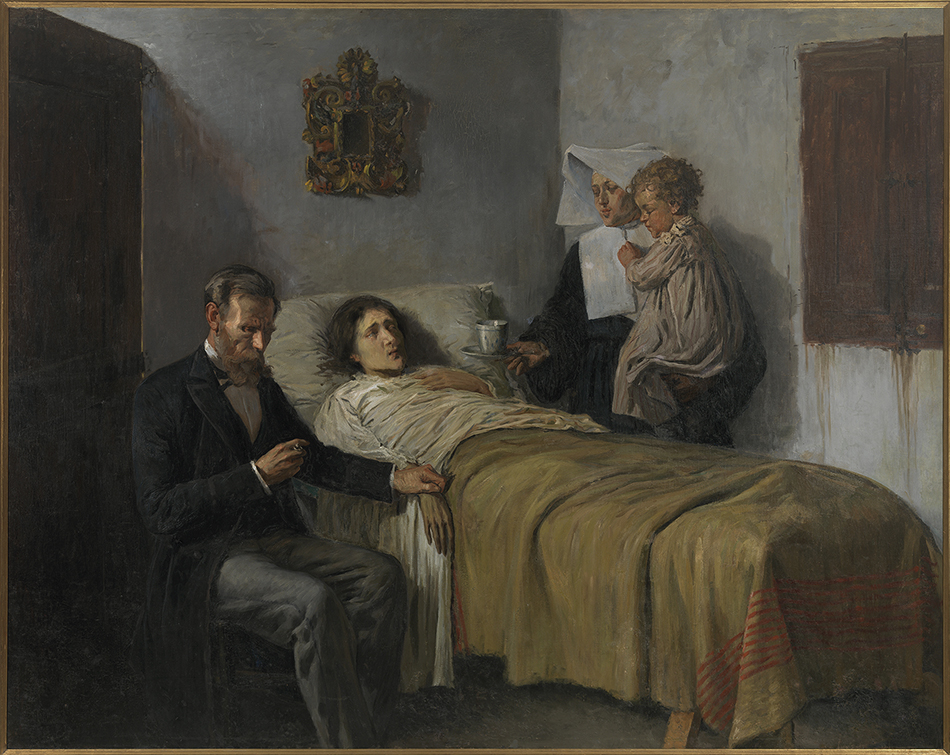
Anyway, lacking the time for a longer post, I thought I’d post a little art quiz. Without googling, or any other form of cheating, can you identify the artist who painted this:

Name the Artist

I’ll post the answer when I get back to Barcelona.

UPDATE 1: the journey wasn’t bad at all. My plane was a bit late but the arrivals process at Barcelona was super-efficient and I walked straight out of the Terminal building and onto the excellent Aerobus which took me to Plaça de Catalunya, which is a five-minute walk from my apartment. As I expected, it’s quite a lot warmer in Barcelona than in not-Barcelona.

UPDATE 2: The painting is called Science and Charity and it is attributed to Pablo Ruiz Picasso (although his father José Ruiz -also a painter – may have helped him. In any case, Picasso was only about 15 years old when he painted it. I don’t think it’s a really great painting – the composition looks a bit stiff and contrived to me – but it is interesting to see the young Picasso experimenting in a style that could be describe as social realism and which is very far from his later work. Incidentally, Picasso signed his early work Pablo Ruiz, but his signature subsequently evolved to Pablo Ruiz Picasso to Pablo R Picasso to Pablo Picasso and finally to Picasso. People have wondered why he did that, but it’s probably just because he wanted to be distinctive: Ruiz is a fairly common name in Spain whereas Picasso is not.

Luck, Privilege and Academia

Posted in Biographical with tags , , , on November 4, 2023 by telescoper

Quite a few times on this blog I have acknowledged the tremendous amount of luck I have had all the way through my career, not least that the opportunity which led to my current position in Maynooth came up when exactly when it did. Another thing that has played a role has been privilege, defined not only in terms of race and social class but also educational and institutional background. Those of us who have benefitted from this are often blind to its influence, preferring to think we achieve things purely on merit.

This morning I read a piece by Izzy Jayasinghe that articulates similar thoughts from the point of view of the author’s own personal experiences. It’s a piece that’s very well worth reading and puts things better than I’ve ever managed to do.

The main point of this post is to draw attention to Izzy’s article, but I thought I’d take the opportunity to pass on links to another couple of pieces I have mentioned on this blog over the years.

The first is a paper on the arXiv by Brian Skinner, which has the abstract:

One of the major benefits of belonging to a prestigious group is that it affects the way you are viewed by others. Here I use a simple mathematical model to explore the implications of this “prestige bias” when candidates undergo repeated rounds of evaluation. In the model, candidates who are evaluated most highly are admitted to a “prestige class”, and their membership biases future rounds of evaluation in their favor. I use the language of Bayesian inference to describe this bias, and show that it can lead to a runaway effect in which the weight given to the prior expectation associated with a candidate’s class becomes stronger with each round. Most dramatically, the strength of the prestige bias after many rounds undergoes a first-order transition as a function of the precision of the examination on which the evaluation is based.

arXiv: 1910.05813

You can read the full paper here. The author acknowledges the role that blind luck played in his own career but also develops a simple mathematical model of prestige bias. It’s an interesting paper, well worth a read.

Luck plays a definite role in winning grant funding. Having been on grants panels I’m away that many very good proposals are not funded. A scoring system is generally used that introduces some level of objectivity into the process, but the fact is that a lot of proposals come out with similar scores and the ranking of these is a bit arbitrary. A slightly different panel would produce slightly different scores, but perhaps a large difference in ranking would result.

This is one of the issues discussed in a paper on the arXiv (by Pluchino et al) with the title Talent vs Luck: the role of randomness in success and failure that discusses the role of good fortune in scientific careers. This is the abstract:

The largely dominant meritocratic paradigm of highly competitive Western cultures is rooted on the belief that success is due mainly, if not exclusively, to personal qualities such as talent, intelligence, skills, efforts or risk taking. Sometimes, we are willing to admit that a certain degree of luck could also play a role in achieving significant material success. But, as a matter of fact, it is rather common to underestimate the importance of external forces in individual successful stories. It is very well known that intelligence or talent exhibit a Gaussian distribution among the population, whereas the distribution of wealth – considered a proxy of success – follows typically a power law (Pareto law). Such a discrepancy between a Normal distribution of inputs, with a typical scale, and the scale invariant distribution of outputs, suggests that some hidden ingredient is at work behind the scenes. In this paper, with the help of a very simple agent-based model, we suggest that such an ingredient is just randomness. In particular, we show that, if it is true that some degree of talent is necessary to be successful in life, almost never the most talented people reach the highest peaks of success, being overtaken by mediocre but sensibly luckier individuals. As to our knowledge, this counterintuitive result – although implicitly suggested between the lines in a vast literature – is quantified here for the first time. It sheds new light on the effectiveness of assessing merit on the basis of the reached level of success and underlines the risks of distributing excessive honors or resources to people who, at the end of the day, could have been simply luckier than others. With the help of this model, several policy hypotheses are also addressed and compared to show the most efficient strategies for public funding of research in order to improve meritocracy, diversity and innovation.

arXiv: 1802.07068

Postscript: I remember a conversation I once had with Lev Kofman – a far more significant scientist than me – during which he called me a “fucking lucky bastard” because of some guesswork that led to a result in a paper of mine that turned out to be right. For a moment I thought he was being abusive but then, with a smile, he added “Welcome to (the)* Club”.

*Lev, like many Russians, never really got the hang of articles; the definite article in parentheses is my addition.

P.S. My good fortune in surviving academia, of course, pales into insignificance when compared to this.

Preparing for Euclid’s First Images

Posted in Euclid, The Universe and Stuff with tags , , , on November 3, 2023 by telescoper

Another quick update about the release of the Early Release Observations (EROs) from Euclid, due to take place next Tuesday 7th November. For one thing, here is a little taster video.

Five images will be released on Tuesday. I know what the Early Release Observations are but you will have to wait until Tuesday to find out. If I told you now I’d have to kill you…

Gold or Green?

Posted in Open Access, Television with tags , , , on November 2, 2023 by telescoper

During my talk yesterday I mentioned the difference between “Green” and “Gold” forms of Open Access, which always makes me think of a scene from Blackadder II. I mentioned this in the talk and it seems not everyone in the audience was aware of the cultural reference, so here is the clip in question. It doesn’t have anything to do with Open Access, of course, but I think it is very funny.

The 21 Group – Update

Posted in Harassment Bullying etc with tags , , , on November 2, 2023 by telescoper

You may have read last week (26th October) a guest post on this blog by Wyn Evans about the launch of the 21Group:

Following this post, the launch of this group has now been covered by the Times Higher

https://www.timeshighereducation.com/news/bullying-support-network-launched-due-universities-inaction

and Nature

https://www.nature.com/articles/d41586-023-03418-3

I’ll update this post with further relevant links if and when I find them; you can also follow the campaign on the 21Group blog.

I very much hope this initiative succeeds in its aims, though it has powerful reactionary forces arrayed against it.

In other news, I’m told that the University of Manchester has blocked access to the 21group website by staff through centrally-managed devices. This may be inadvertent, but if it’s deliberate then it is both sinister and stupid.

Flying visit to Cardiff

Posted in Biographical, Cardiff, Open Access with tags , , , , on November 1, 2023 by telescoper

I got up at 3am this morning to take a bus to an airport, then a flight to Bristol Airport, then another bus to Bristol Temple Meads, and then a train to Cardiff in order to give a seminar. Now I’m in the middle of the reverse process, having a pint in Bristol Airport.

In case you’re thinking of using Bristol Airport at any time in the next 8 weeks, then please bear in mind that there are major roadworks on the approach road, so be sure to allow extra time. It took over an hour from Bristol Temple Meads this evening, more than double the usual time, and it’s only 8 miles…

I’m more than a little tired after all that, but it was still very nice to meet up with friends and former colleagues again. I was particularly delighted to learn that Professor Haley Gomez has been appointed Head of the School of Physics and Astronomy. Congratulations to Haley!

I’ll upload the slides from my talk when I get back to base. For the time being, however, I’m just going to chill in the departure lounge before my return flight.

Update: the return leg ran to schedule so here, as promised, are the slides for the talk I was invited to give:

P.S. I’ll be giving two talks on the same theme later this month in different institutes in France.

On Samhain

Posted in Biographical with tags , on October 31, 2023 by telescoper

So we have arrived at October 31st, Hallowe’en or, in pagan terms, Samhain. This, a cross-quarter day – roughly halfway between the Autumnal Equinox and the Winter Solstice – represents the start of winter (“the dark half of the year“) in the Celtic calendar. Technically, Samhain is tomorrow, 1st November, but the Celtic practice of reckoning days from sunset to sunset makes this a moot point.

Samhain is pronounced something like “sowin”. The h after the m denotes lenition of the consonant (which in older forms of Irish would have been denoted by a dot on top of the m) so when followed by a broad vowel the m is pronounced like the English “w”; when followed by a slender vowel or none “mh” is pronounced “v” or in other words like the German “w” (which makes it easier to remember). The phrase Oíche Shamhna (the Eve of Samhain) is used for Hallowe’en; it contains the genitive form of Samhain.

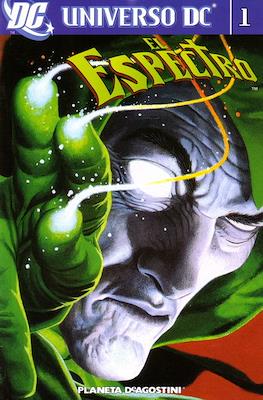
Anyway, as it was foretold, I am not in Barcelona and will continue to be not-in-Barcelona for a few days. Indeed, tomorrow, if all goes to plan, I’ll be in a different part of non-Barcelona. With all that running about I’m a bit busy for a proper blog post so I’ll just take the opportunity to point out that yet another anagram of my name is El Espectro

Oíche Shamhna shona daoibh go léir!

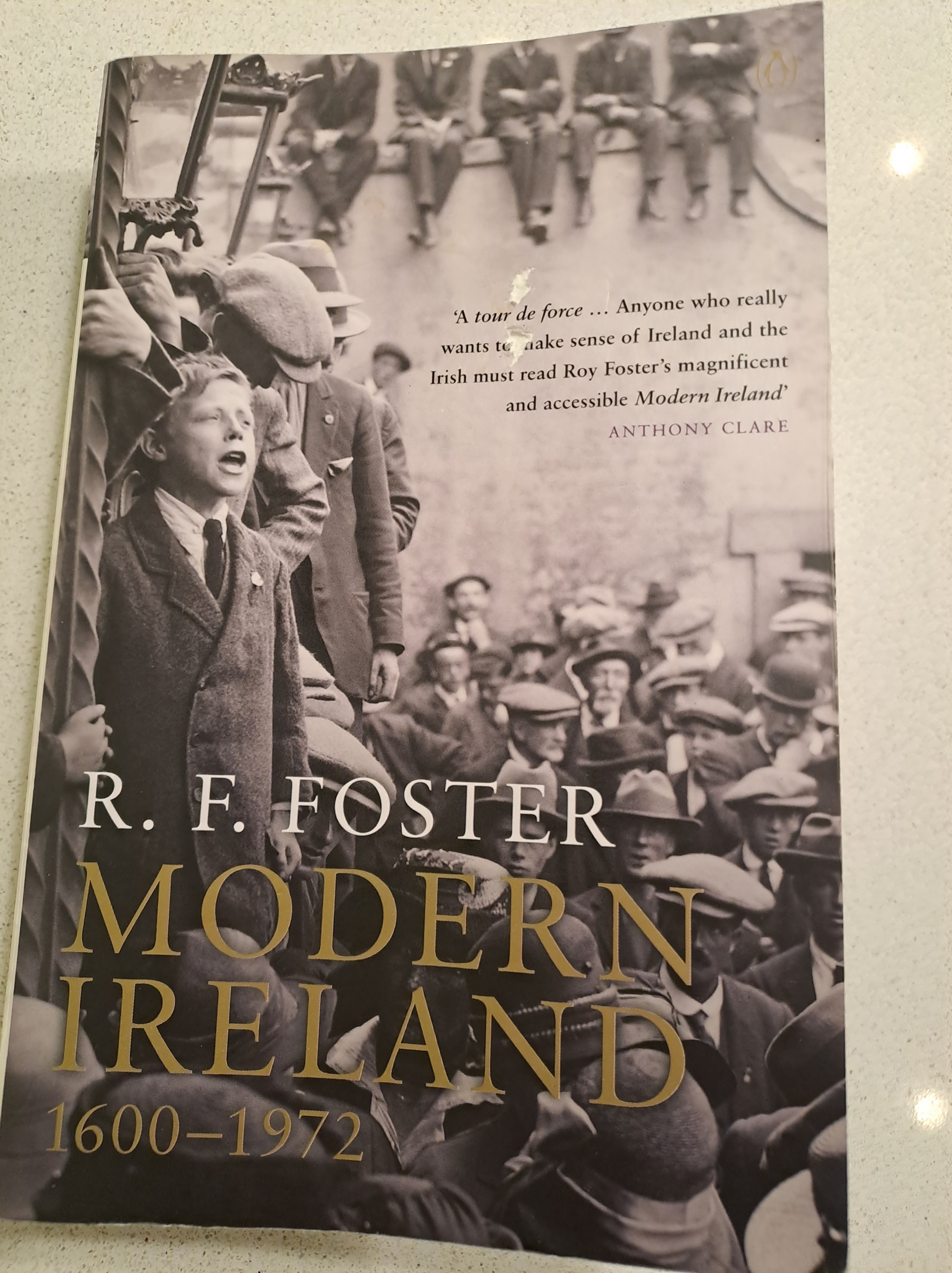
Modern Ireland 1600-1972 by R. F. Foster

Posted in History, Literature with tags , , , , on October 30, 2023 by telescoper

My attempt to catch up with a backlog of reading while on sabbatical has now brought me to Modern Ireland, by R.F. Foster, the paperback version of which, shown above, I bought way back in 2018 but have only just finished reading. In the following I’ll describe the scope of the book and make a few observations.

The book was first published in 1988 so it obviously can’t deal with more recent events such as the Good Friday Agreement. The narrative stops almost 50 years ago in 1972, the year of Bloody Sunday and just before Ireland joined the European Economic Community in 1973, but since it starts way back in 1600 one can forgive Roy Foster for not covering such recent events. The start is in what is usually termed the early modern period, but if truth be told much of Irish society at that point was still organized on mediaeval lines.

To set the scene, Foster starts with a description of the three main sections of the population of Ireland in 1600. These were the (Gaelic and Catholic) Irish, the “Old English”, descendants of the 12th Century conquest of part of the country, who were also Catholic, and the Protestant “New English” who arrived with the Tudor plantations. There were tensions between all three of these groups.

The rest of the book is divided into four parts, roughly one per century: Part I covers the continued Elizabethan plantation of Ireland, rebellions against it, the devastation caused by Cromwell’s so-called “pacification”, and the Penal Laws that basically outlawed the Catholic faith. In Part II Foster discusses a period often called The Ascendancy which showed the consolidation of power in the hands of a Protestant – specifically Anglican – ruling class, though there was a sizeable community of non-conformist Protestants, chiefly Presbyterians, who were regarded by Anglicans with almost as much suspicion as the Catholics. This Part ends with yet another failed rebellion, involving Wolfe Tone and the United Irishmen, against the backdrop of the French revolution. Up until the Act of Union of 1800, Ireland had its own Parliament; after that Irish MPs were sent to the House of Commons in Westminster. The century covered by Part III includes the Irish Famine, rising levels of rural violence, and issues of land reform, and various attempts to deliver some form of Home Rule; it ends with Charles Stewart Parnell. Part IV covers the Easter Rising, War of Independence, Civil War, Partition, the creation of the Irish Free State, and the eventual formation of the Irish Republic. A running theme through all four Parts is a recognition of how historical forces – and not only religion – shaped Ulster in a different way from the rest of Ireland.

As I’ve said before on this blog, it disturbs me quite how little of this history I was taught at school in England so I found it valuable to read a detailed scholarly work whose main message is that everything is much more complex than simple narratives – those peddled by politicians, for example – would have you believe. This is primarily a revisionist history, calling much of received wisdom into question. That said, it’s probably not the best book for a newcomer to Irish history. Foster does assume knowledge of quite a few of the major events and, while reading it, I did have to look quite a few things up. Much is said in the jacket reviews of the author’s writing style. To be honest, I found it sometimes rather mannered and self-conscious, though with some enjoyably arch humour thrown in for good measure. It’s thoroughly researched, as far as that is possible when primary sources are sketchy and contemporary records usually written by someone with an axe to grind. It does seem to rely mainly on documents written in English, however, so one might argue that introduces quite a bias. I gather that there is much greater emphasis among contemporary Irish historians on records written in Irish (Gaelic).

The book is rather heavy on footnotes, too. Usually I dislike these, but in this case they are mostly little biographical sketches of important figures which would have disrupted the flow if included in the main text, and I found many of them valuable. Just to be perverse, I have to say I liked his liberal use of semicolons. Though dense, the books is as accessible as I think a scholarly work can be and although I am not so much a scholar of history as an interested bystander, I learnt a lot. It also made me want to learn more, especially about the period between the death of Parnell in 1891 and the Easter Rising of 1916.

It seems apt to finish with an excerpt that illustrates a theme that crops up repeatedly during the 23 chapters of the book:

Irish history in the long period since the completion of the Elizabethan conquest concerned a great deal more than the definition of Irishness against Britishness; this survey has attempted to indicate as much. But that sense of difference comes strongly through, though its expression was conditioned by altering circumstances, and adapted for different interest-groups, as the years passed. If the claims of cultural maturity and a new European identity advanced by the 1970s can be substantiated, it may be by the hope of a more relaxed and inclusive definition of Irishness, and a less constricted view of Irish history.

Modern Ireland, R. F. Foster, p596

I hope that too. It may even be happening.
Euclid Update!

Posted in Euclid with tags , , , on October 30, 2023 by telescoper

Just a quick post to give advanced notice that, gremlins in the pointing system having been dispelled, the first actual science images from European Space Agency’s Euclid mission will be released on Tuesday 7th November at 14.00 Central European (not Summer) Time, CET. These are called the Early Release Observations (EROs) – they won’t be part of the full survey, but are just to demonstrate the performance of the telescope and detectors.

You can watch the press conference on the new ESA Web TV channel. I’ll post more about the EROs after they become public, but not before.