Bravo, Sorbonne University!

Posted in Education, Open Access with tags , , , on December 10, 2023 by telescoper

Here’s some good news for advocates of open research. Sorbonne University (Paris) has made an important announcement. I quote:

Sorbonne University has been deeply committed to the promotion and the development of  open science for many years. According to its commitment to open research information, it has decided to discontinue its subscription to the Web of Science publication database and Clarivate bibliometric tools in 2024. By resolutely abandoning the use of proprietary bibliometric products, it is opening the way for open, free and participative tools.

That’s the way to do it! Such a decision requires real intellectual leadership, so I’m not sure how many other universities will follow suit. Those paralyzed by managerialism probably won’t.

The Sorbonne statement goes on to explain:

This decision is in line with the University’s overall policy of openness, and it is now working to consolidate a sustainable, international alternative, in particular by using OpenAlex.

Both Web of Science and Clarivate are, of course, fronts for the academic publishing industry and are just as pointless, as they sell to subscribers a biased subset of information which is already in the public domain through services such as CrossRef.

While I’m congratulating Sorbonne for its leadership, I should do likewise (though in a different context) for Utrecht University, which refused to participate in this year’s Times Higher World Rankings. Among their reasons are

  • Rankings put too much stress on scoring and competition, while we want to focus on collaboration and open science.
  • The makers of the rankings use data and methods that are highly questionable, research shows. 

I hope more institutions join the fight back against the box-tickers in this regard too, although I’m not particularly hopeful here either.

Value versus Values

Posted in Biographical, Politics with tags , , , , , on December 9, 2023 by telescoper

I noticed last week that the United Kingdom has a new Home Secretary, the ironically-named James Cleverly, who has taken over the task of making the country even more xenophobic. Among the measures he is proposing is hiking the minimum salary needed for skilled overseas workers from £26,200 to £38,700. That figure has come as a shock to scientific researchers, as the entry level for a new postdoctoral researcher in the UK is about £36-37K. No foreign postdocs, please, we’re British! I wonder how this squares with the recent (belated) decision to join Horizon 2020? I don’t see this latest bout of small-mindedness doing much to repair the damage done by a two-year absence from the programme.

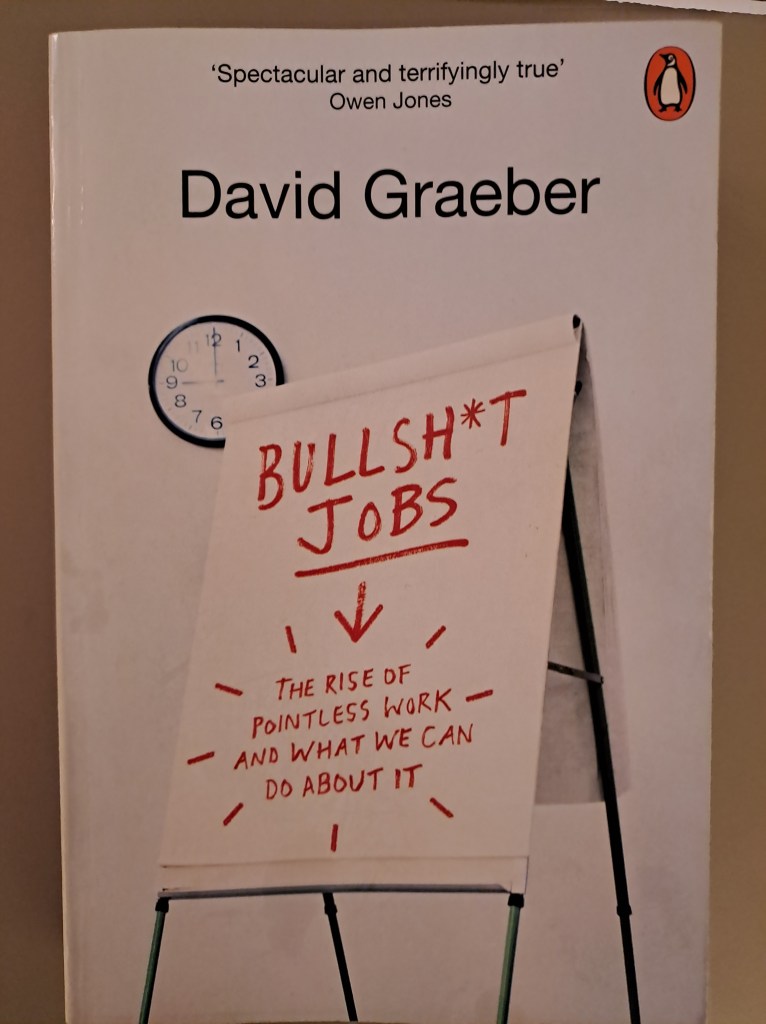
Anyway, the decision to set a high salary threshold for skilled migrants, reminded me of something that struck me when I read David Graeber’s book Bullshit Jobs. It’s really just a side issue in the context of that book, and it’s probably something well known to students of ethics, but I found it interesting:

In English, as currently spoken, we tend to make a distinction between “value” in the singular, as in the value of gold, pork bellies, antiques, and financial derivatives, and “values” in the plural: that is, family values, religious morality, political ideals, beauty, truth, integrity, and so on. Basically, we speak of “value” when talking about economic affairs, which usually comes own to all those human endeavors in which people are getting paid for the work or their actions are otherwise directed at getting money. “Values” appear when that is not the case. For instance, housework and child care are, surely, the single most common forms of unpaid work, Hence we constantly hear about the importance of “family values”.

Bullshit Jobs, David Graeber, p. 203

The point of relevance here is that defining the “value” of a job only in the sense of how large the salary is misses the fact that the financial reward isn’t the only sort of value that a job has; there is social value too. As far as I am aware, though, there is no really satisfactory theory of social value. On the other hand, it does seem that many jobs with the highest social value (care worker, nurse, primary school teacher, etc) are poorly paid, i.e. have low financial value. Nevertheless, people still do them. Why is that? It’s because people are motivated by things other than money – values. It’s possible to find work rewarding in a way that’s not primarily financial. That’s yet another reason why it is daft to measure the success of a University course in terms of the salaries of those who graduate from it.

One thing that confuses me is that there seem to be people – perhaps many of them – who actively resent those who find their work enjoyable or fulfilling. This sometimes manifests itself as exploitation. Take nurses, for example. I think we all agree that health services would fall apart without them, but the are routinely denied decent monetary reward for their work. One can’t live off values. A system that drives nurses out of the profession due to financial hardship is truly rotten.

As a University Professor, I’m well off financially, but that’s not the reason I chose a career as an academic. I don’t think the reason is simple, actually, among the factors are: (a) I think science is important and wanted to make a contribution; (b) I enjoy teaching; and (c) I didn’t want to be bored (in other words I didn’t want a bullshit job).

Marking Scheme

Posted in mathematics with tags , , , on December 8, 2023 by telescoper

With Christmas looming and the January examination period getting closer, I thought I’d help (?) those involved in such assessments by sharing this model of an elegant marking scheme from a Mathematics examination.

What could be simpler?

Do Black Holes have Singularities?

Posted in mathematics, The Universe and Stuff with tags , , , on December 7, 2023 by telescoper

A paper appeared on arXiv this week that has ruffled a few feathers. It’s by Roy Kerr (yes, him) and it has the abstract:

There is no proof that black holes contain singularities when they are generated by real physical bodies. Roger Penrose claimed sixty years ago that trapped surfaces inevitably lead to light rays of finite affine length (FALL’s). Penrose and Stephen Hawking then asserted that these must end in actual singularities. When they could not prove this they decreed it to be self evident. It is shown that there are counterexamples through every point in the Kerr metric. These are asymptotic to at least one event horizon and do not end in singularities.

arXiv:2312.00841

I don’t think this paper is as controversial as some people seem to find it. I think most of us have doubts that singularities – specifically curvature singularities – are physically real rather than manifestations of gaps in our understanding. On the other hand, this paper focusses on an interesting technical question and provides a concrete counterexample. The point is that the famous Penrose-Hawking singularity theorems don’t actually prove the existence of singularities; they prove geodesic incompleteness, i.e. that there are geodesics that can only be extended for a finite time as measured by an observer travelling along one. Geodesic incompleteness does imply the existence of some sort of boundary, often termed a trapped surface, but not necessarily that anything physical diverges there at that boundary. Though a singularity will result in geodesic incompleteness, the assertion that geodesic incompleteness necessarily implies the existence of a singularity is really just a conjecture.

For more details, read the paper. It’s technical, of course, but well written and actually not all difficult to understand.

El Puente

Posted in Barcelona, Biographical with tags , , on December 7, 2023 by telescoper

So here I am on Thursday 7th December, the day between two public holidays. In fact I attended, and gave a brief presentation at, a three-hour Zoom meeting (related to Euclid) yesterday afternoon, so it wasn’t really a holiday for me, and I’ll be working tomorrow too. Most shops are closed on public holidays, though

Today being an example of a Puente (‘bridge’, slang for a day bridging two holidays); at first I thought it was a day for playing Bridge. Many businesses close for a puente and some workers take a holiday even if their place of work is not closed. This is a rather splendid puente, actually, as it joins Wednesday to Friday and thus creates a (very) long weekend. I suppose the best one would be when public holidays are on a Tuesday and Thursday so then one can take Monday, Wednesday and Friday off to make a week-long holiday. I’m told this is called not a puente but an acueducto!

Anyway, I had planned to spent today’s puente working from home like I did yesterday. Unfortunately I had to change plan. There has been construction work going on in my apartment block more-or-less continually since I moved in. This hasn’t really bothered me much, as I have been out during most weekdays and the work never happens at night, at weekends, or on public holidays (such as yesterday). On the occasions when I have been in during the work, however, it has been very irksome. I had assumed that the builders would regard today as a puente but alas this is not the case. No sooner had I eaten my breakfast when the dreaded drilling and banging began. Knowing I wouldn’t be able to get much work done in such an environment, I decided to relocate to the University after all.

The University of Barcelona is actually open today (although not all entrances to the Physics Department are accessible) but there are no classes for students. The Metro coming here to Zona Universitaria was, unsurprisingly, pretty empty. The café downstairs is closed. The only other people are staff members, so It is very quiet and I should be able to put few useful hours of work in…

P.S. Apologies for getting the gender of puente wrong in the original title.It’s interesting that the Welsh word for “bridge” is “pont”, like French (from Latin pons cf puente), whereas in Irish it is “droichead”. The English word “bridge” is of Germanic origin.

Are Students Customers?

Posted in Education with tags , on December 6, 2023 by telescoper

When tuition fees were brought in to the UK higher education system many academics worried that the relationship between students and lecturers would be changed for the worse, as students would be encouraged to see themselves as customers. I haven’t taught in a UK university since 2018 but I have to say I never met any physics students who saw themselves as customers. On the other hand, over the years I have met many parents of students who saw themselves as customers. Maybe the tendency of students to think of themselves as customers has increased over the last six years. I don’t know.

These thoughts popped into my head when my attention was recently drawn to an advertisement for a job at the University of Bristol (which I used to think of as a good university):

Whether or not students see themselves as customers, there is clearly one University that seems to think that’s what they are; at least that’s what the advertisement says.

I have only two comments on this advertisement.

First, it set the ‘Bullshit Job” claxon* ringing very loudly. David Graeber’s book is full of testimonies from people whose job description is just like this! The third paragraph makes it clear that the plan is to bring in someone from outside the higher education system to impose private-sector methods where there is no reason to think they will be productive. I wonder how if the “human-centred approach to experience design” will include anything at all to do with teaching?

Second, I don’t think universities really see students this way at all. The reality is much worse. Students are not really customers, for the same reason that cattle are not customers. They are commodities, the income from which generates profit. A “cattle-centred approach” would have been a more honest form of words…

*If I had time I’d maintain a “Bullshit Jobs” folder in memory of David Graeber…

Bullshit Jobs by David Graeber

Posted in Books with tags , , on December 5, 2023 by telescoper

A little later than promised I thought I write a few things about the latest book I’ve read, Bullshit Jobs – subtitled The Rise of Pointless Work and What We Can Do About It – by anthropologist David Graeber. The book, published in 2015, was inspired by an essay Graeber wrote in 2013 on the same subject and is largely based on anecdotal testimonies sent to him by social media in reaction to that original piece.

I don’t have time to go into every issue raised by this book but I will make some comments based on my experience as someone working in a university, though I should point that it’s not a book about specifically universities. A huge amount of what is this book rings very true and I urge all my colleagues to read it. I suspect however that the people responsible for the proliferation of bullshit jobs in higher education institutions won’t bother.

It is useful to mention the definition of a bullshit job that Graeber settles on:

A bullshit job is a form of paid employment that is so completely pointless, unnecessary, or pernicious that even the employee cannot justify its existence even though, as part of the conditions of employment, the employee feels obliged to pretend that this is not the case.

pp. 9-10

In addition, Graeber divides bullshit jobs into five main types:

  1. flunkies,
  2. goons,
  3. duct tapers,
  4. box tickers,
  5. and task masters.

I think each category is fairly self-explanatory, but you can find each described in detail in Chapter 2. In a typical modern university you will find examples of all five; and many people have jobs in more than one category of bullshit.

An academic and former Head of Department at a UK university is quoted thus

As managerialism embeds itself, you get an entire cadres of academic staff whose job it is to keep the managerialist plates spinning – strategies, performance targets, audits, reviews, appraisals, renewed strategies, etc., etc., – which happen in an almost wholly and entirely disconnected fashion from the real lifeblood of universities: teaching and education.

pp. 53-54

This is very true, but it’s not only the exasperation of the “disconnect” that is the problem. There’s also the level of resources being taken away from teaching and research to sustain the ever-increasing bullshit which is extremely damaging. I would contend that it’s in the interest of the managerial class to keep the academics under as much pressure as possible because by labelling individuals and departments as “struggling” they have an excuse for even more managerialism. And so it goes on.

It’s worth pointing out an even clearer mechanism by which bullshit jobs proliferate in universities. This is that managers generally get paid according to how many people they manage. Appointing more flunkies, goons, and the rest is a sure-fire way of getting ones job “re-graded” and salary increased. A genuinely good administrator should aim to reduce administrative costs so as to maximize the investment in core activities, i.e. teaching and research. This is the exact opposite of what happens now.

Particularly irritating bullshit activities include systems that require one to download data (e.g. coursework marks) from one system only to reformat them for upload to another. Why not just integrate these applications? And the excruciatingly painful process of claiming minor expenses. That is something could easily be automated with AI, but instead every sandwich and cup of coffee is scrutinized by individuals whose wages cost more than could ever be saved by identifying incorrect claims. Financial control of this sort is emphatically not about saving money. It’s about asserting control. The message from the Management is “We have the power, and we don’t trust you. You will have to jump through many hoops for everything you get from us. Or better still, give up and just bear the cost yourself.”

Here is another comment from an “anonymous British academic” that will strike a chord with everyone who works in a university:

Evert dean needs his vice-dean and sub-dean, and each of them needs a management team, secretaries, admin staff; all of them only there to make it harder for us to teach, to research, to carry out the most basic functions of a university.

pp. 181-2

I could write more about this – and may do so in the future – but I’ll leave it there, except to say that bullshit jobs are only part of the problem. There are entire bullshit industries whose existence satisfies the criterion that they are “pointless, unnecessary, or pernicious”. Academic publishing is just one example of a bullshit industry; University rankings are another.

Anyway, this is an enjoyably vigorous polemic written by a man with a very inventive mind. It’s very sad that he passed away in 2020. David Graeber would, I think, have described himself as an anarchist. Not in the sense of the Black Bloc lunatics who smash up buildings for fun, but in the sense of being opposed to excessively hierarchical institutions and systems and the power structures they encourage. I agree with him on that. There’s no doubt in my mind that hierarchies allow bullshit jobs to proliferate just as they also allow abuse and harassment to do likewise.

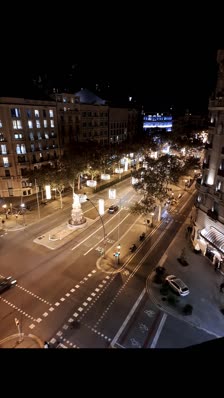
Christmas Lights and Traffic on the Gran Via

Posted in Barcelona on December 4, 2023 by telescoper

Ten Weeks in Barcelona

Posted in Art, Barcelona, Biographical with tags , , on December 4, 2023 by telescoper

Yesterday I suddenly realized that – apart from a couple of short trips elsewhere – I’ve now been in Barcelona for ten weeks. Among other things, that means that in just less than three weeks I’ll be leaving for a Christmas break. The lease on my apartment expires in Friday 22nd December; when I return I’ll be moving into a new place.

Another thing I noticed yesterday was that it was noticeably colder than it has been of late. Between Saturday and Sunday the peak daytime temperature fell by about 7 degrees. That’s not surprising. It is, after all, December and there has been cold weather across Europe – including heavy snow in Germany – but it’s the first time I’ve felt remotely chilly here since I arrived. It’s not actually cold, like in Ireland where it is freezing today.

Unfortunately this little cold-ish snap has caused my arthritis to flare up. It seems to respond to changes in temperature rather than absolute values. I was struggling so much yesterday that I decided I had to do something about it. The drugs I have used in the past are only available on prescription so I had to find a doctor to prescribe them. Fortunately the management company responsible for the apartment I am in has a list of recommended doctors, so first thing this morning I visited one. The consultation was free with my EHIC card. He filled out a prescription and I took it to a pharmacy. Prescription drugs are not free in Spain, but the prices are heavily regulated and you get a discount with an EHIC card. And so it came to pass that I got 60 tablets of Vimovo, which should keep me going for a while, for just less than €15.

This, my 11th week in Barcelona will be quite an unusual one because it contains two public holidays. December 6th (Wednesday) is Constitution Day in Spain (Día de la Constitución) and is a national public holiday. It marks the anniversary of the 1978 Referendum in which the Spanish people approved the current Spanish Constitution. December 8th is the Day of the Immaculate Conception, or Dia de la Inmaculada Concepcion, which is also a public holiday. Only very recently was it explained to me that the person conceived immaculately was the Virgin Mary, and it refers to the fact that she was born without original sin. I myself have plenty of sins, but am not sure how many of them are original.

The Immaculate Conception, by Giovanni Battista Tiepolo (1696-1770); Museo Nacional del Prado, Madrid, Spain

Anyway, many people here take 7th December off work as a “bridge” between the two official holidays, which means this year a (very) long weekend, lasting from Wednesday 6th to Sunday 10th. The University will be closed on Wednesday and Friday. While it is officially open on Thursday, there are no classes on that day and I don’t think there’ll be many people around. I’ll be working at home for that period, but will have to remember to stock up on things to eat as most shops are closed on public holidays. Most bars and restaurants remain open, though, so I could dine out instead…

Euclid in the Media

Posted in Euclid, The Universe and Stuff with tags , , , , , on December 3, 2023 by telescoper

Yesterday came across the above “infographic” – as I’m told such things are called – showing the media traffic generated by last month’s Early Release Observations from the ESA Euclid mission. Some quite interesting facts emerge from it. The new observations were released n 7th November, hence the big spike in the left hand panel on that date.

I see that about 31% of the activity was on Twitter, which I am no longer on, with a slightly smaller amount on Facebook. Overall, social media account for about 60% of the “reach”, with mainstream media (including print, online, and TV/Radio) languishing far behind. Blogs (presumably including this one) account for a mere 1%.

The breakdown by country is interesting too; the table shows only EAS member states. The UK is way out in front, no doubt because BBC News ran a major item on the day of the release. France, Germany, Italy and Spain all have major scientific involvements in Euclid and correspondingly active public engagement activities.

I was pleasantly surprised at the significant amount of interest in Ireland, given that some bigger countries with far greater scientific involvement in Euclid (e.g. Denmark and The Netherlands) generated so little. As the only member of the Euclid Consortium in Ireland I could try to pretend that this was all down to me, but I rather think it’s more likely to be a result of the fact that many Irish people read the UK media so some of the Irish traffic could be spillover from the big UK spike. Still, I think one can interpret this as meaning that the Public in the Republic have an appetite for news about space, something that we have certainly noticed when organizing events in Maynooth.

I thought I’d mention another nice thing. Here is one of the PR images produced by ESA about the early release observations. The point about Euclid is that to achieve its science goals it has to have extremely good optical quality across a very wide field of view. The systems are currently being tested and fine-tuned to see how good their performance actually is, but so far it’s looking good.

The main thing that caught my eye, however, is the collection of little flags along the bottom. How nice it is to see Ireland’s among them!