Archive for David Graeber

What Leads to Administrative Bloat?

Posted in Finance with tags , , , , , on June 5, 2026 by telescoper

I’ve commented many times before on this blog about runaway expenditure on management resulting in the diversion of resources away from the core missions of a university, i.e. teaching and research, while producing no significant improvement in the efficiency, and indeed often a deterioration, of administrative processes. David Graeber wrote a book called Bullshit Jobs about this phenomenon. Management response to this is generally to assert that this administrative bloat is a response to regulatory burden. Many of us working in higher education would instead argue that the entire sector has been hijacked by self-serving parasites who are deliberately sucking the lifeblood out of the system.

I just came across a paper on the Physics and Society section of arXiv that tries to explain management bloat from the point of view of systems theory. The title is What Leads to Administrative Bloat? A Dynamic Model of Administrative Cost and Waste, the authors are Vicky Chuqiao Yang and Levi Grenier of MIT and the abstract is here:

The functioning of complex systems depends on the coordination of diverse components, often supported by regulatory structures that incur costs. In human organizations, such costs manifest as administrative burden, which has been rising despite often reducing efficiency. Classic explanations point to bureaucrat self-interest or regulation, yet they do not explain variation across organizations or clarify how this burden can be reduced. Here, we develop a dynamical model of administrative growth that integrates known behavioral mechanisms of process creation, obsolescence, and removal. The model conceptualizes processes as developed for problem solving, but becoming obsolete as conditions change, while continuing to consume resources until actively pruned. This interplay generates two long-term outcomes: stable equilibrium or run-away growth. The threshold separating these outcomes is shaped by organizations’ propensity to create new processes when faced with problems, and their propensity to prune obsolete ones in response to administrative burden. Importantly, their effects are asymmetric: sufficiently high creation propensity leads to bloat regardless of pruning propensity. Faster environmental change shifts this threshold, making bloat more likely. Simulations of interventions show that lasting reductions in administrative costs and waste require permanent shifts in priorities and investments in distinguishing obsolete from useful processes. Temporary efforts or indiscriminate cuts provide only short-lived relief, and counterintuitively, prioritizing direct production can increase waste. Our work highlights a general mechanism by which well-intentioned problem-solving can create self-reinforcing inefficiencies in complex systems, offering insights possibly generalizable to broader applications, such as legal, policy, and software systems where obsolete elements accumulate.

Here’s a a figure from the paper that provides ample illustration of the problem:
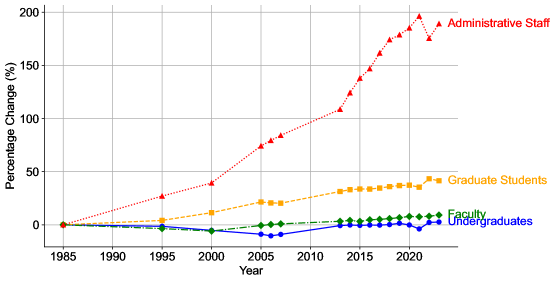
You will find a similar phenomenon on display at universities across the world. In my view this is a large part of the crisis engulfing higher education in the United Kingdom.

It’s an interesting paper, based on a very simple model. The authors also suggest various ways in which this burden could be reduced. The problem with that is that there is no incentive at all for The Management (who hold all the power) to improve the situation, as that would involve eliminating the bullshit jobs held by many of their cronies. With university governance structures notoriously weak and compliant, who manages the Managers? The most likely response from my University would be to appoint a new Vice-President for Self-reinforcing Inefficiency…

Universities: Death by Bullshit

Posted in Education, Maynooth, Politics with tags , , , , , , on March 9, 2025 by telescoper

Just time for a quick post to pass on an Editorial by Masud Husain with the title On the responsibilities of intellectuals and the rise of bullshit jobs in universities which appeared in BRAIN magazine (which I buy for the Spot-the-Cell competition). I agree wholeheartedly with the article, which is available free of charge so I recommend you read it in full here, but I thought I’d give you a couple of tasters. The first is:

For some years now, it has become increasingly apparent to me that we are sleepwalking into a disaster. We are losing sight of the academic mission: to think, to enquire, to design and perform new research, to innovate, to teach and communicate our findings for the purpose of societal improvement. There are many reasons why this has occurred over just a quarter of century but a key contributor has been the corporatization of academic institutions.

The second is

To undertake corporatization, universities have borrowed principles that they think work in the private sector. These involve creating layers of administration to run different sectors of our institutions. In the UK, for example, between 1995 and 2019 while spending on university departments roughly doubled, the amount allocated to administration and central services more than quadrupled.

As you probably imagined, the piece borrows some themes from the book Bullshit Jobs (subtitled The Rise of Pointless Work and What We Can Do About It) by anthropologist David Graeber that I wrote about here.

The other day a colleague asked me if what I thought could be done about the underfunding of UK universities and the consequent job losses. I replied to say that I don’t think the problem so much that the universities as a whole are underfunded, but that the core missions of such institutions, by which I mean teaching and research, are. What is happening is that a huge slice of the money coming into universities is dissipated on bullshit jobs in a bloated management superstructure instead of being spent in the departments, which have become entirely subservient to “The Centre”. That is not only the case in the UK, but also here in Maynooth. Hardly a week goes by without some new bullshit job being advertised while our student-staff ratio soars and we academic underlings are starved of the resources we need to do our real jobs properly. It’s very dispiriting that Management continue to get away with this nonsense. If it continues, Ireland will undoubtedly encounter the same structural problems as are currently affecting the UK. I’m sure this is also the state of affairs in many other universities around the world.

It seems obvious to me that when your income falls, among the first things to do is reduce waste. If I were in charge of Higher Education funding my first priority would not be to increase funding but to impose penalties on universities that spend too little on what they’re actually supposed to be doing and too much on bullshit.

Value versus Values

Posted in Biographical, Politics with tags , , , , , on December 9, 2023 by telescoper

I noticed last week that the United Kingdom has a new Home Secretary, the ironically-named James Cleverly, who has taken over the task of making the country even more xenophobic. Among the measures he is proposing is hiking the minimum salary needed for skilled overseas workers from £26,200 to £38,700. That figure has come as a shock to scientific researchers, as the entry level for a new postdoctoral researcher in the UK is about £36-37K. No foreign postdocs, please, we’re British! I wonder how this squares with the recent (belated) decision to join Horizon 2020? I don’t see this latest bout of small-mindedness doing much to repair the damage done by a two-year absence from the programme.

Anyway, the decision to set a high salary threshold for skilled migrants, reminded me of something that struck me when I read David Graeber’s book Bullshit Jobs. It’s really just a side issue in the context of that book, and it’s probably something well known to students of ethics, but I found it interesting:

In English, as currently spoken, we tend to make a distinction between “value” in the singular, as in the value of gold, pork bellies, antiques, and financial derivatives, and “values” in the plural: that is, family values, religious morality, political ideals, beauty, truth, integrity, and so on. Basically, we speak of “value” when talking about economic affairs, which usually comes own to all those human endeavors in which people are getting paid for the work or their actions are otherwise directed at getting money. “Values” appear when that is not the case. For instance, housework and child care are, surely, the single most common forms of unpaid work, Hence we constantly hear about the importance of “family values”.

Bullshit Jobs, David Graeber, p. 203

The point of relevance here is that defining the “value” of a job only in the sense of how large the salary is misses the fact that the financial reward isn’t the only sort of value that a job has; there is social value too. As far as I am aware, though, there is no really satisfactory theory of social value. On the other hand, it does seem that many jobs with the highest social value (care worker, nurse, primary school teacher, etc) are poorly paid, i.e. have low financial value. Nevertheless, people still do them. Why is that? It’s because people are motivated by things other than money – values. It’s possible to find work rewarding in a way that’s not primarily financial. That’s yet another reason why it is daft to measure the success of a University course in terms of the salaries of those who graduate from it.

One thing that confuses me is that there seem to be people – perhaps many of them – who actively resent those who find their work enjoyable or fulfilling. This sometimes manifests itself as exploitation. Take nurses, for example. I think we all agree that health services would fall apart without them, but the are routinely denied decent monetary reward for their work. One can’t live off values. A system that drives nurses out of the profession due to financial hardship is truly rotten.

As a University Professor, I’m well off financially, but that’s not the reason I chose a career as an academic. I don’t think the reason is simple, actually, among the factors are: (a) I think science is important and wanted to make a contribution; (b) I enjoy teaching; and (c) I didn’t want to be bored (in other words I didn’t want a bullshit job).