Voices

Posted in Biographical, Education, Poetry with tags , , , on April 15, 2023 by telescoper

Not long ago I did a post about an anthology of Poems I studied at school many years ago. I bought that second-hand at the same time as I bought the three volumes shown above, Books 1-3 of Voices (edited by Geoffrey Summerfield). I seem to remember that we studied these at an earlier stage of 11+ education, probably in consecutive years before O-level. I remember the covers quite well, especially the rather spooky picture on Book 3.

They’re quite interesting books, each of which contains an eclectic collection of poems, including traditional rhymes and there is even some music at the back to accompany some of the verses that work as songs.

Anyone else remember these books?

Why Are Universities So International?

Posted in Biographical, Education, Maynooth on April 15, 2023 by telescoper

This is an interesting post about internationalization in universities. The Faculty in the Department of Theoretical Physics at Maynooth provides a good illustration. It includes seven people, only two of whom were born in Ireland. The others were born in the Netherlands, Norway, Czech Republic, USA and UK. The blog post says there are two reasons why universities are so international: specialization and diversification. Both of these do apply, but there is a third reason, which concerns personal life, love, the pursuit of happiness, politics, and so on. I gave my reasons for moving to Ireland here.

The personal dimension shouldn’t be ignored, though it is much more complex than the others. Academics are people after all.

4gravitons's avatar4 gravitons

Worldwide, only about one in thirty people live in a different country from where they were born. Wander onto a university campus, though, and you may get a different impression. The bigger the university and the stronger its research, the more international its employees become. You’ll see international PhD students, international professors, and especially international temporary researchers like postdocs.

I’ve met quite a few people who are surprised by this. I hear the same question again and again, from curious Danes at outreach events to a tired border guard in the pre-clearance area of the Toronto airport: why are you, an American, working here?

It’s not, on the face of it, an unreasonable question. Moving internationally is hard and expensive. You may have to take your possessions across the ocean, learn new languages and customs, and navigate an unfamiliar bureaucracy. You begin as a temporary resident, not…

View original post 437 more words

Tá mé sa bhaile – Biden’s Irish

Posted in Irish Language, Politics with tags , , , , , , on April 14, 2023 by telescoper

TRIGGER WARNING: CONTAINS PRONOUNS!

Yesterday, President of the United States of America, Joe Biden, addressed a joint sitting of the houses of Oireachtas in Dublin. Predictably he included an attempt at Irish in his speech to the obvious appreciation of those attending. I was a bit confused by the way what he said was reported in the Irish media, however, e.g.

My confusion was that I didn’t think he said tá mé seo abhaile as widely reported. For one thing, even I as a beginner could see that phrase means “I am this home”, which doesn’t make any sense (not to me, anyway). There are various possibilities for what Joe Biden did say. For what it’s worth I thought it was tá mé sa bhaile which, loosely, means “I am at home”. I note that the news media have generally changed their accounts (e.g. here) to reflect this, although other forms of words are possible. I’m not surprised that Biden struggled with the pronunciation – most of us beginners do, but I think the writers and editors of the newspapers above might at least have corrected his grammar.

The phrase illustrates a couple of interesting curiosities about the Irish language. Expressing the verb “to be” in Irish isn’t as straightforward as it is English. There are two grammatically distinct ways of doing this. The two Irish forms are , which is like the English verb “to be” and the so-called copula, is, which is sometimes called a defective verb. It’s admittedly a bit confusing that the copula looks like the third-person singular of the verb “to be” in English, but there you go.

Going back to, it is frequently referred to as tá (its present tense form as in the phrase above). It can be fully conjugated in all tenses and persons but it is highly irregular. Grammatically, is also just like any other verb, coming first in the sentence, followed by a subject (either a separate noun or pronoun or a suffix, depending on the tense and person, as shown in the conjugations), and then its predicate and any remaining adverbial information. Thus tá mé is “I am” with the pronoun . The accents (síneadh fada)  mean that this is pronounced taw-may.

The copula, however, is not fully conjugated for different subjects, which are always expressed by separate nouns or pronouns, and it only has two forms for different tenses: is can be used for present or future meaning, and ba (with lenition) is used for past or conditional meanings.

Among the specific situations in which the copular is must be used instead of but the main one is to be followed by a noun. You can’t say “I am a Professor” using – it has to be Is Ollamh – but to say “I am old” it is Tá mé sean.

One final remark. If you’re scared of pronouns please look away now. There are over 120 different pronouns in the Irish language. There’s a special version of the pronoun written mise which has two uses that I am aware of. One is when the copular is used for identification – so “I am Peter” is Is mise Peadar – and the other is for emphasis, when it is roughly equivalent to “myself” in English.

P.S. The Irish word for “pedantry” is pedantraí

The Gruber Prize for Cosmology 2023: Richard Ellis

Posted in Biographical, The Universe and Stuff with tags , , on April 13, 2023 by telescoper
Professor Richard Ellis

I’m delighted to be able to convey the news that the 2023 Gruber Prize for Cosmology has been awarded to Richard Ellis. Heartiest congratulations to him! The official announcement reads:

Over the past five decades Richard Ellis’s innovations have reimagined cosmology in fundamental ways. His observations have pushed the cosmic horizon—how far across the universe we can see—to a period close to the development of the first galaxies. Meanwhile the instruments he conceived, then shepherded through development and execution, have transformed myriad astronomical methodologies.

The full citation is here:

The Gruber Foundation is pleased to present the 2023 Cosmology Prize to Richard Ellis for his numerous contributions in the fields of galaxy evolution, the onset of cosmic dawn and reionization in the high redshift universe, and the detection of the earliest galaxies via the Hubble Ultra Deep Field study. 

Richard Ellis has also driven several frontier instrumental developments in optical astronomy, especially the use of multi-object spectroscopy to study many galaxies in the same field of view.  These included the “autofib” instrument, the “2dF” facility on the Anglo-Australian Telescope, which led to the discovery of baryon acoustic oscillations, the “LDSS” on the Herschel Telescope, which studied the redshifts of faint galaxies, and the “PFS” currently under commissioning on the Subaru Telescope to study dark matter and dark energy.

There’s a lot more information and biographical material in the full press release here.

If I can add just a couple of personal comments. Way back in 1985, when I was about to start my PhD DPhil, I attended an SERC summer school for new research students held in Durham. The lectures on Observational Cosmology at that school were delivered by Richard Ellis. I still have the notes, in fact. In many ways, this was my first encounter with modern cosmology. Quite few things have changed since then of course, but it was a formative experience. One thing I particularly remember is his discussion of the Hubble constant controversy:

 You will see that there were two main estimates, one low and one high, both about three sigma away from the currently-favoured value of around 70. Plus ça change, plus c’est la même chose…

The second comment is that Richard was the external member on the panel that awarded me my first Chair position way back in 1998. Gosh. Was that really 25 years ago? Still, it goes to show that even an eminent scientist such as Richard can sometimes make an error of judgement!

New Results from the Atacama Cosmology Telescope

Posted in The Universe and Stuff with tags , , , , , , on April 12, 2023 by telescoper

I wish to draw your attention to a clutch of new papers out on the arXiv today (here, here and here) which describe latest results from the Atacama Cosmology Telescope (ACT for short). There was a webinar about this yesterday, which I failed to attend because I forgot about it.

The first of the papers listed above summarizes the key science results, which include a mass map obtained from gravitational lensing of the cosmic microwave background and its implications for cosmology.

As cosmic background photons propagate freely through space, i.e. without scattering, from the time of recombination to the observer, they are deflected by the gravitational effect of the large-scale distribution of matter in the Universe. This lensing effect leaves imprints in the temperature and polarization anisotropies, which can be used to reconstruct a map of the lensing potential, the gradient of which determines the lensing deflections. Structures in the CMB temperature pattern look bigger on the sky if we view them through an overdense clump of dark matter. By looking how the typical size of hot and cold spots in the CMB temperature map vary across the sky, it is possible to reconstruct the lensing deflections and hence the distribution of dark matter integrated along the line of sight. Since the structure through which the radiation passes is changing with time, this sort of map can provide constraints on models for the evolution of structure.

To cut a long story short, here is the map obtained using Data Release 6 of the ACT data over about 25% of the sky:

There’s a lot of information in the three papers but the key conclusion can be found in the last sentence of the abstract of the first paper:

Our results provide independent confirmation that the universe is spatially flat, conforms with general relativity, and is described remarkably well by the ΛCDM model, while paving a promising path for neutrino physics with gravitational lensing from upcoming ground-based CMB surveys.

Nothing revolutionary, then, but interesting nevertheless. There is an article on the BBC website about these results.

Response to the Nelson Memorandum from arXiv

Posted in Open Access with tags , , on April 11, 2023 by telescoper

I just noticed on the arXiv blog that arXiv, along with bioRxiv and medRxiv, has released its response in the form of an open letter to the US Office of Science and Technology Policy (OSTP) “Nelson Memorandum” which recommends that US government agencies update their public access policies to make publications and data from research funded by US taxpayers publicly accessible immediately without embargo or cost. I thought I’d take the liberty of reproducing the letter in full here because what it says should apply beyond the United States. I agree particularly strongly with the last paragraph. I haven’t edited the letter except to replace footnotes with links.

—o—

April 11, 2023

The recent Office of Science and Technology Policy “Nelson Memorandum” on “Ensuring Free, Immediate, and Equitable Access to Federally Funded Research” is a welcome affirmation of the public right to access government funded research results, including publication of articles describing the research, and the data behind the research. The policy is likely to increase access to new and ongoing research, enable equitable access to the outcome of publicly funded research efforts, and enable and accelerate more research. Improved immediate access to research results may provide significant general social and economic benefits to the public.

Funding Agencies can expedite public access to research results through the distribution of electronic preprints of results in open repositories, in particular existing preprint distribution servers such as arXivbioRxiv, and medRxiv. Distribution of preprints of research results enables rapid and free accessibility of the findings worldwide, circumventing publication delays of months, or, in some cases, years. Rapid circulation of research results expedites scientific discourse, shortens the cycle of discovery and accelerates the pace of discovery.

Distribution of research findings by preprints, combined with curation of the archive of submissions, provides universal access for both authors and readers in perpetuity. Authors can provide updated versions of the research, including “as accepted,” with the repositories openly tracking the progress of the revision of results through the scientific process. Public access to the corpus of machine readable research manuscripts provides innovative channels for discovery and additional knowledge generation, including links to the data behind the research, open software tools, and supplemental information provided by authors.

Preprint repositories support a growing and innovative ecosystem for discovery and evaluation of research results, including tools for improved accessibility and research summaries. Experiments in open review and crowdsourced commenting can be layered over preprint repositories, providing constructive feedback and alternative models to the increasingly archaic process of anonymous peer review.

Distribution of research results by preprints provides a well tested path for immediate, free, and equitable access to research results. Preprint archives can support and sustain an open and innovative ecosystem of tools for research discovery and verification, providing a long term and sustainable approach for open access to publicly funded research.

Patterns of Earth – Hyam Plutzik

Posted in Poetry with tags , , on April 11, 2023 by telescoper

Now the new grass is vivid with dandelions,
As last night the ancient sky was constellated.

And the Scorpion, the Dog, Perseus and Hercules
Are less than the gold children of my field.

Whom I will name quickly for their time is flying:
The Butcher, the Baker, and the Candlestick maker.

They will be gone in a fortnight, full upon the wind
And the bullies of the sky will resume their mastery.

by Hyam Plutzik (1911-1962)

Personal Internet History

Posted in Biographical with tags , , , on April 9, 2023 by telescoper

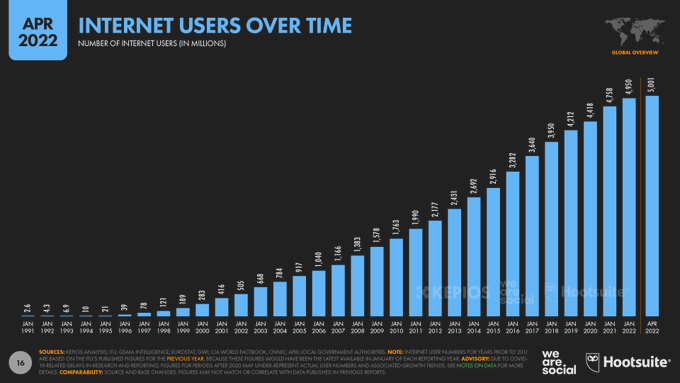
The above graphic, which comes from here, has been doing the rounds on social media and has been eliciting quite a few responses from people of my age or older, about when they started using the internet, so I couldn’t resist a comment or two.

My first experiences of anything like the modern internet was using the computers at the (now defunct) British Gas On Line Inspection Centre (OLIC) in Cramlington, Northumberland. I wrote about this here. That would have been in 1981, in between leaving school and starting University (which I did in 1982). I also went back to OLIC work in the summer holidays while still an undergraduate.

At OLIC did quite a lot of coding (on projects related to pattern recognition), most of which was on VAX computers (and also the odd PDP 11/45). Incidentally, when I later started as a research student in 1985 I was delighted to discover that the STARLINK system in use at Sussex and throughout the UK was also VAX-based because I was already fluent in the command language (DCL) as well as the database software DATATRIEVE. Another reason I am grateful for the experience I gained at OLIC is that, working in that environment, I had to learn to make my code (which, incidentally, was all in Fortran-77) conform to various very strict standards which is no doubt why I am a bit of a stickler when it comes to scripts written in my Computational Physics lab!

Anyway, the Vax computers in use in OLIC and in STARLINK were connected by a thing called DECnet. This allowed users to send emails to other machines. The format of email addresses was much simpler than in use today, being of the form “host::username“. One could send files that way too; the alternative, via, FTP was terribly unreliable. DECnet provided a fast method of communication, but did require the receiving system to be accessible when you tried to send and would fail if this were not the case. Later email protocols would keep trying to send messages if at first they did not succeed.

While working at OLIC, where the powers that be were paranoid about industrial espionage, sending things this way essentially required the sender to log into the receiver’s machine, which terrified the systems people and it was soon blocked. STARLINK allowed this, however, as did the U.S. Space Physics Analysis Network (US-SPAN), the European Space Physics Analysis Network (E-SPAN), and by 1989 there were 17,000 nodes worldwide.

Sending emails outside DECnet was a rigmarole, involving including SMTP% followed by the external address. Messages inevitably had lengthy headers indicating the circuitous taken to reach the destination and often took some time to reach their destination. I was regularly using email in 1985, and if that counts as internet usage, then I started way to the left of the start of the graphic.

I didn’t use the world wide web until later. I’m not sure when, but it must have been around 1991 or so. The arXiv in roughly the form it exists now started in 1993, but it had precursors in the form of an email distribution list and, later, FTP access. Initially, it was based at Los Alamos National Laboratory (LANL) with a mirror site in SISSA (Trieste) that was used by those of us in Europe. In the beginning, arXiv was quite a small-scale thing and it wasn’t that easy to upload full papers including figures. In fact the SISSA system was run from a single IBM 386 PC (called “Babbage”).

The astrophysics section of arXiv (astro-ph) started in April 1992. Although astrophysicists generally were quick to latch on to this new method of distributing preprints, it took me a little time to get onto arXiv: my first papers did not appear there until February 1993; my first publication was in 1986 so there are quite a few of my early papers that aren’t on arXiv at all. In 1993 I was working at Queen Mary & Westfield College (as it was then called). I was working a lot with collaborators based in Italy at the time and they decided to start posting our joint papers on arXiv. Without that impetus it would have taken me much longer to get to grips with it.

Just a Closer Walk with Thee

Posted in Biographical, Jazz with tags , on April 9, 2023 by telescoper

When my father passed away in 2007, the main music music played at his funeral was the hymn or spiritual (and of course Jazz standard) Just a Closer Walk with Thee. It’s a lovely old traditional tune that often plays a central role in New Orleans style funerals and is a melody that, at least for me, has a deep association with loss and bereavement. The recording that was played on that occasion was this one, made at the same session as the track I posted a few days ago, featuring the same personnel (including my Dad on the drums), but with vocals by a fine Jazz and Blues singer by the name of Annie Jenkins.

Newsflash – New MSc Course at Maynooth!

Posted in Education, mathematics, Maynooth with tags , , on April 8, 2023 by telescoper

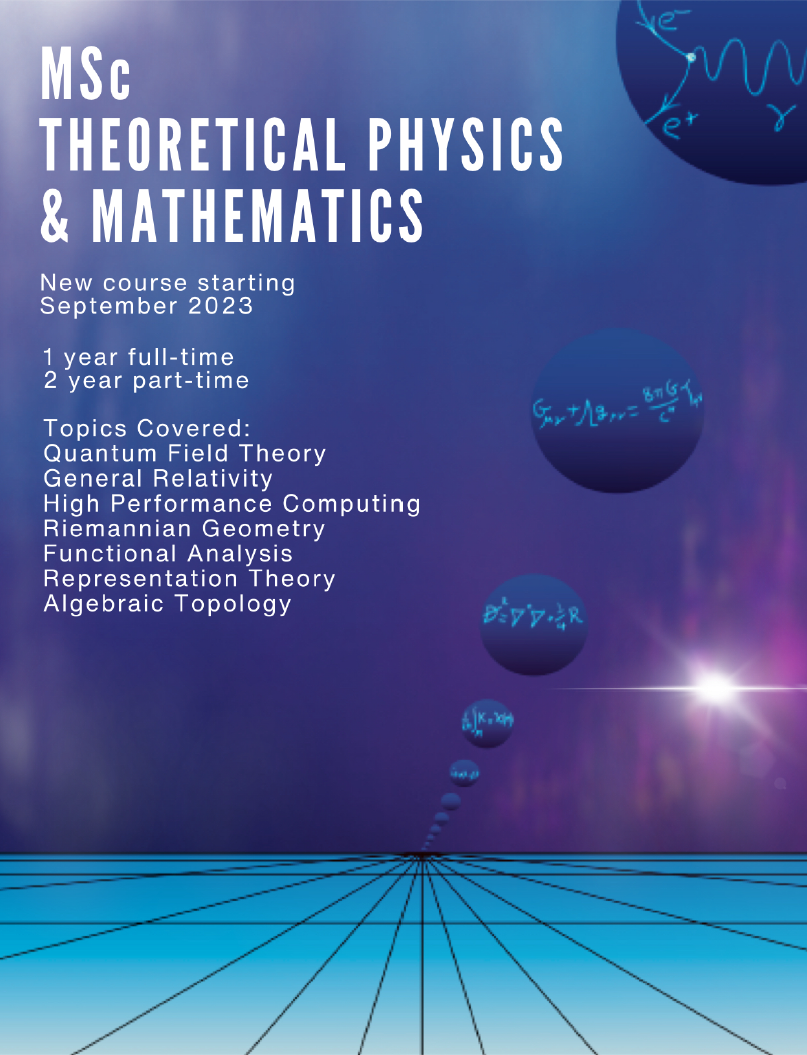
I know it’s the Easter holiday weekend but I couldn’t resist sharing the exciting news that we have just received approval for a brand new Masters course at Maynooth University in Theoretical Physics & Mathematics. The new postgraduate course will be run jointly between the Departments of Theoretical Physics and Mathematics & Statistics, with each contributing about half the material. The duration is one calendar year (full-time) or two years (part-time) and consists of 90 credits in the European Credit Transfer System (ECTS). This will be split into 60 credits of taught material (split roughly 50-50 between Theoretical Physics and Mathematics) and a research project of 30 credits, supervised by a member of staff in a relevant area from either Department.

This new course is a kind of follow-up to the existing undergraduate BSc Theoretical Physics & Mathematics at Maynooth, also run jointly . We think the postgraduate course will appeal to many of the students on that programme who wish to continue their education to postgraduate level, though applications are very welcome from suitably qualified candidates elsewhere.

Although the idea of this course has been on the cards for quite a while, the pandemic and other issues delayed it until now. This has so recently been agreed that it doesn’t yet exist on the University admissions webpages. This blog post is therefore nothing more than a sneak preview. There isn’t much time between now and September, when the course runs for the first time, which is why I decided to put this advanced notice on here! I will give fuller details on how to apply when they are available. You will also find further information on the Department’s Twitter feed, so if you’re interested I suggest you give them a follow.