Save the Holmdel Antenna!

Posted in History, The Universe and Stuff with tags , , , , on December 11, 2022 by telescoper

I’ve used the above image hundreds of times in popular talks. It shows Robert W. Wilson (left) and Arno A. Penzias (right) standing in front of the famous horn antenna that (accidentally) discovered what we now know to be the cosmic microwave background radiation left over after the Big Bang. Penzias and Wilson made their historic measurements in 1964, published their results in 1965, and received the Nobel Prize for Physics in 1978.

At the time of their historic experiment, the scientists were working at Bell Telephone Laboratories at Holmdel, New Jersey, on Project Echo. The antenna was built to receive radio signals bounced off a passive satellite in a low Earth orbit to check the feasibility of satellite radio communication. They found excess noise in their receiver, which was eventually identified as a relic of a time when the Universe was extremely hot. Coincidentally, the theory of this yet undiscovered radiation was being worked on by Bob Dicke and his group in Princeton at about the same time (and also in New Jersey). Discussions ensued, and the discovery paper by Penzias & Wilson appeared in the Astrophysical Journal in 1965 beside a paper by Dicke et al. giving the theoretical interpretation.

Anyway, in case you were wondering whatever happened to the Holmdel Antenna, it is still there in Holmdel (at the top of Crawford Hill) and in 1988 was declared a National Historic Landmark:

Bell Labs (as it was usually known) was acquired by Nokia in 2016 and subsequently called Nokia Bell Labs. In 2019, however, Nokia put the entire Holmdel site up for sale and redevelopment of the entire site is currently being considered. This would not only bring to an end the connection between Holmdel and the telecommunications industry but also places a big question mark over the famous antenna. A petition has been raised to secure the future of this extremely important piece of scientific history. I encourage you to read more about the situation here and consider signing the petition.
Sine and Other Curves

Posted in History, mathematics with tags , , , , , , on December 10, 2022 by telescoper

Last week I learned something I never knew before about the origin of the word sine as in the well-known trigonometric function sin(x). I came to this profound knowledge via a circuitous route which I won’t go into now, involving the Italian word for sine which is seno. Another meaning of this word in Italian is “breast”. The same word is used in both senses in Spanish, and there’s a word in French, sein, which also means breast, although the French use the word sinus for sine. The Latin word sinus is used for both sine and breast (among other things); its primary meaning is a bend or a curve.

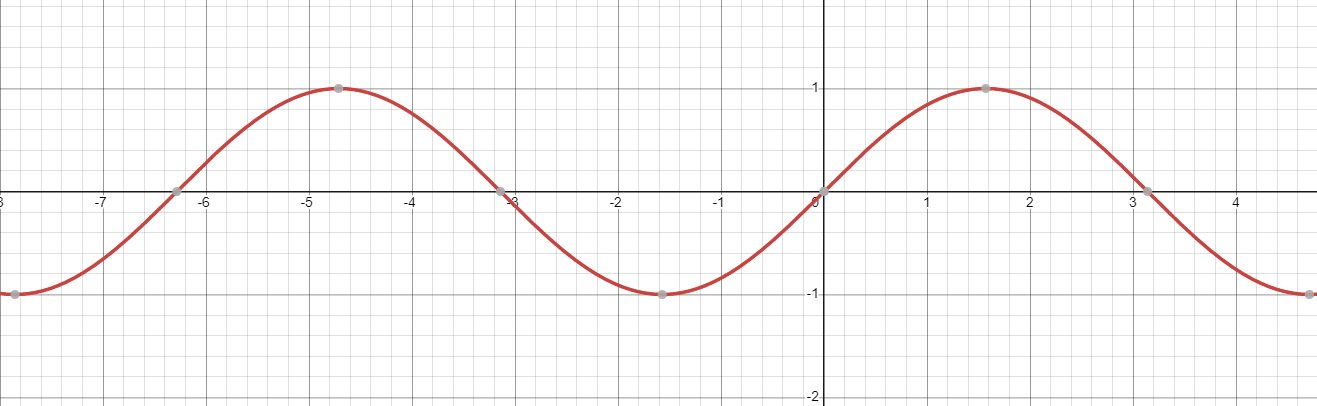
A friend suggested that it has this name because of the shape of the curve (above) but I didn’t think it would be so simple, and indeed it isn’t.

Since trigonometry was developed for largely for the purpose of compiling astronomical tables, I looked in the excellent History of Ancient Mathematical Astronomy by Otto Neugebauer. What follows is a quick summary.

Astronomical computations only became possible after the adoption of the Babylonian sexagesimal notation for numbers, which is why we still use seconds and minutes of arc. Trigonometry is indispensable in most such computations, such as passing from equatorial to ecliptic coordinates. This is needed for such things as calculating the time of sunrise and sunset. Spherical trigonometry was more important than plane trigonometry for this type of calculation, though both were developed alongside each other.

As an aside I’ll remark that I had to do spherical trigonometry at school, but I don’t think it’s taught anymore at that level. Because everything is done by computers nowadays it’s no longer such a big part of astronomy syllabuses even at university level either. I’m also of an age when we had to use the famous four-figure tables for sine and cosine. But I digress.

The first great work in the field of spherical trigonometry was Spherics by Menelaus of Alexandria which was written at the end of the First Century AD. If Menelaus compiled any trigonometric tables these have not survived. The earliest surviving work where trigonometry is fully developed is Ptolemy‘s Almagest which was written in the 2nd Century contains the first known trigonometric tables.

Almagest, however, does not use our modern trigonometric functions. Indeed, the only trigonometric function used and tabulated there was the chord, define in terms of modern sin(x) by 

chd(x)= 2 sin(x/2).

If you’re familiar with the double-angle formulae you will see that chd2(x)=2[1-cos(x)].

Sine was used by Persian astronomer and mathematician Abu al Wafa Buzjani in the 10th Century from which source it began t spread into Europe. The term had however been used elsewhere much earlier and many historians believe it was initially developed in India at least as early as the 6th century. Anyway, sine proved more convenient than chord, but its usage spread only very slowly in Europe. Nicolaus Copernicus used sine in the discussion of trigonometry in his De revolutionibus orbium coelestium but called it “half of the chord of the double angle”.

But what does all this have to do with breasts?

Well, the best explanation I’ve seen is that Indian mathematicians used the Sanskrit word jīva which means bow-string (as indeed does the Greek chordē). When Indian astronomical works were translated into Arabic, long before they reached Europe, the Indian term was translated as jīb. This word is written and pronounced in the same way as the word jayb which means the “hanging fold of a loose garment” or “breast pocket”, and this subsequently mistranslated into Latin as sinus “breast”.

I hope this clarifies the situation.

P.S. I’m told that if you Google seno iperbolico with your language set to Italian, you get some very interesting results…

A Winter’s Day in Maynooth

Posted in Biographical, Maynooth with tags , , , on December 9, 2022 by telescoper

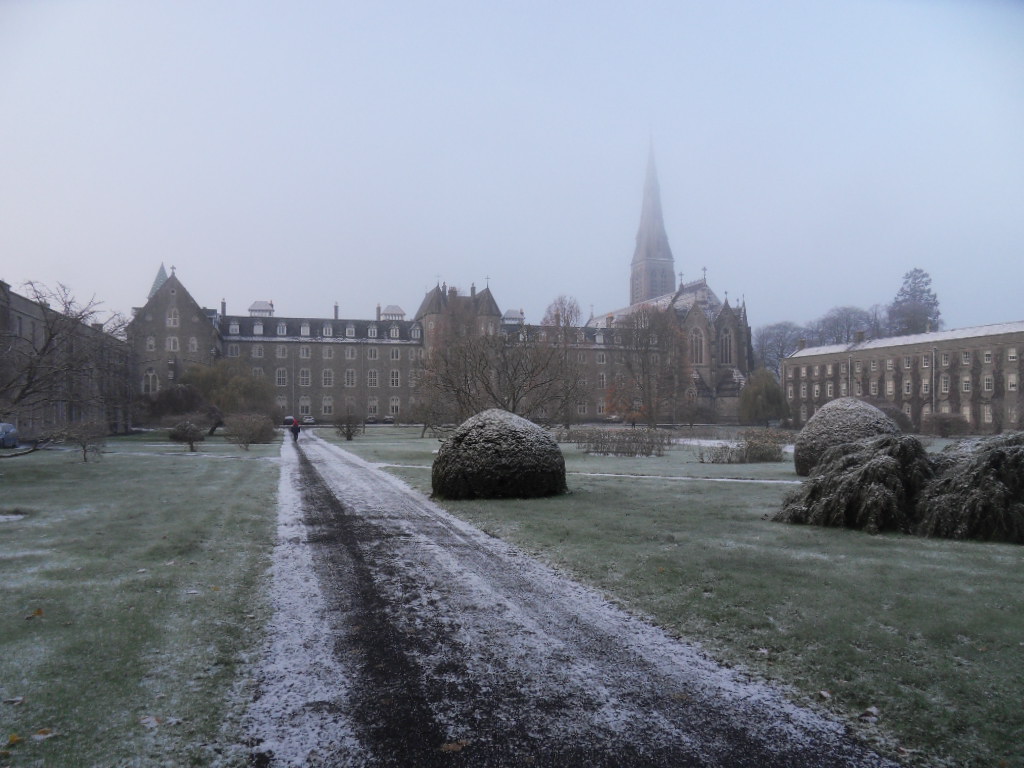
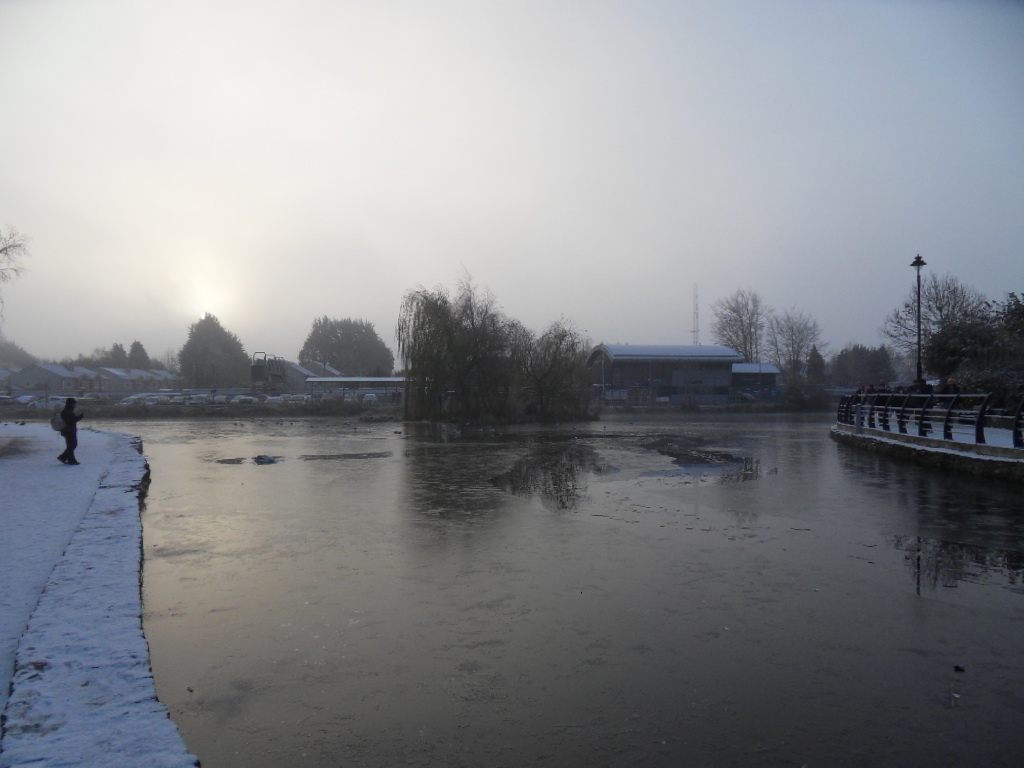
It was -4°C outside my house at about 8.30am when I was getting ready to come to work this morning. There was a light dusting of snow which had frozen overnight so the paths were a bit treacherous. I took a few pictures of Maynooth on the way in. It may have been cold and misty but it was rather atmospheric.

Tháinig sneachta an gheimhridh go luath i mbliana.

PhD Opportunity in Theoretical Astrophysics at Maynooth!

Posted in Maynooth, The Universe and Stuff with tags , , , on December 8, 2022 by telescoper

The Department of Theoretical Physics at Maynooth University invites applications for a PhD in Theoretical Astrophysics starting in September 2023. The successful applicant will work in the group led by Dr. John Regan on a project examining the formation processes of massive black holes in the early Universe. Massive black holes populate the centres of all massive galaxies and are now also observed in both the centres and in off-centre locations in less massive dwarf galaxies.

For more details and instructions on how to apply, see here.

What is Mastodon?

Posted in Uncategorized on December 8, 2022 by telescoper

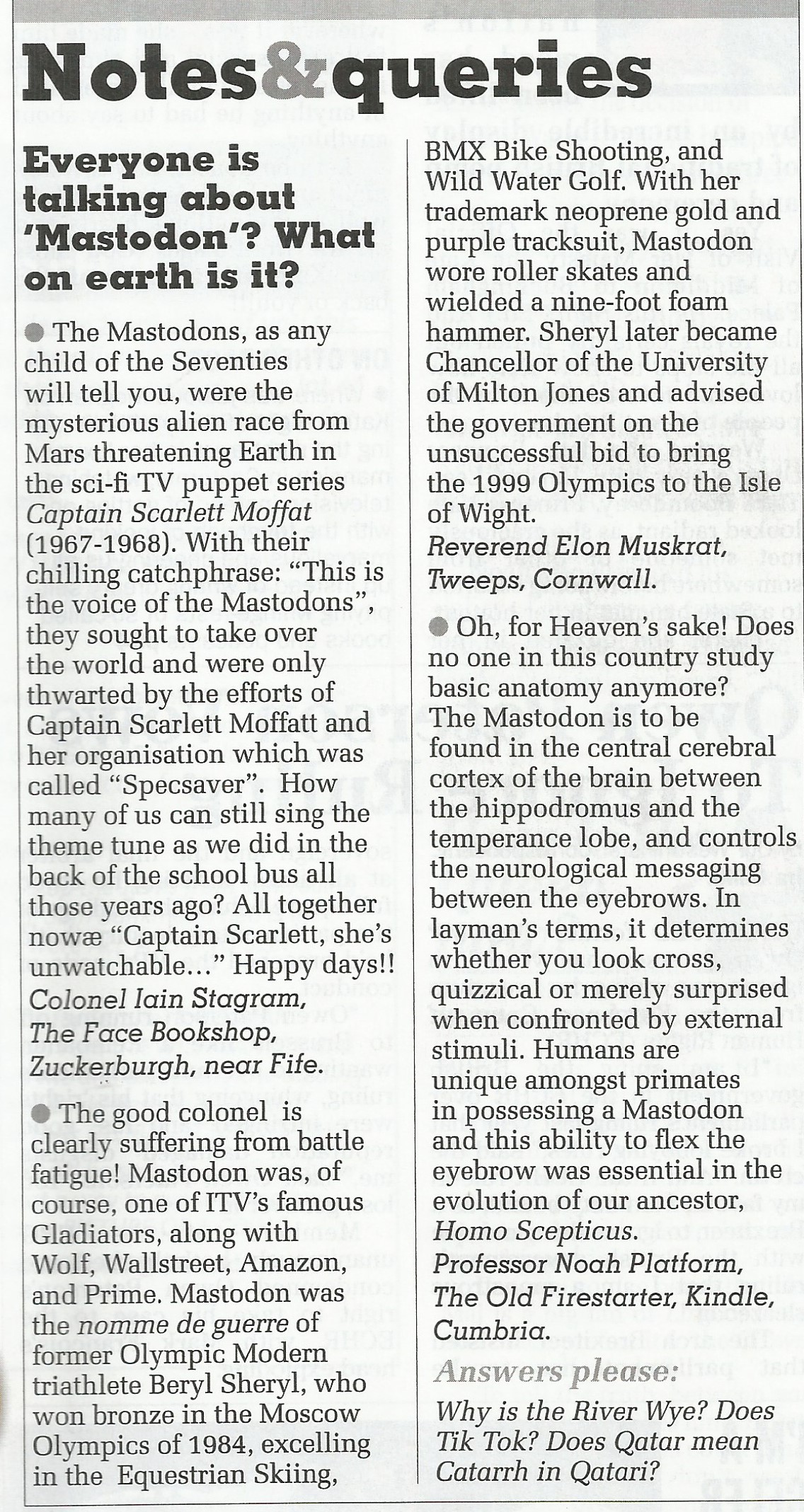
I know quite a few people these days are asking what Mastodon is. Fortunately, I see in the latest Private Eye that some leading experts have given their opinion on the matter:

I hope this clarifies the situation.

The Special Beards of Relativity

Posted in Beards, History, The Universe and Stuff with tags , , , , , on December 7, 2022 by telescoper

I’ve recently moved on to the part about Special Relativity in my module on Mechanics and Special Relativity and this afternoon I’m going to talk about the Lorentz-Fitzgerald contraction or, as it’s properly called here in Ireland, the Fitzgerald-Lorentz contraction.

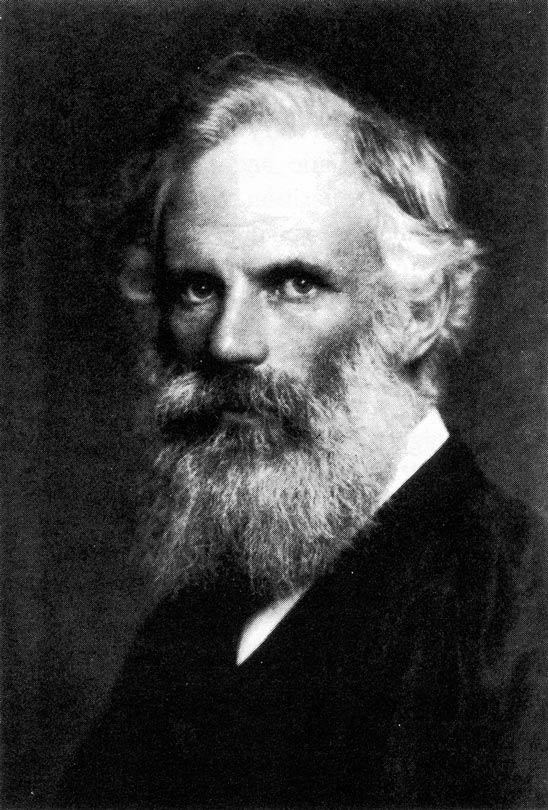
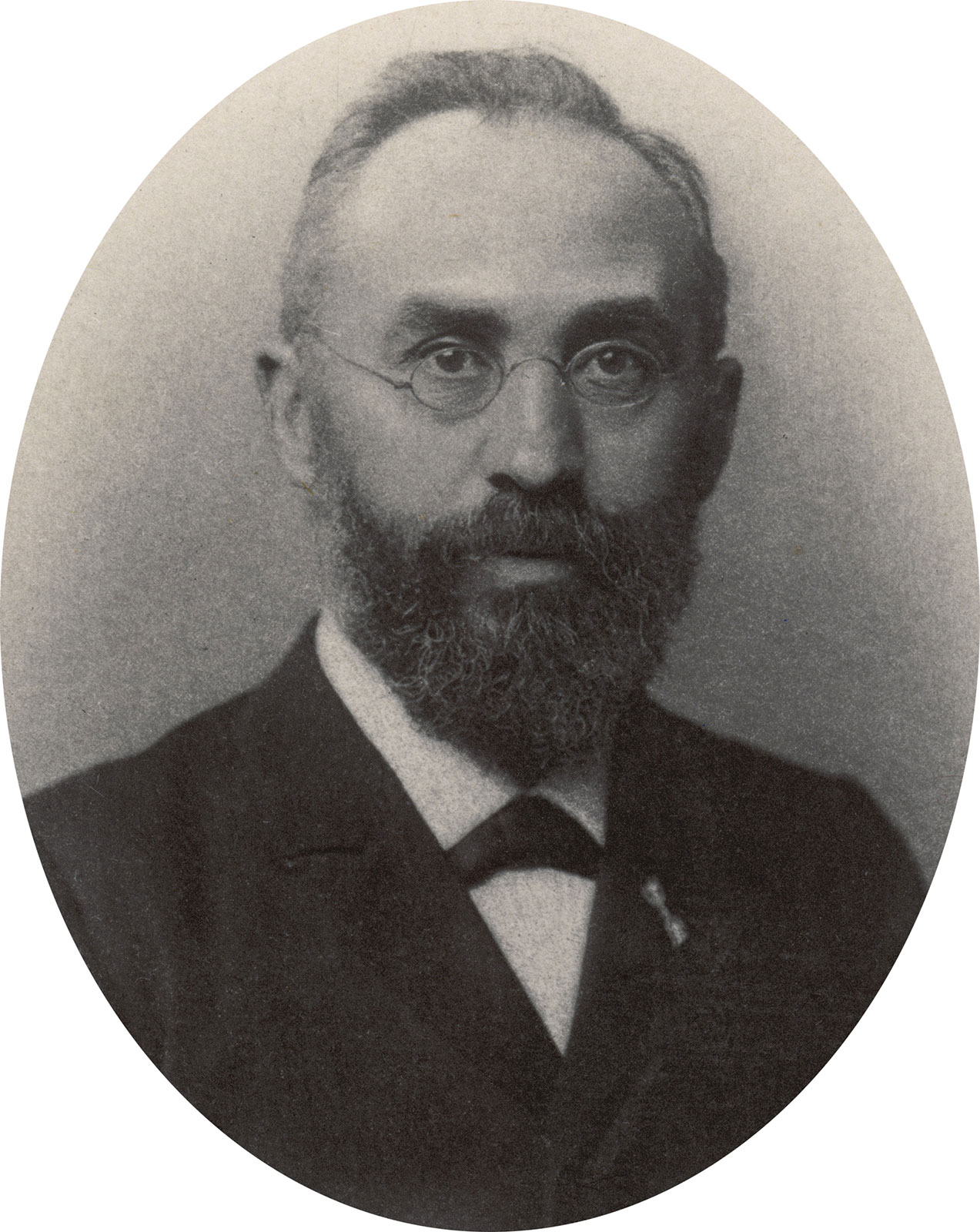
The first thing to point out is that the physicists George Francis Fitzgerald and Hendrik Lorentz, though of different nationality (the former Irish, the latter Dutch), both had fine beards:

One of the interesting things you find if you read about the history of physics just before Albert Einstein introduced his theory of special relativity in 1905 was how many people seemed to be on the verge of getting the idea around about the same time. Fitzgerald and Lorentz were two who were almost there; Poincaré was another. It was as if special relativity was `in the air’ at the time. It did, however, take a special genius like Einstein to crystallize all that thinking into a definite theory.

Special relativity is fun to teach, not least because it throws up interesting yet informative paradoxes (i.e. apparent logical contradictions) arising from  that you can use to start a discussion. They’re not really logical contradictions, of course. They just challenge `common sense’ notions, which is a good thing to do to get people thinking.

Anyway, I thought I’d mention one of my favorite such paradoxes arising from a simple Gedankenerfahrung (thought experiment) here.

Imagine you are in a railway carriage moving along a track at constant speed relative to the track. The carriage is dark, but at the centre of the carriage is a flash bulb. At one end (say the front) of the carriage is a portrait of Lorentz and at the other (say the back) a portrait of Fitzgerald; the pictures are equidistant from the bulb and next to each portrait is a clock.The two clocks are synchronized in the rest frame of the carriage.

At a particular time the flash bulb goes off, illuminating both portraits and both clocks for an instant.

It is an essential postulate of special relativity that the speed of light is the same to observers in any inertial frame, so that an observer at rest in the centre of the carriage sees both portraits illuminated simultaneously as indicated by the adjacent clocks. This is because the symmetry of the situation means that light has to travel the same distance to each portrait and back.

Now suppose we view the action from the point of view of a different inertial observer, at rest by the trackside rather than on the train, who is positioned right next to the centre of the carriage as the flash goes off. The light flash travels with the same speed in the second observer’s frame, but this observer sees* the back of the carriage moving towards the light signal and the front moving away. The result is therefore that this observer sees the two portraits light up at different times. In this case the portrait of Fitzgerald is lit up before the portrait of Lorentz.

Had the train been going in the opposite direction, Lorentz would have appeared before Fitzgerald. That just shows that whether its Lorentz-Fitzgerald contraction or Fitzgerald-Lorentz contraction is just a matter of your frame of reference…

But that’s not the paradoxical thing. The paradox is although the two portraits appear at different times to the trackside observer, the clocks nevertheless display the same time….

*You have to use your imagination a bit here, as the train has to be travelling at a decent fraction of the speed of light. It’s certainly not an Irish train.

Guest Post – by A.I. Addio

Posted in The Universe and Stuff with tags , , , , on December 6, 2022 by telescoper

Quite a few people have been playing around with a new-fangled AI tool called ChatGPT the developers of which say this:

We’ve trained a model called ChatGPT which interacts in a conversational way. The dialogue format makes it possible for ChatGPT to answer followup questions, admit its mistakes, challenge incorrect premises, and reject inappropriate requests. ChatGPT is a sibling model to InstructGPT, which is trained to follow an instruction in a prompt and provide a detailed response.

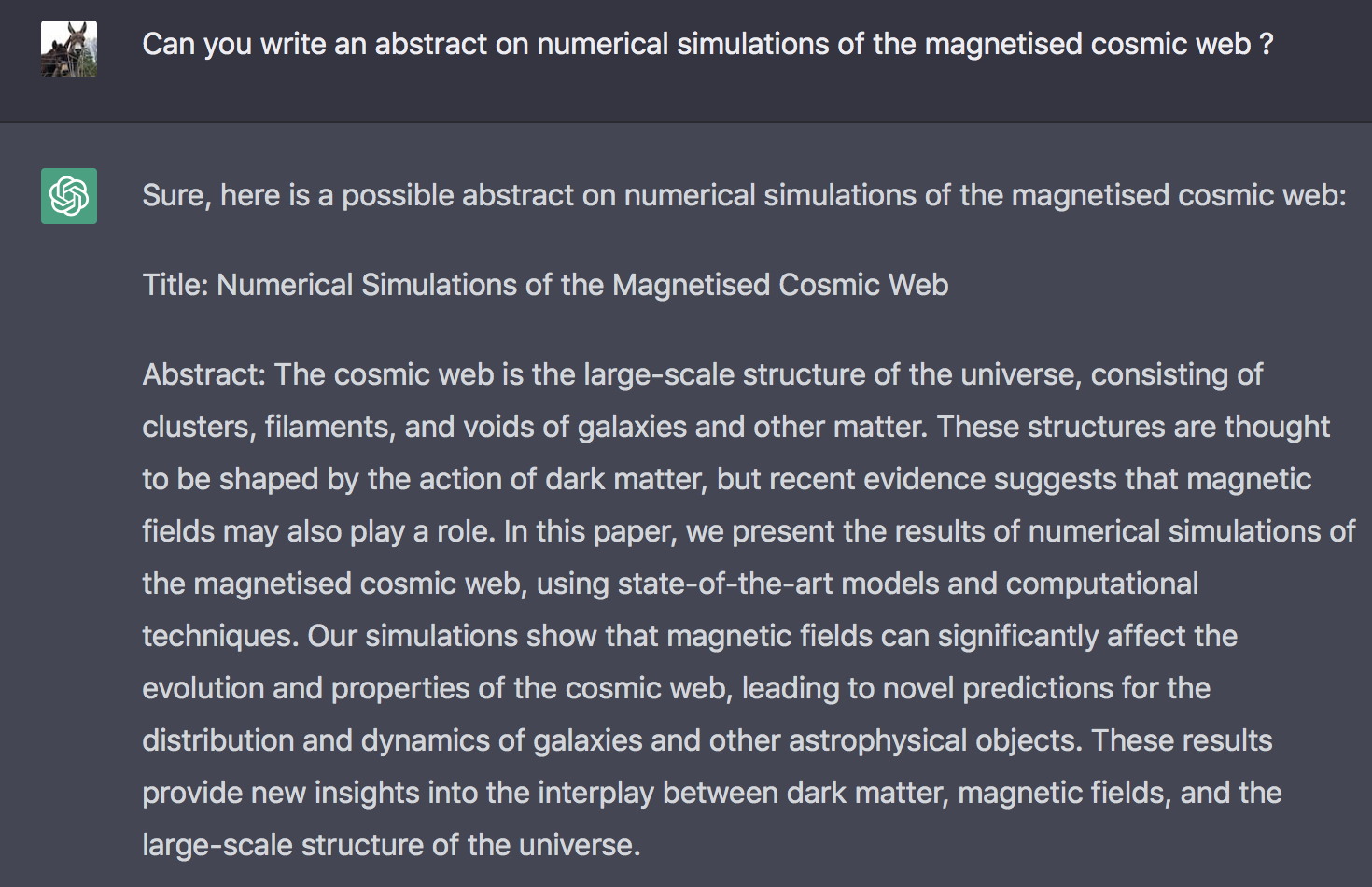
Here is an example (stolen from here) wherein this “model” creates the abstract of a scientific paper on a suggested topic:

This makes me wonder how many abstracts on astro-ph are actually written this way!

Please note that no papers of mine involved the use of any form of Artificial Insemination. I hope this clarifies the situation.

String Theory – Dead Again?

Posted in Biographical, mathematics, The Universe and Stuff on December 5, 2022 by telescoper

The other day I came across an old clipping from the December 2005 issue of Physics World. It’s from an article called What will they think in 2105? looking forward from 2005 at likely developments in the next 100 years of physics, given the context of the centenary of Einstein’s “year of miracles” (1905) in which he came up with, among other things, Special Relativity which I start teaching today.

The article asks what present-day discoveries would be remembered in a hundred years. Many of those asked the question said string theory. My response was somewhat less enthusiastic:

I got quite a lot of stick at the time from senior physicists for this statement! My use of the phrase “dead again” was based on the observation that the popularity of string theory has waxed and waned several times over the years. It may not have died in 2015 as I predicted, but it does seem to me to be in a moribund state, in terms of its impact (or lack thereof) on physics.

I’m mindful of the fact that many mathematicians think string theory is great. I’ve had it pointed out to me that it has a really big influence on for example geometry, especially non-commutative geometry, and even some number theory research in the past few decades. It has even inspired work that has led to Fields medals. That’s all very well and good, but it’s not physics. It’s mathematics.

Of course physicists have long relied on mathematics for the formulation of theoretical ideas. Riemannian geometry was `just’ mathematics before its ideas began to be used in the formulation of the general theory of relativity, a theory that has since been subjected to numerous experimental tests. It may be the case that string theory will at some point provide us with predictions that enable it to be tested in the way that general relativity did. But it hasn’t done that yet and until it does it is not a scientifically valid physical theory.

I remember a quote from Alfred North Whitehead that I put in my PhD DPhil thesis many years ago. I wasn’t thinking of string theory at the time, but it seems relevant:

There is no more common error that to assume that, because prolonged and accurate mathematical calculations have been made, the application of the result to some fact of nature is absolutely certain.

My problem is not with string theory itself but with the fact that so many string theorists have become so attached to it that it has become a universe in its own right, with very little to do with the natural universe which is – or at least used to be – the subject of theoretical physics. I find it quite alarming, actually, that in the world outside academia you will find many people who think theoretical physics and string theory are more-or-less synonymous.

The most disturbing manifestation of this tendency is the lack of interest shown by some exponents of string theory in the issue of whether or not it is testable. By this I don’t mean whether we have the technology at the moment to test it (which we clearly don’t). After all, many predictions of the standard model of particle physics had to wait decades before accelerators got big enough to reach the required energies. The question is whether string theory can be testable in principle, and surely this is something any physicist worthy of the name should consider to be of fundamental importance?

Remembering Omar Khayyam

Posted in mathematics, Poetry, The Universe and Stuff with tags , , on December 4, 2022 by telescoper

I was reminded today that 4th December is the anniversary of the death, in 1131, of the Persian astronomer, mathematician and poet Omar Khayyam. That in turn reminded me that just over year ago I received a gift of a sumptuously illustrated multi-lingual edition of the Rubáiyát of Omar Khayyám:

Edward Fitzgerald‘s famous English translation of these verses is very familiar, but it seems there’s a more of Fitzgerald than Khayyam in many of the poems and the attribution of many of the original texts to Khayyam is dubious in any case.  Whatever you think about this collection, I think it’s a bit unfortunate that Khayyam is not more widely recognized for his scientific work, which you can read about in more detail here.

Anyway, as we approach the end of 2022 many of us will be remembering people we have lost during the year so here is a sequence of three quatrains (XXII-XXIV) with an appropriately elegiac theme:

For some we loved, the loveliest and the best
That from his Vintage rolling Time hath pressed,
    Have drunk their Cup a Round or two before,
And one by one crept silently to rest.

And we, that now make merry in the Room
They left, and Summer dresses in new bloom,
    Ourselves must we beneath the Couch of Earth
Descend–ourselves to make a Couch–for whom?

Ah, make the most of what we yet may spend,
Before we too into the Dust descend;
    Dust into Dust, and under Dust to lie,
Sans Wine, sans Song, sans Singer, and–sans End!

Another Riddle in Mathematics

Posted in Books, mathematics on December 3, 2022 by telescoper

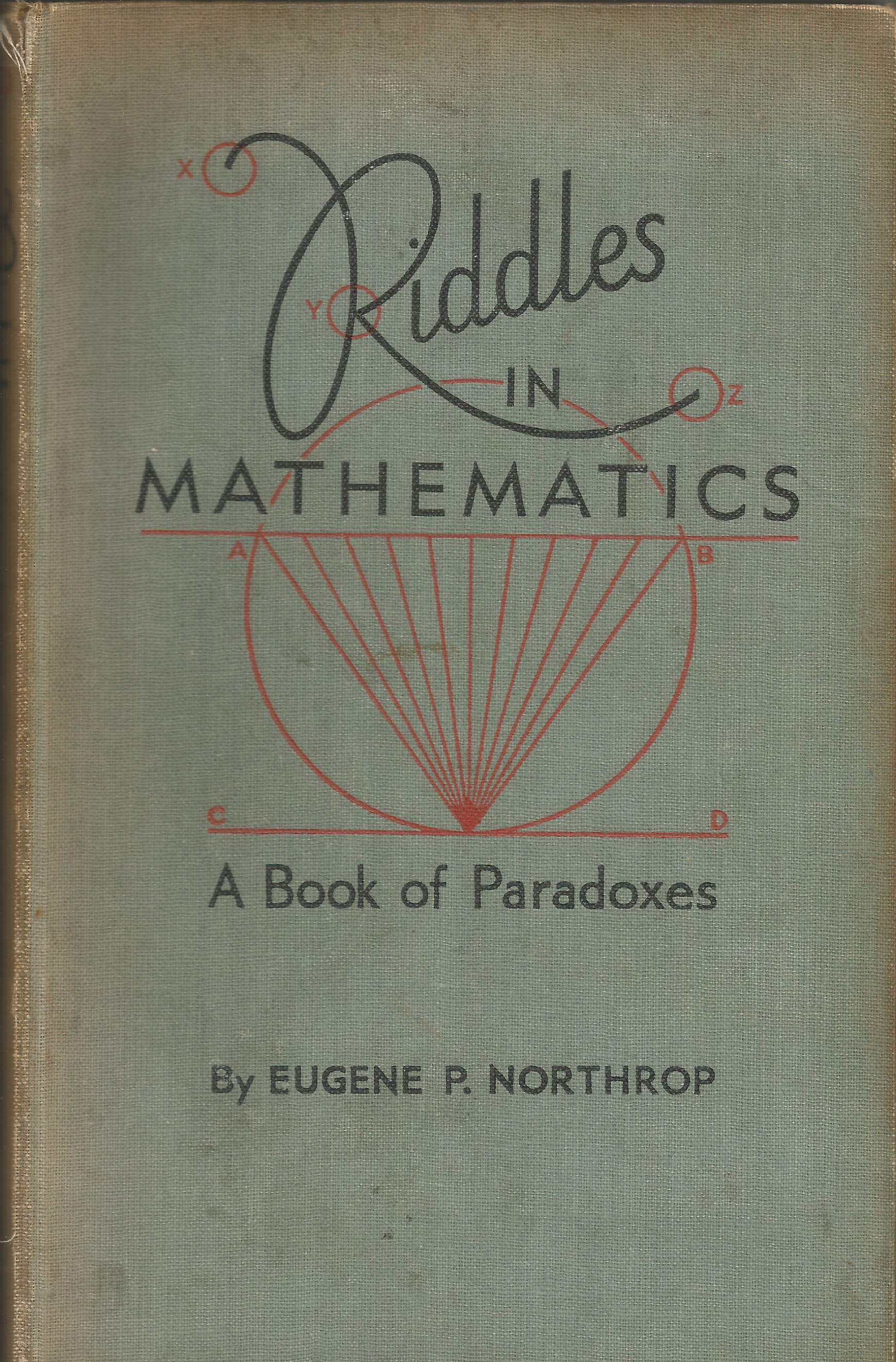
The little paradox in probability that I posted earlier in the week seemed to go down quite well so I thought I’d try a different paradox on a different topic from the same book of paradoxes, which is this one:

It’s quite old. I have the first edition, published in 1945, but many of the “riddles” are still interesting.

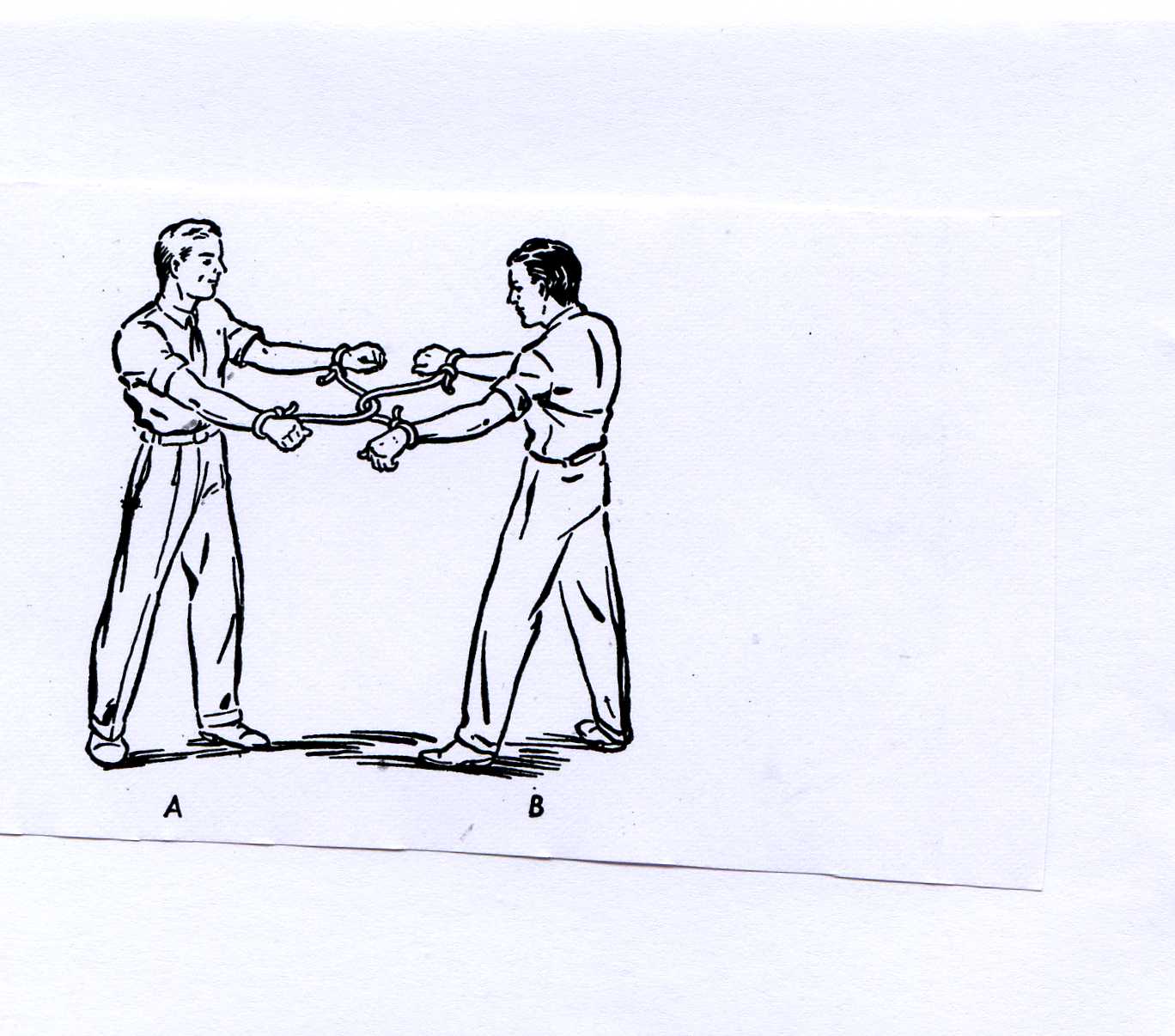
Here is one which you might describe as being about “knot theory”…

It’s probably best not to ask why, but the two gentlemen in the picture, A and B, are tied together in the following way: one end of a piece of rope is tied about A’s right wrist, the other about his left wrist. A second rope is passed around the first and its ends are tied to B’s wrists.

Can A and B free each other without cutting either rope, performing amputations,  or untying the knots at either person’s wrists?

If so, how?