That Wormhole Garbage

Posted in Astrohype, The Universe and Stuff with tags , , on December 2, 2022 by telescoper

I’m glad I was too busy today to respond earlier to a junk science story that has been doing the rounds, in the Guardian, in Quanta and even in Physics World to name but a few. Had I had time to write something as soon as I’d seen these pieces of tripe I would probably have responded with more expletives than would be seemly even for this blog. This sort of crap makes me rather angry, you see.
Meaningless Illustration

The story is basically that a group of scientists have created a “wormhole in space-time” that enables quantum teleportation.

Of course they have done no such thing. The paper, like so many stories hyped beyond the bounds of reason, is published in Nature. There are some interesting things in this publication, but nothing to justify the absurd claims that have propagated into the media. The authors must take some of the blame for allowing such tosh to be spread about in their names. I don’t think it will do them any good in the long run.

At least I hope it doesn’t.

You can read it for yourself and make your own , but my take is the following:

  • Did the authors create a wormhole (even a baby one) in a laboratory? Definitely not.
  • Did they discover anything whatsoever to do with quantum gravity? No way.
  • Did they even simulate a wormhole in a lab? Not even close.
  • Did they even make progress towards simulating a wormhole in a lab? Still no.

Apart from all that it’s fine.

The author of the Quanta article, Natalie Wolchover, writes:

Researchers were able to send a signal through the open wormhole, though it’s not clear in what sense the wormhole can be said to exist.

Au contraire, it’s absolutely clear that no wormhole can be said to exist in any sense whatsoever.

I hope this clarifies the situation.

UPDATE: I see that Peter Woit has gone to town on this on his blog here.

Job Opportunity in Computational Astrophysics at Maynooth!

Posted in Maynooth, The Universe and Stuff with tags , , on December 2, 2022 by telescoper

Just a quick post to advertise the fact that the Department of Theoretical Physics at Maynooth University is inviting applications for a Postdoctoral Fellowship Position in Computational and Theoretical Astrophysics. The successful applicant will join the Research Group led by Dr John Regan and is expected to develop their own independent research program within the confines of a research project investigating the formation, growth, and demographics of Black Holes in the early Universe. The group, currently consisting of four PhD students and one additional postdoctoral researcher, is currently engaged in numerous research topics with the goal of understanding early black hole formation. In line with this we are currently implementing an ambitious research project using the EnzoE exascale class code to run large volume, high resolution simulations focused on the first billion years of black hole formation. The successful candidate will be expected to contribute significantly to this research effort but are free to pursue their own research lines under this remit.

For more information, including deadlines and the applications procedure, please see the AAS Jobs register advertisement here.

Teaching and Fourier Series

Posted in Education, mathematics, The Universe and Stuff with tags , , , , on December 1, 2022 by telescoper

Now as we approach the last fortnight of term, I am nearing the end of both my modules, MP110 Mechanics 1 and Special Relativity and MP201 Vector Calculus and Fourier Series, and in each case am about to start the bit following the “and”…

In particular, having covered just about everything I need to do on Vector Calculus for MP201, tomorrow I start doing a block of lectures on Fourier Series. I have to wait until Monday to start doing Special Relativity with the first years.

As I have observed periodically, the two topics mentioned in the title of the module MP201 (Vector Calculs and Fourier Series) are not disconnected, but are linked via the heat equation, the solution of which led Joseph Fourier to devise his series in Mémoire sur la propagation de la chaleur dans les corps solides (1807), a truly remarkable work for its time that inspired so many subsequent developments.

Anyway I was looking for nice demonstrations of Fourier series to help my class get to grips with them when I remembered this little video recommended to me some time ago by esteemed Professor George Ellis. It’s a nice illustration of the principles of Fourier series, by which any periodic function can be decomposed into a series of sine and cosine functions.

This reminds me of a point I’ve made a few times in popular talks about astronomy. It’s a common view that Kepler’s laws of planetary motion according to which which the planets move in elliptical motion around the Sun, is a completely different formulation from the previous Ptolemaic system which involved epicycles and deferents and which is generally held to have been much more complicated.

The video demonstrates however that epicycles and deferents can be viewed as the elements used in the construction of a Fourier series. Since elliptical orbits are periodic, it is perfectly valid to present them in the form a Fourier series. Therefore, in a sense, there’s nothing so very wrong with epicycles. I admit, however, that a closed-form expression for such an orbit is considerably more compact and elegant than a Fourier representation, and also encapsulates a deeper level of physical understanding. What makes for a good physical theory is, in my view, largely a matter of economy: if two theories have equal predictive power, the one that takes less chalk to write it on a blackboard is the better one!

Five Years in Maynooth!

Posted in Biographical, Education, Maynooth with tags , on December 1, 2022 by telescoper


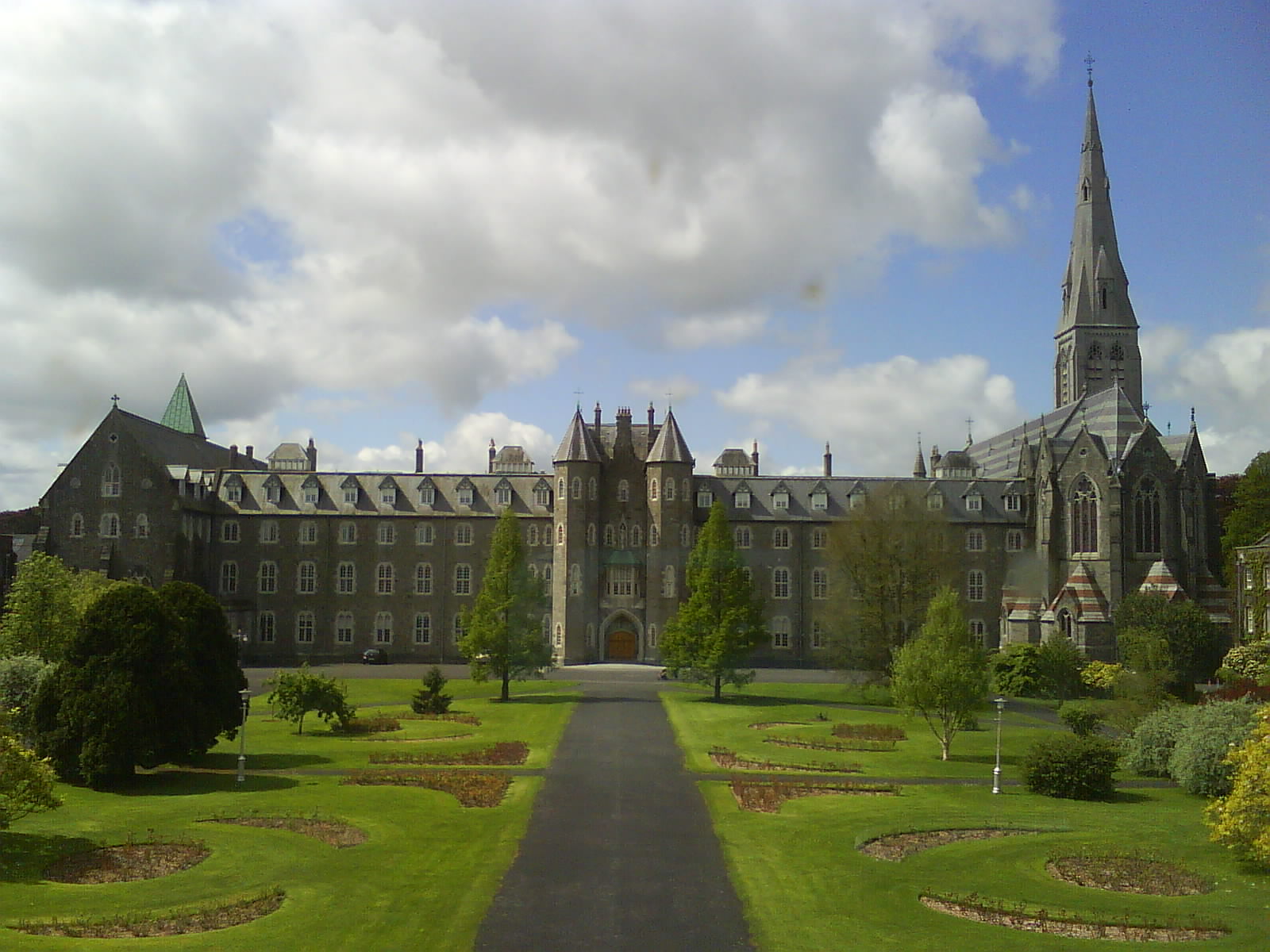
It is 1st December 2022, which means that it’s five years to the day since I started work at Maynooth University. So much has happened in that period it seems very much longer since I first arrived here.
I’m very happy that I made the move here all those years ago. I won’t deny that the past five years have had their frustrations. The teaching and administrative workload, especially for the three years I was Head of Department, especially during the Covid-19 pandemic, has been very heavy and has made it difficult to be very active in research.
Last year was a particularly tough year for the Department of Theoretical Physics, when we were forced to teach a whole year with only half the usual number of full-time teaching staff. It was very depressing not being able to deliver as a good a teaching experience as we wanted without the necessary resources. There never seems to be any shortage of funds for new senior management positions but not for the staff who actually perform the main function of a University.
Fortunately our immediate staffing problem has passed and we now have our usual number of lecturers in place. I was entitled to take a sabbatical when I reached the end of my term as Head of Department, but I deferred it because I didn’t want to leave my colleagues short-staffed again before the ship was properly steadied. I will put in a request in January to take it in 2023/24. If anyone out there feels like playing host to an old cosmologist please let me know!
On the bright side, I have great colleagues in the Department and the students are very engaged. There are few things in life more rewarding than teaching people who really want to learn. This year so far has been particularly enjoyable, if tiring because we have a large first year. I have also acquired two more PhD students and a Research Masters student.
The thing I’m probably most proud of over the past five years is, with the huge help of staff at Maynooth University Library, getting the Open Journal of Astrophysics off the ground and attracting some excellent papers. We’re still growing, though perhaps not as quickly as I’d hoped. The pandemic had something to do with that.
So, after a few years of hard and at times dispiriting slog, things are going pretty well. Meanwhile, in Brexit Britain, events have turned out exactly as I predicted, especially this:
Brexit will also doom the National Health Service and the UK university system, and clear the way for the destruction of workers’ rights and environmental protection. The poor and the sick will suffer, while only the rich swindlers who bought the referendum result will prosper. The country in which I was born, and in which I have lived for the best part of 54 years, is no longer something of which I want to be a part.
In other words I don’t regret for one minute my decision to leave Britain. Incidentally, five years is the term needed to qualify for Irish nationality by residence so if I had needed to I could now apply via that route.
I noticed looking at the similar post I wrote on this day last year that academic colleagues in the UK were on strike on that day. They are still taking industrial action, and indeed were on strike yesterday. My biggest fear for the Irish Higher Education system is that it follows the “business model” of soulless teaching factories with courses delivered by demoralized staff on casual teaching contracts. Things are definitely going that way here and this trend must be resisted.

1000 Days of Pandemic

Posted in Covid-19 on November 30, 2022 by telescoper

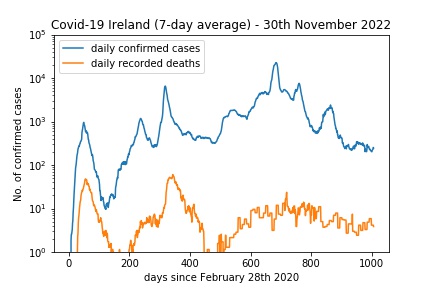
I was updating my Covid-19 page just now when I realized that I have now accumulated 1000 days of data. Nowadays, figures aren’t announced daily but once a week so the ritual of updating the numbers is less frequent now than it was last year, and testing is done less intensively than earlier in the pandemic, but I’ve nevertheless continued plotting the graphs.

The latest summary graphs are here.

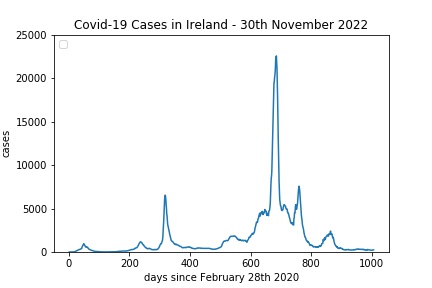
On a linear scale the cases look like this:

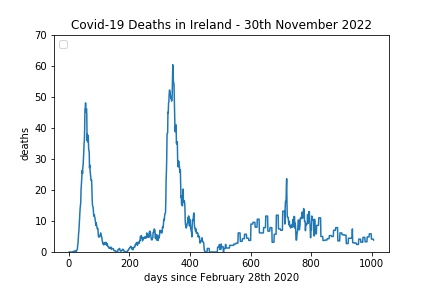
The numbers for deaths on a linear scale look like this:

The current 7-day average number of new cases per day is 246.1, which is reasonably high despite the relatively low levels of PCR testing being done, but the thing I feared most at the start of this Semester – a big surge in cases – just hasn’t happened. Cases have been roughly stable and even slightly declining since September. More importantly the number of Covid-19 related deaths has remained low.

I think I’ll keep updating my page until the end of the year but if nothing dramatic happens over Christmas I’ll stop. Covid-19 hasn’t gone anyway, but it seems to have entered a phase in which it is no longer a large-scale public health emergency.

A Paradox in Probability

Posted in Cute Problems, mathematics with tags , on November 29, 2022 by telescoper

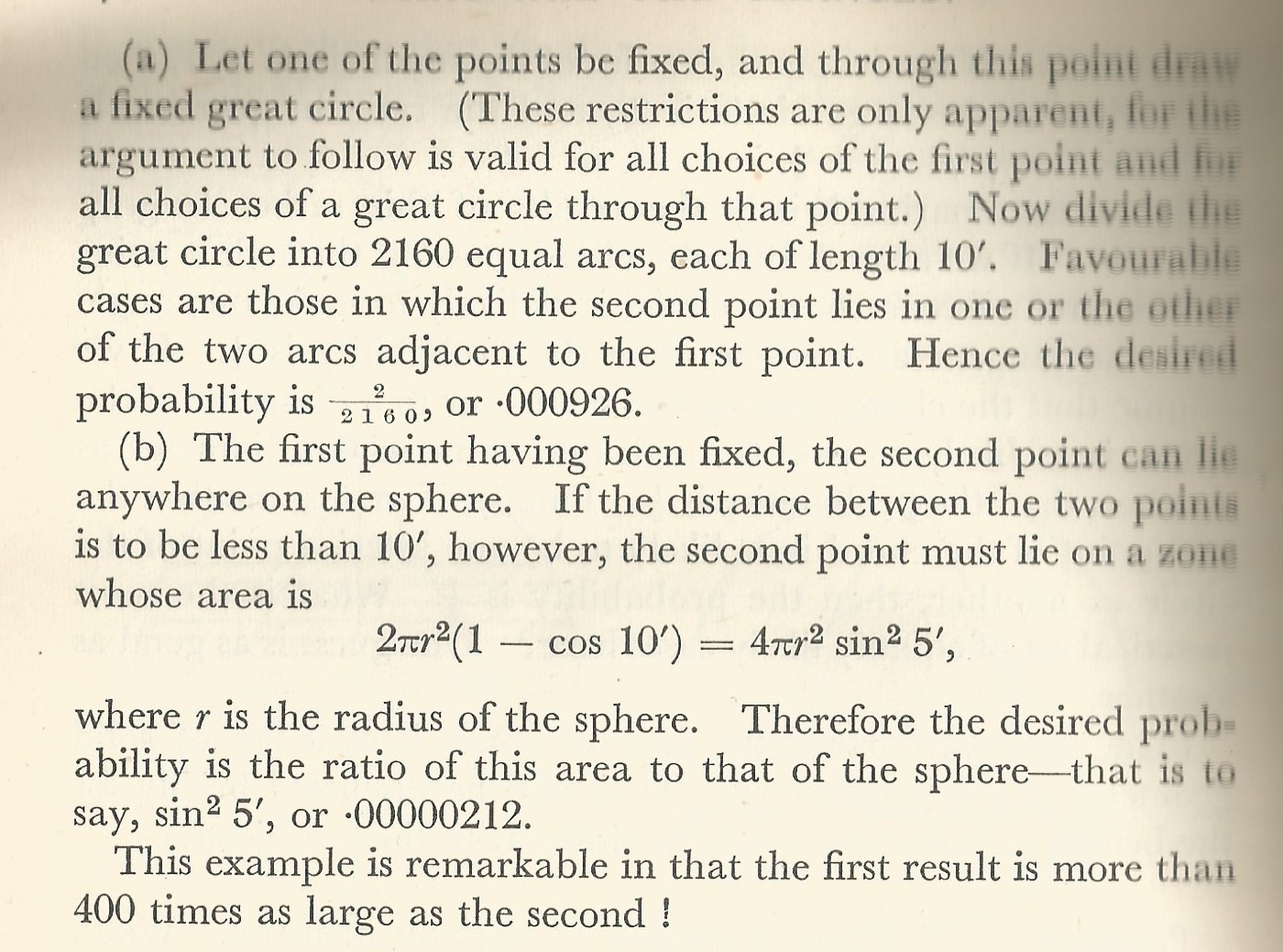
I just came across this paradox in an old book of mathematical recreations and thought it was cute so I’d share it here:

Here are two possible solutions to pick from:

Since we are now in the era of precision cosmology, an uncertainty of a factor of 400 is not acceptable so which answer is correct? Or are they both wrong?

The Physics of the Pole Vault Revisited

Posted in Sport, The Universe and Stuff with tags , , , on November 29, 2022 by telescoper

In yesterday’s Mechanics lecture I decided to illustrate the use of energy conservation arguments with an application to the pole vault. I have done this a few times and indeed wrote a blog post about it some years ago. At the time I wrote that post however the world record for the pole vault was held by the legendary Ukrainian athlete Sergey Bubka at a height of 6.14m which he achieved in 1994. That record stood for almost 20 years but has since been broken several times, and is now held by Armand Duplantis at a height of 6.21m.

Here he is breaking the record on July 24th 2022 in Eugene, Oregon:

He seemed to clear that height quite comfortably, actually, and he’s only 23 years old, so I dare say he’ll break quite a few more records in his time but the fact that world record has only increased by 7cm in almost 30 years tells you that the elite pole vaulters are working at the limits of what the human body can achieve. A little bit of first-year physics will convince you why.

Basically, the pole is a device that converts the horizontal kinetic energy of the vaulter \frac{1}{2} m v^2,  as he/she runs in, to the gravitational potential energy m g h acquired at the apex of his/her  vertical motion, i.e. at the top of the vault.

Now assume that the approach is at the speed of a sprinter, i.e. about 10 ms^{-1}, and work out the height h = v^2/2g that the vaulter can gain if the kinetic energy is converted with 100% efficiency. Since g = 9.8 \, ms^{-2} the answer to that little sum turns out to be about 5 metres.
This suggests that  6.21 metres should not just be at, but beyond, the limit of a human vaulter,  unless the pole were super-elastic. However, there are two things that help. The first is that the centre of mass of the combined vaulter-plus-pole does not start at ground level; it is at a height of a bit less than 1m for an an average-sized person.  Nor does the centre of mass of the vaulter-pole combination reach 6.21 metres.

The pole does not go over the bar, but it’s pretty light so that probably doesn’t make much difference. However, the centre of mass of the vaulter actually does not actually pass over the bar.  That  doesn’t happen in the high jump, either. Owing to the flexibility of the jumper’s back the arc is such that the centre of mass remains under the bar while the different parts of the jumper’s body go over it.

Moreover, it’s not just the kinetic energy related to the horizontal motion of the vaulter that’s involved. A human can in fact jump vertically from a standing position using elastic energy stored in muscles. In fact the world record for the standing high jump is an astonishing 1.9m. In the context of the pole vault it seems likely to me that this accounts for at least a few tens of centimetres.

Despite these complications, it is clear that pole vaulters are remarkably efficient athletes. And not a little brave either – as someone who is scared of heights I can tell you that I’d be absolutely terrified being shot up to 6.21 metres on the end of  a bendy stick, even with something soft to land on!

A Question of Distributions and Entropies

Posted in mathematics with tags , , on November 28, 2022 by telescoper

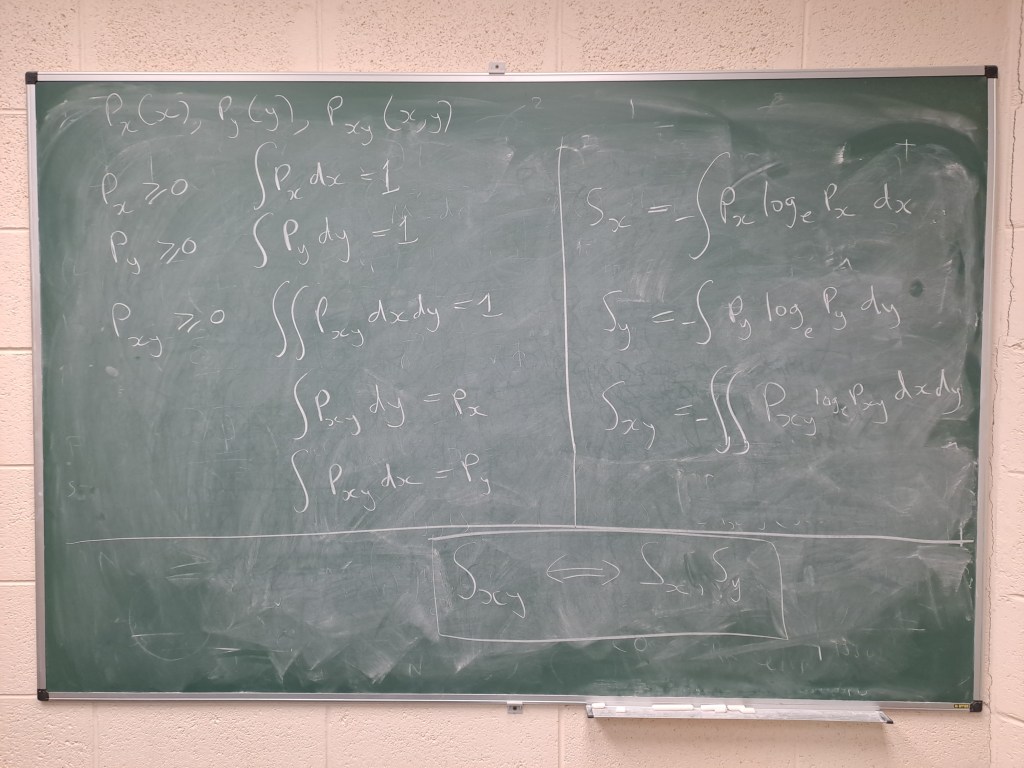
I thought I’d use the medium of this blog to pick the brains of my readers about some general questions I have about probability and entropy as described on the chalkboard above in order to help me with my homework.

Imagine that px(x) and py(y) are one-point probability density functions and pxy(x,y) is a two-point (joint) probability density function defined so that its marginal distributions are px(x) and py(y) and shown on the left-hand side of the board. These functions are all non-negative definite and integrate to unity as shown.

Note that, unless x and y are independent, in which case pxy(x,y) = px(x) py(y), the joint probability cannot be determined from the marginals alone.

On the right we have Sx, Sy and Sxy defined by integrating plogp for the two univariate distributions and the bivariate distributions respectively as shown on the right-hand side of the board. These would be proportional to the Gibbs entropy of the distributions concerned but that isn’t directly relevant.

My question is: what can be said in general terms (i.e. without making any further assumptions about the distributions involved) about the relationship between Sx, Sy and Sxy ?

Answers on a postcard through the comments block please!

Four Quartets, No. 2. – East Coker II by T.S. Eliot

Posted in Poetry with tags , , , on November 27, 2022 by telescoper

What is the late November doing
With the disturbance of the spring
And creatures of the summer heat,
And snowdrops writhing under feet
And hollyhocks that aim too high
Red into grey and tumble down
Late roses filled with early snow?
Thunder rolled by the rolling stars
Simulates triumphal cars
Deployed in constellated wars
Scorpion fights against the Sun
Until the Sun and Moon go down
Comets weep and Leonids fly
Hunt the heavens and the plains
Whirled in a vortex that shall bring
The world to that destructive fire
Which burns before the ice-cap reigns.

That was a way of putting it—not very satisfactory:
A periphrastic study in a worn-out poetical fashion,
Leaving one still with the intolerable wrestle
With words and meanings.
The poetry does not matter.

It was not (to start again) what one had expected.

What was to be the value of the long looked forward to,
Long hoped for calm, the autumnal serenity
And the wisdom of age? Had they deceived us
Or deceived themselves, the quiet-voiced elders,
Bequeathing us merely a receipt for deceit?
The serenity only a deliberate hebetude,
The wisdom only the knowledge of dead secrets
Useless in the darkness into which they peered
Or from which they turned their eyes.
There is, it seems to us,
At best, only a limited value
In the knowledge derived from experience.

The knowledge imposes a pattern, and falsifies,
For the pattern is new in every moment
And every moment is a new and shocking
Valuation of all we have been.
We are only undeceived
Of that which, deceiving, could no longer harm.

In the middle, not only in the middle of the way
But all the way, in a dark wood, in a bramble,
On the edge of a grimpen, where is no secure foothold,
And menaced by monsters, fancy lights,
Risking enchantment.
Do not let me hear
Of the wisdom of old men, but rather of their folly,
Their fear of fear and frenzy, their fear of possession,
Of belonging to another, or to others, or to God.

The only wisdom we can hope to acquire
Is the wisdom of humility: humility is endless.

The houses are all gone under the sea.

The dancers are all gone under the hill.

by T.S. Eliot (1888-1965)

On the Multiple Publication of Academic Research

Posted in Open Access with tags , , , on November 26, 2022 by telescoper

The topic came up in a recent conversation of the ethical issues surrounding what is sometimes erroneously called self-plagiarism, but is more accurately called duplicate publication (or multiple publication or even redundant publication). This refers to the situation in which an author publishing their own intellectual material (specifically research results) more than once in different journals or other media. This is distinct from plagiarism, which involves an author publishing someone else’s intellectual material without attribution. It is also distinct from copyright violation, which can occur if the author tries to re-use material already published in a journal that has retained the copyright; the solution in that case is simply not to publish in a journal that does that.

Publication practice differs widely in different academic fields so in what follows I’ll concentrate on what applies in Physics & Astronomy. Here there is one type of publication, the Conference Proceedings, in which papers are often near-duplicates of others. That is because speakers tend to give the same or very similar talks at different conferences, and also tend to recycle material when writing up their contributions. I see nothing particularly wrong in that, although one wonders whether a plethora of versions of the same talk is needed. I stopped writing conference papers over a decade ago as they take a lot of time to do and I don’t think they fulfil any useful purpose. In any case such articles should not count as research publications, especially if they are not peer-reviewed (which is generally the case in Astronomy). I know this is different in other fields. In Computer Science, for example, the conference article is one of the main modes of research publication.

The more serious issue is when a researcher publishes (or tries to publish) multiple versions of the same research in different journals in an attempt to pad out their publication list by passing off old material as original research. This is difficult to do nowadays because of plagiarism detection software, but not all journals deploy such tools and some cases do get through the editorial process and make it into the journal as a publication. Sometimes this even happens with high-profile journals.

The question is how one reacts to this kind of multiple publication. I did a totally unscientific social media poll recently and the results were quite interesting. Of my respondents, about 20% said that they thought multiple publication was fine. About 30% thought that multiple publication constituted academic misconduct, and about 50% thought that it wasn’t fine but fell short of academic misconduct.

I suppose the definition of research misconduct varies from one institution to another. For reference here is what it says in Maynooth University’s Research Integrity Policy statement:

Publication of multiplier papers based on the same set(s) or sub-set(s) of data is not acceptable, except where there is full cross-referencing within the papers. An author who submits substantially similar work to more than one publisher must disclose this to the publishers at the time of submission.

The document also specifically refers to “Artificially proliferating publications” as an example of research misconduct.

In the past I would have posted a poll on here but I now have to pay $15 per month for the privilege of hosting a poll so with regret I’ve unblocked my Twitter account to let you vote there:

One reason people might be tempted to indulge in multiple publication stems from the fact that the current system of research assessment depends so much on bibliometric indicators relating to refereed publications. While I regret the emphasis on bibliometrics, I do think that multiple publication of research papers is indeed academic misconduct because artificially boosting the number of such items on one’s CV might be a way of gaming the system. It seems to me that such a strategy is unlikely to work, but I have seen people try it.