Archive for Computational Astrophysics

Weekly Update from the Open Journal of Astrophysics – 18/04/2026

Posted in OJAp Papers, Open Access, The Universe and Stuff with tags , , , , , , , , , , , , , , , , , , , , , , , , , , , , , , , , , on April 18, 2026 by telescoper

It is Saturday morning, and therefore time for yet another update of activity at the Open Journal of Astrophysics. Since the last update we have published a further six papers, bringing the number in Volume 9 (2026) to 82 and the total so far published by OJAp up to 530.

I will continue to include the posts made on our Mastodon account (on Fediscience) to encourage you to visit it. Mastodon is a really excellent service, and a more than adequate replacement for X/Twitter (which nobody should be using); these announcements also show the DOI for each paper.

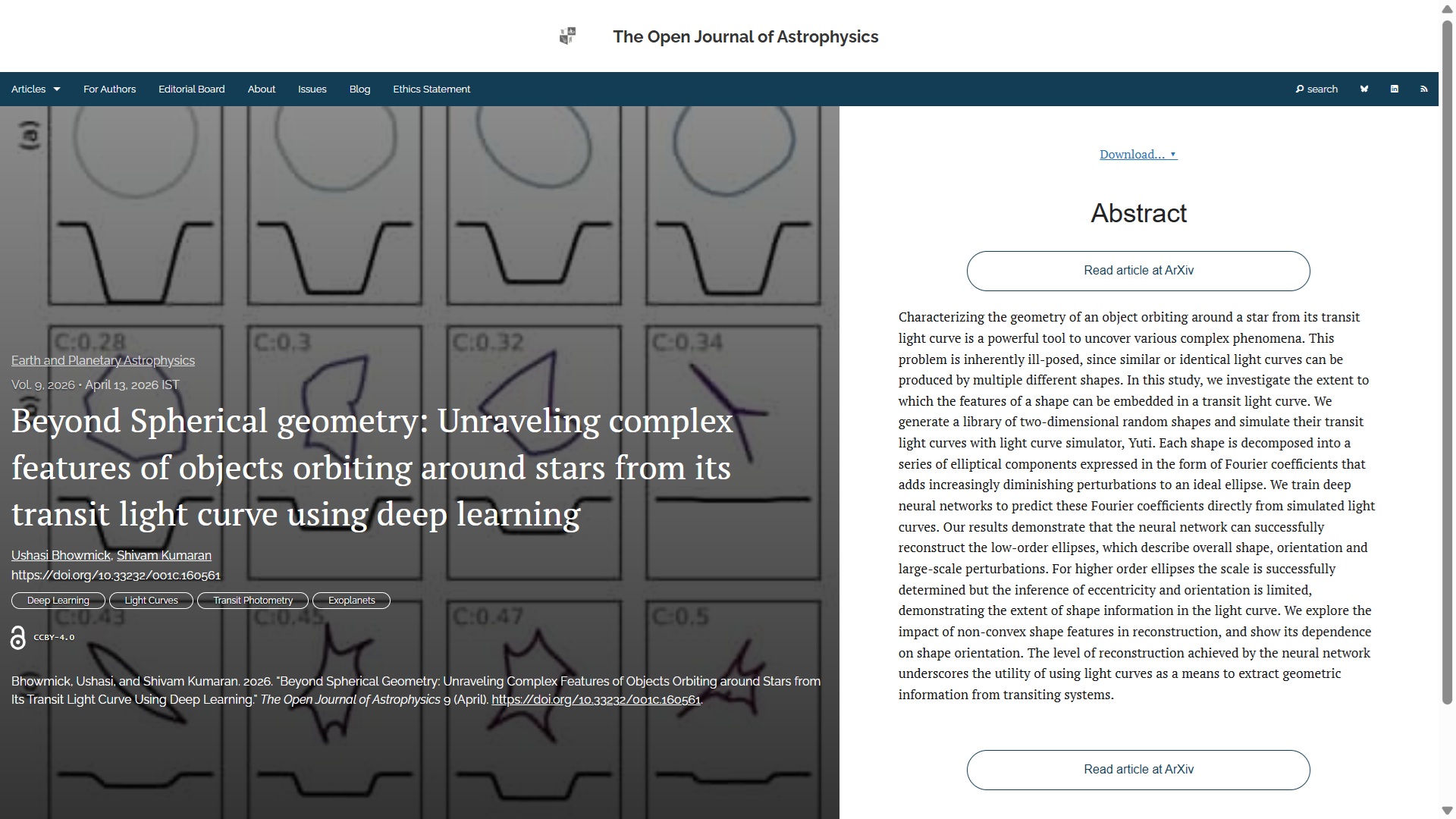
The first paper to report this week is “Beyond Spherical geometry: Unraveling complex features of objects orbiting around stars from its transit light curve using deep learning” by Ushasi Bhowmick & Shivam Kumaran (Indian Space Research Institute, Ahmedabad, India). This study uses deep neural networks to predict the shape of objects orbiting stars based on their transit light curves, demonstrating the potential to extract geometric information from these systems. It was published on Monday 13th April in the folder Earth and Planetary Astrophysics and the overlay can be seen here:

You can find the officially accepted version on arXiv here and the announcement on Fediverse here:

Open Journal of Astrophysics

New Publication at the Open Journal of Astrophysics: "Beyond Spherical geometry: Unraveling complex features of objects orbiting around stars from its transit light curve using deep learning" by Ushasi Bhowmick & Shivam Kumaran (ISRO, Ahmedabad, India)

doi.org/10.33232/001c.160561

April 13, 2026, 6:31 am 1 boosts 1 favorites

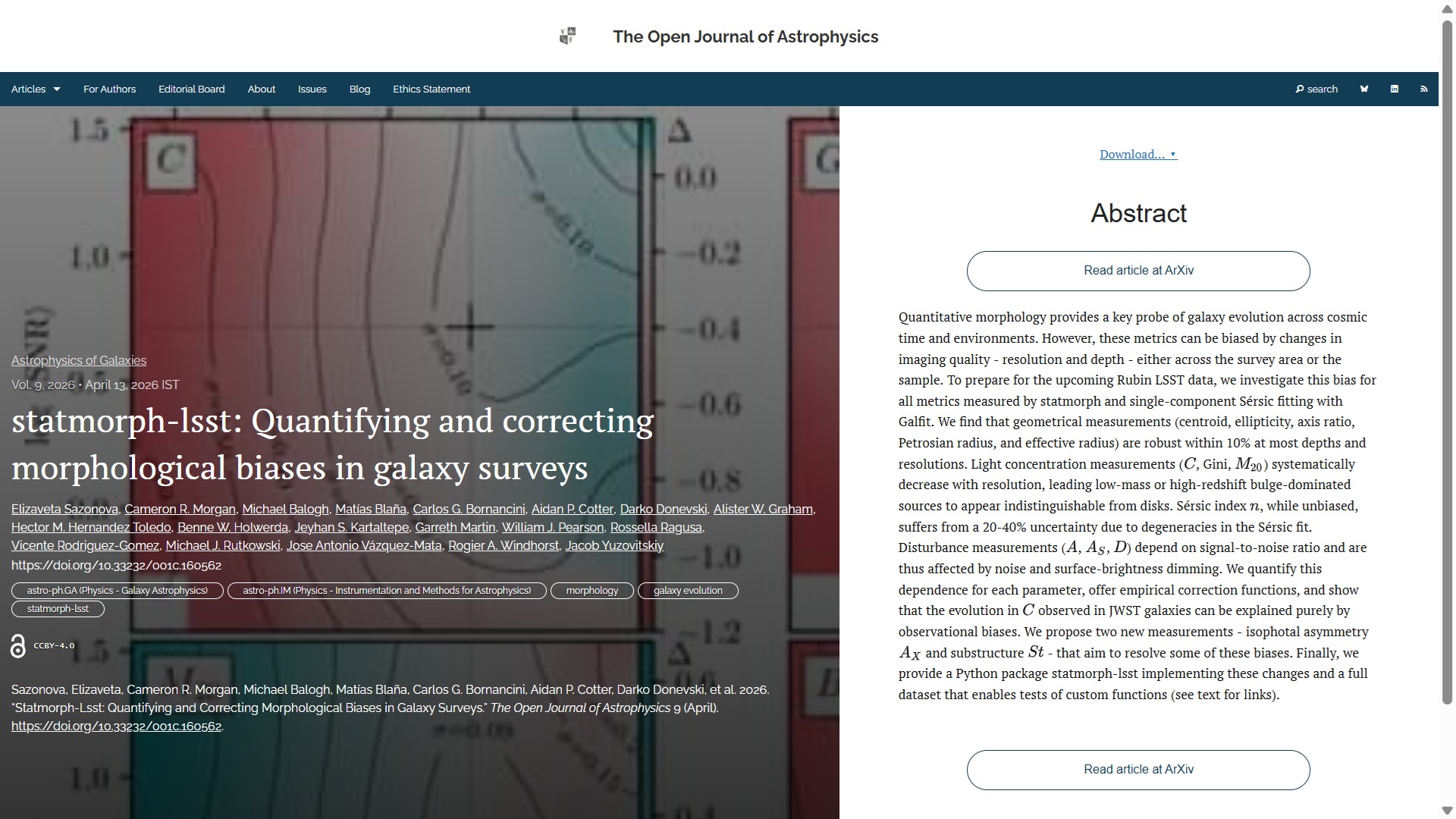
The second paper for this week, also published on Monday 13th April Apil in the folder but in the folder Astrophysics of Galaxies, is “statmorph-lsst: Quantifying and correcting morphological biases in galaxy surveys” by Elizaveta Sazonova (U. Waterloo, Canada) and an international cast of 18 others. This paper presents an investigation of potential biases in quantitative morphology metrics used in galaxy evolution studies, proposing two new measurements to resolve biases, and provides a related Python package (statmorph-lsst), which can be found here on github.

The overlay for this one is here:

The official version of the paper can be found on arXiv here and the Fediverse announcement here:

Open Journal of Astrophysics

New Publication at the Open Journal of Astrophysics: "statmorph-lsst: Quantifying and correcting morphological biases in galaxy surveys" by Elizaveta Sazonova (U. Waterloo, Canada) and an international cast of 18 others.

doi.org/10.33232/001c.160562

April 13, 2026, 6:51 am 3 boosts 1 favorites

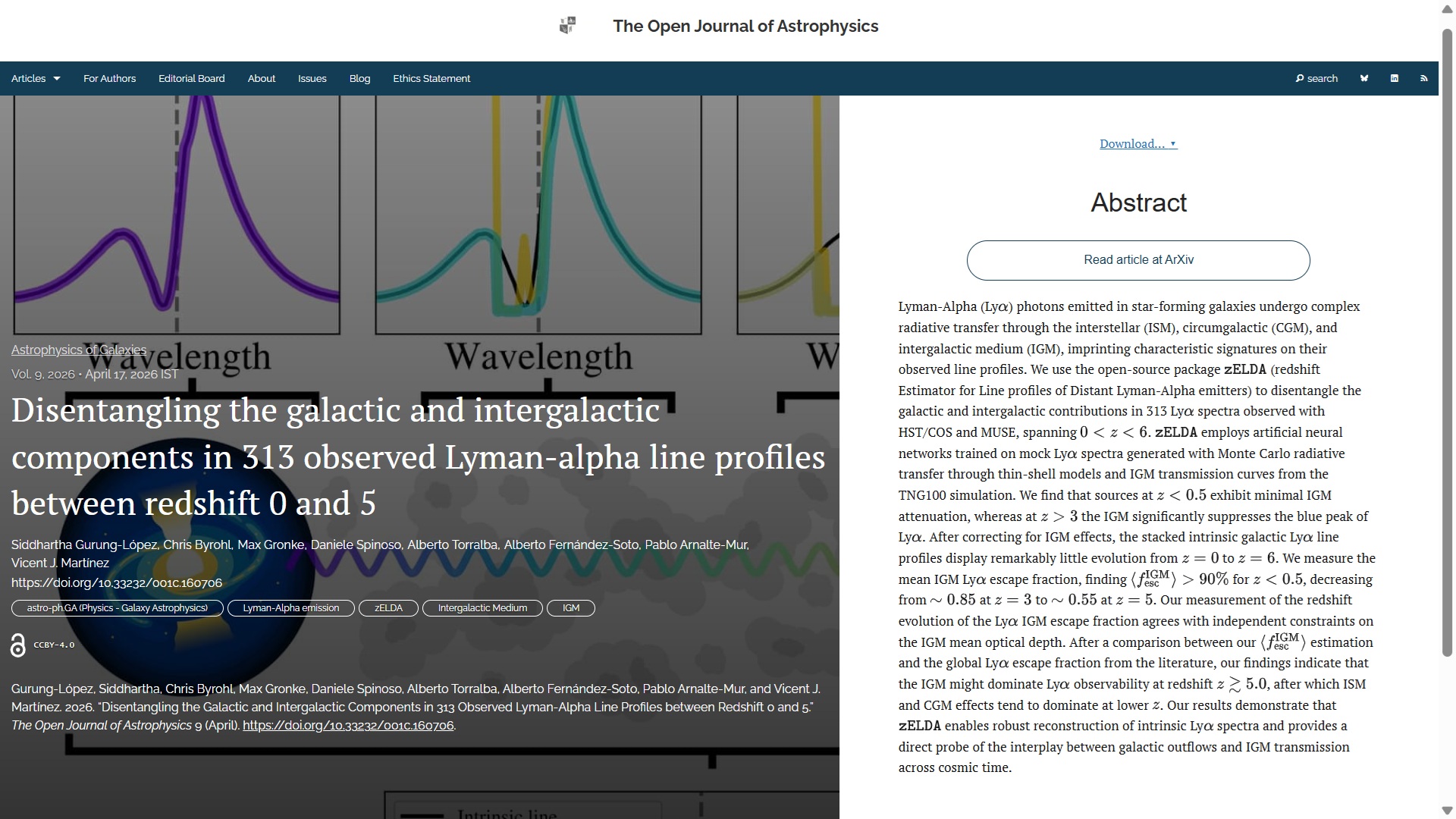
Next one up, the third paper of the week, one of four published on Friday 17th April, is “Disentangling the galactic and intergalactic components in 313 observed Lyman-alpha line profiles between redshift 0 and 5” by Siddhartha Gurung-López (Universitat de València, Spain) and 7 others based in Spain and Germany. Published in the folder Astrophysics of Galaxies, this paper uses the zELDA package to analyze Lyman-alpha photons from star-forming galaxies, revealing IGM effects dominate Lyman-alpha observability at high redshifts, while galactic outflows become more important at lower z.

The overlay for this one is here:

The final, accepted version can be found on arXiv here and the Mastodon announcement is here:

Open Journal of Astrophysics

New Publication at the Open Journal of Astrophysics: "Disentangling the galactic and intergalactic components in 313 observed Lyman-alpha line profiles between redshift 0 and 5" by Siddhartha Gurung-López (Universitat de València, Spain) and 7 others based in Spain and Germany.

doi.org/10.33232/001c.160706

April 17, 2026, 7:19 am 1 boosts 0 favorites

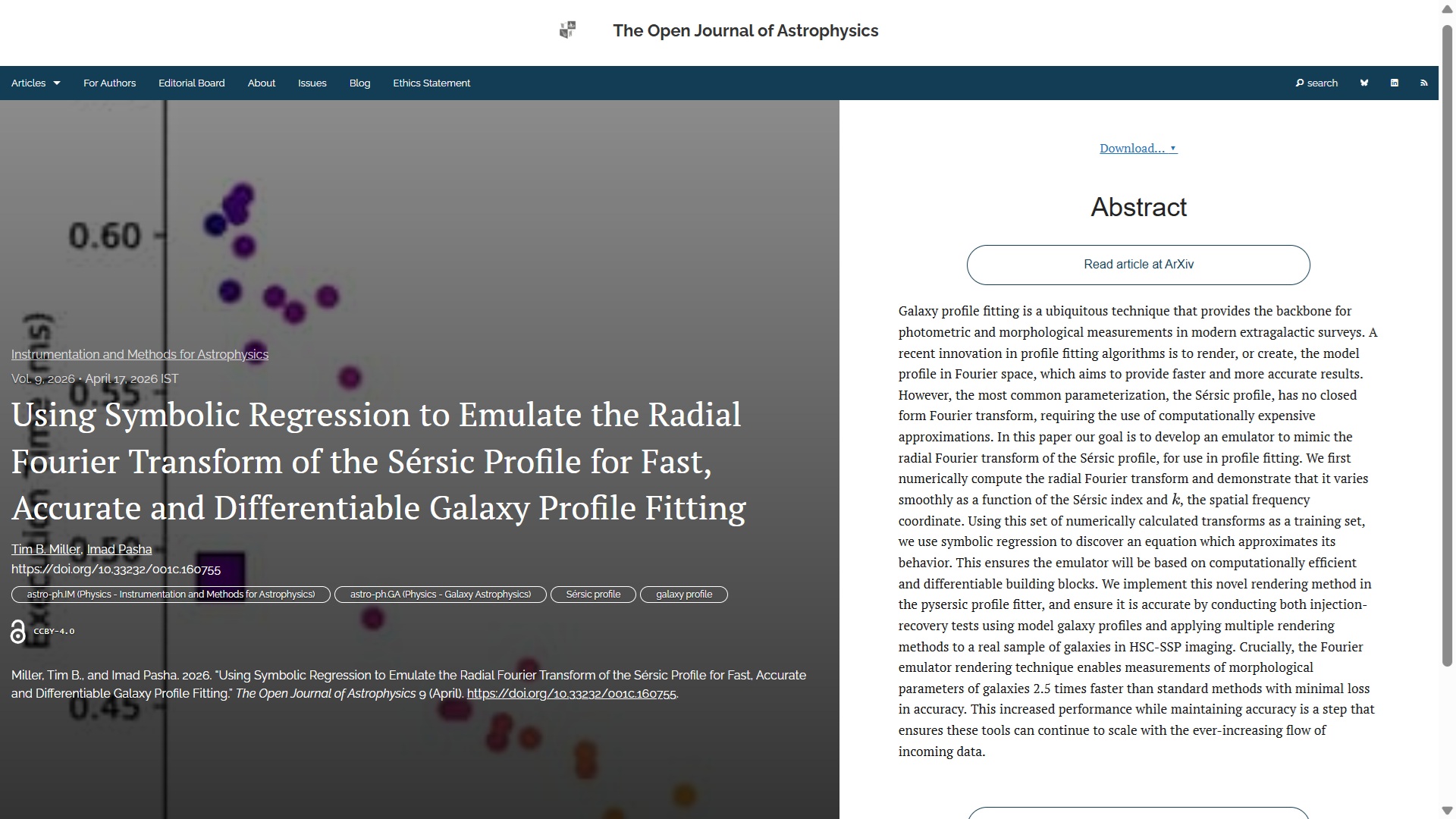
The fourth paper this week, also published on Friday 17th April is “Using Symbolic Regression to Emulate the Radial Fourier Transform of the Sérsic Profile for Fast, Accurate and Differentiable Galaxy Profile Fitting” by Tim B. Miller (Northwestern University, USA) and Imad Pasha (Yale University, USA). This one is published in the folder Instrumentation and Methods for Astrophysics: it develops an emulator for galaxy profile fitting in Fourier space, improving speed by 2.5 times with minimal accuracy loss, aiding in managing increasing data flow.

The overlay is here:

The finally accepted version of this paper can be found here and the Mastodon announcement follows:

Open Journal of Astrophysics

New Publication at the Open Journal of Astrophysics: "Using Symbolic Regression to Emulate the Radial Fourier Transform of the Sérsic Profile for Fast, Accurate and Differentiable Galaxy Profile Fitting" by Tim B. Miller (Northwestern University, USA) and Imad Pasha (Yale University, USA)

doi.org/10.33232/001c.160755

April 17, 2026, 7:25 am 1 boosts 1 favorites

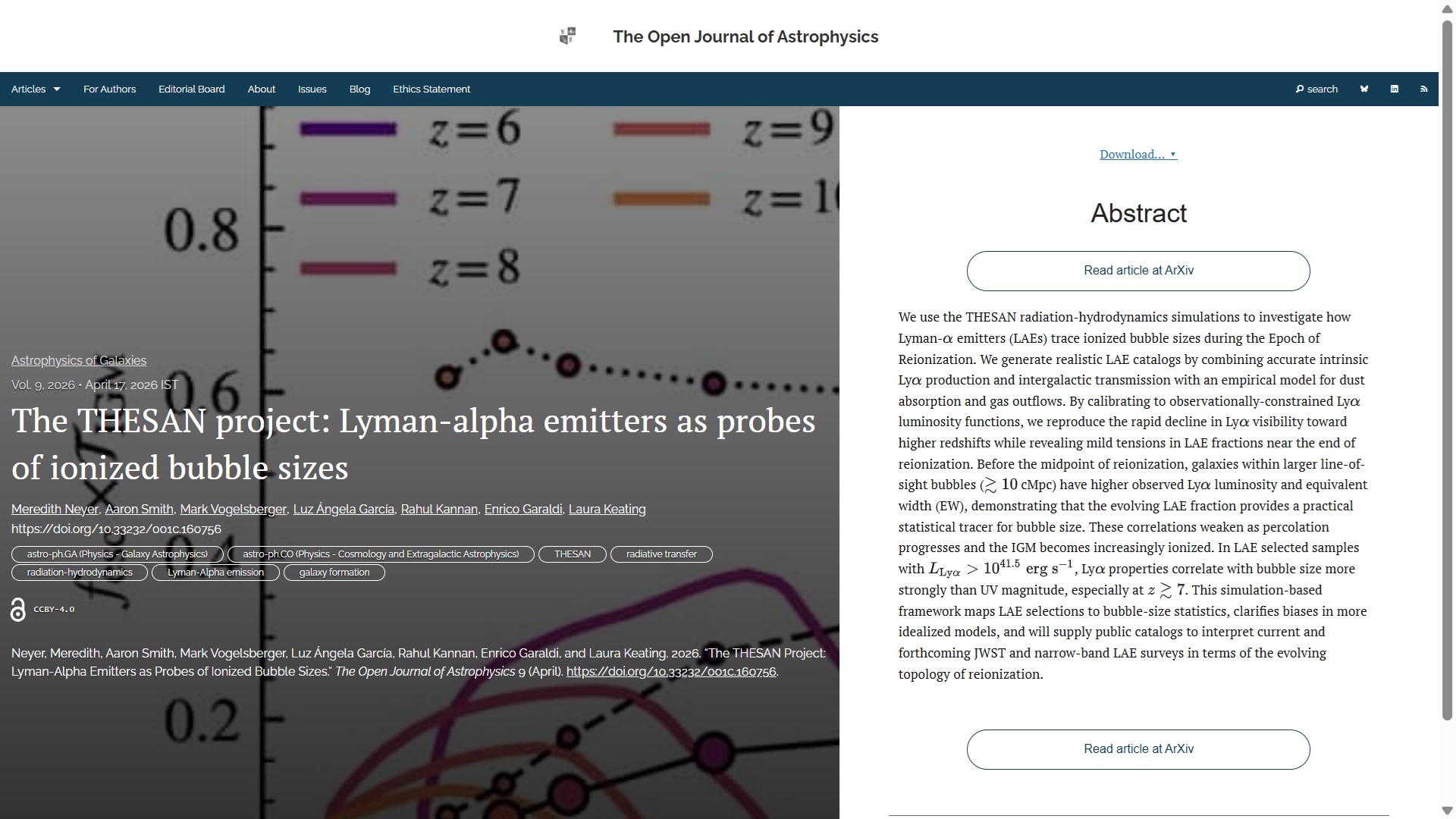
The fifth paper for this week is “The THESAN project: Lyman-alpha emitters as probes of ionized bubble sizes” by Meredith Neyer (MIT, USA) and 6 others based in the USA, Colombia, Canada, Japan and UK. The study uses THESAN simulations to explore how Lyman-alpha emitters (LAEs) trace ionized bubble sizes during the Epoch of Reionization, providing a framework for interpreting LAE surveys. This was published on Friday 17th April in the folder Astrophysics of Galaxies.

The overlay for this one is here:

You can find the authorized version of this paper on arXiv here and the Fediverse announcement is here:

Open Journal of Astrophysics

New Publication at the Open Journal of Astrophysics: "The THESAN project: Lyman-alpha emitters as probes of ionized bubble sizes" by Meredith Neyer (MIT, USA) and 6 others based in the USA, Colombia, Canada, Japan and UK.

doi.org/10.33232/001c.160756

April 17, 2026, 7:34 am 1 boosts 0 favorites

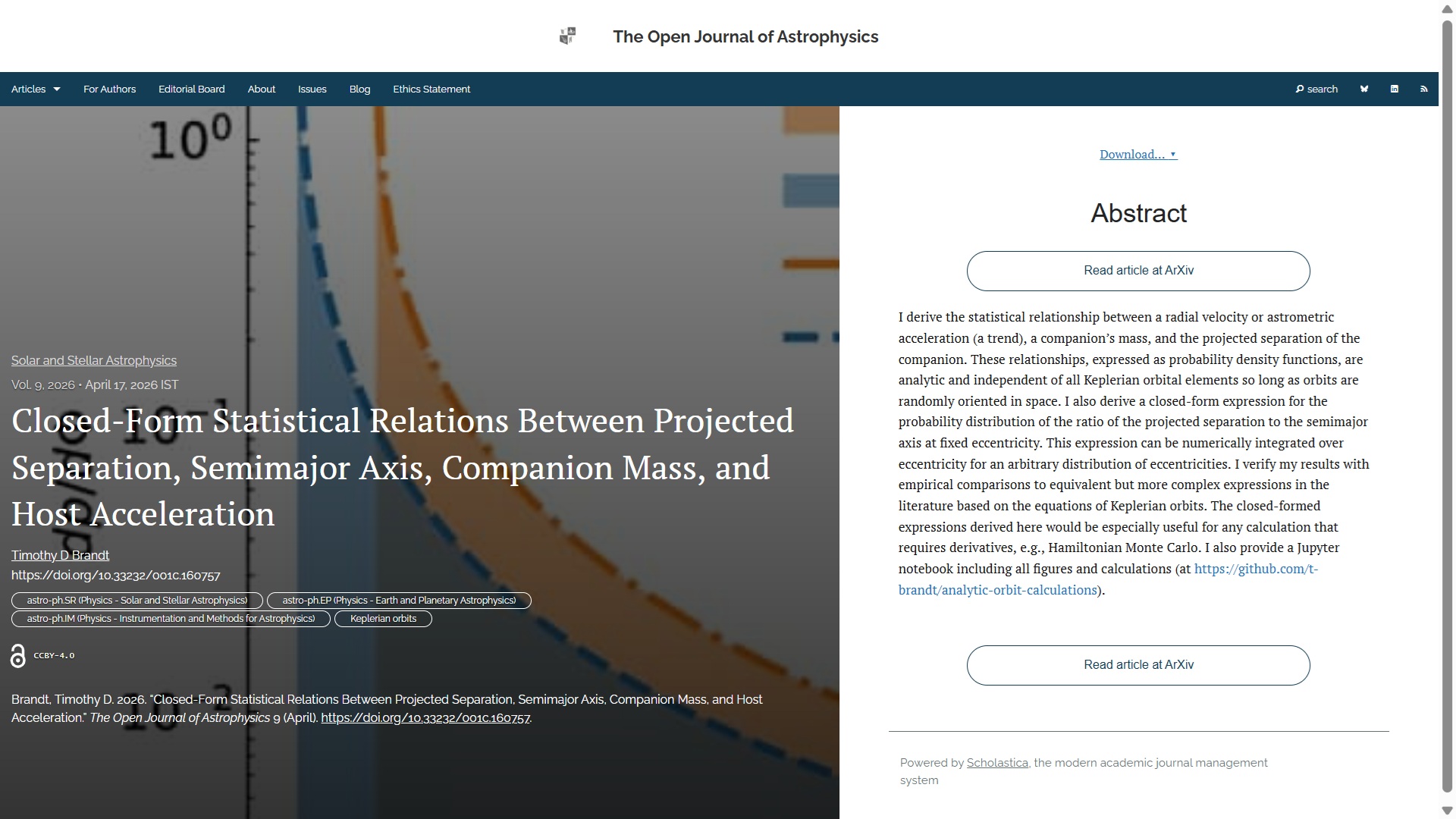
The sixth and final paper for this week is “Closed-Form Statistical Relations Between Projected Separation, Semimajor Axis, Companion Mass, and Host Acceleration” by Timothy D Brandt (Space Telescope Science Institute, USA). This was published on Friday 17th April in the folder Solar and Stellar Astrophysics. In this paper the author derives statistical relationships between radial velocity, a companion’s mass, and projected separation, useful for calculations requiring derivatives. The results are verified with empirical comparisons to existing literature.

The overlay for this one is here:

You can find the officially-accepted version on arXiv here and the Mastodon announcement here:

Open Journal of Astrophysics

New Publication at the Open Journal of Astrophysics: "Closed-Form Statistical Relations Between Projected Separation, Semimajor Axis, Companion Mass, and Host Acceleration" by Timothy D Brandt (Space Telescope Science Institute, USA)

doi.org/10.33232/001c.160757

April 17, 2026, 7:46 am 1 boosts 1 favorites

And that concludes this week’s update. I’ll do another one at the end of next week.

P.S. Just a reminder, for those of you into LinkedIn, that we now have a page there.

Weekly Update from the Open Journal of Astrophysics – 11/04/2026

Posted in OJAp Papers, Open Access, The Universe and Stuff with tags , , , , , , , , , , , , , , , , , , , , , , , , , , , , , on April 11, 2026 by telescoper

With permission, I have time for yet another Saturday morning update of activity at the Open Journal of Astrophysics. Since the last update we have published a further five papers, bringing the number in Volume 9 (2026) to 76 and the total so far published by OJAp up to 524.

I will continue to include the posts made on our Mastodon account (on Fediscience) to encourage you to visit it. Mastodon is a really excellent service, and a more than adequate replacement for X/Twitter (which nobody should be using); these announcements also show the DOI for each paper.

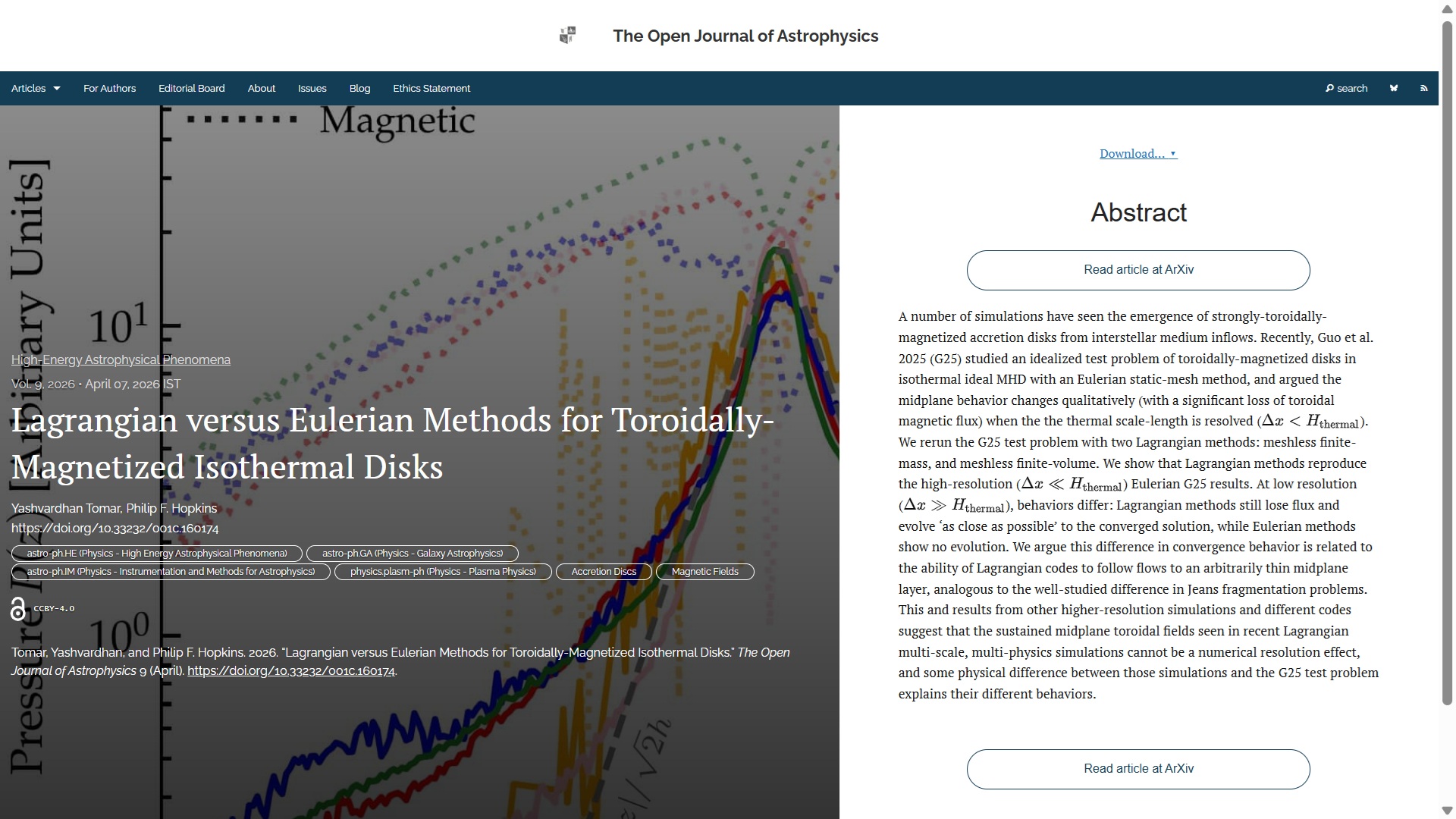
The first paper to report this week is “Lagrangian versus Eulerian Methods for Toroidally-Magnetized Isothermal Disks” by Yashvardhan Tomar and Philip F. Hopkins (California Institute of Technology, USA). This study re-evaluates previous research on toroidally-magnetized disks, using two Lagrangian methods. The results suggest that sustained midplane toroidal fields in recent simulations are not a numerical artefact. It was published on Tuesday April 7th 2026 in the folder High-Energy Astrophysical Phenomena.

The overlay is here:

You can find the officially accepted version on arXiv here and the announcement on Fediverse here:

Open Journal of Astrophysics

New Publication at the Open Journal of Astrophysics: "Lagrangian versus Eulerian Methods for Toroidally-Magnetized Isothermal Disks" by Yashvardhan Tomar and Philip F. Hopkins (Caltech, USA)

doi.org/10.33232/001c.160174

April 7, 2026, 8:07 am 1 boosts 1 favorites

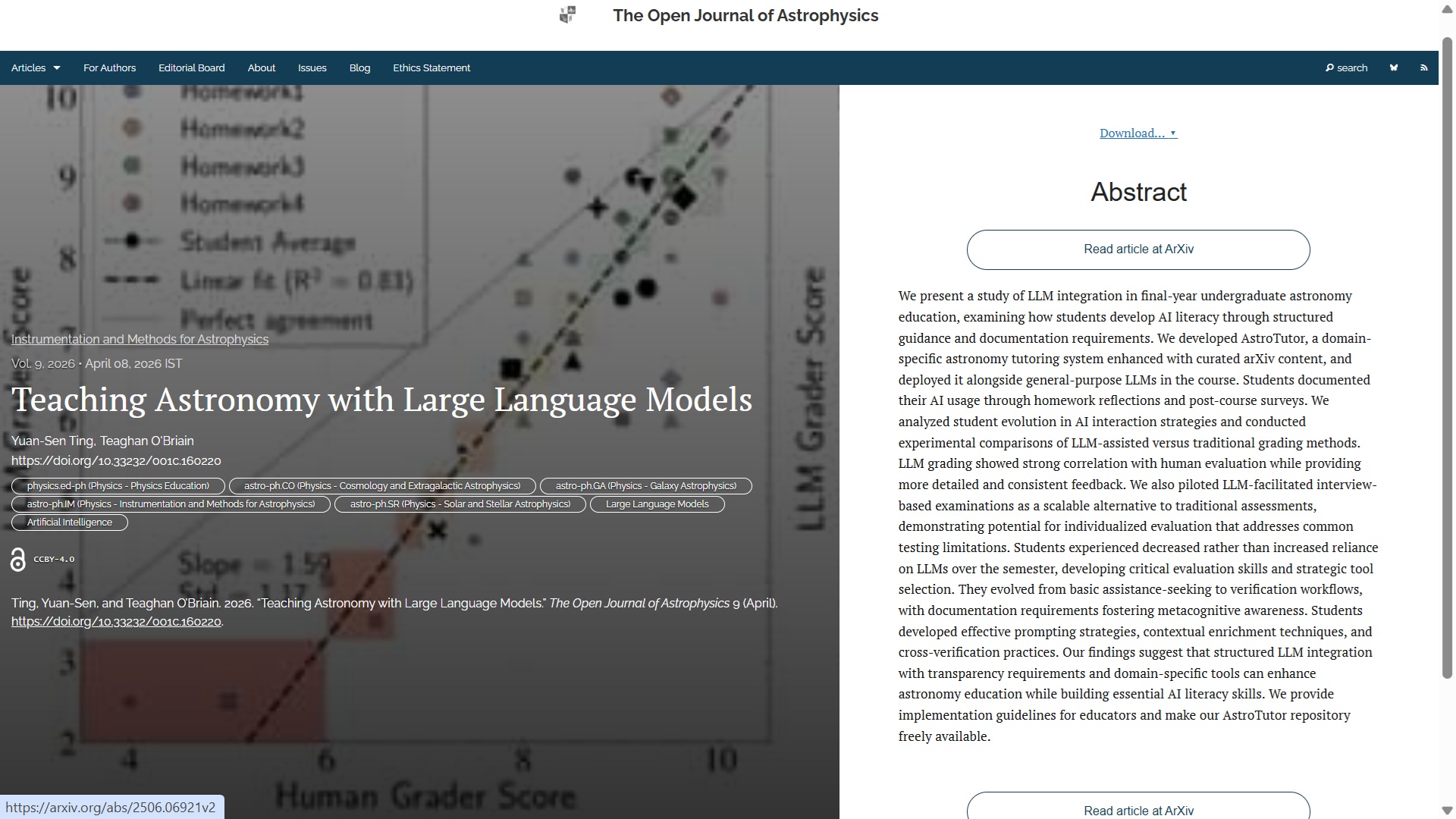
The second paper for this week, published on Wednesday 8th Apil in the folder Instrumentation and Methods for Astrophysics, is “Teaching Astronomy with Large Language Models” by Yuan-Sen Ting and Teaghan O’Briain (Ohio State University, USA). The paper introduces AstroTutor, an AI-enhanced astronomy tutoring system, to improve undergraduate astronomy education and AI literacy. It found that structured AI integration can enhance learning and critical evaluation skills. The primary classification on arXiv for this paper is physics.ed-ph but it is cross-listed on astro-ph which qualifies it for consideration.

The overlay for this one is here:

The official version of the paper can be found on arXiv here and the Fediverse announcement here:

Open Journal of Astrophysics

New Publication at the Open Journal of Astrophysics: "Teaching Astronomy with Large Language Models" by Yuan-Sen Ting and Teaghan O'Briain (Ohio State University, USA)

doi.org/10.33232/001c.160220

April 8, 2026, 8:42 am 0 boosts 2 favorites

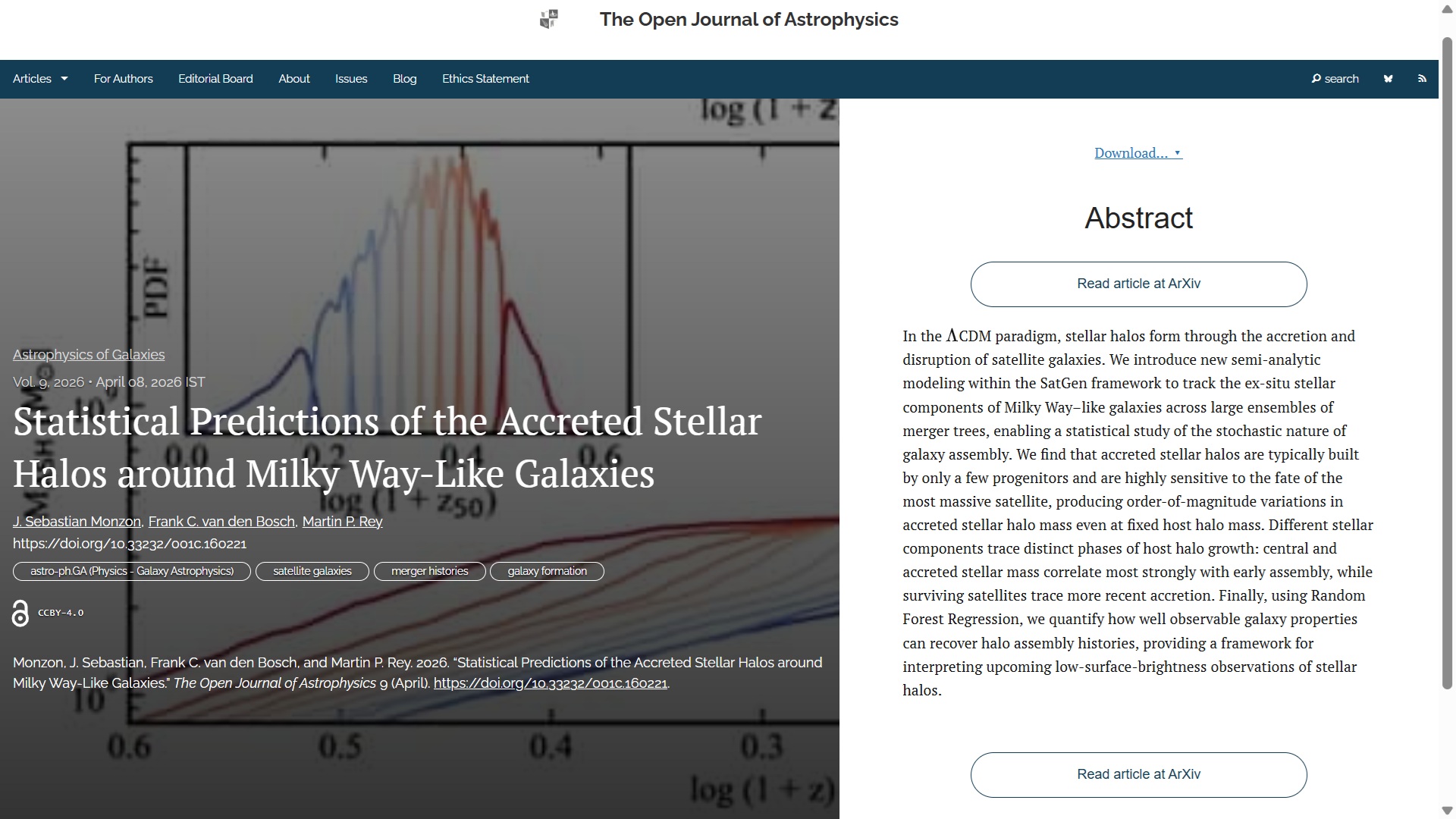
Next one up, the third paper of the week, also published on Wednesday 8th April, is “Statistical Predictions of the Accreted Stellar Halos around Milky Way-Like Galaxies” by J. Sebastian Monzon & Frank C. van den Bosch (Yale University, USA) and Martin P. Rey (University of Bath, UK). This one was published in the section Astrophysics of Galaxies; it describes new model to track formation of stellar halos in Milky Way-like galaxies, revealing their sensitivity to the fate of the largest satellite and whether accretion is early or late.

The overlay for this one is here:

The final, accepted version can be found on arXiv here and the Mastodon announcement is here:

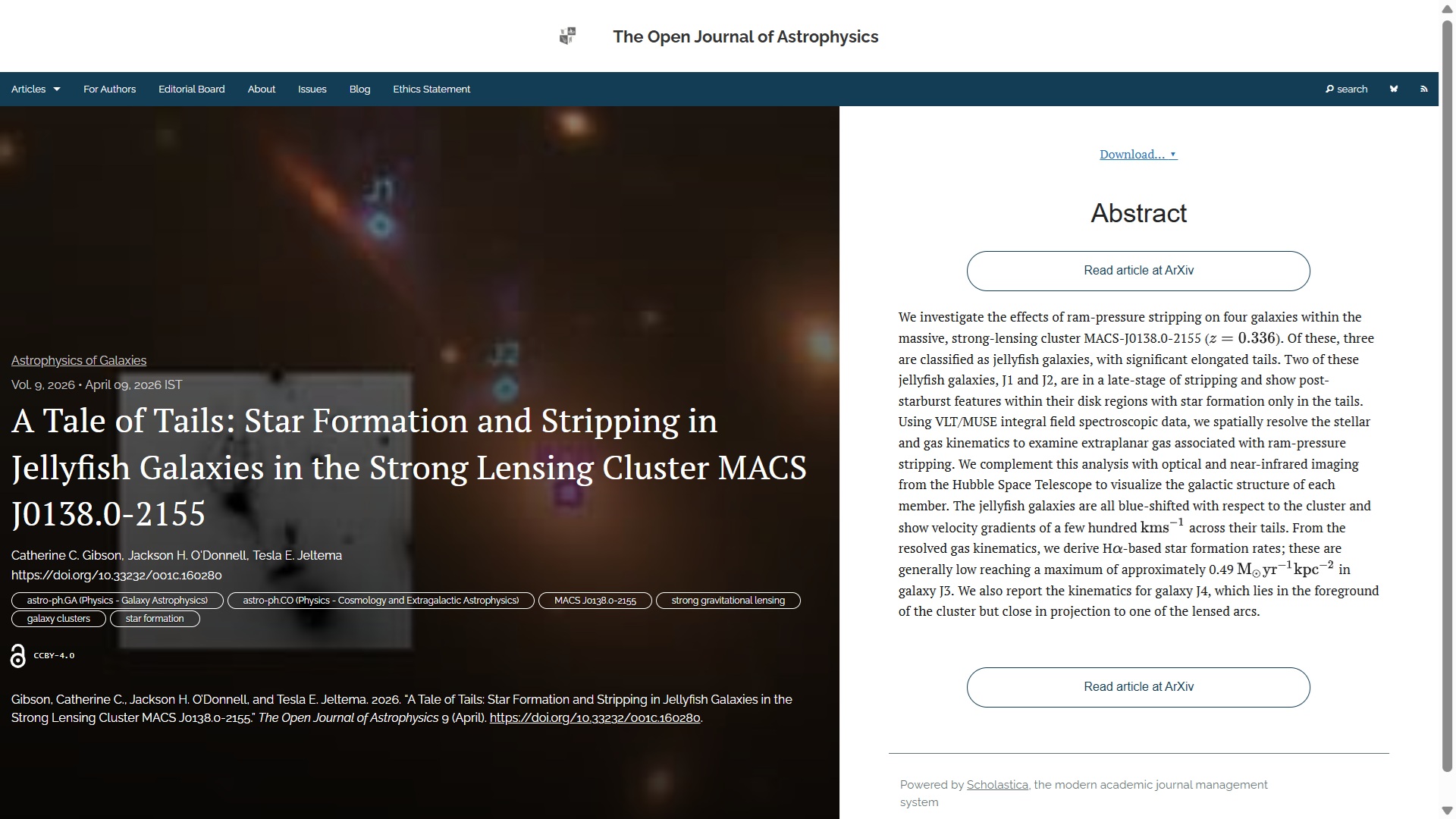
The fourth paper this week, published on Thursday 9th April is “A Tale of Tails: Star Formation and Stripping in Jellyfish Galaxies in the Strong Lensing Cluster MACS J0138.0-2155” by Catherine C. Gibson, Jackson H. O’Donnell and Tesla E. Jeltema (UC Santa Cruz, USA). This investigates the effects of ram-pressure stripping on four galaxies, focusing on their stellar and gas kinematics, star formation rates, and galactic structure and is published in the folder marked Astrophysics of Galaxies.

The overlay is here:
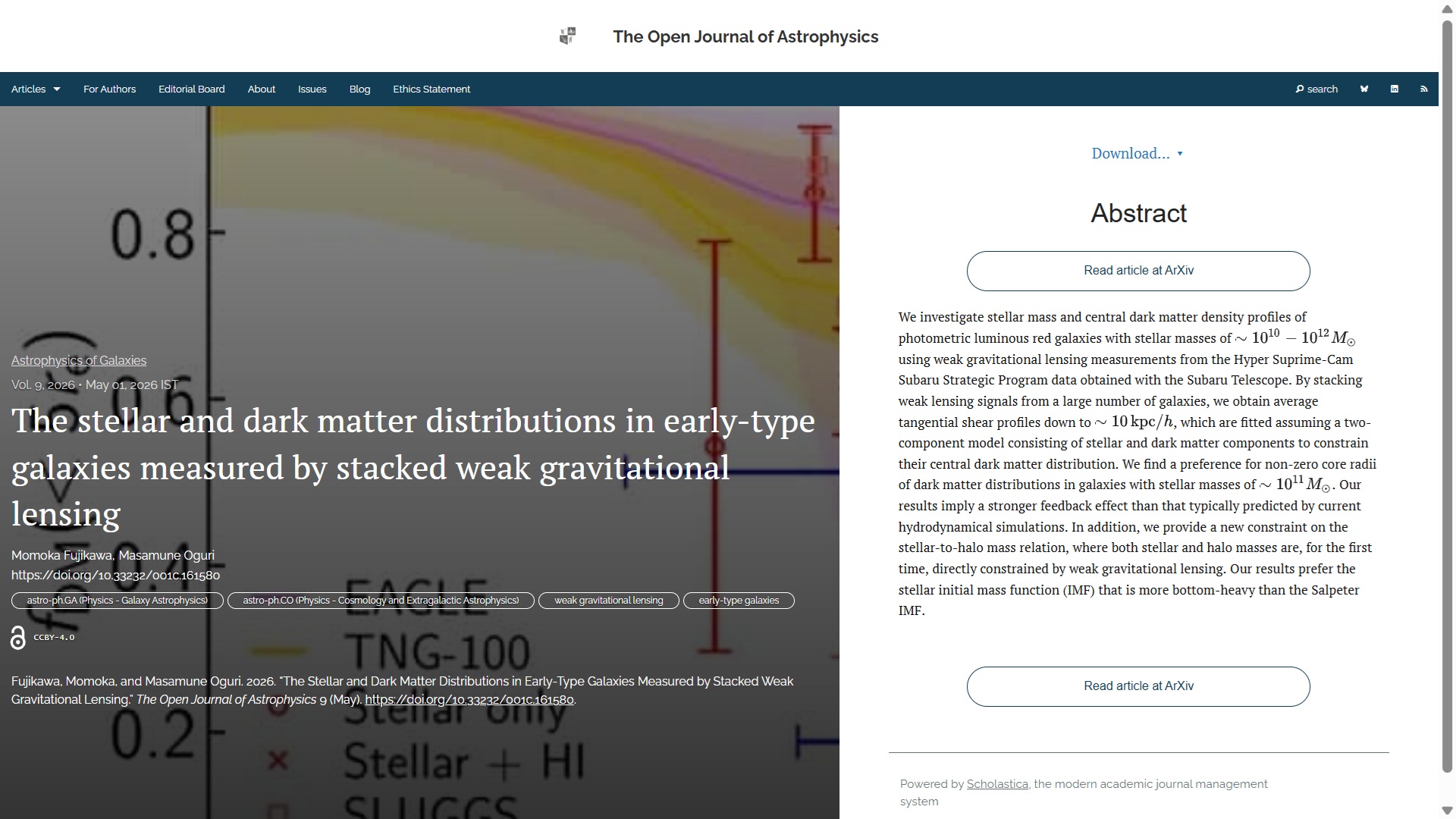
The finally accepted version of this paper can be found here and the Mastodon announcement is here:

Open Journal of Astrophysics

New Publication at the Open Journal of Astrophysics: "A Tale of Tails: Star Formation and Stripping in Jellyfish Galaxies in the Strong Lensing Cluster MACS J0138.0-2155" by Catherine C. Gibson, Jackson H. O'Donnell and Tesla E. Jeltema (UC Santa Cruz, USA)

doi.org/10.33232/001c.160280

April 9, 2026, 9:45 am 1 boosts 0 favorites

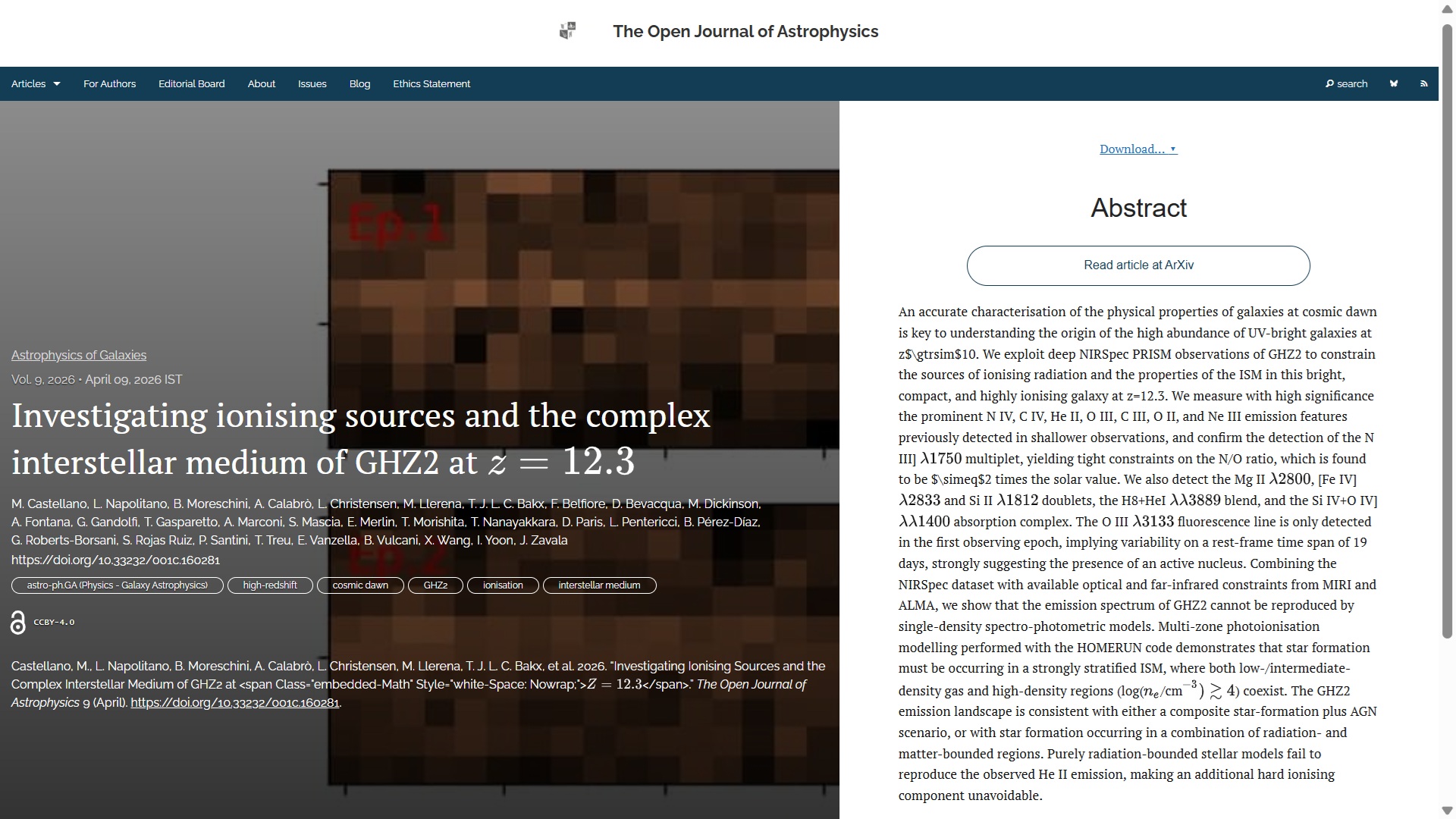
The fifth and final paper for this week is “Investigating ionising sources and the complex interstellar medium of GHZ2 at z=12.3” by M. Castellano (INAF Osservatorio Astronomico di Roma, Italy) and 29 others based all around the world. This was also published on Thursday 9th April in the folder Astrophysics of Galaxies. The paper uses deep observations of galaxy GHZ2 to explore the sources of ionising radiation and interstellar medium properties at cosmic dawn. Findings suggest a stratified environment and a hard ionising radiation component.

The overlay for this one is here:

The officially-accepted version of this one can be found on arXiv here and the Mastodon announcement is here

Open Journal of Astrophysics

New Publication at the Open Journal of Astrophysics: "Investigating ionising sources and the complex interstellar medium of GHZ2 at z=12.3" by M. Castellano (INAF Osservatorio Astronomico di Roma, Italy) and 29 others based around the world.

doi.org/10.33232/001c.160281

April 9, 2026, 10:21 am 2 boosts 0 favorites

That concludes this week’s update. I’ll do another one at the end of next week, when the Easter vacations will be over.

P.S. For those of you into LinkedIn, we now have a page there.

Job Opportunity in Computational Astrophysics at Maynooth!

Posted in Maynooth, The Universe and Stuff with tags , , on December 2, 2022 by telescoper

Just a quick post to advertise the fact that the Department of Theoretical Physics at Maynooth University is inviting applications for a Postdoctoral Fellowship Position in Computational and Theoretical Astrophysics. The successful applicant will join the Research Group led by Dr John Regan and is expected to develop their own independent research program within the confines of a research project investigating the formation, growth, and demographics of Black Holes in the early Universe. The group, currently consisting of four PhD students and one additional postdoctoral researcher, is currently engaged in numerous research topics with the goal of understanding early black hole formation. In line with this we are currently implementing an ambitious research project using the EnzoE exascale class code to run large volume, high resolution simulations focused on the first billion years of black hole formation. The successful candidate will be expected to contribute significantly to this research effort but are free to pursue their own research lines under this remit.

For more information, including deadlines and the applications procedure, please see the AAS Jobs register advertisement here.

R.I.P. Willy Kley (1958-2021)

Posted in Biographical, The Universe and Stuff with tags , , , on December 29, 2021 by telescoper

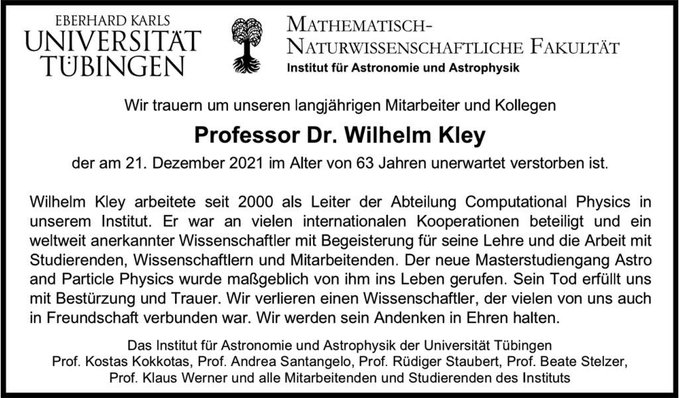
Once again it is my sad task to pass on news of the death of a colleague from the field of astrophysics. Prof. Dr. Wilhelm (“Willy”) Kley of the Institut für Astronomie & Astrophysik at the Universität Tübingen
in Germany passed away suddenly on 21st December 2021, at the age of 63.

Here is the official announcement (in German) from his institution:

Willy Kley was a computational astrophysicist who worked on accretion processes, especially in the context of the formation of planets and planetary systems. I knew him a little personally, as he was for a time in the Astronomy Unit at Queen Mary & Westfield College (as it was then called) at the same time I was there. He worked with the group led by John Papaloizou, alongside Richard Nelson and others, and I was working on cosmology, so we didn’t work together, but I did get to know him a bit and had a number of interesting discussions. He was a very nice man as well as a first-rate scientist. Looking at his (extensive) publication list it seems that he continued to collaborate with former QMW colleagues after his return to Germany in 2000.

His death was unexpected – I believe he suffered a heart attack – and I’m sure the news will come as a shock to many of his friends and collaborators. To them, and to his family, I send heartfelt condolences.