Heatwave

Posted in Biographical, Maynooth with tags , on July 18, 2022 by telescoper

The extremely hot weather currently engulfing much of Europe has reached Maynooth, although the temperature here is around 30°C, which is warm by the standards of Ireland but not as extreme as the >40ºC predicted for the UK today and on the continent. Maynooth is in the part of Ireland where temperatures are predicted to be highest.

I’m told that a “heatwave” is defined in Ireland as four consecutive days with temperatures above 25ºC. That is relatively cool by some standards but not for this temperate island. Still, it looks like it will break by Wednesday.

I don’t function very well in hot weather so I’m staying indoors where it is relatively cool (although we have no air conditioning). The highest temperature I’ve ever been in was 48ºC in Aswan, Southern Egypt, where I was on holiday in the 90s. That was different though as it is basically a desert climate and was a very dry heat. I found as long as I drank plenty of water I felt OK. A few summers later when I spent a few days in New Orleans it was barely 30ºC but so unbearably humid that I found it impossible. Humidity in Maynooth today is about 40% so it’s not too bad.

Before coming to work this morning I put out lots of water in the garden for the birds, who need to drink as well as bathe. The local robin has been very vocal over the last few days as if to demand that I keep the water supply refreshed. I’m convinced this bird thinks it owns my garden and that I am its servant. Elsewhere in the garden I moved my dwarf fig to a shadier spot, it being rather frazzled.

I checked on Maynooth University Library Cat’s bowl on my way too, though he himself was nowhere to be seen, no doubt sheltering in a cool spot somewhere.

The thermoelectric wine cooler in my kitchen has been struggling noisily to maintain cellar temperature (12-14 ºC) . It’s quite old so this heatwave might well finish it off. Let’s hope the same isn’t true for too many humans…

The All-Ireland Senior Hurling Championship Final

Posted in GAA with tags , , , , on July 17, 2022 by telescoper

Today’s the day! Kilkenny v Limerick from Croke Park for the All-Ireland Senior Hurling Championship Final. Over 80,000 spectators will watch this in Croke Park as well as millions around the world. Let’s hope it’s a good one.

Half Time: Kilkenny 0-16 Limerick 1-17

Reasonably comfortable for Limerick who have been ahead since the 2nd minute. Can Kilkenny fight back in the 2nd half? I’m glad for the sake of the players that it’s “only” 27 °C at Croke Park this afternoon and not even hotter!

Full Time: Kilkenny 2-26 Limerick 1-31

So Limerick have won their 3rd All-Ireland Championship in a row by just two points.

Kilkenny scored two goals in the second half to level the scores at which point Limerick seemed a bit ragged, but Limerick pulled themselves together held on for the victory in what was a thrilling second half. Hurling is not a game for faint hearts but alongside the physicality of the game there is an astonishing level skill: the accuracy of the long-range shooting is quite phenomenal.

Congratulations to Limerick, deserved winners, and commiserations to Kilkenny who made a fantastic game of it. What a magnificent final.

New Publication at the Open Journal of Astrophysics

Posted in Open Access, The Universe and Stuff with tags , , , on July 17, 2022 by telescoper

Today is ten years to the day that I wrote the blog post that first proposed setting up the Open Journal of Astrophysics. It took a bit longer than I’d expected to get it going. The prototype site opened at the end of 2015 but owing to personal issues the project didn’t get going in full until after I moved to Maynooth in 2017.

It couldn’t have happened without enormous help from Arfon Smith, Chris Lintott, Adam Becker, Robert Simpson, Stuart Lynn and Mark Rohloff so many thanks to them for assistance in getting it off the ground. I also thank the staff at Maynooth University Library, especially Fiona Morley-Clarke, for their support and assistance. I also acknowledge financial support from the Gordon and Betty Moore Foundation.

I’d also like to thank the Editorial Team at OJAp, all unpaid volunteers, for their efforts and of course to all the authors who have trusted their research findings what was, at least at the start, an experimental venture.

Now seems an appropriate time to announce yet another new publication in the Open Journal of Astrophysics! This one, published last week, is the 10th paper in Volume 5 (2022) and the 58th in all.

The latest publication is entitled “V889 Her: abrupt changes in the magnetic field or differential rotation?” and is written by Teemu Willamo (Helsinki), Thomas Hackman (Helsinki), Jyri J. Lehtinen (Turku), Maarit Korpi-Lagg (Aalto) and Oleg Kochukhov (Uppsala). The first four of these are based in Finland and the last in Sweden.

This is another paper in the Solar and Stellar Astrophysics folder; the subject of the paper V889 Herculis is a young and very active dwarf star with some intriguing properties.

Here is a screen grab of the overlay which includes the (very short) abstract:

You can click on the image to make it larger should you wish to do so. You can find the arXiv version of the paper here.

The (unofficial) 2021 Journal Impact Factor for the Open Journal of Astrophysics

Posted in Open Access, The Universe and Stuff with tags , , on July 16, 2022 by telescoper

Since a few people have been asking about the Journal Impact Factor (JIF) for the Open Journal of Astrophysics, I thought I’d do a quick post in response.

When asked about this my usual reply is (a) to repeat the arguments why the impact factor is daft and (b) point out that the official JIF is calculated by Clarivate so it’s up to them to calculate it – us plebs don’t get a say.

On the latter point Clarivate takes its bibliometric data from the Web of Science (which it owns). I have applied on behalf of the Open Journal of Astrophysics to be listed in the Web of Science but it has not yet been listed.

Anyway, the fact that it’s out of my hands doesn’t stop people from asking so I thought I’d proceed with my own calculation not using Web of Science but instead using NASA/ADS (which probably underestimates citation numbers but which is freely available, so you can check the numbers using the interface here); the official NASA/ADS abbreviation for the Open Journal of Astrophysics is OJAp.

For those of you who can’t be bothered to look up the definition of an impact factor for a given year it is defined the sum of the citations for all papers published in the journal over the previous two-year period divided by the total number of papers published in that journal over the same period. It’s therefore the average citations per paper published in a two-year window. Since our first full year of publication was 2019, the first year for which we can calculate a JIF is 2021 (i.e. last year) which is defined using data from 2019 and 2020.

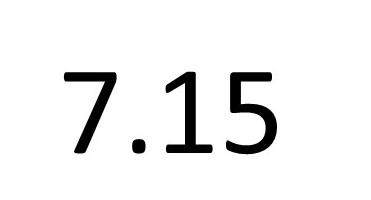
I stress again we don’t have an official Journal Impact Factor for the Open Journal of Astrophysics but one can calculate its value easily. In 2019 and 2020 we published 12 and 15 papers respectively, a 27. These papers were cited a total of 193 times in 2021. The journal impact factor for 2021 is therefore … roll on the drums… 193/27, which gives:

If you don’t believe me, you can check the numbers yourself. For comparison, the latest available Impact Factor (2020) for Monthly Notices of the Royal Astronomical Society is 5.29 and Astronomy & Astrophysics is 5.80. OJAp’s first full year of publication was 2019 (in which we published 12 papers) but we did publish one paper in 2018. Based on the 134 citations received to these 13 papers in 2020, our 2020 Journal Impact Factor was 10.31, much higher than MNRAS or A&A.

Furthermore, we published 32 papers in 2020 and 2021 which have so far received 125 citations in 2022. Our Journal Impact Factor for 2022 will therefore be at least 125/32= 3.91 and if those 32 papers are cited at the same for the rest of this year the 2022 JIF will be about 7.5.

Who knows, perhaps these numbers will shame Clarivate into giving us an official figure?

With so much bibliometric information available at the article level there is no reason whatsoever to pay any attention to such a crudely aggregated statistics at the journal level as the JIF. One should judge the contents, not the packaging. I am however fully aware that many people who hold the purse strings for research insist on publications in journals with a high JIF. If there was any fairness in the system they would be mandating astronomy publications in OJAp rather than MNRAS or A&A.

Anyway, it might annoy all the right people if I add a subtitle to the Open Journal of Astrophysics: “The World’s Leading Astrophysics Journal”…

Tosca at the Bord Gáis

Posted in Opera with tags , , , , , , on July 15, 2022 by telescoper

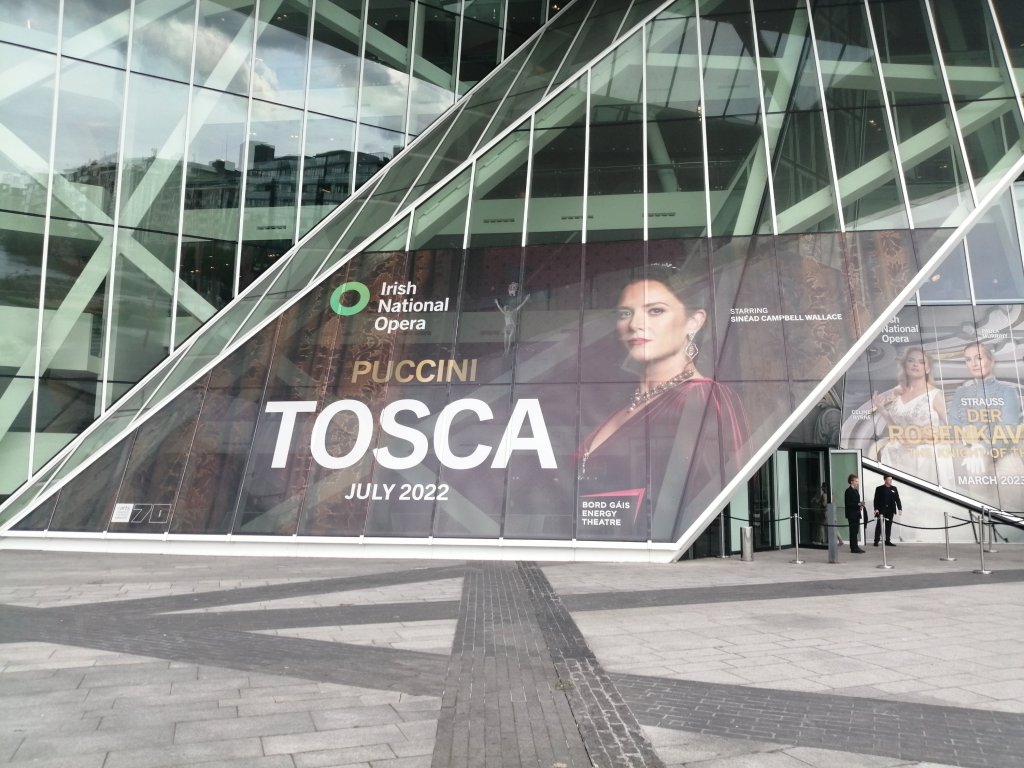
Last night found me for the very first time at Dublin’s splendid Bord Gáis Energy Theatre, for a performance of Tosca by Irish National Opera, a tale of jealousy and murder set to gorgeous music by Giacomo Puccini.

Bord Gáis means “Gas Board”, by the way, but a rose by any other name would smell as sweet.

It’s been a while since I last went to an Opera and it was a last-minute decision to attend this one, but I heard good things about the opening night on Monday and managed to get a ticket. I’m very glad I did as there was much to enjoy, with some quite original variations on a very familiar story.

Tosca is an opera in three acts (which means two intervals wine breaks…). It’s a melodrama, and is set in Rome in 1800. Each Act takes place in a very specific location within the Eternal City. Act I is set in the Church of  Sant’Andrea della Valle, Act II in the Palazzo Farnese, and the final denouement of Act III takes place among the battlements at the top of the Castel Sant’ Angelo overlooking the Tiber.

Most productions of Tosca I have seen stick rigorously to a specific sense of time and place. In this one, directed by Michael Gieleta, the locations are suggested rather than reproduced directly and the costumes and interior design are generally 20th Century, with some sly references. The villainous Spoletta, for example, a police agent, is clearly dressed as a Jesuit. The shepherd boy in Act III appears as an angel, complete with wings, whose ghostly presence leads the prisoners on to their impending execution.

There is also some very ingenious staging, with a rotating set showing the torture scene in Act II while Scarpia and Tosca do their thing. The revolving structure also provides a very interesting alternative view of the end of Act III. I won’t say any more for fear of spoiling it for others…

Floria Tosca (Sinéad Campbell-Wallace, soprano) is a celebrated opera singer who is in love with an artist (and political radical) by the name of Mario Cavaradossi (Dimitri Pittas, tenor), who helps to hide an escaped political prisoner Cesare Angelotti (John Molloy, bass) while working on a painting in Act I. The odious Baron Scarpia (Tómas Tómasson, bass-baritone), Chief of Police, comes looking for the convict and decides to catch (in different ways) both Tosca and Cavaradossi: he lusts after the former and hates the latter.

In Act II, we find Scarpia at home eating dinner for one while Cavaradossi is being tortured in order to find out the location of the escapee. Tosca turns up to plead for his life, but she hasn’t bargained with the true depths of Scarpia’s depravity. He wants to have his way with her, and to put pressure on he lets her listen to the sound of her lover being tortured. She finally consents, in return for Scarpia’s promise to let Cavaradossi go and grant free passage to the two of them. This he seems to do, but while she is waiting for him to write the letter of conduct she sees a knife. Instead of letting Scarpia defile her, she grabs it and stabs him to death. Act III begins with Cavaradossi facing execution, sure he is about to die. Tosca is convinced that this is just a charade and that Scarpia ordered them to pretend to shoot Cavaradossi so he wouldn’t look like he was being merciful, which would be out of character. The firing squad fire and Cavaradossi falls. But it was no fake. He is dead. Tosca is distraught and bewildered. Shouts offstage reveal that the police have found Scarpia’s body and that Tosca must have murdered him. To avoid capture she hurls herself from the battlements. Her last words are “O Scarpia, avanti a Dio!” – “I’ll meet you before God, Scarpia”, though in this production we don’t actually see her jump…

The opera wasn’t particularly well received when it was first performed in 1900, being famously described by one critic as “a shabby little shocker”, but it has become a firm favourite with audiences around the world and is now acknowledged as a masterpiece of music drama. So how did Puccini manage to transform a penny-dreadful plot into a great work of art? I don’t think it’s hard to see why it works so well.

First and foremost, there’s the music, which  is wonderful throughout, but it is always plays an essential part in keeping everything moving. Of course there are the great arias: Vissi d’arte, Vissi d’amore sung by Tosca in Act II and E Lucevan le Stelle from Act III, sung by Cavaradossi; but even apart from those tremendous set-pieces, Puccini uses the music to draw out the psychology of the characters and underline the drama.

Although not usually associated with the use of leitmotifs, Puccini deploys them throughout: Scarpia’s arrival is announced with a suitably menacing theme that recurs whenever he is present or even just referred to.  This theme is actually the first thing we hear as the Opera starts. It also plays Scarpia out at the end of Act 1 when he sings his magnificently chilling Va Tosca over a setting of the Te Deum. Time does stand still for Tosca’s great Act II aria, the dramatic fulcrum of the Opera, but that just emphasises the pace of the rest of the piece. This is a work with no spare flesh or padding anywhere, and a perfect interplay between music and action. The moment when Tosca sees the knife with which she will kill Scarpia is signalled by the orchestra. And after Scarpia dies with Tosca preparing to make her getaway we hear, slower and deep down among the strings, Scarpia’s motif yet again. Even in death we feel he is still present…

Each of the three principal roles could have been very one-dimensional: Cavaradossi the good guy.; Scarpia the bad guy; Tosca the love interest. But all the characters have real credibility and depth. Cavaradossi is brave and generous, but he succumbs to despair before his death. No superhero this, just a man. Scarpia is a nasty piece of work all right, but at times he seems vulnerable; he is trapped by the same system he exploits. And then there’s the glamorous and loving, but not entirely likeable, Tosca who haughty and jealous, and at times spiteful. It is a truly shocking moment when she kills Scarpia. There’s no attempt to sanitise the violence of his death. It’s all so real. I guess that’s why this type of opera is called Verismo!

As for this production, I thought the principals were excellent: Dimitri Pittas seemed to be straining a bit in Act I but recovered and sang beautifully in Act III. Scarpia was suitably villainous and got a few pantomime boos at the end. A special mention must be made of the young shepherd (Joe Dwyer, treble) who was outstanding in a very difficult part for a young singer. Music director was Nil Venditti who bounced across the stage at the end to take the applause from a very appreciative audience.

There are still two performances of this production, on Saturday 16th and Sunday 17th.

Characterization of JWST science performance from commissioning

Posted in The Universe and Stuff with tags , , , on July 14, 2022 by telescoper

I don’t suppose it will take very long for science papers based on the first data from JWST to start appearing on arXiv but I haven’t seen any yet. There is however a very important with an uncountable number of authors, led by Jane Rigby, that describes the commissioning process. Uncountable by me, that is.

Here is the abstract:

This document characterizes the actual science performance of the James Webb Space Telescope (JWST), as known on 12 July 2022. Following six months of commissioning to prepare JWST for science operations, the observatory is now fully capable of achieving the discoveries for which it was built. A key part of commissioning activities was characterizing the on-orbit performance of the observatory. Here we summarize how the performance of the spacecraft, telescope, science instruments, and ground system differ from pre-launch expectations. Almost across the board, the science performance of JWST is better than expected. In most cases, JWST will go deeper faster than expected. The telescope and instrument suite have demonstrated the sensitivity, stability, image quality, and spectral range that are necessary to transform our understanding of the cosmos through observations spanning from near-earth asteroids to the most distant galaxies.

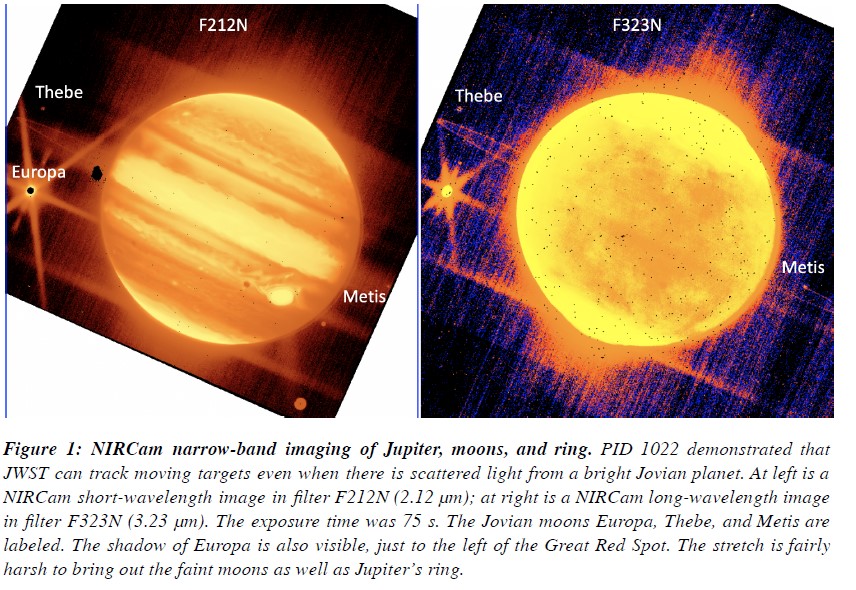
Although it’s very long (60 pages) it’s well worth reading for an account of how meticulously the various calibrations etc were done. Various objects make cameo appearances, including Jupiter:

James Webb: the wrong name for a Space Telescope

Posted in History, LGBTQ+, The Universe and Stuff with tags , , , on July 13, 2022 by telescoper

Following yesterday’s excitement about the new images from the James Webb Space Telescope I thought I’d share this video documentary that explains why the choice of name for this facility is highly inappropriate and should be changed. This is a matter I’ve blogged about previously, in fact, but the video is new.

Those First Results from JWST

Posted in The Universe and Stuff with tags , , , , , on July 12, 2022 by telescoper

As promised in my post earlier today, we gathered in a small lecture theatre in Maynooth to watch the “reveal” of various new images and other data from the James Webb Space Telescope. The images are indeed wonderful and spectacular, but the video stream was excruciatingly bad to watch, with more technical glitches than I’ve had hot dinners. It was like an astronomical version of Acorn Antiques!

Anyway, you can find them all the new results together with explanations and descriptions here so Ill just put up a gallery here:

Those are the four results released today. This image was previewed last night and appeared in my post earlier today:

I couldn’t resist, however, adding this spectrum of a faint reddish galaxy in the above image:

This spectrum is taken using the NIRSpec instrument on JWST. The observed wavelength along the horizontal axis is measured in microns. If I’ve got the line identifications correct I think this galaxy is at an amazing redshift of about z=8.5. Amazing. High redshift galaxy spectra obtained are usually a lot rattier than this. I think this demonstrates that JWST is going to revolutionize the field of galaxy formation.

The First Deep Field from JWST

Posted in Astronomy Lookalikes, The Universe and Stuff with tags , , , , , on July 12, 2022 by telescoper

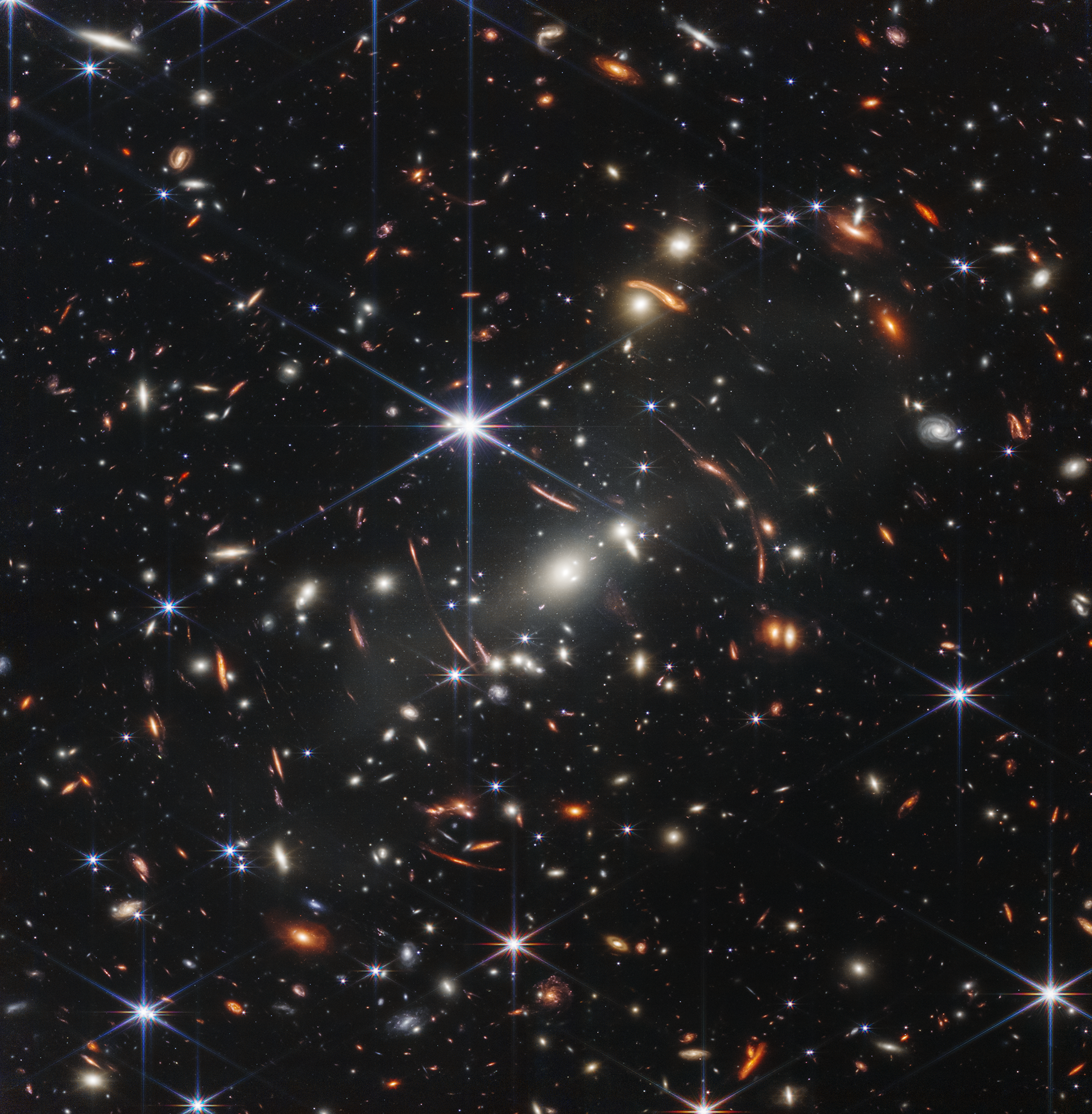
I have to say that I didn’t stay up to watch the live stream of last night’s preview of this afternoon’s release of the first images from the James Webb Space Telescope. It started very late and I got sick of listening to the dreary music on the feed so went to bed. Nevertheless here is the first picture:

Credits: NASA, ESA, CSA, and STScI

This is a deep field image taken using JWST’s NIRCAM (Near-Infrared Camera). Note that the artifacts you see around some objects are diffraction spikes which occur around bright sources; their six-fold symmetry reflects the hexagonal structure built into the JWST’s mirror assembly. Sources sufficiently bright and compact enough to cause these spikes in deep field images are foreground stars: the extended, fainter objects are all much more distant galaxies.

The description from the NASA page is:

NASA’s James Webb Space Telescope has produced the deepest and sharpest infrared image of the distant universe to date. Known as Webb’s First Deep Field, this image of galaxy cluster SMACS 0723 is overflowing with detail.

Thousands of galaxies – including the faintest objects ever observed in the infrared – have appeared in Webb’s view for the first time. This slice of the vast universe is approximately the size of a grain of sand held at arm’s length by someone on the ground.

This deep field, taken by Webb’s Near-Infrared Camera (NIRCam), is a composite made from images at different wavelengths, totaling 12.5 hours – achieving depths at infrared wavelengths beyond the Hubble Space Telescope’s deepest fields, which took weeks. 

The image shows the galaxy cluster SMACS 0723 as it appeared 4.6 billion years ago. The combined mass of this galaxy cluster acts as a gravitational lens, magnifying much more distant galaxies behind it. Webb’s NIRCam has brought those distant galaxies into sharp focus – they have tiny, faint structures that have never been seen before, including star clusters and diffuse features. Researchers will soon begin to learn more about the galaxies’ masses, ages, histories, and compositions, as Webb seeks the earliest galaxies in the universe

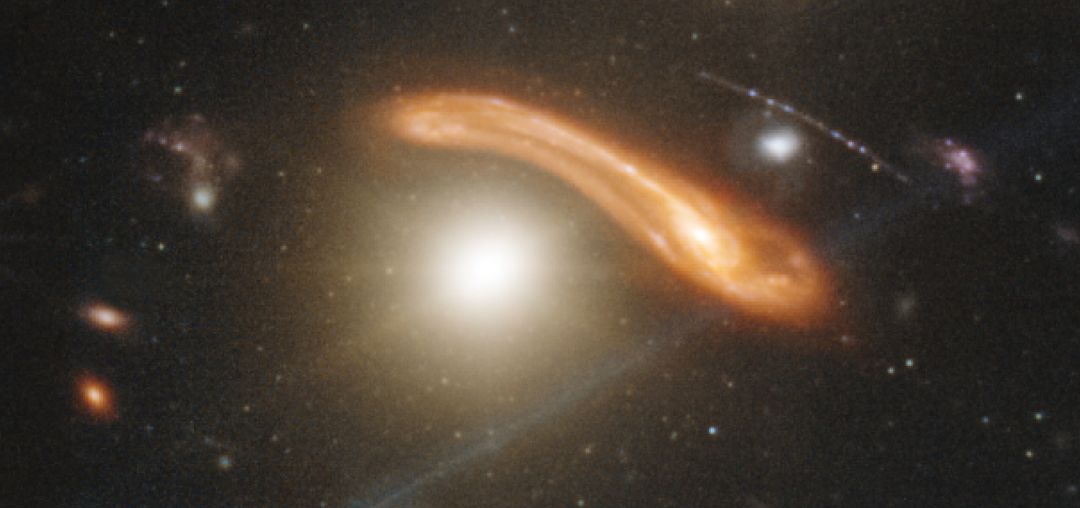
Here is a close-up of one of the distorted galaxy images and othe features produced by gravitational lensing:

We’re having a special viewing in Maynooth this afternoon of the press conference which will unveil more new images from JWST – nice telescope, shame about the name. I may add comments on here if anything particularly exciting turns up. You can watch it here:

Let’s hope this one starts on time!

The Consequences of Decoupling

Posted in Politics, The Universe and Stuff with tags , , , on July 11, 2022 by telescoper

I was struck by the similarity between the UK’s export performance post-Brexit (left) and the behaviour of radiative perturbations in the post-recombination Universe (right). It seems that, in different ways, they are both consequences of some form of decoupling