Science vs Marketing

Posted in Astrohype, Education, Science Politics, The Universe and Stuff with tags , , , on May 20, 2022 by telescoper

I saw a paper some months ago by former Sussex colleague Xavier Calmet and collaborators that attracted quite a lot of press coverage largely based on a press release from the University of Sussex that claimed:

Stephen Hawking’s famous black hole paradox solved after hair-raising discovery

(If you want to learn more about the black hole information paradox you could start here.)

The press release is pure unadulterated hype. The paper in Physical Review Letters is actually rather good in my opinion but it says next to nothing about the black hole information paradox. Unfortunately the Sussex press release was picked up by the BBC’s science editor Pallab Ghosh who turned it into a very garbled article. Unfortunately Ghosh has quite a lot of form when it comes to producing nonsensical takes on science results. See, for example, this piece claiming that recent results from the Dark Energy Survey cast doubt on Einstein’s general theory of relativity when they do nothing of the sort.

Fortunately in the case of the black hole paper David Whitehouse has done a good job at demolishing the “BBC’s black hole baloney” here so I don’t need to repeat the arguments.

What I will mention however is that there is an increasing tendency for university press offices to see themselves entirely as marketing agencies instead of informing and/or educating the public. Press releases about scientific research nowadays rarely make any attempt at accuracy – they are just designed to get the institution concerned into the headlines. In other words, research is just a marketing tool.

This isn’t the only aspect of the marketisation of universities. If an academic tries to organize a public engagement event or do some schools outreach activity, the chances are their institution will hijack it and turn it into a marketing exercise, aimed exclusively at student recruitment. Universities are increasingly unconcerned with education and research and obsessed with income.

Forget the phony controversies about woke politics and free speech manufactured by right-wing press. The real culture war in modern universities is between those who believe in the intrinsic value of higher education and those who see it simply as a means of generating profit by whatever means possible. As in any war, truth is the first casualty.

Solomon Linda’s Original Evening Birds – Mbube

Posted in Music with tags , , , , , on May 19, 2022 by telescoper

And now for something completely different…

The other evening it was warm enough for me to sit out in the garden, listening to the birdsong until it got dark. I couldn’t identify some of the sounds so when I came inside I started googling about for various combinations of “birds singing in the evening”. To cut a long story short I found this, and it’s been in my head ever since so I thought I’d share it here.

The song Mbube by South African singer and composer Solomon Linda was first performed in 1939 and was an immediate hit in his native land. Since then it has had more cover versions than I’ve had hot dinners, mostly with an English title The Lion Sleeps Tonight or Wimoweh, a not-entirely-accurate phonetic attempt to render the isiZulu phrase uyimbube (“you are a lion”) which occurs in the song. Solomon Linda sold the rights to the Gallo record company for just ten shillings in 1949 so never received significant income from the worldwide sales. The song was also used in the Disney film The Lion King without any royalties being paid, leading to a lawsuit brought by Linda’s surviving relatives (which was settled out of court).

There are two other fascinating things about this tune.

The first is that the “lion” referred to in the song is none other than the famous Zulu king Shaka Zulu (the subject of this famous poem) who acquired legendary status after his death. Rather like King Arthur, there was a folk belief that Shaka is not dead but only sleeping and one day he will return to liberate his people from their colonial oppressors.

The second is that the (mostly wordless) falsetto vocals were improvised by Solomon Linda (over wonderfully sonorous and rhythmically compelling bass riffs) but it was not until near the end (about 2:22) of this, the third, take that he was inspired to produce the melody that is now universally associated with the words “In the jungle, the mighty jungle, the lion sleeps tonight”.

Anyway, here it is.

The Researchfish Saga continues

Posted in Science Politics with tags , , , on May 19, 2022 by telescoper

You may recall that I blogged here and here about a software platform called Researchfish and the heavy-handed reaction response to criticism by the provider of this “service”, a company called Interfolio, and the Government organization UK Research and Innovation that harvests the data thereby collected. In its response to Interfolio’s apparent misuse of data and bullying of academics who dared to express negative opinions about Researchfish – which I would say, based on my own experiences (admittedly several years ago), is a very poorly designed system – UKRI made a sort of non-apology that managed to make matters worse.

A couple of days ago, in response to a Freedom of Information request, UKRI released correspondence between itself and Infosys that shows not only that UKRI knew about the bullying by Infosys but actively encouraged it. The story is covered in full by Research Professional so I shall comment on briefly here.

Here’s an example from UKRI which talks about taking “disciplinary” action against someone for criticizing Researchfish on Twitter (even though they subsequently apologized and deleted the tweet) and goes on to list their grant awards, presumably in order to facilitate sanctions against the individual:

Here’s another that claims that bullying by Researchfish “set the right tone”:

Unbelievable. I bet the redacted bits are even worse!

It’s a shocking indictment of the culture at UKRI that they are prepared to behave in such a way, conniving in threats against the community it is supposed to be supporting. Moreover, Interfolio seems to be keener to police comments about Researchfish than it is to make improvements to its service. It can’t be healthy for researchers in the UK to have their freedom of speech stifled to protect a software company’s reputation.

The brevity and informality of the emails between UKRI and Infotech suggests they have a very cosy relationship. Does anyone know anything about the tendering process by which Interfolio acquired its contract with UKRI?

A Major Merger in Irish Research

Posted in Science Politics with tags , , , , on May 18, 2022 by telescoper

Taking a short break from examination matters I just read a news item announcing a big shake-up in Irish research funding. As part of a new Research and Innovation Strategy, called Impact 2030, it seems the Irish Research Council (RC) and Science Foundation Ireland (SFI) are to merge to produce a single entity, perhaps as early as next year.

Changes are much needed, especially for science. Science in Ireland is in a dire state of under-investment, especially in basic (i.e. fundamental) research. For many years SFI has only funded applied science, though recently seems to have shifted its emphasis a little bit in its latest strategic plan. Currently Ireland spends just 1.1% of its GDP on scientific research and development and SFI’s current exclusive focus on research aligned with industry that can be exploited for short-term commercial gain) is making life very difficult for those in working in “blue skies” areas which are largely those that dras young people into science, and has consequently driven many researchers in such areas abroad, to the great detriment of Ireland’s standing in the international scientific community.

Here is an excerpt from an old post explaining what I think about the current approach:

For what it’s worth I’ll repeat my own view that “commercially useful” research should not be funded by the taxpayer through research grants. If it’s going to pay off in the short term it should be funded by private investors, venture capitalists of some sort, or perhaps through some form of National Investment Bank. When the public purse is so heavily constrained, it should only be asked to fund those things that can’t in practice be funded any other way. That means long-term, speculative, curiosity driven research.

SFI recently announced a new strategy, to cover the period up to 2025, with plans for 15% annual rises that will boost the agency’s grant spending — the greater part of the SFI budget — from €200 million in 2020 to €376 million by 2025. Much of this is focused in top-down manner on specific programmes and research centres but there is at least an acknowledgement of the need to support basic research, including an allocation of €11 million in 2021 for early career researchers. The overall aim is to increase the overall R&D spend from 1.1% of gross domestic product, well below the European average of 2.2%, to 2.5% by 2025. I hope these commitments will be carried forward into the new organization.

The Irish Research Council funds research in all areas, not exclusively applied science, so what little jam it has is spread very thinly. Applying for IRC funding is a lottery, with very few winners and the vast majority rejected without even cursory feedback.

There are two main worries about the fate of IRC in the merger merger. One is that research in arts & humanities will suffer as a result of being lumped in with science, and the other is that the culture of short-termism will be adopted so the small amount of basic research that the IRC currently funds will be sacrificed on the altar of quick commercial gain.

There is a welcome emphasis in the Impact 2030 document on early career researchers, especially at doctoral level where it is currently difficult to find funding for excellent graduate students. It has to be said though that there are problems in this area which are much wider than the shortage of appropriate schemes. The cost of living in Ireland is such that PhD stipends are inadequate to provide an adequate quality of life, especially in the Dublin area. The same goes for postdoctoral salaries which make it difficult to recruit postdocs from elsewhere in Europe.

Another crucial difficulty is the complete lack of funding for Master’s degrees, for many an essential bridge from undergraduate to research degrees. Many of our best graduates leave for European countries where a Master’s degree is free (and may even attract a stipend) and it is then difficult to entice them back.

There’s no question that the current lack of opportunity, low salaries, high living costs and the availability of far better opportunities elsewhere is leading to a net exodus of young research talent from Ireland. Whether any of this will change with Impact 2030 remains to be seen, but at least it doesn’t propose an Irish version of the dreaded Research Excellence Framework!

International Day Against Homophobia, Transphobia and Biphobia

Posted in Football, LGBTQ+ with tags , , , on May 17, 2022 by telescoper

Today is May 17th which means that it is International Day Against Homophobia Transphobia and Biphobia, This is a worldwide celebration of sexual and gender diversities and a chance to show solidarity against bigotry and intolerance.

I noticed yesterday that Jake Daniels of Blackpool (who is just 17) yesterday became the first professional footballer in the UK to come out as gay since Justin Fashanu did 32 years ago. It’s a shame that we live in a world in which such an announcement makes headlines, but we do. There are undoubtedly many gay professional footballers, but there is also a great deal of prejudice in the world of football. Jake Daniels made a very courageous decision and I congratulate him for it and wish him all the best. I hope his teammates and the fans of Blackpool give him the support he deserves.

Research Excellence in Physics

Posted in Bad Statistics, Education, Science Politics on May 16, 2022 by telescoper

For no other reason that I was a bit bored watching the FA Cup Final on Saturday I decided to construct an alternative to the Research Excellence Framework rankings for Physics produced by the Times Higher last week.

The table below shows for each Unit of Assessment (UoA):  the Times Higher rank;  the number of Full-Time Equivalent staff submitted;  the overall percentage of the submission rated  4*;  and the number of FTE’s worth of 4* stuff (final column), by which the institutions are sorted. The logic for this – insofar as there is any – is that the amount of money allocated is probably going to be more strongly weighted to 4* (though not perhaps the 100% I am effectively assuming) than the GPA used in the Times Higher.

1. University of Oxford 9= 171.3 57 97.6
2. University of Cambridge 3 148.2 64 94.8
3. Imperial College 18= 130.1 49 63.7
4. University of Edinburgh 13= 118.0 51 60.2
5. University of Manchester 2 87 66 57.4
6. University College London 24= 112.5 42 47.3
7. University of Durham 23 84.2 45 37.9
8. University of Nottingham 7 63.9 59 37.7
9. University of Warwick 20 79.2 47 37.2
10. University of Birmingham 4 55.2 66 36.4
11. University of Bristol 5 54.1 61 33.0
12. University of Glasgow 12 58.2 53 30.8
13. University of York 13= 59.9 51 30.5
14. University of Lancaster 21 56.1 46 25.8
15. University of Strathclyde 13= 46.7 52 24.3
16. Cardiff University 18= 52.2 46 24.0
17. University of Exeter 22 49.4 48 23.7
18. University of Sheffield 1 34.7 65 22.5
19. University of St Andrews 8 40.8 55 22.4
20. University of Liverpool 16 44.4 49 21.7
21. University of Leeds 9= 34 53 18.0
22. University of Sussex 26 42.7 42 17.9
23. The University of Bath 24= 38.8 42 16.3
24. Queen’s University of Belfast 31 49.7 32 15.9
25. Queen Mary University of London 28= 48 33 15.8
26, University of Southampton 27 41.7 38 15.8
27. The Open University 32= 41.8 36 15.0
28. University of Hertfordshire 38 42 32 13.4
29. Liverpool John Moores University 17 25.8 50 12.9
30. Heriot-Watt University 9= 21 55 11.6
31. King’s College London 28= 33.9 34 11.5
32. University of Portsmouth 6 19.8 58 11.5
33. University of Leicester 35= 34.3 28 9.6
34. University of Surrey 35= 30.6 31 9.5
35. Swansea University 32= 25.2 32 8.0
36. Royal Holloway and Bedford New College 35= 19.1 36 6.9
37. University of Central Lancashire 39 19.3 25 4.8
38. Loughborough University 40 19.8 22 4.4
39. University of Keele 32= 9 38 3.4
40. The University of Hull 30 11 28 3.1
41. University of Lincoln 43 15.2 16 2.4
42.The University of Kent 41 19 12 2.3
43. Aberystwyth University 44 18.2 7 1.3
44. University of the West of Scotland 42 8 11 0.9

Using this method to order institutions produces a list which clearly correlates with the Times Higher ordering – the Spearman rank correlation coefficient is + 0.75 – but there are also some big differences. For example, Oxford (=9th in the Times Higher) and Cambridge (3rd) come out 1st and 2nd with Imperial (=18th in the Times Higher) moving up to 3rd place. Edinburgh moves up from =13th to 4th. The top ranked UoA in the Times Higher table is Sheffield, which drops to 18th in this table. Portsmouth (6th in the Times Higher) drops to 32nd in this version. And so on.

Of course you shouldn’t take this seriously at all. The lesson -if there is one – is that the use of the Research Excellence Framework results to produce rankings is a bit arbitrary, to say the least…

Notes on Eurovision

Posted in Biographical, Music, Politics with tags , , , , on May 15, 2022 by telescoper

To nobody’s surprise Ukraine won last night’s Eurovision song contest after collecting a huge dollop of the televotes. After the jury votes, the United Kingdom’s entry was in the lead which surprised me because I thought it wasn’t much of a song at all. I’ve never been very good at picking the tunes that do well though. I didn’t like Ukraine’s entry – Stefania by the Kalush Orchestra – much either, but obviously there are special circumstances this year and I’m not at all sorry that they won.

In fact I thought the best song – and the best singer – by a long way was the Lithuanian entry sung by Monika Liu, who held the stage brilliantly by standing there and singing, without any fancy staging. She finished a disappointing 14th.

Monika Liu

Other entries I enjoyed were: Spain, catchy dance number with excellent choreography that finished 3rd; Moldova, an energetic performance full of humour (7th); and Norway, whose entry Give that Wolf a Banana was enjoyably deranged (10th). The less said about the other entries the better. I’m still as baffled by how Sam Ryder’s entry for the UK, Space Man, did so well in the jury votes as I am that Lithuania did so badly there, but there you go. What do I know?

I’ll state without comment that the Ukrainian jury gave a maximum douze points to the United Kingdom, but in return the UK jury gave Ukraine nil points

Anyway, three things struck me as I sipped my wine and watched the show:

  1. Ironically the Opera on the radio last night was Wagner’s Die Meistersinger von Nürnberg which is about a sixteenth century song contest that resembles the Eurovision versiononly in the length of time it goes on for. Perhaps someone should write a modern music drama called Die Meistersinger von Eurovision?
  2. I think the Research Excellence Framework would be much more fun if it were done like the Eurovision Song Contest. Each University regardless of size could be given the same distribution of scores to allocate to the others (but not itself). I can see interesting patterns emerging during that!
  3. When I was formally presented with my DPhil in the summer of 1989, the graduation ceremony took place on the same stage (at the Brighton Centre) on which Abba won the Eurovision Song Contest in 1974 with their song Waterloo.

New Publication at the Open Journal of Astrophysics

Posted in Open Access, The Universe and Stuff on May 14, 2022 by telescoper

The last couple of days have been very busy but at last I’ve got time to announce a new publication in the Open Journal of Astrophysics! This one is the 5th paper in Volume 5 (2022) and the 53rd in all. It was published on Thursday in fact but I’ve only just found time to mention it here.

The latest publication is entitled “Statistical Uncertainties of the NDW=1 QCD Axion Mass Window from Topological Defects” and is written by Sebastian Hoof & Jana Riess of the Georg-August-Universität Göttingen in Germany and David Marsh of King’s College London.

This paper is in the Cosmology and Nongalactic Astrophysics folder (cross-listed on arXiv from High-Energy Physics).

Here is a screen grab of the overlay which includes the abstract:


You can click on the image to make it larger should you wish to do so. You can find the arXiv version of the paper here.

P.S. We have quite a number of papers out there waiting for revised versions to be submitted. I get the feeling that everyone is very busy these days. Hopefully as we emerge from the pandemic things will improve.

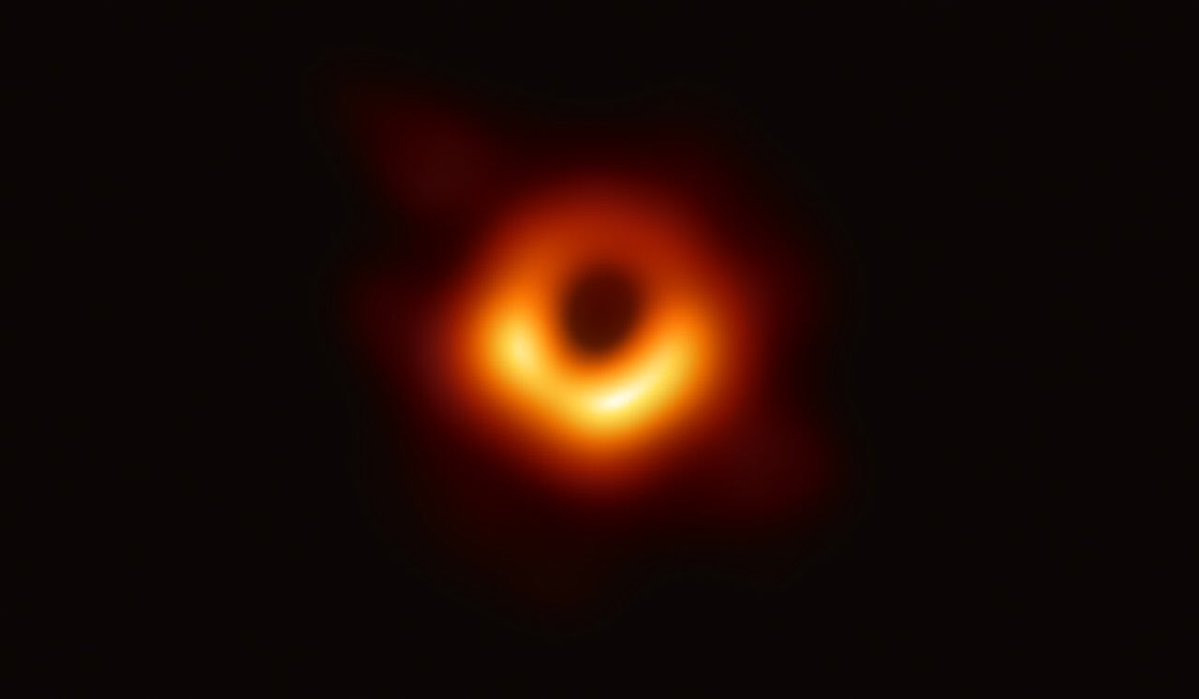
M87: Ring or Artefact?

Posted in The Universe and Stuff with tags , , on May 13, 2022 by telescoper

Following on from yesterday’s post here is an arXiv preprint that I’ve only just seen, though it was submitted on Tuesday 10th May, ahead of yesterday’s announcement about Sagittarius A*. It says inside the manuscript (though not in the arXiv entry) that it was accepted for publication in ApJ on 5th May, though it has not yet appeared there.

The abstract is:

We report our independent image reconstruction of the M 87 from the public data of the Event Horizon Telescope Collaborators (EHTC). Our result is different from the image published by the EHTC. Our analysis shows that (a) the structure at 230 GHz is consistent with those of lower frequency VLBI observations, (b) the jet structure is evident at 230 GHz extending from the core to a few mas, though the intensity rapidly decreases along the axis, and (c) the unresolved core is resolved into bright three features presumably showing an initial jet with a wide opening angle of about 70 deg. The ring-like structures of the EHTC can be created not only from the public data, but also from the simulated data of a point image. Also, the rings are very sensitive to the FOV size. The u-v coverage of EHT lack about 40 micro-asec fringe spacings. Combining with a very narrow FOV, it created the 40 micro-asec ring structure. We conclude that the absence of the jet and the presence of the ring in the EHTC result are both artifacts owing to the narrow FOV setting and the u-v data sampling bias effect of the EHT array. Because the EHTC’s simulations only take into account the reproduction of the input image models, and not those of the input noise models, their optimal parameters can enhance the effects of sampling bias and produce artifacts such as the 40 micro-asec ring structure, rather than reproducing the correct image.

I draw your attention to the sentence “The ring-like structures of the EHTC can be created not only from the public data, but also from the simulated data of a point image”. In other words the authors (Miyoshi, Kato and Makino) are saying that the ring-like structure in the now-iconic image could be an artefact of the image reconstruction process as they can apparently be produced by a point source.

From the manuscript itself:

The EHTC conducted various surveys, but their methods were not objective and biased towards their desires from the very beginning of their analysis. They also failed to perform the basic data checking that VLBI experts always do.

That’s very blunt. The plot thickens!

It’s a lengthy paper and I haven’t gone through it in detail. Comments from experts are welcome through the box below.

Our own Galactic Black Hole

Posted in The Universe and Stuff with tags , , , , on May 12, 2022 by telescoper

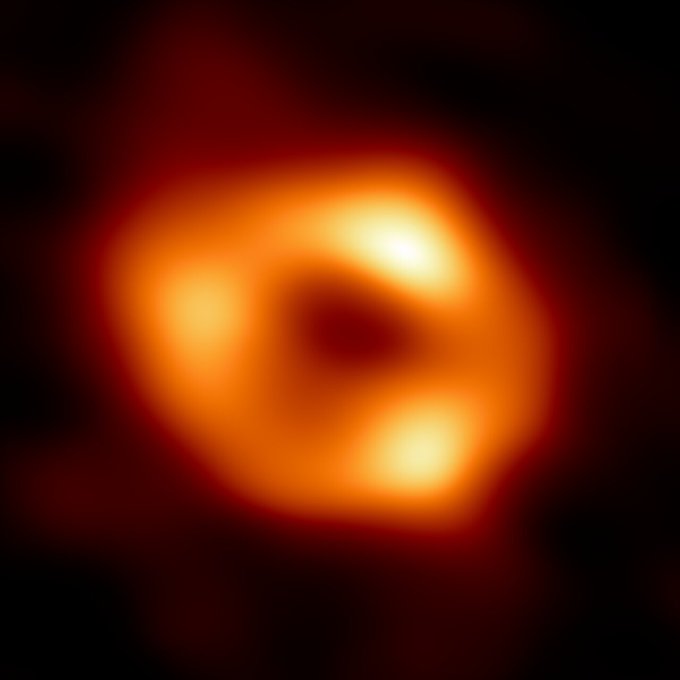
As I mentioned a while ago the Event Horizon Telescope team held a press conference this afternoon and to nobody’s surprise they used it announce an image of the (shadow of the event horizon around the) black hole at the centre of the Milky Way.

Here it is:

You can read the full press release here.

You may recall a great deal of excitement about three years ago concerning the imaging of the “shadow” of the event horizon of the black hole in the centre of the galaxy M87. The question I was asked most frequently back then is that there’s a much closer black hole in the centre of our own Galaxy, the Milky Way, so why wasn’t that imaged first?

It it true is that the black hole in the centre of M87 is ~103 times further away from us than the black hole in the centre of the Milky Way – known to its friends as Sagittarius A* or SgrA* for short – but is also ~103 times more massive, so its Schwarzschild radius is ~103 times larger. In terms of angular resolution, therefore, the observational challenge of imaging the event horizon is similar in the two cases. However, in the the case of the Milky Way’s black hole the timescales involved are much shorter than in M87 and there is a greater level of obscuration along the line of sight. That’s why it took longer to produce the image.

It’s a very difficult observation of course and I’m not sure of the significance of the “lumps” you can see, but the dark region in the centre is what the image is really about and that seems to be exactly the predicted size. The resolution is about 20 microarcseconds. Congratulations to the Event Horizon Telescope team!

If you’re interested in learning more about how this image was made I recommend this short video: