Geometric Algebra

Posted in Education, Maynooth, The Universe and Stuff with tags , , , on March 26, 2022 by telescoper

Yesterday we had a very nice pedagogical seminar in the Department of Theoretical Physics by one of our PhD students, Gert Vercleyen, who talked about something that isn’t really to do with his main research topic. A departmental seminar is a good environment for research students to gain experience giving presentations. Anyway, the abstract for this talk was:

Anyone doing a degree in physics, engineering, or mathematics will, at a very early stage, need to learn how to deal with vectors. Typically the theory of vectors comes with several products, like the dot product which is useful for determining lengths and angles, the cross product which allows one to find orthogonal vectors, and in 2D the complex product which allows one to easily describe rotations and dilations. Each of these products has its benefits and problems. The dot product is not invertible, the complex product only works in 2D, and the cross product has too many issues to put in this abstract. The goal of the talk is to present an alternative product of vectors, the geometric product, that works in any dimension, allows one to get geometric data, and can be used to apply geometric transformations. I will describe how the usual products can be obtained from the geometric product and work out various examples. 

I was familiar with the basic ideas of this approach (related to Clifford algebra) which encompasses many ideas used frequently in theoretical physics – including quaternions for example (I have to mention them as I’m in Ireland) – in a single elegant formalism. I have never actually used it for anything however. Maybe that will change, though, as many interesting ideas suggested themselves during the talk.
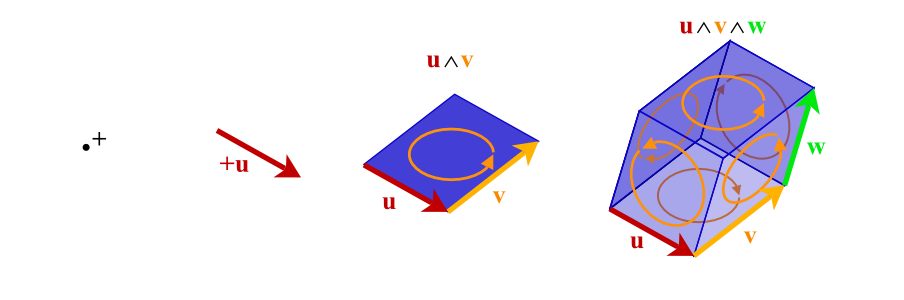
If you’d like to learn a bit more at an introductory level about Geometric Algebra you could do a lot worse than read this paper which, unbelievably, is almost 30 years old. I mentioned at the end of the talk that the first author of this paper, Steve Gull, taught the first course in Mathematics for Natural Sciences I took when I was in the first year at Cambridge way back in 1982. Although he crammed a huge amount into that course, including the “standard” way of talking about vectors, rotations thereof using matrices, and a bit of cartesian tensors, he didn’t talk about Geometric Algebra.

I do think however that there is a case for starting in Year 1 with geometric algebra instead of the way we do it nowadays, not least because as well as being an elegant formalism it lends itself very easily to computational implementation; indeed, I note that there is a Python implementation of Clifford Algebra (which I have not yet played with). Also I think it’s harder to “unlearn” traditional methods and adapt to new ones as you get older.

Physics in a diverse world…

Posted in Biographical, LGBTQ+, Maynooth with tags , , , , on March 25, 2022 by telescoper

Regular observers of the arXiv will have noticed a recent deluge avalanche of papers from the recent Snowmass Community Planning Exercise. There are many excellent reports although they came out all in a flurry which has made it difficult to keep on top of them.

An example that I missed was one that appeared in the Physics Education section of arXiv that arose from a talk by theoretical physicist Howard Georgi given at the KITP Conference: Snowmass Theory Frontier on Feb. 23, 2022. The paper, entitled Physics in a diverse world or A Spherical Cow* Model of Physics Talent, doesn’t have an abstract but is quite short and is well worth reading. You can download it here.

Here is a short extract with which I agree fully the philosophy of which I have tried very hard to follow ever since I got my first Professorship in 1998 (though not always with the cooperation of all colleagues, and sometimes, in the past, against the opposition of a few):

If your career is established and you are not making an explicit and continual effort to encourage, mentor, and support all young physicists, to create a welcoming climate in your department, and to promote the hiring of diverse faculty members, you are part of the problem.

I’m hoping next week to be able to pass on some exciting news in this regard about Maynooth University.

I wrote some of my own thoughts from the point of view of LGBT+ diversity here but much of what I said in that context is of wider relevance.

But that brings us to the question of why we should care about whether LGBT students might be deterred from becoming scientists. This is much the same issue as to why we should worry that there are so few female physics students. The obvious answer is based on notions of fairness: we should do everything we can to ensure that people have equal opportunity to advance their career in whatever direction appeals to them. But I’m painfully aware that there are some people for whom arguments based on fairness simply don’t wash. For them there’s another argument that may work better. As scientists whose goal is – or should be – the advancement of knowledge, the message is that we should strive as hard as possible to recruit the brightest and most creative brains into our subject. That means ensuring that the pool from which we recruit is as large and as diverse as possible. The best student drawn from such a pool is likely to be better than the best student from a smaller and more restricted one.

Big companies haven’t become gay-friendly employers in recent years out of a sudden urge for altruism. They’ve done it because they know that they’d otherwise be discouraging many excellent potential employees from joining them. It’s exactly the same for research

*This is an allusion to the old joke for the tendency of scientists – especially theoretical physicists – to adopt highly simplified models of complex phenomena.

Nice Tutorial Problems

Posted in Education, The Universe and Stuff with tags , , , , on March 24, 2022 by telescoper

Back to the day job, teaching Advanced Electromagnetism, I put up these two nice tutorial problems about the Lorentz transformation of Electric and Magnetic fields, as a prelude to doing the fully covariant formulation of the Maxwell equations. You might like to have a go at these exercises:

Blog Life

Posted in Biographical, Film, History with tags , , on March 23, 2022 by telescoper

It has been a very strange past few weeks on the blog with much higher levels of traffic than usual (though it is now reverting to more normal levels). Initially I assumed that this abnormal activity was generated by a certain person sniffing around old posts looking for things to complain about, but further investigation revealed that wasn’t the case at all.

In fact, a large fraction of the increase was generated by a post I wrote about a decade ago about Operation Carthage, a British air raid on March 21st 1945 aimed at destroying the Gestapo Headquarters in Copenhagen.

The reason for the sudden increase in interest in this particular post is that a new film about the tragic events of that day, The Shadow of My Eye, has been on Netflix this month and this has apparently spurred people to google the subject, some of them finding my old post as a consequence. I haven’t seen the film so won’t comment on it myself, although there are some recent comments on the old post from people about it.

Talking about comments, I should remind my readers that I do have a policy which is published on the front page of this site. The statement of this policy includes

Feel free to comment on any of the posts on this blog but comments may be moderated; anonymous comments and any considered by me to be vexatious and/or abusive and/or defamatory will not be accepted.

If people make it necessary for me to ban them from posting comments, then all their previous comments will automatically be moved offline. I don’t take this step very often, but I make no apology for doing so when a person’s behaviour justifies it.

I hope this clarifies the situation.

Blues Yesterday – Art Hodes

Posted in Jazz with tags , , on March 22, 2022 by telescoper

I’ve long been a fan of Art Hodes, a brilliant jazz and blues pianist, whose self-taught style reminds me quite a lot of Thelonious Monk, although Monk was a modernist and Hodes a traditionalist. It was only tonight however that I was reminded that he was actually born in Mykolaiv (Ukraine), in 1904, although he moved to America when he was only a few months old. He’s probably best remembered for some of the great early records of the Blue Note label, including some with Sidney Bechet, made in New York in the late 30s and early 40s, but he spent much of his later life playing and recording and living in and around Chicago. He died in 1993.

Anyway, here’s a record that wasn’t released until 1994, after his death, which is typical of his relaxed yet slightly quirky take on the blues and which I couldn’t resist sharing today because of the Ukrainian connection.

“March” by A.E. Housman

Posted in Poetry with tags , , , , on March 22, 2022 by telescoper

The Sun at noon to higher air,
Unharnessing the silver Pair
That late before his chariot swam,
Rides on the gold wool of the Ram.

So braver notes the storm-cock sings
To start the rusted wheel of things,
And brutes in field and brutes in pen
Leap that the world goes round again.

The boys are up the woods with day
To fetch the daffodils away,
And home at noonday from the hills
They bring no dearth of daffodils.

Afield for palms the girls repair,
And sure enough the palms are there,
And each will find by hedge or pond
Her waving silver-tufted wand.

In farm and field through all the shire
They eye beholds the heart’s desire;
Ah, let not only mine be vain,
For lovers should be loved again.

by Alfred Edward Housman (1859-1936)

Back from the Break

Posted in Biographical, Covid-19, Maynooth on March 21, 2022 by telescoper

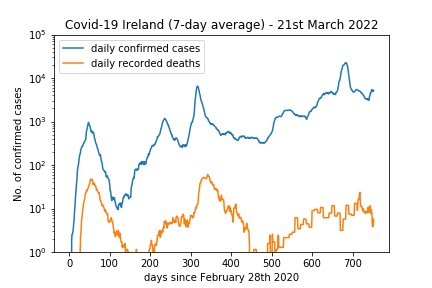
As well as returning to the Department for the first time after the Study Week break, I’ve also had the chance to update my Covid-19 data page with five days’ worth of numbers after the Bank Holiday and Weekend hiatus. A total of 63,954 positive tests (either antigen or PCR) were reported today.

The latest 7-day rolling average is around 5200 new PCR-confirmed cases per day, but that number is a considerable underestimate because much less PCR testing is being done compared with earlier in the pandemic. Over 10,000 positive antigen tests were logged today (21st March) but not included in the figure below:

The surge expected after the St Patrick’s Day festivities won’t have registered in this plot yet either. Anecdotal evidence is that lots of undergraduate students have been absent from lectures and tutorials on the first day back from the break citing Covid-19 as the reason, and some tutors are also off sick. My first lecture and first laboratory session aren’t until tomorrow though.

As of this morning, 1308 people are in hospital in Ireland with Covid-19, over double the number at the start of the month. Fortunately the number in ICU and the number of deaths remain reasonably low.

It seems there is no intention at Government level to reintroduce public health restrictions so we have to continue teaching as if nothing is wrong. The fact of the matter remains, however, that the much-vaunted “return to campus” hasn’t really been achieved this Semester, with many students staying away from classes either through choice or necessity.

As Head of a small Department that is already short-staffed I am worried about what I’m supposed to do if we suffer absences among those who are teaching. We’ve got six weeks until the end of the Semester. I just hope we get through it without a crisis caused by the high case numbers.

The Vernal Equinox 2022

Posted in Maynooth with tags , , , on March 20, 2022 by telescoper

Just a quick note to say that the Vernal Equinox, or Spring Equinox, (in the Northern hemisphere) takes place this afternoon at 15.33 UTC (which is 3.33 pm local Irish Time). Many people regard this as the first day of spring. The weather in Maynooth is certainly spring-like. Of course in the Southern hemisphere this is the Autumnal Equinox.

The date of the Vernal Equinox is usually given as 21st March, but in fact it has only been on 21st March twice this century so far (2003 and 2007); it was on 20th March in 2008, has been on 20th March every spring from then until now, and will be until 2044 (when it will be on March 19th).

People sometimes ask me how one can define the `equinox’ so precisely when surely it just refers to a day on which day and night are of equal length, implying that it’s a day not a specific time?

The answer is that the equinox is defined by a specific event, the event in question being when the plane defined by Earth’s equator passes through the centre of the Sun’s disk (or, if you prefer, when the centre of the Sun passes through the plane defined by Earth’s equator). Day and night are not necessarily exactly equal on the equinox, but they’re the closest they get. From now until the Autumnal Equinox days in the Northern hemisphere will be longer than nights, and they’ll get longer until the Summer Solstice before beginning to shorten again.

Loughcrew (County Meath), near Newgrange, an ancient burial site and a traditional place to observe the sunrise at the Equinox

Here in Ireland we celebrated Saint Patrick’s day on March 17th, the reputed date of his death in 461 AD. Although he may have been born in Wales, nobody really knows for sure precisely where St Patrick was born, though, so it would be surprising if the when were any better known.

In any case, it wasn’t until the 17th Century that Saint Patrick’s feast day was placed on the universal liturgical calendar in the Catholic Church. In the thousand years that passed any memory of the actual date was probably lost, so the Equinox was perhaps rebranded for the purpose.

The early Christian church in Ireland incorporated many pre-Christian traditions that survived until roughly the 12th century, including the ancient festival of Ēostre (or Ostara), the goddess of spring associated with the spring equinox after whom Easter is named. During this festival, eggs were used a symbol of rebirth and the beginning of new life and a hare or rabbit was the symbol of the goddess and fertility. In turn the Celtic people of Ireland probably adapted their own beliefs to absorb much older influences dating back to the stone age. St Patrick’s Day and Easter therefore probably both have their roots in prehistoric traditions around the Spring Equinox, although the direct connection has long been lost.

On Researchfish

Posted in Biographical, Cardiff, Maynooth, Science Politics with tags , on March 18, 2022 by telescoper

One of the things I definitely don’t miss about working in the UK university system is the dreaded Researchfish. If you’ve never heard of this bit of software, it’s intended to collect data relating to the outputs of research grants funded by the various Research Councils. That’s not an unreasonable thing to want to do, of course, but the interface is – or at least was when I last used it several years ago – extremely clunky and user-unfriendly. That meant that once a year along with other academics with research grants (in my case STFC) I had to waste hours uploading bibliometric and other data by hand. A sensible system would have harvested this automatically as it is mostly available online at various locations or allowed users simply to upload their own publication list as a file; most of us keep an up-to-date list of publications for various reasons (including vanity!) anyway. Institutions also keep track of all this stuff independently. All this duplication seems utterly pointless.

I always wondered what happened to the information I uploaded every year, which seemed to disappear without trace into the bowels of RCUK. I assume it was used for something, but mere researchers were never told to what purpose.

When I left the UK in 2018 to work full-time in Ireland, I took great pleasure in ignoring the multiple emails demanding that I do yet another Researchfish upload. The automated reminders turned into individual emails threatening that I would never again be eligible for funding if I didn’t do it, to which I eventually replied that I wouldn’t be applying for UK research grants anymore anyway so there. Eventually the emails stopped.

Now, four years later, it seems the software is no better. That’s not surprising as since everyone has to use it on threat of excommunication there is no incentive to improve it.

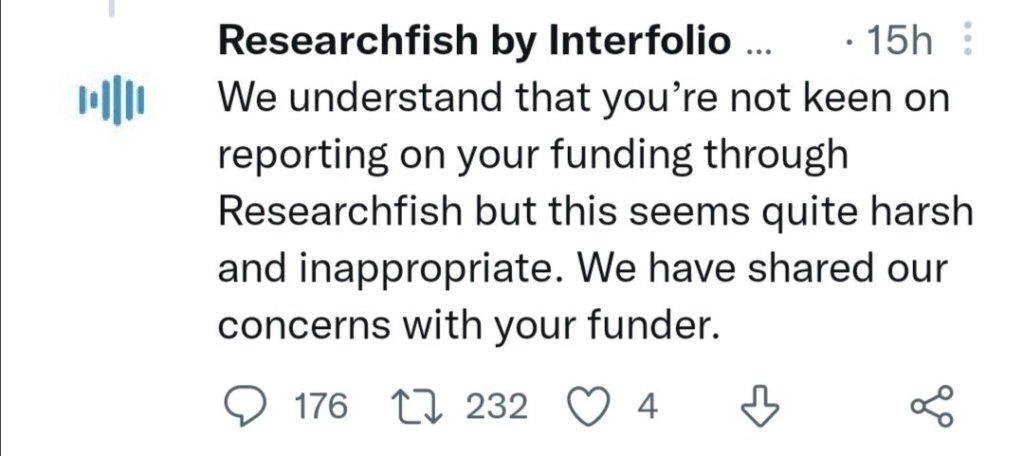
Yesterday I noticed on Twitter – not for the first time – an academic complaining about Researchfish. It was however the first time I saw this sinister reply from the company that runs the system:

I’m out of the UK system for good, so I can say what I think. To put it mildly I don’t think this response is at all appropriate. Researchfish would be better off trying to engage with the research community to improve its system, especially the awful user interface, than threatening the people who criticize it.

(And there are other software providers, you know…)

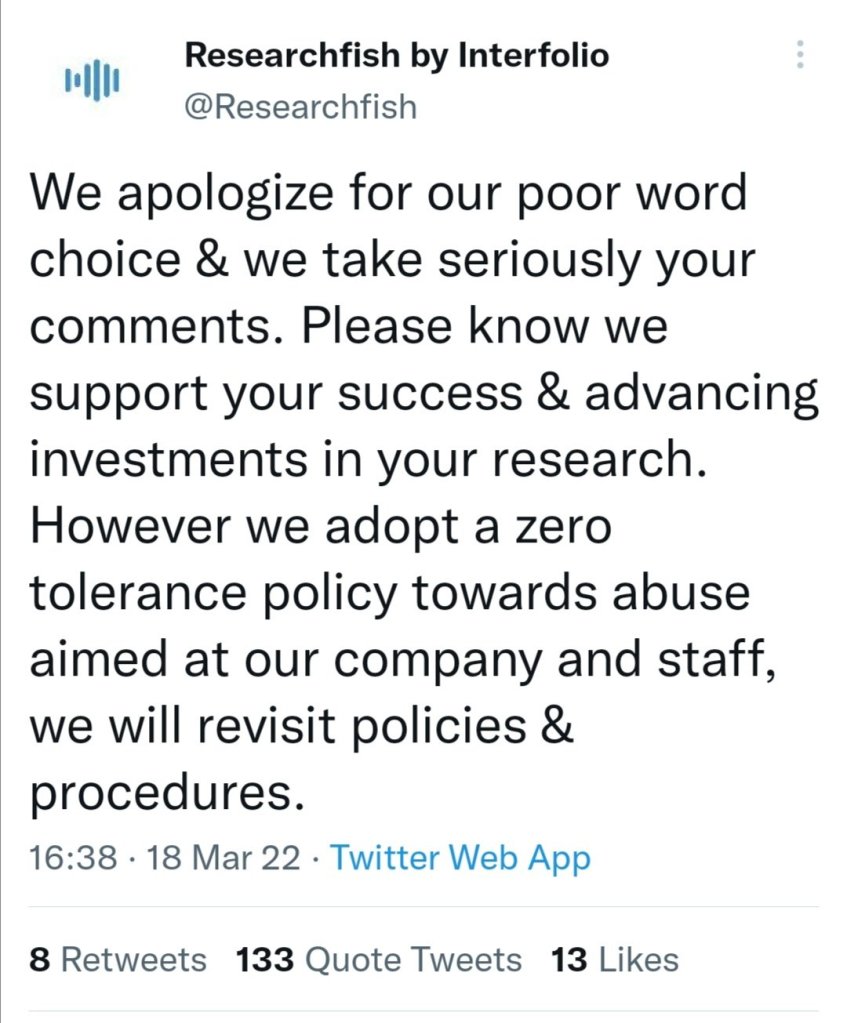
Update; unbelievably, with this crass “apology” they’ve made matters even worse!

Update: “ResearchfishGate” has now been covered by Research Professional and the Times Higher.

And now here’s their second attempt at an apology:

Apart from the very weird prose style, I’ve yet to see much evidence for what is claimed in the second paragraph…

Paráid Lá Fhéile Pádraig i Maigh Nuad

Posted in Biographical, Maynooth with tags , , on March 17, 2022 by telescoper

Lá Fhéile Pádraig sona daoibh go léir!

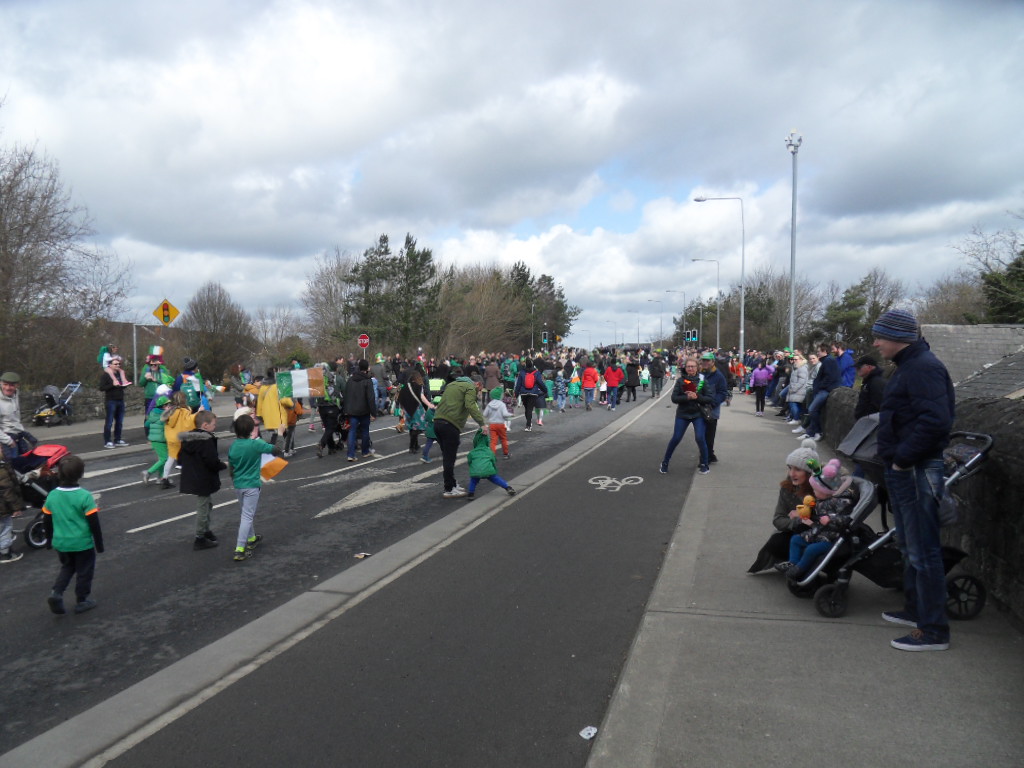
Today being 17th March it is St Patrick’s Day, and there not having been a St Patrick’s Day Parade for the last two years in Maynooth, I decided to make the most of my morning off and go watch the festivities. Here are some snaps I took on Straffan Road as the Parade made its way into town. As you can see it was a bit overcast, and it was also a bit breezy, but it wasn’t cold and everyone seemed to be enjoying themselves!