Professor Gene Parker, May 18, 2017. (Photo by Jean Lachat)
I was very sad to hear via the NASA website of the death, yesterday at the age of 94, of Professor Eugene N. Parker (known to all as “Gene”). He was best known for his work on solar magnetism and the solar wind, but he made important contributions across a wide range of astrophysics; he wrote an excellent book entitledCosmical Magnetic Fields: Their Origin and Activity which I bought many years ago. Most recently NASA’s Parker Solar Probe was named in his honour.
I only met Gene Parker once, many years ago, and was a bit in awe of him because of his intellectual reputation but he came across as a very likeable and friendly man.
We have lost a giant in the field of astrophysics who leaves a huge legacy and will be greatly missed. I send my condolences to his family, friends and colleagues at the University of Chicago where he worked since 1955.
Yesterday afternoon it was my turn to present a paper at our bi-weekly cosmology journal club. Because this is Study Week – that’s my excuse anyway – I forgot about it until I was reminded in late morning. I decided on a paper to present but it was only when I started that I was reminded that I had done that paper before, last year.
I had no recollection at all of having done that paper before. I didn’t have time to do another one, so I went through the paper again. Perhaps I’ll end up doing that paper once a year, like Groundhog Day! The last two years of pandemic have played havoc with my memory, so ‘ll put this lapse down to that. I’ve had to do so many things that maybe my old brain can’t cope with it all.
Maybe I’m just getting too old. I’ll be 60 next summer.
On the other hand, this morning I was chatting some colleagues before forming the academic procession for a conferring ceremony. One of the people there was Italian and he complained that the robe hire company couldn’t find appropriate academic dress for the University of Padova, where he graduated, so he had just been given a random set of robes. I visited Padova many times in the past, until my colleague and co-author Francesco Lucchin passed away about 20 years ago.
While we waited for the procession to start we chatted about places in the City. Amazingly I could remember the names and addresses of various restaurants and other establishments, the precise location of the Physics Department Galileo Galilei, and all kinds of other details about the place that are still intact in my head.
Moreover, when we were inside the Aula Maxima and the conferring ceremony began (parts of which are in Latin) I found myself sitting there recalling the first lines of Book II of Virgil’s Aeneid, which I did for O-level many moons ago:
Conticuere omnes intentique ora tenebant inde toro pater Aeneas sic orsus ab alto: Infandum, regina, iubes renovare dolorem, Troianas ut opes et lamentabile regnum eruerint Danai, quaeque ipse miserrima vidi et quorum pars magna fui.
I wish we could have better control over what we remember and what we forget. If the problem is that there’s a finite amount of space in one’s head, it would be nice to have a spring clean every now and again to create a bit more room, jettisoning some old junk to let new things in. Unfortunately I don’t think it works like that.
Anyway, I almost forgot until all this Latin reminded me that today is the Idus Martiae (“the Ides of March”) so here is the traditional extract from the First Folio Edition of Carry On Cleo, starring the sublime Kenneth Williams as Julius Caesar delivering one of the funniest lines in the whole Carry On series. The joke may be nearly as old as me, but it’s still a cracker…
Posted in Uncategorized on March 14, 2022 by telescoper
Against my expectations I’ve made it into the final round of voting for Beard of Ireland 2022! The competition is stiff and I’m currently in fourth place (out of four). Please consider giving me a vote! You can do so via the post below!
BEARD OF IRELAND 2022 POLL FINAL ‘BEARD OFF’ ROUND OPEN
The Beard Liberation Front, the informal network of beard wearers, has said that competition for the final of the Irish Beard of the Year 2022 is officially open
Academic Peter Coles and rugby player Jamison Gibson-Park won the first Trim Off round with Businessman Adohan Connolly and Northern Ireland Health Minister Robin Swann winning the second and completing the line-up for the Beard Off final
The 2017 winner was politician Colum Eastwood who bearded broadcaster William Crawley for the annual Award.
In 2018 the DUP’s Lee Reynolds shaved writer Dominic O’Reilly for the honour with Colum Eastwood in a steady third place.
In 2019 Lee Reynolds retained the title
The 2020 winner was Maynooth academic Peter Coles
In 2021 Aodhan Connolly shaved opponents to win the coveted title
So we arrive at the start of the mid-Semester study break at Maynooth University. There are no lectures next week, and there are two bank holidays (17th March, St Patrick’s Day, and 18th March, the new holiday announced earlier this year).
I was talking to some students on Thursday and I think they’re all as tired as the staff are. Many have long commutes to and from college because they weren’t able to find local accommodation, some have to work to provide income, and some have been ill with Covid-19 and are still recovering. Some staff are also having to work from home being close contacts of people with Covid-19.
Although the Minister responsible for Higher Education declared that students would return to campus, the reality is not really like that. For the above reasons (and, no doubt, others), attendance at in-person lectures has fallen to very low levels, and from what I’ve heard this is not only in the Department of Theoretical Physics. I don’t know whether it is the case at other universities in Ireland. At least I’m recording my lectures – except when there’s a power cut! – so students who can’t come in can have something to study from.
Ironically, the one module I am teaching that is quite easy to deliver online – Computational Physics – still has good attendance for the laboratory sessions, with only one or two students tuning in remotely.
At the end of this Semester, in May 2022, we have examinations on campus for the first time in two years. For students in the first and second year these will be the first university examinations they have ever taken. I for one am a bit nervous about how things will go given the difficulties facing students up to this point.
But that’s for later. For now we have a break from teaching. I have an assignment ready for my Advanced Electromagnetism students but I decided not to put it up until after Study Week as I think it’s better for them to take a bit of a break before the final six weeks of the Semester. For many in my class this will be the final six weeks of their course so it’s important to approach this period with as much energy as possible.
For myself although I have no teaching next week there are a number of things going on between Monday and Wednesday – including some conferring ceremonies – and I’m behind with quite a lot of things, so I’ll be in the office more-or-less as usual. I’ll be looking forward to a glass of wine or several on Wednesday evening though, ahead of Thursday morning’s St Patrick’s Day parade in Maynooth (weather permitting).
Posted in Open Access on March 11, 2022 by telescoper
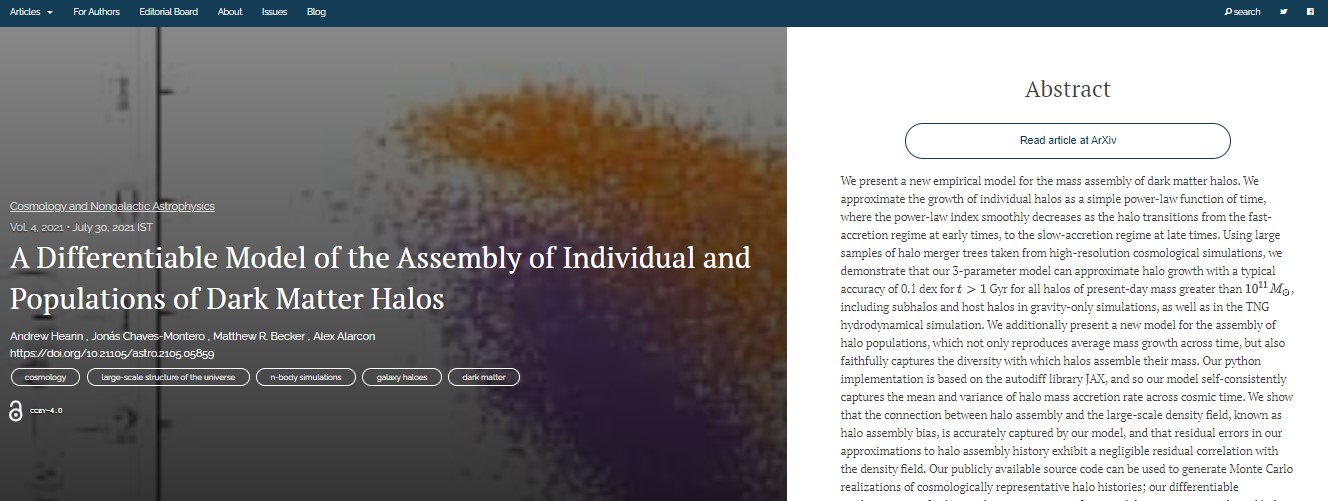
In the summer of 2021 we published a paper in the Open Journal of Astrophysics entitled A Differentiable Model of the Assembly of Individual and Populations of Dark Matter Halos. The authors are Andrew P. Hearin, Jonás Chaves-Montero, Matthew R. Becker and Alex Alarcon, all of the Argonne National Laboratory.
Here is a screen grab of the overlay which includes the abstract:
One of the authors contacted me recently to ask if it would be possible to make some minor textual modifications to the version we already published. After discussing this with the Editorial Board we agreed on the following steps:
The author sent us a new version containing the proposed revisions;
The Editor checked that they were reasonable (i.e. minor and without any significant changes to the scientific content);
After getting the green light the author placed a revised version on arXiv with a comment explanation the revisions (in this case v3);
We changed our overlay to point at the new version.
The way we are set up no further action was necessary. I think this is a nice demonstration of the flexibility of an overlay journal!
We’ve had several power cuts on Maynooth University campus today.
I had a lecture during one of them. The lecture went ahead with the usual chalk-and-talk, although the room was a bit on the dark side without any electric lights. More seriously I could neither record nor webcast the lecture because there was no internet so I couldn’t connect to Panopto. Ironically, the topic of the lecture was electromagnetism.
After a couple of false starts we finally got power back this afternoon, but the power failure seems to have had a number of fairly drastic consequences. Our office machines which are currently unable to access the internet. Also the data projector in our computer lab seems to be completely bust, but that is less important than the fact that the none of lab computers is working. Fortunately we don’t have a lab session on Wednesday afternoons, but I hope we can get this fixed before tomorrow when we do have a lab session!
By the way this is what our computer lab looks like:
Fortunately, next week is study week (the week containing the St Patrick’s Day holiday) which will give us time to regroup. It can’t come soon enough!
With an energy crisis looming as a result of Russia’s invasion of Ukraine I wouldn’t bet against much worse problems with electricity supply in the near future. I’m old enough to remember the Oil Crisis of 1974, with petrol rationing, regular power cuts and the Three Day Week. I wonder if we will soon be experiencing something similar again?
Update: after yet another power cut I decided to go home earlier than usual. When I got back to my house in Maynooth at 6pm I saw no sign that the power had been off at all!
Kharkiv fell to German forces after the First Battle of Kharkiv took place in October 1941. The first attempt by the Soviets to take it back led to the Second Battle of Kharkiv, which took place in May 1942, and was a catastrophic defeat for the Red Army. Among other things this fiasco revealed Stalin to be a military leader of legendary incompetence. He had a huge numerical advantage in men, tanks, artillery and but most of his troops were poorly trained conscripts who were sent into a position from which they were easily outflanked, then encircled and finally destroyed. The losses were appalling: almost 300,000 casualties and the destruction of over a thousand tanks. This defeat left the way open for German forces to advance on Stalingrad (now Volgograd), where they were finally halted in 1943.
The Third Battle of Kharkiv of January 1943 was another German victory but resulted in a salient which was successfully attacked during the Battle of Kursk leading to a massive German defeat. Kharkiv was finally recaptured by the Soviets in August 1943 after a fourth major battle.
It seems in the Fifth Battle of Kharkiv, Putin is following Stalin’s policy of sacrificing the resource he values least – the lives of his young conscripts – but the big difference between then and now is that it is the Russian army is attacking a predominantly Russian-speaking part of Ukraine; Kharkiv is only 25km from the Russian border. If Putin’s army is prepared to behave so abominably to people he claims are his own, one can barely imagine the horrors he will inflict on the Ukrainian-speakers elsewhere in Ukraine. This isn’t just a war, it’s a genocide.
This lunchtime I attended a public vigil for Ukraine on Maynooth University campus. It was a moving experience, not least because of the presence of a Ukrainian PhD student, Oleg Chupryna, who addressed the gathering. Although he has lived in Ireland for over 20 years many members of his family are still in Ukraine. They were in Kharkiv when the invasion happened, having refused to leave because they didn’t think the Russians would actually invade, but then found themselves under relentless shelling by Russian artillery. His family managed to flee Kharkiv for the countryside a couple of days ago, but are still trapped in Ukraine, apart from one family member who has arrived safely in Dublin and who read the following poem (in Ukrainian) by Taras Shevchenko, followed by the English translation. you see below.
Shevchenko (who was a painter and illustrator as well as a poet) was born a serf, so the use of the word slavery is not metaphorical. Sales of artwork enabled him to be bought out of his serfdom in 1838, but he spent a great deal of time imprisoned by the Russian authorities. He died in St Petersburg in 1861 at the age of 47.
The poem Calamity Again was written in 1854, in the middle of the Crimean War, at which time Ukraine was part of the Russian Empire. The poem was written at Novopetrovsk Fortress, depicted in the above painting by Shevchenko himself.
Dear God, calamity again! …
It was so peaceful, so serene;
We but began to break the chains
That bind our folk in slavery …
When halt! … Again the people’s blood
Is streaming! Like rapacious dogs
About a bone, the royal thugs
Are at each other’s throat again.
Just a very quick post to mark the fact that it was on Sunday 5th March 1972 that the first Azed Crossword set by Jonathan Crowther was published in the Observer. Today’s special 50th anniversary competition puzzle “Looking Back” is No. 2595. I have been too busy recently to spend much time on competition entries – I didn’t have time to look at last month’s puzzle at all – but I did buy the Observer today because it’s a special occasion and hope to have a bash at the puzzle sometime in the week.
There’s a piece about the 50 years of Azed dated a few days ago here.
Incidentally, I noticed that the Everyman Crossword competition in the Observer is now accepting postal entries again so I may send in an entry for the first time in over two years.
Another thing I noticed is that there is a lunch to commemorate Azed’s 50th anniversary at Wolfson College, Oxford on 28th May. The timing is a bit tricky because of University examinations here in Maynooth but I’ll see if I can manage to go. The Azed 2500 lunch planned for 2020 was cancelled owing to Covid-19 restrictions, but I attended the Azed 2000 lunch in 2010 and enjoyed it enormously. On that occasion, though, I only had to travel to Oxford from Cardiff!
The views presented here are personal and not necessarily those of my employer (or anyone else for that matter).
Feel free to comment on any of the posts on this blog but comments may be moderated; anonymous comments and any considered by me to be vexatious and/or abusive and/or defamatory will not be accepted. I do not necessarily endorse, support, sanction, encourage, verify or agree with the opinions or statements of any information or other content in the comments on this site and do not in any way guarantee their accuracy or reliability.




 In the Dark