Countdown to Semester 2

Posted in Covid-19, Education, Maynooth on January 17, 2022 by telescoper

In between correcting examination scripts and preparing for another examination I’ve been putting the finishing touches to the allocation of teaching to Semester 2 which starts a fortnight today, on Monday 31st January. You might think this is a bit late to be assigning lecturers to modules and it is, but we’ve had lots of staffing difficulties this year and there’s been a lot to manage.

We haven’t yet had any official information from on high about how precisely we will proceed next Semester, but I’m assuming that it will be roughly like last Semester, i.e. with most classes in person and only the very big ones online. The one headache is our Computational Physics class which is quite large this year so we will have to take care about physical distancing requirements for the laboratory sessions. I’m actually teaching that module.
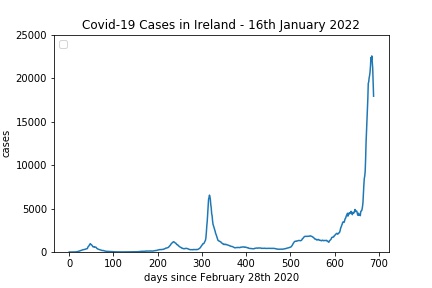
As Maynooth colleague Professor Paul Moynagh has explained, it does look like the omicron wave has peaked in Ireland though I am very confused about how much of this is down to changes in testing strategy. The figures plotted above (7-day rolling averages) only show PCR tests; there are many thousands of positive antigen tests that would previously have been referred for PCR confirmation but which are now just being reported separately outside the official figures.

Anyway, the least we can say is that things do not seem to be getting dramatically worse so there’s no real motivation for imposing fresh restrictions. All the talk is now about relaxing things, actually. The existing rules haven’t been very effective at halting the propagation of the omicron variant so there’s no very good reason for keeping them as they are. I think we just need to ensure that unlocking is not done in such a way that another surge ensues.

We first went into lockdown about halfway through Semester 2 two years ago, which led to our first set of online assessments. Two years later on we look like we might actually have a return to on-campus examinations. Perhaps the set of online exams we’re marking now will be the last? Let’s see.

Michael Collins and the Handover of Dublin Castle

Posted in Film, History with tags , , on January 16, 2022 by telescoper

Today is the centenary of the formal handing over of Dublin Castle, on 16th January 1922, by British authorities to the Provisional Irish Government formed after the ratification of the Anglo-Irish Treaty. It was a significant event, but was not what many people (including until recently myself) thought it was.

I went to the Cinema to see the Neil Jordan film Michael Collins when it came out. I enjoyed the film but only subsequently discovered how many glaring historical inaccuracies there are in it, right from the scenes at the beginning of the film, of the Easter Rising in 1916, that show Michael Collins alongside Eamonn De Valera at the surrender of the GPO. In fact the GPO was evacuated long before the surrender and De Valera was never there anyway: his battalion was in the East of the City at Boland’s Mill. I suppose the Director thought it was more dramatic the way it was depicted in the film, but I just find it irritating.

Now to the handover at Dublin Castle. This is how it is portrayed in the film, with Liam Neeson as Michael Collins:

Almost nothing in this entire scene is historically accurate. Collins arrived 90 minutes late owing to a transport strike, so the famous line about “you can have your seven minutes” is a concoction (as is the rest of the dialogue). Moreover, Collins arrived in civilian dress not in military uniform. The handover happened in a private meeting inside the buildings, not outside in a grand ceremony. There was no lowering the Union flag either.

I suppose the cinematic version is more dramatic than what happened in reality, which was much more mundane, but I think this kind of deliberate manipulation is more than a little sinister. If you want to know history then you shouldn’t try to learn it from a movie but instead do a bit of reading of properly researched literature. That’s one of the reasons why we have historians.

Congratulations to the 2022 RAS Award Winners!

Posted in The Universe and Stuff with tags , , , , , on January 15, 2022 by telescoper

Given all the doom and gloom going around I thought I’d take the opportunity to share some good news and also offer my public congratulations to the all the winners of medals and awards announced yesterday by the Royal Astronomical Society. Let me draw particular attention to the following subset, purely on the grounds that I know them and their work personally (and because they’ve all either been mentioned on this blog recently and/or been known to read it from time to time and/or have recently published in the Open Journal of Astrophysics and/or are on the Editorial Board thereof).

First, the Gold Medal goes to Professor George Efstathiou of Cambridge University a true giant of cosmology (metaphorically speaking of course – I’m actually taller than him):

I’m looking forward to George receiving his medal so he can tell us what kind of chocolate is inside.

Second, Professor Alan Heavens of South Kensington Technical College Imperial College London who gets the Eddington Medal:

I should mention that among many other things Alan has worked extensively on the application of Bayesian methods to cosmological data.

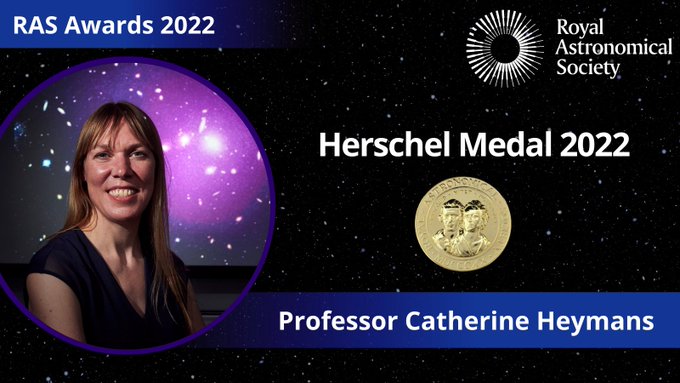
Third, Professor Catherine Heymans of Edinburgh, Astronomer Royal for Scotland, wins the Herschel medal;

Catherine was actually a PhD student supervised by Alan Heavens back in the day. I wonder if this is the first time that a PhD student/supervisor combination has won RAS medals in the same year?

Correction: I’m now told that Catherine actually did her PhD in Oxford supervised by Lance Miller so I withdraw the question.

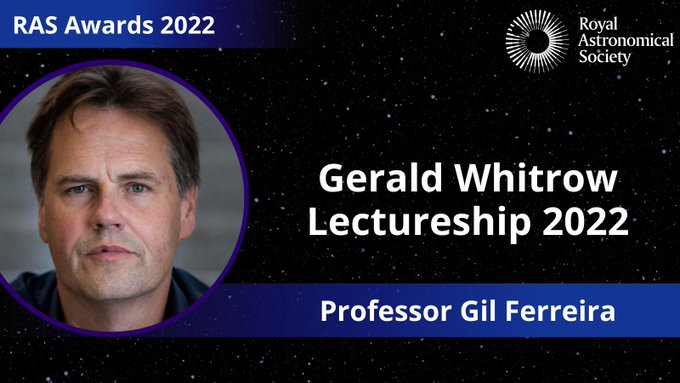
And last but by no means least we have Professor Pedro Gil Ferreira who will give this year’s Gerald Whitrow lecture:

Two interesting facts about Pedro: (i) a direct English translation of “Pedro Ferreira” would be “Peter Smith”; and (ii) he is a member of the Editorial Board of the Open Journal of Astrophysics.

Congratulations to them and indeed to all the winners of awards and medals, a complete list of whom may be found here.

P.S. It suddenly struck me when I saw the announcements yesterday evening that it’s now two years since I last attended the RAS Ordinary Meeting in person or the RAS Club Dinner. Let’s hope these can start again reasonably soon.

The Largest Map of the Universe

Posted in The Universe and Stuff with tags , , , on January 14, 2022 by telescoper

Now I’m going to have to update the bit of my popular talks (e.g this one) about `Mapping the Universe’!

After just seven months of operations of the Dark Energy Spectroscopic Instrument (DESI) we now have the largest galaxy redshift survey – and it’s only about 10% of the way through its 5-year programme. Currently mapping the positions of about 7.5 million galaxies, the map will contain over 35 million by the time the survey is complete. Even now it is larger than all previous spectroscopic galaxy redshift surveys put together. The speed of DESI is accounted for by its use of 5000 robotically-positioned fibre-optic cables that can generate spectra of thousands of galaxy from a single pointing of the 4-m telescope on which it is mounted.

You can read more about the latest results from DESI here. I’ll just whet your appetite with this groovy animated picture:

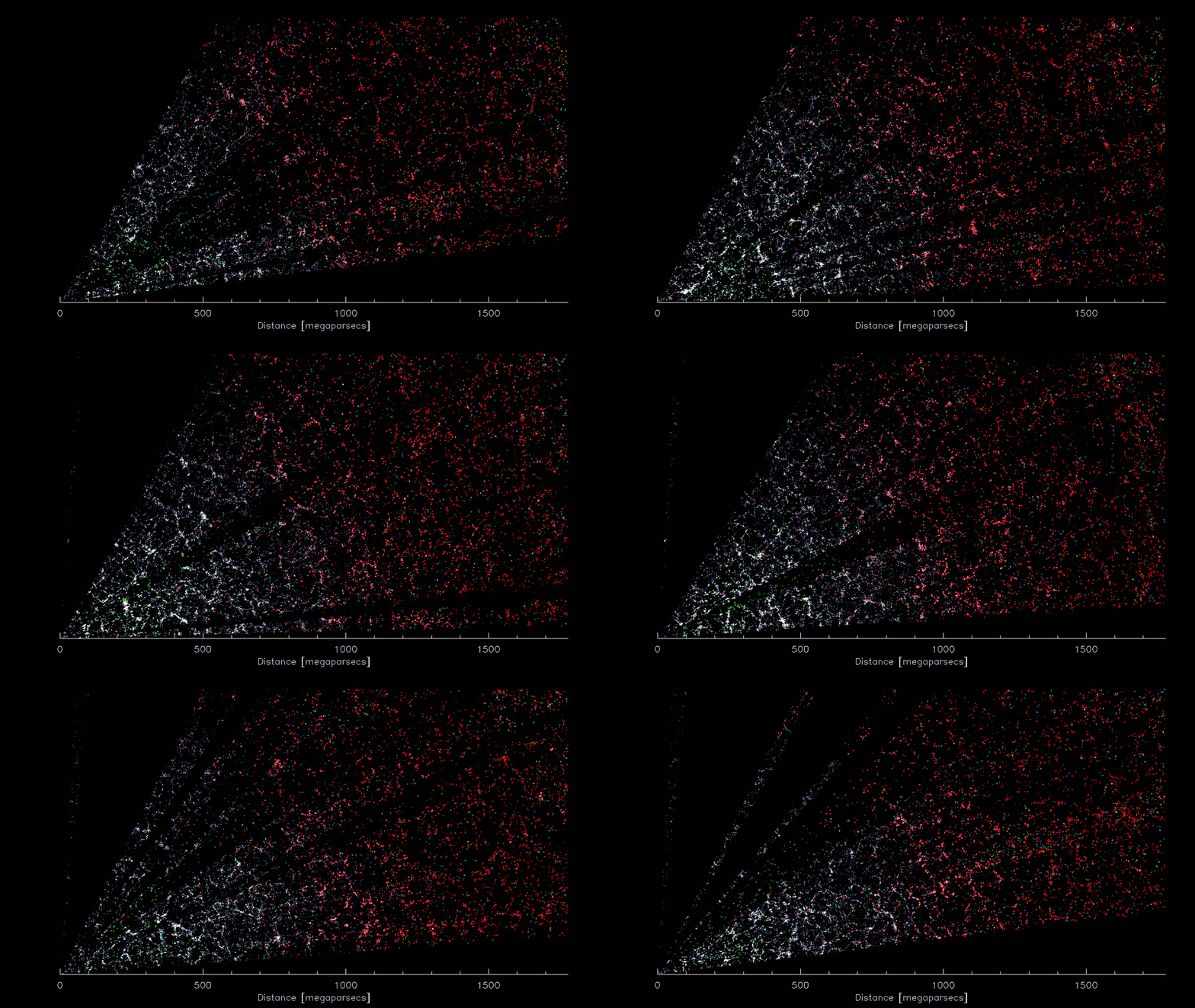
DESI’s three-dimensional “CT scan” of the Universe. We are at in the lower left, looking out over 5 billion light years in the direction of the constellation Virgo. As the video progresses, the perspective sweeps toward the constellation Bootes. Each colored point represents a galaxy; gravity has pulled the galaxies into a “cosmic web” of dense clusters, filaments and voids. (Credit: D. Schlegel/Berkeley Lab using data from DESI)

The twinkling effect arises from the fact that you are viewing different thin slices through the 3D distribution. The dark sections that appear and disappear from time to time are just bits not yet included in the survey.

For those of you not familiar with astronomical distance measurements, 1500 megaparsecs = 1.5 Gigaparsecs = 4.5 billion light years (approximately), so this map is not only mapping the spatial distribution of galaxies but also how this distribution has evolved with cosmic time over billions of years.

Teaching + Learning ≠ Lecturing

Posted in Biographical, Education, Maynooth with tags , , , , , on January 13, 2022 by telescoper
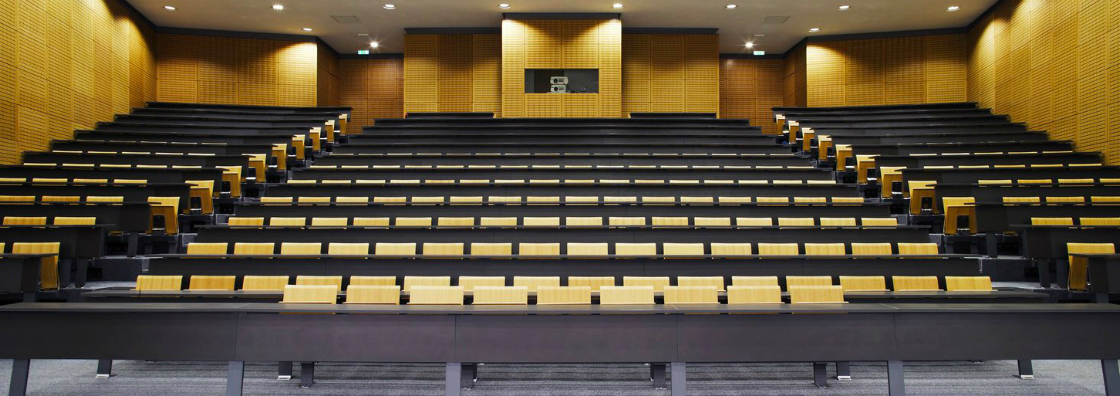
Iontas Lecture Theatre, Maynooth University

The main purpose of this post is to encourage you to read a piece written by a second-year student at the blog run by Phil Moriarty of Nottingham University entitled Death of the Lecture: Musings of a second year student as it provides at least some first-hand reflections from a current student about the difficulties being faced by a student. So, go on, or as they say round here, gwan. Read it.

I couldn’t resist making a few tangential comments of my own.

First, on my philosophy of teaching (such as it is) which is largely formed by my own experiences both as a student many years ago and as a lecturer for many years since then. When I was an undergraduate I didn’t get much out of the lectures I attended at Cambridge and my attendance dropped off a bit as my course went on (though I still attended most). This was because the majority of lectures just involved transparency after transparency being put on and taken off the overhead projector, with students frantically writing down as much as they could but with little time to think. I think that’s what people nowadays call a “traditional” lecture. I agree with Phil Moriarty that these are pedagogically useless. If there ever is a return to normality, the New Normal – to use a very hackneyed phrase – should not be based on this as the primary mode of teaching.

I think this form of non-teaching evolved because it is cost-effective, but academics have gone along with it largely because lots of them actually enjoy standing up and talking about their subject; sometimes it’s difficult to get them to stop. As a matter of fact, that applies to me too. I enjoy talking about physics and astrophysics. I like to think that I can at least communicate some enthusiasm for the subjects through lectures, but I do realize that this does not necessarily make me a very effective teacher.

But in many ways I think the “traditional lecture” described above is a straw man. Many lecturers actually use the traditional format (50 minutes with a class in a large room) to do much more than I’ve just described. When we had to switch teaching online I bought a blackboard and did my lectures from home using it. I know a lot of people found it quaint that I adopted this “traditional” approach but I think explaining mathematical concepts through examples works well via a chalkboard and by standing up I could put more energy into the session than I could if sitting at a screen.

The point is that nowadays we provide students with many more resources to back up this kind of activity – besides my sessions the students get tutorials, and besides the live sessions they get printed notes, problem sets to do on their own, various online resources and of course video recordings. Having all that allows the lecturer to free themselves from the task of delivering material and instead try to cultivate understanding. I never lecture verbatim from notes; I prefer to cover the material in a complementary fashion, expanding on the bits I think need most explanation and/or are most important.

When I was a student I found I learned best not by attending lectures but by reading textbooks and doing problems. That’s just me though. Over the years I realized that different students learn in very different ways. The most important thing for teachers to do is to provide as many ways as possible for the students to learn so they can use what works best for them. In some respects I think of higher education as being more like a smorgasbord than a set menu.

But there lies the difficulty. There is now so much extra material available that many students find it hard to know where to start, just as when you arrive at a buffet table: it might look appetizing but you might not even know what’s in many of the dishes. There needs to be some structure, especially in the early years of a degree to help students find their own way to navigate the more independent methods of study required in an undergraduate degree.

The question for me is not whether lectures have a role to play in the New Normal – I think they do – but what is the best way to incorporate them in a blend. More importantly we need to do a lot more to help students develop their study skills and structure their time so they can learn most effectively. There was no time to do this when the pandemic forced us to change and we were given few resources to assist in the task, but it’s going to be necessary in future as we move inevitably to a more flexible future. Timetabled lectures do of course provide a structure, but there’s almost certainly a better way. As one concrete proposal, I’d call for a vastly expanded induction programme for new students focussing on study skills and other aspects of learning to put in place for the benefit of future intakes.

Like most universities, Maynooth University has a “Teaching & Learning Committee”. I sometimes wonder whether there is as strong a connection between these two words as we’d like to believe. At any rate, switching teaching online does not necessarily mean that learning goes with it!

UNESCO and Open Science

Posted in Open Access, Politics with tags , , , , , on January 12, 2022 by telescoper

Time to pass on news of an interesting development from the United Nations Educational, Scientific and Cultural Organization (UNESCO) concerning Open Science. Here’s a little video to explain what it’s about:

A press release announcing the new recommendations begins thus:

The first international framework on open science was adopted by 193 countries attending UNESCO’s General Conference. By making science more transparent and more accessible, the UNESCO Recommendation on Open Science will make science more equitable and inclusive. 

Through open science, scientists and engineers use open licenses to share their publications and data, software and even hardware more widely. Open science should, thus, enhance international scientific cooperation. 

Some 70% of scientific publications are locked behind paywalls. Over the past two years, however, this proportion has dropped to about 30% for publications on COVID-19 specifically. This shows that science can be more open. 

The framework document itself is here (21 pages). It’s a very general document, the strongest aspect of which is that it takes a broad view of open science. When I’ve talked and written about open access publishing I’ve always stressed that represents only one aspect of open science: there is a need to share data and analysis software too.

You can find an upbeat commentary on the new agreement by James Wilsdon here. Here’s a snippet:

At a time when ideologies opposed to universalism, multilateralism, and collaboration are gaining ground in many parts of the world—exacerbated by greed, corruption, and exploitation of common assets and resources—the scientific system is as vulnerable as it has always been to reflecting both the best and the worst of society’s wider tendencies.

Moves towards open research have gained significant ground over the past twenty years, but this progress remains fragile, under-resourced, and at times willfully or unintentionally blind to the fresh inequalities and pressures it can create—particularly for researchers and institutions in the global south.

For me, the greatest strengths of the UNESCO statement are its breadth and holism—unlike some declarations in this field, it speaks with an authentically international chorus of voices. It reasserts the need for cultural, linguistic, and disciplinary pluralism, and reminds us that openness is ultimately a means to more fundamental ends. The recommendation returns repeatedly to the importance of infrastructures and incentives, which need to be financed, sustained, and better aligned.

I couldn’t agree more!

A Memoir of Thomas Bewick

Posted in Art, Education, History, Politics with tags , , , on January 11, 2022 by telescoper

Thomas Bewick (1753-1828) was a superb illustrator and natural historian who lived in the North East of England. He is celebrated primarily for his fine engravings and woodcuts of wild animals and birds, and humorous vignettes, some of which are quite cheeky, such as this one called “Man Pissing”…

Man Pissing (c.1797, wood engraving on laid paper, 8.9 x 12.5 cm)

You can find many other examples of his fine work here.

Bewick also held radical political views in a time of great social unrest across the continent of Europe. His views were heavily influenced by the terrible conditions of the rural poor in his native Northumberland and the corruption of the Government. In 1822 he began to write his Memoir, which is absolutely fascinating, not least because part of it is devoted to his views about the British Government and the media of the time. Two hundred years later, many of his words still ring true.

Here’s an excerpt from a section covering the period from about 1818 to 1823, a period of domestic instability in Britain that led to acts of protest and brutal suppression, including the Peterloo Massacre of 1819:

The pen of literature was prostituted to overshade the actions of good men, and to gloss-over the enormities of the base. The energies of many members of both Houses of Parliament were unavailing against this compact confederacy of undeserving placemen and pensioners, who were bound together by fellow feelings of self-interest, in which all ideas of public trust were lost in private considerations. They had sinned themselves out of all shame. This phalanx have kept their ground, and will do so till, it is to be feared, violence from an enraged people breaks them up, or, perhaps, till the growing opinions against such a crooked order of conducting the affairs of this great nation becomes quite apparent to an immense majority, whose frowns may have the power of bringing the agents of government to pause upon the brink of the precipice on which they stand, and to provide in time, by wise and honest measures, to avert the coming storm.

A Memoir of Thomas Bewick, Written by himself, CHAPTER XVII.

Plus ça change

P.S. Not far from where I grew up in Newcastle upon Tyne there is a school for children and young adults with autism called the Thomas Bewick School. His name is well known in the Newcastle area for that reason and his artistic legacy, but I’m not sure his memory is as widely celebrated as it should be. He was a fascinating character.

ERC Starting Grant Statistics

Posted in Politics, Science Politics, The Universe and Stuff with tags , , , , , on January 10, 2022 by telescoper

Today the European Research Council (ERC) announced the first round of winners of Starting Grants under the new Horizon Europe programme. The results make for interesting reading. Some 397 grants were awarded worth a total of €619 million, i.e. about €1.5 million each on average, all intended for researchers in the early stages of their careers. A complete list of award winners can be found in this PDF document. Congratulations to all of them!

Here is the breakdown by host country:

You will see that Ireland has secured 8 (half in social sciences & humanities, and half in science). That’s not bad for a small country, and is comparable with Denmark, Norway and Finland. The only two funded in Physical Sciences & Engineering in Ireland are both at the University of Limerick.

The big shock, however, is that the number of grants to be hosted in the UK is down sharply on previous Starter Grant rounds. In previous years that I can remember the UK was at the top of the awards table. Now top spot goes to Germany, with the UK in third place, only just above the Netherlands. I wonder what the reason could be for that?

You might be surprised that the UK is listed at all because it is not in the EU has not signed an association agreement with the European Union. Switzerland, also not in the EU, has been awarded 28 grants but these are not eligible for funding because negotiations on association have ended without a signature. According to the ERC website:

As a result, host institutions established in Switzerland are not eligible for funding. Exceptionally for this call, since it was already closed before the termination of the negotiations between the EU and Switzerland, the proposals submitted with Swiss host institutions and which have been selected for funding may remain eligible if their host institution is replaced with a legal entity established in an eligible country.

This looks like a cue for other institutions to start poaching! Israel and Norway are non-EU countries have agreements in place.

The situation with the UK, as far as I understand it, is that negotiations towards an association agreement are currently snarled up with issues surrounding the Northern Ireland Protocol component of the UK’s withdrawal agreement from the European Union. If an agreement is signed before contracts have to be issued (in April) then the grants to UK institutions will be funded by the EU. If not then not.

In addition, successful applicants established in a country in the process of associating to Horizon Europe will not be treated as established in an associated country if the association agreement does not apply by the time of the signature of the grant agreement. 

In this case, however, the UK Government will fund these through the UKRI budget. So they say.

On the other hand, these grants are portable and some winners may decided to change host institution to avoid any uncertainty. Cue some more poaching?

Another thing that is striking is that although 46 UK institutions are intended hosts for such funding, only 12 of the grantees have UK nationality.

It follows that many of the UK’s grantees are from elsewhere, either in the EU or outside. It is possible under this scheme for awardees to relocate to institutions in member countries from non-member countries, which accounts for the large number of “Others” in the plot.

Notice the opposite applies to Italy: there are 58 Italian grantees but only 28 grants will be hosted in Italy.

Here is the breakdown by gender:

Anyway, you can read more about the statistics in this PDF document here.

After The Treaty

Posted in Biographical, History, Television with tags , , , , , on January 9, 2022 by telescoper

On Friday I saw a bit of a programme on RTÉ One called Treaty Live which covered the events of January 7th 1922 in the form of a modern live news broadcast. It was on that date that the Dáil Éireann voted on whether to ratify the Anglo-Irish Treaty (usually called “The Treaty”) negotiated between the British Government (led by Prime Minister David Lloyd George) and representatives of the Irish Government (led by Arthur Griffith) and signed on 6th December 1921. The Treaty was intended to end the Irish War of Independence and bring about the removal of Crown forces from Ireland, but it fell short of establishing a fully independent Irish Republic, instead creating an Irish Free State with the status of a British dominion rather like New Zealand or Australia (i.e. with its own government but with the British Monarch as Head of State). It also led to the partition of Ireland with six of the nine counties in the province of Ulster remaining under British rule.

Three days of debate preceded the momentous vote in the Dáil which, incidentally, took place in a room in a building in University College Dublin that is now the National Concert Hall. Here is some footage of TDs leaving the building after the debate:

It’s strange to think of the number of times I’ve walked up those steps to attend a concert without realizing this historic event took place there.

Anyway, in the end the vote was to ratify The Treaty by 64 votes to 57. It seems popular opinion at the time was in favour of ratification, and what was surprising was not the fact that the vote was carried but that the margin was so narrow: had just four TDs voted the other way it would have failed.

Éamonn de Valera, then President of the Irish Republic, was the most prominent opponent of ratification. Michael Collins, who was a member of the delegation of plenipotentiaries who negotiated The Treaty, was prominently in favour. Many questions can be asked about the conduct of the negotiations, including why de Valera did not conduct the negotiations himself. During the negotiations Lloyd George insisted that the Irish plenipotentiaries sign the agreement on the spot otherwise there would be “war within three days”. The Irish delegation clearly assumed he wasn’t bluffing so signed it. De Valera was unhappy that they did not consult more widely (especially with him) but then if that’s what he wanted he shouldn’t have sent “plenipotentiaries” – that word means “delegates having the full power to sign agreements” – but participated directly. Valera resigned as President on 9th January 1922 and was replaced by Arthur Griffith.

The anti-Treaty side considered it to be a betrayal of the sacrifices made during the War of Independence; the pro-Treaty side thought it was a stepping-stone towards the goal of independence. As it turned out a fully-independent Irish Republic was eventually established in 1949, though the partition of Ireland is still in place.

In retrospect the narrowness of the Dáil was an indication of what was to come. In June 1922 The Irish Civil War erupted between the two factions that lasted almost a year. All wars are dreadful, but there’s something about a Civil War that is particularly dreadful: people who had fought on the same side against British rule would now fight each other.

And that brings me to the point of this rather rambling post. I moved to Ireland at the end of 2017. Like most people born and educated in England I knew very little of Irish history before coming here; topics such as the Irish Famine are simply not taught in British schools, though they certainly are in Irish schools. I missed being here through the centennial commemorations of the 1916 Easter Rising, for example, but have followed subsequent events in the “decade of centenaries” and done the best I can to read about Irish history to gain some knowledge.

What’s interesting about this is that the events of the Easter Rising and the War of Independence, although commemorated with appropriate solemnity, do form a righteous narrative relating to the heroic birth of a new nation. As we approach the centenary of the outbreak of Civil War the issues are much more complex. An Irish friend told me that when he was taught history at school, it basically stopped at the Civil War. People generally are much less willing to talk about it than the events preceding. The Civil War left deep wounds, some of which have still not healed. Perhaps the centenary will provide an opportunity to confront some of the very difficult issues arising from this period of this nation’s history.

Webb Deployment

Posted in Biographical, The Universe and Stuff with tags on January 8, 2022 by telescoper

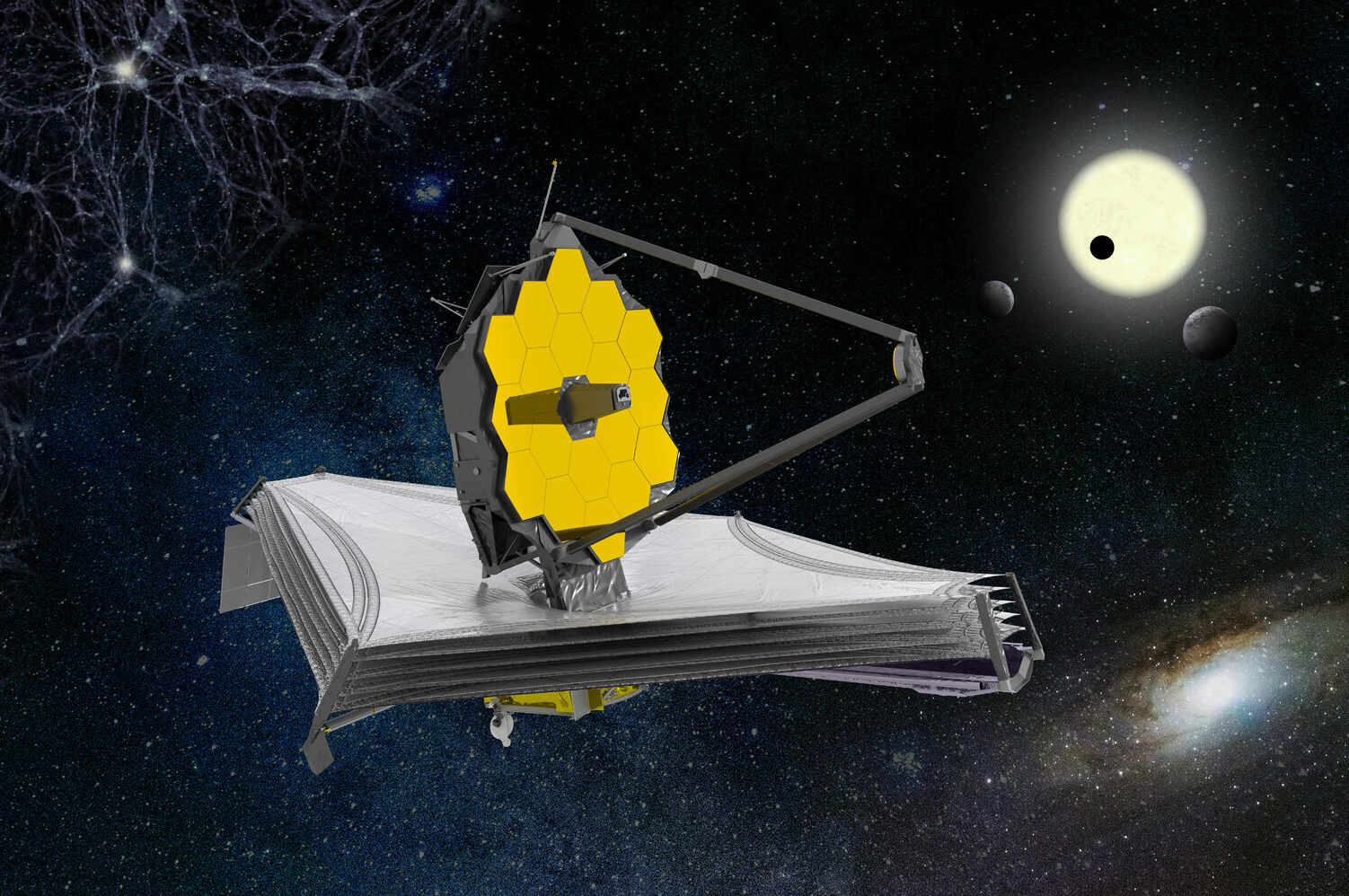
I’ve been busy all afternoon supervising an online examination and I’m now about to cook my dinner, which means I haven’t got time to post anything much but I will pass on the very welcome news that the James Webb Space Telescope has now completed the lengthy sequence of operations that were required to deploy a large sunshield, the primary and secondary mirrors and other bits and bobs needed to turn it into a proper observatory rather than just a basket of deployables. The whole thing should now look something like this:

Artists impression of Webb (with, by the look of it, a bit of the Cosmic Web)

There were over 300 potential single-point failures in this sequence so these last couple of weeks have been as stressful as the launch. Now commissioning work can begin.

This all gives me the excuse to have a celebratory drink just like I did on Christmas Day. Cheers!