A Question of Balance

Posted in Cute Problems, The Universe and Stuff with tags , , on November 3, 2021 by telescoper

Here’s an interesting physics problem for you, based on the idea that the mass of a set of bodies changes if the energy of their mutual interactions changes according to Einstein’s famous formula “E=mc2“.

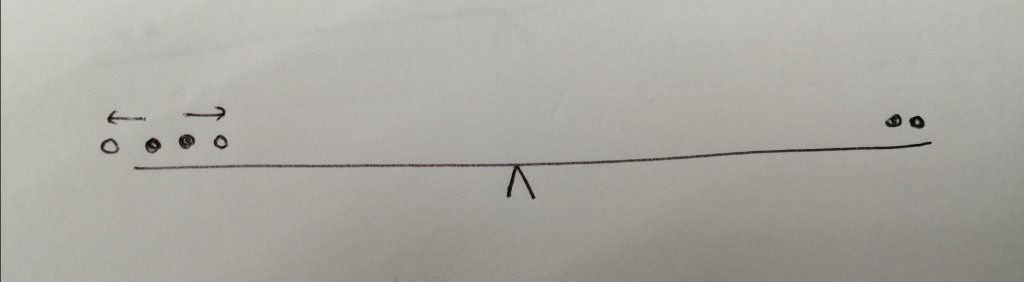
Four identical masses are placed at rest in pairs either side of an extremely sensitive balance in a symmetrical way such that the distance between the members of a pair is identical for each pair and the centre of mass of each pair is equally spaced from the fulcrum of the balance. In this configuration the system is in equilibrium and the balance is level.

As illustrated schematically in the graphic, one pair of weights is adjusted by displacing each weight slightly away from the centre of mass of the pair by an equal and opposite distance, thus keeping the position of the centre of mass of the pair constant. The other pair of weights is not adjusted.

Assuming that the balance is sufficiently sensitive to detect the slight change in mass associated with the gravitational interactions between the masses in each pair, does the balance move?

If it does move which pair moves up: the displaced pair or the undisturbed pair?

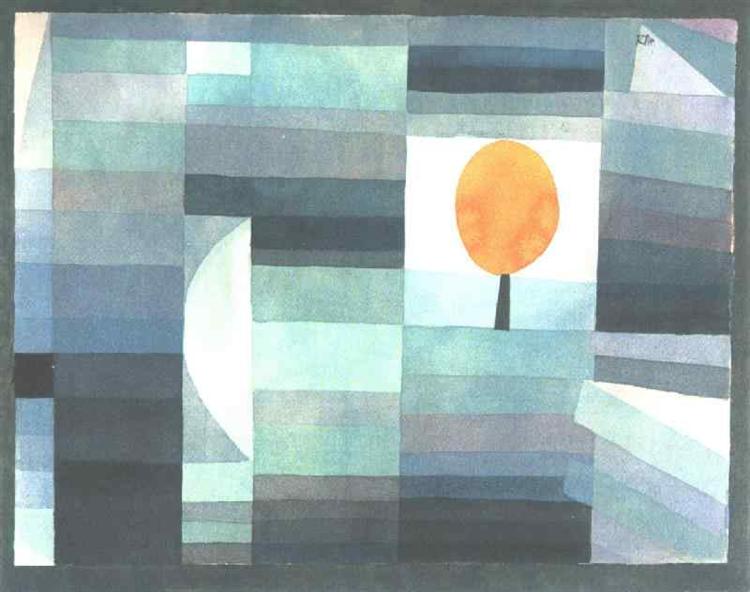
The Messenger of Autumn – Paul Klee

Posted in Art with tags , , on November 2, 2021 by telescoper

by Paul Klee (1922, 24cm x 31cm, watercolour and pencil on paper, Yale University Art Gallery).

Save Dublin’s Science Gallery!

Posted in Science Politics with tags , , on November 1, 2021 by telescoper

Last week Trinity College Dublin decided to close the Science Gallery on Pearse Street owing to losses generated during the pandemic. It would be a terrible shame to lose such an excellent venue and the range of fascinating exhibitions it has hosted. The Irish Government has apparently intervened and a reprieve may be on the way but I think it’s important to demonstrate the strength of feeling about the decision.

There is a piece on RTÉ Brainstorm about the reasons why the Science Gallery should not be closed here.

There is a petition here for you to sign should you so wish. It has so far attracted over 3000 signatures.

Hallowe’en – Charles Ives

Posted in Music with tags , , on October 31, 2021 by telescoper

I posted about this fascinating piece by Charles Ives ten years ago today, when I was still in Cardiff, but the link on that post to the actual music has died so I’m posting it again today.

If you like you can read my first ever Hallowe’en post from 2008 here.

Newton’s Fractal

Posted in mathematics with tags , , on October 30, 2021 by telescoper

Here’s another thing I bookmarked recently and then forgot about. It’s about a fractal structure that arises when using Newton’s Method (aka the Newton-Raphson Method) to find the roots of a real-valued function. I hope I remember this when I’m teaching root-finding in Computational Physics next term!

Citation Metrics and “Judging People’s Careers”

Posted in Bad Statistics, The Universe and Stuff with tags , , , , on October 29, 2021 by telescoper

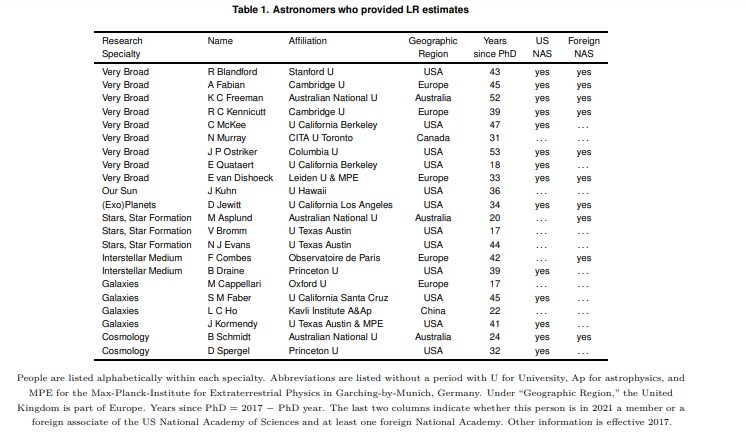
There’s a paper on the arXiv by John Kormendy entitled Metrics of research impact in astronomy: Predicting later impact from metrics measured 10-15 years after the PhD. The abstract is as follows.

This paper calibrates how metrics derivable from the SAO/NASA Astrophysics Data System can be used to estimate the future impact of astronomy research careers and thereby to inform decisions on resource allocation such as job hires and tenure decisions. Three metrics are used, citations of refereed papers, citations of all publications normalized by the numbers of co-authors, and citations of all first-author papers. Each is individually calibrated as an impact predictor in the book Kormendy (2020), “Metrics of Research Impact in Astronomy” (Publ Astron Soc Pac, San Francisco). How this is done is reviewed in the first half of this paper. Then, I show that averaging results from three metrics produces more accurate predictions. Average prediction machines are constructed for different cohorts of 1990-2007 PhDs and used to postdict 2017 impact from metrics measured 10, 12, and 15 years after the PhD. The time span over which prediction is made ranges from 0 years for 2007 PhDs to 17 years for 1990 PhDs using metrics measured 10 years after the PhD. Calibration is based on perceived 2017 impact as voted by 22 experienced astronomers for 510 faculty members at 17 highly-ranked university astronomy departments world-wide. Prediction machinery reproduces voted impact estimates with an RMS uncertainty of 1/8 of the dynamic range for people in the study sample. The aim of this work is to lend some of the rigor that is normally used in scientific research to the difficult and subjective job of judging people’s careers.

This paper has understandably generated a considerable reaction on social media especially from early career researchers dismayed at how senior astronomers apparently think they should be judged. Presumably “judging people’s careers” means deciding whether or not they should get tenure (or equivalent) although the phrase is not a pleasant one to use.

My own opinion is that while citations and other bibliometric indicators do contain some information, they are extremely difficult to apply in the modern era in which so many high-impact results are generated by large international teams. Note also the extreme selectivity of this exercise: just 22 “experienced astronomers” provide the :calibration” which is for faculty in just 17 “highly-ranked” university astronomy departments. No possibility of any bias there, obviously. Subjectivity doesn’t turn into objectivity just because you make it quantitative.

If you’re interested here are the names of the 22:

Note that the author of the paper is himself on the list. I find that deeply inappropriate.

Anyway, the overall level of statistical gibberish in this paper is such that I am amazed it has been accepted for publication, but then it is in the Proceedings of the National Academy of Sciences, a journal that has form when it comes to dodgy statistics. If I understand correctly, PNAS has a route that allows “senior” authors to publish papers without passing through peer review. That’s the only explanation I can think of for this.

As a rejoinder I’d like to mention this paper by Adler et al. from 12 years ago, which has the following abstract:

This is a report about the use and misuse of citation data in the assessment of scientific research. The idea that research assessment must be done using “simple and objective” methods is increasingly prevalent today. The “simple and objective” methods are broadly interpreted as bibliometrics, that is, citation data and the statistics derived from them. There is a belief that citation statistics are inherently more accurate because they substitute simple numbers for complex judgments, and hence overcome the possible subjectivity of peer review. But this belief is unfounded.

O brave new world that has such metrics in it.

Update: John Kormendy has now withdrawn the paper; you can see his statement here.
Hope Springs Eternal…

Posted in Finance, Politics on October 28, 2021 by telescoper

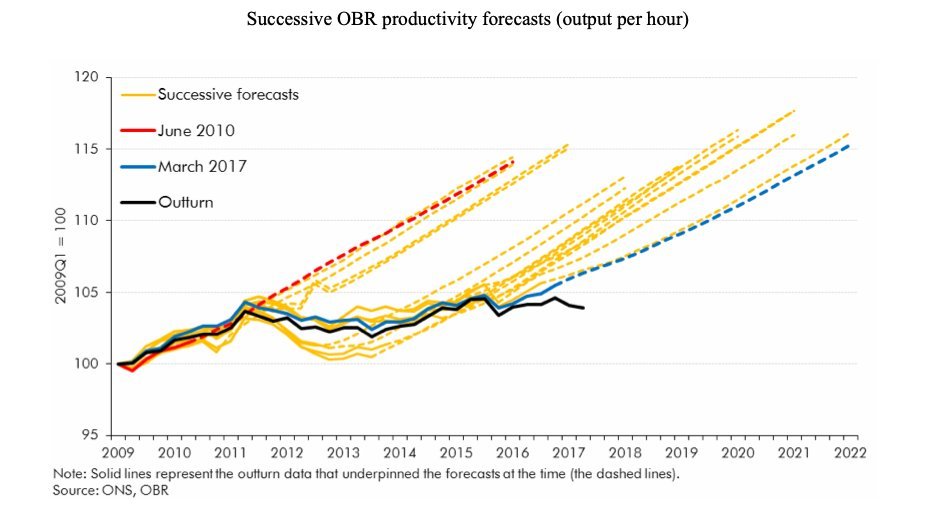
… in the “Office for Budget Responsibility

A decade of ludicrously over-optimistic forecasts.

“Man never is but always to be blest.”

Still no Primordial Gravitational Waves…

Posted in Astrohype, Bad Statistics, The Universe and Stuff with tags , , , , , , on October 27, 2021 by telescoper

During March 2014 this blog received the most traffic it has ever had (reaching almost 10,000 hits per day at one point). The reason for that was the announcement of the “discovery” of primordial gravitational waves by the BICEP2 experiment. Despite all the hype at the time I wasn’t convinced. This is what I said in an interview with Physics World:

It seems to me though that there’s a significant possibility of some of the polarization signal in E and B [modes] not being cosmological. This is a very interesting result, but I’d prefer to reserve judgement until it is confirmed by other experiments. If it is genuine, then the spectrum is a bit strange and may indicate something added to the normal inflationary recipe.

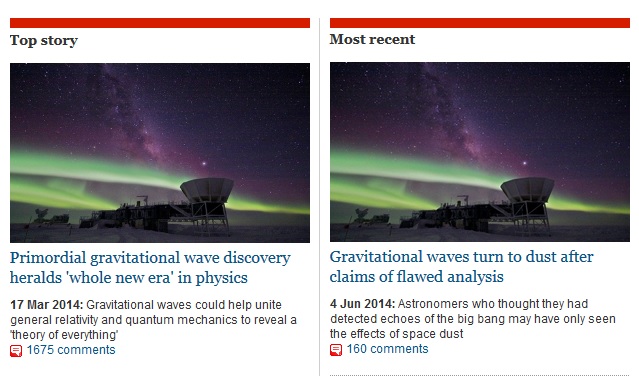
I also blogged about this several times, e.g. here. It turns out I was right to be unconvinced as the signal detected by BICEP2 was dominated by polarized foreground emission. The story is summarized by these two news stories just a few months apart:

Anyway, the search for primordial gravitational waves continues. The latest publication on this topic came out earlier this month in Physical Review Letters and you can also find it on the arXiv here. The last sentence of the abstract is:

These are the strongest constraints to date on primordial gravitational waves.

In other words, seven years on from the claimed “discovery” there is still no evidence for anything but polarized dust emission…

A Time to Confer

Posted in Biographical, Education, Maynooth on October 27, 2021 by telescoper

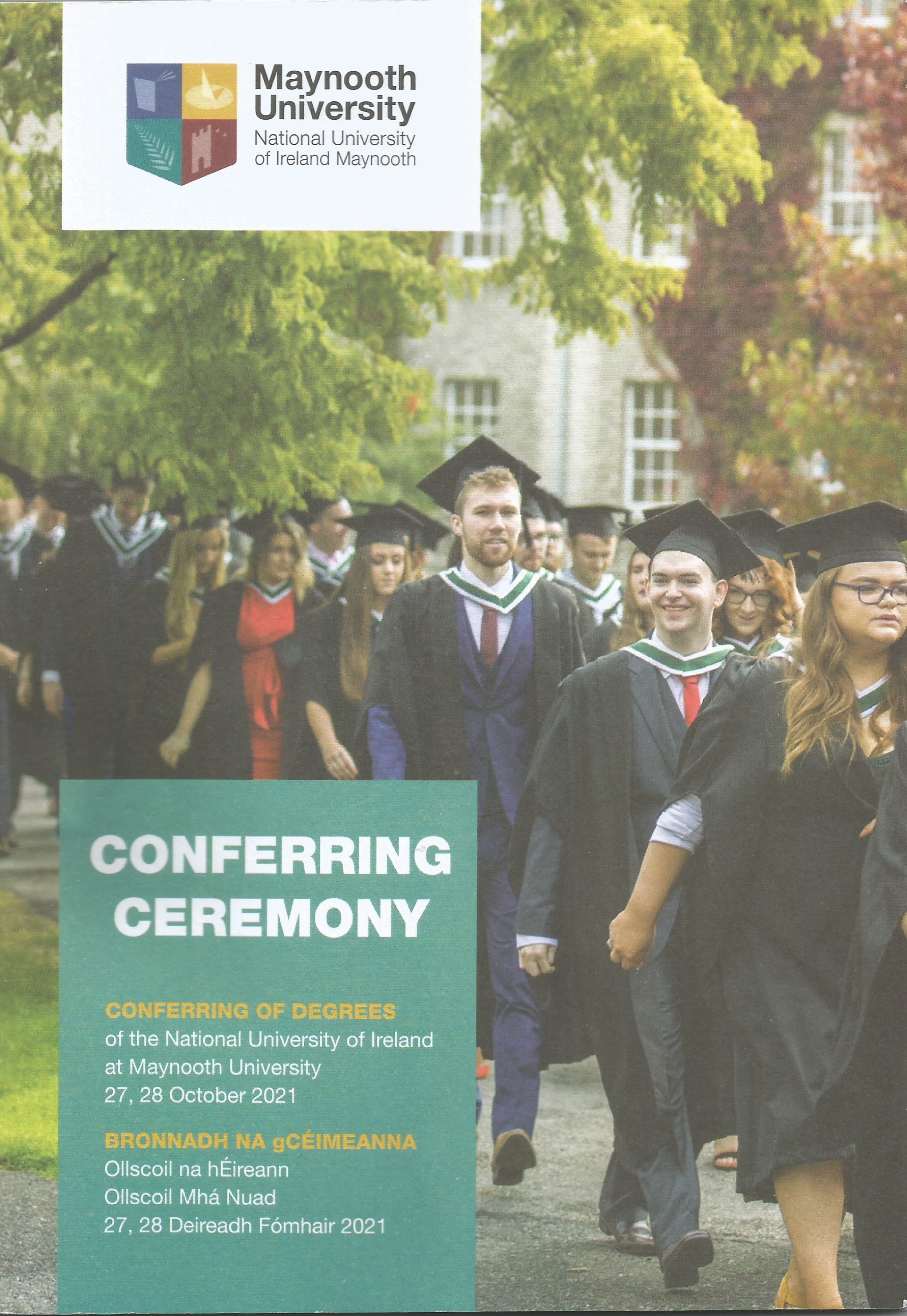
Booklet Cover

This morning I braved the inclement weather to attend a Conferring Ceremony at Maynooth University. This was the first Conferring Ceremony to be held in person since for about two years and the first ever featuring the new President of Maynooth University, Prof. Eeva Leinonen, presiding.

There were only four students from Theoretical Physics graduating this morning, and two of them graduated in absentia but I did get to see two students get their Master of Science by Research awards. If you’re interested their theses are available online here and here.

I wouldn’t say the ceremony went off without any hitches. There were quite a few late arrivals among the graduands. I think the bad weather elsewhere in Ireland caused some delays which led to some people being late for the ceremony (which was due to start at 10am, but didn’t get going until about 10.30). Then there were some last minute changes of order which led to one or two students initially getting the wrong scroll. I remember how nerve-wracking it was when that sort of reshuffling happened when I was involved in similar ceremonies at Sussex. It’s bad enough stressing over the correct pronunciation of the names! Anyway I was glad that these days all I have to do is sit there.

The last conferring ceremony I attended in person was on October 31st 2019. It was while I was en route to give a talk at DIAS that evening after the ceremony that I heard that my Mam had passed away. So much has happened between then and now that it is hard to accept that was only two years ago…

Back to Exams

Posted in Education, Maynooth on October 26, 2021 by telescoper

After a welcome break for yesterday’s traditional Hallowe’en Bank Holiday it’s time today to embark on the tradition of the Writing of the First Semester Examinations. I have to come up with four papers (two main exams for January and two repeat exams for next August) by next week, complete with solutions. I always find it very difficult writing examinations, perhaps for the same reason that I find devising clues for crosswords much harder than solving the puzzles. In this world there are setters and solvers and I definitely count myself among the latter.

Anyway, it has been decided that the exams in January will be of the traditional type, sat in person in an Examination Hall, as opposed to the online version we have been using since May 2020. I feel I should point out that was the plan this time last year too, but it didn’t work out that way in the end because of climbing Covid-19 cases. I wouldn’t rule out an abrupt volte-face this year either. The situation is not looking good at all. In fact it looks very much like last year…

I think the “open-book” style of our online examinations had much to recommend it, with an emphasis on problem solving. The one flaw is that we can’t really do anything about collusion when students are sitting remotely and can exchange messages with each other in the absence of an invigilator. I never saw any evidence of significant collusion in the exams I graded, but there’s no denying it was a possibility that we couldn’t negate.

Interestingly, the student representatives present at our Department Meeting a couple of weeks ago indicated that their discussions with other students came out heavily in favour of on-campus examinations. As a result only one of our examinations – for an advanced postgraduate module with very few students taking it – will be of the online “open-book” style. The rest, including my own, will be written and marked on paper. That’s the plan, anyway…