Del or Nabla?

Posted in Biographical, mathematics with tags , , on October 12, 2021 by telescoper

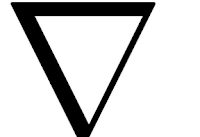
I am today preoccupied with vector calculus so, following on from yesterday’s notational rant, I am wondering about the relative frequency of usage of names for this symbol, commonly used in math to represent the gradient of a function ∇f:

To write this in Tex or Latex you use “\nabla” which is, or so I am told, so called because the symbol looks like a harp and the Greek word for the Hebrew or Egyptian form of a harp is “nabla”:

When I was being taught vector calculus many moons ago, however, the name always used was “del”. That may be a British – or even a Cambridge – thing. Here is an example of that usage a century ago.

Anyway, I am interested to know the relative frequency of the usage of “nabla” and “del” so here’s a poll.

There may be other terms, of course. Please enlighten me through the comments box if you know of any…

Writing Vectors

Posted in mathematics, The Universe and Stuff with tags , , , on October 11, 2021 by telescoper

Once again it’s time to introduce first-year Mathematical Physics students to the joy of vectors, or specifically Euclidean vectors. Some of my students have seen them before, but probably aren’t aware of how much we use them theoretical physics. Obviously we introduce the idea of a vector in the simplest way possible, as a directed line segment. It’s only later on, in the second year, that we explain how there’s much more to vectors than that and explain their relationship to matrices and tensors.

Although I enjoy teaching this subject I always have to grit my teeth when I write them in the form that seems obligatory these days.

You see, when I was a lad, I was taught to write a geometric vector in the following fashion:

\vec{r} =\left(\begin{array}{c} x \\ y \\ z \end{array} \right).

This is a simple column vector, where x,y,z are the components in a three-dimensional cartesian coordinate system. Other kinds of vector, such as those representing states in quantum mechanics, or anywhere else where linear algebra is used, can easily be represented in a similar fashion.

This notation is great because it’s very easy to calculate the scalar (dot) and vector (cross) products of two such objects by writing them in column form next to each other and performing a simple bit of manipulation. For example, the scalar product of the two vectors

\vec{u}=\left(\begin{array}{c} 1 \\ 1 \\ 1 \end{array} \right) and \vec{v}=\left(\begin{array}{c} 1 \\ 1 \\ -2 \end{array} \right)

can easily be found by multiplying the corresponding elements of each together and totting them up:

\vec{u} \cdot \vec{v} = (1 \times 1) + (1 \times 1) + (1\times -2) =0,

showing immediately that these two vectors are orthogonal. In normalised form, these two particular vectors appear in other contexts in physics, where they have a more abstract interpretation than simple geometry, such as in the representation of the gluon in particle physics.

Moreover, writing vectors like this makes it a lot easier to transform them via the action of a matrix, by multipying rows in the usual fashion, e.g.
\left(\begin{array}{ccc} \cos \theta & \sin\theta & 0 \\ -\sin\theta & \cos \theta & 0 \\ 0 & 0 & 1\end{array} \right) \left(\begin{array}{c} x \\ y \\ z \end{array} \right) = \left(\begin{array}{c} x\cos \theta + y\sin\theta \\ -x \sin \theta + y\cos \theta \\ z \end{array} \right)
which corresponds to a rotation of the vector in the x-y plane. Transposing a column vector into a row vector is easy too.

Well, that’s how I was taught to do it.

However, somebody, sometime, decided that, in Britain at least, this concise and computationally helpful notation had to be jettisoned and students instead must be forced to write a vector laboriously in terms of base vectors:

\vec{r} = x\hat{\imath} + y \hat{\jmath} + z \hat{k}

Some of you may even be used to doing it that way yourself. Why is this awful? For a start, it’s incredibly clumsy. It is less intuitive, doesn’t lend itself to easy operations on the vectors like I described above, doesn’t translate easily into the more general case of a matrix, and is generally just …well… awful. The only amusing thing about this is that you get to tell students not to put a dot on the “i” or the “j” – it always gets a laugh when you point out that these little dots are called “tittles“.

Worse still, for the purpose of teaching inexperienced students physics, it offers the possibility of horrible notational confusion. In particular, the unit vector \hat{\imath} is too easily confused with i, the square root of minus one. Introduce a plane wave with a wavevector \vec{k} and it gets even worse, especially when you want to write \exp(i\vec{k}\cdot \vec{x}), and if you want the answer to be the current density \vec{j} then you’re in big trouble!

Call me old-fashioned, but I’ll take the row and column notation any day!

(Actually it’s better still just to use the index notation, a_i which generalises easily to a_{ij} and, for that matter, a^{i}.)

Or perhaps being here in Ireland we should, in honour of Hamilton, do everything in quaternions.
Weekend Jobs

Posted in Biographical, Maynooth on October 10, 2021 by telescoper

If I ever used to feel guilty about not working at weekends I don’t anymore. I may have a big backlog of things to do but I’ve come to accept that life is too short to work every day of the week.

I’ve explained many times on this blog that we’re very short-staffed in the Department of Theoretical Physics. That is no fault of mine or any of the other staff so I’m not going to work myself into the ground. I did enough unpaid overtime during the lockdown and I’m not going to allow stress and overwork to become the new normal.

So, despite toying with the idea of finishing a paper this weekend, I settled for domestic chores. That doesn’t make for a very exciting blog post but there you are.

The main task I accomplished was to deal with the ivy that is growing in profusion on the outside of my house. It was in danger of getting into the loft space so I got my flat-bladed chisel out and went at it. It’s nearly all cleared now, but my garden waste bin is full so I’ll have to do the rest when I have space to put the bits and pieces.

It being October now I’ve also resumed food service for the birds. I put out one feeder last week and it was emptied in a matter of hours. I saw mainly blue tits attacking it. I haven’t seen any of those for a while. I forgot to buy peanuts but I’ll try to do that in the week so I can deploy the mesh feeders; the seed I’ve already put out is too fine for those.

Another exciting job I did was clean out my coffee maker. I have a nice espresso machine that requires regular de-scaling. That takes quite a while to do as one has to send a whole tank full of solution through the works, then rinse it out with water afterwards.

I also put a few pictures up, having rescued my Black-and-Decker from the shed. I still have more to do, largely because I’m very indecisive about where to put my artwork. I still have to hang my big blackboard too. I might be needing it for online lectures again. Who knows?

Other than the highlight of the weekend was Saturday night dinner, which was roast confit of duck with braised red cabbage, roast Romanesco with garlic and lemon, and new potatoes. It was delicious, especially when accompanied by a very nice Barolo. I even enjoyed shopping for some of the ingredients.

Anyway, week four begins tomorrow. That’s a third of the way into term for the returning students. I don’t think I’ve ever started counting the days to the end of term this early before.

Thomas Mann the Magician

Posted in Literature with tags , , , on October 9, 2021 by telescoper

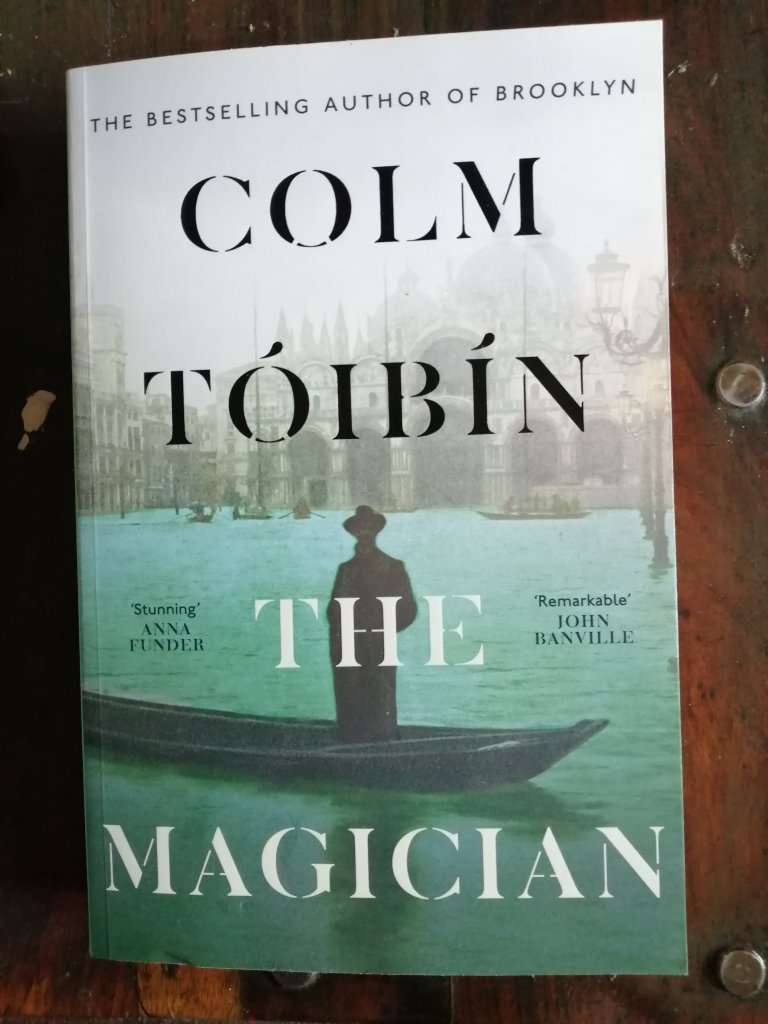
This week I had visitors from Cardiff, one of whom runs a bookshop in Penarth, as a consequence of which on Thursday evening I attended a Zoom event featuring acclaimed author Colm Tóibín whose book The Magician is on sale now. It’s a fictionalised account of the live of Thomas Mann. The event was so interesting that today I went to the local bookshop in Maynooth and bought a copy.

The life of Thomas Mann was colourful to say the least. Born in the German city of Lübeck in 1875, Mann’s father was a wealthy merchant and his mother was from Brazil. His elder brother Heinrich Mann was also a novelist essayist and playwright of considerable reputation. Despite his homosexuality, Thomas Mann married Katia Pringsheim in 1905, his wife seemingly not minding about his sexual orientation. He led a comfortable life until he began to see the signs of the coming descent of Europe into the First World War. He was awarded the Nobel Prize for Literature in 1929 and went into exile from Nazism in 1933, becoming an American citizen in 1944. He spent the last year’s of his life in Zurich, where he died in 1955.

I haven’t read The Magician yet – I’ll post a review when I have – but the event inspired me to dig out my copy of Mann’s greatest novel, The Magic Mountain. The stamp inside reveals that I bought it in 1987, while I was doing my DPhil at Sussex.

In 1912 – the year Death in Venice was published – Thomas Mann and his wife spent some time in a sanatorium where he got the idea for his greatest novel, The Magic Mountain, though it took him over a decade to finish it. It was finally published in 1924 and in my view it merits a place among the greatest works of 20th Century literature.

I had read Death in Venice before The Magic Mountain and there are definite thematic similarities, illness and death being metaphors for the state of Europe at the time. In The Magic Mountain Hans Castorp goes to a Swiss sanatorium for a three-week stay and ends up spending seven years there on a kind of spiritual journey, his isolation from the rest of the world and the ever-present shadow of death heightening his emotional awareness. When he eventually leaves for “real life” outside the dream-like sanatorium, he heads straight for the Great War with the inevitable consequence.

But trying to summarize The Magic Mountain in terms of a plot is pointless. It’s a novel of atmosphere and internal questioning. I found it hard going but immensely rewarding. I always intended to follow up with Buddenbrooks and the Confessions of Felix Krull, but for some reason I never got around to them. I suppose there’s still time, though.

Three Weeks In…

Posted in Biographical, Maynooth on October 8, 2021 by telescoper

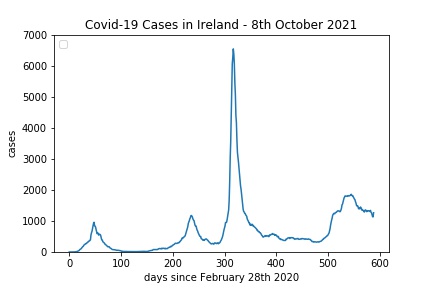
Today marks the end of the third week of the Autumn Semester in Maynooth, which is also the end of the third week of teaching for returning students and the end of the second week of teaching for new arrivals. I was talking to some friends from Cardiff yesterday and expressed relief that the daily number of new cases seemed to be falling despite the return of students to campus.

Today, however, the number of positive test results reported was 2002, which is a big increase on recent days. Last Friday’s figure was 1059 and the intervening numbers have been hovering around the 1000 mark. I was quite shocked when I saw the latest number.

The latest data for students testing positive in Maynooth are for the week ending October 3rd, during which there were only 7 cases. I’d be interested to see whether those numbers have risen significantly.

The latest increase doesn’t look much on the 7-day average, and it might just be a blip. After all, we’ve had plenty of those over the last 18 months! I was just starting to relax because of the falling curve but now I am very worried.

I have to say that the students have behaved impeccably in my classes. If there has been an increase in transmission associated with the return to campus it seems more likely to me that it is associated with social activities, or travelling on crowded public transport.

The reason I am so concerned is partly that I really don’t want to have to switch everything back online again like we did last year, but more immediately that we are so short-staffed this year that if any lecturer or tutor falls ill we have no spare effort available to provide cover. We still have one lecturer without a visa having to give lectures remotely. Our increased student numbers this year make this an especially bad time to be short of teaching staff.

Well just have to wait and see how things develop over the next few days and weeks, but I could do without this stress!

Romanesco and the Golden Spiral

Posted in mathematics, The Universe and Stuff with tags , , , on October 7, 2021 by telescoper

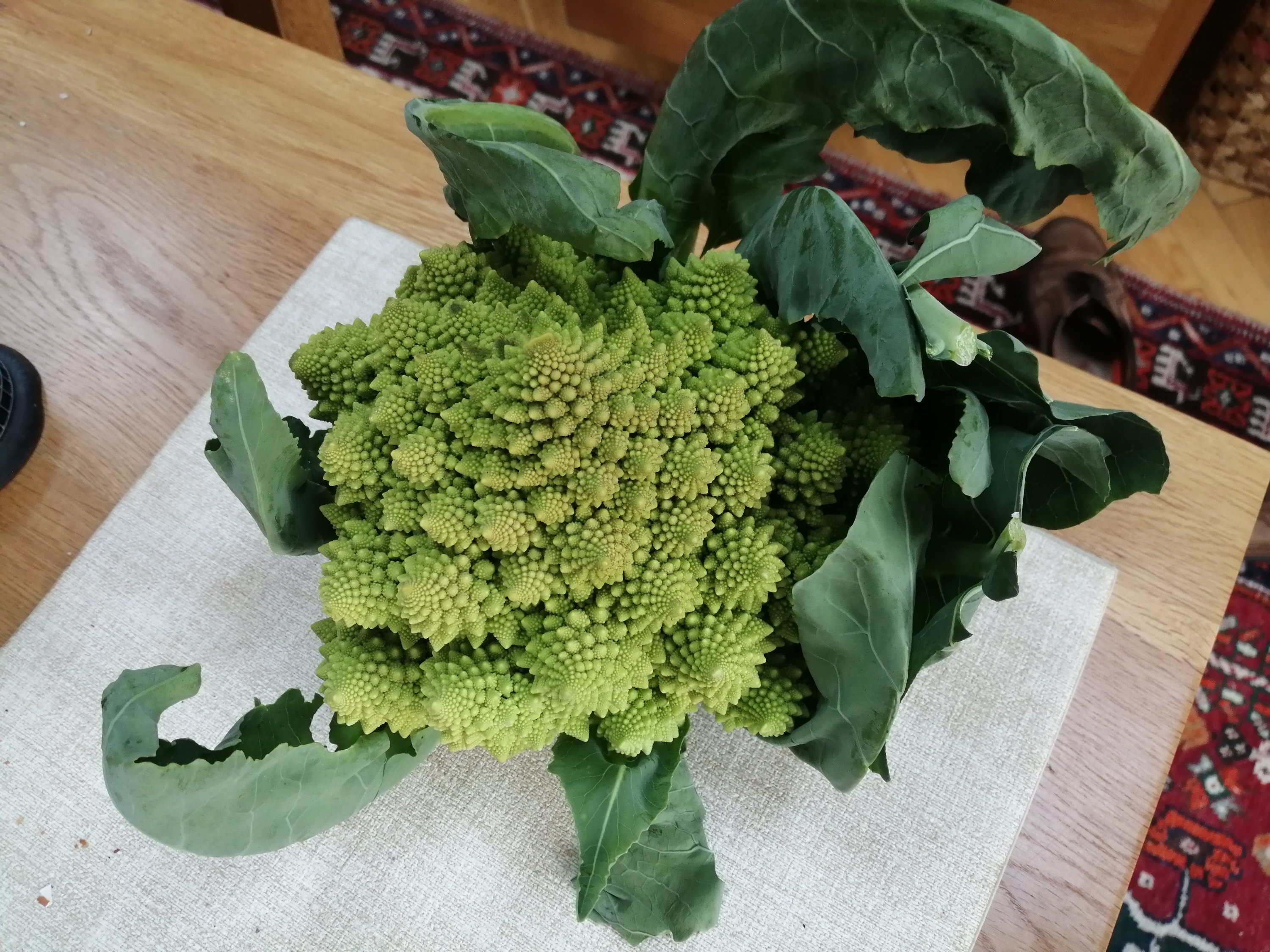
This week’s veggie box included the following beauty

The vegetable in the picture is called Romanesco. I’ve always thought of it as a cauliflower but I’ve more recently learned that it’s more closely related to broccoli. It doesn’t really matter because both broccoli and cauliflower are forms of brassica, which term also covers things like cabbages, kale and spinach. All are very high in vitamins and are also very tasty if cooked appropriately. Incidentally, the leaves of broccoli and cauliflower are perfectly edible (as are those of Romanesco) like those of cabbage, it’s just that we’re more used to eating the flower (or at least the bud).

A while ago, inspired by a piece in Physics World,  I wrote an item about  Romanesco, which points out that a “head” of Romanesco displays a form of self-similarity, in that each floret is a smaller version of the whole bud and also displays structures that are smaller versions of itself. That fractal behaviour is immediately obvious if you take a close look. Here’s a blow-up so you can see more clearly:
romanesco-broccoli2-550x412

There is another remarkable aspect to the pattern of florets, in that they form an almost perfect golden spiral. This is a form of logarithmic spiral that grows every quarter-turn by a factor of the golden ratio:

\phi = \frac{1+\sqrt{5}}{2}.

Logarithmic, or at least approximately logarithmic, spirals occur naturally in a number of settings. Examples include spiral galaxies, various forms of shell, such as that of the nautilus and in the phenomenon of phyllotaxis in plant growth (of which Romanesco is a special case). It would seem that the reason for the occurrence of logarithmic spirals  in living creatures is that such a shape allows them to grow without any change in shape.

Although it is rather beautiful, the main attraction of Romanesco is that it is really delicious. It can be eaten like cauliflower (e.g. in a delicious variation of cauliflower cheese) but my favourite way of cooking it is to roast it with a bit of olive oil, lemon juice and garlic. Yum!

Maynooth University Library Cat Update

Posted in Maynooth with tags on October 6, 2021 by telescoper
Cat On Post

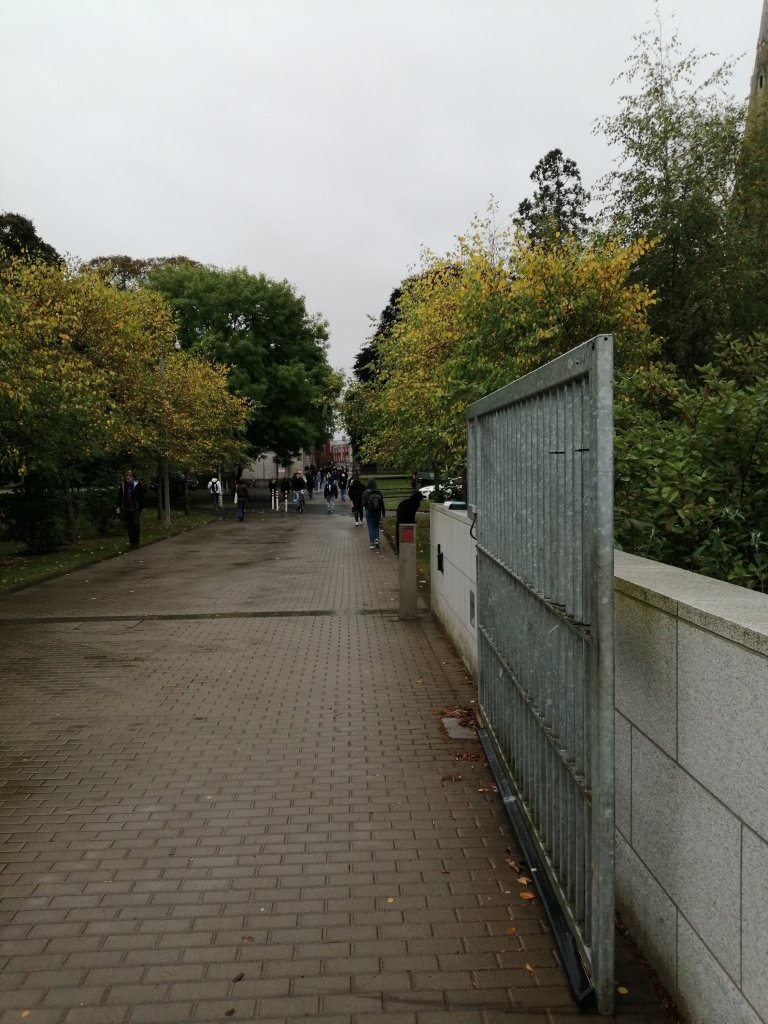
On my way through the drizzle to my 2pm lecture today I happened to see Maynooth University Library Cat at his usual position so stopped to take a snap. When I got closer I discovered that his food dishes were awash with rainwater so emptied one of them out and gave him some food from the plentiful stash next to his little box. There are many more people on campus now than a few weeks ago so he’s getting a lot of attention (and food) and seems in good health. I wonder what he thinks about all these strange humans rushing to and fro past his residence?

A Day in Autumn, by R.S. Thomas

Posted in Maynooth, Poetry with tags , , on October 5, 2021 by telescoper

Tree-lined Avenue at Maynooth University


It will not always be like this,
The air windless, a few last
Leaves adding their decoration
To the trees’ shoulders, braiding the cuffs
Of the boughs with gold; a bird preening

In the lawn’s mirror. Having looked up
From the day’s chores, pause a minute,
Let the mind take its photograph
Of the bright scene, something to wear
Against the heart in the long cold.

by R.S. Thomas (1913-2000)


Nobel Prize for Physics Speculation

Posted in Biographical, The Universe and Stuff with tags , , , on October 4, 2021 by telescoper

Just  to mention that tomorrow morning (October 5th 2021) will see the announcement of this year’s Nobel Prize for Physics. I must remember to make sure my phone is fully charged…

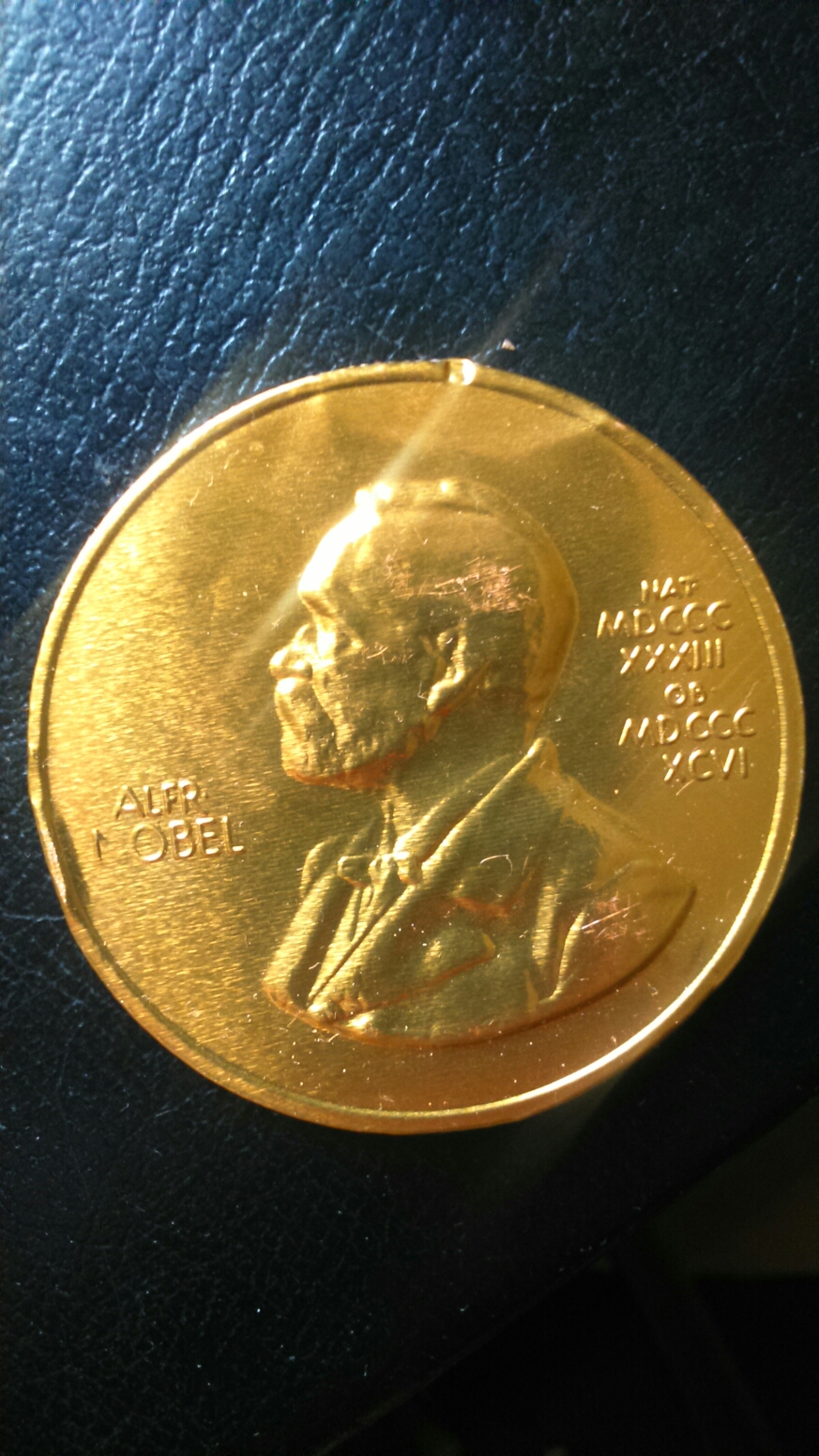
I do, of course, already have a Nobel Prize Medal of my own already, dating from 2006, when I was lucky enough to attend the prize-giving ceremony and banquet.

I was, however, a guest of the Nobel Foundation rather than a prizewinner, so my medal is made of chocolate rather than gold. I think after 15 years the chocolate is now inedible, but it serves as a souvenir of a very nice weekend in Stockholm!

I have a spectacular bad track record at predicting the Physics Nobel Prize winner. Most pundits have, actually. I certainly didn’t see the last two coming. I couldn’t resist having a go again however.

It’s been a good few years for cosmology and astrophysics, with Jim Peebles (2019), Roger Penrose, Andrea Ghez & Reinhard Genzel (2020) following on from Kip Thorne, Rainer Weiss and Barry Barish (2017) for the detection of gravitational waves.  Although I said so last year only to be proved wrong, I think it’s very unlikely that it will be in this area again. I have no idea who will win but if I had to take a punt I would suggest  Alain Aspect, Anton Zeilinger and John Clauser for their Bell’s inequality experiments and contributions to the understanding of quantum phenomena, including entanglement. I’m probably wrong though.

Feel free to make your predictions through the comments box below.

To find out you’ll have to wait for the announcement, around about 10.45 (UK/Irish time) tomorrow morning. I’ll update tomorrow when the wavefunction has collapsed.

Anyway, for the record, I’ll reiterate my opinion that while the Nobel Prize is flawed in many ways, particularly because it no longer really reflects how physics research is done, it does at least have the effect of getting people talking about physics. Surely that at least is a good thing?

UPDATE: Unsurprisingly, I was wrong again. The 2021 Nobel Prize for Physics goes to Syukuro Manabe and Klaus Hasselmann (1/4 each) and Giorgio Parisi (1/2). Manabe and Hasselmann were cited for their work in “the physical modeling of Earth’s climate, quantifying variability and reliably predicting global warming”. The second half of the prize was awarded to Parisi for “the discovery of the interplay of disorder and fluctuations in physical systems from atomic to planetary scales.” Congratulations to them all!

A Question of Accommodation

Posted in Covid-19, Education, Maynooth with tags , , , on October 3, 2021 by telescoper

Two weeks into the Autumn Semester, we’ve now had a week of teaching first-year students and two-weeks for all other years. I won’t say there have been no challenges but I think it has gone as well as can be expected. In particular the students (at least in my lectures) have impeccably observed the protocols. Although I’ve had to improvise with the equipment they do seem to appreciate my attempts to record my classes too.

The biggest problem Irish universities seem to be facing as we emerge from the pandemic is student accommodation. The media are full of stories about this issue, pointing the social cost as well as the difficulty posed to students’ education; see, e.g. here. There is a chronic housing shortage in Ireland anyway and this is a specific manifestation of that general problem.

The situation here in Maynooth is particularly acute, with some students having to make 220km round trips by bus to and from Co Wexford. I saw that bus the other day, actually. It’s always been an issue with my Tuesday MP110 lecture (which starts at 5pm) that some students have had to leave early in order to get a bus home. Even more students are doing that this year. I’m definitely glad I decided to record my lectures for the benefit of these students who have to miss part of the class for no fault of their own.

So why is there a student accommodation crisis? One factor is that Maynooth has had a bumper year for recruitment. There is only room on campus for 1,170 students out of a total enrolment approaching 14,000 and those rooms were all snapped up weeks ago. It’s a similar situation elsewhere. Universities have not been able to construct sufficient numbers of sufficiently affordable student rooms to keep up with demand. This is partly because of high building costs and planning bureaucracy, but also because Irish third-level institutions are strapped for cash thanks to decades of underfunding.

But there’s another issue, caused by the lingering effect of Covid-19. A significant number of students at Maynooth usually rent rooms locally in a family home on a four or five days a week basis, sometimes with meals included. This sort of arrangement is highly unusual in the UK, so it surprised me when I first moved here that so many students live that way. On the weekends they go back to their families, often travelling a considerable distance to do so. Typically these students arrive in Maynooth on Sunday evening or Monday morning and leave on Friday afternoon or evening; we see lots of students waiting for buses on the Kilcock Road on Friday afternoons.

Because we’re not fully out of Covid-19 restrictions, the supply of rooms available on this kind of letting arrangement is greatly diminished because of the perceived risk of a tenant being infectious (especially for elderly landlords). I know personally quite a few people who used to offer this kind of accommodation but are not doing so this year, hence the particular difficulty. I hope this situation improves soon, but for the time being it leaves many students having to commute great distances. I hope this doesn’t lead to some with difficult journeys dropping out.

I actually feel a bit guilty about this myself. I have a spare room in my house in Maynooth. It’s not huge but it has a single bed and a small desk in it so would work quite well for a student. I don’t really need the money, though it would be useful, but given the crisis I’ve thought of offering it as a weekday let. I do think, however, that it would be very awkward for a member of University staff to be landlord to one of their own students (both for me and for the student). On top of that, after such a long time as a bachelor I’ve just got used to living on my own! It’s a bit selfish, I know, but I therefore decided not to do it, though if there is an emergency (such as if people get snowed in as happened a few years ago) I would obviously offer my spare room as temporary accommodation.