Revision of Lecter Notes

Posted in Film, The Universe and Stuff with tags , , , , , , , , on October 19, 2021 by telescoper

I’ve just finished my 11th Lecture on Mechanics and Special Relativity. The Tuesday lecture is in a 5pm to 6pm slot which means quite a few students need to leave early in order to get buses home. I try therefore to design it in such a way that the last 10 minutes or so is optional, so those that depart before the end don’t miss anything vital. Today I ended with a sort of philosophical aside about the nature of things versus how they interact with other things. I wrote about such thoughts already on this blog but that was almost a decade ago so I reckon enough time has elapsed for me to reiterate it here in a slightly modified form.

The text for this dissertation is a short speech by Hannibal Lecter from the film The Silence of the Lambs (1991), specifically the “quotation” from the Meditations of Roman Emperor and stoic philosopher>Marcus Aurelius.

The quotation by Lecter reads

First principles, Clarice. Simplicity. Read Marcus Aurelius. Of each particular thing ask: what is it in itself? What is its nature? What does he do, this man you seek?

I always felt this would make a good preface to a book on particle physics, playing on the word “particular”, but of course one has to worry about using part of a film script without paying the necessary copyright fee, and there’s also the small matter of writing the book in the first place.

Anyway, I keep the Penguin Popular Classics paperback English translation of the Meditations with me when I go travelling; I can’t read Greek, the language it was originally written in. It is one the greatest works of classical philosophy, but it’s also a collection of very personal thoughts by someone who managed to be an uncompromisingly authoritarian Emperor of Rome at the same time as being a humble and introspective person. Not that I have ever in practice managed to obey his exhortations to self-denial!

Anyway, the first point I wanted to make is that Lecter’s quote is not a direct quote from the Meditations, at least not in any English translation I have found. The nearest I could find in the version I own is Book 8, Meditation X:

This, what is it in itself, and by itself, according to its proper constitution? What is the substance of it? What is the matter, or proper use? What is the form, or efficient cause? What is it for in this world, and how long will it abide? Thus must thou examine all things that present themselves unto thee.

Or possibly, later on in the same Book, Meditation XII:

As every fancy and imagination presents itself to unto thee, consider (if it be possible) the true nature, and the proper qualities of it, and reason with thyself about it.

There are other translated versions to be found on the net (e.g. here), all similar. Thus Lecter’s reference is a paraphrase, but by no means a misleading one.

A more interesting comment, perhaps, relates to the logical structure of Lecter’s quote. He starts by asking about a thing “in itself”, which recalls the ding an sich of Immanuel Kant. The point is that Kant argued that the “thing in itself” is ultimately unknowable. Lecter continues by asking not what the thing (in this case a man) is in itself but what it (he) does, which is not the same question at all.

It has long struck me that this is similar to the way we work in physics. For example, we might think we understand a bit about what an electron is, but actually what we learn about is how it interacts with other things, which of its properties change and which remain the same, i.e. what it does. From such behaviour we learn about what attributes we can assign to it, such as charge, mass and spin, but we know these only through their interactions with other entities. The electron-in-itself remains a mystery.

This is true of mathematical objects too. Objects are defined to do certain things under certain operations. That is the extent of their definition. Physicists tend to think there is a reality beyond the mathematics used to represent it, but can we ever really know anything about that reality?

If the reference to mathematical physics all sounds a bit nerdy, then I’ll make the obvious point that it also works with people. Do we ever really know what another person is in himself or herself? It’s only through interacting with people that we discover anything. They may say kind or nasty things and perform good or evil deeds, or act in some other way that leads us to draw conclusions about their inner nature. But we never really know for sure. They might be lying, or have ulterior motives. We have to trust our judgement to some extent otherwise we’re forced to live in a world in which we don’t trust anyone, and that’s not a world that most of us are prepared to countenance.

Even that is similar to physics (or any other science) because we have to believe that, say, electrons (or rather the experiments we carry out to probe their properties) don’t lie. This takes us to an axiom upon which all science depends, that nature doesn’t play tricks on us, that the world runs according to rules which it never breaks.

Theoretical Astrophysics Job Opportunity in Cork

Posted in The Universe and Stuff on October 18, 2021 by telescoper

Just time today to pass on the news that the University of Cork is advertising a Lectureship in Theoretical Astrophysics “with a specialism in astrophysics, gravitational physics or cosmology (although outstanding candidates from any research area in astronomy can also apply)”. More details can be found here. The deadline for applications is 11th November.

I’m posting this information here to encourage cosmologists and gravitational physicists to apply because I would love to see the community in these areas grown in Ireland. This is a follow-up position to the Professorship in Astrophysics recently advertised.


JWST: Nice Telescope, Shame about the Name…

Posted in LGBTQ+, Science Politics, The Universe and Stuff with tags , , , , , , , on October 17, 2021 by telescoper
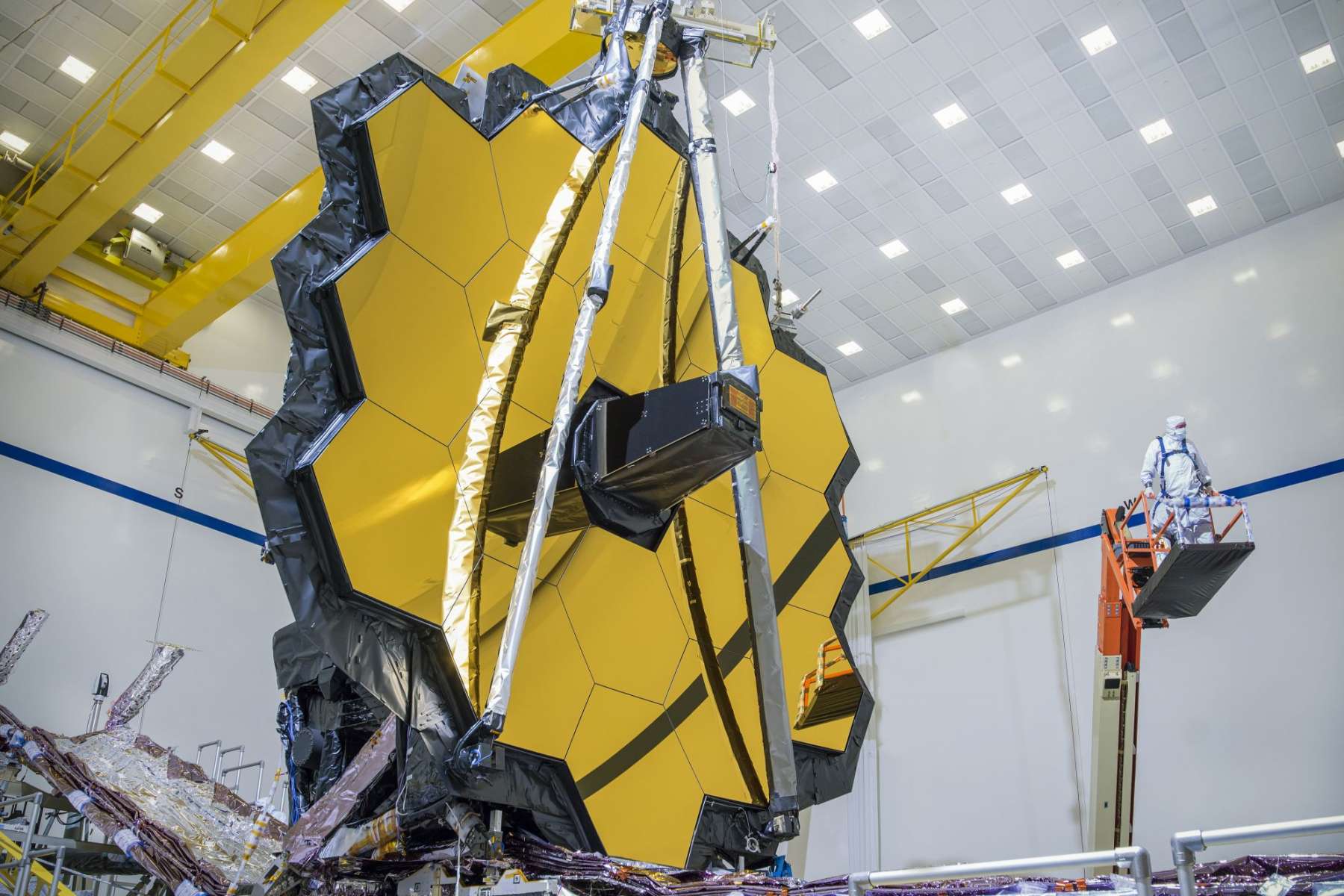
The JWST deployable mirror undergoing tests

I heard last week that the ship carrying the James Webb Space Telescope (JWST) arrived safely in French Guiana and is now being prepared for launch on an Ariane-5 rocket at the European Space Agency’s facility at Kourou. Since the telescope cost approximately $10 billion there was some nervousness it might have been hijacked by pirates on the way.

I’m old enough to remember JWST when it was called the Next Generation Space Telescope NGST); it was frequently discussed at various advisory panels I was on about 20 years ago. Although the basic concept hasn’t changed much – it was planned to be the successor to the Hubble Space Telescope working in the infrared and with a deployable mirror – at that time it was going to have an even bigger mirror than the 6.5m it ended up with, was going to be launched in or around 2010, and was to have a budget of around $600 million. About a decade ago cost overruns, NASA budget problems, and technical hitches led to suggestions that it should be cancelled. It turned out however that it was indeed too big too fail. Now it is set for launch in December total cost greater than ten times the original estimate.

I know many people involved in the JWST project itself or waiting to use it to make observations, and I’ll be crossing my fingers on launch day and for the period until its remarkable folding mirror is deployed about a fortnight later. I hope it goes well, and look forward to the celebrations when it does.

There is a big problem with JWST however and that is its name, which was changed in 2002 from the Next Generation Space Telescope to the James Webb Space Telescope after James E. Webb, a civil servant who was NASA’s chief administrator from 1961 to 1968.

It’s not uncommon for scientific space missions like this to be named after people once the proposal has moved off the drawing board and into serious planning. That happened with the European Space Agency’s Planck and Herschel to give two examples. In any case Next General Space Telescope was clearly never anything but a working title. Yet naming this important mission after a Government official always seemed a strange decision to me. Then news emerged that James Webb had enthusiastically cooperated in a McCarthyite purge of LGBT+ people working in government institutions, part of a wider moral panic referred to by historians as the Lavender Scare. There have been high-profile protests (see, e.g., here) and a petition that received over a thousand signatures, but NASA has ruled out any change of name.

The main reason NASA give is that they found no evidence that Webb himself was personally involved in discrimination or persecution. I find that very unconvincing. He was in charge, so had responsibility for what went on in his organization. If he didn’t know then why didn’t he know? Oh, and by the way, he didn’t have anything to do with infrared astronomy either…

It’s a shame that this fantastic telescope should have its image so tarnished by the adoption of an inappropriate name. The name is a symbol of a time when homophobic discrimination was even more prevalent than it is now, and as such will be a constant reminder to us that NASA seems not to care about the many LGBT+ people working for them directly or as members of the wider astronomical community.

P.S. As an alternative name I suggest the Lavender Scare Space Telescope (LSST)…

Meeting in Person

Posted in Covid-19, Education, Maynooth on October 16, 2021 by telescoper

Yesterday was the end of Week 4 of the Autumn Semester. Because Hallowe’en is on Sunday this year, the mid-term study break is a bit earlier than usual, meaning that Week 5 is the last week before that. That’s not to say we have a holiday of course, apart from the October Bank Holiday on 25th October, the first day of that week. There is, however no teaching in that week. Although the break is welcome, it does mean a rather long run-in of seven uninterrupted weeks of teaching until the Christmas break.

Anyway, yesterday we had our first in-person Departmental Meeting since I don’t know when. It wasn’t quite “normal” as some members of the Department joined via Teams, everyone wore masks and we held the meeting in a large-ish lecture theatre to enable physical distancing. We still have one lecturer who is not able to be in Ireland because of visa delays, so he joined remotely. At least there is a sign of movement on that issue, and we think he’ll be in Ireland and ready to teach after the study break, on November 1st. We did have student representatives present, which was very welcome, as it was difficult to arrange during the lockdown.

Although I’ve had about 18 months of practice to get used to virtual meetings I still dislike them so intensely that my heart sinks whenever anyone calls one that I have to attend, which is depressingly often. Meetings in person are so much better in my view. I don’t know why that is. Just call me old-fashioned. I think yesterday’s meeting went rather well, all things considered, with contributions from just about everyone present.

The October study break is traditionally when we prepare our examinations for the January period. One of the most important items on the agenda was what to do for this January. The official line is that we’re supposed to return to normal, with traditional examinations on campus. I think most lecturers will do their exams like that unless the public health situation deteriorates even more rapidly and we are forced to switch online again. With Covid-19 cases rising significantly, that is a distinct possibility.

I think most staff agree that there are positives to the online style of examinations and I’ve left it up to individuals to decide what they think is best for their particular modules. The important thing however is to inform the students as quickly as possible so they know what’s going to hit them. Students in Year 2 have never had a “traditional” examination at Maynooth and those in Year 3 only had one set, way back in January 2020. They will need to readjust to not having an “open book” style of examination. On the other hand, in theoretical physics we try to test problem-solving rather than memory so I think we’re in a better position than many disciplines to manage this.

First-year students this year are in a different but also tricky situation, in that they are facing their first set of University examinations having had their school education significantly disrupted by the pandemic. We have to help them cope with the fact that they may not be as well prepared as students in previous years. Since I’m teaching the first-years this Semester, this means doing more revision classes and tips on examination technique.

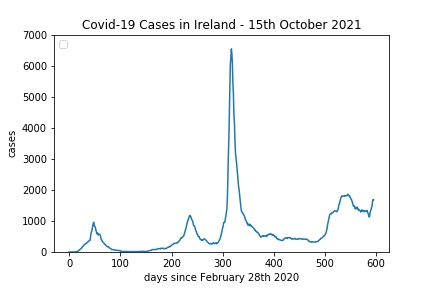
I’ve alluded to the backdrop of rising Covid-19 cases already, and this is causing considerable uncertainty. Some time ago the Irish Government announced that most remaining public health restrictions would be scrapped from 22nd October, i.e. on Friday but case numbers are alarmingly high:

There has been a steep rise recently, not only in positive tests as shown on the graph, but also in positivity rate and hospitalizations. I think this is not surprising. The Coronavirus is circulating like wildfire in the UK right now and it is very difficult for Ireland to insulate itself from that given the open border. In addition it is still the case that about 10% of the adult population is not vaccinated and those who refuse the vaccine are also most likely not to observe social distancing, wear masks, etc. Only 1-in-10 are not vaccinated, but it only takes one to give you the virus.

At least I can say that students in my classes have observed the rules on mask-wearing diligently once in the classroom. The one-way systems in place in campus and staggered lecture start times have been less somewhat successful. I’ve arrived for classes several times only to find the previous lecturer over-running with the consequence that the students in my class are in close proximity to those in the previous class on the way in and out respectively.

I doubt if these infringements are causing significant problems, however. I think it’s far more likely that the virus is spreading in social events and on public transport. The basic problem is that in the minds of some people the pandemic is already over, though in my experience of everyday life outside the University people in shops etc are masking up and behaving sensibly.

We await the announcements due on Friday with interest. If I had to guess I would say that the Government will once again cave in to pressure from the hospitality industry and remove restrictions on bars, restaurants and nightclubs and then feign surprise that infections rise yet again. That won’t have an immediate effect on universities and colleges but it will probably prolong the pandemic well into next year, and necessitate a programme of booster shots for the whole population.

Cosmology Talks: James Alvey on Big Bang Nucleosynthesis in 2021

Posted in The Universe and Stuff with tags , , , , , on October 15, 2021 by telescoper

It’s been a while since I last shared another one of those interesting cosmology talks on the Youtube channel curated by Shaun Hotchkiss. This channel features technical talks rather than popular expositions so it won’t be everyone’s cup of tea but for those seriously interested in cosmology at a research level they should prove interesting. I found this one particular interesting as it is a field that I lost track of quite a long time ago and it was great to see what has been going on!

Here James Alvey gives a pedagofical overview of the general state of the field of Big Bang Nucleosynthesis (BBN) in 2021, including the basic physics that goes into BBN calculations through each of the relevant epochs (neutrino decoupling, the deuterium bottleneck, etc). He gives particular emphasis to the recent LUNA measurements of the D + p →γ + 3He reaction (or deuterium + proton goes to photon and 3-Helium). This was previously the source of greatest uncertainty in predicting the final deuterium abundance of BBN. He ends by talking about the implications of the LUNA measurements on possible new physics beyond the standard model, in particular possible thermal relics.

There is a Nature paper about the LUNA results here and  two other papers on this topic by James can be found here and here.

Writing Papers for Scientific Journals

Posted in Literature, The Universe and Stuff with tags , on October 14, 2021 by telescoper

Knowing that not all readers of this blog have a flair for writing like what I have got, I thought I’d pass on a link to a paper that appeared on the arXiv earlier this week. Here is the abstract:

Writing is a vital component of a modern career in astronomical research. Very few researchers, however, receive any training in how to produce high-quality written work in an efficient manner. We present a step-by-step guide to writing in astronomy. We concentrate on how to write scientific papers, and address various aspects including how to crystallise the ideas that underlie the research project, and how the paper is constructed considering the audience and the chosen journal. We also describe a number of grammar and spelling issues that often cause trouble to writers, including some that are particularly hard to master for non-native English speakers. This paper is aimed primarily at Master’s and PhD level students who are presented with the daunting task of writing their first scientific paper, but more senior researchers or writing instructors may well find the ideas presented here useful.

Knapen et al. 2021, arXiv:2110.05503

The title of the paper is actually Writing Scientific Papers in Astronomy, which seems curious wording to me – rather like Writing Scientific Papers in French (for example) – which is why I didn’t use it for the title of this post. Not that I’m pedantic or anything.

One of the problems with the scientific literature is that most journals have their own style rules which are often in conflict with one another so the detailed guidance on grammar, etc is probably of lesser value than the good tips on how to structure a paper. Those bits apply to any scientific field really, not just astronomy.

I remember very well what a struggle I found it when I wrote my first scientific paper. I had invaluable help, though, from my supervisor, who was an excellent writer. This is well worth reading for those early career researchers who want to avoid at least some of the pain!

The only tip I can offer to a postgraduate student struggling to write a paper is to think of who is going to be reading it. In most cases that will mainly be other early career researchers, so write in such a way that you can connect with them. That usually means, for example, taking special care to explain the things that you found difficult when you started in the area. In other words, you should put enough in your paper to allow someone else entering the field to understand it.

Other tips are of course welcome through the Comments Box.

Windows, Bugs and Updates

Posted in Biographical, Maynooth with tags , , on October 13, 2021 by telescoper

While having breakfast at home this morning I noticed that my laptop was asking for a restart to complete Windows update. Since this machine was set up by my employer’s IT services, it has BitLocker installed which means I have to be present to type in a PIN every time it restarts. It is therefore not possible to schedule updates overnight, as a sensible system would allow. In fact I can’t adjust very much at all about the update policy. All of this explanation is meant as an excuse for why I made the rookie error of restarting it before going to work.

Three restarts later, at 10am, I finally decided to go into work. I should have waited until then before starting the updates because my desktop machine works on Linux and is immune from Windows update nonsense so I would have been able to get on with other stuff while my laptop was starting and restarting.

Anyway, when I did arrive in the office, the laptop wanted to do yet another restart. That’s four altogether (so far); the latest one having taken much longer than the others. Had I been at home and relying on my laptop I would have wasted an entire morning.

I did think that perhaps the updates manager on my laptop had gone berserk and this plethora of starts and restarts was some kind of bug. It turns out though that it wasn’t: since yesterday, Microsoft has been flooding the internet with huge updates and patches of various kinds, mainly to fix “vulnerabilities” of various kinds. There’s been quite a lot of comment on social media about this from people (including myself) fed up with the state of their computers.

One of the vulnerabilities I know about concerns the print spool Windows er, which apparently was in a state that allowed it to be easily hacked. The solution chosen by my employer’s IT Services team was to disable all printing by shutting down the print spooler on University machines. After sending an inquiry to the system support people they recommended that if I wanted to print something I should manually restart the spooler, print the document, then manually terminate the spooler again. If I wanted to print several documents I should do this for each one…

Yeah, right.

I have no idea how many person-hours are being wasted by these vulnerabilities nor how much bandwidth is being used up worldwide to fix these Windows bugs. Unfortunately I don’t think it’s possible for organizations to sue Microsoft for lost productivity…

Del or Nabla?

Posted in Biographical, mathematics with tags , , on October 12, 2021 by telescoper

I am today preoccupied with vector calculus so, following on from yesterday’s notational rant, I am wondering about the relative frequency of usage of names for this symbol, commonly used in math to represent the gradient of a function ∇f:

To write this in Tex or Latex you use “\nabla” which is, or so I am told, so called because the symbol looks like a harp and the Greek word for the Hebrew or Egyptian form of a harp is “nabla”:

When I was being taught vector calculus many moons ago, however, the name always used was “del”. That may be a British – or even a Cambridge – thing. Here is an example of that usage a century ago.

Anyway, I am interested to know the relative frequency of the usage of “nabla” and “del” so here’s a poll.

There may be other terms, of course. Please enlighten me through the comments box if you know of any…

Writing Vectors

Posted in mathematics, The Universe and Stuff with tags , , , on October 11, 2021 by telescoper

Once again it’s time to introduce first-year Mathematical Physics students to the joy of vectors, or specifically Euclidean vectors. Some of my students have seen them before, but probably aren’t aware of how much we use them theoretical physics. Obviously we introduce the idea of a vector in the simplest way possible, as a directed line segment. It’s only later on, in the second year, that we explain how there’s much more to vectors than that and explain their relationship to matrices and tensors.

Although I enjoy teaching this subject I always have to grit my teeth when I write them in the form that seems obligatory these days.

You see, when I was a lad, I was taught to write a geometric vector in the following fashion:

\vec{r} =\left(\begin{array}{c} x \\ y \\ z \end{array} \right).

This is a simple column vector, where x,y,z are the components in a three-dimensional cartesian coordinate system. Other kinds of vector, such as those representing states in quantum mechanics, or anywhere else where linear algebra is used, can easily be represented in a similar fashion.

This notation is great because it’s very easy to calculate the scalar (dot) and vector (cross) products of two such objects by writing them in column form next to each other and performing a simple bit of manipulation. For example, the scalar product of the two vectors

\vec{u}=\left(\begin{array}{c} 1 \\ 1 \\ 1 \end{array} \right) and \vec{v}=\left(\begin{array}{c} 1 \\ 1 \\ -2 \end{array} \right)

can easily be found by multiplying the corresponding elements of each together and totting them up:

\vec{u} \cdot \vec{v} = (1 \times 1) + (1 \times 1) + (1\times -2) =0,

showing immediately that these two vectors are orthogonal. In normalised form, these two particular vectors appear in other contexts in physics, where they have a more abstract interpretation than simple geometry, such as in the representation of the gluon in particle physics.

Moreover, writing vectors like this makes it a lot easier to transform them via the action of a matrix, by multipying rows in the usual fashion, e.g.
\left(\begin{array}{ccc} \cos \theta & \sin\theta & 0 \\ -\sin\theta & \cos \theta & 0 \\ 0 & 0 & 1\end{array} \right) \left(\begin{array}{c} x \\ y \\ z \end{array} \right) = \left(\begin{array}{c} x\cos \theta + y\sin\theta \\ -x \sin \theta + y\cos \theta \\ z \end{array} \right)
which corresponds to a rotation of the vector in the x-y plane. Transposing a column vector into a row vector is easy too.

Well, that’s how I was taught to do it.

However, somebody, sometime, decided that, in Britain at least, this concise and computationally helpful notation had to be jettisoned and students instead must be forced to write a vector laboriously in terms of base vectors:

\vec{r} = x\hat{\imath} + y \hat{\jmath} + z \hat{k}

Some of you may even be used to doing it that way yourself. Why is this awful? For a start, it’s incredibly clumsy. It is less intuitive, doesn’t lend itself to easy operations on the vectors like I described above, doesn’t translate easily into the more general case of a matrix, and is generally just …well… awful. The only amusing thing about this is that you get to tell students not to put a dot on the “i” or the “j” – it always gets a laugh when you point out that these little dots are called “tittles“.

Worse still, for the purpose of teaching inexperienced students physics, it offers the possibility of horrible notational confusion. In particular, the unit vector \hat{\imath} is too easily confused with i, the square root of minus one. Introduce a plane wave with a wavevector \vec{k} and it gets even worse, especially when you want to write \exp(i\vec{k}\cdot \vec{x}), and if you want the answer to be the current density \vec{j} then you’re in big trouble!

Call me old-fashioned, but I’ll take the row and column notation any day!

(Actually it’s better still just to use the index notation, a_i which generalises easily to a_{ij} and, for that matter, a^{i}.)

Or perhaps being here in Ireland we should, in honour of Hamilton, do everything in quaternions.

Weekend Jobs

Posted in Biographical, Maynooth on October 10, 2021 by telescoper

If I ever used to feel guilty about not working at weekends I don’t anymore. I may have a big backlog of things to do but I’ve come to accept that life is too short to work every day of the week.

I’ve explained many times on this blog that we’re very short-staffed in the Department of Theoretical Physics. That is no fault of mine or any of the other staff so I’m not going to work myself into the ground. I did enough unpaid overtime during the lockdown and I’m not going to allow stress and overwork to become the new normal.

So, despite toying with the idea of finishing a paper this weekend, I settled for domestic chores. That doesn’t make for a very exciting blog post but there you are.

The main task I accomplished was to deal with the ivy that is growing in profusion on the outside of my house. It was in danger of getting into the loft space so I got my flat-bladed chisel out and went at it. It’s nearly all cleared now, but my garden waste bin is full so I’ll have to do the rest when I have space to put the bits and pieces.

It being October now I’ve also resumed food service for the birds. I put out one feeder last week and it was emptied in a matter of hours. I saw mainly blue tits attacking it. I haven’t seen any of those for a while. I forgot to buy peanuts but I’ll try to do that in the week so I can deploy the mesh feeders; the seed I’ve already put out is too fine for those.

Another exciting job I did was clean out my coffee maker. I have a nice espresso machine that requires regular de-scaling. That takes quite a while to do as one has to send a whole tank full of solution through the works, then rinse it out with water afterwards.

I also put a few pictures up, having rescued my Black-and-Decker from the shed. I still have more to do, largely because I’m very indecisive about where to put my artwork. I still have to hang my big blackboard too. I might be needing it for online lectures again. Who knows?

Other than the highlight of the weekend was Saturday night dinner, which was roast confit of duck with braised red cabbage, roast Romanesco with garlic and lemon, and new potatoes. It was delicious, especially when accompanied by a very nice Barolo. I even enjoyed shopping for some of the ingredients.

Anyway, week four begins tomorrow. That’s a third of the way into term for the returning students. I don’t think I’ve ever started counting the days to the end of term this early before.