A Vaccination Fallacy

Posted in Bad Statistics, Covid-19 with tags , , , , on June 27, 2021 by telescoper

I have been struck by the number of people upset by the latest analysis of SARS-Cov-2 “variants of concern” byPublic Health England. In particular it is in the report that over 40% of those dying from the so-called Delta Variant have had both vaccine jabs. I even saw some comments on social media from people saying that this proves that the vaccines are useless against this variant and as a consequence they weren’t going to bother getting their second jab.

This is dangerous nonsense and I think it stems – as much dangerous nonsense does – from a misunderstanding of basic probability which comes up in a number of situations, including the Prosecutor’s Fallacy. I’ll try to clarify it here with a bit of probability theory. The same logic as the following applies if you specify serious illness or mortality, but I’ll keep it simple by just talking about contracting Covid-19. When I write about probabilities you can think of these as proportions within the population so I’ll use the terms probability and proportion interchangeably in the following.

Denote by P[C|V] the conditional probability that a fully vaccinated person becomes ill from Covid-19. That is considerably smaller than P[C| not V] (by a factor of ten or so given the efficacy of the vaccines). Vaccines do not however deliver perfect immunity so P[C|V]≠0.

Let P[V|C] be the conditional probability of a person with Covid-19 having been fully vaccinated. Or, if you prefer, the proportion of people with Covid-19 who are fully vaccinated..

Now the first thing to point out is that these conditional probability are emphatically not equal. The probability of a female person being pregnant is not the same as the probability of a pregnant person being female.

We can find the relationship between P[C|V] and P[V|C] using the joint probability P[V,C]=P[V,C] of a person having been fully vaccinated and contracting Covid-19. This can be decomposed in two ways: P[V,C]=P[V]P[C|V]=P[C]P[V|C]=P[V,C], where P[V] is the proportion of people fully vaccinated and P[C] is the proportion of people who have contracted Covid-19. This gives P[V|C]=P[V]P[C|V]/P[C].

This result is nothing more than the famous Bayes Theorem.

Now P[C] is difficult to know exactly because of variable testing rates and other selection effects but is presumably quite small. The total number of positive tests since the pandemic began in the UK is about 5M which is less than 10% of the population. The proportion of the population fully vaccinated on the other hand is known to be about 50% in the UK. We can be pretty sure therefore that P[V]»P[C]. This in turn means that P[V|C]»P[C|V].

In words this means that there is nothing to be surprised about in the fact that the proportion of people being infected with Covid-19 is significantly larger than the probability of a vaccinated person catching Covid-19. It is expected that the majority of people catching Covid-19 in the current phase of the pandemic will have been fully vaccinated.

(As a commenter below points out, in the limit when everyone has been vaccinated 100% of the people who catch Covid-19 will have been vaccinated. The point is that the number of people getting ill and dying will be lower than in an unvaccinated population.)

The proportion of those dying of Covid-19 who have been fully vaccinated will also be high, a point also made here.

It’s difficult to be quantitatively accurate here because there are other factors involved in the risk of becoming ill with Covid-19, chiefly age. The reason this poses a problem is that in my countries vaccinations have been given preferentially to those deemed to be at high risk. Younger people are at relatively low risk of serious illness or death from Covid-19 whether or not they are vaccinated compared to older people, but the latter are also more likely to have been vaccinated. To factor this into the calculation above requires an additional piece of conditioning information. We could express this crudely in terms of a binary condition High Risk (H) or Low Risk (L) and construct P(V|L,H) etc but I don’t have the time or information to do this.

So please don’t be taken in by this fallacy. Vaccines do work. Get your second jab (or your first if you haven’t done it yet). It might save your life.

Thank-You Notes

Posted in Biographical, Education, Maynooth on June 26, 2021 by telescoper

I’ve just finished my presentation about Theoretical Physics at today’s Open Day in Maynooth and now have a short break before the online Question-and-Answer session so I thought I’d use the time to do a quick post.

Yesterday our students got their marks and as a consequence I had quite a few emails from students about their results. Happily the vast majority were absolutely lovely. Here are two excerpts of emails from graduating students (I’ve removed bits to ensure anonymity):

Thanks a million for all your support throughout the 3 years. I enjoyed every minute of this course, largely due to yourself and the other lecturers..

Thank you and everyone in the TP department for everything, I am indebted to you all and am incredibly gratefully for all your support, help and advice.

And another:

I want to express my gratitude to yourself and the rest of the department. I had a great experience in Maynooth and having personable and helpful professors helped a lot.

Such nice comments mean a very great deal, especially since these students – and others too numerous to mention – have been taught remotely for the last three semesters. They’re not just about me, of course; they refer to all the staff in the Department. I’m sure the gratitude expressed goes both ways too. I’d like to take this opportunity to thank all our students for putting up with everything that’s been thrown at them over the last year and a half and for being so determined and cooperative.

I really do hope it will be possible to offer congratulations in person to our graduating class at a formal Conferring Ceremony due to take place in September, but that I suppose is dependent on the progress of the Covid-19 pandemic, vaccination, and so on. It’s out of my hands.

I’ve said before on this blog that I always feel a curious sense of loss at the end of an academic year. After three or four years in the Department you’re only just starting to get to know students and then suddenly they’re finished. This year in particular it would be very sad if they just disappeared without a proper goodbye. As one of my correspondents said:

I am really looking forward to attending the conferring ceremony. As you said, it’s been far too long since we’ve talked to anyone in the department in person.

Of course this little tinge of sadness is more than made up by the success of these students which is hard won and thoroughly well deserved. I’m very pleased for them all. They now have the opportunity to follow a career of their choice. It must be very exciting for them, as a degree in Theoretical Physics opens a great many doors!

Catching up on Cosmic Dawn

Posted in The Universe and Stuff with tags , , , , , on June 25, 2021 by telescoper

Trying to catch up on cosmological news after a busy week I came across a number of pieces in the media about “Cosmic Dawn” (e.g. here in The Grauniad). I’ve never actually met Cosmic Dawn but she seems like an interesting lady.

But seriously folks, Cosmic Dawn refers to the epoch during which the first stars formed in the expanding Universe lighting up the Universe after a few hundred million years of post-recombination darkness.

According to the Guardian article mentioned above the new results being discussed are published in Monthly Notices of the Royal Astronomical Society but they’re actually not. Yet. Nevertheless the paper (by Laporte et al.) is available on the arXiv which is where people will actually read it…

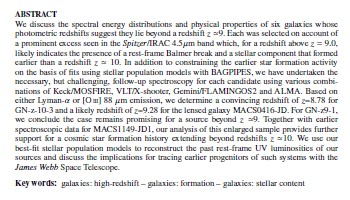
Anyway, here is the abstract:

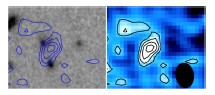
Here is a composite of HST and ALMA images for one of the objects discussed in the paper (MACS0416-JD):

I know it looks a bit blobby but it’s not easy to resolve things at such huge distances! Also, it’s quite small because it’s far away. In any case the spectroscopy is really the important thing, not the images, as that is what determines the redshift. The Universe has expanded by a factor 10 since light set out towards us from an object at redshift 9. I’m old enough to remember when “high redshift” meant z~0.1!

At the end of my talk on Wednesday Floyd Stecker asked me about what the James Webb Space Telescope (due for launch later this year) would do for cosmology and I replied that it would probably do a lot more for galaxy formation and evolution than cosmology per se. I think this is a good illustration of what I meant. Because of its infrared capability JWST will allow astronomers to push back even further and learn even more about how the first stars formed, but it won’t tell us much directly about dark matter and dark energy.

End of Term Hiatus

Posted in Biographical, Education, Football, Maynooth on June 24, 2021 by telescoper

Yesterday was quite a busy day because, as well as my talk in the afternoon, we had the main University Examination Board in the morning. Because many students in Maynooth are taking courses that spread across more than one Department, this is an opportunity to raise any issues arising when marks are combined. The full results for each student are presented on “Broadsheets” which I suspect in days gone by would have been broad sheets of paper, but which nowadays are hefty PDF files, one for each faculty. Science & Engineering was the first session, kicking off at 9.15 via Teams but because we all had access to the Broadsheets since last Friday we had time to identify any relevant matters and the meeting itself went quite smoothly.

Now there’s a short hiatus because the formal results will not be communicated to students until tomorrow (Friday 25th). Next Tuesday (29th June) is Consultation Day, on which students can discuss their results and any matters arising with staff. Obviously we can’t do this in person this year because of Covid-19 restrictions but, because the examination scripts were scanned and uploaded electronically this year the students will actually have the originals, discussing any issues of marking shouldn’t be too difficult.

Some students will need to take repeat examinations before they can progress. These are in the period 4th-14th August in Maynooth so I’ll have to be around for those. I was hoping to try to get some summer holiday this year – which I didn’t last summer – starting on 5th July, but that has already been pushed back because something important has arisen that means I have to be working on 7th July. I hope nothing else eats into my leave entitlement. It says in my contract how many weeks holiday I should have per year so I will not accept another year of not being able to take it.

Although we have a short break in the examination process that doesn’t mean everything stops. I have to work this Saturday (26th June) at the Summer Open Day here at Maynooth, recruiting the September intake…

The sense of hiatus is amplified by the fact that there are no matches today or tomorrow in the European Championship, the final group games being last night and the first in the Round of 16 being on Saturday. I’ve got quite used to watching the 8pm matches over the last couple of weeks!

The State of the Universe Slides

Posted in Talks and Reviews, The Universe and Stuff on June 23, 2021 by telescoper

So I have given my talk on the State of the Universe. It’s a bit intimidating giving a talk with Nobel Laureates in the audience, but I think it went OK.

The slides are here:

I’ll add a link to the recording when I have it. Here is a link to the event. The video is very long because of a lengthy introduction and discussion at the end so if I get time I’ll put an edited version of just the talk on my Youtube channel.

In the meantime here’s a picture of me looking weird during the presentation:

40 years since A-level

Posted in Biographical, Education on June 22, 2021 by telescoper

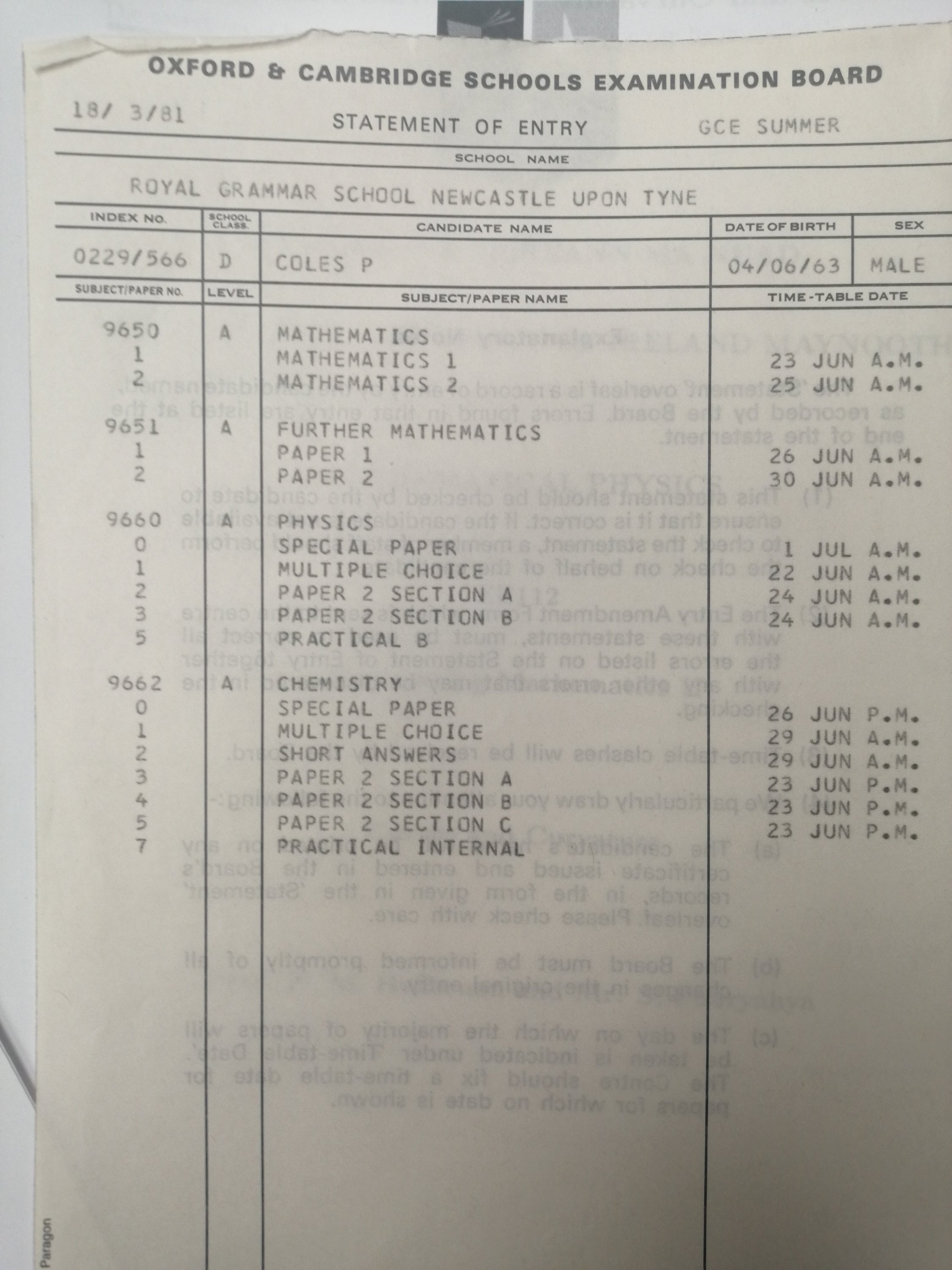
It was with quite a shock that I realized the other day that it is no less than forty years since I took my GCE A-levels. Here is the evidence:

I don’t know why kept this “Statement of Entry” all this time but you’ll see that my first exam was the Physics Multiple Choice paper exactly 40 years ago today on 22nd June 1981. The following day was a toughie with Mathematics 1 in the morning and a Chemistry Paper in the afternoon, but I remember 26th June (which was a Friday) being the hardest with the with Further Maths examination in the morning followed by the Chemistry Special Paper in the afternoon, both of them of 3 hours duration. I’ve actually posted the first of these on this blog, here, along with quite a few of the papers I took way back then.

The State of the Universe Talk – Reminder

Posted in Biographical, Books, Talks and Reviews, Sport, Talks and Reviews, The Universe and Stuff with tags on June 21, 2021 by telescoper

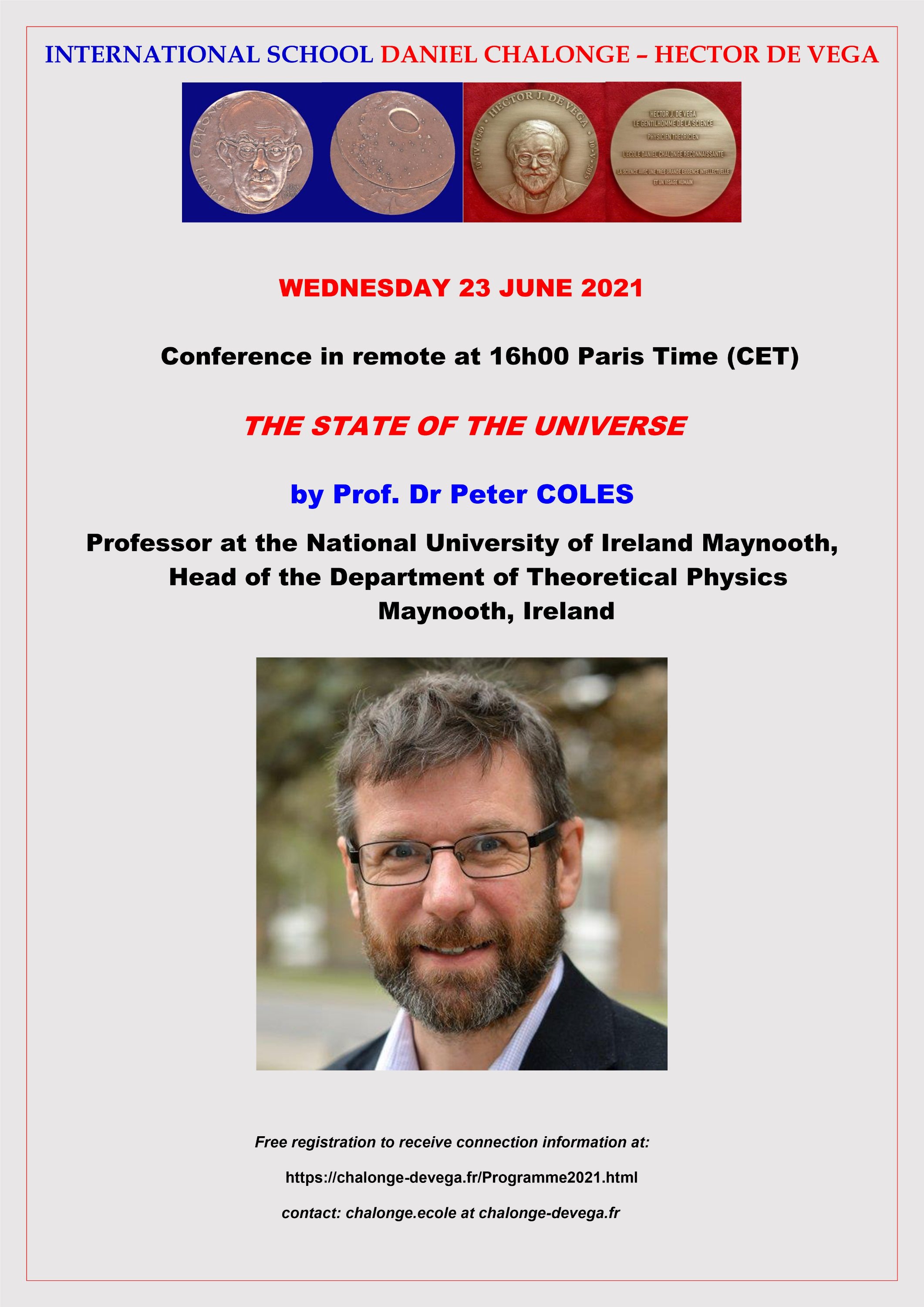
Just time for a quick reminder that I’m giving a talk on Wednesday (23rd June 2021). It’s at 4pm Paris Time which is 3pm Irish Time. See my original post here.

I had a sudden sense of dread that this Colloquium might clash with the Portugal-France game in the European Championship which takes place the same day but it turns out that won’t kick off until 9pm Paris Time which means that I should just about be finished before the football starts. I don’t think even I could overrun by 4 hours! Indeed I should finish before the earlier games that day, which kick off at 5pm Paris Time…

If you want to attend the Colloquium (via Zoom) you can register for it here.

The Summer Solstice 2021

Posted in The Universe and Stuff with tags , , , , , , on June 20, 2021 by telescoper

The Summer Solstice in the Northern hemisphere happens tomorrow, Monday 21st June 2021, at 04:32  Irish Time (03:32 UTC). Among other things, this means that tomorrow is the longest day of the year around these parts.  Usually I post about the Solstices and Equinoxes close to the time that they occur,  and on the same day, but because I don’t want to get up before 4.32am and few would be awake to read it then, I thought I’d do this one in advance.

Sunrise in the Dublin area is about 04:56 local time tomorrow and sunset is at 21:57: the interval between sunrise and sunset will be just about 1s longer on 21st June than today, 20th June, and 5 seconds longer than Tuesday 22nd June. The longest day will last 17 hours and 11 seconds (approximately) so make the most of it – it’s all downhill from now on!

Days will get shorter from tomorrow until the Winter Solstice in December, although this does not mean that sunset will necessarily happen earlier on 22nd  than it does tomorrow. In fact it is a little later. This is because there is a difference between mean solar time (measured by clocks) and apparent solar time (defined by the position of the Sun in the sky), so that a solar day does not always last exactly 24 hours. A description of apparent and mean time was given by Nevil Maskelyne in the Nautical Almanac for 1767:

Apparent Time is that deduced immediately from the Sun, whether from the Observation of his passing the Meridian, or from his observed Rising or Setting. This Time is different from that shewn by Clocks and Watches well regulated at Land, which is called equated or mean Time.

The discrepancy between mean time and apparent time arises because of the Earth’s axial tilt and the fact that it travels around the Sun in an elliptical orbit in which its orbital speed varies with time of year (being faster at perihelion than at aphelion).

Using a rapid calculational tool (Google), I found a table of the local mean times of sunrise and sunset for Dublin around the 2021 summer solstice. This shows that the earliest sunrise was actually on 17th June and the latest sunset is on 24th.

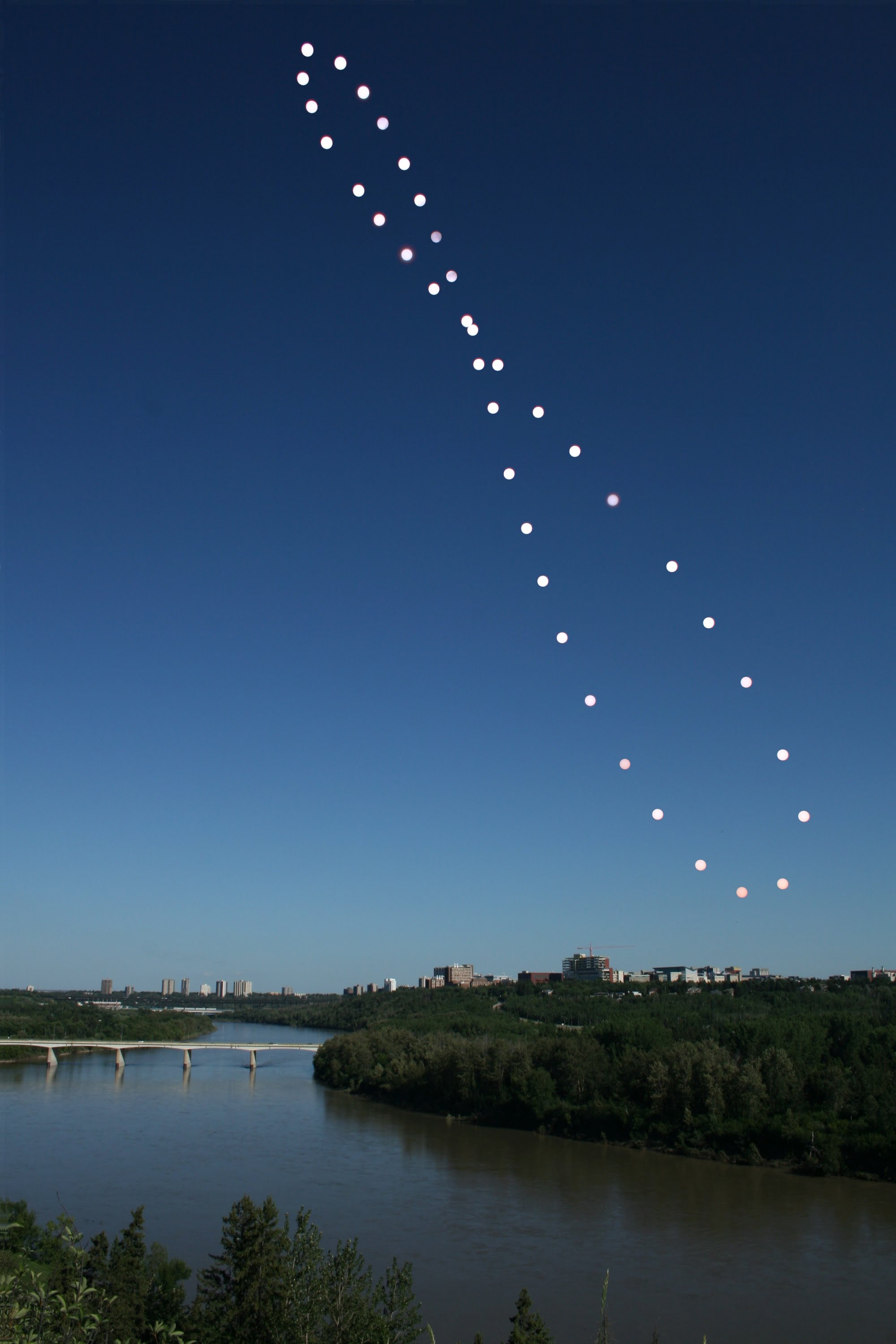
If you plot the position of the Sun in the sky at a fixed time each day from a fixed location on the Earth you get a thing called an analemma, which is a sort of figure-of-eight curve whose shape depends on the observer’s latitude. Here’s a photographic version taken in Edmonton, with photographs of the Sun’s position taken from the same position at the same time on different days over the course of a year:

maxresdefault

The summer solstice is the uppermost point on this curve and the winter solstice is at the bottom. The north–south component of the analemma is the Sun’s declination, and the east–west component is the so-called equation of time which quantifies the difference between mean solar time and apparent solar time. This curve can be used to calculate the earliest and/or latest sunrise and/or sunset.

P.S. A bit of light googling revealed to me that if you live in York then your sunrise on 21st June 2021 is at 4.32am, precisely the same time as the Solstice.

Canal Bank Walk, by Patrick Kavanagh

Posted in Maynooth, Poetry with tags , , on June 19, 2021 by telescoper

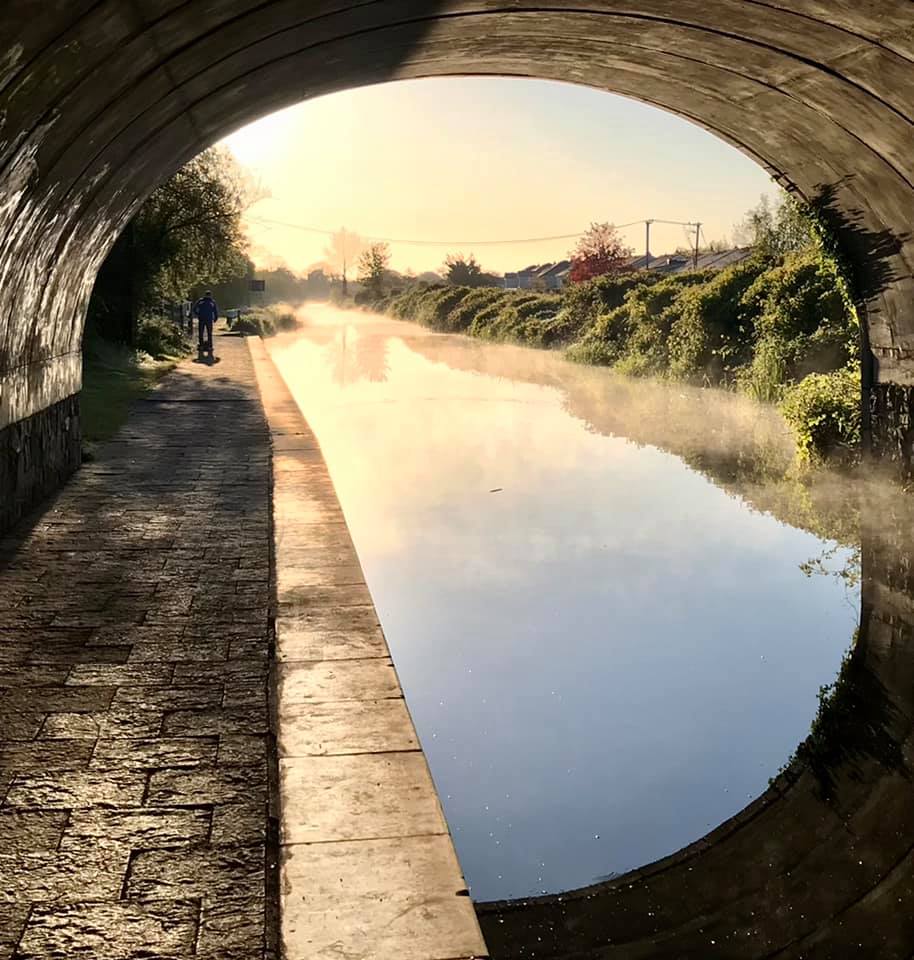
The Royal Canal, Maynooth (Picture Credit: M. Maher)

Written in 1954 when the poet was recovering from a life-threatening illness this poem – a sonnet by Patrick Kavanagh – is a celebration not only of nature’s powers of regeneration but of the delight in taking things slowly. As he expressed in his lecture Man and Poet:

We are in too great a hurry. We want a person or thing to yield their pleasures and their secrets to us quickly for we have other commitments. But it is the days when we are idle, when nothing appears to be happening, which provide us, when no one is looking, with all that is memorable.

Here is the poem Canal Bank Walk:

Leafy-with-love banks and the green waters of the canal
Pouring redemption for me, that I do
The will of God, wallow in the habitual, the banal,
Grow with nature again as before I grew.
The bright stick trapped, the breeze adding a third
Party to the couple kissing on an old seat,
And a bird gathering materials for the nest for the Word
Eloquently new and abandoned to its delirious beat.
O unworn world enrapture me, encapture me in a web
Of fabulous grass and eternal voices by a beech,
Feed the gaping need of my senses, give me ad lib
To pray unselfconsciously with overflowing speech
For this soul needs to be honoured with a new dress woven
From green and blue things and arguments that cannot be proven.

The Hundred

Posted in History with tags , on June 18, 2021 by telescoper

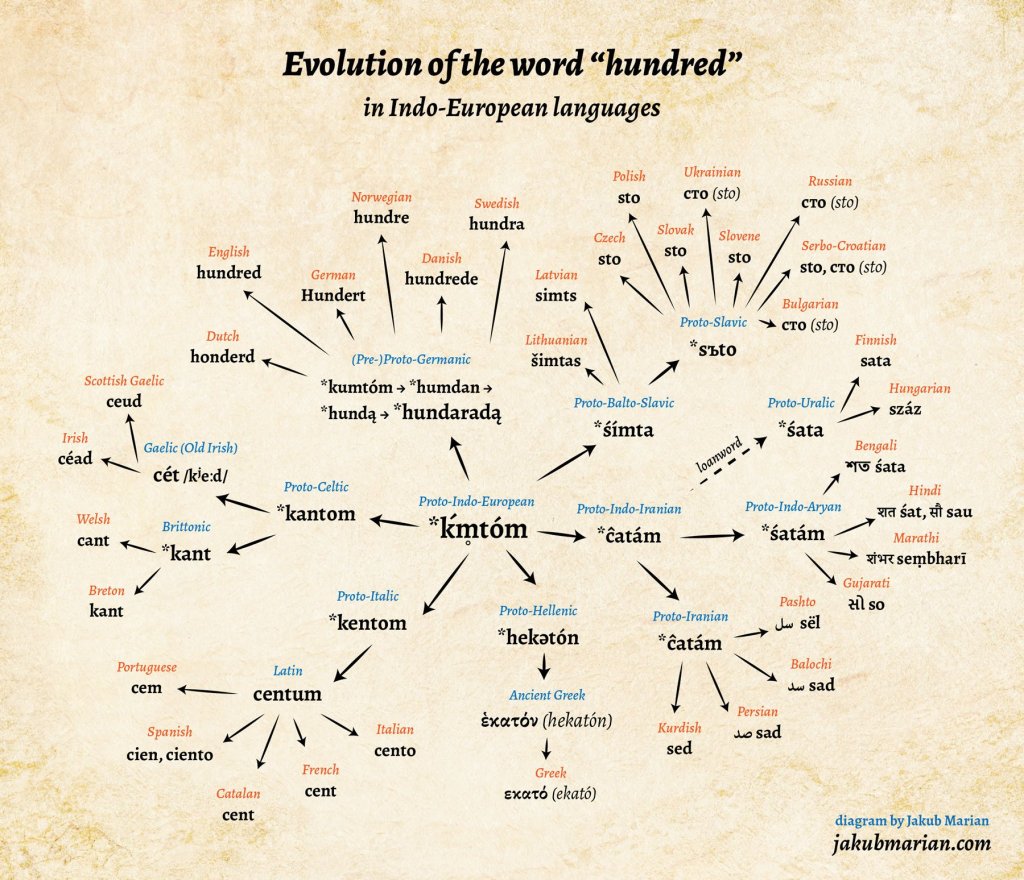
I saw this on Twitter recently and thought I’d share it because I found it fascinating. Taken from here and it shows the evolution of the word “hundred” across Indo-European languages:

Apologies if you thought I was going to go off on one about the silly new English cricket format. I think it’s best I don’t discuss that.