I’m Late, I’m Late…

Posted in Jazz with tags , , , , on January 12, 2021 by telescoper

It has been a long time since I last listened to the album Focus featuring Stan Getz on tenor saxophone so it was nice to be reminded of it when Bernard Clarke played the first track from that album on his show The Blue of the Night yesterday. I was listening when this track came up and I thought I’d share it here because I think it’s a cracker.

If you assume that a Stan Getz album from 1961 is going to be full of Samba and Bossa Nova tracks then you couldn’t be more wrong. This is an experimental album featuring Getz with a string orchestra. The suite of music for the album was originally commissioned by Getz from composer and arranger Eddie Sauter. Sauter’s orchestration did not include melodies for Getz. Instead he left spaces in the arrangements in which Getz would improvise.

The theme of the opening track, “I’m Late, I’m Late”, is nearly identical to the opening minutes of the second movement of Béla Bartók’s Music for Strings, Percussion and Celesta which Sauter intended the track as an homage. Not only the theme but also the broken rhythms and string orchestration definitely show the the influence of Bartók. One thing that struck me listening to this last night after not hearing it for a while is that it sounds very much like part of a movie soundtrack. Maybe it will be some day!

As an added bonus I’m Late, I’m Late also features the great  Roy Haynes on drums, but front and centre for most of the time it’s Stan Getz himself playing quite brilliantly.  In fact I’m told that Getz regarded this as his best album. Anyway, I think it’s great and I hope you enjoy it.


R.I.P. Kumar Chitre (1936-2021)

Posted in The Universe and Stuff with tags , on January 11, 2021 by telescoper

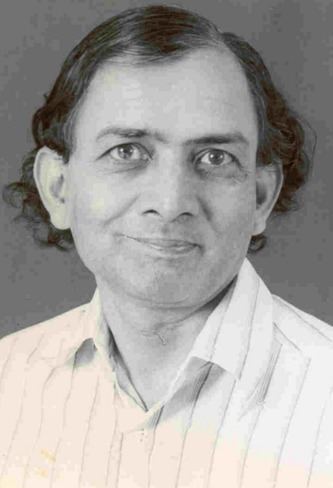
Shashikumar Madhusudan Chitre

Yet more sad news to pass on, I’m afraid.

I heard today of the death at the age of 84 of Indian theoretical astrophysicist Sashikumar Madhusan Chitre. Kumar worked on diverse subjects from solar physics to gravitational lensing (and many things in between) and had a very strong interest in science education. He was a frequent visitor to Queen Mary College when I worked there and I remember very many interesting discussions with him there, and then later when we met up at the Tata Institute for Fundamental Research in Mumbai and spent a very pleasant evening chatting to him over dinner at his home.

Kumar held a number of Visiting Professorships including the Universities of Cambridge, Sussex, Columbia, and Amsterdam, as well as Queen Mary, so many people around the world will miss not only his scientific expertise but also his wonderfully warm, kindly, humorous and generous personality.

R.I.P. Professor Sashikumar Madhusan Chitre (1936-2021).

Two Job Opportunities in Quantum Computing/ Quantum Information Processing in Maynooth!

Posted in Maynooth, The Universe and Stuff with tags , , , on January 11, 2021 by telescoper

Gratuitous Graphic purporting to represent Quantum Information Processing

Regular readers of this blog may recall an announcement that the Department of Theoretical Physics scored a notable success, or rather Dr Professor Jiri Vala did, in securing funding as part of a project called Quantum Computing in Ireland: A Software Platform for Multiple Qubit Technologies. To be eligible for this kind of funding, projects must involve businesses and this particular project includes IBM Ireland Ltd, MasterCard Ireland, Rockley Photonics and Equal 1 Laboratories, the latter two being SMEs based in the Dublin area. The project also involves the Tyndall National Institute (Cork); University College Dublin; and Maynooth University. This is the first large collaboration in Ireland in this area.

Well, now that the funds have actually arrived, I  thought I’d use the medium of this blog to pass on the information that the Department of Theoretical Physics at Maynooth University is looking two appoint not one but two theoretical physicists as postdoctoral researchers to work on this project.

The first position (for which you can find further details here) is  to work on modelling and simulations of quantum photonic systems for quantum information processing.

The second position (further details here) is to work on the development of compilers, quantum control protocols and algorithms for quantum information processing in quantum photonic systems.

The deadline for both positions is Sunday 31st January 2021!

Please feel free to pass this on to anyone you think may be interested!


Covid-19 in Ireland: where it all went wrong

Posted in Covid-19, Politics with tags , , on January 10, 2021 by telescoper

I don’t buy a daily paper, but I am a regular reader of the Irish Times Weekend edition. The reporting, especially on international news, is generally good and although it is basically an Establishment newspaper it is fairly balanced. That can’t be said for the opinion pieces however, which are frequently execrable. A particularly shitty example is provided by a column by Political Editor Pat Leahy in this Weekend’s edition.

It’s bad enough that he writes as if the most important thing about the pandemic is not that people are dying but that there might be implications for Ireland’s political establishment. And that he takes the opportunity to take churlish swipes like “Many public servants have, of course, been working furiously hard. Some haven’t.” As a public servant who has put in countless hours of unpaid overtime over the past year that snide comment really got my goat, coming as it does from a Political Editor who trots out lazy evidence-free rubbish for a living.

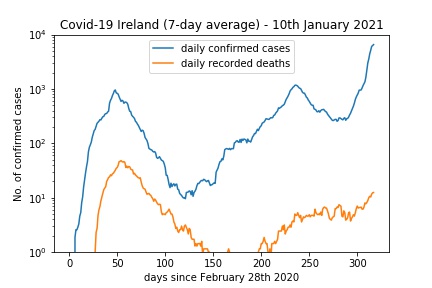
This is the trajectory of the Covid-19 pandemic in Ireland.

Restrictions were lifted on 1st December. New cases started to climb steeply almost immediately, doubling roughly every 7 days. It was obvious then – by simple extrapolation of the exponential curve – that there would be around 1000 new cases per day by Christmas and about 2000 by New Year.

The only reason we didn’t have 2000 cases per day by 31st December was that the system couldn’t cope with so many positive test results and a backlog developed. Today, 10th January, 6888 cases were reported. Hospitalizations, ICU admissions and, sadly, deaths are now tracking upwards after the inevitable delay.

Loosening the restrictions with new cases at hundreds per day always looked to me to be very wrong-headed. I’m not happy to have been proven right.

Against this backdrop Pat Leahy says this:

What?

This is simply untrue. It is true that there was a general expectation that the growth curve would not be so steep, with perhaps 500 cases by Christmas. That was wrong by about a factor two but given the doubling time and no interventions 1000 would have been reached a week later. As someone who argued for relaxation in December, Mr Leahy is rather obviously trying to rewrite history to make him appear less culpable.

In my view the reason why the residual restrictions in December did not slow the increase in Covid-19 cases was that the messaging from the Government was too complicated, had too many exceptions, and gave the appearance that it was arbitrary and without clear justification. This, together with persistent lobbying by vested interests in the hospitality sector, encouraged enough people to ignore even the weakened restrictions in the run-up to Christmas and through the holiday period. In short, the Government has lost the room. Worryingly, I don’t think that it understands this even now.

Even now with a dire health emergency in clear view, I still see people circulating in groups without face coverings. What went wrong, in my opinion, is that the Government was too weak to stick to the advice given to it from the National Public Health Emergency Team and instead started tinkering about trying to satisfy various lobby groups.

But back to Mr Leahy. The statement that “nobody suggested the price for Christmas would be so severe” is plainly untrue: plenty of people knew exactly what was coming and said so loudly and publicly. Neither he nor the politicians listened. If there’s any justice the “political fallout” from this catastrophic weakness will be severe.

Anyway, after being angered by that dreadful Opinion column I’m seriously thinking of switching to a different paper. Any suggestions?

Postponed: Astrophysics & Cosmology Masterclass at Maynooth

Posted in Education, Maynooth, The Universe and Stuff with tags , , on January 10, 2021 by telescoper

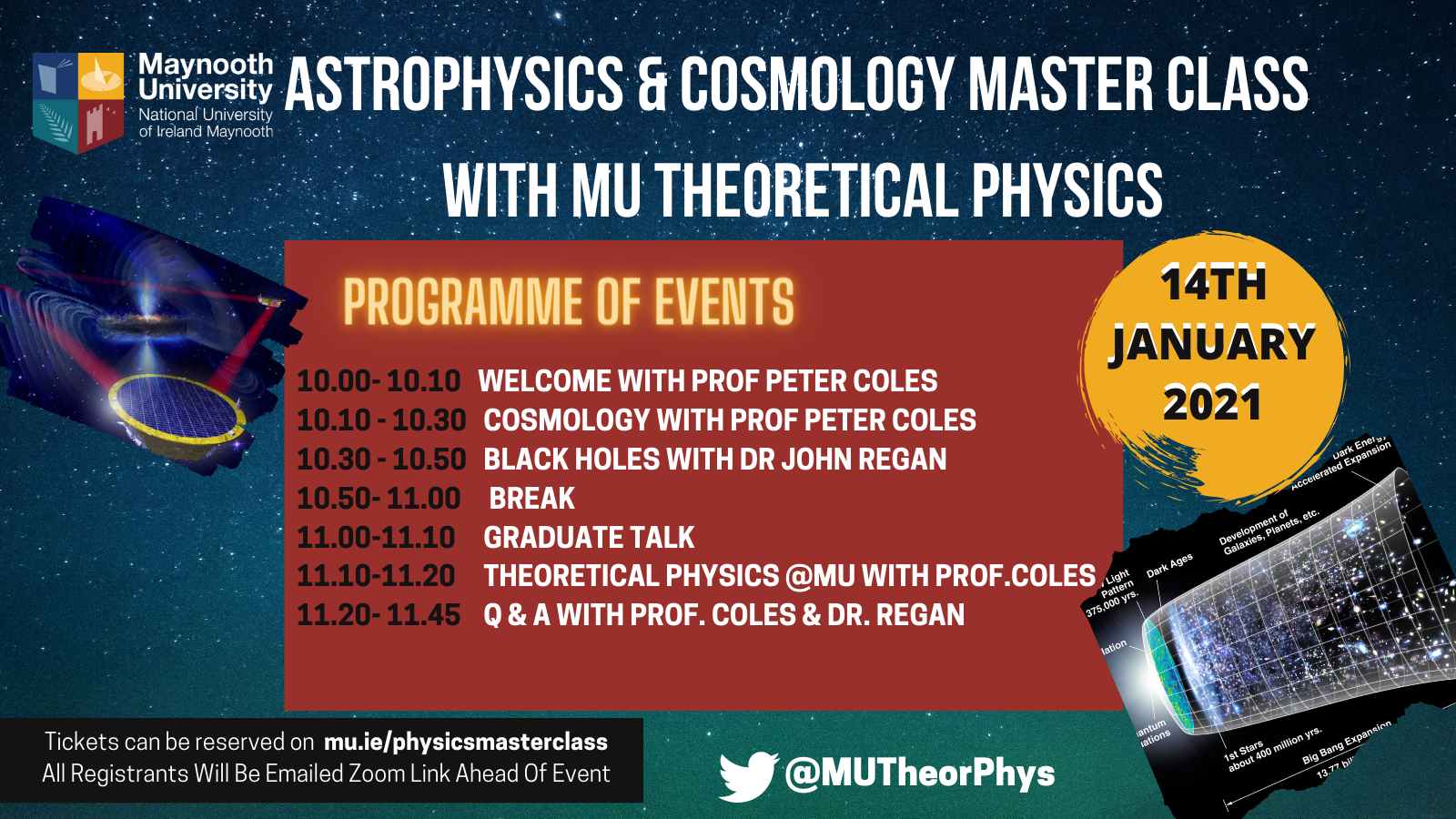
Regular readers of this blog may recall that the Department of Theoretical Physics at Maynooth University  planned to host a Masterclass in Astrophysics & Cosmology on January 14th 2021 (i.e. next Thursday). Unfortunately the closure of schools in Ireland until at least the end of January has given us no alternative but to postpone this event. It’s not cancelled though and we intend to run it as soon as possible: the date is now set provisionally for 25th February.  Limited places remain available and bookings are still open. You can find more information, including instructions on how to book a place, here.

Here is the official poster and the programme (timings still apply, but not the date..):

I’ll be talking about cosmology early on, while John Regan will talk about black holes. After the coffee break one of our PhD students will talk about why they wanted to study astrophysics. Then I’ll say something about our degree programmes for those students who might be interested in studying astrophysics and/or cosmology as part of a science course. We’ll finish with questions either about the science or the courses.

For updates please follow the Department’s on twitter-feed:

Congratulations to the RAS Medallists!

Posted in The Universe and Stuff with tags , , , , , , on January 9, 2021 by telescoper

Given all the doom and gloom going around I thought I’d take the opportunity to share some good news and also offer my public congratulations to the all the winners of medals and awards announced yesterday by the Royal Astronomical Society. Let me draw particular attention to the three, purely on the grounds that I know them and their work personally.

First, Dame Jocelyn Bell Burnell who receives the Gold Medal. For some reason the citation doesn’t mention that she should have won a share of the Nobel Prize in 1974.

Second, star cosmologist Hiranya Peiris who gets the Eddington Medal.

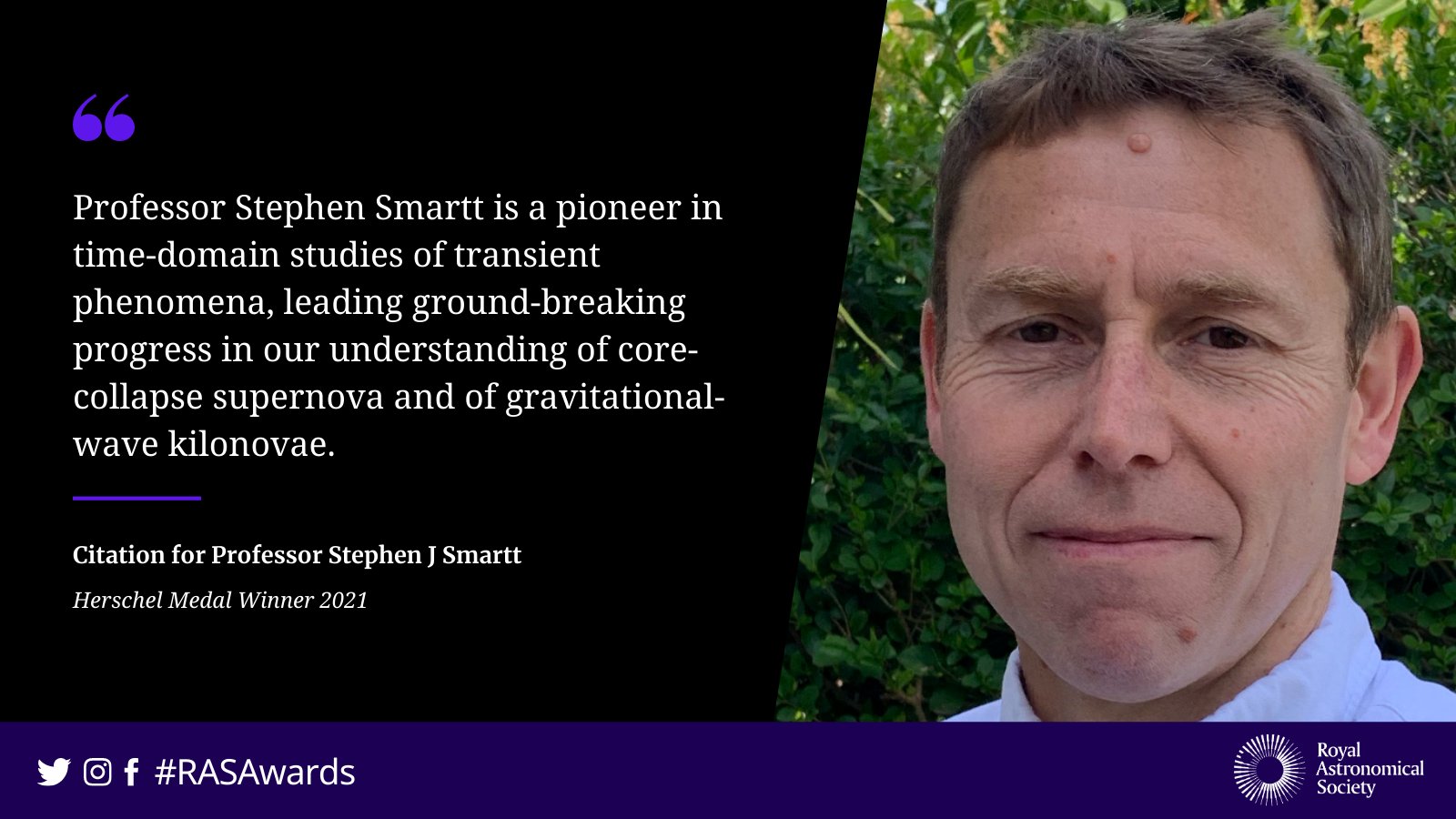
And third, Steven Smartt of Queen’s University Belfast, who gets the Herschel Medal.

Congratulations to them and indeed to all the winners of awards and medals, a complete list of whom may be found here.

Cold Spell

Posted in Biographical, Maynooth on January 9, 2021 by telescoper

It’s bitterly cold in Maynooth today. We haven’t had much snow but it sure is freezing. As I write it’s 1pm and the temperature is only -4°C. I went to put some stuff in the wheelie bin just now but the lid was frozen shut.

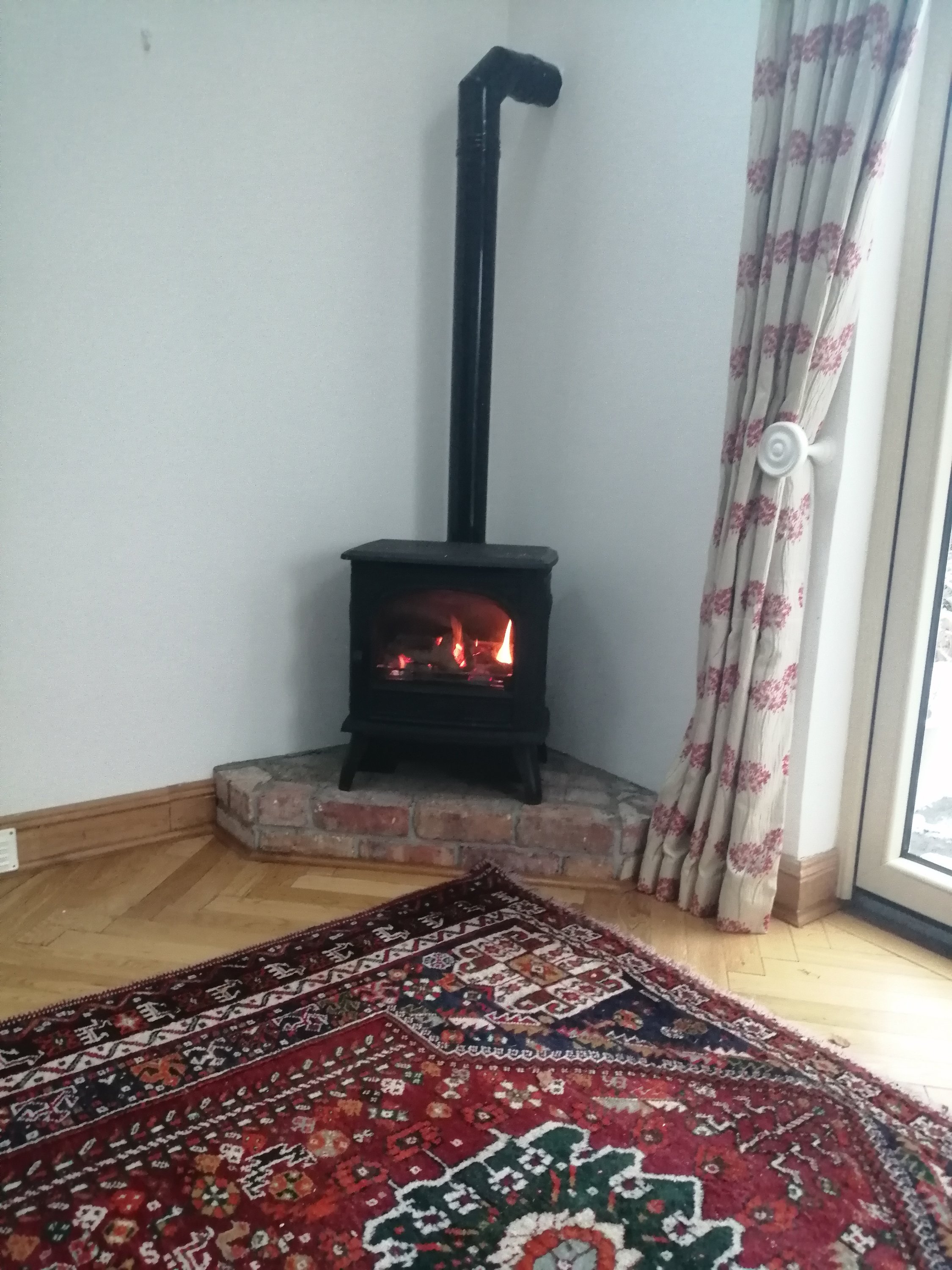
At least I’ve now figured out how to switch this thing on, so I’m nice and cosy indoors.

Outside it’s a different story though at the moment the garden is full of birds tucking into the food I’ve put out for them. They need food to maintain their body temperature or they will freeze to death. I can tell you that these days they’re emptying the feeders at a considerable rate of nuts.

The birds seem to be getting a bit more adventurous. The other day I went out to out refill the bird feeders and the robin who seems to think he’s in charge of my garden bobbed into the kitchen through the open door. He looked around, seeming very unimpressed, did a little poop on the floor and left the way he came in.

The robin is pretty much constantly visible in the garden these days, patrolling his territory and occasionally picking fights with other birds. I saw him have a go at a jackdaw yesterday. You’ve got to admire his nerve.

I’ve seen the resident wren a few times too. Wrens only eat insects so I was curious as to how they survive the winter. I’m reliably informed however that there are still plenty of insects (and other arthropods) around at this time of year. Many hibernate in various crevices (under logs, stones etc., or in nests). Other insect species are still active as adults throughout winter, e.g. smaller flies and moths, and some true bugs.

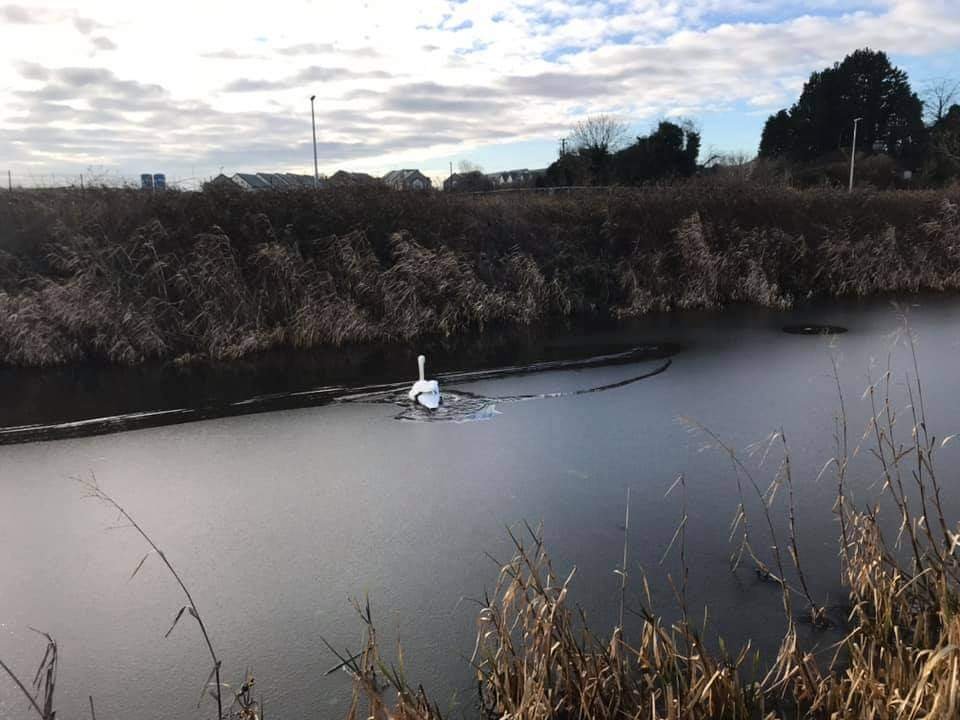
Meanwhile the swans on the Royal Canal have been having to cope with the ice by learning to skate (not entirely successfully):

Anyway hopefully the extreme cold will keep people indoors to reduce the rate of Covid-19 transmission.

There’s a Moose Loose Aboot this Hoose!

Posted in Covid-19, Maynooth, Music with tags , on January 8, 2021 by telescoper

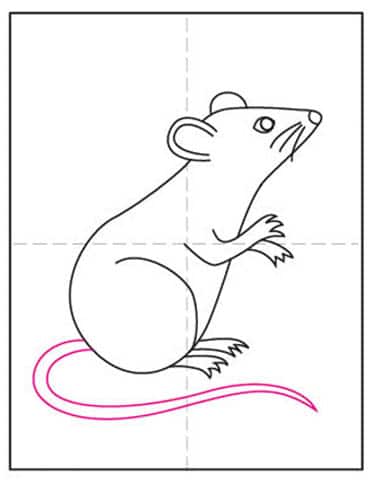
Artist’s Impression

I am working from home at the moment owing to Covid-19 restrictions on campus activity but I have been informed by on campus staff that an unauthorized mouse bas been seen in the Department of Theoretical Physics. This is a very serious situation as access to the Science Building is for essential work only and this does not include rodents, even if they have a PhD. Furthermore, the mouse is not wearing a face mask and, from what I have heard, is not observing proper sanitary procedures.

More importantly, our Covid-19 protocols require all visitors to the Department to be in receipt of a letter authorizing their presence. I have contacted Human Rodent Resources and no such letters have been issued.

I have therefore instructed all staff and students in the Department that if they see this mouse they should instruct it to leave and that any refusal to comply will be met with disciplinary action, initially taking the form of a formal written warning but escalating if necessary to a meeting with Maynooth University Library Cat.

There now follows a  message concerning these developments from Professor Brian Dolan.

I hope this clarifies the situation.

Beard Wearers who stormed Capitol building condemned for bringing hirsute into disrepute

Posted in Beards, Politics with tags , , , on January 7, 2021 by telescoper

Here is an important perspective on yesterday’s shocking scenes in Washington DC. There’s no question that if Abraham Lincoln were alive today he’d be turning in his grave.

But seriously though, how come the Police presence was so thin that this rabble managed to get into the Capitol buuldings more-or-less unchallenged? Surely they knew what was going to happen?

kmflett's avatarKmflett's Blog

Beard Liberation Front

7th January

Beard Wearers who stormed US Capitol building condemned for bringing hirsute into disrepute

The Beard Liberation Front, the informal network of beard wearers, has condemned beard wearers who stormed the Capitol building in Washington on 6th January for bringing the hirsute into disrepute.

The campaigners, who promote positive images of the hirsute, say that while beard wearers were a minority amongst those trying to disrupt a legislative session confirming Joe Biden as the next President, they were a significant minority.

Two alt-right to fascist groups in particular appear to have been involved. The crazed conspiracy theorist group QAnon is not particularly associated with beards.

However the all-male Proud Boys are frequently to be seen with beards. Founder Gavin McInnes who was born in Hitchin but resides in the US is a noted beard wearer.

The BLF says that the Proud Boys have worked…

View original post 98 more words

Remote Exam Time

Posted in Education, Maynooth with tags , , , on January 7, 2021 by telescoper

It’s the day before the start of the January examination period at  Maynooth University so I thought I’d do a quick post on the topic of examinations or, as they are right now, online timed assessments.

First, for readers elsewhere, full-time undergraduate students at Maynooth what is called 60 “credits” in a year, usually split into two semesters of thirty credits each. This is usually split into 5-credit modules with an examination in each module at the end of each semester. Projects, and other continuously-assessed work do not involve a written examination, but the system means that a typical student will have at least 5 written examination papers in January and at least another 5 in May.  This is very similar to the system in most UK universities that I am aware of except that a full year’s work over there is 120 credits so there’s a conversion factor of 2:1. A 5-credit module in Ireland would be a 10-credit module in the United Kingdom, for example, but otherwise the system is similar.

Each examination is usually of two hours’ duration. We’ve kept that length after moving examinations online, although students are given extra time to scan and upload their answers. The question papers themselves have been slightly adapted online use by having much less “bookwork”. Generally these asssessments are unsupervised and students are allowed to consult notes and textbooks so there is little point in asking them to copy out standard derivations and formulae. That means we can concentrate on the problem-solving aspects of theoretical physics, which are the most interesting bits (and perhaps the most challenging).

One big difference between our examinations in Theoretical Physics in Maynooth and those at other institutions I’ve taught at in the UK is that most of the papers here offer no choice of questions to be answered.  A typical format for a two-hour paper is that there are two long questions, each of which counts for 50 marks. Elsewhere  one normally finds students have a choice of two or three questions from four or five on the paper.

One  advantage of our system is that it makes it much harder for students to question-spot in the hope that they can get a good grade by only revising a fraction of the syllabus. If they’re well designed, two long questions can cover quite a lot of the syllabus for a module, which they have to in order to test all the learning outcomes. To accomplish this, questions can be split into parts that may be linked to each other to a greater or lesser extent to explore the connections between different ideas, but also sufficiently separate that a student who can’t do one part can still have a go at others. With such a paper, however, it is a  dangerous strategy for a student to focus only on selected parts of the material in order to pass.

As an examiner, the Maynooth style of examination also has the advantage that you don’t have to worry too much if one question turns out to be harder than the others. That can matter if different students attempt different questions, but not if everyone has to do everything.

But it’s not just the number of questions that’s important, it’s the duration. I’ve never felt that it was even remotely sensible for undergraduate physics examinations to be a speed test, which was often the case when I was a student. Why the need for time pressure? It’s better to be correct than to be fast, I think. I always try to set examination questions that could be done inside two hours by a student who knew the material, including plenty of time for checking so that even a student who made a mistake would have time to correct it and get the right answer. If a student does poorly in this style of examination it will be because they haven’t prepared well enough rather than because they weren’t fast enough.

The structure of the Maynooth examinations at more introductory level is rather different, with some choice. In my first year module on Mechanics & Special Relativity, for example, there is a compulsory first question worth 50 marks (split into several pieces) and then the students can pick two out of three shorter questions worth 25 marks each. This is a somewhat gentler approach than with the more advanced papers, partly adopted because we have quite a few students doing the General Science degree who taking Mathematical Physics as one of their 4 first-year subjects but will not be taking it further.

As both my examinations are not until next week, I’ll have to wait to find out how my students have done. This will be the examination taken at University level for most of my class, so let me take this opportunity to pass on a few quick tips.

  1. Try to get a good night’s sleep before the examination!
  2. Be ready well before the start and try to ensure you won’t be disturbed for the duration.
  3. If you’re doing an unsupervised examination
  4. Read the entire paper before starting to answer any questions. In particular, make sure you are aware of any supplementary information, formulae, etc, given in the rubric or at the end.
  5. Start off by tackling the question you are most confident about answering, even if it’s not Question 1. This will help settle any nerves.
  6. Don’t rush! Students often lose marks by making careless errors. Check all your numerical results on your calculator at least twice and – PLEASE – remember to put the units!
  7. Don’t panic! You’re not expected to answer everything perfectly. A first-class mark is anything over 70%, so don’t worry if there are bits you can’t do. If you get stuck on a part of a question, don’t waste too much time on it (especially if it’s just a few marks). Just leave it and move on. You can always come back to it later.

Oh, and good luck to anyone at Maynooth or elsewhere taking examinations in the next few weeks!

P.S. It snowed overnight in Maynooth, although only a centimetre or so…