Gratuitous Graphic purporting to represent Quantum Information Processing
Regular readers of this blog may recall an announcement that the Department of Theoretical Physics scored a notable success, or rather Dr Professor Jiri Vala did, in securing funding as part of a project called Quantum Computing in Ireland: A Software Platform for Multiple Qubit Technologies. To be eligible for this kind of funding, projects must involve businesses and this particular project includes IBM Ireland Ltd, MasterCard Ireland, Rockley Photonics and Equal 1 Laboratories, the latter two being SMEs based in the Dublin area. The project also involves the Tyndall National Institute (Cork); University College Dublin; and Maynooth University. This is the first large collaboration in Ireland in this area.
Well, now that the funds have actually arrived, I thought I’d use the medium of this blog to pass on the information that the Department of Theoretical Physics at Maynooth University is looking two appoint not one but two theoretical physicists as postdoctoral researchers to work on this project.
The first position (for which you can find further details here) is to work on modelling and simulations of quantum photonic systems for quantum information processing.
The second position (further details here) is to work on the evelopment of compilers, quantum control protocols and algorithms for quantum information processing in quantum photonic systems.
The deadline for both positions is Sunday 6th December 2020, so there’s not much time to apply!
Please feel free to pass this on to anyone you think may be interested!
Since moving to Ireland almost three years ago I have (somewhat unexpectedly) become a fan of GAA and regularly watch both hurling and Gaelic football on the TV, which is quite often.
Ireland is very keen on sports generally, with big followings for both rugby and soccer but, at least in terms of attendances, hurling and Gaelic football are by far the most popular sports in Ireland. That’s quite remarkable because these are entirely amateur games. One of the great things about the GAA is that it’s a real grass roots organization, where even games between local clubs can attract very big crowds. (I’m talking about the pre-Covid era there, obviously.) The players tend to be local and there’s a strong involvement of the community in the local clubs.
Hurling is my favourite GAA sport – the level of skill on display is truly awesome and it’s played at an amazingly fast tempo – but I do watch the football when I can too and am more gradually getting into it. Incidentally, these two sports are played on the same pitches with the same goals and the same number of players on each side (15) and have basically the same rules – with a player’s hurley (stick) in hurling being in one-to-one correspondence as far as the rules are concerned with a player’s foot in Gaelic football. The ball of course is bigger in football; the small one used in hurling is called a sliotar. Scoring is the same in both: 1 point getting the ball between the two posts over the bar as in rugby and a goal (3 points) for getting the ball into the back of the net below the bar.
I took a break in the early afternoon yesterday to watch the All Ireland Quarter Final match in the hurling between Galway and Tipperary, an entertaining match played in fine weather which was won by Galway 3-23 to 2-24. Later on, I settled down to watch the Leinster provincial final between Dublin and Meath live from Croke Park in the evening. Given that this match was on the same day as Bloody Sunday it was preceded by a solemn commemoration of those that died a hundred years ago which I thought was beautifully done. Here’s a video tribute made by the GAA itself, played at the end of the pre-match commemoration along with specially-composed music.
After the match there was a wreath-laying ceremony involving the players which was unfortunately spoiled on the television broadcast by a commentator who talked all the way over it.
The match itself was a very one-sided affair, which was effectively all over by half time (when the score was Dublin 2-12 Meath 0-2). It ended Dublin 3-21 Meath 0-9, which is a margin of 21 points: quite a thrashing for Meath. I’m not an expert, but the Dublin side were far more mobile and inventive than Meath and thoroughly deserved their win.
There wasn’t a crowd of course. I think the commemorative event would have been even more emotional if there had been. Watching the actual match though it struck me that we’re all getting used to watching sport in an empty stadium. It’s probably going to take some getting used to the noise when (if) live audiences eventually return.
UPDATE: Tipperary beat Cork in Munster final this afternoon to win it for the first time in 85 years. The team were wearing replica jerseys of those worn by the Tipperary team that played Dublin in 1920.
After all the provincial finals, including a surprise win for Cavan over Donegal in Ulster, the four teams in the semi-finals of the All Ireland Senior Football Championship in 2020 is exactly the same as it was in 1920. The final, between Dublin and Tipperary, was not played until 1922.
(The match played on Bloody Sunday was a Challenge Match not part of the Championship.
In the days before lockdown I would often travel past Croke Park on the train from Maynooth into Dublin Connolly station. It’s a magnificent stadium, with a capacity over 80,000, its stands towering up on all sides of the playing field which is used for major sporting events organized by the Gaelic Athletics Association (GAA), chiefly hurling and gaelic football. It’s located quite close to Drumcondra Station, the last stop before Connolly on the way into Dublin. I’ve never actually been inside the ground, and you can’t see much of the interior from the train because of the stands, but I do hope to see a match there one day.
Croke Park looked very different a hundred years ago today, on November 21st 1920 (which was a Sunday).
Croke Park, looking towards Hill 16, taken on the day of November 21st 1920.
Incidentally, the low hill you can see in the background is Hill 16. There’s a story that this was built up using rubble from buildings destroyed during the 1916 Easter Rising, but this seems to be apocryphal.
Anyway, as you can see, there wasn’t much in the way of buildings around the playing field in those days, and not much to give spectators cover if they were trying to flee from gunfire.
A Gaelic football match between Dublin and Tipperary started in Croke Park at 2.45 pm on November 21st. About ten minutes into the game, armed police (including members of the regular Royal Irish Constabulary, Auxiliaries, and some Black and Tans) suddenly arrived at the southern end of the park, panicking some of the spectators who tried to run away. Without warning the police opened fire on the crowd. The first to die was 11 year old William Robinson who was sitting in a tree outside the ground to get a better view. Overall the firing lasted about 90 seconds. Thirteen people were killed outright and another died of his wounds later. Others were injured either by gunfire or in the crush resulting from the panic.
Among the dead was Tipperary’s star player Michael Hogan, who was shot dead on the playing field as he tried to find cover. Information from post-mortems released many years after the event revealed that most of the victims had been shot in the back.
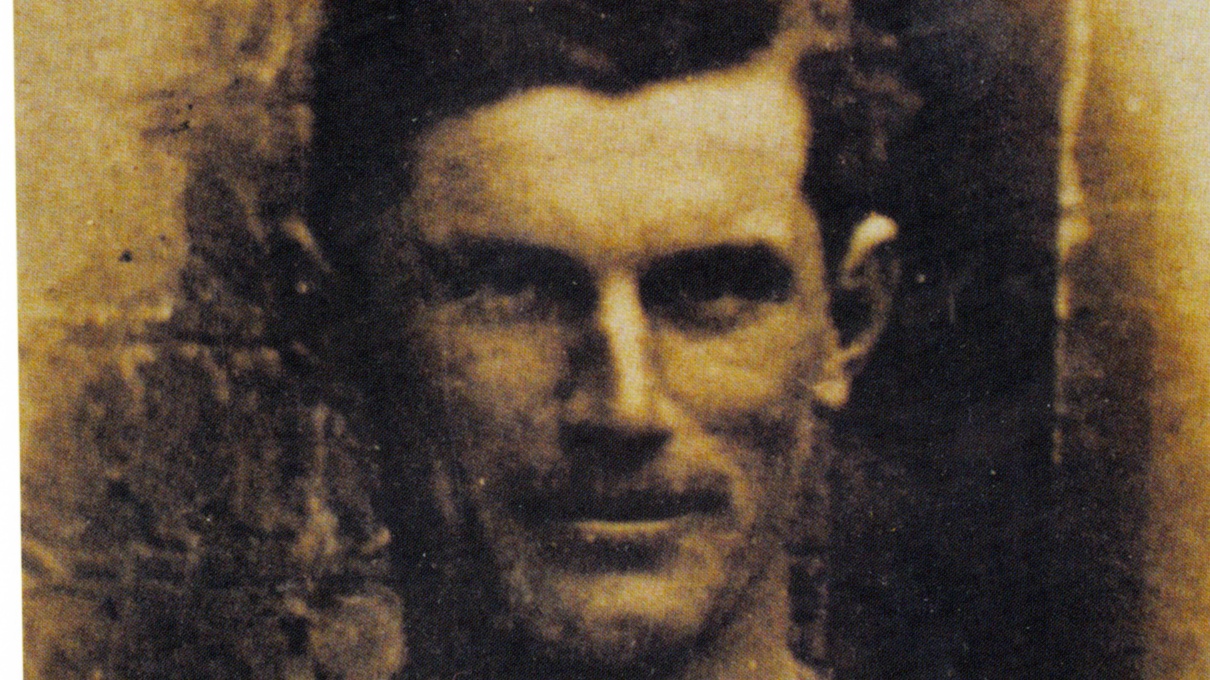
Michael Hogan, star player and Captain for the Tipperary team at Croke Park on Bloody Sunday. He died that day.
The massacre could have been even worse had the British forces at the other end of the ground, who had an armoured car with a machine gun, shown more restraint. The machine gun was fired above the heads of the people running towards this contingent. They didn’t shoot anyone but they did force the crowd back towards the gunfire from the other end of the ground. Had they opened fire at the crowd there would have been a massacre on the scale of Amritsar, where hundreds died.
Witnesses also said that while the security forces let all the Dublin players go, they lined up the entire Tipperary team against a fence and were preparing to shoot them all when a junior officer intervened and ordered them to be released. Tipperary was perceived to be a hotbed of IRA activity. Michael Hogan was in fact a member of the Irish Volunteers.
So what on Earth had happened to trigger this indiscriminate slaughter, on the day known now as Bloody Sunday (Irish: Domhnach na Fola)
The overall context is the Irish War of Independence which started in 1919 and was largely a guerilla campaign waged in rural areas. There had not been large-scale eruptions of violence in Dublin. That changed on November 21st 1920. That morning, members of the Irish Republican Army under the direction of Michael Collins, had carried out an operation across Dublin intended to eliminate the ability of the British forces to gather intelligence on the IRA. Hit squads entered the homes of known or suspected British intelligence operatives across the town and shot them. Fifteen people were killed that morning, including at least two innocent civilians in the process.
The IRA members responsible for the killings on Sunday morning melted away into the city. Once again the police and security services seemed to be fighting an invisible enemy. However, knowing that there was a football match going on that afternoon, and that at least some of those involved with the GAA had strong Republican leanings and may indeed be active IRA members, they decided to search all the spectators at the match of which there were over 10,000. The hope was, presumably, to find in the crowd at least some of those responsible for the morning’s assassinations. Instructions were given that anyone who ran away when the search operation began should be presumed guilty and shot.
News about the morning’s events had spread through Dublin that morning and it was widely anticipated that the British would carry out reprisal killings, probably in their usual indiscriminate fashion they had employed previously. When armed men arrived in vehicles outside the ground, the instinct of many spectators was therefore to run even before the searching began. Nervous and trigger-happy police deployed in a harebrained plan to make the slaughter inevitable. Nobody has ever been brought to justice for the murders at Croke Park.
Later that day two members of the IRA were caught by the security services, taken to Dublin Castle, beaten and then shot under the pretext that they were trying to escape. These killings brought the death toll past thirty. Bloody Sunday indeed.
The events in Croke Park handed a major propaganda victory to the IRA and also sparked an escalation of the violence. Just a week later, at Kilmichael in County Cork, the IRA ambushed two trucks carrying a total of 18 Auxiliaries, killing 17 of them and leaving the other for dead. On December 11th the British burned down a large part of the city of Cork in retaliation against another attack on their forces. And so it went on into 1921 to the point where the British eventually realized that Ireland had become ungovernable (by them) and a process was started that brought about independence (at least for part of Ireland).
As you can imagine there have been many commemorations of the grim events of a century ago. I watched a very interesting documentary on the TV earlier this week and there have been many articles in the newspapers and elsewhere about it, taking different angles. Those I found the most moving were those that dealt with the memory of the innocent lives lost. One very poignant idea was to stage 14 very short plays around Croke Park about each of the victims.
Here is a sort of trailer, featuring the heartbreaking story of Jane Boyle – the only woman to die on Bloody Sunday. Her death was particularly tragic as she was due to marry her fiancé Daniel Byron the following week. The couple went to mass at St Kevin’s Church on Harrington Street on Sunday morning and proceeded to Croke Park afterwards. When the firing started, they fled. In the scramble for safety, Daniel felt Jane’s hand go limp; she had been shot in the back and died instantly. She was buried later that week in her wedding gown.
I’ve blogged before about the strange dreams that I’ve been having during this time of Covid-19 lockdowns, but last night I had a doozy. I’ve recently been doing some examples of Newtonian Mechanics problems for my first-year class: blocks sliding up and down planes attached by pulleys to other blocks by inextensible strings; you know the sort of thing.
Anyway, last night I had a dream in which I was giving a lecture about cars going up and down hills taking particular account of the effects of friction and air resistance. The lecture was in front of a camera and using a portable blackboard and chalk, but all that was set up outside in the middle of a main road with traffic whizzing along either side and in the presence of a strong gusty wind. I had to keep stopping to pick up my notes which had blown away, dodging cars as I went.
It would undoubtedly make for much more exciting lectures if I recorded them in such a situation, but I think I’d be contravening traffic regulations by setting up in the middle of the Straffan Road. On the other hand, I could buy myself a green screen and add all that digitally in post-production…
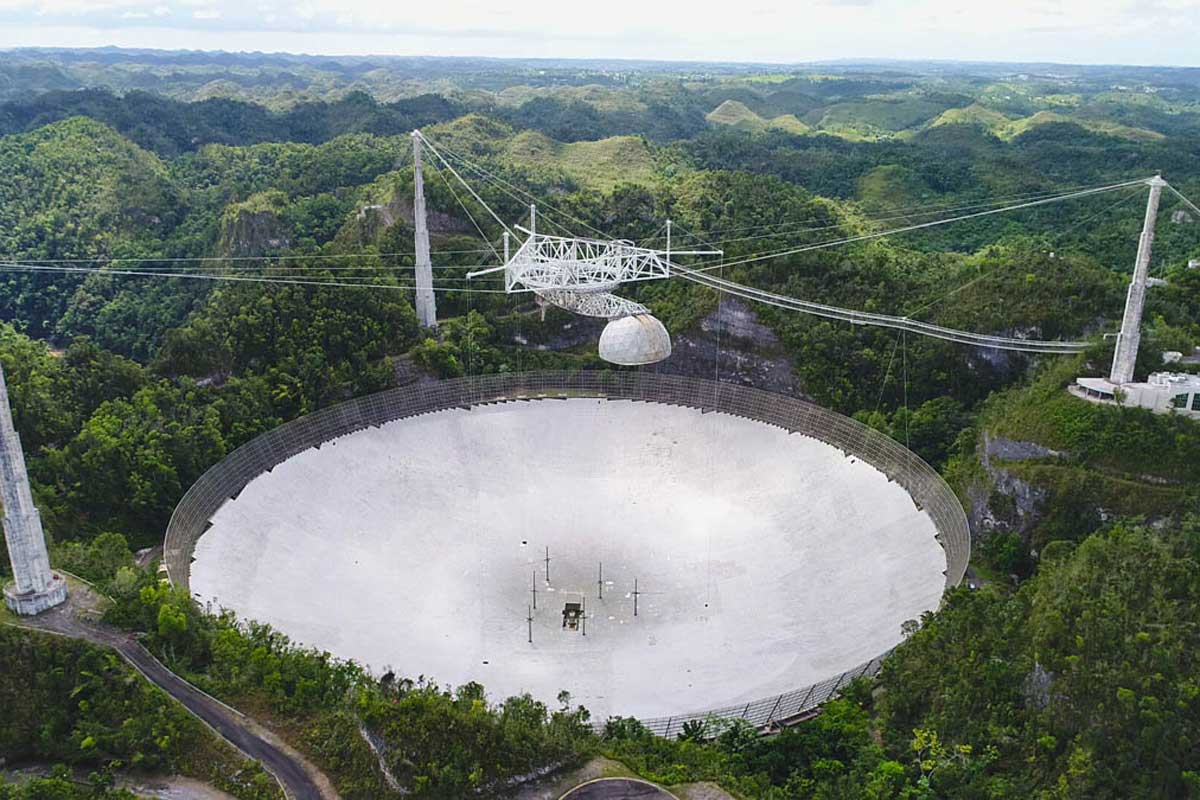
I’ve just heard the news that the famous (and indeed iconic) radio telescope in Puerto Rico known as the Arecibo Observatory is to be decommissioned. The facility was badly damaged by Hurricane Maria in 2017 and it was feared it might close then, but it was saved when an agreement was reached whereby a Consortium led by the University of Central Florida took over its operations.
Unfortunately, in August 2020 an auxiliary cable broke in August and tore a 30-metre diameter hole in the reflector dish and damaged the dome above it. Then, earlier this month, one of the telescope’s main steel cables snapped, causing further damage. It has now been decided that it will be too dangerous and too expensive to repair the telescope. It is to be decommissioned and then dismantled entirely. Presumably the site will be returned to the state it was in before the telescope was built.
This will be sad news for the people who work at Arecibo Observatory and for the local economy in Puerto Rico not to mention the many astronomers who have used the facility over the years. For a time it was the largest radio telescope in the world, its 1000ft diameter dish enabling it to achieve a resolution of about 3.5 arc minutes at 21cm. Even before the Hurricane struck, however, Arecibo had been struggling to find the funds necessary to maintain its operations. Now, almost 60 years after it was built, that struggle is over.
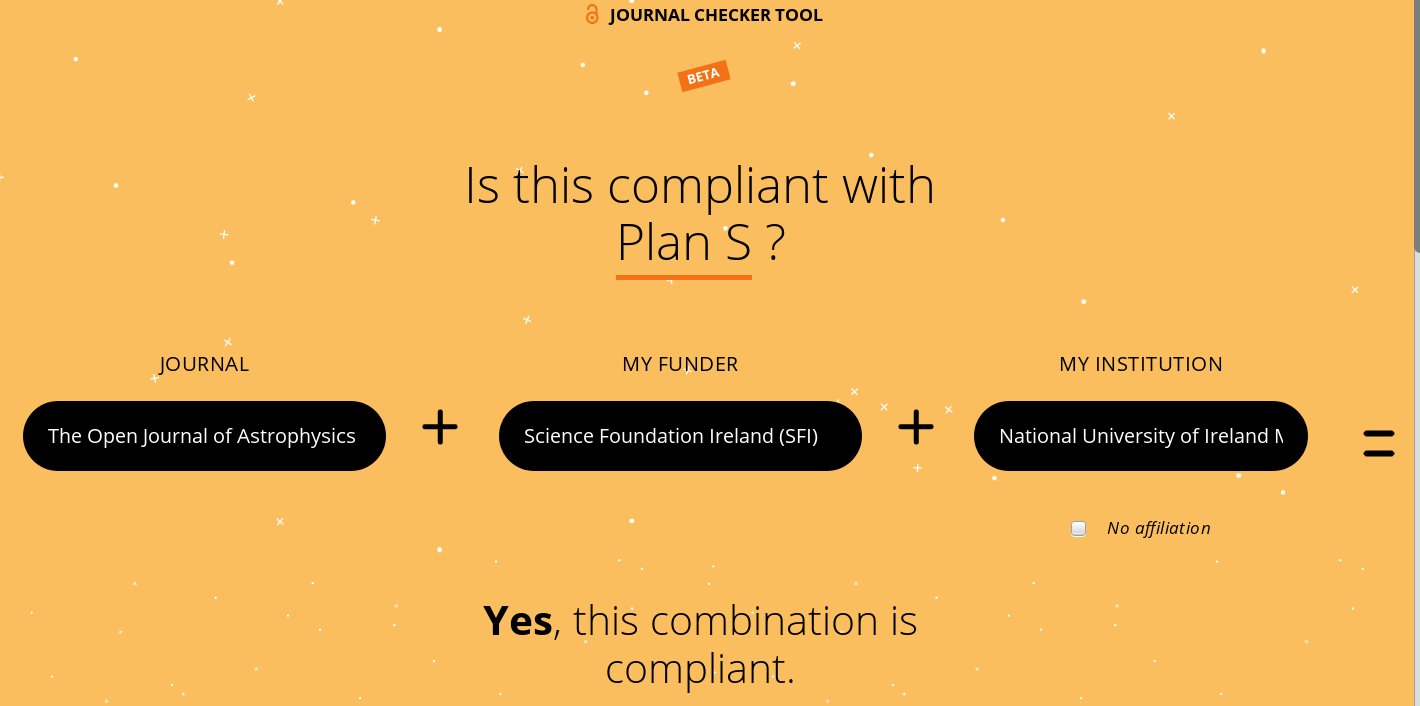
Those nice people at cOAlition S have produced a new online tool that allows authors to check whether a given academic journal complies with the requirements of Plan S as they apply to a given funder and institution. For information on how ot works see here. For the actual tool (beta version) see here.
Well, we’re here at LGBTQ+ STEM day. I’ll shortly be giving my zoom talk. I’ll post the slides here afterwards; it’s only fair that those people who are listening to the talk should get to see them first!
Incidentally, you’re probably wondering why this year’s LGBTQ+ STEM Day is today, November 18th, instead of the previous date, July 5th. The answer is that it honours astronomer Frank Kameny who, sixty years ago, brought a case of wrongful discrimination on grounds of sexual orientation to the Supreme Court of the United States of America. He lost his case, but it is an important milestone. Frank Kameny died in 2011, at the age of 86.
About 60 people attended the live session, which is quite a good turnout. Probably some more will watch the recording. My slides, such as they are, can be found here:
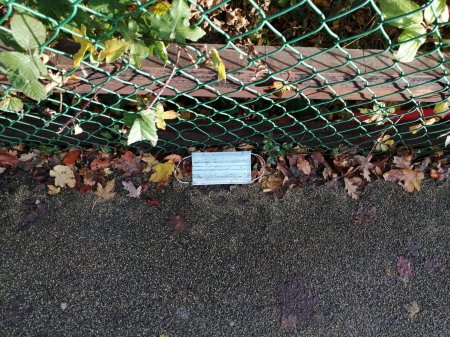
If there’s an image that sums up Autumn 2020 for me, this is it:
I can hardly go anywhere these days without seeing the disagreeable sight of a discarded face mask at some point. I wish people would take more care when disposing of these things!
I haven’t posted any physics problems for a while so here’s a quickie involving dimensional analysis. You have to assume that the supernova remnant mentioned in the question is roughly spherical, like the one shown above (SNR 0500-67.5):
As usual, answers and comments through the box below please!
Click on the `continue reading’ thing if you would like to see my worked solution:
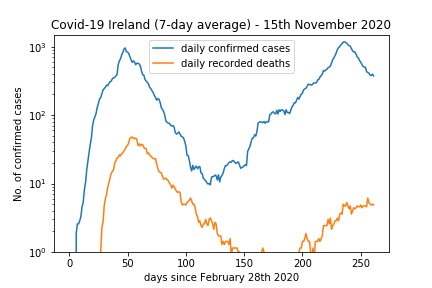
I’ve just done my daily update of Covid-19 numbers here and thought I’d show the latest figure:
There are now 262 data points on these graphs. When I started doing the updates I thought it might carry on for two or three months -i t’s now been almost nine and there’s no end in sight.
As you can see the 7-day average of new cases has been falling steadily since entered the period of Level 5 restrictions that is now about half-way through. That, of course, is good news. The problem is that the rate of decrease is really quite slow. The number of new cases on each day for the last week (including today) were: 270, 270, 362, 395, 482, 456, and 378 (today). That is fairly flat, the steep downward trend of the previous week apparently faltering. As a rough guess I’d say that by the time we come out of the current period of restrictions (at the beginning of December) we’ll probably still be having over a hundred new cases per day.
I think that level is far too high for comfort, but the current government is probably going to find it difficult to resist the political pressure to exit the lockdown in time for Christmas. If that does happen, I can see another lockdown looming in January. My superiors at Maynooth University are talking about having on-campus teaching again next Semester, but I think that’s highly unlikely in the circumstances.
Things are even worse in Northern Ireland where the number of new cases announced today was 478. Daily cases have been running higher there than in the Republic for some time, despite the fact that the six counties of Northern Ireland have a population of just 1.9 million compared to the 4.9 million of the 26 counties in the Republic.
That brings me to the issue of the Pfizer Covid-19 vaccine that everyone is getting excited about. Assuming that it passes the various tests needed for it to be approved, Ireland would get about 2 million doses from the stock procured by the European Union. The population of Ireland is about 4.9 million, and each person would require two doses, which means that supply will only enable about 20% of the population to be vaccinated.
(Actually I don’t know whether the 2 million refers to people that can be vaccinated or individual doses, but even if it’s the former that still accounts for only 40% of the population.)
The question then is who should be prioritized? I think we’d all agree that all health care workers should be vaccinated ASAP but that’s only about 25,000 people (source). Who should get the other doses? Most people seem to be assuming that those at highest risk of mortality should be vaccinated, but there’s also a case to be argued that it should it should be those groups within which the virus is most likely to spread that should get it, which is presumably the otherwise healthy population.
I don’t know the answer, but it will be interesting to see how this all develops. In any case as far as I can see it there’s very little prospect of high levels of population immunity being reached by this time next year. And that’s even if the vaccine is available soon, which is by no means clear will be the case. As a matter of fact I wouldn’t bet against me still having to do daily updates on Covid-19 statistics for most of next year.
The views presented here are personal and not necessarily those of my employer (or anyone else for that matter).
Feel free to comment on any of the posts on this blog but comments may be moderated; anonymous comments and any considered by me to be vexatious and/or abusive and/or defamatory will not be accepted. I do not necessarily endorse, support, sanction, encourage, verify or agree with the opinions or statements of any information or other content in the comments on this site and do not in any way guarantee their accuracy or reliability.







 In the Dark